Two Tallies
Astra Militarum (First Vandauer Shaft Rifles) · The Ember Watch
„A struck name is a name with a line through it. A hole is a place where somebody has been.“
I. The Tithe
The tally keeper was called Warle, was seventy-two years old, and had done two things in his life: issued tallies and taken tallies back. On the morning of the day the ships came, he did the one as he always did.
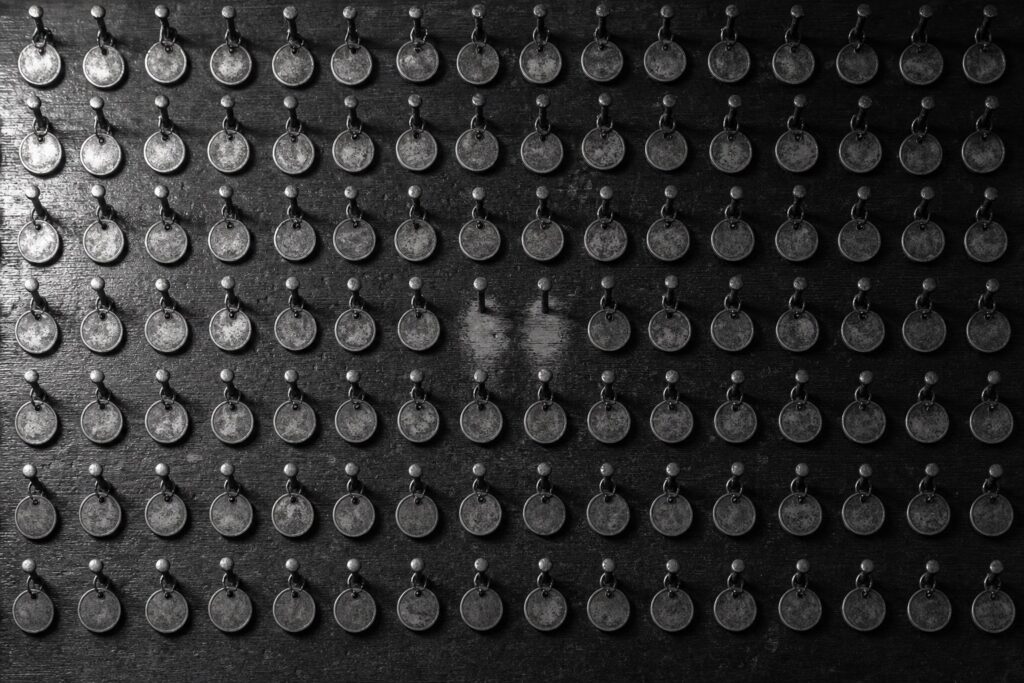
Fourth Level, early shift. A hundred and sixty pit tallies on a hundred and sixty nails — brass discs, each with a number, none with a name. Whoever went down took his tally from the board and hung it on the hook above the cage. Whoever came up hung it back. What still hung on the hook in the evening was counted, and what was counted was searched for.
That was the whole procedure. It had held on Vandau for six hundred years, because it contained nothing that could have been misunderstood.
Jarik Sund was thirteen and had number one hundred and eleven. He took it off the nail without looking — one did not look, one reached, and if one reached properly it was one's own — and went past Warle to the cage, where Onnen Roder was already standing with his gloves between his teeth, because he was retying the straps of his lamp.
"Late," said Onnen around the gloves.
"Early," said Jarik. "The cage doesn't go until Warle has counted."
"Warle counted before me."
"Warle counts twice."
Onnen took the gloves out of his mouth and grinned, and in that grin was the whole order of their relationship: Onnen was sixteen and taller and faster and had not won a single argument in three years, because Jarik never argued, but only said how it was, and waited.
Then they went down, and about the ninth hour the light went out above them.
Not the lamps. The light at the shaft head, the daylight that fell through the winding tower as far as the second level and ended there in a grey stripe by which one knew the time even without a clock. The stripe went out. It did not come back.
They stood in the gallery and looked up, a hundred and twenty metres of rock above them, and heard something none of them had ever heard: a deep, even grinding that did not come out of the mountain but through it, the way thunder goes through a house without touching it.
"Fall," said someone further back.
"No fall," said Onnen.
In a fall, dust comes down. No dust came down.
They came up. It was the only right decision, and forty-three out of a hundred and sixty did not make it, because forty-three went on working until the shift was over, and therefore learned only in the evening what by then stood above their world.
On the forecourt before the winding tower stood half the settlement, looking into the sky, and the sky was full.
Vandau had lain behind an interdiction zone for sixty years. The reason for it stood in no document that had ever arrived on the world itself: two sectors had been unable to agree which of them it was assigned to, and until that was decided no one was allowed to make planetfall, because every landing would have asserted a jurisdiction. Vandau had gone on raising ore. Vandau had stacked the ore. It lay north of the settlement in heaps that one saw from the Fourth Level as a line of hills, and children played on them, and no one had ever said that they were not allowed to.
Now they came.
There were two ships, and they were not alike. The one hung high and narrow and was grey as slate, and on its flank, in letters that from the ground looked two metres high and were in truth twelve, stood a word that no one on Vandau could read, because on Vandau nobody had learned High Gothic for four generations.
The other was smaller, deeper, and it was burning. So it looked. It was not burning, it was painted so: a dark red that went over into orange at the edges, and above it, across the bow, a sign like a hand holding an ember.
Onnen said: "Ore ships."
Warle, the tally keeper, who had stepped out of the pithead house and still had his hands on the strap of his apron, said: "No."
He said it quietly and without any excitement, like a man reading out a figure.
"Ore ships come up to the heaps from below. Those are standing over the settlement."
They took nine days.
In those nine days Vandau learned a word it had not known, and the word was tithe.
It was explained to them by a man who climbed out of the small tender in a black uniform and introduced himself as a Subadjutor of the Munitorum, and he explained it very exactly and very patiently, three times on three days, with a board and a pointer, as to a child. A world owes the Imperium a tithe. The Imperial Tithe may consist in ore. It may consist in grain. It may consist in people. Vandau owed sixty years.
Sixty years of ore lay in the north and was not collectable, because its removal would have presupposed a jurisdiction that continued not to exist.
People could be taken away without asserting anything.
"That makes no sense," said Onnen's mother on the third evening.
"It does," said Warle. "It makes sense. Only not for us."
On the seventh day two lists hung on the wall of the pithead house, and between the two lists lay a gap of a hand's breadth, and this gap was the only thing about that day Jarik Sund could later remember exactly.
On the left-hand list stood two hundred and twelve names. Above it: Levy. First Regiment Vandau.
On the right-hand list stood nine.
Above the nine stood no word that would have explained what for. It said only: Presented.
Onnen Roder stood on the left, in ninety-third place.
Jarik Sund stood on the right, in fourth.
II. The Board
The nine were presented in the pithead house, because the pithead house was the only room in the settlement in which a hundred and sixty men could stand at once, and because those who came did not want to stoop.
They came as three. They wore no armour, but something Jarik took for working clothes until he grasped how much cloth was needed to cover such shoulders. Their skin was grey. Not dirty — grey like cooled ash, evenly so up under the sleeves, and their eyes had the colour of lamp glass when the flame behind it is nearly out.
One spoke. The other two did nothing Jarik could have described, and he noticed all the same that they were working the whole time.
"You have heard what the clerk said," said the speaker. His voice was not loud. It filled the room all the same, because at no point did it come back to him. "You owe a tithe. We are not taking it."
He let that stand until it grew uncomfortable.
"We take nothing. We ask for nine. Seven will be sent back if they cannot bear the hill. Of the two who stay, perhaps one survives the embedding of the heart."
Someone at the back of the room laughed briefly, a reflex, not mockery, and the speaker did not turn his head.
"If you give us sons, you give them away. They do not come back. They do not write. There is no procedure by which you learn whether they live. I tell you this because there are others who do not."
He waited again.
"If you give us none, we go. No one on this world has a duty to give us anything."
Warle, the tally keeper, who stood right at the front because he always stood right at the front, said into the silence: "And what for?"
"What for what?"
"What do you take them for."
The grey man looked at him. He took longer than Jarik had expected.
"So that on worlds like this one somebody stands when something comes," he said. "A Chapter that does not protect people is none."
"You were not here for sixty years," said Warle.
"No," said the grey man. "We did not know that you existed."
That was, Jarik thought much later, the only apology he ever heard from one of theirs, and it was not one.
They tested him that evening as four, but there were only the three, and Jarik has never understood why he remembers four.
They measured nothing. There was no instrument. One laid his hand flat on his chest, on the left, and left it lying there so long that it stopped being embarrassing and began to be something else. One asked him about the Fourth Level: how deep, how warm, how long the way from the shaft to the last face, how many paces, whether he had counted them.
He had counted them. Nine hundred and forty; in summer nine hundred and thirty-three, because in summer one walked faster.
The third asked nothing at all. He looked at him with those lamp-glass eyes, and at some point he said a single word to the one who had his hand on Jarik's chest, and the word was not High Gothic and not the language of Vandau either.
Then the first took his hand away and said: "You are coming."
Jarik said: "When?"
"Now."
"I have to —"
"No," said the grey man, not unkindly. "You do not have to. But you may."
They let him walk two hundred paces. Not more. One went along, but stopped at the end of the lane with his back to the settlement, which Jarik took at the time for courtesy and which was probably regulation.
Onnen sat on the threshold of the pithead house with the levy papers in his hand, three sheets, badly folded.
"They give you a number," he said without looking up. "It says so here. Ident number. You have to know it by heart, the clerk says, because one day you have to say it out when you no longer know what your name is."
"Onnen."
"I've got mine already. Four-one-seven-zero-nine. Do you want to hear it? Four-one-seven-zero-nine." He looked up. "And you?"
"I don't know."
"They don't give you one?"
"I think they give nothing at all."
Onnen folded the sheets wrongly once more and put them away.
Then they stood beside each other for a while, and because they were thirteen and sixteen and because on Vandau there was no language for such a thing, they did the only thing they could: they went to the board.
The board hung in the pithead house, a hundred and sixty nails, and Warle sat beside it on his stool, as on every evening, and acted as though he were not looking.
Onnen took his tally off the nail. Forty-two.
Jarik took one hundred and eleven.
"You're not allowed to do that," said Onnen.
"Nor are you."
"Warle's watching."
"Warle isn't watching."
Warle was not watching.
They exchanged. It was no ceremony, it took three seconds, and neither of them said anything while doing it, because what one might have said would have been wrong in every version. Onnen put the one hundred and eleven into the breast pocket of his jacket. Jarik pushed the forty-two into the shaft of his boot, because he had no pocket that closed.
Then they hung two empty nails back into the board and went out, and behind them Warle stood up, took two tallies out of the box under the stool — forty-two, one hundred and eleven, from the old stock, unstamped — and hung them on the empty nails, so that the count in the evening would come out.
He never told anyone. It was the one forgery of his life, and he held it to be right until his death.
III. First Ride Out
The regiment was not called First Regiment Vandau. So it had stood on the list, but lists are intentions, and what stood in the end in the rolls of the Munitorum was: the First Vandauer Shaft Rifles.
The regimental staff quarrelled over the suffix for eight months, and the quarrel is documented because it went up through official channels three times. Shaft Rifles was the proposal of an adjutant who had never seen Vandau and assumed that one shot into shafts there. The counter-proposal was Vandauer Mountain Chasseurs and came from Colonel Vessen, who had likewise never seen the world but thought chasseurs sounded better.
The men called themselves from the first day the Fourth Level, and nobody ever tried to drive it out of them, because nobody on the staff noticed that it was happening.
The training did not take place on Vandau. It took place on board, on the troop transport Steadfast Purpose, in a hold from which the cargo had been cleared and into which decks had been fitted, three levels one above the other, two thousand four hundred men. It lasted fourteen months, because the voyage lasted fourteen months, and its scope was determined not by what a Guardsman had to be able to do, but by how much time was left.
Sergeant Hedde Mork was responsible for the third platoon, thirty-two men, and he began his service by taking something away from them.
"Lamps," he said.
They had all brought their pit lamps. Every single one. It was the first time in the history of the First Vandauer that an instructor was surprised by something taken for granted.
"You get no lamps. You get lasguns. Whoever makes light while there is shooting tells the other man where he is."
Onnen Roder, third rank, said: "And if you can't see anything?"
Mork looked at him. He was a small, broad man from a world whose name he never gave, with a face like a slammed door, and he had, as they learned much later, eighteen years and four regiments behind him, two of which no longer existed.
"Then you feel your way," he said. "Like in the pit."
"In the pit we have lamps."
"In the pit," said Mork, "nobody was shooting at you either. Sit down, Roder. You're right, and it does you no good, and you get used to that, or you're dead in the first year."
It was not a good beginning, and it was the best they could get.
What Mork taught them was not what stood in the training programme.
The training programme said: weapon handling, order of march, field fortification, recognition signals, prayers for use in the field, conduct under gas attack, conduct on contact with the enemy, conduct on contact with members of the Adeptus Astartes.
The last point ran to four lines and came down to standing still, not speaking and not being in the way.
What Mork taught them was closeness.
He did it without using the word, and he did it with a consistency that Onnen recognised as method only after years. He divided the thirty-two into pairs, and the pairs he never changed. He had them fall in in pairs, eat in pairs, stand watch in pairs, be punished in pairs. If one was late, both stood. If one dropped his rifle, both carried it through the hold in turns for a night, and the one who was not carrying it walked alongside.
"This is harassment," said Kalle Brue, Onnen's pair, in the second week, as they passed the same seam in the wall for the fourteenth time at three in the morning.
"Yes," said Onnen.
"Say something against it."
"I'm not saying anything against it. I was only thinking."
"About what."
"Why he doesn't want us to be three."
Brue carried the rifle a while in silence.
"Because three leaves one over," he said then.
"Yes," said Onnen. "And because with two you can't take a vote."
Sanne Lunde came from a settlement six hundred kilometres north, where they drew not ore but water out of the rock, and she was the only one in the third platoon who had shot at someone before, which she did not tell, but which one noticed by the fact that she did not blink when she brought the weapon up.
Mikkel Dubb was seventeen and the youngest in the platoon, and he was the only one who had gone voluntarily. He had stood on the list and had gone to the clerk all the same and asked whether he was certainly on it. He had had an elder brother who in 919 had stayed down in the level, under a face that was never cleared, because the clearing would have cost more than the face was worth.
"Well?" Brue asked him once. "Is it better?"
"It is brighter," said Mikkel Dubb.
He said such sentences without noticing that they were anything, and the platoon took to passing them on. It is brighter became in the First Vandauer a saying still used thirteen years later by men who never learned who had said it first.
In the eighth month of the voyage Mork had them fall in in the dark.
He had had the lighting of the hold shut off, all three levels, and the emergency lighting with it, and he stood somewhere in that blackness and spoke, and his voice came from a place that was not the one he had stood in before.
"Take hold of your man."
Thirty-two hands searched in the darkness and sixteen times found another hand.
"That is all," said Mork. "That is the whole of the instruction. Everything else the enemy can teach you too."
He left them standing like that for two hours.
Onnen Roder held in the one hand Kalle Brue's wrist and in the other, in his fist, in his breast pocket, through the cloth, a brass disc with the number one hundred and eleven, and he thought of a boy of whom he did not know whether he still existed, and of a board in a pithead house at which there was a count every evening.
IV. The Hill
On Kaldrath ash falls on three hundred days of the year.
That is how it stands in the registers, and like most sentences in registers it is correct and says nothing. What it does not say: that the ash is warm. That it does not fall like snow, but like dust through a shaft of light, slowly, sideways, without haste. That after three days one stops wiping it away. That it smells of flint and of nothing else, and that this nothing is the worst of it, because a smell that recalls nothing admits of no getting used to.
Jarik Sund arrived on one of the sixty-five other days, and it was the only clear sky he saw in four years.
They had been nine. On Kaldrath they were a hundred and twenty-three, from eleven worlds, and the nine from Vandau were the last to arrive.
The Aspirants' Hill lay twelve kilometres west of the fortress-monastery, and it was not a hill but the settled flank of an old crater into which chambers had been driven, chambers without doors, forty-two of them, each for thirty. There was no gate and no guard. One could walk out at any time. In the first nine days fourteen did, and none of them was fetched back, and three came back of their own accord and were taken in as though nothing had happened, and one of those, Torve Skarv from Vandau, was later elevated.
Sergeant Tolm had charge of chambers one to fourteen. He was ninety years old, which Jarik learned only when it no longer mattered, and in his left forearm he had no bone any more, but something that did the same work and made a sound while doing it.
He spoke to them as to adults, and that was the first thing Jarik noticed about him, and the second was that he never lied.
"You are being measured," said Tolm on the first evening. "Not today. You will be measured for four years, and you will not learn by what. If you learn it, you can imitate it, and then we measure the imitating."
Aske Nossen, who also came from Vandau and was the smallest of the nine, asked: "How many stay?"
"Of you nine?" Tolm did not reckon. He had the number. "Two. Perhaps three. It hangs on the heart, and the heart cannot be seen."
"And the others?"
"Go home."
"Really home?"
Tolm looked at him.
"Boy," he said, "we are a Chapter of Salamanders blood. We do not kill children for having had the wrong father."
What they did in the first year was a third work, a third training, and a third something for which Jarik never found a word.
The work was simple: they cleared ash. The whole flank had to be kept clear, every day, with shovels and baskets, and it was pointless, because the next day it lay there again. After four months nobody asked what for any more.
The training was running, carrying, climbing, standing still. Standing still above all. They stood up to twelve hours in the ash, without a task, without being spoken to, and whoever sat down was not punished, but noted.
The third took place in the evenings.
In the evenings a brother came into the chamber, a different one every evening, and told them things. Not about the Chapter. About worlds. About a hive world that had been without power for twelve years and was still standing. About a village on an agri world that had held off a company of Genestealer Cultists for three weeks with scythes and a wall of dung. About a Chapter fortress that had not opened its gates when the population stood before them, and about what had become of that Chapter afterwards.
They were allowed to ask. They were allowed to ask anything.
Jarik asked once — in the second year, when he already dared — why they did this.
The brother that evening was young, at least by the Chapter's measure, and he thought for a long time.
"Because in four years you will stop being men," he said. "And because then you have to remember what it was like."
Torve Skarv was the first of the Vandauers to break down, and he did not break down bodily.
It was in the fourteenth month, after a night in the ash, and he sat on the floor of the chamber and did not weep and did not speak and did not get up, and in the morning he set off down the flank, in the direction of the gravel road that led to the coast.
Jarik ran after him. It was forbidden, not expressly, but in the sense in which everything was forbidden that led one away from the chambers.
He caught him up after four kilometres.
"Go back," said Skarv.
"No."
"I'm not coming with you."
"I didn't say you were coming with me."
They sat by that gravel road until evening. They hardly spoke. At some point Jarik told him about the Fourth Level, about the nine hundred and forty paces, about Warle, who counted twice, and about a board with a hundred and sixty nails, and Skarv, who came from a settlement three hundred kilometres further on and knew the same board, because every settlement on Vandau had the same board, began to argue against him, and they quarrelled for two hours about whether the tally keeper may hang the tally back himself or whether the hewer has to do it, and it was the most pointless quarrel of their lives, and it saved Torve Skarv.
They went back in the evening.
Sergeant Tolm stood in front of the chamber and watched them come and said nothing, and Jarik expected a punishment the whole of the next day that did not come.
Only years later, when he stood beside Tolm himself and looked on himself, did he understand that it had been the measuring.
Not Skarv's running away.
His running after.
V. It Is Brighter
On Hallgart the Munitorum discovered what the First Vandauer were good for, and it discovered it for the wrong reason.
Hallgart was an industrial world with an uprising, and the uprising had withdrawn, after the upper levels fell, into the supply galleries — four hundred kilometres of tubes beneath the works, built for pipework, high enough for a stooping man.
Three regiments had been sent in ahead of the Vandauers. Two came out with losses that could still be written down. The third did not come out, and in its rolls there stood, eighteen months later, as circumstance, the short word unclear, because of the eleven permissible short words none fitted.
The reason was not the enemy. The reason was that people who have never stood a hundred metres under rock begin, down there in the third hour, to shoot at noises.
Colonel Vessen received the order on a Tuesday and established in the same hour that his regiment consisted of two thousand four hundred men and women who had on average worked seven years underground before they were given a rifle.
In his report there stands one sentence about this that was later quoted in two staff courses: The regiment is extraordinarily suited to this task.
It does not state that he had not known this when he took them on.
The third platoon went in on the eleventh day, tube seven, thirty-two men, depth of advance eighty metres.
It was narrow, it was warm, it smelled of old grease, and it was for Onnen Roder the first time in fourteen months that he did not feel out of place.
"Turn your lamp off," said Sergeant Mork.
"I haven't got one."
"That was a test."
They felt their way forward. The Vandauers did it as one does it in the pit: left hand on the wall, right shoulder free, halt every twelve paces and listen. Kalle Brue went ahead of Onnen, Sanne Lunde behind, Mikkel Dubb was fourth.
In the second hour they found the third regiment.
Not all of them. Nine. They lay in a widening where two tubes ran together, and they had not been shot. They had suffocated, in a section in which a partition had been fitted somewhere further ahead, behind which the airflow ended, and they had not noticed, because one does not notice it.
Mork went from one to the other and turned each of them onto his back. That took a long time. He did it alone and would not be helped.
"Write down the ident numbers," he said then. "All nine. Brue, you write."
"Sergeant, we have no orders for —"
"Nine numbers, Brue. If nobody writes them down, in eighteen months they'll stand as unclear too."
They wrote down nine numbers. It took twenty minutes they did not have, and it led, so far as that could ever be established, in nine cases to a Form M-9 somewhere in the Segmentum being capable of being filled in completely.
Mikkel Dubb died in the fifth hour, and it took four seconds.
He went fourth, he had his hand on the wall, and at a place where the tube made an offset, the wall was not wall but a sheet of metal that someone had set in front of a niche. He noticed it. He even said something — Brue later testified that it had been "Wait", Lunde thought it had been "There" — and then a charge went up behind the sheet that had not been meant for him, but for the heavy weapon carried four men further back, and that triggered two seconds early.
Onnen was thrown against the opposite wall and heard nothing for five minutes.
When he heard again, the first thing he heard was Mork, counting.
He counted the men off. He did it calmly, in the order of the pairs, and when he got no answer at Dubb he went on counting to thirty-two and then began again from the beginning, and the second time he was two names slower.
"Roder."
"Sergeant."
"Your man's standing?"
Kalle Brue was standing. He stood entirely unhurt at the wall and had laid both hands flat against it, as though he had to hold it up.
"Standing," said Onnen.
"Good." Mork was already at Dubb. "Then carry him."
"Sergeant —"
"I know what he weighs. Carry him."
It was eighty metres to the shaft, then a hundred and twenty metres of ladder, and there is no procedure by which one gets a dead man up a ladder, except the one. Onnen Roder took two hours. Sanne Lunde climbed below him and took the weight when he could not go on, and Kalle Brue climbed above him and talked the whole time, without stopping, every piece of nonsense that came into his head, because Mork had ordered him to.
Above it was day. Hallgart had a white, flat sky without a sun, but it was day.
They laid him on the concrete, and Onnen knelt beside him and got no air for a minute, and then he said, without knowing why that of all things:
"It is brighter."
Sergeant Mork, who stood three paces off and looked like a slammed door, did not turn his head.
"Yes," he said. "It is."
In the regiment's report on tube seven there stands one loss.
It does not stand in the report that the third platoon was afterwards for fourteen days the only platoon in the regiment in which nobody slept alone any more. That they no longer separated the pairs, off duty as well. That Kalle Brue touched no wall for four months.
That in the kit box of Mikkel Dubb, which was broken up and distributed according to regulation, there lay an object for which there was no column: a brass disc, number eighty-seven, old stock, unstamped.
And that Sergeant Hedde Mork, who had eighteen years and four regiments behind him and never gave an explanation, hung it that evening on the inside of his locker, on a nail he had driven in himself.
It was the tenth. By Gramm there hung sixty-one.
VI. The Hole in the Book
In the third year forty aspirants were detailed to the fortress-monastery, because there was something to be done in the Reclusiam for which hands were needed and no questions.
Jarik Sund was among the forty. He never learned why.
They carried water. That was the whole task: water from the cisterns of the lower level into the chambers of the Reclusiam, in shallow tubs, two men to a tub, fourteen hours a day, for six days. Something was being washed there. It was being washed very thoroughly, and the forty were not to see what.
On the fourth day Jarik saw it after all.
He came a chamber too early into a passage, because he had miscounted — six doors, not five — and in the chamber two brothers stood at a table of black stone, and on the table lay nineteen containers, forearm-long, of plasteel, opened, and from every single one the cooling had been drawn and stood beside it.
One of the two brothers was the Apothecary. Jarik did not know him by name, then; he knew him by what hung at his arm.
The Apothecary held one of the containers up to the light and said, without turning round: "Nineteen."
"I counted nineteen," said the other.
"I am not counting them. I say the number so that somebody has heard it."
Then he turned round and saw Jarik standing in the doorway.
He did not say: Out. He said nothing. He looked at him — grey, amber-eyed, very tired — and Jarik thought later that he had been measured in that moment, and he never found out whether that was so.
"Water," said Jarik.
"Over there."
He set the tub down and went out, and going out he saw that a man was sitting in the corner of the chamber.
The man was an Astartes. One saw that even though he sat, even though he did nothing. He wore no armour, but something grey without device, and at the place over the heart where everyone else in the monastery had a badge, he had none, and one saw where it had been.
He did not look up.
On the sixth day the forty were called into the great hall of the Reclusiam and had to stand against the wall, and what happened then took eleven minutes.
On a lectern in the middle lay a book. It was large and old and lay open, and beside it stood a brother with a knife whose blade was shorter than a finger.
The Dreadnought stood at the head of the hall.
Jarik had until then seen a Dreadnought only once, from a distance, at a procession. Close to, the first thing one noticed was not the size. It was that he stood as a man stands who has stood a long time: shifted minimally, with one foot a little forward. Somewhere inside that machine was someone distributing weight although he did not have to.
He did not speak much. He said one sentence Jarik did not understand, because it was in a formula, and then he said one he did understand:
"He comes back. All seven came back. We have never known what we are to do then, and we do the same thing every time."
Then the brother with the short knife cut the name out of the book.
He did it carefully. He did it the way Warle counted the tallies: without haste and without expression, because it had to be done and because the care was the only thing one could still give the proceeding. It took almost two minutes for one word. When he had finished, he did not pick the cut-out piece of parchment up, but left it lying, and another took it and carried it out.
In the book there remained a hole the size of a thumbnail.
The book was not closed. It stayed lying open, and the forty aspirants had to walk past it, one after another, and each had to look in.
Jarik Sund looked into the hole, and through the hole he saw the page beneath, on which something also stood, and he grasped in that moment something that never let go of him again for the rest of his life: that a hole is not the same thing as a striking-out. A struck name is a name with a line through it. A hole is a place where somebody has been.
It was exactly one empty nail.
He told nobody at the time, because there was nobody one could have told without having to begin with Vandau.
Outside, ash was falling.
Aske Nossen walked beside him and was white in the face, which was hard to see in the ash and therefore stood out all the more.
"What did he do?" asked Nossen.
"I don't know."
"He must have done something. Otherwise you don't cut anyone out."
"I don't know."
"Sund. You saw him. I heard you were in the chamber."
Jarik stopped.
"I saw nineteen containers," he said. "And one man who had brought them in."
Nossen needed a moment.
"But that's —" he said. "But that's the opposite."
"Yes," said Jarik.
They walked on. They were fifteen and sixteen years old, and at that age they still had the notion that between what a man does and what happens to him there is a relation, and they both lost it that afternoon, in different directions.
Aske Nossen was sent back the following year. He could bear the hill, but not the monastery.
He lives on Vandau today. He has told nobody.
VII. The Seam
A promotion in the Astra Militarum is a procedure with four signatures and a processing time that in the Segmentum Tempestus runs, in good years, to eleven weeks.
Onnen Roder became a corporal on the nineteenth day of the eighth month of 931.M41. The document establishing this reached him on the fourth day of the second month of 932.M41, together with a demand from the Munitorum for two water bottles missing from the regimental stock and for which he was now responsible.
Between the two dates lay a hundred and sixty-six days, and in those hundred and sixty-six days he led the platoon without anybody having ordered it, because there was nobody left who could have ordered it, and because twenty-three men and women had agreed on it in the second night without discussion.
Sergeant Hedde Mork died on a world whose name the Vandauers never pronounced properly, in a place carried in the orders as Junction Gramm and consisting of a bridge, a silo and forty houses.
They held the bridge for six days. On the seventh the order to disengage came, and it came late, as such orders come late, because the office that issues them knows the situation from reports that are twelve hours old.
The platoon went over the bridge in two groups. The first was across. The second was half across when the silo collapsed — not from shelling, but because six days of shelling had been enough and it chose the seventh — and the road lay under the rubble with three people beneath it.
Onnen saw Mork stop.
He saw him stop and turn his head and look at the situation, and he saw how long it took: not long. Two seconds. It did not look like a decision. It looked like the end of a reckoning that had been finished beforehand.
"Roder."
"Sergeant."
"You go."
"Sergeant —"
"You go with those who are across, and you stay across." Mork did not lay his hand on his shoulder. In eight years he never touched a single man, except to carry him. "That is an order, and I give it to you so that you do not have to give it to yourself."
Then he went back.
He got two of the three out. Sanne Lunde was the second. He was still at the third when the bridge went.
Twenty-six hours later the platoon sat in a cleared-out granary eleven kilometres further west, and it was the worst night in the history of the First Vandauer Shaft Rifles, and it was bad in a way for which there is no report.
They quarrelled. Not loudly. It was about whether one went back in the morning.
"We're eleven kilometres away," said Kalle Brue. "Eleven. That's half a day."
"The bridge is gone."
"There's a ford three kilometres north, it says so on the map —"
"The silo's on the map too."
"He got Lunde out," said Brue. "He got her out, she's lying back there, she's breathing, and we're sitting here talking about a map."
Onnen Roder sat with his back against a concrete pillar and said nothing for two hours.
In those two hours he did not think about Mork. He thought about Warle, the tally keeper, who was seventy-two years old and had done two things in his life, and about what Warle did every evening when the count did not come out: he did not go into the pit. He wrote the number down and passed it on and stayed sitting, and the next morning he issued tallies again, and for that nobody on Vandau had ever called him a coward, because everyone knew that the early shift the next morning needed a man at the board.
At four o'clock he stood up.
"We're not going back," he said.
It stayed quiet.
"Say something against it," he said to Brue.
Brue looked at him. They had known each other for ten years, they had held each other by the wrists in a dark cargo hold, and Kalle Brue was the only man in the platoon who would have had the right to strike him in that moment.
"I'm not saying anything against it," said Brue. "I was only thinking."
"About what."
"About nothing at all," said Brue, and turned away, and it took four months before he spoke to him as before.
The locker was broken up according to regulation.
There was a procedure for it: personal effects to the person named in the field To be notified, service items to the stock. Sergeant Mork had entered nothing in the field To be notified. In four regiments he had four times not entered it, and a clerk on the regimental staff who had not known him had duly noted this each time.
Onnen Roder opened the locker alone, because as platoon commander he had to open it, and on the inside of the door hung sixty-one brass discs on sixty-one nails.
They were not numbered in any order. They hung in the order in which they had come.
They were not all from Vandau. The first nine were not tallies, but something else: two buttons, an ident plate with a number from a stamping series not used for forty years, a piece of chain. From four regiments.
Onnen stood in front of it for eight minutes.
Then he took out of his breast pocket the brass disc with the number one hundred and eleven, which did not belong to him and which he had carried for eight years, and did not hang it with them.
He hung it on the free nail beside them and took it off again at once.
It was a pointless movement. It cost him nothing, it helped nobody, and he never explained it to anyone.
On Vandau that is called hanging in and coming up, and it means that a man is still alive.
VIII. The Hearth-Coal
Of the nine from Vandau, two stayed.
Aske Nossen left in the fourth year. Four more left earlier, and about two of them there is no information, because about those sent back there is none as a matter of principle. One died in 927 under the embedding of the heart, in the second night, of something the Apothecary recorded as not avertible and about which he spoke to nobody for three days.
Jarik Sund came through the embedding. Torve Skarv, who had once run away and come back, came through it as well, and the two of them never talked about it, because for that there is no language, only technical terms.
What came after lasted seven years and can be summed up in a sentence Sergeant Tolm had said in the first year and that none of them had understood at the time: You stop being men, and you have to remember what it was like.
Jarik remembered nine hundred and forty paces.
He checked it, in the fifth year, out of an impulse he could not explain to himself: he walked the line of chambers of the Aspirants' Hill, from the first to the forty-second and back, and counted, and it was three hundred and eleven paces, because his paces were by then other paces.
He did not write the result down. He stopped relying on the number, and kept the memory that he had once had it.
The elevation took place in the Reclusiam, in the winter of 934.M41, for fourteen brothers.
It is no feast. Among the Ember Watch it is a proceeding of twenty-two minutes in which three persons take part: the one elevated, the Apothecary and a Chaplain. There are no spectators. There is no music. There is a chamber with a hearth in it that has not gone out since the founding of the Chapter, which is probably untrue and which nobody checks.
The Apothecary was Sevrin Ott.
He had grown old. Jarik knew him by name by then and knew also the story that nine years earlier he had held nineteen containers up to the light at a table of black stone, but he knew it in the version in which it was told in the Chapter, and in that version a good deal was missing.
Ott took a piece of charcoal out of the hearth with the tongs. The size of a finger joint. He let it cool on a stone slab, which took two minutes, and in those two minutes nobody said anything, and Jarik heard for the first time that a hearth does not make one sound, but three.
Then Ott laid the coal in the belt compartment and sealed it.
His hands were steady. They were entirely steady the whole time, and only when the seal was set did he pause for a moment — not long, half a second, less — and look at the compartment as though it were not the first he had sealed today, and not the first at which he had done that either.
"It stays in there," he said. "Until it burns with you."
"Yes."
"You will never see it."
"Yes."
"That is the point," said Sevrin Ott.
The Chaplain was Hadrek Vurn.
He had been embedded in a Dreadnought for forty-five years, and Jarik had not seen him close to since the third year. Close to, he still stood like a man who has stood a long time.
At the elevation the one elevated may ask a question. That stands in no ordinance; it is a custom, and like most customs of the Ember Watch it is practical: a brother who carries something about with him otherwise carries it for three hundred years.
Most ask nothing.
Jarik Sund asked: "Why did he get a hole?"
Vurn did not move.
"Who."
"The one from the book. Nineteen containers. I was in the chamber, I carried water, I was fifteen."
"That is nine years ago."
"Yes."
"And you have carried it nine years."
"Yes."
There arose a pause, and Jarik often measured it afterwards in his mind and never arrived at a result.
Then Hadrek Vurn spoke.
The first answer belongs to the man. It is not written down, it is bound to no form, and nobody but the two involved ever learns it. With Jarik Sund it lasted nine sentences.
In the first Vurn said that he could not answer the question.
In the second he said that he had asked it of himself.
In the fourth he said that he had put it to the Chapter Master in 925 and had received no answer, because there was none.
In the seventh he said that a Chapter needs rules that hold even when they are wrong in the particular case, because otherwise a Chapter decides afresh every time, and a Chapter that decides afresh every time decides in the end by what is useful at the moment.
In the eighth he said that he held that to be right.
In the ninth he said: "And it has never been enough."
Then he was silent long enough for Jarik to grasp that the first answer was at an end.
The second answer belongs to the Chapter.
It has stood fixed since the founding, it is seventy-one words long, and it is spoken without deviation. With it the matter counts as disposed of — not as solved. Whoever has received it does not come again in that matter.
Jarik Sund listened to it and did something while doing so that he noticed only afterwards himself.
He counted along.
He counted because he came from a settlement in which a seventy-two-year-old man counted twice every evening, and because that was the only thing he had been able to bring away from that settlement, apart from a brass disc with the number forty-two that had lain for eleven years in a box under his bunk, because a brother of the Ember Watch owns nothing.
There were seventy-one.
They came out right.
And Jarik Sund, who was elevated that evening and in whose belt compartment there lay a piece of charcoal he would never see, understood for the first time why a proceeding that explains nothing can be worth something all the same — and that this is not the same thing as an answer, and that one needs both, and that the Ember Watch had just given him both, in that order, and the order was the whole difference.
IX. Immerhalt
The world was called Immerhalt, which was a promise somebody had made it sixteen hundred years before, and the name still stood when of what it meant nothing stood any more.
The Orks came in the spring of 936.M41 out of a direction in which there was nothing. They came not as a Waaagh, but as what is left of one when it has been broken somewhere else: no order, no purpose, three million of them.
On the nineteenth day it was clear that Immerhalt could not be held. On the twenty-second that stood in a document as well. Between the two days lay three thousand dead, and about that difference nothing has since been said.
What remained was the evacuation.
The Ember Watch came on the twenty-seventh day with four ships, and the Chapter did what the Chapter has done since Serrivan and for which it is smiled at in two sectors and revered in one: it cleared not the works and not the depots and not the sacral buildings, but the habitation levels.
Four hundred and twelve thousand people in eleven days. It was too few. It was more than anyone had thought possible, and it was too few, and both stood side by side in the same report.
Brother Jarik Sund of the Third Company had one single task in those eleven days, and it had nothing to do with the fighting. He stood at the foot of a loading ramp in the eastern district and regulated the inflow. Twelve hours, six hours' rest, twelve hours. He lifted children over the edge, because the edge was too high. Twice a day he halted the line because a ferry was full, and then stood before people whom he had to hold back, and told them the truth, because he had been taught at the Aspirants' Hill that they can bear the truth.
On the ninth day he heard a regiment's name.
It came out of a vox-set that an Imperial liaison officer had at his ear twenty paces away, and the officer passed it on to somebody who did not know it either, and in the sentence in which it occurred it was a matter of releasing a sector.
The First Vandauer Shaft Rifles.
Jarik Sund lifted a child over the edge.
Then he lifted the next.
He went there on the night of the tenth day, in his rest period, and he did not afterwards claim that it had been official.
The Vandauers held the approach to the eastern district, three thousand metres, in the underpasses and cable ducts of the old works railway. It was their seventh world and their fourth underground. Of the two thousand four hundred who had embarked on the Steadfast Purpose in 923, six hundred and ninety were still standing.
The platoon commander sitting at the northern barrier was a man of twenty-nine with a grey streak in his hair that he had had since Gramm. He had been a corporal for five years and had worn since the spring the stripes of a sergeant, awarded him by a clerk on the regimental staff who had never seen him. He had just spoken to the staff for the fourth time that day, because he wanted to know how many ferries were still running, and for the fourth time had been given no number.
When the Astartes stepped into the underpass, eleven people stood up, and Onnen Roder stayed sitting, because his knees were no longer doing what they should.
"Stay," said the Astartes.
His voice was deep and without emphasis, and Onnen thought that he would never in his life be able to tell it from another.
"You are the rearguard," said the Astartes.
"We hold the approach."
"Until when?"
Onnen looked up at him. Grey in the face, amber eyes, armour whose edges went over into orange, and over the heart a sign like a hand holding an ember.
"That's in no order," he said. "If it were in an order, we'd have a time. We haven't."
"I know."
"You know?"
"There is no ship's room for the rearguard," said the Astartes. "It has not run short. It was never planned in."
It went quiet in the underpass.
Onnen Roder had known that for four days, in the way one knows such things: as a reckoning one opens and then leaves lying. He had told nobody. Eleven people were standing behind him now and had heard it, and he would very much have liked to know in that moment whether the one in front of him had done it because he was stupid or because he held it to be right.
He stood up.
"Thank you," he said.
"For what."
"For saying it. Otherwise somebody would have told us who makes it nicer."
They talked for nine minutes.
About nothing. About the cable ducts, about the airflow in section four, about the question whether one can hear at a partition that there is no air behind it. Onnen explained it. The Astartes asked twice more, like a man who is really listening.
Then Onnen said: "Do you get to Vandau?"
"Why?"
"Because there ought to be one there. He went off with you, thirteen years ago." He said you, without noticing it. "Nine of them, it was. We never learned whether any stays."
"No word comes," said the Astartes. "There is no procedure for it."
"I know. We were told. The one who told us at least told us."
He reached into his breast pocket.
It was a brass disc, worn down into the number itself, and it had spent thirteen years and seven worlds in a pocket over a heart.
"One hundred and eleven," said Onnen Roder. "If you're ever on Vandau, whenever, in a hundred years — that belongs on the board. Fourth Level. The tally keeper knows about it, and if he's dead the next one knows. There's been a false nail hanging there for thirteen years."
The Astartes took the tally.
He held it in a hand in which it could not be seen, and said nothing for quite a while.
Then he said: "Nine hundred and forty."
Onnen Roder stood four seconds entirely still.
"In summer nine hundred and thirty-three," he said.
"Because in summer one walks faster."
There were eleven witnesses in that underpass, and none of them ever understood what happened in that moment, and all eleven told to the end of their lives that they had been there.
Jarik Sund did not take him along.
He could have done it. A brother of the Ember Watch who puts a Guardsman on a ferry is not punished for it; nobody would have counted, and if anyone had counted, one place out of four hundred and twelve thousand would not have shown.
He asked. Exactly once, at the barrier, on his way out, without turning round.
"I have access to the ramp."
Onnen Roder said: "And the six hundred and eighty-nine others?"
To that there was no answer, and Jarik Sund did not look for one, because two years earlier he had learned that there are questions to which a Chapter has seventy-one words, and that those seventy-one words solve nothing.
He went back to the loading ramp.
He lifted children over the edge, twelve hours, then six hours' rest, then twelve hours, and in his gauntlet lay a brass disc, and on the thirteenth day the last ferry went.
X. The Tally Keeper
The First Vandauer Shaft Rifles have never been struck.
The proceeding was begun in 937.M41 and was discontinued nine years later without being concluded, because the responsible reconciliation chancellery established that the striking of a unit presupposes the assignment of its levy world and that Vandau has none. The file has borne the note pending ever since and lies in a register in which it does not stand out.
A unit on the Pending roll is neither in being nor extinguished. It remains entitled to supply.
Since 938.M41, therefore, a Munitorum freighter makes for Vandau every four years, contrary to the interdiction zone, because an order of supply does not assert a jurisdiction but discharges one. It brings equipment for a regiment: boots, water bottles, spare barrels, oilpaper, field dressings in quantities calculated for two thousand four hundred people.
Vandau takes it. Vandau got nothing for sixty years and takes everything.
The field dressings go into the levels. The oilpaper too. Children drink out of the water bottles who know of the First Vandauer only that they existed, and out of the boots that fit nobody a cobbler in the north settlement made working shoes for twenty-seven years.
It is the only delivery that has ever come through the interdiction zone, and it comes because six hundred and ninety people on Immerhalt held an approach until the last ferry was away, and because afterwards nobody was competent to take them off a list.
That is no comfort. It is not nothing either.
Brother Jarik Sund came to Vandau in 944.M41.
He did not come for that reason. The Third Company had business in the Aschtor Interval, Vandau lay on the way, and a brother who asks for two days need not give the reason.
The settlement had grown smaller. The winding tower stood. Children still played on the heaps in the north, and the ore still lay there, sixty years plus twenty-one, and nobody had ever fetched it.
He went along the lane to the pithead house and had to stoop.
The tally keeper was called Rothe and was forty-nine and had known Warle as a boy, three years, before the old man died in 931 — sitting, on his stool, after the count, which had come out right that evening.
Rothe said nothing when the Astartes came in. He had never seen one in his life and did not know how one greets them, and settled on standing up.
"I am looking for the board," said Jarik Sund.
"That's it."
It was the same. A hundred and sixty nails, worn wood, the numbers in two rows, and on two of the nails hung tallies that looked different from all the rest: unstamped, smooth, without the grooves that thirty years of hands leave behind.
"Those two," said Jarik. "How long have they been hanging?"
Rothe looked, although he knew.
"Always," he said. "Forty-two and one hundred and eleven. They've hung there since I've been here, and Warle said they stay, and I didn't ask, because he wasn't a man you ask. They've never been issued. They're just there so it comes out."
"I know," said Jarik Sund.
He took the two unstamped tallies off the nails. He did it with two fingers, very slowly, because his hands were not built for this board and because he did not want to tear the nail out.
Then he laid two others down.
They were worn down into the number itself. The one had spent thirteen years and seven worlds in a breast pocket. The other had lain twenty-one years in a box under a bunk, because a brother of the Ember Watch owns nothing and because there was nobody who would have taken the box away from him.
He hung them in. Forty-two. One hundred and eleven.
On Vandau a tally on the board means that the man is out.
"The one for one hundred and eleven," said Rothe, "is he alive?"
"No."
"And the other?"
Jarik Sund looked at the board.
He was forty-one years old and would, if nothing came between, live to be three hundred. In his belt compartment there lay sealed a piece of charcoal he would never see. He had in seventeen years of service lifted twenty-one thousand people over an edge and four thousand not, and he knew of both numbers that they were right, because he counted.
"He's out too," he said.
Rothe entered the matter in the shift book that evening, because everything that happens at the board is entered in the shift book.
The entry reads, complete:
Two tallies back. Count comes out.
He did not add who had brought them, because he had not asked the name and because on Vandau one does not ask a man his name when he is standing at the board.
The shift book of the Fourth Level is kept to this day. It stands in the pithead house, on the same shelf, and it is the only register in this part of the Segmentum in which Brother Jarik Sund of the Ember Watch and Sergeant Onnen Roder of the First Vandauer Shaft Rifles occur in the same line.
In neither of the two lines does a name stand.
There stands only the number, and that it comes out.
Download story as PDF or EPUB
Enter your email address. After confirming your subscription you'll get the download links immediately and by email.