The Ring
The Witnesses · Part One
The Fire Wardens of Nocturne · Word Bearers (The Witnesses of the Wound) · Astra Militarum (PDF Hollbrunn)
„A wall holds what stands behind it. A ring decides who stands behind it.“
Aus dem Buch des Hauptmanns Bre'kar, Eintrag ohne Datum
I. The Brine
From above, the siege looked like a fault in the landscape.
The plain around Hollbrunn was white. Not the white of snow, which gives light back, but the dull, burnt white of old brine that had been rising out of the ground for millennia and drying to crusts in the sun. In the middle of it the city stood on its salt dome like an anvil on a cloth. And around the anvil, in an arc of twelve kilometres, lay the enemy's camp: tents of cargo tarpaulin, gutted mass transports with their bellies torn open, fires that burned in daylight as well. Forty thousand, the report had said. Bre'kar counted the fires he could see through the vision slit of the Thunderhawk and arrived at a figure that fitted.
"No artillery," said Ashek beside him. The sergeant had his helmet in his lap and his eyes on the ground auspex. "No heavy equipment. A few Chimera transports, most of them without tracks. They have nothing to open a wall with."
"They have opened a wall."
"Salzgrund has no wall. Salzgrund has a fence and three gates."
Bre'kar did not answer. He looked at the lower city, which spread out onto the plain at the foot of the dome, a grid of flat roofs, pipework and the tall black frames of the graduation towers, in which the brine was trickled until it was heavy enough for the boiling houses. Ninety thousand people lived down there. They boiled the salt that had made the city rich, before the Great Rift cut the sky in two and left Eschenwerth on the wrong side. For six years no salt had left this place. The graduation towers went on trickling all the same. People do not stop working because the Imperium has lost them. Bre'kar had seen that on more worlds than he cared to count.
Above Salzgrund, thirty metres higher on the back of the dome, lay the Ring.
It was the old city wall, built at a time when Hollbrunn had still been small enough to fit inside it. Eleven kilometres around, fourteen metres high, quarried out of the salt stone of the dome itself, and over the centuries the city had built it up, overgrown it, bored it through with pipes and covered it with tenement blocks until it was barely recognisable as a wall. But a wall it was. Bre'kar had studied the plans aboard the Ashen Watch while the strike cruiser fell out of the Warp and the captain shot an unmarked frigate out of orbit that had noticed too late that somebody had come. The Ring was the only line on Eschenwerth that he could hold with seventy-eight brothers.
He had not come to hold a line. He had come because an astropath in the Astropathic Relay Station of Chainhold Nineteen had caught three words out of Imperium Nihilus that were seldom heard there since the Rift: Hollbrunn asks for. The rest had been missing. The Imperium does not hear much from the wrong side of the sky. But sometimes it hears enough.
The Thunderhawk set down on the landing field behind the Ring, and Bre'kar was the first out. It smelled of salt and of cold smoke. On the field a woman was waiting in the grey uniform of the planetary defence force, with a colonel's rank markings and a face that had not had a full night's sleep in weeks. Behind her stood twelve soldiers at attention who were too young to know how one should stand in front of an Astartes and who therefore did it very straight.
"Colonel Meret Vollrath," said the woman. "I command what is left of the PDF. Twenty-four thousand. The governor is in the palace and will receive you whenever you wish."
"Later." Bre'kar took off his helmet. "How many people are down in Salzgrund?"
She had expected a different question. He saw it in the fact that she had to look for the answer first.
"Around ninety thousand. The count is from the last tithe. Since the enemy landed, some have come up, but not many. Most of them stay with their boiling houses."
"And how long has the enemy been on the plain?"
"Eleven days. He landed, made camp and has not attacked since. He sends envoys. He sends sermons over the vox. And every night a few hundred go out of Salzgrund to him and do not come back." She hesitated. "And a few hundred come in from the camp. We no longer know who is who."
Bre'kar looked towards the edge of the landing field, where the Ring began. From up here you could not see the plain. You saw only the roofs of the lower city and behind them the white that went to the horizon.
"Show me the wall," he said. "Then show me the gates."
II. The Ring
You have to walk a wall to understand it. Bre'kar walked the Ring on the first night, all eleven kilometres, with Vollrath at his side and Ashek three paces behind, and over the whole distance he asked fourteen questions. Vollrath answered eleven of them. To the other three she said, "I do not know," and Bre'kar counted every one of those in her favour. Officers who know everything are more dangerous in a siege than artillery.
The Ring was good. That was the first thing he noted. The salt stone had stood twelve hundred years of wind without crumbling, the rampart walks were passable, the embrasures were not bricked up but merely hidden behind tenement blocks that could be cleared. There were three gates down to Salzgrund, the only openings: Gate One on the Salt Climb, wide enough for the tithe carts; Gate Two on the Trickle Slope, where the brine pipes ran through the wall; Gate Three in the east, a narrow passage the city had meant to close a hundred years ago and had never closed, because the boiling folk needed it as their way to work.
The second thing he noted was the arithmetic. Eleven kilometres of wall. Seventy-eight brothers. Twenty-four thousand PDF, of whom by Vollrath's own estimate a third had never fired a shot. That came to seven Fire Wardens and two thousand frightened men for every kilometre of Ring. It was enough. If the enemy came without artillery and if the Ring was the only line, then it was enough to hold for forty days or eighty or as long as the stores in the upper city lasted. Bre'kar had held walls with less.
But the Ring was not the only line. Below it lay Salzgrund, and in Salzgrund ninety thousand people lived, and around Salzgrund stood a fence of corrugated iron and old cargo containers that could not be defended.
He stood on the rampart walk above Gate Two and looked down. The lower city lay in darkness apart from the fires of the boiling houses, which never went out, and the lanterns on the graduation towers, which were needed so that the night shift could see the trickling faces. Behind them, beyond the fence, the fires of the camp. Perhaps three hundred metres of salt between the two.
"If we fall back on the Ring," said Vollrath, "we hold."
"Yes."
"And Salzgrund?"
"Salzgrund is the question." Bre'kar turned to her. "You have not yet asked it. Not in eleven days."
She looked at him, and he saw that she had asked it, every night, and that there had been nobody there she would have had to give the answer to.
"The governor wants the lower city held," she said. "The boiling houses are the only thing this world has. My officers want it evacuated and the gates closed. I have given no order. I have waited."
"For what?"
"For somebody who knows what is right."
Bre'kar was silent for a while. Down in Salzgrund a lantern went from one graduation tower to the next, slowly, a man on his way to work.
He knew the answer. He had learned it before he had carried his first bolter, and he had given it on a dozen worlds, and it had never let him down, not even on Ossilar, where he had carried it up a shaft with a child in his arms, a shaft the Golden Wall would rather have sealed. Protection of the civilian population above tactical advantage. That was not a sentence you said. That was the air you breathed.
"We hold Salzgrund," he said. "We leave nobody behind."
Vollrath breathed out as though she had been holding her breath for eleven days. She nodded and went to fetch her officers.
Behind Bre'kar a voice said, "Say it again."
Vel'Schwur stood at the end of the rampart walk, in the black armour that no night could make darker, his helmet under his arm, the scarred face calm. Bre'kar had not heard him come. He never heard the Chaplain come. It was one of those characteristics you got used to over the years without ever liking them.
"We hold Salzgrund."
"Not that. The other sentence."
"We leave nobody behind."
Vel'Schwur nodded slowly. He asked no question. He had merely listened, and Bre'kar knew what that meant: that somewhere in the book the Chaplain kept in his head an entry was coming into being, with place and with hour. A Chaplain at every place where a decision is made that bears the name of the Chapter. That was how Vel'Schwur had put it once, without explaining it.
"Then let us go down," said the Chaplain, and they went.
III. The Voice
The enemy spoke on the third day.
He spoke on every frequency at once, over the vox masts of the camp, over the handsets of the PDF, over the old loudspeakers on the graduation towers, whose circuits somebody must have opened, and he did not speak the way Bre'kar had expected. No threat. No ultimatum. A voice, deep and calm, with the heavy sound of a throat that had not been built for human noises, in a Gothic that sounded ten thousand years old, and it said:
"I have not come to take from you what you have. I have come so that you may see what was taken from you. Look up. The sky is open. Your Emperor did not close it. For six years he has not looked at you, and for six years you have boiled salt for ships that do not come. I ask nothing of you. I only ask you to be witnesses. Come, if you wish. Stay, if you wish. I will not touch you, and whoever touches me, I will not hate. The word is patient. So am I."
Then silence.
Bre'kar stood in the command post Vollrath had set up in a boiling house at the foot of Gate One, among boiling pans as big as landing craft, and listened to the recording three times. The third time, he saw that the soldiers at the vox sets were no longer looking at their displays. They were looking at the loudspeaker.
"Shut it down," he said. "All receivers onto the Chapter frequency. Anybody who listens to another will be reported."
It was a useless order. He knew it as he gave it. You can shut down a loudspeaker. You cannot shut down what a man has already heard.
In the night they came.
The auspex reported them first as heat, a broad front detaching itself from the camp and moving slowly across the salt towards the fence, too slowly for an attack, too broad for a patrol. Bre'kar stood on the roof of a graduation tower, sixteen metres above the plain, with the flamer in his arm and Or'dun's squad around him, and saw them coming before the PDF searchlights found them.
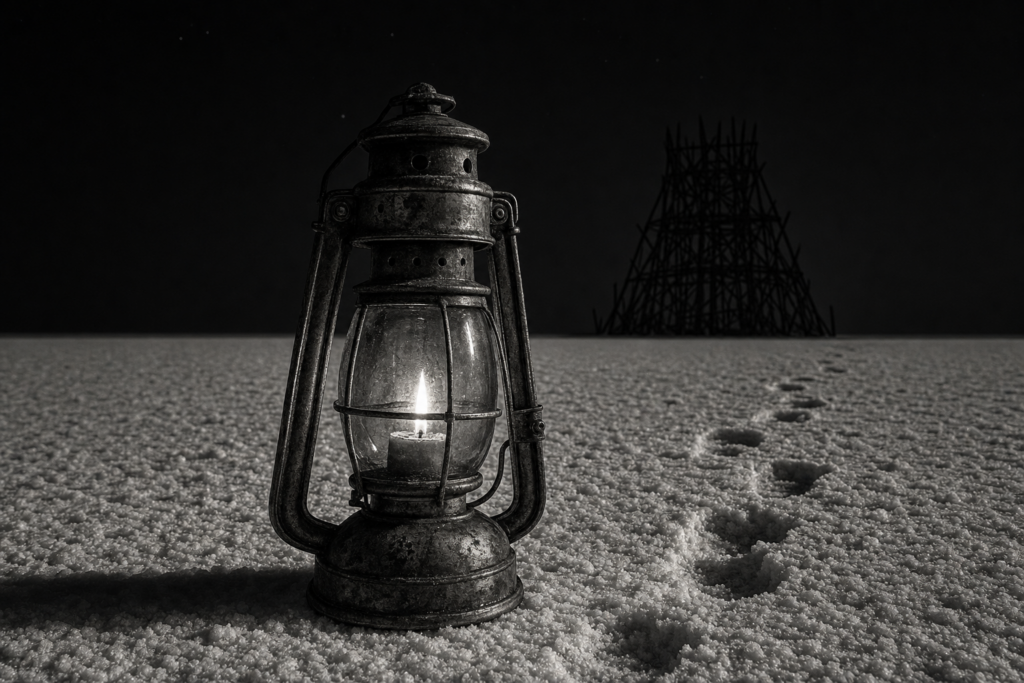
They were people. Perhaps two thousand. They walked in ranks, without hurrying, without weapons, and each of them carried a light. Candles. Lanterns. Torches of rag and oil. They did not sing. They called out nothing. They walked towards the fence, and when the searchlights caught them they raised the lights higher, as though to show that they held nothing else in their hands.
"Captain." Or'dun's voice over the helm vox, entirely flat. "Instruction."
Behind the lights, in the darkness the searchlights no longer reached, something else was moving. The auspex showed it as denser heat, better ordered, faster. Bre'kar did not need the auspex. He knew the pattern. He had seen it on other worlds, when cults sent children in front of bolters, and he had hated it with a hatred that had not grown colder in all those years.
"Not at the lights," he said. "Not at anything that carries a light. Searchlights over them. Show me what is coming behind."
The searchlights lifted. And behind them came the Rauhgraters.
That was what Vollrath called them, after the world they came from, a mining world three jumps away that had stopped answering a year ago. Forty thousand men of a planetary defence force that no longer defended its world, in uniforms that still bore the colours of the Imperium, with the lasguns the Imperium had given them. They were running now. They ran through the gaps between the light-bearers, and the light-bearers stopped and held the lights up, and the Rauhgraters reached the fence and tore it down.
The PDF fired. Too late, too high, then too low. Bre'kar saw lights fall. He saw candles lying in the salt, still burning, while the people who had carried them did not get up again.
"Fire Wardens," he said. "To me."
The graduation towers were a forest of blackthorn and timber, three hundred metres long, sixteen metres high, row behind row, and the brine trickled in them even now, with a sound like rain that never stops. The Rauhgraters came in, because you had to come in to reach the gates. The Fire Wardens were waiting inside. You could not fight this engagement at a distance. It was one for flamer and blade, for bolters at twenty paces, for the weight of power armour against a body that had nothing to set against it.
Bre'kar fought the way he always fought: without haste. He waited until a line of Rauhgraters stood between two trickling walls, then he filled the passage with fire, and the salt on the wood crackled and went black, and the men did not scream for long. Then he moved on. He thought of Vulkan's word, which every novice learned by heart: a fire that burns everything it touches is no longer a fire. It is devastation. He thought it and let it stand, the way you let a stone stand that you cannot lift, and moved on.
They held the graduation towers until morning. The Rauhgraters withdrew when the light came, and they withdrew in good order, which was worse than a rout. On the salt lay twelve hundred of them and four hundred of the PDF and a number of light-bearers that nobody wanted to count.
And four brothers.
Bre'kar was standing by them when Dra'kaan came. The Apothecary worked in silence, as always; the narthecium opened the ceramite, the blade found what it had to find, and afterwards Dra'kaan said the four names aloud, once, short and not open to negotiation, before he moved on. Bre'kar said them after him, to himself.
Then he looked out across the plain. There, far back at the edge of the camp, where the salt went over into the morning, a figure stood and looked back. It was too far away to make out. But it was too big for a man, and it stood too still.
IV. What a Witness Is
"They are not fighting," said Dra'kaan.
It was midday. They stood in the yard of the boiling house where Vollrath was gathering her wounded, because the boiling pans gave warmth and the city had no infirmaries large enough. Among the wounded sat the prisoners. There were seventy or eighty of them. They had been found at first light among the graduation towers, where they had stayed when the Rauhgraters withdrew: people from Salzgrund who had gone out in the night with lights and had now come back without lights, and people from the camp, recognisable by their unfamiliar clothes. They sat on the ground. They had not resisted. They were not resisting now either. They looked at the soldiers guarding them, and the soldiers looked away.
"I have examined nine of them," said Dra'kaan. "No sedation. No implants. None of the stigmata I know. They are awake, they are in their right minds, and they answer when they are asked."
"What do they answer?"
"All the same thing." The Apothecary looked across at the prisoners. "They say: I have seen."
Bre'kar went over to them. He knelt down, as he always did, so that the people did not have to look up at a tower of green ceramite, and picked one out, a man of perhaps fifty with the white hands of a salt boiler who never quite gets the brine out of his skin.
"What is your name?"
"Hanke." The man looked at him. He was not afraid. That was what Bre'kar noticed at once and could not place. "Hanke, boiling-master of the second pan."
"Why did you go out, Hanke?"
"To see."
"See what?"
"What he said we should see." The man raised his eyes to the sky, where by day there was nothing to see but the sun and the haze off the brine. "He said we should look up. For six years I have not looked up. I have boiled salt for ships that do not come. And then I looked up, and the sky was open, and there was nobody there."
"The Emperor is there," said Bre'kar.
"Yes, lord," said Hanke politely. "That is what I always used to say too."
Bre'kar stood up. He had spoken with cultists on many worlds, with the possessed, with people whose minds had been cut out and something else put in. He knew the signs. There were none here. Here was a boiling-master who had worked for six years without anybody looking in on him, and whom somebody had told to look up.
"They are not fighting," said Dra'kaan again, when Bre'kar came back. "They carry the lights and go in front, and when the Rauhgraters are through them, they stop. They are not a shield. A shield would move. They are a testimony. He wants us to fire at them first, before we fire at him. And if we do it, they have seen it. And if we do not do it, the Rauhgraters come through."
"I know what he wants."
"Then you also know what he is."
Bre'kar nodded. He had seen the figure at the edge of the camp. He had heard how the voice had used the word witnesses as though it were an office, and how it had said: the word is patient. He knew which Legion spoke like that. There was only one that held war to be a sermon.
Vollrath came with her officers, six men and two women who had all lost people in the night and were not telling one another. She placed herself in front of Bre'kar and said what she had to say, and he let her say it.
"We cannot hold Salzgrund, captain. Not like this. Not if they send unarmed people ahead of them every night. My people will either fire at them or not fire at them, and both will kill us. I request the order to give up the fence and close the gates."
"No."
She had expected it. He saw that she had expected it, and saw too that it struck her all the same.
"Not the gates," said Bre'kar. "Not now. We evacuate Salzgrund. All ninety thousand, up into the upper city, through all three gates, by day and by night, for as long as it takes until nobody is down there any more. Your people organise the columns. My brothers hold the graduation towers as long as the columns are running. Then we close the gates, when nobody is standing in front of them any more."
"Ninety thousand through three gates." One of the officers, a major with a burnt sleeve, said it quietly, as though calculating. "That takes seven days. Eight."
"Then it takes eight days."
"And those who do not want to?"
Bre'kar looked across at the prisoners, who sat on the ground and looked at the sky.
"Ask them every day," he said. "Every day, until the last one."
V. Three Gates
The evacuation began on the fifth day, and it looked the way evacuations always look: like too little time.
Through Gate One went the carts, with everything the boiling folk could load onto them in the way of household goods, tools and stores, and with the old people on top. Through Gate Two went those who could walk, in columns of five hundred, each column with a platoon of PDF in front and one behind. Through Gate Three, the narrow passage in the east, went the sick and the children, because the way was shortest there and because Bre'kar had Or'dun's squad standing there, his best men, and Dra'kaan just behind the gate.
The Fire Wardens held the graduation towers. They held them by day, when the Rauhgraters did not come, and by night, when they did, and they came every night. Never at full strength. Always behind the lights. Always in good order, always back before morning, and every time they left a few hundred dead in the salt and took sleep, ammunition and a very few brothers for them. On the fifth day, two. On the sixth, one. Bre'kar counted them the way Dra'kaan counted them: once aloud, then in silence.
On the seventh day he saw one of them close to.
He came through Gate Two, where the brine pipes ran through the Ring and where the columns pressed most tightly, because the Trickle Slope was the only way that carts and people on foot could take at the same time. He did not come with the Rauhgraters. He came ahead of them, alone, in the middle of the afternoon, through a gap in the fence that nobody had noticed, and he came so fast that the PDF at the gate only fired when he was already among them.
Bre'kar heard it over the vox: first a scream, then no more reports. He was two hundred metres away, in the graduation towers. He needed forty seconds.
When he arrived, eighteen soldiers lay on the ground and two of his brothers, and between them stood an Astartes in armour whose red was so old that it looked almost black, a red that nobody had touched up for ten thousand years, with chains over the shoulder plates and a helmet that no longer looked quite like a helmet. He had no gun. He had an axe with a blade as broad as a shield, and in his strength there was nothing ritual any more and nothing of a doctrine, only an outlet for something that had no words. He killed the way water runs down a slope.
Bre'kar filled the gate arch with fire.
The stranger walked through it. He burned, and he walked through it, and the axe came down from above, and Bre'kar caught it on his blade, and the blow pushed him back a step, which nobody had done to him in decades. Behind the stranger he saw Vel'Schwur coming, the crozius in both hands, and the column pressing into the gate behind them, women with bundles, a man with a child on his shoulders, all of them wanting to get between the fighters and unable to.
"Malkor," said the stranger. Only that. It was not a word said to Bre'kar. It was a word he said to himself, in a voice like a rough growl, as though he had to make sure that he still had a name.
Then the Rauhgraters came through the gap in the fence, three hundred, four hundred, without lights this time, because it was day, and Malkor turned and went to meet them, not as though he meant to lead them, but as though he meant to be among them, where there were targets enough, and the PDF at the gate found their rifles again, and the fight for Gate Two lasted three hours.
When it was over they held the gate. Malkor was gone, with the last of the Rauhgraters, in good order, without haste. On the Trickle Slope lay six hundred dead, most of them people from Salzgrund who had wanted to go up.
By the evening of the seventh day fifty-five thousand were in the upper city.
"And the other thirty-five thousand," said Vollrath in the command post, "do not want to."
Bre'kar looked at her.
"I have had them asked. Every day, as you said. They are not all witnesses. Most of them are simply boiling folk who will not leave their pans, because the pans are all they have. But there are more of them. Every night some go out with lights, and every morning more are sitting in the streets. They simply sit there, captain. With candles. In daylight."
"How many?"
"We have not counted. There are streets full of them."
That night Bre'kar walked through Salzgrund alone. He had forbidden Ashek to follow him, and Ashek had followed him, at fifty paces, as he had for decades. The alleys between the boiling houses were narrow and smelled of brine. And they sat there, as Vollrath had said. On doorsteps. Against walls. On the paving, with their legs crossed. Each with a light in front of him that did not go out, because the wind did not reach into the alleys. They watched him come, the green giant with the flamer, and they watched him go, and none of them stood up, and none of them ran away, and none of them said a word.
In his years Bre'kar had seen many ways in which people look at an Astartes. This one he did not know. It was not hatred. It was not fear. It was the look of people who have seen something and are waiting until you see it too.
VI. Forty Days
The answer came on the eighth day, by way of the Ashen Watch's astropath, who pulled it in three attempts out of the noise that Imperium Nihilus had put in the place of the Astronomican.
Chainhold Nineteen to Ashen Watch. Golden Wall force assembled. Relief on the fortieth day after your landing, if the Warp holds. Hold.
Bre'kar read it twice and laid the sheet on the table of the command post, beside the map of Salzgrund on which Vollrath's officers marked in chalk every morning the streets in which the people with the lights were sitting. The chalk stain had grown larger every day since the fifth.
Forty days. That was not bad. For Imperium Nihilus, for a world nobody had looked at in six years, it was a promise of the kind only the Golden Wall could give, who wrote their promises in a book and then kept them. Bre'kar thought of Vel'Kaddar and of a chain that you hold because you once closed it. Forty days. He had held longer sieges.
He had never held one that was reckoned like this.
He did the arithmetic in the night, alone, without a map, because he had the map in his head, and he did it the way a smith looks at a piece of metal that has a flaw and determines where the flaw sits and whether it can be forged out.
Seventy-eight brothers at the landing. Sixty-nine on the eighth day. Nine in eight days, all of them in Salzgrund, all of them in the graduation towers or at the gates, none on the Ring, because the Ring was not being attacked, because the enemy was not stupid. That was one brother a day, and it would not become fewer, because the Rauhgraters learned more every night and because there were Astartes down there now who had had ten thousand years to learn killing. At one brother a day he had thirty-seven on the fortieth day. At two a day, which was likelier, he had five on the fortieth day.
With five brothers you do not hold a ring of eleven kilometres. With five brothers you hold one gate. And if the Ring fell, one million three hundred thousand people in the upper city fell, and Salzgrund fell anyway, and in forty days the Golden Wall would drop out of the Warp and find a city in which every candle was burning.
He did the arithmetic three times. It came out the same every time, and he had known the first time that it would. You do not calculate in order to find the result. You calculate in order to be no longer able to spare yourself it.
There was the other calculation. He set that one up as well, because one had to. Close the gates today. All brothers onto the Ring, all PDF onto the Ring, no more nights in the graduation towers. Then he would perhaps lose a brother in three days instead of two a day, and on the fortieth day sixty Fire Wardens would stand on a wall that had never fallen, and the Golden Wall would find a city that stood. One million three hundred thousand and fifty-five thousand who had come up. And down below thirty-five thousand who had not wanted to come, and all who would still have come if they had been allowed to, and all who had not yet decided, because they had not yet been asked.
We leave nobody behind.
He had said it on the rampart walk, and Vel'Schwur had let him say it, twice. He had said it to a girl of eight whom he had carried up a shaft on Ossilar, and it had been true, and he had said it on a dozen worlds, and it had always been true, because there had always been a way, a shaft, a corridor, twenty minutes that could be got out of an old pit-master. It had been true because he had been able to afford it.
Vel'Schwur found him before sunrise on the rampart walk above Gate Two, at the same place as on the first night. The Chaplain placed himself beside him and looked down at the lower city, in which more lights were burning now than there were lanterns on the graduation towers.
"You have done the arithmetic," said Vel'Schwur.
"Yes."
"And?"
Bre'kar did not say it. He looked down.
"Say it aloud," said the Chaplain. "Not for me. I know it. I have had the figure since the fifth day. Say it, so that it is said before you write it."
"Salzgrund falls," said Bre'kar. "One way or the other. All I decide is whether the Ring falls with it."
Vel'Schwur nodded slowly, as he had on the first night. And then he said something Bre'kar had not expected.
"He knows it too. That is why he is not attacking the Ring. He does not want Salzgrund to fall, brother. He wants you to give it up."
VII. The Champion
He came on the ninth day, in daylight, and he came alone.
The sentries on the Ring reported him first as a vehicle, because something was approaching across the salt that was too big for a man and moved too evenly for a vehicle. Then they reported what it was. Bre'kar was already on his way.
He waited in front of Gate One, at the foot of the Salt Climb, with Ashek and six brothers behind him and Vel'Schwur at his side, and the columns going up the climb stopped walking and looked back. He had not called Vollrath. There were things for which a man was not needed, and this was one of them.
The stranger came up the road between the boiling houses, through Salzgrund, straight through the alleys in which the people with the lights sat. They stood up as he went past. They did not run away. They stood up the way you stand up when somebody enters a room that belongs to him, and then they sat down again.
He was bigger than Malkor. He was bigger than anything Bre'kar had seen on two legs for a long time, and it was not the armour. The armour was the same: the ancient, almost black red, the chains, the branded marks. But something was growing over the armour. Plates that were not ceramite, that looked like the back shield of an animal nobody had ever seen, pushed over shoulders and chest as though the body underneath had decided to build itself a second suit because the first no longer sufficed. He wore no helmet. His face was the face of an Astartes, broad, old, with eyes that looked at Bre'kar calmly. And under the right jawbone, where on a man there was nothing, sat a second pair of eyes, small and black, which moved independently and looked at Vel'Schwur while the upper eyes looked at Bre'kar.
He carried no weapon. He stopped twenty paces in front of the gate and waited until the column on the climb had fallen silent, and then he spoke, with the voice from the vox, which sounded deeper still at close quarters.
"Captain. I thank you for not firing."
"I do not fire on the unarmed," said Bre'kar. "You relied on that."
"Yes."
"Then you have nothing to thank me for. You calculated."
The stranger inclined his head, and it was not a bow but a concession, as between two craftsmen looking at the same seam. "We have both calculated. You arrived at the same figure as I did, or you would not be standing here to listen to me."
Bre'kar said nothing. He stood still and listened, with that cold curiosity with which he had listened to a fallen confessor on Sordenval, because you have to know an enemy before you kill him.
"My name is Thagoth. I am champion of a company I have left, and lord of a warband that has not existed long, and I spent ten thousand years in a coffin drifting through the Warp, and none of that is a threat. It is a provenance. I tell it to you so that you know that I have time."
"What do you want?"
"Witnesses." He said it the way you name a tool. "Not the city. I could take the city, in time; you know it, you have calculated it. I do not want to take it. A city taken is a city that is taken from me again afterwards. I want them to see. To look at the sky your Emperor opened and does not close, and to answer for themselves. Whoever goes, goes. Whoever stays, stays. I have not touched a single one of them, and I will not do it."
"You sent twelve hundred Rauhgraters into my graduation towers."
"The Rauhgraters are witnesses. They have seen, and they have answered, and their answer was to go with me and to fight for what they have seen. That is their right. It is the same right by which your brothers fight for what they have seen." The lower eyes wandered to Ashek, to the six brothers, back to Vel'Schwur. "I know what you are, captain. I know which primarch you carry in your blood, for I saw his sons on a black plain when they were still a Legion, and I know what they held to. You ask after the people before you ask after the walls. I built on that. I am still building on it."
"Come to the point."
"The point is simple. You cannot hold Salzgrund. If you go on trying, you will lose the Ring, and I do not want the Ring, but I will take it if it falls into my hands, and then I shall have a million witnesses whether they wish it or not, and that is not what I want. I want volunteers. Give me Salzgrund. Take your brothers onto the wall. I will not attack the wall. No Rauhgrater will set foot on the Salt Climb. And down below I will preach, and whoever comes to me, comes, and whoever wants to go up to you, I will let go up. That I swear to you on the word."
It was quiet for a long time. On the climb Bre'kar heard a child crying and somebody soothing it.
"And the one who does not come and does not go?" he said. "The boiling-master who stays with his pan because it is all he has?"
"He will see. For as long as it takes, every day. I have patience, captain. I have more of it than you."
Bre'kar looked at him. Then he looked past him at the alleys in which the people sat, and at the salt behind them, and at the graduation towers in which nine of his brothers had died so that people could walk up a climb. And he understood what Vel'Schwur had meant. The enemy did not want Salzgrund to fall. He wanted it given up. For a city that has been given up is the proof of everything he preached: that nobody looked in on them, that the sky was open and empty, that those who came to protect them closed the gates in the end and went up. He wanted Bre'kar's decision. He wanted it as testimony.
"No," said Bre'kar.
Thagoth nodded, as though he had expected nothing else. There was no disappointment in his face, rather something like respect, of the kind one pays a man who answers honestly even when the answer is wrong.
"Then I will wait until you say it without me," he said. "You will say it. Not to me. To them." He looked at Vel'Schwur, with all four eyes at once. "And you will bear witness to it, priest. That is your office, is it not? A Chaplain at every place where a decision is made."
He turned and went back the same way, through the alleys, and the people stood up as he passed and sat down again.
"He knew my words," said Vel'Schwur when he had gone. It was the first time since Bre'kar had known him that he heard in the Chaplain's voice something that might have been called shock.
"He has good ears." Bre'kar put his helmet on. "And he has listened for nine days."
VIII. Dated
He wrote it on the tenth day.
He wrote it in his book, which he had kept for decades and into which went only what he would not later want to disown, and he wrote it the way he wrote everything: with the date, in short lines, without a word that could also have been left out.
Tenth day of the siege of Hollbrunn. The lower city of Salzgrund is given up. Final deadline for the ascent through all three gates: thirty-six hours from noon. After that the gates will be closed, regardless of who is standing in front of them. The company goes onto the Ring. Decision: Captain Bre'kar, Fire Wardens of Nocturne. Witnessed: Chaplain Vel'Schwur.
He showed it to Vel'Schwur, and the Chaplain read it and gave it back and said, "There is one word missing from it."
"Which?"
"Behind."
"It does not say either that I am not doing it."
Vel'Schwur looked at him for a long moment. "No," he said then. "That it does not say."
The officers heard it in the command post, standing, the way Bre'kar said everything standing. Vollrath heard it with the face of a woman who had wanted to hear exactly that since the first day and now found that she had not wanted to hear it. The major with the burnt sleeve nodded and was already calculating. Ashek stood against the wall and looked at the floor, and Bre'kar knew that in all those years he had never seen the sergeant look at the floor.
"Thirty-six hours," said Vollrath. "We will manage perhaps fifteen thousand. If they want to."
"Then we manage fifteen thousand."
"And the announcement? Who tells them?"
"You. Over the loudspeakers of the graduation towers, in every alley, every hour."
Vollrath shook her head. It was the first time she had refused him anything, and she did it quietly. "No, captain. I will have it cried out because you order it. But I will not tell them myself. I waited eleven days for somebody to come who knows what is right. I am not going down there to tell them that he came and did the arithmetic."
She looked at him as she said it, and Bre'kar held the look, and he did not hold it against her. He had not wanted it either.
He went himself.
He went down in the afternoon through Gate Three, the narrow passage in the east, because that was where the sick and the children had gone up and because the way to the boiling houses was shortest there, and he went without his helmet, with the flamer lowered, and Vel'Schwur went beside him, and Ashek went behind, at fifty paces. In the alleys they sat with their lights and looked at him.
At the brine canal that carried the brine from the graduation towers to the boiling houses he found the man he was looking for. Vollrath had given him the name: Tammo Rieck, bridge-warden of the canal, an office that had existed for three hundred years and that consisted of opening and closing the sluices at the seven bridges so that the pans got their brine. Rieck knew every alley and every boiling-master. If anybody in Salzgrund was listened to, it was him.
He was a small man of about sixty, with the white hands of the boiling folk and a back bent from the sluices, and he was standing on his middle bridge when Bre'kar came, and he was not looking at the sky. He was looking at the canal.
Bre'kar knelt down, on the bridge, so that his head was at the man's height.
"Bridge-warden Rieck."
"Lord."
"The gates close tomorrow at midnight. All three. Whoever is up by then is up. Whoever is not stays down. We go onto the wall, and we do not come down again until help comes, and that will be thirty days." He said it slowly. He did not look away as he said it, and he did not make it shorter than it was. "I am telling you first, because you are the one they listen to. I need you to make them go. As many as possible. As fast as possible."
Rieck looked at him. He looked at him for a long time, and in his face there was nothing of what Bre'kar had seen in the faces of the light-bearers, no waiting, no knowing. It was only an old man standing on a bridge who had just been told that his city was being given up.
"You said you leave nobody behind," said Rieck. "The colonel had that cried out. On the second day. That is what you said."
"Yes."
"And now?"
"Now I am saying something else." Bre'kar held the look. "I have done the arithmetic, bridge-warden. I have done it three times. If I stay down here, everything up there falls. I can tell you that it is the right decision, and it is true. But it changes nothing about what I said on the second day. Both stand. I take back neither of them."
Rieck was silent. Then he nodded, once, and wiped his hands on his jacket although they were dry.
"I will tell them," he said. "I will tell them in every alley. But I am not going up, lord. The sluices have to be worked, or the pans run over and then the boiling houses burn. I am staying at the sluices."
"Rieck—"
"I have not looked at the sky," said the bridge-warden. "I have looked at the canal. For six years. I am not going to start now." He looked at Bre'kar, and for the first time there was something in his face that seemed familiar to the captain: the quiet, unbending courtesy of a man who understands a thing and therefore does not let go of it. "Go up onto your wall. I will work the sluices. If your help comes, I will be here. Or not. But the canal runs."
Bre'kar stayed on his knees a moment longer. Then he stood up.
"Take care of yourself," he said, and Vel'Schwur beside him did not move, but Bre'kar knew that he had heard it.
IX. Thirty-Six Hours
They came.
They came after Rieck had gone through the alleys and said it, in every single one, with his canal voice that was used to being heard over the trickling. Not all of them. Not half. But out of doors that had been shut for ten days came families with bundles, and boiling-masters let their pans run dry and went, and out of the alleys where the lights sat, individuals stood up and left their light standing on the paving and went up the climb. Bre'kar did not count them. Vollrath counted. By noon of the eleventh day there were nine thousand. By midnight, twelve.
The enemy came in the fourteenth hour, in the middle of the night.
He did not come as before. He came with everything he had, and he came at all three gates at once, and he came without lights, because it was dark and because Thagoth had understood that on this night Bre'kar would no longer be watching for lights. The Rauhgraters came through the graduation towers, which nobody was holding any more, and through the alleys in which the lights sat and did not stand up, and they came to the gates, where the columns were backed up, and they fired into the columns.
Bre'kar stood at Gate Three.
He had chosen it, because it was the narrowest and because the last ones would come there, the slow, the old, those who had decided too late. Or'dun's squad held the passage, eight brothers in an arc around the opening, and Dra'kaan stood in the gate and pulled the people through, literally, with his hands, one after another, because in the narrowness and the darkness they stopped and looked around. Vel'Schwur stood beside Bre'kar. Ashek held the rampart walk above with the bolters.
It was a fight of the kind Bre'kar had not fought since Ossilar: with his back to people. Every bolt round he fired went into a crowd in which there were Rauhgraters and boiling folk who still wanted to get up, and he fired them all the same, because otherwise he could have done nothing at all, and every time he brought the flamer up he waited half a second to see who was standing in the passage. Half a second is a long time. Sha'vek fell in one of them, a las hit through the visor, a young brother who in his first year had held the graduation towers and who, as he fell, still brought his bolter up.
In the eighteenth hour one of them came.
He came through the alley that ran towards Gate Three, and the Rauhgraters parted in front of him, and he was not Malkor. He was slimmer, faster, and he had no axe but a sword that glowed without a power field, and he had a voice. He sang. Bre'kar heard it over the fighting, a single note that went up and down, in the old Gothic Thagoth had spoken, and he understood not a word of it and knew all the same what it was: a litany, sung by one who had known it for ten thousand years.
Or'dun stood against him, and the stranger went through him the way Malkor had gone through the fire. Not unhurt. He left half his shoulder plate on Or'dun's chainsword. But he went through, and Or'dun was down, and the stranger was in the gate, three paces from Dra'kaan, who was holding an old man by both arms.
Bre'kar hit him in the back with the flamer, full stream, from four metres.
He burned. He turned round, burning, and looked at Bre'kar, and in his face, which a helmet without a visor left open, there was no pain. He smiled. He raised the sword, and Bre'kar went to meet him, into the fire, and the captain's blade found the gap Or'dun had cut, and went in to the hilt.
The stranger stood still. He looked down at himself, at the blade, and then up at Bre'kar, and his smile grew wider, and he said something. Bre'kar heard it exactly. He heard it all night.
"I have seen," said the stranger. "I bear witness to it."
Then Vel'Schwur's crozius came down on his helmet, and he said nothing more.
They held Gate Three until the sun came over the plain. Or'dun was alive; Dra'kaan had him lying under the gate while with one hand he went on pulling people through. The Rauhgraters withdrew with the light, in good order as always, and left their dead lying and the dead of the boiling folk among them, and the dead Astartes in the gate, whom nobody touched.
In the last hour Bre'kar carried somebody himself.
A woman, old, with a leg that would no longer bear her, who was sitting at the edge of the alley thirty metres from the gate, and whom he picked up without asking, the way he had picked up a child on Ossilar, and carried up the climb. She did not resist. She laid her hand on his shoulder plate, on the bronze dragon, and looked back into the alley, and halfway up she said, "Put me down."
"It is thirty paces."
"My son is down there. He is sitting with the lights. He did not come." She looked at him, calmly. "Put me down, lord. I am going to him."
Bre'kar walked on. Three paces. Five. Then he stopped, in the middle of the Salt Climb, with the woman in his arms, and behind him the last of them pressed upwards, and in front of him the gate stood open.
He put her down.
She nodded to him and went down the climb, slowly, with the bad leg, and he watched her until she disappeared into the alley.
X. The Gate
At midnight of the eleventh day nineteen hundred people were still standing in front of Gate Three.
They stood in the passage and on the climb and in the alley, packed tight, with bundles, with children, and they stood because they could not go faster. The passage was two metres wide. Dra'kaan pulled. The PDF above pulled. But it did not go faster, it had not gone faster in thirty-six hours, and the arithmetic Bre'kar had set up on the eighth day had never had a place for these nineteen hundred.
The auspex reported the Rauhgraters at the fence. Not a few hundred. All of them. They had waited all day, and they were waiting for the hour Rieck had cried out, as Bre'kar had known they would when he set it. You set a deadline so that the enemy knows it. You set it so that you do not have to choose it yourself.
"Captain." Ashek's voice over the vox, from the rampart walk. "They are advancing. Eight minutes to the graduation towers. Twelve to here."
Bre'kar stood under the gate arch. Beside him Vel'Schwur. In front of him the nineteen hundred who wanted to go up. Behind him the Ring with one million three hundred and seventy thousand inside it.
He knew what the gate would take. He had seen it on the first day. Two metres of passage, a portcullis of plasteel that had not come down in a hundred years, and behind it a gate leaf of salt stone and iron that four men closed. Open, it was a hole in the Ring. Closed, it was the Ring. If the Rauhgraters found it open, they would come in, into the Ring, into the upper city, in among the million, and then there would be no Ring any more but a city in which you fought alley by alley, with sixty brothers, for thirty days, and lost.
"Make the portcullis ready," he said.
"Captain." Ashek. Only the word.
"Make the portcullis ready, sergeant."
It was quiet over the vox. Then: "There are people standing under it."
"I know where they are standing."
Silence again. Bre'kar looked up to the rampart walk. He could not see Ashek. He knew that the sergeant was standing at the winch with his hand on the lever, as he had stood at every lever Bre'kar had assigned him for decades, and that he was not moving his hand.
"I cannot do it, Bre'kar," said Ashek. It was the first time he had used the name without the rank.
"I know," said Bre'kar. "I am coming."
He went up onto the rampart walk. He walked past Ashek, who stepped aside without looking at him, and placed himself at the winch. Below him, in the torchlight, he looked down into the passage, at the heads, the bundles, a girl of eight or nine who was looking up at him because something had moved above her.
He looked back.
"Dra'kaan," he said into the vox. "Everything standing in the passage, pull it through. Now. What is standing on the climb stays."
"Understood," said the Apothecary, and there was nothing in his voice, because he had emptied it in order to be able to work.
It took four minutes. Then the passage was empty but for Dra'kaan, who stepped back, and the dead Astartes still lying in the gate arch, and the first from the climb, who pressed in because space had opened in front of them.
Bre'kar pulled the lever.
The portcullis came down. Not quickly; a hundred years of salt in the guides. It came down, heavy, grinding, and the people on the climb saw it coming and stood still, and it struck the ground with a sound Bre'kar never got rid of, and then it stood, and behind it four soldiers of the PDF closed the leaf of salt stone and iron, and Gate Three was a piece of the Ring.
On the climb it was quiet. Then somebody began to scream, and then many.
Bre'kar stood on the rampart walk and looked down. He saw every face that looked up at him. He looked at them for as long as they looked up at him, and he did not look away, because it was the only thing he still had to give them, and because he knew that it was nothing. He saw the girl who had looked up at him standing behind the portcullis, on the wrong side, with one hand on the plasteel.
Then the Rauhgraters came through the graduation towers, and the people on the climb turned and ran down, into the alleys, to the lights, and the climb was empty, and Bre'kar heard behind him that Vel'Schwur came up the steps and stopped and said nothing.
At Gate One and Gate Two the portcullises fell in the same hour. Vollrath reported it. Her voice was steady. She named no figures.
XI. What the Book Says
On the morning of the twelfth day Vollrath counted, because somebody had to count.
In the upper city, behind the Ring: one million three hundred and seventy thousand, approximately, among them sixty-seven thousand out of Salzgrund. In Salzgrund: twenty-three thousand, approximately, among them all those who had not wanted to, all those who had not got there in time, and one bridge-warden at his sluices. The canal was running. You could see it from the rampart walk, the trickling in the graduation towers, like rain that does not stop.
Fire Wardens of Nocturne, on the Ring: sixty-three. Fifteen in twelve days. Dra'kaan carried them all in the narthecium, and he had said every name aloud once.
PDF Hollbrunn: nineteen thousand two hundred.
Rauhgraters on the plain: Vollrath estimated thirty thousand still. And in addition now, she said without raising her eyes, all those who had stayed below.
Bre'kar listened to it standing and nodded once, the nod of a man who has seen the reckoning and paid it, and went onto the rampart walk above Gate Two.
Vel'Schwur was waiting there. That night the Chaplain had spoken the litanies for the fallen of the last two days and had entered the names of the fallen in the book he kept in his head, and he looked at Bre'kar with the look of a man who had something to say and was waiting to see whether he would have to say it.
"Show me," he said.
Bre'kar gave him the book. Vel'Schwur read the lines from the tenth day again, then the new one standing beneath them, with the date of the twelfth.
Gates closed at midnight of the eleventh day. Remaining in Salzgrund: twenty-three thousand. They were asked. Not all of them could answer. I left them behind.
The Chaplain looked at the last words for a long time. Then he gave the book back.
"You wrote it," he said.
"It is in my book, with the date. It will still be there when it becomes inconvenient."
"It is inconvenient now."
"Yes."
Vel'Schwur looked down at Salzgrund. Down below, in the alleys, more lights were burning in daylight than on any night before, and from up here you could see how they were ordering themselves: no longer in doorways and against walls, but in rows, in the streets that led to the square in front of the boiling houses. Somebody was dressing them. Somebody was building something down there, and it was not a wall.
"He will preach," said the Chaplain. "Four weeks. Every day. And we shall hear it."
"Yes."
"And those who still want to come up?"
"He said he would let them." Bre'kar looked at the graduation towers. "I said that we would not come down again. We shall see which of us is lying."
The vox at his collar crackled, on the Chapter frequency, which nobody knew but his brothers. And then the voice spoke, deep, calm, in the old Gothic, which sounded deeper still at close quarters, as though it were meant for him alone.
"Captain. You left them the choice. I will bear testimony to it. I will bear testimony to it for them every day, until they can do it themselves. You are an honest man. That is more than I can say of most who stand on a wall."
Bre'kar did not answer. He switched the vox off, slowly, the way you put down a tool you will need again.
Beside him Vel'Schwur said, very quietly, a phrase out of the Reclusiam that every novice learned and that the Chaplains taught without ever saying what it referred to: "Not every fire is allowed to burn where it can be seen."
Bre'kar looked down at the lights in the alleys. At the rows that were ordering themselves. At a trickling that did not stop, and at a bridge over a canal on which a small man stood working a sluice and not looking at the sky.
"Twenty-eight days," he said.
He had held sieges that lasted longer. He had never held one in which he would have to look down on every single one of them.
Download story as PDF or EPUB
Enter your email address. After confirming your subscription you'll get the download links immediately and by email.