Salzgrund
The Witnesses · Part Two
Civilians (Salzgrund, Hollbrunn) · Word Bearers (The Witnesses of the Wound) · The Fire Wardens of Nocturne
„A sluice is open or shut. What lies between is called wear.“
Merksatz der Brückenwarte von Salzgrund, seit dreihundert Jahren
I. The Sluices
Seven bridges, fourteen sluices, one man.
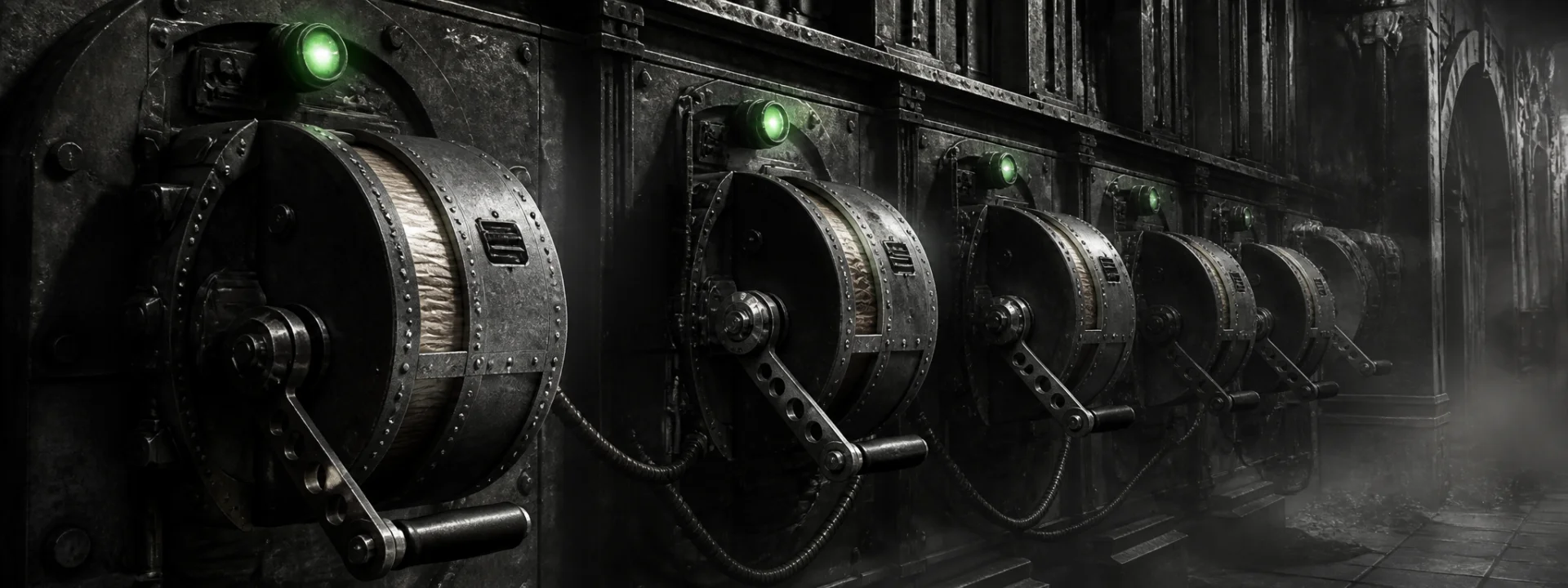
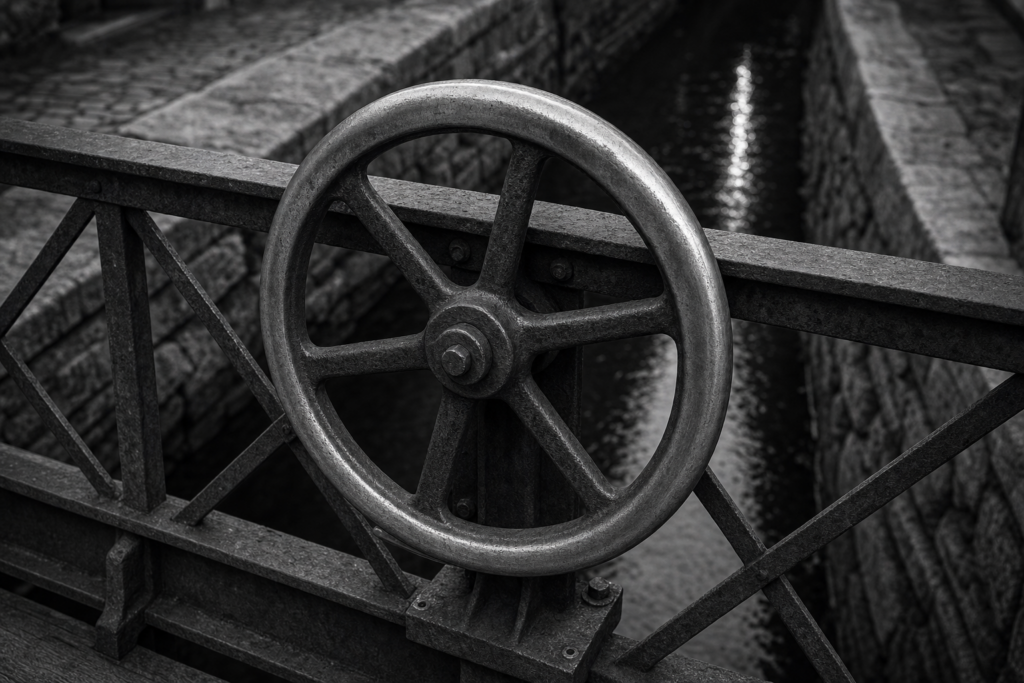
That was how it stood in the duty book of the brine canal, and that was how it had been for three hundred years, and in his forty-one years at the sluices Tammo Rieck had never understood why people thought it was little. A sluice opened a hand's width too far gave a pan too much brine, and the pan ran over, and the brine ran into the fire beneath it, and a boiling house whose fire went out needed three days to come back up to temperature. A sluice closed too far let a pan boil dry, and then the boiling house burned. In between lay the canal. In between lay Salzgrund.
On the tenth day that the strangers had lain on the plain, the green giant came to his middle bridge and knelt down.
Rieck had seen him coming, down the alley, with a second one in black and a third further back, and he had not stopped turning the wheel, because the second pan was just getting its measure. Then the giant was standing in front of him, then he knelt, and his head was at the height of Rieck's head, and in forty-one years nobody had done that. Not the governor, not the colonel, not the boiling-master of the first pan, who thought he was the governor.
The giant said that the gates would close. Tomorrow at midnight. He said it slowly and did not look away while he said it, and Rieck counted that in his favour, the way he counted it in an apprentice's favour who reported a mistake before the pan ran over.
"You said you leave nobody behind," said Rieck. The colonel had had that cried out, on the second day, and Rieck had heard it at the fourth bridge, with the wheel in his hand.
"Yes."
"And now?"
The giant said that he had done the arithmetic. Three times. And that both stood, the sentence from then and the one from today, and that he took back neither of them.
Rieck had nothing to say to that. He wiped his hands on his jacket, which were dry, and said that he would tell them, in every alley. And that he would not be going up. The sluices had to be worked.
"I have not looked at the sky," he said, because the giant was looking at him as though he were still waiting for something. "I have looked at the canal. For six years. I am not going to start now."
The giant stayed on his knees a moment longer. Then he stood up and said something that Rieck only understood later, when he was alone and adjusting the wheel of the third bridge by a quarter turn, because the brine was heavier today than yesterday.
"Take care of yourself," the giant had said. An Astartes. To a bridge-warden.
II. Marrit
He said it in every alley.
He said it in the voice with which he had been calling over the trickling after the apprentices for forty-one years, and people came out of their doors and listened, and some went back and packed, and some went back and shut the door. The ones sitting in the alleys, with their candles in front of them, listened to him too. They looked at him and said nothing, and he moved on, because he still had nineteen alleys.
Marrit was waiting at the middle bridge when he came back. She had packed. One bundle, her mother's jacket, the shoes with the good soles.
"You are coming with me," she said.
"No."
"Father."
"The sluices."
She looked at him the way her mother had looked at him when he did not go to bed after the night shift because the seventh bridge was making a noise he did not like. She was twenty-three. She had been boiling in the fifth pan since she was sixteen, and she was better at it than he was, because she smelled the brine before she saw it.
"Nobody is coming to work the sluices while you are up there," he said. "Then the pans run over, and the boiling houses burn, and when the help comes it finds a city in which nothing boils any more. I told the giant that the canal runs. I did not say it because of you. I said it because it is true."
"And me?"
"You are going up."
She wanted to cry and did not, which she also had from her mother. She stood there a while longer. Then she took the bundle and the jacket, and on the bridge she stopped and laid her hand on the wheel of the sluice, not to turn it, only to have touched it.
"The canal runs," she said.
"The canal runs."
He watched her go until she disappeared into the alley towards the Salt Climb, and then he looked at the canal, because the brine was running a little too fast and the fourth bridge needed half a turn.
At midnight he heard the portcullis fall. You heard it down here, all three of them, one after another, and then it was quiet, and then they screamed up on the climb. Rieck stood at the middle bridge with both hands on the wheel and did not turn it. He just stood there, with his hands on the wheel, so that they had something to do.
III. The Morning After
They came with the light, as they had always come, except that this time there was nobody there to fire at them.
Rieck watched them come down the alley from the bridge. Men in grey uniforms that still bore the aquila on the collar, with lasguns over their shoulders, not levelled. They walked like people entering a city somebody has promised them. Ahead of them went a man without a gun, with a lantern he held up although it was light.
They did nothing. That was the first thing Rieck grasped, and it was worse than anything he had imagined in the night. They walked through the alleys and looked into doorways and walked on. They took up position on the Boiling Square in front of the boiling houses and waited. One of them, a captain with a face like a miner's, came to the bridge, looked at Rieck, looked at the wheel, looked into the canal.
"What is that?"
"The brine canal. The brine for the pans."
"Does it keep running?"
"If somebody works it."
The captain nodded as though that were an answer he could reckon with, and went back to the square.
Only once that morning was a shot fired. A boy from the alley behind the third boiling house, the son of the boiling-master Brenneke, had a lasgun the PDF had left lying in the night, and he raised it, and three men in a different armour, which was not grey but a red like dried blood, were faster. They were not Rauhgraters. They were the others. The boy fell, and the three walked on, and one of the Rauhgraters bent down and took the rifle off him and laid it aside, and nobody said anything.
Around the midday hour the voice spoke.
Not out of the vox. From the Boiling Square, over the heads, without amplification, because it needed none. From the bridge Rieck could not see the speaker. He heard the voice, deep, in a Gothic that sounded as old as the foundations of the boiling houses, and it said that nobody would be touched. That nobody had to go and nobody had to stay. That there was bread, for everybody on the square, and that they should only look up if they wanted to. Nothing else.
The bread came from the mass transports. It was grey bread, of the kind the PDF had baked, and the Rauhgraters handed it out on the square, to everybody who was there. Whoever was not on the square got none. Nobody said that you had to come to the square. It was simply that the bread was there.
In the evening Rieck counted the lights in his alley. Before the night there had been eleven. Now there were fifteen.
IV. Nine Days
He learned the rhythm the way you learn the rhythm of a pan.
In the morning the bread on the square. At midday the voice. It spoke every day, never long, never loud, and every day it said roughly the same thing in different words, the way a canal carries the same water every day and never the same. The sky is open. Nobody has looked in on you. Look up. In the afternoon those who had looked up sat in the alleys with their lights, and those who had not stayed in their houses, and the Rauhgraters walked about in between and did nothing. In the evening the boiling houses burned, because Rieck worked the sluices, and the pans boiled salt that nobody would ever collect, and the warmth went through the alleys, and that was something for which even the ones with the lights thanked him when he went past. Some of them stood up as he did.
On the third day under the strangers the widow Erdmann from the house next to his knelt. She had had a son in the PDF, up above, and nobody could tell her whether he was alive, and in the afternoon she knelt down in front of her door with a candle and looked up.
On the fourth day Brenneke knelt. The boiling-master of the third pan, who had seen his son lying in the alley on the first morning and who had not come out of his house for three days, came out on the fourth day, went to the square and stayed there. Rieck saw him in the evening on his way to the sixth bridge: Brenneke sat at the edge of the square with a lantern in front of him, and his face was the face of a man from whom somebody has taken something that was too heavy.
"Hauke," said Rieck.
"Tammo." Brenneke did not look up. He looked into the lantern. "I have looked up."
"And?"
"There is nothing there, Tammo. There is nothing and nobody. And he said that it was not my fault. For six years I have thought it was my fault that nothing comes. That we did not boil enough. He said the salt was never the problem."
Rieck stood there a while. Then he went on to the sixth bridge, because the sixth bridge did not wait.
On the ninth day under them half the alley knelt. Rieck no longer counted the lights, he counted the dark windows, because there were fewer of them: seven. Seven out of nineteen houses in which nobody sat in the evening with a candle in front of the door. His was one of them. He did not sit inside either. He stood at the bridges.
The bread held out. That was the strange thing. Rieck had waited for it to grow short, for the Rauhgraters to hold it back, for somebody at some point to say that whoever does not kneel does not eat. Nobody said it. The bread lay on the square, every morning, and whoever went to the square got it, and whoever did not go got none, and nobody stopped anybody who went. Rieck did not go. He had salt, he had dried fish from his store, he had the warmth of the boiling houses. He had done the arithmetic: seventeen days. Then he would have to go to the square, or not.
V. The Champion at the Bridge
On the fifteenth day of the siege, the fourth under the strangers, the speaker came to the middle bridge.
Rieck had not yet seen him. He had heard the voice, for four days, and had imagined something, and what came down the alley was bigger than what he had imagined. The green giant had been big. This was bigger, and it was not the armour. The armour was red, so old that it was almost black, with chains over the shoulders, and over the armour something was growing that did not belong to it, plates like those of a beetle that did not exist. The head was bare. A broad, old face. And under the jaw, on the right, where on a man the artery lies, something small and black moved that did not look in the same direction as the eyes.
The people in the alley stood up as he passed and sat down again.
He stopped in front of the bridge. He did not kneel. He was so tall that kneeling would not have brought him to Rieck's height; he would have had to lie down. He simply stood there and looked at the wheel, at the canal, at the brine running in it.
"Bridge-warden," said the voice, and from here it was deeper still than from the square.
"Lord."
"I am told you do not look up."
"No, lord."
"Why not?"
Rieck had thought about it, in the four nights in which he had not slept, and he had found no answer that sounded the way an answer ought to sound. So he gave the one he had.
"Because there is nothing up there that I can work."
The stranger looked at him. The small eyes under the jaw looked at the wheel.
"And the canal?"
"The canal is open or shut. What lies between is wear. If I look up, I see neither open nor shut. I see something that is not my office."
It was quiet for a long time. On the square somebody was handing out bread; you could hear it. The brine ran.
"Then bear witness to the canal," the stranger said at last, and Rieck did not know whether it was mockery or an order or some third thing he did not know. "It too is something nobody collects any more. And it runs all the same. That is more than most of those who look up can say of themselves."
He turned away. Then he stopped once more, without turning round.
"The captain of the Fire Wardens came to you before he closed the gates. He knelt in front of you."
"Yes, lord."
"What did he say?"
Rieck considered whether he should lie, and found that he did not know what for.
"He said that both stand. That he leaves nobody behind and that he is doing it. And that he takes back neither of them."
The stranger stood there a moment longer. Then he nodded, once, like somebody who has heard something he already knew and wanted to hear all the same.
"An honest man," he said, and went.
In the evening one of the Rauhgraters brought bread to the bridge. Two loaves, grey bread, without a word. Rieck looked at him, and the man looked away, and left the bread lying on the railing and went. Rieck did not take it. It lay there through the night. In the morning it was gone, and he did not know who had taken it, and he told himself that it was all the same to him.
The next evening there was bread lying there again. He took it and brought it to the widow Erdmann, who by now no longer knelt, because she was too weak to go to the square, and who took it without asking where it came from.
VI. The Gate
On the twenty-first day Brenneke's wife wanted to go up.
She came to the bridge in the morning, with the two little ones by the hand and the bundle she had packed on the eleventh day and not taken, because her husband had not wanted to go, and her husband still did not want to. He was kneeling on the square. He had not buried the dead boy; the Rauhgraters had buried him, behind the third boiling house, properly, with a stone.
"Will you take us up, Tammo?"
"There is no getting up. The gate is shut."
"The stranger said that whoever wants to go up, he lets go up. He said it on the square. He says it every day."
Rieck looked at her, at the two children, at the bundle. He thought of the portcullis he had heard fall, and of the giant who had said that they would not come down again.
"I will take you to the climb," he said. "No further. I have the sluices."
They went through the alleys, past the lights, past the Rauhgraters, who watched and did nothing. At the foot of the Salt Climb stood a sentry, grey, with the aquila on his collar, and he looked at the woman and the children and the bundle and stepped aside. He said nothing. He only stepped aside.
The climb was empty. It had been empty since the eleventh day, and the dead from then no longer lay there, somebody had carried them away, but the bundles still lay there that had been dropped, and the candles that had been left standing. Brenneke's wife went up, slowly, with the children, and Rieck stayed standing at the foot of the climb, beside the sentry, and watched her go.
At the top stood the portcullis. Behind it the leaf of salt stone and iron. Nothing moved.
The woman stopped in front of the portcullis. She did not call out. She simply stood there with the children and waited, and Rieck thought that she would stand there until the children began to cry, and then she would come back down, and the stranger would have kept his word, and the giant would have kept his, and the two together made a gate that was shut.
Then the leaf moved.
Not much. A hand's width. Behind the portcullis, in the gap, there was something green, and then the portcullis went up, slowly, grinding, just far enough for a woman to get under it if she stooped, and a green hand that was bigger than the head of one of the children came out under it and waited. The woman pushed the first child in. Then the second. Then she stooped and crawled, and the hand took her by the arm and pulled, and then the climb was empty, and the portcullis came down again, and the leaf closed.
The sentry beside Rieck had watched. He said nothing. Rieck said nothing.
He went back to the bridges, because the fourth needed half a turn. He thought the whole way that he now knew which of the two had lied, and that it was neither of them, and that he did not know what to do with that.
VII. The Sluice
On the twenty-fourth day the red ones came to the bridges.
It was the three from the first morning, the ones who had shot the boy, and a fourth who was bigger than the three and carried an axe whose blade was as broad as a cartwheel, and who wore a helmet that looked as though it had once melted and set again. They did not come from the square. They came from the lower alleys, where the seven dark houses stood and where the widow Erdmann lay, and they went past the first bridge and the second, and at the third the one with the axe stopped and looked at the sluice.
Rieck was standing at the middle one. He saw it from there. He did not understand at once what they wanted, and then he understood, because one of the three laid his hand on the wheel of the third bridge and began to turn it. Upwards. Open.
"Don't," said Rieck.
They did not hear it, or they heard it and went on turning. The third bridge fed brine to the lower brine main, which led to pans seven to ten, and pans seven to ten had stood idle since the eleventh day, because nobody boiled there any more, and their run-off channels led into the lower alleys. Whoever opened the third sluice fully was not filling a pan. He was filling the alleys. With brine, knee-deep, into the houses where the ones sat who did not go to the square.
Rieck ran. He was sixty-two and had a back bent by fourteen sluices, and he ran the forty metres to the third bridge as he had not run in thirty years, and placed himself in front of the wheel, between the wheel and the man who was turning it.
"Don't," he said again. "The canal runs into the pans. Not into the alleys."
The man looked at him. He was an Astartes, and Rieck came up to his chest, and the man could have lifted him off the wheel with one hand. He did not do it. He looked over Rieck's head at the one with the axe.
The one with the axe came over. He walked slowly. He did not raise the axe. He looked at Rieck, then at the wheel, then into the canal, and out of the helmet came a noise that was not a word, a growl, like something that had not spoken for a long time and did not miss it.
Rieck held the wheel with both hands. He thought nothing. He thought afterwards that he ought to have thought something, of Marrit, of the widow Erdmann in her dark house, of the pans, and he had thought nothing. He had only held the wheel, because the wheel was what he held.
The axe did not come.
Instead the voice came. From the square, without a vox, over the roofs, not loud, but so that everybody in Salzgrund heard it, and it said two words that were not a prayer and not a sermon.
"Malkor. No."
The one with the axe stood still. The small eyes under the helmet, if they were eyes, looked at Rieck. Then he turned and went, without hurrying, up the alley to the square, and the three went after him, and the one who had turned the wheel let go of it, and it stood a quarter turn too far open.
Rieck turned it back. A quarter turn. His hands shook as he did it, and the wheel had never seemed heavy to him, and now it seemed heavy.
Then he went back to the middle bridge and sat down on the railing, which he had never done in forty-one years, and sat there until it grew dark. In the alleys the lights came on, in twelve out of nineteen houses. On the square nobody spoke. Up on the Ring, fourteen metres above everything, the lanterns of the rampart walks were burning, and Rieck did not look up.
He sat and asked himself what that had been, at the third bridge. Whether he had stood firm. Whether that was a word for it. He came to no conclusion, and when he got up to set the night sluices, the only thing he knew for certain was that he was tired, as tired as you get when you have not slept for twenty-four days, and that he did not know whether a man too tired to step aside is the same thing as a man who stands his ground.
The brine ran. The second pan got its measure. The canal was open or shut, and what lay between was called wear, and Rieck found that after three hundred years of bridge-wardens he was the first to know what the in-between felt like.
Download story as PDF or EPUB
Enter your email address. After confirming your subscription you'll get the download links immediately and by email.