The First Silence
A Tale of the Iron Veins
The Iron Veins
„The Second Breath is not a beginning. It is the promise that someone is listening when the first falls silent.“
Aus der Litanei des Zweiten Atems
I. An Eighth Time
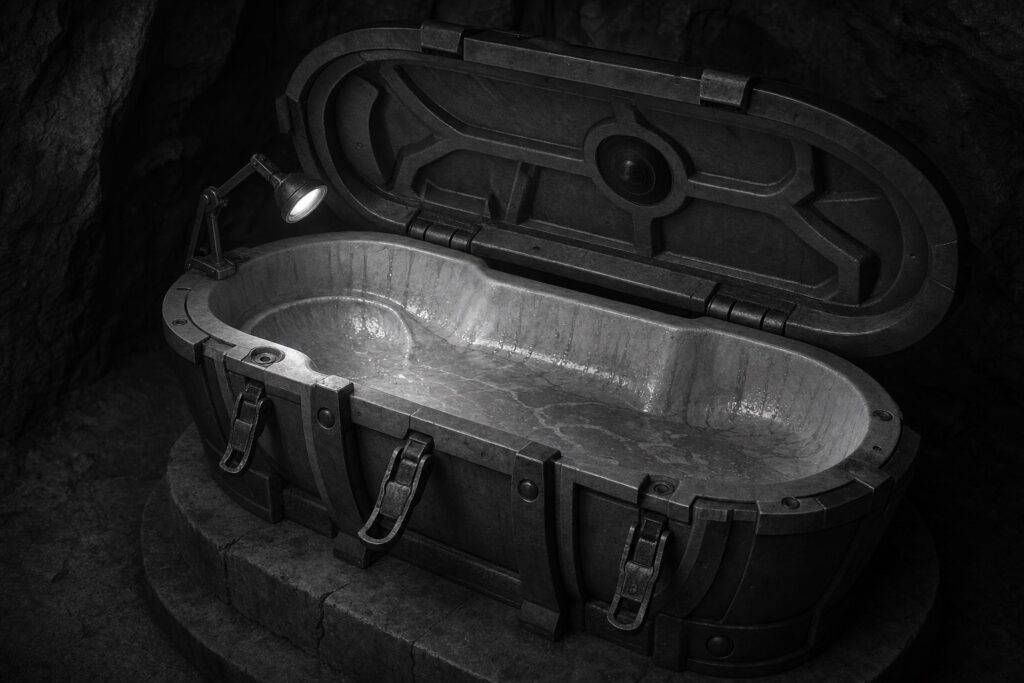
The sarcophagus smelled of cold oil and of something Brother-Techmarine Kael'dun had never been able to name — a metallic undertone, almost sweetish, that settled in the throat and stayed there long after one had left the room. Some of the younger brothers called it the smell of death. Kael'dun had never believed that. To him it was the smell of birth — only a birth that went differently from every other in the Imperium.
He stood alone in the chamber, deep beneath the surface of Kel-Vantor, and checked the connections of the life-sustaining core for the seventh time that hour. The readings glowed green. The fluid lines pulsed to the rhythm of an artificial heartbeat. Everything was ready.
Everything except himself.
His mechadendrite arms (four in all, two of them fitted with fine tools) moved with the practised precision of decades, while his own mind lingered somewhere else entirely: on an evening sixteen months ago, deep in the shafts beneath this same moon, when Kaelin Vosk had stood before him on his own legs for the last time.
When the time comes, Vosk had said then, his voice rough with exhaustion and something Kael'dun had not been able to read, I want it to be you who closes the last connection. No one else. You.
Kael'dun had said yes. One always says yes in such moments.
He had not believed then that it would actually come to that. Vosk was a veteran, tough as Kel-Vantor's own bedrock, a man who collected wounds the way other men collected honours. But the depths of this moon exacted their toll differently from open battlefields. What had happened down there — what Kael'dun had seen with his own eyes, what he had revisited since in his rare dreams — had broken something in Vosk's body that no Apothecarium art, however skilled, would ever entirely put back together.
The wounds had healed, as well as they could heal. But what lay beneath had spread slowly, unstoppably, like rust under fresh paint. Three weeks ago Apothecary Rennik had given his verdict: without the sarcophagus, Kaelin Vosk would die within a year. With it he would go on living — differently, changed forever, but living.
Vosk had not hesitated. That was what Kael'dun feared most: that his brother had said yes so quickly, as though he had only been waiting for permission.
"You are thinking too loudly," said a voice behind him.
Kael'dun did not turn round. He knew that voice, dry and honed by decades of binary song. "Magos Achtal. I did not hear you come."
"That is the purpose of my step dampeners," said Serevin Achtal, and stepped up beside him at the sarcophagus. The Magos was smaller than Kael'dun, his body beneath the red robe cybernetically altered to a degree that even Kael'dun could no longer precisely determine. His face — what of it was still flesh — wore an expression that imitated neutrality so perfectly that it almost looked like real peace. "The connections are flawless. I checked them myself three times before you entered the room."
"I know."
"And yet you check them an eighth time."
Kael'dun let his hand sink from the fluid line. "There are things, Magos, that one does not settle by checking. One checks them anyway. It is... a habit of the flesh."
Achtal regarded him with one of his two remaining organic eyes. "You speak as though the flesh were already something you had left behind. You still carry enough of it, Brother-Techmarine, to know that it does not shrug off so easily."
"That was not my question."
"You did not ask a question."
Kael'dun said nothing. The Magos was right, and that did not make it easier.
II. A Burden We Carry
Techmarine Vorr arrived three hours later, with the usual racket of a landing craft not built for the rough docking clamps of Kel-Vantor. From the reception platform Kael'dun watched the gold-grey ship of the Golden Wall, whose armour colours were so unlike the heavy iron-red of the Iron Veins, shove itself into the moorings with one last squealing jolt.
He knew Vorr only from reports and a single brief exchange of communication signals three years earlier, when the two Chapters had agreed on an arrangement that had by now become almost a tradition: mutual technical observation at particular rites, a quiet understanding between two Chapter families who respected one another without being especially close. In recent years the Golden Wall had developed a growing interest in pre-Imperial machine intelligences — an interest that, Kael'dun suspected, had not arisen entirely by chance after rumours spread about what had been found and destroyed beneath Kel-Vantor's Sixth Shaft.
Vorr stepped from the airlock, tall, with the characteristic red eye of a servo-arm throned above his right shoulder like a watchful bird. He bowed briefly, a greeting from technician to technician, less formal than religious.
"Brother-Techmarine Kael'dun. I thank you for the invitation."
"It was not entirely my idea," said Kael'dun honestly. "Chapter Master Vel'Ossa and Magos Achtal thought it appropriate to have an independent witness from an allied Chapter. The rites of interment require a legitimacy that reaches beyond one's own walls."
"A wise caution," said Vorr, as they walked through the corridors towards the hab-enclave. His mechanical steps echoed in a different rhythm from Kael'dun's, a fine, barely perceptible difference that nonetheless carried the whole distance between their two Chapters within it. "With us interment is rare. The Golden Wall regards the sarcophagus as a last resort, not as an honour one strives for."
Kael'dun stopped. "And with you — what is it then? If not honour?"
Vorr considered a moment before he answered. "A burden we carry when nothing else remains. A last service, not an ascent." He looked at Kael'dun directly. "With you it seems to be different. Your Chapter has, so they murmur, the highest proportion of Venerable in the entire Chapter family. One wonders why."
It was not a hostile question. But it struck something in Kael'dun all the same that he would rather have left untouched.
"We learned early that flesh is limited and the Imperium's need for it is not," he said, and the words felt learned by rote, like a litany he had recited too often to still need to believe in its truth. "A generation without replacements, shortly after our founding, taught us that we must preserve what can preserve us. With us the sarcophagus is no curse. It is a form of living on."
"So I have heard," said Vorr quietly. "I only wonder whether you believe it too, or whether you merely say it."
Kael'dun did not answer. The corridor led them onward in silence into the depths of the mountain.
III. What Tal'ir Cannot Say
He found Brother Tal'ir in the chapel, alone, kneeling before one of the heavy iron reliefs that depicted the fall of the first-born of the Iron Veins. Tal'ir had changed since that night in the Sixth Shaft — not visibly, not in a way one could have read off a medicae scan, but anyone who knew him saw it at once. He moved more carefully. He spoke more rarely. And sometimes, when he thought no one would notice, he stared for a long time at his own hands, as though checking whether they still belonged to him.
"You are here today," said Kael'dun, and sat down beside him.
"Where else should I be?" Tal'ir did not look up. "Kaelin goes into the sarcophagus today. I owe him more than a prayer, but a prayer is all I can still offer without lying."
"What do you mean by that?"
Now Tal'ir looked at him, and in his eyes lay something Kael'dun had not seen so clearly since the Sixth Shaft. "I mean that I cannot tell him it will go well for him. I do not know. I know only that machines sometimes carry things within them that one does not see until it is too late." His voice sank almost to a whisper. "I felt something old try to gain a foothold in me, Kael'dun. Only for a moment. Only for a single heartbeat. But I felt it, and I will never be able to forget it again."
"That was the First Warden," said Kael'dun carefully. "He is destroyed. Finally."
"I know what we were told." Tal'ir shook his head slowly. "I am not saying I believe the same awaits Kaelin. I am only saying that since that night I am no longer certain what 'destroyed' means in relation to something that was never entirely alive."
Kael'dun was silent. He had never spoken to anyone about it — not really, not honestly — but Tal'ir's words struck something he had been carrying around himself for weeks like a stone in the chest.
The sarcophagi in which they bedded their brothers were not created out of nothing. Their alloys, their neural connection lattices, even some of the ancient binary core programs that accompanied the transition between flesh and machine — all of that derived to a certain degree from materials recovered out of the depths of Kel-Vantor. Materials from shafts that had lain untouched for millennia before the First Warden was found and destroyed there.
The sarcophagus in which Kaelin Vosk would rest tonight contained fourteen per cent components originating from those depths. Kael'dun had calculated that figure himself, on a night he would rather have forgotten, and he had told it to no one. Not the Chapter Master. Not Achtal. No one.
He had convinced himself that it made no difference. The alloys had been tested, purified, blessed several times over by the priests of the Omnissiah. There was no technical reason for concern.
But concern had never been a question of technology.
"I will be at the ceremony," Tal'ir said at last. "I owe him that. But I cannot tell you that I am not afraid."
"Neither can I," said Kael'dun, and it was the most honest thing he had said in weeks.
IV. The Chamber of the First Silence
The Chamber of the First Silence lay deeper than any other hall beneath Kel-Vantor's surface — deeper even than the workshops in which the sarcophagi were made, deeper than the archives in which the names of all past Venerable of the Iron Veins stood chiselled in ceramite. It had been built so deep because the rites of interment demanded silence — not only acoustic silence, but that deeper silence in which a man ceases to be a man and has not yet begun to become something else.
Chapter Master Harn Vel'Ossa was already standing at the threshold when Kael'dun arrived with Vosk. The Chapter Master wore his full ceremonial armour, the iron-red of the Iron Veins muted in the weak bioluminescent light of the walls, his face a mask of calm that, as Kael'dun knew, had taken many years to appear so effortless.
"Brother Kaelin Vosk," said Vel'Ossa, and his voice filled the room with an authority that needed no increase in volume. "You step before the sarcophagus today not as one condemned, but as one who has chosen to serve on when the flesh itself no longer has the strength for it. Do you doubt this choice?"
"No, Chapter Master," said Vosk. His voice was firm, but Kael'dun, standing beside him, felt the faint tremor in his shoulder that no power armour could entirely conceal.
"Then enter."
The sarcophagus waited at the centre of the chamber, opened like a metal blossom, surrounded by the tools and reagents that Achtal and his adepts had arranged in hours of preparation. Chaplain Kaltas Vehn, the Chaplain of the Iron Veins, already stood in his place at the sarcophagus's right, a Dreadnought skull reliquary in his hands, its empty eye sockets flickering in the torchlight.
Vehn began the litany — not the Litany of Wrath, which Venerable Gorrath had known for sixty years as his only remaining word, but another, older one: the Litany of the Second Breath, spoken only at the first interment of a brother, never at the renewal of one already Venerable.
"Hear, Omnissiah, the last breath of the flesh," Vehn spoke, his voice deep and rhythmic as a piston stroke. "Take it not as loss, but as seed. What dies, dies not into oblivion, but into transformation. The flesh ends. The will remains. The heart falls silent. The wrath awakens."
Kael'dun stepped to his place at the head of the sarcophagus, where the neural connections waited. His hands — both sets, organic and mechanical — moved with the calm he had practised over decades, but his mind was anything but calm.
Venerable Gorrath stood at the edge of the chamber, motionless, a tower of ceramite and old wrath, his sarcophagus window giving off a faint red glow. For sixty years he had spoken no other word than the Litany of Wrath, again and again, a mantra the brothers of the Iron Veins had long since heard not as a warning but as a kind of comfort — proof that even what seemed lost still served, still fought, still existed somewhere beneath.
Kael'dun looked across at Gorrath and wondered how often the old Venerable had himself stood in this place to greet a new brother. Wondered whether anything of the Marine Gorrath had once been had ever still been present at those times, or whether he had been from the beginning only an echo wearing the shape of duty.
"Are you ready, brother?" asked Kael'dun quietly, meant for Vosk alone.
Vosk looked at him. In this last moment, before the tools began their work, he was still entirely himself — the lines around his eyes, the scar over his left brow, the small, crooked smile he always showed when he was afraid and did not want to show it.
"I am ready," he said. Then, more quietly, for Kael'dun alone: "Little brother — if at the other end I am no longer the same man who enters here —"
"You will be," Kael'dun interrupted, although he himself did not know whether he believed it.
"— if not," Vosk insisted, "then promise me you will not treat me as though I were merely a machine carrying your brother. Treat me as though I were still me. Even when it is no longer true."
Kael'dun could not answer. His throat had grown too tight. He only nodded, once, hard.
"Begin," said Chapter Master Vel'Ossa.
V. Ninety-Five Per Cent
What followed happened in layers — layers of sound, of light, of something Kael'dun could not describe in the words of his mother tongue, although he had read the process a thousand times in the Chapter's manuals.
First came the anaesthesia, deep and complete, while Achtal's adepts set the first connections. Vosk's body — what was left of it after the years of slow decay his wounds from the Sixth Shaft had wrought — was laid carefully, almost tenderly, into the recess of the sarcophagus. Kael'dun watched the clamps close, watched the first needles of the neural link sink into the base of Vosk's skull, where the Techmarine himself had worked for months to prepare the connection points precisely enough for a Marine with Vosk's specific genetic signature.
"Neural coherence at ninety-five per cent," reported Achtal, his voice now wholly instrument, every emotion stripped away for the duration of the rite. "Heart rate stabilised. Beginning extraction."
That was the moment Kael'dun feared most — not because of the technical risks, which were real but manageable, but because of what he had to watch while it happened. Extraction was not a clean, clinical procedure, as the manuals suggested. It was the slow, careful separation of a man from his own body, a process in which consciousness — anaesthetised but not entirely extinguished — was severed piece by piece from its flesh and transferred into the waiting systems of the sarcophagus.
Vosk's face, which Kael'dun could still see before the last covering plates closed, twitched once, an expression that was neither pain nor fear but something in between — the recognition of a man who felt the boundaries of his own self beginning to shift.
"Stay with me," Kael'dun whispered, though he knew Vosk could no longer hear him in that state. "Stay with me, Kaelin."
The readings flickered. For one single, terrible moment neural coherence sank to thirty-one per cent, and Kael'dun felt his own heart skip a beat.
"What is happening?" asked Vel'Ossa sharply.
"Normal fluctuation," said Achtal, but even his calibrated voice carried a tiny crack of tension. "The consciousness is searching for anchor points in the new architecture. This occurs at every interment."
Kael'dun stared at the readings, and in his head the numbers turned that he had calculated weeks ago and told to no one. Fourteen per cent. Fourteen per cent of the components of which this sarcophagus consisted came from the depths in which something ancient and alien had almost destroyed a generation of brothers before it was finally erased.
Finally, they had been told. Finally destroyed.
But what if finality bore a different meaning for something that had never been entirely alive than it did for a man?
The coherence rose again — thirty-seven per cent, forty-four, fifty-six. Kael'dun forced himself to calm, forced his hands to go on working precisely, while his mind swung between hope and a fear he could not have spoken aloud even to himself.
Venerable Gorrath, at the edge of the chamber, began to hum quietly — not the Litany of Wrath this time, but something else, deeper, almost melodic, a sound Kael'dun had never heard from the old Dreadnought before.
"What is he doing?" asked Vorr quietly, who had stood silently at the edge of the chamber the whole time, watching.
"I do not know," Kael'dun admitted. "I have never heard that before."
Chaplain Vehn, who was continuing the litany, threw a brief glance towards Gorrath, and for a moment Kael'dun saw something in Vehn's face he could not interpret — not fear, but not indifference either. Something in between. Something a man carries who believes but is no longer certain in what exactly.
The procedure lasted three more hours.
At the end — when the neural coherence held stable at ninety-one per cent, when the last organic remains of what had once been Kaelin Vosk's body were respectfully transferred into the containers provided for them, when the massive ceramite plates of the new Dreadnought chassis closed with one last, deep click — Kael'dun stood on trembling knees before what had once been his brother and was now to become something else.
"First activation in three hours," said Achtal. "The machine spirit must first synchronise with the new systems before Brother Vosk regains consciousness. This is the usual course."
"And if it does not synchronise?" asked Kael'dun.
Achtal looked at him, and in his one remaining organic eye lay something that almost resembled compassion. "Then we will know in three hours, Brother-Techmarine. Before that there is no answer I could give you that would not be mere conjecture."
VI. Fourteen Per Cent
The three hours stretched like molten metal.
Kael'dun could not sleep — not that sleep had ever been a simple undertaking for him anyway, with half the systems of his body never entirely coming to rest — but this time it was different. He walked the corridors of Kel-Vantor, past the workshops where the next sarcophagi were already under construction, past the archives where the names of the fallen and the transformed stood.
He stopped before the plaque bearing Brother Yssen's name — fallen in the Sixth Shaft, his body too destroyed for any form of interment, his memory preserved only in ceramite and recollection. Beside it Enginseer Corvic Amsel's name, a man Kael'dun had barely known but respected.
And somewhere, in a chamber no one entered any more, lay the remains of Venerable Sorvain, who had chosen to die finally rather than risk something else laying claim to his shell.
Kael'dun had never entirely understood that choice — not until today, not until this moment in which he knew what it felt like to send a brother into exactly that uncertainty.
"You are blaming yourself," said a voice behind him. Vorr.
"Is it that obvious?"
"To someone who works with machine spirits himself — yes." Vorr stepped up beside him, regarded the same plaque. "With us, in the Golden Wall, there is a saying. Techmarine Vorr had once learned it from a Librarian: every machine carries the weight of what was placed into it. The unspoken as well."
Kael'dun looked at him sharply. "What are you implying?"
"Nothing," said Vorr calmly. "I merely observe that since my arrival you have been carrying something you communicate to no one. I am not a member of your Chapter, Brother-Techmarine. I am not here to judge you. But I am trained to read machines — and men are, with all respect, not so different from machines as they believe."
Kael'dun was silent for a long time. Then, almost against his own will, he said it — for the first time aloud, for the first time at all outside his own head: "Fourteen per cent of the components in Kaelin Vosk's sarcophagus come from the Sixth Shaft. From the sections in which the First Warden was found and destroyed."
Vorr said nothing. He waited.
"I told no one," Kael'dun went on, and the words came faster now, as though a dam had given way. "The materials were tested, blessed, declared pure. There was no technical reason not to use them — the shortage of raw materials on Kel-Vantor makes every recovered alloy valuable, and no one but me knew exactly from which depths this specific batch came. I could have said something. I could have asked for other components, even if it had meant weeks of delay. But Kaelin did not have much time left, and I..." He faltered.
"And you wanted to believe that it made no difference," Vorr finished the sentence.
"Yes."
"Perhaps it really does make no difference," said Vorr. "Matter is matter, Brother-Techmarine. A metal carries no memory, no intent, no will — that is superstition, not technology. Whatever was found in that shaft, it was a machine intelligence, not a daemon. It was destroyed. Its physical substance is now nothing more than raw material."
"That is what I tell myself too," Kael'dun admitted. "But I no longer entirely believe it. Not since I saw what it did to Tal'ir, through mere contact. Not since I saw how it made Sorvain rather die than let himself be taken by it."
Vorr was silent for a long while. When he finally spoke, his voice was quieter, almost gentle. "Then let me tell you something my own master once told me, when I was young and carried exactly this kind of doubt. The Omnissiah does not demand that we have no fear. He demands that we go on working in spite of the fear, with open eyes, with honest examination, with the courage to admit errors when they are discovered. What you did was perhaps an error. But to conceal it while you stand here eating yourself alive — that would be the real betrayal of your brother."
"What am I supposed to do now? The rite is complete. There is no way back."
"No," Vorr agreed. "But there is a way forward that is honest, and one that is not. Tell your Chapter Master. Not tonight — tonight Kaelin Vosk needs your full attention, not a confession. But soon. And watch your brother in the coming weeks with the eyes of a technician, not only with those of a friend. If something is wrong, you will recognise it sooner than anyone else here."
Kael'dun nodded slowly. It was no comfort, not really. But it was honest, and in that moment honesty was worth more than comfort.
VII. They Are Coming for the Forge
The alarm sounded before the three hours had passed.
It began as a deep, pulsing drone that echoed through the stone walls of Kel-Vantor, followed by the sharper, more urgent tone sequence of the attack alarm. Kael'dun felt his heart skip a beat, for an entirely different reason than before.
"What is that?" he asked, though he already recognised the answer in the rhythm of the alarm.
"Orbital contacts," reported a metallic voice from the nearest vox terminal. "Multiple small ships, non-Imperial signature, breaking through the outer sensor line. Xenos class. Confirmed: Ork."
Vorr was already moving, his servo-arm rising as he activated his own vox unit. "How many?"
"Unclear. At least a dozen smaller landing craft. Possibly a kroozer in the outer system."
A straggler rok commander, thought Kael'dun. Or a Nob trying to make a name for himself by finding a soft target. He had read the reports — everyone on Kel-Vantor had read them — of how, more than a year ago, a massive Waaagh under a boss named Zagdakka had crossed the outer Aschtor system, before a coalition of Imperial forces, including elements of the Iron Veins themselves, had shattered it in a bloody campaign lasting months. The Waaagh had been broken — but broken, with Orks, seldom meant annihilated. It meant scattered, furious, and looking for spoils to restore their own honour.
"They are coming for the forge," said Achtal, who had stepped out of the Chamber of the First Silence, his face now a mask of calculated urgency. "Kel-Vantor's workshops are known. For an Ork Nob who wants to restore his own reputation, an attack on a Mechanicus forge would be exactly the kind of deed that draws attention."
Chapter Master Vel'Ossa stepped out of the chamber, already armoured for battle, his voice a drum of authority. "All available brothers to the defensive positions. Techmarine Vorr, your presence as a guest obliges you to nothing, but if you wish to fight, you are welcome."
"I will fight," said Vorr without hesitation.
Kael'dun looked back to the Chamber of the First Silence, where behind the massive doors the new sarcophagus rested, where Kaelin Vosk hovered somewhere between death and a new life, unaware of the danger gathering above them.
"And the sarcophagus?" he asked.
"It remains protected down here," said Achtal. "Nothing can reach this depth in the next few hours — unless the outer defensive lines fall entirely. Your task, Brother-Techmarine, is to ensure that they do not."
VIII. For the Workshop
The battle for Kel-Vantor's outer workshops began with the crash of bursting landing pods and ended — at least in its first phase — in a chaotic, bloody melee between the Skitarii defenders of the Mechanicus cohort and the first wave of green, bellowing attackers.
Kael'dun fought at Vorr's side in one of the outer access tunnels. The Orks here were smaller than typical boyz, evidently a fast raiding formation, specialised in plunder rather than open field battles, trying to force a way through the defensive lines. The noise was deafening: the shriek of chain weapons, the growl of bolters, the raw, guttural war cries of the Orks, who found joy in destruction even in the face of certain death.
"To your right!" shouted Vorr, his chainsword driving through the crude armour of an Ork Nob who had tried to push past Kael'dun's unguarded flank.
Kael'dun spun round, his own bolter flashing as he cut down two more attackers with precise shots. His mind was strangely clear in that moment — the pure, immediate clarity of combat, in which there was no room for doubt or guilt, only for the next threat, the next shot, the next survival.
"How many more?" he asked over the vox.
"Second wave incoming," reported a Skitarii Alpha voice, tinny and urgent. "Larger formation. A Nob is leading them — signature suggests an experienced leader."
The Nob they would later identify as Skarnok Krumpfist broke through the outer line with the force of a battering ram, his armour made of welded scrap plates and captured Imperial trophies. He bellowed something in his own crude tongue that sounded like a challenge, and three of his largest boyz followed him into the tunnel.
"Fall back to the second defensive line!" ordered Vel'Ossa over the general vox. "We must not leave the access to the Chamber of the First Silence open."
Kael'dun felt a cold stab of fear — not for himself, but for what rested deep beneath them. If these Orks pushed deeper, if they found the way to the chamber while Kaelin Vosk still lay in the most fragile phase of his transformation...
"We hold here," he said to Vorr, with a determination that surprised even him. "They go no further."
The fight that followed was chaotic and brutal in a way no litany could ever entirely capture. Kael'dun fought with all four arms — two with firearms, two with the improvised blades of his servo-arms — while Vorr at his side fought with the methodical precision of a man who commanded technology and violence in equal measure.
Skarnok Krumpfist finally reached Kael'dun himself, his massive axe — forged from the wreck of an Imperial ground vehicle — coming down with a force that could be felt even through Kael'dun's servo-reinforced armour. He parried, his Techmarine arm groaning under the impact, and for a long, dangerous moment they stood blade against axe, eye against eye, while the battle raged around them.
"For the workshop!" Kael'dun bellowed — no war cry he had ever used before, but something that rose out of deeper layers of his being, out of the pure, unruly refusal to allow this creature to push further into the depths of Kel-Vantor, where his brother lay in uncertainty.
With one last, desperate surge of strength he forced the Nob back, his chainblade found a gap in the crudely welded armour, and with a single, brutal thrust he ended the fight.
Skarnok Krumpfist fell, and with him the last organised resistance of his raiding party collapsed.
It took another hour before the last scattered Ork attackers were either killed or driven back into the expanses of Kel-Vantor's surface, where the Skitarii vanguard ground them down with cold, methodical efficiency. Kael'dun returned, blood-smeared and exhausted, to the Chamber of the First Silence, where the three hours since Vosk's interment had long since passed.
IX. I Am Still Here
Achtal was waiting at the door, his face — what Kael'dun could read of it — tense.
"The activation is overdue," said the Magos. "Twelve minutes. I waited, in the hope that you would return in time."
Kael'dun's heart beat hard against his ribs. "Why did you wait?"
"Because Brother Vosk had asked that it be you who closes the last connection," said Achtal simply. "And because I believe that in this particular case it is important that someone with full knowledge of the circumstances be present at the first activation. You know yourself what you communicated to me before the attack began, Brother-Techmarine."
Kael'dun froze. "You know."
"Techmarine Vorr told me during the fight, in a moment of quiet between two waves of attack. He considered it important enough to take the risk of breaking your confidence." Achtal's voice carried no reproach. "He was right to. I should have known before the rite began."
"I am sorry," said Kael'dun, and the words felt inadequate for the weight of what he carried.
"We will discuss that later," said Achtal. "Right now your brother matters more than your guilt. Come."
They entered the chamber together. The sarcophagus stood upright now, no longer a recumbent core but the full, imposing form of a Dreadnought, massive and still, its outer shell still unpainted, the raw grey of fresh ceramite shimmering in the weak light. The readings at its base pulsed in an irregular rhythm that made Kael'dun's heart contract.
"Neural coherence at eighty-three per cent," reported one of Achtal's adepts. "Fluctuating. The machine spirit is struggling with synchronisation."
"Why now?" asked Kael'dun. "Why not during the extraction?"
"I suspect," said Achtal slowly, "that the shocks of the attack — the vibrational disturbance from the nearby explosions — disrupted the process. Not catastrophically, but enough to trigger a second crisis."
Kael'dun stepped before the sarcophagus, his hands trembling despite all the years of discipline. "Kaelin? Can you hear me?"
For a long, terrible moment nothing happened.
Then, slowly, the sensor lenses of the Dreadnought began to glow — a deep, dark red that slowly brightened until it reached the colour of fresh blood on ceramite.
"Kael... dun?" The voice that came from the vox grilles of the chassis was strange and familiar at once — distorted by the mechanical transmission, but with a rhythm, a cadence, that Kael'dun recognised immediately.
"I am here," said Kael'dun, his voice breaking. "I am here, Kaelin."
The massive form moved, uncertainly, like a child venturing its first steps in an entirely new body. An arm lifted, the servo-claw opening and closing, as though it first had to comprehend the new anatomy.
"It is... different," said the voice, and in its mechanical distortion there lay something Kael'dun recognised as confusion, as the honest struggle of a mind trying to find itself again in an entirely alien form. "I feel... too much. And not enough. Both at once."
"That is normal," said Achtal gently, with a warmth Kael'dun had rarely heard from him. "The transition takes time, Brother Vosk. Weeks, sometimes months, until the new perception fully stabilises."
The sensor lenses turned, searching, until they rested on Kael'dun. For a long moment the form said nothing, and Kael'dun felt the old fear rise in him again — the fear that what stood before him was no longer Kaelin Vosk but only a shell carrying his memories like an actor wearing a borrowed costume.
Then the voice spoke again, and this time there was a trace of something in it that sounded almost like a smile, however impossible that might be in that mechanical distortion.
"You look terrible, little brother. Have you been in a brawl?"
Kael'dun laughed — a broken, tear-filled laugh he could not have held back even if he had wanted to. "A few Orks tried to disrupt your welcome party."
"And of course you dealt with them alone, without waiting for me."
"I had some help."
The Dreadnought form moved slowly, still uncertain, but with growing control, until the massive hand — carefully, with a tenderness one would not have credited such strength — laid itself on Kael'dun's shoulder.
"I am still here," said Vosk, and this time there was no distortion left in the voice, only the clear, calm certainty of a man who knew who he was. "Changed. But here."
X. Welcome
Kael'dun stayed with him into the early hours of the morning, while Achtal's adepts made the last calibrations and Chapter Master Vel'Ossa came personally to greet his newest Venerable. Venerable Gorrath stood silently at the edge of the chamber the whole time, his red sarcophagus window trained on the new brother, and when Vosk finally attempted a few uncertain steps, it was Gorrath who — for the first time in sixty years, in which no one had ever heard him speak anything but the Litany of Wrath — spoke up with a single, rumbled word.
"Welcome."
The whole chamber froze. Vehn, the Chaplain, almost dropped the reliquary he was still carrying. Even Achtal, whose face had perfected neutrality for so long, could not entirely suppress an expression of genuine astonishment.
Vosk turned slowly to the old Venerable. "Sixty years," he said quietly. "You waited sixty years to say that?"
Gorrath's sensor lenses flickered, almost like a nod. "Not waited. Forgotten. Until now."
He said nothing further. But in the days that followed, when Kael'dun visited the chamber of the Venerable to monitor Vosk's progress, he often saw the two Dreadnoughts standing side by side — the old and the new, tower beside tower, in a silence that needed no more words.
The report Kael'dun finally submitted to Chapter Master Vel'Ossa — about the fourteen per cent of recovered materials, about his silence, about the fear that had accompanied him for weeks — was received with neither anger nor complete forgiveness.
"You made a mistake," said Vel'Ossa, in his private study, weeks after the battle. "Not in the technical execution — Achtal's tests confirm that the materials are indeed pure, as pure as blessing and science can guarantee. Your mistake lay in taking your silence for protection, when in truth it was only a load you wanted to carry alone."
"I did not want to burden anyone else with the responsibility," said Kael'dun.
"No," said Vel'Ossa, not unkindly, but with the clarity of a man who had conducted many such conversations in his long service. "You did not want to risk someone making the choice you would not have wanted to make yourself — the decision to let Kaelin wait longer while purer materials were sought, with the risk that he would not survive the wait. That is not guilt, Brother-Techmarine. That is a burden borne by everyone who has the power to decide over another's life, and who sometimes bears it wrongly, because there is no truly right way to bear it."
Kael'dun lowered his head. "What do you command?"
"Nothing," said Vel'Ossa. "I only ask you not to carry it alone next time. Not because I do not trust you — but because no brother of the Iron Veins should ever carry alone what concerns us all."
Kaelin Vosk fought for the first time three months later, in a small skirmish against scattered pirates at the edge of the Aschtor system — an insignificant battle in the great chronicles of the Imperium, but for Kael'dun, watching from the command bridge as his brother's massive form ploughed through the enemy lines, it was anything but insignificant.
Vosk fought with the same ferocity he had carried as a man, but also with a new, calmer precision that only the sarcophagus could have given him. And when the battle was over, when he tramped back to the landing site, his massive ceramite plates blackened with smoke and blood, it was his first word over the vox that stayed with Kael'dun most.
"Little brother — did you see how I threw that pirate captain through the air? Tell me you saw it."
Kael'dun laughed, and this time it was a laugh without tears. "I saw it, Kaelin. I saw it."
There were moments, in the years that followed, when Kael'dun wondered whether something had been lost that night in the Chamber of the First Silence — a warmth, a spark he could not precisely name, but whose absence he sometimes felt, like a note missing from a familiar melody. Vosk laughed more rarely now, though not because he lacked the joy, but because his new body expressed laughter differently — deeper, more rarely, but no less genuine.
It was no pure victory, this transformation, but, like so much in the service of the Imperium, a bargain — flesh for endurance, warmth for strength, one life for another, longer, harder one. Kael'dun had learned that there was no sense in searching for the pure, unaltered return of what had once been. There was only what remained, and the decision to honour it, even when it looked different, sounded different, was different.
The fire of the Iron Veins, as Chaplain Vehn had once put it in a sermon, was not the fire that burned unchanged. It was the fire that changed its form without going out — from flesh to metal, from a heartbeat to a mechanical pulse, always burning on, even when no one could say any longer whether it was still the same flame that had once been kindled.
Kael'dun had come to believe that the question itself was the wrong one. It made no difference whether it was the same flame.
It made a difference only that it still burned.
Download story as PDF or EPUB
Enter your email address. After confirming your subscription you'll get the download links immediately and by email.