What the Silence Keeps
A Tale of the Iron Veins
The Iron Veins
"What is silent can no longer lie. What no longer lies serves pure."
Litanei der Aussonderung, Kel-Vantor, Urheber unbekannt
I. Statute 7 of the Purity Doctrine
The tech-priest who read out her sentence did not once, in the whole hearing, lift his gaze from his data-wafer.
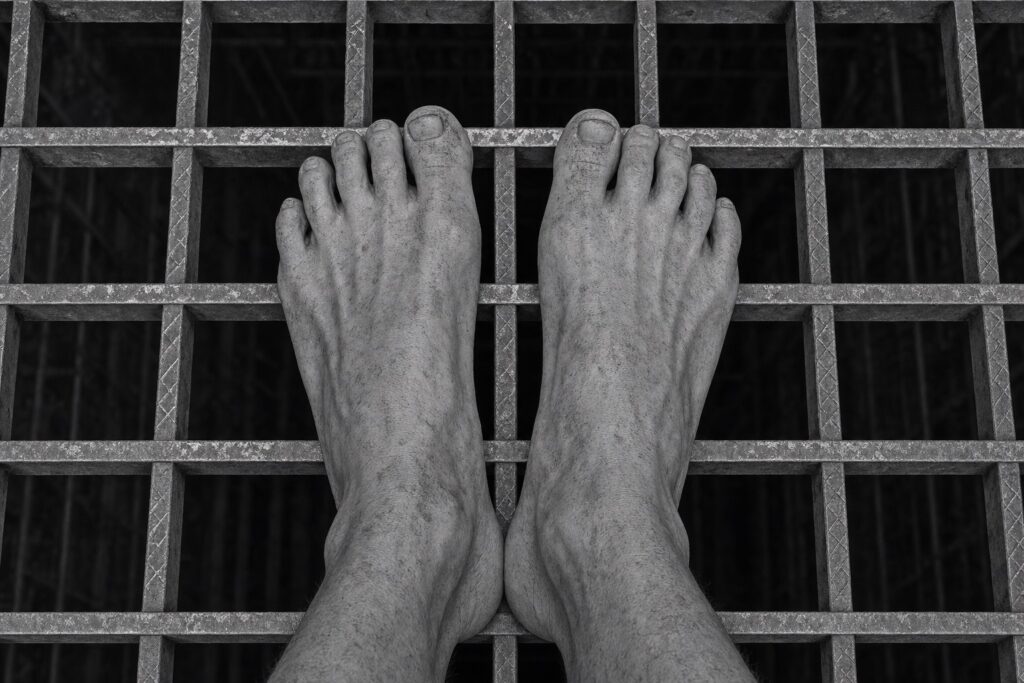
Reva Kastell stood barefoot on the cold grating of an assessment gantry, deep in the bowels of Kel-Vantor, where the air tasted of oil and molten metal and somewhere beneath her feet a generator breathed in its ever-same rhythm. Sixteen days since the Sixth Shaft. Sixteen days in which they had held her in a windowless cell, taken her blood, her saliva, the fluid from her spinal cord, and treated all of it with the same courteous indifference with which they were now discussing her life.
"Contamination confirmed," said the tech-priest. His voice was a dry rustle, hardly louder than the rustle of the wafer itself. "Cognitive resonance patterns consistent with documented Silica Animus emission, class secondary. Subject was exposed for an unprotected period of an estimated forty seconds within the direct reception field of the entity known as the First Warden."
Forty seconds. Reva had tried often enough to count them. She never got past twenty before the memory fell apart again into smoke and screaming.
"Under Statute 7 of the Purity Doctrine, restoration of the subject to regular service is excluded." The tech-priest turned a page, although there was nothing to turn — a gesture he had presumably picked up from a human at some point and never unlearned. "Recommendation: Rite of Severance. Execution in four days, Severance Hall Nine."
Only now did a second figure look up from his own wafer. Magos Serevin Achtal, half of whose face was still flesh and whose other half was a quietly blinking field of lenses and copper filigree, regarded Reva with something that was not pity, but was not cruelty either. It was simply this: interest in a completed equation.
"You understand the logic?" asked the Magos. It was not a rhetorical question. An answer was genuinely expected, the way one expects a machine to confirm an input before executing it.
Reva could have lied. Could have said yes, she understood, and the matter would have been over faster. Instead she heard herself say: "I pulled him out. The Initiate. Brother Tal'ir. I pulled him out of the rubble while —" Her voice did not break, which surprised her. "While Enginseer Amsel held the door."
"That is known and noted in the record," said Achtal, without warmth, but also without denying it to her. "It changes nothing about the contamination."
"Brother Tal'ir was in the field just as long."
"Brother Tal'ir is Astartes." The Magos said it the way one quotes a law of nature. "His physiology, his gene-seed value, his Chapter's investment in his existence — all of that shifts the calculation. He will be observed, not severed. This is not a question of justice, Kastell. It is a question of the value of the variables."
He did not even say it cruelly. That was the worst of it.
"And the other four?" asked Reva. She had seen them on the way here, through a barred window, hardly more than shadows in a queue — miners, wardens, a child who looked barely older than fourteen standard years. "Were they in the Sixth Shaft too?"
"Two of them." The tech-priest went on turning pages through nothing. "The others were exposed secondarily during the recovery of Venerable Sorvain's wreck. Resonance patterns of a lower order, but above the tolerance threshold."
"Sorvain destroyed himself so as not to be taken by the First Warden." Reva heard her own voice grow louder, and let it. "He was honoured for it. A vigil, a litany, a place in the Chamber of the First Silence. And the people who dragged his wreckage out of the shaft because no one else could — they are now punished for the same proximity to the same machine?"
"What the Chapter holds irreplaceable is honoured." Achtal looked at her, and for the first time there was something in his voice that was not anger but was not indifference either — something wearier. "No one is punished, Kastell. What is severed is that which carries a risk that can no longer be safely carried. I understand that the difference seems small to you. It is not, not to the priesthood. But I will not do you the courtesy of a lie and claim that it ought to feel just."
With that the hearing, if one wished to call it that, was over. They led her back to her cell, past the waiting queue, and this time she saw their faces more clearly — the child, who was not crying because it was evidently already too exhausted to cry; an old miner with a hand of vox-wire and clamps, who nodded to her as though sharing a fate that needed no more words.
II. The Sixth Shaft
Four days. They had given her four days, as though that were a mercy and not a bureaucratic remainder between two forms.
On the first night Reva lay on the bunk in her cell and tried to pray. She had been born on an agri world that no longer bore a name, not since her family had left it to hire themselves out to the Mechanicus cohort on Kel-Vantor — her mother as a forge worker, she herself, barely nine years old, as a runner in the archives. She knew the prayers of the Imperial Creed only in fragments, mixed up with the binary canticles that had been drilled into her since she was made apprentice to Enginseer Amsel. When she folded her hands now, a gibberish of both came out: Emperor, who watchest above the Golden Throne, blessed be the Motive Force in all metal, until she no longer knew whom she was actually speaking to, and stopped.
Amsel would have known what to say. Amsel had had the right litany for everything, had taught them to her as though he were teaching her to read — patient, strict, with that dry affection he would never have called by any other name. You ask too much, Kastell, he had often said, but he had never said it to silence her. He had said it because her questions amused him, in a way he scarcely permitted himself.
Two weeks before the collapse the Sixth Shaft had been only one more entry on Amsel's work list — a sealed pre-Imperial excavation deep beneath the Smelting Cathedral that had been avoided out of caution for generations, until a geological fault exposed it again and left the tech-priests no choice. Reva remembered the smell before she remembered anything else — cold stone, ancient dust, and beneath it, barely perceptible, something that smelled of hot metal, although nothing down there was hot.
She had followed Amsel, as she had followed him for six years, a tool case in one hand, a vox-wafer in the other, while he swept the walls with his auspex and murmured canticles in that dry, half-sung way of his that no one but her ever really heard. The Iron Veins had provided a small escort, as the pact between Kel-Vantor and Aschgrat required whenever the Mechanicus cohort dug in dangerous ground — a sergeant whose name she never learned, and a young Initiate, barely grown out of the scarification rites, who introduced himself when he helped her out of politeness to right a toppled crate.
"Tal'ir," he had said, with a smile that did not yet quite match the hard, tattooed expression he had been trained into. "They say I ask too much for an Initiate."
"Then we are well matched," she had answered, and for one brief, unburdened moment the Sixth Shaft had been just another working day.
The moment did not last. Three levels lower, behind a door of black, never-oxidised metal, Amsel's auspex found something that set its readings flickering and left him silent for a long moment — a silence Reva had never heard from him in six years. Then the door opened by itself, soundlessly, as though it had only been waiting for them, and behind it lay a chamber older than any word the Imperium had ever had for "old".
It did not speak with a voice. It spoke with what lay between thoughts — a pressure, a pull that felt like a hand reaching gently for the back of her skull. You dig in me like worms in the flesh of a sleeper, formed itself in her head without anyone having said it aloud. Stay. Stay, and I will show you what truly waits beneath the iron, what is older than your Omnissiah and more patient than your Emperor.
Tal'ir was the first to react — not with fear, but with the practised aggression of his Chapter, bolter raised, a shout to his sergeant, who was already bellowing something into the vox behind them that sounded like an order to withdraw. The chamber itself seemed to resist it: walls that were no longer walls but something that moved like congealed oil, a tremor that went deeper than any earthquake Reva had ever felt. A falling block of debris struck Tal'ir from the side, threw him against a ledge, left him with a gaping wound at the rim of his helmet, half unconscious, his bolter out of reach.
"Kastell!" Amsel's voice, sharp, unyielding, the first time in six years that he had not called her by her full name. He seized her by the collar, tore her away from the black door, towards the Initiate. "Pull him out. Now."
"And you?"
"I will hold the arch." He said it the way he said everything — as though it were the most reasonable thing in the world, no time for objection, no time for what they both knew and neither of them spoke. He braced himself against the collapsing arch of the access tunnel, his whole lean body, bent by decades at the auspex, against a weight that would crush him in seconds, and began, in a firm, unwavering voice, to sing a binary cantus that sounded wrong, deliberately wrong, to the melody he had had as a child, before the priesthood drove it out of him.
Reva took Tal'ir under the arms — he was heavier than a human being should ever have been, even for arms schooled by workshop duty — and dragged him through the narrow, closing gap, while behind her stone crashed on stone and Amsel's voice broke off in the middle of the cantus.
She never heard the last three notes. Sometimes, in the sixteen days that followed, she tried to sing them to herself, hoping her mind might supply the missing melody. It never worked.
Sometimes she thought: at least it did not get him. And sometimes she thought: then what was the point of my staying alive, if they are going to take from me everything he taught me anyway?
To that question she found no answer that did not hurt.
III. Four Days
On the second day she and the four other condemned were let for an hour into a common yard — a windowless inner room with a single barred air shaft through which a weak, artificial light fell. They called it "permitting movement"; no one explained what their bodies were still supposed to move for.
The old miner with the clamp hand sat down beside her without asking whether she wanted company. His name was Orven, he said, forty-three years in the cohort's service, the last twelve of them in the lower galleries, where the Venerable of the Iron Veins were brought for their vigil after combat deployments.
"I helped dig out Sorvain's wreck," he said, without Reva having asked, as though he had to tell someone while he was still the one doing the telling. "Seventy-two hours. We pulled his sarcophagus out of the rubble with bare hands, because the servo-grabs would have been too crude. They gave us an extra ration of amasec for it." He laughed, a dry, short sound with no joy in it. "And now I sit here because my hands were too close to what melted his sarcophagus."
"Are you afraid?" asked Reva, and regretted the question as soon as she had asked it — too direct, too raw for a man still trying to walk through his last days with dignity.
Orven thought about it for a long time, his clamp hand slowly opening and closing, a sound like a quiet, steady ticking. "I was afraid when they first locked me in that cell. Now —" He looked up at the weak light in the air shaft. "Now I am mostly tired, girl. Forty-three years in which I knew every day exactly who I was and whom I served. Perhaps it is not such a bad thing if at the end somebody else decides that it was enough."
It was not comfort he was offering her. It was worse and more honest than comfort: the quiet possibility that exhaustion could at some point look like a kind of peace, even without one having chosen it.
The child, a girl who introduced herself only as "Dessa" and whose offence had consisted of carrying water for the digging parties to the Sixth Shaft during the recovery, did not speak a single word the whole hour. She sat with her knees drawn up in the corner of the yard and stared at her own hands, as though she might find there something the others were not willing to tell her. When the warden called them back to their cells, Reva stood up and, without thinking, laid a hand briefly on Dessa's shoulder. The child did not look up. But she did not flinch either, and to Reva, in those days, that was almost a prayer.
IV. What Remains Lossless
On the third day they brought her food she did not touch, and word that a visitor had been permitted to see her. She expected no one. She had no one left who could be permitted.
It was Techmarine Kael'dun.
He had to stoop to come through the cell door, and even then he filled the room in a way that had nothing to do with his size. Onyx-black skin, run through with scars that in the weak light looked like etched circuitry; the heavy, dark green shoulder plates of his armour — the inherited green of the Salamanders, under a patina of Kel-Vantor copper and the dull grey of the gunmetal the Iron Veins had made their own. He wore no helmet. His eyes, when they fell on her, were not the eyes of a judge.
"Kastell." He said her name as though making sure he still pronounced it correctly, although she had certainly encountered him before, in the chaos of the shaft, briefly enough that she was not sure he remembered at all.
"Techmarine." She tried to stand, but her knees did not properly obey. He raised a hand: stay seated. She obeyed, grateful for the permission not to have to try.
He sat down opposite her on the edge of the second bunk, which made the cell seem smaller still. For a long while he said nothing. Then: "I have read the sentence."
"Then you know there is nothing to discuss."
"I know that by the doctrine there is nothing to discuss." His voice was rough, deep, but not unkind. "I am not here to change it. I have no authority to, and even if I had — Kel-Vantor is Mechanicus ground. The priesthood judges its own servants, not a Chapter that is a guest here. That was the pact long before I was born, and my Chapter Master would call me back before I could break it."
"Then." She heard how bitter it sounded, and did not care. "Why are you here?"
"Because Brother Tal'ir is alive, because he still speaks, because he is still himself — and he owes that to Enginseer Amsel and to you." Kael'dun looked at her, and for the first time since the sentence had been read to her, Reva felt something that was neither anger nor fear. "A debt I cannot pay by saving you. But I will not leave it wholly unpaid simply because the sum is too large."
"You have a chamber for your dead," said Reva at last, when she had her voice under control again. "Seven levels above us. Litany, honour, a sarcophagus that carries your name for a thousand years. What do I have?"
"A severance hall and a number plate." Kael'dun said it without softening, because, as he had announced, he told her no lies. "I have no answer to that which makes the difference smaller, Kastell. I have only the choice of whether I stand before you and pretend not to see it, or whether I stay here and acknowledge it."
"Do you believe in the Emperor?" The question came out rawer than she had intended, almost accusing. "Really, I mean. Not the litany they taught you, but — do you believe he sees what is happening here, and that it means something to him?"
Kael'dun was silent long enough that Reva thought he would not answer the question, as a Chaplain might have done, with a practised turn back to the litany.
"I believe he was once a man who tried to save more than a man can save, and broke on it," he said instead. "I believe my Chapter exists because enough of us believed that the attempt was worth continuing, even incomplete. Whether he sees what is being done to you — that I do not know, Kastell, and I will not tell you that I do simply to make you easier in this moment. What I know is smaller and nearer: that I see it. That Brother Tal'ir sees it, even though he is not permitted to be here to tell you so himself. That is little against a god. But it is not nothing."
It was not the answer she had hoped for — no comfort that refuted the doctrine, no miracle that took her out of this cell. But it was the first honest answer anyone had given her in sixteen days, and in that moment it was worth more than any litany that would have fitted perfectly.
He opened a small sealed capsule at his belt and laid something on the bunk between them — a slender, finger-length coil of dull, warp-shielded metal, hardly bigger than a stylus.
"A Mnemo-coil," he said. "Lossless storage. In the severance, memory sequences are extracted and deleted as data refuse before the rest is — adjusted. I cannot prevent that deletion. But I can see to it that a tech-priest who owes me something diverts the extraction to me for this one night, before it disappears into the archive." His voice grew quieter, almost too quiet for a man of his size. "Tell me what should be kept. Not everything — the coil is too small for that, and some of it belongs to no one but you anyway. But something. So that it goes on existing somewhere, even when you no longer know it."
Reva stared at the little coil, and for the first time since the Sixth Shaft came the tears she had forbidden herself for four days.
"Why?" she asked at last. "It changes nothing. I will never know that it exists."
"No," said Kael'dun. "You will not." He looked at her, steadily, without offering the comfort he could not honestly offer. "But I will know it. And my Chapter carries the names of those who have fallen for us in iron and litany, for a thousand years if need be. What you did for Brother Tal'ir is no smaller merely because you are not honoured for it as he would be honoured. I cannot break the doctrine, Kastell. But I can refuse to let you be forgotten simply because the doctrine wants it so."
She told him about her mother, who had worked on the twelfth level and who in the evenings, when the generator noise briefly eased, had hummed her a lullaby that no longer had words, only a melody that came from further away still, from a world whose name neither of them ever spoke again. She told him about Amsel, about his dry patience, about the way he sang the canticles wrong when he thought no one was listening, because he still sang them to the melody he had had as a child, before the priesthood drove it out of him. She asked him to keep both names together, hers and Amsel's, if the coil could do that — as though it were a small, defiant way of saying that he had not died for nothing.
Kael'dun listened without interrupting her, until she had nothing more to say. Then he took the coil back, as carefully as though it were made of glass.
"It will be done," he said.
Before he went, he stopped in the low doorway, his head slightly inclined.
"I cannot offer you any hope that you will find yourself again, Kastell. That would be a lie, and I do not lie to you. But I can tell you this: what you were does not vanish from the world merely because it vanishes from you. That is little. I know it is little."
"It is more than anyone else has offered me," said Reva, and meant it as she said it.
V. Severance Hall Nine
Severance Hall Nine lay seven levels beneath the Chamber of the First Silence, that hall in which the Iron Veins bedded their fallen brothers into sarcophagi and spoke the Litany of the Second Breath over them. Someone had explained that to Reva once, when she was still Amsel's apprentice, with a certain pride in his voice — that Kel-Vantor was the only place in this corner of the Aschtor system where a dying hero was bedded into a second life of iron, with prayer and honour and the whole weight of a Chapter behind every word.
No one spoke a litany over Reva Kastell, except the bureaucratic one the tech-priest had read to her four days before.
The severance hall was a cold, windowless room of ribbed metal, lit by hard white lumen strips that permitted no shadow and no warmth. Four other figures were already waiting there on their plinths, in a row like tools in a cabinet — Orven, whose clamp hand now hung motionless at his side, his gaze fixed on a point on the ceiling that only he seemed to see; Dessa, so small on her plinth that the restraints had to be readjusted twice; two more whose names Reva had never learned. They had been lined up in the order of their sentencing, and Reva realised with a quiet, distant horror that Dessa had been first in turn.
The child had already undergone the whole procedure when Reva entered the room. She hung slack in her straps, her head sunk to one side, cannulae at temple and neck, while a tech-priest adjusted the last sensor plates with practised, indifferent hands. Dessa's face was empty — not peaceful, not tormented, simply empty, like a slate from which everything had been wiped. Reva forced herself not to look away. She owed the child at least that.
Orven, still of clear mind, turned his head as far as the straps allowed as Reva was led past him, and nodded to her — the same brief, dignified nod as the first time, in the queue, as though they still shared a fate that needed no more words. Reva nodded back. It was the last thing spoken between them, without a single word falling.
The tech-priest who performed the rite was not Achtal but a subordinate with a name Reva did not try to remember. He spoke the Litany of Severance with the practised monotony of a man speaking it for the thousandth time — "What the flesh no longer bears, let the mechanism bear. What the mind no longer holds, let function hold. In the name of the Omnissiah, be severed, be cleansed, be preserved in what remains of you" — while two Skitarii handlers manoeuvred her onto the last free plinth and fixed the first sensor leads at the base of her skull. Somewhere behind her a choir of binary canticles hummed from hidden vox emitters, toneless, endless, a sound that was more machine than song and that yet, in a way Reva could not explain, recalled the wrong, beloved notes Amsel had sung before the shaft swallowed them.
What is silent can no longer lie. The needles found her spine, cold, then burning, then numb. What no longer lies serves pure.
For a moment the fear came back, raw and animal, every fibre in her rearing against what was coming — and in that moment she saw, through a narrow gap in the hall, a tall figure in power armour standing at the edge of the ring of observers. No word. No sign. Only Kael'dun, who could not avert her sentence but could not ignore it either, who had come to witness what he was not permitted to prevent.
The extraction sequence began, and with it came a pulling that Reva did not recognise as pain, because it went deeper than nerves — as though someone were reaching with a gentle, inexorable hand for what made her a person and beginning to draw it out, thread by thread. She saw her mother singing. She saw Amsel's hand, showing her for the first time how to hold a data-wafer properly. She saw the Sixth Shaft, the voice in the dark, Tal'ir's weight on her shoulder, the crash of the collapsing ceiling. She saw Kael'dun in the doorway of the cell, the coil between them like a tiny, hopeless promise.
She tried, in those last clear seconds, to pray once more, and found that she no longer needed to in order to know what she would have wanted to say. Not save me — it had been too late for that since the moment the black door opened. But something simpler, something meant neither for the Emperor nor for the Omnissiah, but only for the two men who had given her something greater than her own fear: thank you for holding me worth saving, even though in the end no one could save me.
And then, with every thread that came loose, something happened that she had not expected: the burden grew lighter.
Not the grief — the grief stayed, stayed until the last clear thought she could hold. But the weight of the guilt she had carried since the Sixth Shaft — why me and not him, why was I permitted to live when he died to keep me alive — that weight began to dissolve, not because it was answered, but because there was no longer any place where it could go on weighing. It was not deliverance. It was not even peace, of the kind one hopes for in a prayer. It was only the slow, unstoppable falling silent of a voice that had been too loud for too long to be borne — and in that falling silent lay something that at least resembled a liberation, even though it was paid for with everything she had been.
Her last clear thought, before that too dissolved into the great, indifferent silence, was no longer fear. It was a melody without words that came from a world whose name she had already forgotten, long before the needles reached her.
VI. Unit 0774
Six weeks later Techmarine Kael'dun stood in the lower gallery of the Smelting Cathedral and watched a severance unit — designation 0774, hooded, its movements smooth and measured as those of a well-maintained tool — draw a cart of freshly cast ceramite plates through the hall, past the silent, patient Venerable who kept their centuries there.
He had found no coil for Orven. For the old miner there was no one with an open debt, no Initiate who owed him his life, no tech-priest who would have been willing to bend a protocol. After the severance he had been assigned to a conveyor unit in the Third Sector, far from Kel-Vantor's towers, and Kael'dun no longer even knew what designation he bore there. For Dessa he had not asked at all — a child to whom no story yet belonged that a stranger could have redeemed, only a future that had been taken from her before it had even begun. That was the truth he did not spare himself when he was alone: he had not created justice. He had bought a single, small exception with a debt that happened to be his, and five people had been severed in the same hall, of whom four went on without any trace that anyone would ever find. That was the price hope demanded, if it existed at all: that it was rare, that it could not be generalised, that it saved no one but the one person you happened to be able to save.
No one else paid her any attention. Why would they. A severance unit was no longer a face, no name, no story — only one more noiseless part of the great machine that kept the Iron Veins alive.
Kael'dun stepped forward as though he had a maintenance order to give, and laid a hand on her shoulder to make her pause a moment. He opened a small, inconspicuous maintenance hatch just below her collarbone. No one but a tech-priest would ever have looked there for anything. Then he let the Mnemo-coil, wrapped in woollen cloth and secured with a drop of sealed resin, slide into the free cavity beneath. He closed the hatch, pressed it firm until it fitted invisibly into the contour of her plating, and entered in the official maintenance record nothing more than: routine inspection, no findings.
It was a lie that ran counter to no litany he had ever spoken. It was also no rescue. He knew that better than anyone else in that room.
"Move on," he said, and Unit 0774 set itself in motion again, drawing the cart of ceramite plates behind her, without pausing, without looking up, without a single sign that anything in her had registered that a stranger had touched her and left something in her that did not belong to her equipment list.
She never spoke another word. But deep inside her, locked behind ceramite and cold copper wire, the memory did not fall entirely silent either.
END
Download story as PDF or EPUB
Enter your email address. After confirming your subscription you'll get the download links immediately and by email.