What the Guilt Demands
A Tale of the Iron Veins
The Iron Veins
"What the body can no longer bear, let duty bear onward."
Spruch der Halle der Letzten Pflicht, Kel-Vantor
I. The Span of Reflection
In sixty-one standard years in the service of the Kel-Vantor cohort, Tech-Priest Ilun Vashko had learned that one did not put anything past a Magos that the Magos had not already seen for himself. So he did not even trouble to suppress his cough as he stood before Magos Serevin Achtal's wafer desk, nor did he lower the hand he pressed against his chest while the fit ran through him like a piston running too hot.
The chamber was small, windowless like almost every administrative room on Kel-Vantor, but more warmly lit than the assessment gantries where the contaminated were judged — a concession Vashko had himself ordered a hundred times in forty-three years as overseer of excavation clearances, without ever suspecting that one day he would stand on the other side of it. On the wall behind Achtal hung a row of small copper plaques, each bearing the name of a predecessor in the office, back to the founding of the cohort. Vashko's own name would never stand there. That was one of the smaller griefs he had permitted himself in recent weeks, and one he would admit to no one.
"Forge-lung, stage four," said Achtal, not as a question. The copper eye in the augmetic half of his face had read Vashko's vital values long before the man himself had finished speaking. "Alveolar scarring bilateral, oxygen saturation at the lower reference range, calcification along the bronchial branches, as one expects in enginseers who have worked three decades or longer unprotected in raw forge dust and metal vapour. Prognosis: six to fourteen weeks with continued treatment. Less without."
"I am not asking for treatment, Magos." Vashko's voice was brittle but firm. "I am asking for the Last Service."
For a moment it was quiet in the small chamber, except for the hum of the ceiling lumens and the rattle in Vashko's chest.
"The Last Service is not a mercy one earns by asking for it in time, before the illness takes the decision away." Achtal laid the wafer aside, which, as Vashko had learned over many years, he did only when something genuinely interested him. "Nor is it a penance. We grant it to servants whose bodies are spent but whose experience still has value — a last act of usefulness before usefulness is extinguished altogether. Twenty-two applications this standard year, eleven granted, seven of them from enginseers with a diagnosis similar to yours. It is an ordered procedure, Vashko, not an escape route. Tell me: which of the two are you seeking?"
Vashko had prepared his answer to that question over the last three nights, because he had known it would come. "I do not know whether I can separate them cleanly, Magos. I know only that I have fourteen weeks in which I either lie in a bed and wait for my lungs to close for good, while they give me palliatives that no longer palliate — or in which I am useful one more time. And that if I am going to lose my memory of what I did, I would at least like to see to it that my body is still worth something afterwards."
"What you did." Achtal repeated the words as he repeated everything that seemed worth examining. "You are not speaking of your illness, Vashko. You are speaking of something else."
Vashko said nothing for a long time. Then, more quietly: "You know the report on the Sixth Shaft."
"I know every report on the Sixth Shaft. Including yours, from before the collapse." Achtal looked at him with an expression Vashko could not read — not accusation, not absolution, but something in between that the Magos himself perhaps could not have named. "The Reva Kastell case raised questions in this cohort that no one had asked aloud before, myself included. I had wondered when you would come, Vashko. More precisely — I had wondered whether you would come at all, or whether you would prefer to die in a bed without anyone but yourself ever having to learn what you signed."
"Then you also know why I do not simply want to die in a bed, while others have paid for my decisions."
Achtal was silent for a long while. When he spoke again, his voice sounded almost tired. "I grant you a Span of Reflection. Seven days — not the four allowed for a severance on grounds of contamination, but the full term due to the Last Service, because you have chosen this path yourself and no one is forcing you to it. Not because I doubt your medical necessity — that is documented and indisputable. But because I want to be sure that at the end of those seven days you still want to know what you believe you know today. The Last Service cannot be undone, Vashko, any more than the severance can. The only difference is that you push the door open yourself instead of being pushed through it."
"Seven days," said Vashko, and it sounded as though merely saying the number cost him more strength than he still had.
"Use them well." Achtal was already turning back to his wafer, but before Vashko left the chamber he added something that would not have appeared in the official record of his words. "And, Vashko — whatever you decide in those seven days: there is no calculation that weighs your guilt against your usefulness. The one does not cancel the other. I do not tell you this to torment you. I tell you so that you do not attempt it as well."
II. Two Days
Before it became the place where Enginseer Corvic Amsel died, the Sixth Shaft had first been, for Vashko, a date in a schedule — one of seventeen objects on a list he was to work through in four weeks, with a resource allocation sufficient for two.
He remembered the day Amsel had stepped into his office, a data-wafer in his hand, with that dry, unyielding courtesy Vashko had liked in him all those years, even when it had driven him often enough to despair. It had been a narrow room, crowded with shelves of sealed clearance wafers, the light weak and yellowish because the main conduit had given priority to the smelting furnaces that day. Vashko even remembered the sound — a quiet, steady drip of condensation somewhere behind the wall panelling that he had never had repaired, because there had never been time for it.
"The resonance values in the access shaft are not clean, Ilun." Amsel had laid the wafer on the table, not as a request but as a finding, and his voice had not even sounded pressing — only precise, as everything about him had been precise. "I need at least three more days for a full archeotech barrage analysis before I go down there with a team. The patterns remind me of the old warning protocols from the time when the shaft was originally sealed — not identical, but close enough that I would rather not ignore them."
"You have two days, Corvic." Vashko had not enjoyed saying it. He still remembered the weight in his own voice as he said it, the knowledge that it was the wrong answer even as he gave it. "The priesthood in Hive Karsvahl expects our quota of recovered archeotech raw material by the end of the cycle, or they cut our allocation of reactor fuel for the next. Chapter Master Vel'Ossa has already promised material for the Vigil of the Venerable in spring that does not yet exist. The Fabricator Locum has informed me personally that a further delay would be judged as a lack of cooperation on this cohort's part. I cannot give you the three days without someone else somewhere in this cohort paying for them."
"Then perhaps someone somewhere else will pay for my not getting them." Amsel had not said it angrily. That had been the worst of it: he had said it with the same dry matter-of-factness with which he said everything, as though he had already reckoned with the answer and were entering it in advance as one more figure in his long, patient bookkeeping. "I am not saying you are wrong, Ilun. I am only saying that I do not sign this gladly, and that I will put it on record, so that someone can read later that I did not sign it gladly."
"Put it on record," Vashko had said, with a weariness he had taken in that moment for professional distance and that he recognised only years later for what it had really been — the exhaustion of a man who had stood too long between too many conflicting demands to notice any more when one of them was a human life and not merely a resource line.
Amsel had looked at him for a long time, then pocketed the wafer and left without another word. He had countersigned the clearance the next morning without further objection — not because he had been convinced, but because, as he would once explain to Reva Kastell later, he had learned which fights were worth having and which were lost before they began.
Vashko had signed the clearance. Two days. He had told himself that Amsel was over-cautious, as he often was, that the priesthood in Hive Karsvahl meant its cut in allocation seriously, that a cohort which could no longer keep its material promises to its own Chapter partners would in the end lose more than two days of caution were worth. He had told himself that this was the sensible decision, the correct calculation of the variables, as Achtal would have called it.
Amsel died twenty-two days later in exactly the shaft he had wanted to survey, because Vashko had not given him the three days.
No one had called Vashko to account for it. The record listed the clearance as "within the scope of discretion, according to the resource situation at the time of decision". No tribunal, no severance hall, no verdict. Only a dry line in a file, a note of condolence to the cohort chronicle, and a man who woke every day afterwards with the knowledge that he had written the bill and another had paid it. In the weeks after the collapse they had even given him a formal commendation for his "prudent resource management under adverse conditions", which he made disappear into a drawer without ever showing it to anyone.
III. What the Son Learns
For the first three days of the Span of Reflection, Vashko spoke to no one but the servitors who brought his food, which, as Reva Kastell had done months before, he barely touched. He spent the hours going through old maintenance records again, as if in them he might retroactively find another decision he could have made — there was none. Every line led back to the same signature, his own, in the same terse, practised hand with which he had signed a thousand other clearances in forty-three years, not one of which had otherwise cost anyone their life.
On the fourth day his son came.
Joran Vashko was Skitarii vanguard in the Twelfth Cohort, a broad-shouldered man with the first augmetics they had fitted him still unfamiliar on his young face, and he wore his uniform with the stiff dignity of a man who still wanted to prove he deserved it. After his mother's death twelve years before, he had been raised largely by Vashko himself, in exactly those evening hours Vashko should properly have devoted to scheduling — one of the few decisions in his life about which, in hindsight, he would have changed nothing, however far back it had set him professionally. Joran knew that. He had never had to thank Vashko for it, because neither of them had ever had to say it aloud.
He also knew what he had been told about the present situation: that his father was being placed into early retirement because of the forge-lung, an honour for faithful service, a thing one was permitted to be sad about but not alarmed by.
"They say they are taking you to the Hall of Last Duty," said Joran, after he had seated himself awkwardly on the only chair in the chamber, hands folded between his knees as he had done as a child when he was nervous. "That is an honour, isn't it? They did that for Enginseer Halvorn's father too, when he got too old for service. They dedicated a whole line of the cohort litany to him. I have already spoken to the scriptorium about a line for you."
"Yes," said Vashko. "That is an honour."
He could have left it there. He had resolved in the three days before to leave it there — to let his son have the simple version, the version in which an old man accepted his illness with dignity, rather than the version in which a man had himself erased because he could not bear to stay awake another fourteen weeks and remember a name. He had told himself it would be a mercy to leave Joran that simple version, just as he had once believed it was a mercy to give Amsel no three days, because the cohort would otherwise have suffered.
That thought finally made him speak: the realisation that he was in the act of telling himself the same convenient lie that had already brought him to this pass once before.
"There is something else you should know," he said instead, and hated himself for how relieved he felt at finally being able to say it. "About the Sixth Shaft. About the man who died there. I never told you what really happened with that clearance, because I thought it would be better if you did not come to know your father as the man who signed it."
Joran listened without interrupting him, his face growing steadily more immobile, while Vashko told him everything — the two days he had given, the three Amsel had asked for, the record that had never led to a tribunal, the commendation in the drawer he had never shown to anyone.
"You could have given the three days." It was not a question. "You could have gone to Achtal, or to the Chapter Master, and said the term was too short. You could have risked the cut."
"I could have."
"And instead you now want to — what? Punish yourself by disappearing? How is that supposed to undo anything, Father?" Joran's voice had grown louder, not from anger alone but from something Vashko recognised only too well, because he had felt it himself in every waking hour of the last months. "And what about me? Am I simply to go on, knowing that somewhere in this Smelting Cathedral there stands a machine that was once my father, and that I will never learn which one?"
"It undoes nothing." Vashko coughed, at length, until Joran leaned forward involuntarily, as though there were something he could do. There was nothing to do. "Nothing undoes it, Joran. I have learned that in these last months as thoroughly as I have learned anything in my life. Either I die in a bed, with this memory as my last clear thought, or I do not die — and something of me still works, without that memory, for a Chapter I owe it to. I do not know whether that is penance. I know only that the bed is the worse option. Not for me, Joran. I no longer have the right to choose what is best for me. For you. I do not want the last thing you see of me to be a man suffocating on his own guilt, slowly, before your eyes, week after week, until nothing is left of him that could mean anything to you."
Joran said nothing for a long time. When he finally spoke, his voice was no longer that of a man who had come to celebrate an honour. "I will not know which one it is. Afterwards. I will be able to walk through the Smelting Cathedral and pass you by, and I will not know."
"No," said Vashko. "You will not."
He reached out his hand, the only touch he still permitted himself in that chamber, for weeks the only one at all, and Joran took it, held it, until the warden knocked at the door and said visiting time was over.
"I hate this," said Joran, already half through the door, without turning round. "I hate that you think it is right. I hate even more that I cannot tell you that you are wrong."
"I know," said Vashko. It was the last thing he said to his son while he was still the man who said it.
IV. Why You Deserve It
Techmarine Kael'dun came on the sixth day, and he did not come, as he had come to Reva Kastell, with an offer already in hand.
"I know your name from the report," said Kael'dun, after he had settled into the low chamber without sitting down — he remained standing, which Vashko understood as a kind of judgement before another word had fallen. "I know what you signed. I know who died for it. And I know that you are now asking for the same thing that was taken from Reva Kastell without her having asked for it."
"You came to tell me that?"
"I came to understand why I should believe that you deserve it." Kael'dun looked at him with the same steady gaze he had given Reva, but harder, more impatient with himself. "You understand what I mean. Reva Kastell dragged an Initiate of my Chapter out of the rubble. She did nothing wrong except stand in the wrong place when a priesthood decided that her proximity to something ancient was a risk it did not wish to carry. I could not avert her sentence, but I could at least be certain that I owed nothing to anyone who condemned her. With you it is different, Vashko. You do carry responsibility. And I do not want to give away the same mercy twice, if the second is meant to buy an admission of guilt and not a memory."
It was the most brutal thing anyone had said to Vashko in weeks, and he was grateful to him for it, more than for any consolation he might otherwise have been offered.
"You are right," said Vashko. "I carry responsibility. Not all of it — the rock would have fallen eventually without me, and the priesthood in Hive Karsvahl would have imposed its cut one way or the other, with or without my signature. But enough of it that I cannot wash it off by saying that circumstances forced me. I could have said no. I could have gone to Achtal's predecessor and begged for more time, even if it had cost me my post. I said yes, because it was easier, and because I told myself that ease was the same thing as reason."
"And now you want to punish yourself for it."
"No." Vashko shook his head, as firmly as he could without provoking another coughing fit. "If I wanted to punish myself, I would stay lying in that bed and hold up to myself, every day I could still think clearly, what I had done, until the illness spared me that. That would be the punishment, Techmarine, and I have considered whether I do not owe it to myself. But I have a son who in fourteen weeks would lose me as a man eaten up by his own guilt, slowly, visibly, week after week — and I have decided that I do not want to do that to him merely to give myself the feeling that I had suffered enough. What I am asking for is something else. I want what is left of me at least to be useful — to the Chapter I owe it to. Not because it settles the debt. Because it is the only thing I can still do that does not consist solely of myself."
"That sounds like a very clean answer for a question you have supposedly spent seven days thinking about," said Kael'dun, and there was no kindness in his voice, only the precise, unyielding examination of a man who had too often seen convenient explanations prove to be the opposite of honesty.
"It is clean because I have had it taken apart seven times, Techmarine — by myself, on each of those seven nights." Vashko looked at him without evading. "I will gladly give you the unclean version, if you want to hear it: I am afraid of the bed. I am afraid of staying awake until my own body betrays me, while my memory stays intact to feel every minute of it. Part of me is seeking escape, Kael'dun, I do not deny it. But the part that told Joran the truth yesterday, after I had promised him three times to spare him it, wants something of what I owe Amsel to be paid before the rest of me disappears. If you cannot believe that both can be true at once, then perhaps you have never carried anything too heavy to be folded cleanly into a single intention."
Kael'dun was silent for a long while. When he spoke, his voice was quieter. "Reva gave me a melody that I could keep in a coil. Something greater than her fear, as I called it then. What would you give me, Vashko, if I offered you the same? Not as a reward. As a question."
Vashko thought for a long time. "Amsel's name," he said at last. "Not mine. I have no right to be remembered, Techmarine, and I am not asking for it. But if anything of me is to remain, let it be his name, pronounced correctly, with the respect I did not give him when it would still have changed something. And, if it could be arranged — also that he knew what I did not know when I signed, namely that the bill I wrote for him was in the end paid a second time by myself. Not as forgiveness. Only as truth."
Kael'dun said nothing more, but when he left the chamber he lingered a moment longer in the doorway than necessary — the same gesture that Vashko would later, in the last clear hours left to him, interpret as a kind of assent, even though none had been spoken.
V. Nine Grams
Magos Serevin Achtal did not find the anomaly because he was looking. He found it because a routine inventory check of all units severed in the last standard year — ordered by Chapter Master Harn Vel'Ossa himself, as part of a general review of Mechanicus cooperation before the next Vigil of the Venerable — registered a mass deviation of nine grams in Unit 0774, at a place where, according to the construction schematic, no cavity should exist.
He could have settled the matter with a single line in the inspection report: foreign object, origin unclear, marked for removal. The matter would then have travelled in the ordinary order of processing to some tech-priest of the lower consecrations, who would have opened the hatch, found the coil and routinely recorded it as data refuse, without ever asking who had put it there or why. It would have been the simplest solution, and in ninety years as a Magos Achtal had learned almost always to prefer the simplest solution.
Instead he checked the maintenance records himself, for three nights, until he found the one signature logged at the right hour in the right place. He did not have the unit opened. Instead he went himself, at an hour when the Smelting Cathedral was nearly empty, and found Techmarine Kael'dun servicing a Kastelan unit on the lower deck.
"Nine grams," said Achtal, without preamble. "Below the collarbone of Unit 0774. I have checked the maintenance records. They read: routine inspection, no findings. In your hand, Techmarine."
Kael'dun set down his tool, slowly, and drew himself to his full height, but he did not evade Achtal's gaze. "Then you already know what you would find if you had it opened."
"I know it." Achtal stepped closer, and for the first time since Kael'dun had known him the Magos did not seem like an equation but like an old man weighing a burden he showed to no one. "I ought to file a report. Violation of the Purity Doctrine, unauthorised modification of a severed unit, misuse of maintenance authority. That would mean disciplinary proceedings for you, Kael'dun, and for Unit 0774 a further procedure to remove the foreign object. I have drafted the report three times. Three times I have not sent it."
"Why not?"
"That question I have put to myself, every time I closed the wafer again without transmitting it." Achtal turned half away, the organic part of his face towards the weak ceiling light, the augmetic in shadow. "I have personally supervised forty-two severances since I took the office of senior Magos on Kel-Vantor. I have judged every one of them by the same criteria — contamination risk, remaining utility value, calculation of the variables. I believed that this coldness is necessary, because a system that takes emotional part in every single severance breaks down in the administration of ten thousand servants. I still believe that, Kael'dun. And yet I could not send this one report."
Achtal was silent so long that Kael'dun already believed he would get no further answer. "I was not always called Serevin Achtal," the Magos said at last, in a voice that was no longer that of a tribunal. "Before my third consecration gave me this name, I had another, which I can no longer pronounce myself, because the ritual that made me a Magos took the capacity for it from me — a side effect, not an intention, but one I have lived with since, as one lives with a missing hand that one still reaches for sometimes, decades later, before remembering that it is no longer there. There is no one left who knows that name, Techmarine. No coil, no Techmarine who would have kept it for me, because in my day it would have occurred to no one that a Skitarii candidate on the way to his third consecration deserved such a thing. They did not call it severance then. They called it elevation. In hindsight, it does not feel very different.
I have not come to tell you that I understand you, because understanding plays no part in what the doctrine requires of me. I have come to tell you that I am overlooking it this one time — not out of leniency, but because in ninety years as a Magos I have learned that some rules exist to keep a system running, and that a system which leaves no room for nine grams of memory eventually becomes the very thing it supposedly protects people from."
Kael'dun said nothing for a long time. "Thank you," he said at last.
"Do not thank me." Achtal's voice grew colder again, as though closing a door he had opened only a crack. "Do not do it again, Techmarine. Not because I would not understand it a second time. Because a third time I could no longer overlook it without becoming a variable myself, one that would have to be severed. I have told you today what I have told no one in ninety years, Kael'dun. Do not make a habit of it."
VI. Tell Me About Amsel
Kael'dun thought about Achtal's warning for three days before he went to Vashko a second time.
"I cannot promise you the same thing I promised Reva Kastell," he said, without preamble. "Not because I could not. Because the next time it would cost me something that does not belong to me alone — someone else has already vouched once for my silence, and I have no right to claim that guarantee a second time without reason."
"Then I understand," said Vashko, and he meant it, without bitterness.
"I said, without reason." Kael'dun sat down this time, for the first time, on the edge of the narrow bunk. "You gave me a name you wanted remembered, not your own. That is the difference between penance and escape that Achtal wanted to learn from you, and that I can now answer for myself. A man who wants to escape asks to be forgotten. A man who wants to do penance asks that another not be forgotten. You asked for the latter. That is reason enough."
He opened the small sealed capsule at his belt, the same one he had opened months before in another cell, and laid the slender coil between them.
"Tell me about Amsel," said Kael'dun. "Not what he did. Who he was."
Vashko spoke for an hour, and for the first time in weeks his voice trembled not with fear but only with the effort of saying so much at once before the time for it ran out — of Amsel's dry humour, which hardly anyone but Vashko had ever noticed; of the way he sang wrong when he thought no one was listening; of the twenty-two years in which they had worked side by side without either of them ever using the word friend, although there was none that would have fitted better.
VII. I Will Let It Stand Anyway
Joran came one last time, on the morning of the seventh day, not in uniform but in the plain grey clothing civilians wore on Kel-Vantor, as though he had deliberately decided to face his father not as a soldier but as a son.
They did not speak much. There was nothing left to say that the last six days had not already said, and both of them knew it. Joran simply sat beside him, as close as the narrow bunk allowed, and stayed until the warden came to take Vashko to the Hall of Last Duty.
At the door Vashko turned round once more. "I will not know that you were here," he said. "Not in an hour. But I know it now, and that will have to be enough."
"It is not enough," said Joran. "But I will let it stand anyway."
VIII. The Hall of Last Duty
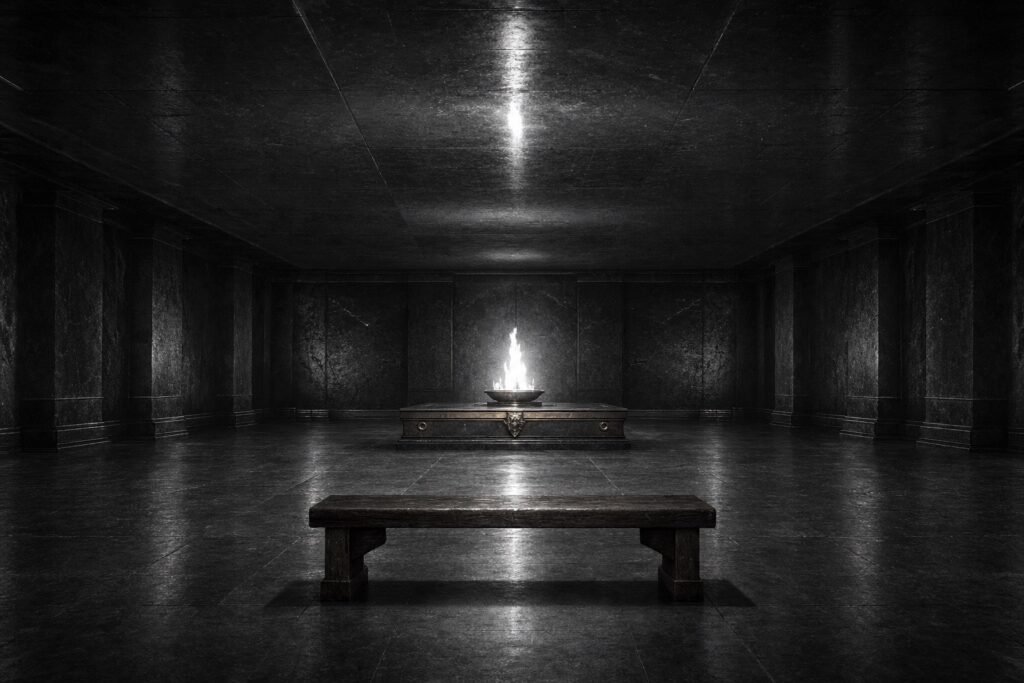
The Hall of Last Duty lay two levels above Severance Hall Nine, and although it was built of the same ribbed metal, under the same hard white lumen strips, someone at some point in its long history had decided that here at least there was time for a little dignity — a single line of litany chiselled above the portal, a narrow altar with an extinguished Eternal Flame that was lit anew for every ceremony, and benches along the walls where family and colleagues were permitted to sit and bear witness if they wished.
Techmarine Kael'dun stood at the edge of the hall, as he had done months before in Severance Hall Nine, but this time he did not conceal himself in the shadow of an observation ring — he stood openly, in full armour, as though he had every right to be there, and no one questioned it. To his surprise Magos Serevin Achtal also appeared, a few minutes before the rite began, and took a seat silently on the outermost bench, without exchanging a word with Kael'dun, but also without turning his gaze from Vashko while the tech-priests prepared him.
Vashko walked the last twenty paces to his plinth under his own power, without escort, and laid himself on the restraints before the tech-priests had to ask him to. He was given no hood of the kind pulled over the heads of the contaminated in the severance hall — a last, small concession to a man who had come voluntarily and whose face, as the doctrine of the Last Service had at some point determined, was permitted to remain visible until the final moment.
"What the body can no longer bear," the officiating tech-priest began the litany, and this time it did not sound like thousandfold monotony but like something that at least kept the appearance of reverence, "let duty bear onward. What duty can no longer see, let the work it leaves behind bear. In the name of the Omnissiah, be preserved in what you have served, even when you yourself no longer know whom."
Vashko closed his eyes before the needles found his spine. The extraction began more gently than he had read in the report on Reva Kastell — a difference he had not been able to explain to himself, until it occurred to him that perhaps there was no technical difference at all, only the difference between a body that resisted and one that gave itself over, as best it could, to what was coming.
He thought of Amsel as he had last seen him alive, with the wafer on the table, with the request for three days that he had not given him. He thought of Joran, of the hand he had held until the warden knocked, of the words it is not enough, but I will let it stand anyway. He thought of the bill he had written and another had paid, and for the first time in months he felt not the weight of that bill but only the relief of having finally finished writing it.
It was not forgiveness he found in those last seconds. He had never imagined that a machine could forgive him what a dead man would no longer be able to forgive. It was only an end — a clean, self-chosen end that no one else had to pay for because he had taken it.
His last clear thought was not an image and not a prayer, but a single, quiet finding with which he was content: this time I wrote the bill myself.
IX. Two Units, One Cart
It took three months before Kael'dun saw the two units working together for the first time — Unit 0774 and the newly assigned Unit 0839, side by side at one of the great casting ladles of the Smelting Cathedral, their movements synchronised in the same dull, even rhythm usual in servitor pairs that have long worked together.
He had applied for the assignment himself, under the inconspicuous pretext of an "optimised work pairing by load profile", and no one had questioned the request. It was the smallest gesture he could still make, having taken Achtal's warning seriously — no second foreign object hidden in a maintenance hatch, only seeing to it that two people who had never met and yet owed each other more than either would ever know at least stood beside one another while they did what was left of them.
Neither Unit 0774 nor Unit 0839 looked at the other. Neither would have known why they should.
But somewhere, deep beneath ceramite and cold copper wire, both carried something that did not appear on their equipment lists: a name in the one, a melody without words in the other. In the Smelting Cathedral, where the Iron Veins kept their centuries in litany and iron, that was, as Kael'dun slowly began to grasp, perhaps the utmost that hope could still achieve in this part of the galaxy: not to save someone. Only to see to it that no one disappeared entirely alone.
Joran Vashko came to the Smelting Cathedral once a month, under the official pretext of a material delivery that had in truth needed no Skitarii vanguard, and then stood a while in the upper gallery, without knowing which of the dozens of servitor units down there carried his father. Kael'dun had once considered telling him — bending the doctrine one last time, so that a son would at least know where to look. He had not done it. Not out of obedience to Achtal's warning, but because, when he first saw Joran standing up there, he had understood that the man had long since stopped looking for a particular machine. He simply stood there, watching the whole hall at work, and that seemed to him, in a way Kael'dun did not entirely understand, to be enough.
Magos Serevin Achtal, who noticed the change of assignment in passing in the record, said nothing about it. But the next time he encountered Kael'dun in a corridor of the Smelting Cathedral, he paused a moment longer than necessary, a nod that needed no words and got none — and for a brief instant, before the Magos walked on, Kael'dun believed he saw in the copper eye something that no longer sprang from any calculation.
It was no victory. Kael'dun would never have claimed that it was. Two men were dead — one in the rubble of a shaft he had wanted to warn about, the other voluntarily under the same needles that had been given without any choice to a child named Dessa and a miner named Orven, and no one would ever take their names into a litany as was done for fallen Venerable. But somewhere between the cold logic of the severance and the colder indifference of a universe that would have forgotten both men anyway, there were now two coils, a son who knew enough to grieve, and a Magos who had decided for the second time to break a rule he himself held to be necessary.
That was little. Kael'dun knew that better than anyone in the Smelting Cathedral. But it was, as he sometimes told himself in the quiet hours of his own watch, not nothing.
END
Download story as PDF or EPUB
Enter your email address. After confirming your subscription you'll get the download links immediately and by email.