Lost Twice
The Iron Veins
„The Chapter promises that no one is lost twice. Once in death, not once more in forgetting. The promise is not kept by the Chapter. It is kept by a single man, and he keeps it with a pair of forceps.“
Randbemerkung im Aufnahmebuch des Apothecariums, unsigniert
I. The Intake Book
The Apothecarium of the Iron Veins did not lie in the rock.
Everything else in the Smelting Cathedral lay in the rock — the reliquary hall, the armouries, the cells of the Initiates, the workshops in which the Techmarines did what they did. Aschgrat was a world one entered by going into it. Whoever stayed on it stayed beneath it.
The Apothecarium lay above. An annexe of welded plates on the southern flank of the ridge, three chambers in a row, with windows. It was the only place in the Chapter seat from which one could see without detour what the light of Aschgrat looked like when it was day: red, dusty, very far. The second Chapter Master had had the annexe built, and the justification still stood on a ceramite plate above the outer door, in the clipped script of those years:
THE FLESH NEEDS LIGHT. THE IRON DOES NOT.
It had been meant as a concession. Rennik had needed over a hundred years to understand that it was also a ranking.
It was the third month after the Sixth Shaft.
He stood at the high standing desk in the first chamber, where the light was best, and made his entries. Before him lay the intake book of the Apothecarium: not a book in the proper sense, but a stack of ground ceramite leaves in an iron frame, each leaf double-sided, each side divided into four columns. Name. Origin. Neck gland. Chest gland. There was no column for the day of death. The day of death stood in the Chapter books, and the Chapter books were kept by the Chaplain, and the Chapter books were there for remembrance.
The intake book was not there for remembrance.
Rennik set the stylus and entered the seventeenth entry of the year. He wrote slowly. In ninety-seven years as an Apothecary he had learned that writing which comes into being quickly is later read like something that was a matter of indifference to somebody.
Immarn, Brother. Aschgrat, settlement Chain Four. Neck gland: extracted, full maturity, storage place twelve-C-nine. Chest gland: —
He stopped at the dash, as he always did, and as it always changed nothing.
"Lost" he did not write. The word did not stand in the vocabulary of the book. A dash was neutral. A dash said: something is missing here, and we do not know why, and we enter no blame, because blame has no column.
Rennik knew very well why.
Brother Immarn had lain forty-two hours on a slope field, six hundred kilometres north-east of the cathedral, under a wall of slipped slag, because a recovery party had searched the wrong valley first. Forty hours. The neck gland is tough; it sits deep, it is small, it holds a long time. The chest gland does not hold a long time. The chest gland is the riper, larger, more valuable organ, and it is also the more delicate, and when a body lies thirty-six hours in the warmth of Aschgrat's scree, then what the reductor brings out is no longer an organ but a finding.
He had made the finding all the same. One always makes it. One cuts even when one already knows.
Rennik laid the stylus aside and looked out of the window. The sky above the ridge had the colour it almost always had, the deep glowing red that had given the world its name before anyone had hit upon the idea of calling it fondly the Grey World. Thirty-two metres below him a servitor column worked at the slag channel. They worked in perfect uniformity, as they had for fourteen years.
He counted in his head, because he could not leave it alone.
Three hundred and seventy-two gland pairs in the vault, usable, tested, sealed. Of those one hundred and six with deviations in the second chamber line, which one tolerated because one had to tolerate them. The Imperial Tithe to Terra: every forty-eight years, the next time in six. What remained after that divided into what arrived in the Initiates and what was allowed to age in the vault, in case there should one day be a bad decade.
There was always a bad decade.
Out of the reckoning came a number, and the number was the actual content of his office, and nobody but him ever spoke it aloud: the Chapter could, with honest bookkeeping, lay down between seven and nine Initiates in any year. Not more. The number did not fluctuate with the will of the Chapter Master and not with the need at the front. It fluctuated with how many brothers died and how quickly somebody was with them.
That was the sentence Rennik had never said aloud, and he had thought it often enough that it was by now worn smooth like the handle of a tool:
The Chapter does not grow by how well we fight. It grows by how fast I run.
Behind him the door went. He heard by the step who it was before he turned round — Delm walked as though testing a floor that did not yet belong to him.
"First Apothecary. Sergeant Malm requests an examination."
Rennik did not turn round. "Malm was here seven months ago."
"He says it is not an examination he requests. He says it is an examination he requests so that the record will be correct."
Now Rennik turned round.
"Verbatim?"
"Verbatim, First Apothecary."
Rennik looked at the aspirant, who had stood in his service for nineteen years and who still had not learned that one does not stand at attention in these three chambers. Then he looked out of the window again, at the servitors at the channel, at the very far, very red light.
A brother who wanted the record to be correct never wanted the record to be correct.
"Bring him into the second chamber," he said. "And warm the slab. He has cold joints."
II. Forty Hours
Before Malm came, Rennik went down to the cold chamber, because he had made it a rule never to look at a living brother while a dead one lay untended.
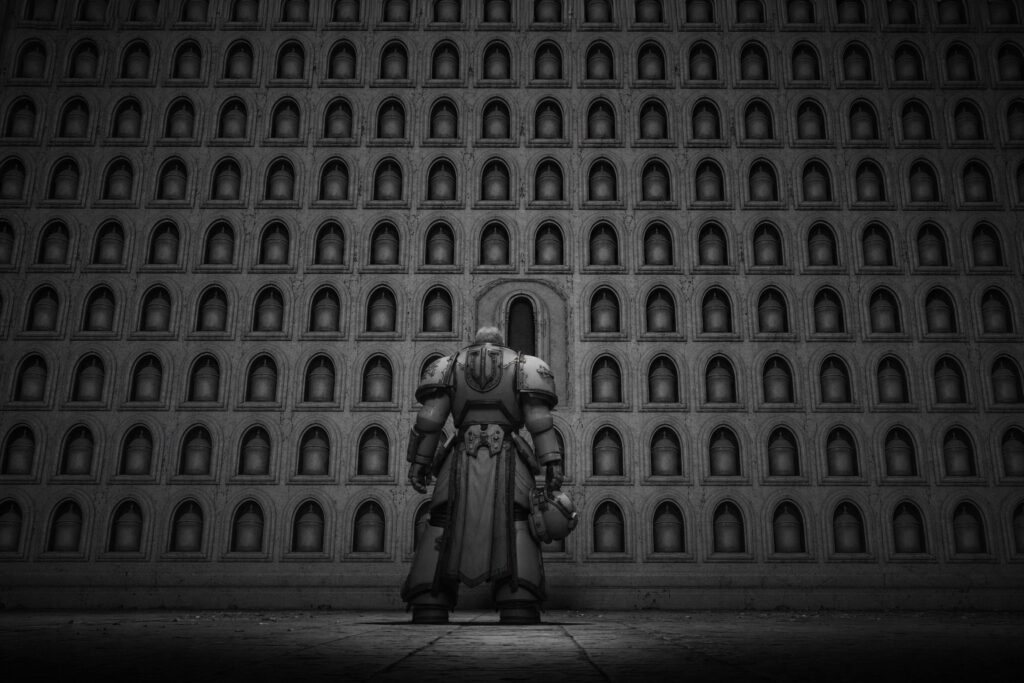
The cold chamber was the only part of the Apothecarium that did lie in the rock after all. It had been driven in when they noticed that windows were a problem for the dead. It was nine metres deep, three metres wide, and along both walls the drawers lay one above another like the drawers in a workshop, because that is exactly what they were.
Brother Immarn lay in drawer seven. Rennik pulled it out and worked.
He did it without Delm. The aspirant had seen this part often enough, and Rennik had by now grasped that it was not the seeing that made an Apothecary, but the being alone afterwards.
The body was less damaged than the report suggested. The slag had crushed him, not torn him. The face was whole. Rennik knew it. He knew all of them. He had put the first suture in Immarn twenty-six years ago, and sixteen years ago he had taken a splinter out of his left eye, and he knew that Immarn, while waiting, had always tapped his thumbnail against his forefinger nail, a tiny, dry ticking of which he himself was not aware.
Rennik opened the ribcage.
There is a notion of this procedure that goes about among the younger brothers and which he had never corrected, because a false notion is sometimes kinder than a true one: that the reductor is a fine instrument. It is not a fine instrument. It is a drill with a crown of four curved blades, and it is built to get through the reinforced rib plate of an Astartes, and when it works it does not sound like surgery. It sounds like a tool in a workshop, and the smell it makes is the smell of hot bone meal, and the smell stays in the chamber afterwards for eight to ten hours, no matter how the ventilation runs.
Rennik set it, guided it, held the depth. Four seconds. Then the change to the gripping forceps, then the small, very precise movement inward and to the left that one makes only with the wrist and never with the arm.
The chest gland came out, and it was grey.
It should be mother-of-pearl, almost translucent, with a fine dark veining that looks like frost on metal. This one was grey, and it was soft, and when he laid it in the dish it lost its shape.
He stood a moment with the dish in his hand.
Forty hours. Not forty hours of enemy contact, not forty hours of siege, not forty hours of assault. Forty hours because a squad had searched the northern valley first instead of the eastern, because the map had two valleys at that place and the report only one.
For that there was no enemy one could punish, and no battle one could rewrite, and that was the reason Rennik had experienced every loss twice for ninety-seven years: once when the brother died, and once when he himself came too late.
He tended the body. He sutured the rib plate closed, although nobody would ever see it again, although the body would be in the smelt in eighteen hours. He did it because he did it with every one, and he had stopped looking for reasons.
Then he carried the dish into the assay chamber, set it under the eye, let the judgement run, and the judgement said what he knew.
Not usable.
Rennik went back up and washed his hands for a very long time in cold water, as always after a chest gland, and thought of a thing his predecessor had once said to him, in exactly this chamber, with exactly this smell in the air.
We are not the physicians of the Chapter, boy. Physicians we are on the side. We are the customs men. We stand at the border and take from everyone who crosses the one piece he is not permitted to take with him.
At the time Rennik had held that to be a bitter joke.
III. Sergeant Orwin Malm
Malm was sitting on the slab when Rennik came in, and did not stand up.
That was not discourtesy. Malm had not stood up when he did not have to for four years, because since the fracture of the left hip shell standing up was a procedure of three separate movements, and because he did not want anyone watching him do it. Rennik knew that, because he had written it in his leaves, four years ago, in a column that officially did not exist.
"First Apothecary."
"Sergeant."
Orwin Malm was one hundred and ninety years old and the second-oldest still serving battle-brother of the Chapter. He was not a large Astartes; he was one of those who had turned out broad rather than tall, with a short, heavy neck and hands one could see had held tools before the elevation. His face was covered on the right side by an old burn, and that was not unusual in a Chapter whose home world was called ash.
He held himself very straight. That too stood in Rennik's leaves.
"You wanted an examination so that the record will be correct," said Rennik.
"Yes."
"Then let us begin with the record instead of the examination." Rennik took the leaf Delm had looked out and read aloud, without emphasis. "Left hip shell, fracture with comminution zone, four years. Spine, segments eleven to fourteen, calcification progressing, measured every seven months. Increase in the last period: slight. Left lung, scarring after smoke damage, unchanged for sixteen years. Ossmodula activity in the lower normal range, age-appropriate. Both hearts unremarkable."
He laid the leaf down.
"The record is correct, Sergeant."
"No," said Malm.
"What is missing?"
"What follows from it."
Rennik drew up the low stool he kept for these conversations and sat down, because a standing Apothecary over a seated brother is a statement he did not wish to make.
"What does follow from it, in your view?"
"That I have eleven years left. Perhaps fourteen." Malm said it the way one states a march time. "And that I will spend them in the armoury, where for four years I have been explaining to Initiates why a bolter jams. And that at the end of those eleven years I will lie in a drawer in your cold chamber, and that you will then go down to me and do what you do, and that out of it an Initiate will come. One."
"Two," said Rennik. "At your age and with your line, two rather."
"Two." Malm nodded slowly, as though he had miscalculated and were glad of it. "Two in eleven years. Or" — he raised a hand, and the hand was steady — "two this year, and two hundred years of service in a sarcophagus besides."
So there it was.
Rennik had seen it coming since Delm had repeated the formulation, and he had hoped all the same to be mistaken, and that was an impulse he was too old for.
"You want to be interred."
"I want what a brother in my condition gets when his condition is correctly written down."
"Your condition is correctly written down."
"My condition is completely written down," said Malm. "That is not the same as correctly. You write increase slight. Another would write increase progressing. Both are true. Only the one has a sarcophagus at the end and the other an armoury."
Rennik said nothing for a long time.
Outside, far below, the servitor column worked at the slag channel, and the sound of it came in through the window like a very slow heartbeat.
"Tell me why," he said at last. "Not what you would say to the Chapter Master. The other thing."
Malm looked at him, and Rennik watched him decide to tell the truth, and watched that decision cost him more than the fracture of the hip shell.
"Because I stand in the armoury," said Malm, "and explain to the Initiates why a bolter jams, and because every time I think: one of you stands here because I am not yet dead. And the other does not."
IV. What a Finding Is
"That is wrong," said Rennik.
"It is arithmetical."
"It is arithmetical and wrong. Both are possible." Rennik stood up, because now he did have to stand. "Your glands lie in the vault when they come out. They lie there among three hundred others. There is no chain from your ribcage to a particular boy in a particular cell. That is not a guilt you can discharge, because it is not a guilt."
"You tell me there is no chain." Malm inclined his head a little. "First Apothecary. You are the man who keeps the chain. You know to within two exactly how many Initiates this Chapter will lay down next year. I asked you eleven years ago, and you told me, and you did not have to think about it, because you always know."
Rennik remembered the conversation. He had said eight then.
"That I know it does not make it a chain," he said. "It makes me someone who counts."
"Yes," said Malm calmly. "And whoever counts knows what is missing."
Rennik went to the window and stayed there, with his back to him, which was against every habit.
The sergeant was entirely right on one point, and Rennik could not say so without damaging his own office. There really were two sentences, and both were true, and the difference between them was not a medical one. It was a matter of syntax.
The calcification is progressing slightly.
The calcification is progressing.
One could write the one and write the other and never lie. And the Chapter Master, who received a leaf from the Apothecarium, did not read a leaf. He read a decision that had already been made, and he read it in the tone in which it was written, and the Chaplains read it so, and the priesthood of Kel-Vantor read it so, and at the end of that reading stood a chamber very far beneath a moon, and in the chamber stood a sarcophagus, and the sarcophagus was open.
"I do not write a tone," said Rennik to the window. "I write a finding."
"You write a sentence," said Malm behind him. "And out of the sentence comes a judgement, because nobody after you looks again. You are the last place, Rennik. After you comes only the execution."
He had used his name, without rank. In one hundred and ninety years he had perhaps done that four times.
Rennik turned round.
"No," he said.
Malm nodded, a single time, briefly.
"I will also tell you why no, so that you do not have to piece it together yourself," said Rennik, and he noticed that his voice was louder than he had intended. "Not because I do not understand you. Not because the Chapter could not use you — it could. Two hundred years of Orwin Malm in a sarcophagus would be a better bargain for this Chapter than fourteen years of Orwin Malm in an armoury, and we both know it, and the Chapter Master would know it too."
"Why then."
"Because on the day I write a sentence that says a truth and means a decision, this leaf here" — he struck the intake book of the Apothecarium with the flat of his hand, and the sound was bright and wrong in the chamber — "is worth nothing any more. Not yours. All of them. Retrospectively. Every leaf I have written in ninety-seven years would then be one about which someone might ask: and what did he wish for while doing it?"
He left his hand lying there.
"The Chapter promises that no one is lost twice. For that promise to mean anything, someone must be there who tells the truth the first time. If I begin to choose, I am no longer the one who counts. Then I am the one who allocates. And the Chapter has provided no oversight for the one who allocates, because it never reckoned that this man would be its Apothecary."
Malm heard it out, to the end. Then he did the thing Rennik could not shake off for years afterwards: he seemed relieved.
"Good," he said.
"Good?"
"I had to ask." Malm slid off the slab, in the three separate movements, without apologising for it and without taking help. "If I had not asked, in eleven years I would have believed you would have said yes. Now I know."
At the door he stopped.
"First Apothecary. When the time comes — come quickly."
V. The Aspirant
"Why grey?" asked Delm.
They stood in the cold chamber, two days later, over the dish with what had come out of Immarn. Rennik had not discarded it. He never discarded at once. An unusable gland was the only teaching material the Chapter could not manufacture.
"You tell me."
Delm leaned forward. He was young — forty-four, in the twentieth year of his training, and he had the narrow, very deft hands that in this office one either brings along or never acquires. He also had the quality Rennik feared in him: he wanted things to have a reason.
"Autolysis," said Delm. "The body's own enzymes. The body was warm, the capsule gave way, the tissue digested itself."
"Correct. How long did it take?"
"The report says forty-two hours to recovery."
"I did not ask about the report. I asked how long it took."
Delm hesitated. "Thirty-six. Perhaps thirty-four. After that it made no difference whether we came at all."
"Thirty-six," said Rennik. "Do not remember the number as a number. Remember it as a distance. Thirty-six hours are, with an assault boat at full load, eight hundred kilometres. With a recovery party on foot in scree, forty. If one day you stand here and send out a squad, you will do that conversion in your head while somebody is talking into your face. You will not be able to look it up."
"Yes, First Apothecary."
Rennik took the reductor out of its bracket and laid it between them on the slab.
"Take it."
Delm took it. He held it correctly, and had for six years.
"What is that?"
"A reductor."
"Wrong."
Delm looked up. It was the look of a man who had expected an examination and got a trap instead.
"It is a reductor," said Rennik, "for the duration of four seconds. In those four seconds it is a tool, and you are a craftsman, and what lands in the dish is material. That is necessary. If in those four seconds you feel, you tremble, and if you tremble, the capsule tears, and then you are holding this here" — he pointed at the grey mass in the dish without looking at it — "and the boy who in eight years will not be sitting in a cell will not reproach you for it, because he knows nothing of it, because he does not exist."
He took the instrument back from Delm.
"And in the fifth second," he said, "you lay it down and look the brother in the face and know again who he was. If you let the fourth second run into the fifth, you will become a bad Apothecary. If you strike out the fifth second, you will become a very good one, and then the Chapter is lost, and nobody will notice what it was lost to."
Delm said nothing. After a while he asked:
"And if I can do neither?"
"Then you tell me," said Rennik. "And I write a leaf, and in four weeks you are a sergeant in a company and will be happier for a hundred years than I have ever been."
He pushed the drawer shut.
"There have already been two. Both are still alive. One of them leads the second squad of the Fourth. Ask him some time whether he regrets it."
"And?" said Delm. "Does he regret it?"
"No," said Rennik. "He can eat again now."
VI. The Reverberation
Once a month, always on the same day, Brother Tal'ir came into the third chamber and sat down, and Rennik did something that officially was called observation and that in truth consisted mostly in two men sitting in the same room and one of them listening.
There was no procedure for it.
Rennik had looked for one, in the records of his predecessor and in those of the Apothecarium generally, and he had found nothing, because such a thing had not occurred before. The Chapter had a procedure for wounds, a procedure for mutation, a procedure for gene-seed deviation, a very precise procedure for suspicion of possession — and for a brother who had come up out of the Sixth Shaft and since then sometimes looked at his own hands as though he had to check whether they still belonged to him, there was no procedure.
The priesthood of Kel-Vantor had one. Theirs was called severance and was for mortals, and Rennik had once had it explained to him and afterwards had not spoken to Achtal's adepts for two days.
"How long this time?" he asked.
"Four nights," said Tal'ir. "Not consecutively. The second was the longest."
"Words?"
"No words. It is never words." Tal'ir sat with his forearms on his knees and looked at the floor. He was the youngest brother who had been down there that day, and he was since then the one in whom one could see most clearly that something had happened, because he was the only one who had still been young enough to change. "It is an emphasis. As though somebody were speaking in a neighbouring room, and one understands nothing, but one hears where the sentence is stressed. And one knows that the sentence is about oneself."
Rennik wrote it down.
"And afterwards?"
"Afterwards it is gone, and I no longer know where the emphasis lay." Tal'ir raised his head. "First Apothecary, I have a question I have been wanting to ask for seven weeks."
"Ask it."
"If I one day get as far as Brother Vosk —" He broke off, ordered it anew. "If I am one day in the condition in which one receives a sarcophagus. Is that then a possibility for me? Or am I excluded from it?"
Rennik laid the stylus down.
He had known the question would come. He had asked it of himself thirty times, and thirty times he had got the same answer, and the answer was useless.
A Venerable is awake. Not always, not entirely — Sorvain had once put it in a way that stayed in Rennik's ear: I am never entirely awake and never entirely not. But awake enough, and for a very long time, and without a body with which one could distract oneself, without hunger, without weariness, without the thousand small occupations with which a creature of flesh passes the hours.
A man with an emphasis in a neighbouring room, for two hundred years, in a box in which there is no neighbouring room.
"I do not know," said Rennik.
"That is not an answer."
"Yes it is. It is the only one I have, and it is true, and it is worse than either of the others." Rennik looked at him. "I cannot tell you whether the sarcophagus imprisons what you carry or whether it gives it a room in which it no longer disturbs anyone that it speaks. Nobody can tell you that. It has never happened to anyone. If it happens to you, you are the first, and then we will know, and you are the answer."
Tal'ir looked at the floor again. He nodded.
"The Chaplain says I should trust that the iron preserves what the flesh cannot hold."
"Vehn is a good man."
"That is not an answer to what I said."
"No," Rennik conceded. "It is not."
He entered the four nights, and the second as the longest, and that no words had fallen, and that the brother had asked. Then he entered in the column that officially did not exist a sentence he had been entering there again and again for three months, every time with the same wording, because he had not yet found a better one:
The Chapter has no procedure. The Chapter has me.
VII. Two Offices
Chaplain Kaltas Vehn came seldom to the Apothecarium and never without occasion, and the occasion that evening was that he needed the lists for the next Vigil. They are written eight years in advance, because the cohort of Kel-Vantor plans its workshops that far ahead.
He sat on the same stool on which the brothers otherwise sat, and he looked wrong on it. Vehn was large, even for an Astartes, and in the black armour of his office every room he sat in looked like a room being cleared.
"Four Venerable for renewal, when the time comes," said Rennik, and pushed the ceramite leaves across to him. "Gorrath is among them. Coolant, all seals, and the left hip actuator has been noticeable since the last Vigil."
"I do not read actuators."
"No. You read the names." Rennik drew a second leaf forward. "And you read this one too, because you have to pass it on. It is the list of brothers whose condition has worsened since the last Vigil. It is long this year."
Vehn took it and did read it, slowly, with his finger, like a man who wants to go through every name singly so that none remains merely a line.
"Malm is on it," he said.
"Malm has been on it for four years."
"He came to me." Vehn laid the leaf aside. "Nine days ago. He confessed — nothing I would be permitted to pass on, and nothing you do not know anyway. Afterwards he asked me something, and I gave him an answer I have not been able to manage since."
"What did he ask?"
"Whether the sarcophagus is an honour."
Rennik leaned back. From outside came the long, slow sound of the slag channel.
"And what did you say?"
"I said: yes."
"That is the teaching of the Chapter."
"That is the teaching of the Chapter," said Vehn. "I have spoken it a hundred and seventy times at a sarcophagus, and in those hundred and seventy times I have believed it. I believe it still. And yet, when I said the word yes, I noticed for the first time that I do not know what the yes refers to. To the condition? To the decision? To the office I exercise in doing it?"
He looked at Rennik, and Rennik saw a man who had administered the certain all his life and who had at some point noticed that beneath the certain there lay nothing, only further administering.
"I put the same question to you," said Vehn. "You are the only one who can answer it without preaching."
"No."
"No, you will not answer it, or no, it is not an honour?"
"No, I am not the only one who can answer it," said Rennik. "Ask Gorrath. For sixty years he has said nothing but the Litany of Wrath, and I am fairly sure that was his answer."
Vehn did not laugh. But he breathed once differently, and in a Chapter like this one that was the same thing.
"You are evading."
"Yes." Rennik took the leaves back and ordered them, because he had to occupy his hands. "I will tell you what I know, and you make of it what you will. A sarcophagus is an honour for the Chapter. It is a service to the brothers who come after the Venerable. And for the man inside it, it is what the man inside it makes of it, and that we learn only when it is too late to ask him."
"And that is your teaching?"
"That is my finding," said Rennik. "I have no teaching. For that I have you."
VIII. The Tithe
In six years a ship would come.
It came every forty-eight years, and it never had a name that was communicated to the Chapter, and the men who came ashore wore the robes of the Adeptus Terra and the insignia of an authority whose full designation had nineteen syllables. They stayed eleven days. They were courteous. They drank nothing and ate nothing and, so far as one could establish, did not sleep.
On the eighth day they went into the vault, and on the eleventh they left with the Imperial Tithe.
Rennik had experienced it twice, and both times he had been fit for nothing for a week afterwards.
It was not the quantity. The quantity was bearable; the norm had been unchanged since the end of the founding era, and every Chapter rendered it, and a Chapter that did not render it received a visit from other people. It was the selection. The men of the Adeptus Terra did not take just anything. They took by a procedure they did not explain, and what they took was every time the best.
The second time, Rennik had asked. He had asked because he had been forty-nine years in office and had still believed that asking is of some use.
By what standard do you choose?
The man had looked at him, kindly, with the patience of a person who knows the question.
By the standard that in eight hundred years, at a place neither you nor I will know, a Chapter will be founded that would otherwise not exist. Your best will be its first. Do not be sad, Apothecary. You have just learned that you are ancestors.
Rennik had thought about it, for decades, and had come to the conclusion that the sentence was not false and that he hated it all the same, and that both were permitted to hold at once.
He went down into the vault that evening, because he did that every eighth evening.
The vault lay beneath the Apothecarium and was thus the only part of the annexe that ended in the rock after all. One entered it down thirty-nine steps. The air was dry and smelled of nothing. In the walls lay the compartments, in rows of twelve, each with a stamped designation, and in each compartment lay a sealed capsule, and in each capsule lay what was left of a man who would one day no longer exist.
There were three hundred and seventy-two.
Rennik walked the rows, as always, and read the designations, as always, and he could have given the name of about two hundred of them if anyone had asked him.
That was the part of his office nobody knew about, because nobody asked.
To the Chapter this room was a reserve. To the priesthood of Kel-Vantor it was a holding with a decay curve. To the men of the Adeptus Terra, every forty-eight years, it was a harvest.
To Rennik it was the only room in the Smelting Cathedral in which the dead were not sorted by what they had achieved.
He stopped at compartment twelve-C-nine, in which Immarn's neck gland had lain for six days, alone, without the second, half an entry with a dash.
And then Rennik did what he had done forty-three times in ninety-seven years and what stood in no record.
He said the name aloud.
"Immarn."
It did not echo. The room was too full for echo.
IX. What He Demanded
The report came four months later, in the middle of the Aschgrat spring, when the wind fetched the slag off the northern slopes and for three weeks nobody saw the sun.
It was not a campaign. It was a security task in the protective belt: a pit installation three hundred kilometres to the south in which a handful of people had dug up something they would have done better to leave lying. Two squads of the Second, one squad of the Fourth, an assault boat, eighteen hours' march.
Rennik flew with them, because he always flew with them when he could, and because an Apothecary who sits on the ridge is an Apothecary who has already lost the thirty-six-hour reckoning before it begins.
They lost two brothers in the first hour and one in the third.
The third was Brother Bodrek, and Bodrek did not die.
Rennik found him in a tunnel mouth, half under a girder, with an abdominal wound that no narthecium in the galaxy would have closed any more, and fully conscious, because the flesh of an Astartes protected him by not letting him lose consciousness.
He did not need to examine. He did it anyway, for four seconds, because a man who lies over you and does not examine is a man who has already given up.
"How long," said Bodrek.
"Two hours. Perhaps three."
"And the recovery?"
Rennik did not answer at once, and that was the answer.
They were three hundred kilometres from the cathedral and forty minutes from the assault boat, and the assault boat was under fire, and above the protective belt stood the ash wall, and in such weeks the ash wall stood for six to nine days.
Six to nine days.
"Take them now," said Bodrek.
Rennik looked at him.
"I can anaesthetise you."
"If you anaesthetise me, someone has to stay here and cover you, and then the squad up ahead is short." Bodrek's voice was entirely calm, and that was the worst of it; one is trained for it in this Chapter, and the training holds to the last. "I promised Malm. In the armoury. He said, when the time comes, tell the Apothecary early enough that he does not have to wait."
Rennik knelt down.
This is the place where the record stops, and therefore this is the place where Rennik has been alone for ninety-seven years.
There is in the Chapter books a formula for the Emperor's Mercy, and there is a procedure for the execution, and both are clean. The brother is anaesthetised. The brother dies. Afterwards the Apothecary works, and what he does in doing so he does to a dead man, and all involved have preserved the order.
And there is the other possibility, for which there is no formula, because a formula would make it a practice: that one begins while the heart is still beating, because warm tissue holds better, because a capsule under pressure does not tear, because what one brings out this way really does become a boy in a cell, and the other only a dash.
"It will hurt very much," said Rennik.
"I know."
"It will not go quickly. I need the chest gland, and your rib plate is strong. I estimate seventy seconds to the first cut."
"Rennik." Bodrek moved his head a little, and in his eyes stood nothing of what Rennik had expected, but something far worse: impatience. "I have served sixty-two years in this Chapter and in that time have heard four hundred times that none of us is lost twice. I thought it was a comfort. It is an order. Begin."
Rennik began.
The reductor needs four seconds when the body lies still.
It did not lie still.
X. The Fifth Second
Afterwards Rennik sat in the tunnel mouth and waited until his hands were usable again.
It was a process of about four minutes. He knew it. It had nothing to do with shock; it was purely mechanical, an over-acidification of the small muscles in the palm, as after too long a firm grip. One waits, one opens and closes the hand eleven times, and then it works again.
Eleven metres away Brother Bodrek lay under a length of canvas, and in the dish in Rennik's field case lay two organs, and both were mother-of-pearl, and both had the fine dark veining that looks like frost on metal.
Two Initiates. Perhaps three. Bodrek's line was good.
Rennik sat there, and the ash wall came over the ridge, and he thought of what he had said to Delm about the fifth second, and then he thought about the fact that he himself had not had the fifth second in the chamber for about forty years, but afterwards, alone, with eleven times hand open and shut.
Sergeant Berrun of the Second found him there and stopped at a respectful distance, as one stops before an Apothecary who has just worked.
"First Apothecary. We have the installation. Six prisoners. And we have recovered Bodrek's weapon, if you want it in the book —"
"I do not keep weapons."
"No. Forgive me." Berrun hesitated. "Did he still speak?"
Rennik looked down at his hands. Open, shut. Nine. Ten.
"He said it was an order," he said. "Not a comfort. An order."
Berrun nodded slowly, as though he had heard something edifying, and went.
And Rennik sat in the tunnel mouth of Installation South-Four and grasped with a clarity that took his breath away that he had just, for the first time in his life, passed on a sentence he himself no longer believed.
XI. Malm, a Second Time
Seven weeks later a pump burnt out in the slag channel beneath the Apothecarium.
The channel had been automated for fourteen years. It ran with a servitor column and two pressure pumps, and if one pump failed, the liquid slag backed up in a chamber built precisely for that, and the chamber held nine hours. After that it overflowed and ran down the ridge and into the training yard, in which that afternoon stood thirty-one Initiates of the second intake.
It was not a battle. It was a pump.
Orwin Malm stood as instructor in the yard.
What afterwards stood in the Chapter books was correct and complete and described a sergeant who had got the Initiates out of the yard in eighty seconds and had then torn open the hand sluices of the emergency channel, all four, one after another, which diverted the flow and saved the yard and did not save the man standing at the sluices.
What did not stand in it was the question why the four hand sluices had been torn open one after another and not three.
Three would have sufficed.
Rennik had worked the installation through himself after the accident, twice, because the first time he had not believed it. Three sluices diverted eighty-six per cent of the flow. The rest would have run into the lower yard, where nobody stood. Whoever tears open the fourth sluice stands nine seconds longer in the path of what he is diverting, and those nine seconds are the whole difference.
Rennik needed twenty-two minutes to get down from the Apothecarium to the training yard, and that was a record, and it was entirely immaterial.
What comes out of a slag channel is at eight hundred degrees.
He found no body. He found a shape.
He worked all the same, for forty minutes, in the cooled channel, on his knees, with tools made for something else, and Delm stood beside him and held the dish and said nothing, and at some point Delm did say something, very quietly:
"First Apothecary. There is nothing left."
"I know."
"Then —"
"I know it only when I have looked," said Rennik. "As long as I have not looked, it is a supposition, and a supposition does not go into the book."
He looked to the end.
XII. The Entry
That same evening Rennik stood at the high standing desk in the first chamber, where the light was best, and the light had been gone for four hours.
Before him lay the leaf. Name. Origin. Neck gland. Chest gland.
Malm, Orwin, Sergeant. Aschgrat, settlement Pit Edge Two. Neck gland: — Chest gland: —
Two dashes. The second entry of that kind in ninety-seven years in which both columns stayed empty; the first had been a brother caught by a Titan's foot.
It was not the entry Rennik stood over for two hours.
It was the fourth column, the one that officially did not exist.
Into it an Apothecary wrote the circumstances, insofar as they were relevant to the assessment of the material. Forty-two hours to recovery. Fire damage. Warm extraction, consent of the brother. It was a technical column. It was meant for the successor, so that he could learn from two hundred years of bookkeeping what it was down to when something came out grey.
Rennik set the stylus and did not write.
Four sluices instead of three.
If he wrote that, then it stood there, forever, in ceramite, indelible, and Delm would read it in thirty years and work the installation through as Rennik had worked it through, and then he would understand, and then there would be two men in this Chapter who knew it, and after Delm four.
And the Chapter had a word for what Orwin Malm had done. It did not stand in the Chapter books; it stood in the training code, in the section on conduct in a hopeless position, and it was Fortwurf — self-expenditure. A brother who throws his life away does not throw his life away. He throws away two Initiates who will now not exist, and he does it for a reason he holds to be honourable, and the Chapter has decided that this reason is not honourable but an arithmetical weakness.
Rennik stood at the desk and thought of a sergeant who had sat on a slab and said: One of you stands here because I am not yet dead. And the other does not.
He had told him then that there was no chain.
He had lied. Not with a sentence, but with a tone. He had said there is no chain, and he had meant I do not want you to see it, and Malm had heard the difference, because Malm had been one hundred and ninety years old and had listened all his life to men who meant something other than what they said.
And then Malm had gone out and had known for eleven years that the chain existed, and that it hung on him, and that nobody would take it from him.
Rennik wrote:
Executed in the line of duty. Remains recovered without delay. Material entirely lost, cause heat.
It was true. Every word of it was true.
He laid the stylus down, and his hands did not tremble, because they never did, and he stood there for a very long time still.
XIII. The Chapter Master
Chapter Master Harn Vel'Ossa came to the Apothecarium nine days later, alone and unannounced, which he did about twice a decade.
He walked through the three chambers, as he always did, and finally stopped before the ceramite plate above the inner door on which stood the justification of the second Chapter Master.
THE FLESH NEEDS LIGHT. THE IRON DOES NOT.
"I have always wondered," said Vel'Ossa, "whether he meant that as a concession or as a verdict."
"As both," said Rennik. "He wrote it after eleven Initiates had died at the implantation in one year. It stands in the leaves. He came up and ordered the annexe and was never here again afterwards."
"I did not know that."
"It does not stand in the Chapter books. It stands in mine."
Vel'Ossa nodded slowly and did not sit down, because he sat nowhere.
"I have read Malm's entry," he said.
Rennik waited.
"And I have read the maintenance service's report on the emergency channel, because I read all reports." The Chapter Master looked at him, and his face was the mask of calm that by all accounts had cost him many years. "Three sluices would have sufficed."
"Yes."
"Why does that not stand in your book?"
"Because I do not know whether he knew it," said Rennik. "He was an instructor. He knew the installation. But he stood in eight hundred degrees of radiant heat and had thirty-one Initiates at his back, and I cannot exclude that he simply saw four sluices and pulled four sluices."
"Can you exclude it?"
"No."
"Can you believe it?"
Rennik said nothing.
Vel'Ossa went to the window and looked out, at the channel in which a new pump had been running for nine days.
"I will tell you what I believe," he said. "I believe that Orwin Malm knew three would suffice. I believe that he pulled the fourth. And I believe that while doing it he was thinking of a reckoning he should never have opened and that somebody opened for him."
He turned round.
"I did not ask you so that you would enter it. I asked you because I wanted to know whether you know it."
"Chapter Master —"
"I am not finished." Vel'Ossa raised a hand, not sharply. "This Chapter has a promise, and you hear it at every grave and in every litany, and it runs that none of us is lost twice. Once in death, not once more in forgetting. It is a good promise. I have spoken it a hundred times myself."
He came a step closer.
"But it is addressed to you, Apothecary, and to nobody else. The Chaplain sees to it that we keep the names. The Techmarines see to it that we keep the bodies. And you see to it that we keep the possibility that we still exist in three hundred years. Of the three, yours is the only task in which the failure is not visible. A forgotten name is noticed. An empty sarcophagus is noticed. An Initiate who does not exist is noticed by nobody. Never. Not once in four hundred years."
"That is known to me," said Rennik.
"Yes. That is the problem." Vel'Ossa looked at him very directly. "It is known to you, and you carry it alone, and you have carried it for ninety-seven years, and in that time I have spoken with you about it twice. That is my failing, not yours."
He went to the door.
"I take nothing from you. I could not, and you would not want it. But I tell you one thing, and I want you to write it down, so that it stands somewhere where someone after you will find it." He stopped, without turning round. "The Chapter demands the truth of you. It does not demand that you hold it alone. The next time you stand two hours over a leaf, come to me and stand two hours beside me, and we will stand together, and afterwards you will write down the same thing you would have written anyway. It changes nothing about the leaf. It changes something about the man."
Then he went.
Rennik stood a while longer in the empty chamber.
Afterwards he took a new leaf and entered what the Chapter Master had said, verbatim, in the column that officially did not exist, because after ninety-seven years he had learned that a sentence one does not write down has, in this Chapter, after two generations never taken place.
XIV. Vosk
Four months later, in the fourteenth month after the Sixth Shaft, they brought Kaelin Vosk up for the seventh time.
Rennik had had him under treatment since that night, as he had all of them under treatment who had come up out of the lower levels of Kel-Vantor. At first every four weeks, then every three, then every two. It is the contraction of the intervals by which one recognises in this office where a case is running, long before one writes it down.
The case was not difficult.
That was the first thing he wrote in his leaves, and it was the sentence he remembered most clearly afterwards. The case is not difficult. The wounds were tended and healed to the extent that they could heal. What lay beneath was the actual matter: a progressive decomposition of the connective tissue matrix that proceeded from the left flank and that in every measurement had advanced its way by exactly the same amount as in the measurement before. Not faster. Not slower. Rust under fresh paint.
One did not have to estimate the course. One could calculate it.
Rennik calculated it. Then he calculated it again, by a different method, because two methods that yield the same result are a result and one method is only an opinion.
Both said: eleven to fourteen months.
Afterwards he sat for a long time in the third chamber.
Eleven to fourteen months. And in his hands lay the span, and the span was the whole room in which his office moved, and he saw it for the first time so clearly that it made him sick.
Within about a year.
Within a little more than a year.
The difference was a syllable. And the syllable decided whether a leaf led to the Chamber of the First Silence or to fourteen months of waiting, for a sarcophagus is not built for a brother who still has fourteen months. It is built for a brother who has a year, because the preparation takes nine months, because the connections must be worked to a genetic signature, because a Techmarine sits at a connection point for months on end for it.
Fourteen months meant: we begin.
Eleven meant: we begin at once.
And a year meant, in the language everyone read without noticing it: it is decided.
Rennik did not go into the vault that evening.
He went to the armoury, in which for four months another sergeant had been explaining to the Initiates why a bolter jams, and he stood ten minutes in the doorway and watched, and the sergeant did not notice him.
XV. Three Weeks
He wrote the leaf on a morning when the wind came from the south and one could see the ridge as far as the third crest.
He wrote it standing, at the high desk, where the light was best. He wrote it alone; he had sent Delm away, with an errand he had had to invent.
First he wrote the findings. That was easy; those were measured values, in four rows, with dates. Then the methods, both, with a statement of the deviation between them, which lay at six per cent.
Then came the sentence.
Rennik stood with the stylus in his hand and thought of a man who had sat on a slab and said: You are the last place. After you comes only the execution.
He thought of himself, how he had answered, loudly and too fast: I do not write a tone. I write a finding.
He thought of Malm in the training yard and of the fourth sluice.
And then he thought, very calmly, of something he had never admitted to himself before: that he had not refused Orwin Malm because a finding may not be a judgement. He had refused him because he had been afraid that he would otherwise find out how easily allocating would come to him.
He set the stylus and wrote the truest sentence at his disposal, and while writing he knew exactly what the sentence would set in motion, and that was the first time in ninety-seven years that he knew it while writing.
Without the sarcophagus, Brother Kaelin Vosk will die within a year. With it he will live on.
He read it twice.
It was true. It was verifiable, it was documented, it lay within the span, it was the middle of the span, it was the sentence any Apothecary would have written, and if Delm read it in thirty years he would find nothing wrong with it.
And it was a decision.
Rennik laid the stylus down. Then he took it up again and wrote in the column that officially did not exist three words:
I have chosen.
He took the leaf down himself instead of giving it to Delm. The Chapter Master read it standing, as he read everything, and passed it on, and the machinery began to turn: a report to Kel-Vantor, an enquiry to the cohort, an answer, a date, a Techmarine who from that day on would work at connection points for months, a Chaplain preparing a litany he spoke only at first interments.
Three weeks later Kaelin Vosk lay on the slab in the second chamber of the Apothecarium, awake, with the small, crooked smile that by everything Rennik had heard he always showed when he was afraid.
"First Apothecary. I have been told this one comes before the other."
"Yes."
"Why, actually? I thought one did this at the end."
Rennik set out the dish, and the reductor, and the gripping forceps, and he adjusted the lamp, and he told the truth, because a very long time ago he had once sworn to himself always to tell the truth in this chamber, and because that oath was the only one he had still kept entirely.
"Because it no longer works on a dead man, brother," he said. "And because you will not die. You will only stop having the part that could do it."
Vosk thought about it.
"That is a very unpleasant sentence."
"Yes," said Rennik. "Breathe out."
Four seconds.
And then, as always, the fifth.
XVI. He Did Not Go
Sixteen months after the Sixth Shaft a delegation of the Chapter went down to Kel-Vantor, into the Chamber of the First Silence, deeper than the workshops and deeper than the archives, and interred Brother Kaelin Vosk.
The Chapter Master was there. The Chaplain was there and spoke the Litany of the Second Breath. A Techmarine stood at the head, where the neural connections waited, because a brother had stipulated it, and a witness from an allied Chapter stood beside him, because the rites of interment require a legitimacy that reaches beyond one's own walls.
Rennik did not go.
He was not asked. Nobody asked after him; his part had been finished three weeks ago and lay sealed in compartment nineteen-A-four, and in the Chamber of the First Silence an Apothecary has nothing to do. What happens there happens with tools that do not belong to him, and the last organic remains of a brother are transferred there by other hands into the containers provided, respectfully, and that is as it should be, for they are hands that did not know this brother.
Rennik spent the day in the Apothecarium.
In the late afternoon Delm came and reported what had come over the vox: the interment had been performed. The neural coherence lay at ninety-one per cent. There had been a disturbance, Orks, remnants of an old Waaagh in the lower levels, but the ceremony had been carried through to the end, and the Venerable Vosk had spoken.
"What did he say?"
"He asked the Techmarine whether he had been in a brawl."
Rennik nodded.
"And," said Delm hesitantly, "Gorrath spoke. One word. After sixty years."
Rennik looked up.
"Which one?"
"Welcome."
The aspirant stood there and waited, visibly, for something — for astonishment, for joy, for a remark that could be retold later. Rennik gave him none of it, not out of hardness, but because in that moment nothing occurred to him that would not have been wrong.
"Thank you," he said. "Go and eat."
When Delm had gone, Rennik went down into the vault, thirty-nine steps, into the dry air that smelled of nothing.
He walked the rows. He read the designations. At compartment nineteen-A-four he stopped, in which for three weeks two capsules had lain, both full, both tested, both mother-of-pearl with the fine dark veining that looks like frost on metal.
Two Initiates. Perhaps three. Vosk's line was good.
The man they came from had not died that day. He had lived on, a thousand metres beneath a moon, in twelve feet of ceramite, and in about six weeks he would be making jokes again, and in two hundred years a Techmarine not yet born would look up at him and ask him about a war nobody else remembered.
It was the exact opposite of a loss. It was the promise of the Chapter, redeemed, entire, in one single man, and Rennik had redeemed it, with a sentence he had written himself.
He stood before the compartment and waited to feel something about it.
After a while he said the name aloud, as he had done forty-three times and as stood in no record.
"Vosk."
It did not echo. The room was too full for echo.
Rennik went up, washed his hands for a very long time in cold water, although he had touched nothing that day, and entered in the intake book of the Apothecarium the eleventh entry of the year.
He wrote slowly.
Download story as PDF or EPUB
Enter your email address. After confirming your subscription you'll get the download links immediately and by email.