62nd Ossenfeld Rifles
“Hold the seam. Share the bread. Count who is missing. And when the dyke-reeve opens the sluice, do not ask whose field drowns.”
Story: The Dead-Draw
Core Data
| Regiment type | Line Infantry (lasgun, four charge packs, flak armour; the backbone) |
|---|---|
| Munitorum designation | OSF-62-R/932-LI |
| Homeworld | Ossenfeld |
| Establishment strength | 1,020 |
| Current strength | 412 |
| Allegiance | Loyal |
| Origin | Original regiment |
The pillars
The Seam
On Ossenfeld, no dyke breaks as a whole; it breaks at a seam. The riflemen think of positions as their fathers thought of dyke chambers: every section has one man answerable for it, and whoever leaves his seam endangers all the others. A line consists of people who know where they stand. This makes the 62nd tenacious in defence and ponderous in attack, for a man ordered to leave his seam feels like a deserter.
The Bread
After the flood, no cart gets through for three weeks. Ossenfelders therefore store, apportion and count in daily rations before they count in bullets. In the field this means hidden depots, counted-out charges, and canteens that are never drunk quite empty. The quartermasters of other regiments take them for hoarders and thieves. The riflemen take anyone who trusts the supply line for a fool. Since Karnau, this has been considered proven.
The Count
Every evening the names are read out, including those of the missing. Whoever is missing stays on the list until someone has seen him, dead or alive. The answer for a missing man is "Adrift". Until 936.M41 the regiment read out the 160 names of Company Three every evening. No commissar has ever been able to forbid this list. It was only allowed to grow shorter as the fallen were confirmed.
The Obedience
When a chamber overflows, the dyke-reeve opens the sluice to the neighbouring province and drowns its harvest, sometimes its houses too, to save four others. Ossenfelders learn as children that this order is right and that it is not debated. The regiment therefore believes that an order which sacrifices people does not become wrong merely because one knows those people. At the causeway of Karnau, they were the regiment's own.
Further core facts
| Fact | Value |
|---|---|
| Byname | The Suspended |
| Origin of the name | Earned in battle: after the Karnau Footbridge, their Company Three stood on the suspended list, and the neighbouring regiments carried the word over to the whole regiment. |
| Regiment type | Line infantry |
| Founding | 932.M41 |
| Tithe grade | Exactis Tertius |
| Battle cry | "The seam holds!" |
Raising, Homeworld & Culture
Raising & Tithe
The 62nd were raised in 932.M41 in the regular tithe, though early: a war zone three jumps away demanded line infantry, and the Munitorum drafted the next year-group eighteen months ahead of time. On Ossenfeld, conscription means that the Planetary Governor takes the entire birth-years of two provinces at once. A village then loses not one son; it loses all its nineteen-year-olds on the same morning at the Ossenfeld-North landing field. Whoever turns back angers the drill instructors, so no one turns back. The conscripts have known one another since childhood, which welds the companies together and makes every loss a loss to one's own village. The Governor sent well-drilled, fully outfitted year-groups, for a deficient tithe is punishable by death. He did so without any sense of duty: three decades earlier, Ossenfeld had delivered the 59th short of greatcoats, and his predecessor was shot for it at the Ossenfeld-South landing field.
What the Homeworld Lost
In 932.M41 the provinces of Westmarsch and Kammerland lost their dyke-runners: the young men and women who walk the seams at flood and report breaches. Since then the dyke-masters have held entire provinces alone. In Westmarsch, the flood watch is a sandbag chain of forty people between chamber and sluice. It is now laid by eleven elders and children, who take twice as long. The knotting of the sluice ropes, learned only by nineteen- to twenty-year-olds in competition, is no longer taught. The chamber songs, with which the runners called to one another through fog, are now sung in chapels, slowly and without answer.
The Homeworld
Ossenfeld lies low, for the most part below the level of its shallow seas. Its fields are dyke chambers, basins edged with earth and plasteel in which grain and fibre crops grow for as long as the dykes hold. Twice a year floods come and cut the land off for weeks. The climate is damp, windy and cool, the sky seldom clear. Socially, the dyke-master stands above all: he holds a chamber or province, his decision on sluice and flooding is law, and his family provides the dyke-runners. The Ecclesiarchy maintains chapel-houses in which flood prayers are said. The post arrives only when the water falls below the mark.
This produces serviceable soldiers. Ossenfelders have shovelled since they could stand. They read terrain for water and weak points, they work in wet and cold without complaint, and they are used to living off their stores for weeks. They obey a single authority without reservation. This makes them reliable, unimaginative line infantry.
The Disadvantage They Carry
Ossenfelders do not dig deep. At home, a hole below the water table means the chamber softens from beneath. Every child learns to build up rather than dig out. In the field, the riflemen therefore build breastworks and ramparts of sandbags and earth, cleanly compacted but shallow, and they avoid dugouts. No order has ever wholly driven out this reflex.
On Druwen in 933.M41, Company Five lay under artillery fire in a trench system one metre too shallow. The engineers had dug it to depth, but NCOs and troopers had filled it back according to their feel for water. The ground was dry. In a single night 31 riflemen died from fragments that a deeper floor would have caught. Since then the staff has measured every trench floor with a gauge-stick. The men call it "the Shame" and use it all the same.
Regimental Culture
The drill is plain and unceasing: clean the lasgun, count the charges, consolidate the position. An NCO inspects the parapet more closely than the marching step. The men sing the "Chamber Song", a work song kept to the rhythm of the shovel, in which each verse names one chamber of Ossenfeld and asks whether it holds. The chorus answers "It holds". After losses a verse is left out, and everyone knows which one.
The officers have given up on the superstition of the seam: no one sews up a tear in his uniform before an engagement, because a closed seam "has already had its test". That is why the green hangs in tatters at the seams.
The transport decks smell of wet wool, gun oil and the peat that some brought from home in little sacks. Shovels can be heard on metal, even where there is nothing to dig. The spirit ration is collected, not drunk: one jug per platoon, opened only after a flood, meaning after an assault or a cloudburst that has been survived.
When there is time, the riflemen bury their dead on a raised mound, never in a pit, face turned towards the presumed direction of home. When there is no time, they take the identity tag, scratch the number OSF-62- into the nearest stone and call the name at the evening count with the answer "Floats".
The Commissariat
The regiment has made its peace with its commissars, because they have grasped whom it obeys. An Ossenfelder who follows a dyke-reeve needs no commissar to drive him forward. He needs one who bears witness that an order was lawful. That is precisely what the commissars are used for: since Karnau, the Senior Commissar countersigns every order that accepts casualties. Executions are rare. The only one since the founding, 933.M41, struck a man who sold his platoon's rations to traders. The regiment found that just.
Ranks & Organisation
Ranks
Rank Dyke-Hand
Description
Munitorum rank: Private · Form of address: "Hand"
Rank Seam-Warden
Description
Munitorum rank: Non-commissioned officer · Form of address: "Warden"
Rank Chamber-Warden
Description
Munitorum rank: Lieutenant · Form of address: "Chamber"
Rank Sluice-Master
Description
Munitorum rank: Captain · Form of address: "Master"
Rank Province-Warden
Description
Munitorum rank: Major · Form of address: "Sir Province"
Rank Dyke-Count
Description
Munitorum rank: Colonel · Form of address: "Count"
Structure
In 932.M41 the establishment strength of 1,020 comprised a regimental staff of 60 and six companies of 160 each. Each company had a Sluice-Master with command squad (10), three platoons of 45 each (Chamber-Warden with a command squad of five, four squads of ten), and a heavy weapons squad of 15 with autocannons and missile launchers. The regiment possesses neither artillery nor tanks. The actual strength of 412 is distributed as follows: staff 40, Company One 88, Company Two 74, Company Four 96, Company Five 61, and the new Company Six with 53 men from Varreth. Company Three, unit number OSF-62-K3, no longer exists for the regiment: its 19 survivors were renamed, re-designated and assigned to another regiment in 936.M41. The original Company Six was absorbed into the others in 935.M41. No platoon still has four complete squads.
Constituent regiments
Name 58th Ossenfeld Rifles, "the Second-Flooded"
Role / notes
Line infantry. Colonel Rendel Kaasbeck, whose left ear was taken by a shell splinter. Wiped out entirely in 919.M41, re-raised in 924.M41. The new intakes inherited the number, the standard pole and an unpaid Munitorum debt of 4,000 rations, which is still being deducted from them to this day. Serving on garrison duty on a border world.
Name 62nd Ossenfeld Rifles, "the Hovering"
Role / notes
Line infantry. Colonel Aldo Venkhaus, grey beard that never grows back on the right side. After Karnau and the Teskar Slopes at 412 men. A request for re-raising has lain unanswered since 936.M41.
Name 65th Ossenfeld Dyke-Diggers
Role / notes
Entrenching regiment for fortification work. Colonel Tjarke Hollm, whose palms have shone smooth and scarless since a promethium fire. Building on a siege line whose world name the censor blacks out; strength presumably below half.
Command Staff
Command staff
Name Colonel Aldo Venkhaus
Titel / Rolle Dyke-Count
Beschreibung
54 years old, gaunt, a grey beard that never grew back on the right since a glancing las-shot burned it there. He carries the measuring staff of a dyke-master, a notched lath of dark wood with which he measures trench floors and, so the men claim, orders as well. Venkhaus weighs everything and attacks late. On the Teskar Slopes he let three days pass until the artillery of a neighbouring regiment had smashed the ridge. He lost 40 men doing so instead of the estimated 200. The Varrethers on his right, who did not wait, lost almost everything in those same three days. Their remnants now stand in his Company Six.
Zitat
"A dyke opened too early drowns more than it saves. I open late. For that I am hated. I can live with that."
Name Senior Commissar Irmeline Sarc
Beschreibung
In her mid-forties, from the Schola Progenium, broad, with a crookedly healed nose and a voice that carries over artillery. She rarely carries her bolt pistol. Her most important tool is a seal stamp with which she countersigns orders. On the day after the loss of the staff headquarters at the causeway she stood beside Venkhaus when the order for the demolition came, read it twice and set her seal beneath it. She has never claimed it was wrong. But she defended Company Three's evening count against a Lord Commissar who wanted to forbid it.
Zitat
"I signed the order. So you will also hear me read out the names."
Name Field Surgeon Wenna Drost
Beschreibung
Senior Medicae, scrawny, strawberry-blonde, with a perpetually fogged magnifying lens on a chain around her neck. She treats dysentery more often than gunshot wounds and keeps a book of her own in which she records deaths from sickness by cause, among them the 23 who died of hunger on the Teskar Slopes. When a Lieutenant demanded that she cut rations for the wounded, she showed him this book, page after page, until he left.
Zitat
"The enemy kills them faster. But we are the ones who do it more often."
Attached Personnel
| Personnel | Number | Origin |
|---|---|---|
| Commissars (incl. Senior Commissar) | 6 | Commissariat |
| Field Preachers | 9 | Ecclesiarchy |
| Ecclesiarchy servants | 24 | Ecclesiarchy |
| Sanctioned Psykers | 2 | Scholastica Psykana |
| Enginseer | 1 | Adeptus Mechanicus |
The friction shows in the provisioning: Field Preachers and psykers receive rations from lines the regiment may not touch, and in hunger weeks everyone feels who is fed.
The Regimental Standard
The standard is a strip of tarred sailcloth cut from a dyke tarpaulin, green, with a dyke outline stitched on in clay ochre and the number 62. From the plasteel pole hang two bronze shields of the Old Sixty-Second and, since 933.M41, a third for Druwen. For Karnau there is no honour, only knots of sluice rope, one for each of the 141 dead of Company Three. The standard was almost lost when its bearer fell at the causeway and it slid into the water. A dyke-hand pulled it out by the seam, the way one pulls out a drowning man.
The Flaw
The flaw
Karnau is the crack through which everything has run ever since. The cause is documented: the casualty report of Captain Corvan Altmaier, Company Four, records the demolition on the 35th day of 934.M41 as "ordered, countersigned, carried out" and beneath it, against all regulations, one line: "Light signals observed from the eastern bank after the demolition." The line was never answered.
In daily life the stain shows in the evening count, which until 936.M41 lasted an hour. It also shows in the fact that no Ossenfelder leaves a bridge or a dam behind him any more without leaving a man standing on it. In battle, companies refuse to break contact with the enemy as long as the missing are uncounted. That cost the 62nd further dead on Teskar. They tell one another that they are the regiment that forgets no one. The truth is that they once abandoned someone.
Other regiments say, when the 62nd are not present, that one should never lie down next to the Floating, for they count you in before you have fallen. If the regiment is quartered next to another, its Seam-Wardens ask on the first evening for that regiment's list of the missing. Most neighbours then move one row of tents further away.
The return of the 19 in 936.M41 healed nothing. It only proved that there had been light on the other bank.
A Munitorum Failure
With the staff quarters at the jetty, the 62nd's requisition seal was also lost, which is why the regiment had to apply anew under a new number. Ordinate Corrin checked the application against the records, found the old number OSF-62-K3 still actively supplied and blocked the new one as a possible double entry. For nine weeks, rations, dressings and ammunition went to a company the Munitorum listed as missing, while the living 625 on the Teskar slopes went without. Field Surgeon Drost recorded 23 dead from hunger and dysentery in those weeks. The dead-run that kept the 19 alive was thus paid for by the regiment's survivors.
Known Campaigns
Campaigns
Name Druwen
Epoche 933.M41, in the second month after landing
Gegner Renegade planetary defence forces
Dauer five months
Ausgang Victory by attrition.
Erzählung
| Time | Theatre | Enemy | Duration |
|---|---|---|---|
| 933.M41, in the second month after landing | Druwen, dry hill country | Renegade planetary defence forces | five months |
The 62nd landed untested and were immediately pushed into trench warfare against the troops of a rebel planetary governor. They held a twelve-kilometre sector between the 19th Aurelsk Grenadiers and the gun positions of the 4th Morrach Artillery. Without Morrach they would have had nothing against the enemy mortars, for an infantry regiment is given no guns. The 31 dead of the too-shallow trenches fell here. The decisive sortie was led by the Aurelskers; the 62nd merely held the seam. The rebels capitulated after five months, when their promethium ran out.
Outcome: Victory by attrition.
Losses: 87 of 1,020.
Allies: One evening, at the request of a Chamber-Warden, the Morrach gunners drew their fire so close to their own line that they shattered a breakthrough in Company Two. The regiment owes them that. The formation was disbanded afterwards, and no one knows where Morrach was shipped.
Name The Causeway of Karnau
Epoche 934.M41, 34th day
Gegner Listed in the records as enemy forces Category III
Dauer four weeks
Ausgang Position held, company abandoned.
Erzählung
| Time | Theatre | Enemy | Duration |
|---|---|---|---|
| 934.M41, 34th day | Causeway of Karnau, dam road across marshland | Listed in the records as enemy forces Category III | four weeks |
The 62nd held the western bank, Company Three the bridgehead beyond the causeway, together with the formation's staff headquarters and a tank company of the 31st Selmar Armoured Regiment. On the 34th day the staff headquarters went under. The Selmar tanks rolled back across the causeway, pushing wounded into the marsh as they went. On the following day the order came from the formation staff to blow the causeway in order to seal off the breakthrough. Over on the far side there was still light and vox static. Venkhaus measured the order and obeyed, Sarc countersigned, the sappers of the regiment's own Company Four laid the charges. Later Form M-9 arrived: Company Three missing, presumed fallen.
Outcome: Position held, company abandoned.
Losses: 308 of 933, of them 160 from Company Three, as the Munitorum booked them: 141 were dead, 19 were alive and holding an earthwork behind the line.
Allies: The regiment harbours a lasting grudge against the Selmarers. The formation was disbanded; there will be no settling of accounts.
Name The Teskar Slopes
Epoche 935–936.M41
Gegner Orks
Dauer eleven months
Ausgang Stalemate until the Orks withdrew.
Erzählung
| Time | Theatre | Enemy | Duration |
|---|---|---|---|
| 935–936.M41 | Teskar, slate slopes in ceaseless rain | Orks | eleven months |
Without replacements and under a new requisition number, the 62nd waited nine weeks for resupply while holding a slope against Ork mobs. The survival craft of the Ossenfelders carried them through: hidden depots, halved rations, charges counted out one by one. Beside them fought the 11th Varrether Line Infantry and the 7th Kestrin Howitzers. Venkhaus' three days of waiting spared his people and cost the Varrethers their ridge. Afterwards the Munitorum decreed the amalgamation: 53 Varrethers became Company Six. They eat apart, do not sing the Chamber Song, and behind his back call the Colonel "the Ditherer". The Ossenfelders call them "the Dry Ones".
Outcome: Stalemate until the Orks withdrew.
Losses: 266 of 625.
Allies: The Kestrins were disbanded and shipped out. The Varrethers remained, the only allies no one has managed to be rid of.
Vehicle livery
How the regiment’s vehicles are painted: base colour, camouflage for the theatre, turret band and markings, derived from the regimental colours.
| Theatre | Mixed terrain · Blotch camouflage |
|---|---|
| Base colour | #3E4F32 · Castellan Green (Uniform Green) |
| Camouflage | #5E5A4E · Steel Legion Drab (theatre standard)#3B3A33 · Dryad Bark (theatre standard) |
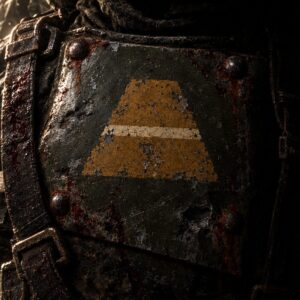
| Turret band | #988E56 · Zandri Dust (Dike Ochre) |
| Markings | #E6E0CF · Wraithbone (standard colour) |
| Hull recipe | Castellan Green (Base) · Athonian Camoshade (Shade) · Dawnstone (Layer) · Nurgling Green (Edge) |
Company bands on the turret
- 1.
- 2.
- 3.
- 4.
- 5.
- 6.
- 7.
- 8.
- 9.
Derived from the regimental colours; the silhouettes are our own sketches, not copies of any Games Workshop model.
Notes on the core facts
The ordinal 62 is high for a low-lying Agri World: for centuries Ossenfeld has given up whole year-groups in every generation, and the Munitorum reissues extinguished numbers rather than retiring them. Today's 62nd is the third raising under this number, after 611.M41 and 787.M41. Both predecessors were ground down; neither came home. The men and women of 932.M41 bear their two battle honours on the standard, yet know not a single name of the dead behind them. People speak of "the Old Sixty-Seconds" as one speaks of a flood that came before one's own birth: with respect, without memory.
A Scene
The rain on the Teskar slopes fell horizontally, and for four days Commissar Ilian Brecht had known dry socks only as a memory. He had been assigned a week earlier, fresh from the Schola, with a bolt pistol that still smelled of sacred oil and a personnel file stating that the 62nd Ossenfeld Rifles were considered "reliable, with reservations".
He understood the reservations that evening.
Company Four stood in the mud behind the parapet, too low, as he noted, and a seam-warden with hollow cheeks read names from a sodden data-slate. For each one a voice answered: "Here." Then the list changed.
"Ammerlan, Josse."
"Pending," said sixty voices at once.
"Baarsch, Hedde."
"Pending."
Brecht leaned towards the Senior Commissar standing beside him, her hood pulled over the crooked bridge of her nose. "Who are these people?"
"Company Three," said Sarc. "Karnau."
"The company has been struck off. I have seen the form."
"Presumed struck off," she said. "The word is in there."
The names went on. At first Brecht counted along, then he stopped. A boy in the second row, by his face twenty at most, did not say the answer aloud, only with his lips, and at one particular name not at all. The man beside him laid a hand on his shoulder without looking.
"This is against regulations," said Brecht. "An evening count covers actual strength."
"Then write it down." Sarc did not look away from the company. "The Lord Commissar wrote it down too. He sits somewhere else now, and the count still goes on."
"Why do you allow it?"
She was silent for so long that he thought she would not answer. The seam-warden had reached the Ks.
"Yes," said Brecht.
"This," she said, indicating the ranks in the mud with her chin, "is the price for it. They pay it every evening. I do not want to be the one who forbids them to pay."
"Reiss, Tobias," read the seam-warden.
"Pending."
This time the boy in the second row said it aloud, louder than all the others, and then he said nothing more until the end of the list. That was 160 names, and it took an hour. Afterwards the seam-warden gave the order to raise the parapet by one layer. No one protested, and no one dug deeper.
Brecht drew out his data-slate to record the infraction. He wrote the date. He wrote "Evening count, Company Four". Then he stood there in the rain, stylus poised over the field, until the slate fogged and switched itself off.
From this Regiment
Stories 1
Characters 2
- Nahtwartin Geeske Siefken Nahtwartin der 62. Ossenfeld-Schützen, Abschnitt Nordwall des Sammellagers Gethsemar
- Tobias Reiss Guardsman, from the 11th day de facto company commander without orders