The Dead-Draw
Astra Militarum (62nd Ossenfeld Rifles) · Munitorum (Ordinat Corrin)
„A man is not struck out by one signature. He is only confirmed by a second.“
I. The Return
The dyke-runner brought the post only after the tide, when the water had fallen back below the Ossenfeld South marker, and that morning he brought three letters and an official sheet with the double eagle of the Munitorum. Halvard Reiss took it with the same hands with which he had been mending the dykes of the Fourth Chamber for twenty-seven years, hands that knew where a seam was giving before the eye saw it.
He had used those hands to pull Elena out of the water as well, eleven years before, when Chamber Two broke in the night and they were both outside, because they had always both been. With her he had come too late. He had sworn to himself that it would not happen again to anybody he loved, an oath no dyke in the world could guarantee and that he kept all the same, every day, with the same hands.
Form M-9 had fourteen fields. He read them in the order in which they were printed, because he believed that a form which closed a human life ought at least to follow its own logic.
Name: Tobias Reiss. Identity number: OSF-62-4471. Circumstance: missing, presumed killed, engagement at the Karnau Causeway, 34th day 934.M41.
Under the field for the circumstance stood the first signature of a unit commander whose name he did not know, and beneath it, in a different ink, the countersignature of an officer who had never commanded Tobias. Two signatures, neither of them from anybody who had ever seen his son, since the boy had stepped into a line of shaved heads on the landing field of Ossenfeld North and had not turned round again, because they had been told that turning round angered the instructors.
Presumed. The word sat in that form like a pebble in a seam, small, but enough that a whole structure gave way eventually if you let it.
Halvard folded the sheet along the line provided, the way he had been taught, neatly, without tearing the paper, and did not put it away, not in the drawer, not in the fire. He went out to the chamber that same day and checked Seam Fourteen, which had been worrying him for a week, because a man who is working is not thinking, and because he thought as soon as he stopped.
II. What a Pending Roll Is
Father Ossred of the chapel house knew the word when Halvard brought it to him in the evening, together with the folded sheet. "Presumed is not a verdict," said the father, who had once served as a field chaplain himself before Ossenfeld reclaimed him. "It is a deferral. The Munitorum does not write lies, Halvard. But neither does it write what it does not know, and what it does not know becomes its pending roll."
The pending roll, he explained, was a register for units that were neither confirmed as existing nor struck out as extinguished. A regiment could stand on it for years, sometimes for ever, a name in a book nobody closed, because nobody wanted to carry the responsibility of closing it.
"And the men in it?"
"Stand with it. Neither the one nor the other. For as long as it takes until somebody looks."
That was more than the form had said, and Halvard took it like a second seam that could be worked at. He sold the spare sluice-gate he had been keeping for twelve years against the day the old one finally broke, for a passage on a freighter of the Ordinat line. He told nobody in the chamber where he was going, because he knew what they would say: that a man who held the dykes of a whole province alone was not allowed to leave them, not for a dead man.
He left them all the same, entrusted to a neighbour who did not know the seams as well as he did. He was not certain that it was for a dead man. That was the whole reason he needed.
III. Ordinat Corrin
The reconciliation chancellery Ordinat Corrin hung in an orbit Halvard could never have found had it not been so large that it darkened half the sky over the Gethsemar collection point: a gothic tower of blackened metal in which, as he was told at the reception counter, more paper was stored than there were people living on Ossenfeld.
He waited eighteen days in the antechamber of the Third Registry, on a bench with others who carried the same waiting as he did: an old man asking after his granddaughter, a married couple who no longer looked at each other, a woman with an infant whom nobody addressed, because her eyes said she did not want it. Halvard spoke little with any of them. He watched the noticeboards instead, on which requisition numbers and reconciliation notes hung, because a man who reads dykes reads a noticeboard too, if you give him nothing else.
On the nineteenth day a voice called his identity number, not his name, and he stepped up to a desk at which a young woman sat with the badge of a Subadjutrix, her eyes red from the artificial light of the chancellery.
"Reiss, Tobias, OSF-62-4471," she read off a screen Halvard could not see. "The file is in reconciliation."
"What does that mean for me."
"It means it is not closed." She looked at him properly for the first time, not through him, the way the guard at the gate had done. "It also does not mean that it will be soon. Ordinat Corrin reconciles over four hundred regiments, Master Reiss. Karnau was one of thirty-nine engagements in this quarter alone."
"How long does a reconciliation take."
"Sometimes years."
He said that he would wait, however long it took, and she looked at him as though she had heard that sentence often and knew exactly how seldom it was true. Her name plate bore the name Meva Holt. She wrote no undertaking into his file, she was not permitted to, but she wrote a note he could not read, and named him a dormitory for those waiting in which it cost nothing to take a bunk.
On the seventh day he saw the old man from the bench beside him being called, and coming back empty-handed, his face so expressionless that Halvard grasped it: that was the answer he himself feared most, not a no, but nothing at all, a file that was neither closed nor opened, only moved, into a queue behind another queue. The old man did not sit down again. He went, without anybody watching him go, and the next morning his place on the bench was empty, as though he had never been.
Halvard began to memorise the faces that disappeared, and the ones that stayed. More disappeared.
IV. The Dead-Draw
He came back every day, not because anybody had told him to, but because a man with nothing to mend slowly loses his mind, and because the waiting hall of Ordinat Corrin with its endless noticeboards was the only thing in that strange orbit that felt like a dyke chamber: something that could be read if you were patient enough and knew what you were looking for.
On the twelfth day of his second week he found the figure.
Requisitions for the 62nd Ossenfeld Rifles, Third Company, were still running. Rations. Dressings. Bolter ammunition, standard calibre. All charged to the old unit number OSF-62-K3, dated six weeks after the day that stood on his Form M-9.
A dead-draw, an old administrative adept explained to him later, whom he stood a drink with the last money he had, because the man did not talk otherwise. A supply line that keeps running after the unit it supplied has stopped existing in the register. Usually an error, said the adept. A cart following a dead address because nobody formally withdrew the order.
"Usually," Halvard repeated.
"Sometimes," said the adept, and did not look up while he said it, "it means that somebody at the other end is still signing for it."
Halvard laid the list on Meva Holt's desk the next morning, with the six weeks underlined in red, the way he would have done with a seam nobody else had noticed. This time she looked at it longer than her position required of her, and this time she did not put the sheet back in the file but into a different folder, without telling him which.
V. The Karnau Causeway
What happened after that did not happen because Halvard forced it. It happened because a Subadjutrix second class wrote a note she need not have written, and passed it one level higher than her rank actually permitted. Six weeks later a decision came, short and without a salutation: a reconnaissance party of the Ordinat had visited the Karnau Causeway again, this time not to count the fallen but to check a footnote that a Subadjutrix second class had judged important enough.
They found nineteen men and women of Third Company in an earthwork position eight hundred metres behind a line that existed on no Munitorum map any more, because the map which had once drawn that line lay buried with the rest of the staff quarters at the causeway. They had reordered themselves, without orders, because there was nobody left who could have given any, and they had gone on using the requisition number of their officially extinguished company, because it was the only number under which anybody still delivered them anything.
Tobias Reiss had led them since the eleventh day, on which the last officer above him had died. He had lost his left hand at the causeway and wore in its place a field prosthetic of blackened plasteel, crudely welded but serviceable, the way a man builds a prosthetic who knows that nobody is coming to do it for him. He had been nineteen when he left Ossenfeld. He was twenty-two when the decision reached his father, and in the time between he had learned to command a company that, by every book the Imperium kept, no longer existed.
VI. The One Hour
Tobias stood narrower in the doorway than Halvard remembered him, the skin over the cheekbones taut as sailcloth, the green of the uniform lighter at the seams where it had been washed too often. A man who did not know him would have taken him for older than twenty-two. They did not bring Halvard to him. They brought Tobias to Ordinat Corrin, with the eighteen others, for reconciliation, for medical examination, for reassignment, a procedure with its own forms and its own deadlines that Halvard could not change, any more than he could have changed the tide that had taken Elena. Only at the outermost edge of that procedure, in a waiting room of the Fourth Registry, did Meva Holt, against a regulation she did not read that day, leave father and son alone for an hour.
Tobias recognised him first by the hands. "You never finished mending Seam Fourteen," he said, and it did not sound like a reproach. It was simply the first thing that came to him about a home he had not seen for three years, except behind closed eyes.
"It holds," said Halvard. "It has held since I knew you were coming back."
They did not talk about Karnau. An hour was not enough for a causeway where nineteen out of a hundred and sixty had been left, and Halvard did not ask, because he knew what a man who mends seams did not have to force his son to say as well.
The reconciliation, he knew just as well, would not end where both of them wished it would end. A company that had survived nineteen months without orders was not sent home. It was re-equipped and assigned to a regiment that needed reinforcement, for nineteen survivors of a lost post possessed exactly the hardness the Munitorum would demand next, and nobody in that tower would decide otherwise just because a dyke-master from Ossenfeld had waited nineteen days in an antechamber.
Halvard knew that as he drew his son to him one last time, before the guard came to take him to the examination. He had not expected to see him alive again. He had not believed it, against every form, every signature, every pending roll, and he had been proved right. That was not enough to be sure what would become of Tobias. It was enough to know what he had been, in the one hour they had been given, and to know that he would do it again.
He returned to Ossenfeld alone and finished mending Seam Fourteen, in the night the next tide came, because a dyke that held was the only thing he could still give his son, while somewhere far from here they were re-equipping him for a war whose name neither of them would ever learn.
VII. What Gets Past the Censor
The Munitorum's message service let one line past the censor twice a year, no more, and the first reached Ossenfeld seven months later, on a day when the tide stood unusually high and Halvard was working knee-deep in the water of the Fourth Chamber. A messenger brought the slip out to the dyke, because he knew that Halvard would otherwise not come home before dark.
Seven lines, blacked out but for four. Company renamed. New designation assigned. Right hand, not left, shrapnel this time, healed. Greet the dyke.
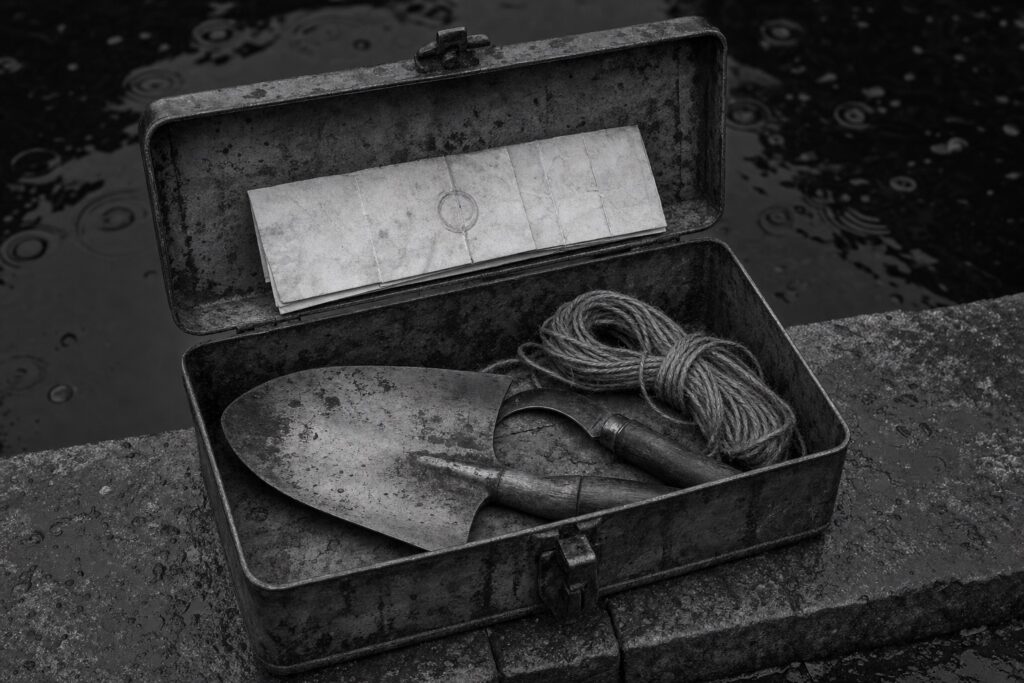
There was no regiment with it, no theatre of war, no date except that of the stamp, and Halvard knew that there could not be one, that a blacked-out line was the only form in which the Imperium allowed a father to know his son still alive without betraying where. He folded the slip as he had folded Form M-9, along a line, neatly, and tucked it between the lid of his toolbox and the metal, where the water could not reach it.
He waited now twice a year for the messenger, the way he had once waited for the dyke-runner, and in between he mended every seam the Fourth Chamber possessed, because he had learned that waiting came easier when the hands found something to hold. It was not an ending he would have wished for when he sold the spare sluice-gate. It was the ending he had been given, and he took it the way he took everything the dyke gave him: with both hands, without choosing.
Download story as PDF or EPUB
Enter your email address. After confirming your subscription you'll get the download links immediately and by email.