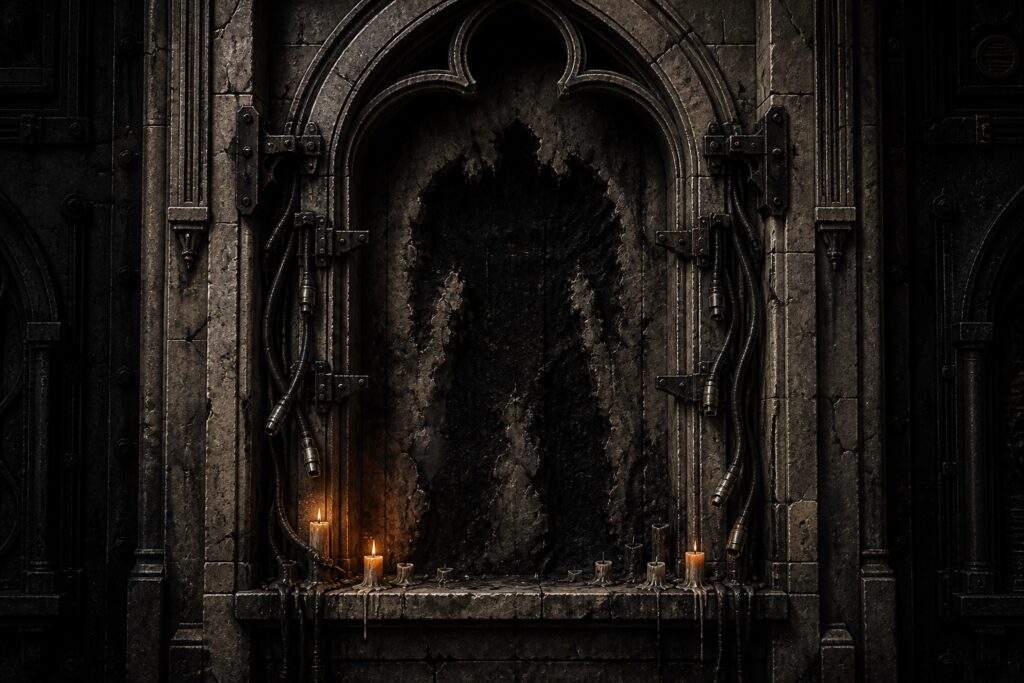
What the Iron Keeps
A Tale of the Iron Veins
The Iron Veins
„The iron keeps what the flesh forgets. It also keeps what would be better forgotten.“
Aus der Vigil der Ehrwürdigen, Orden der Eisenadern
I.
The incense they burned in the Smelting Cathedral did not smell of herbs. It smelled of hot metal and of the bitter oil with which the adepts anointed the joints of the Venerable, and Brother-Techmarine Kael'dun had breathed that smell so often that he no longer noticed it, until it was missing.
He knelt on the lowest step of the Hall of Relics, his skull leaned against the cold brow plate of the sarcophagus, and waited.
"You are here again," said the voice from the vox-grille. It came slowly, with the reverberation of something that had to pass through a great deal of metal and a great deal of time before it reached the air. "The third time this week."
"It is the only week in which I am counting, Venerable."
"That is no answer."
Kael'dun opened his eyes. Above him the sarcophagus loomed, twelve feet of ceramite and adamantium, blackened by two centuries of incense and battle-soot, its armour plates covered with the names of worlds that no longer existed. Venerable Sorvain had stood motionless in his alcove for four days, his fists lowered to the floor, waiting as Kael'dun himself waited for the Vigil to begin.
"We lost Ossiaan," Kael'dun said at last. "And Threll. And half the third squad."
"I know. I heard the litany when it was read out."
"You were not awake."
"I am never fully awake and never fully not." A sound like a sigh, though Kael'dun knew perfectly well that there was no lung left in that shell that could sigh — only a circulatory system that cooled the half-dead remnant of a brain, and a vox-transducer that pressed the remains of a man into words a man could still understand. "Tell me how they died."
So he told him. That was the bargain the two of them had kept for seven years, since Kael'dun had first entered the Hall of Relics as a young Initiate to clean the oil channels of the sarcophagus, and Sorvain had spoken to him without anyone ever having told him that the Venerable did such a thing. Kael'dun brought him the dead, one after another, with names and circumstances, and Sorvain listened the way an old man listens to a grandchild telling of the harvest — with an attention that knew no haste, because haste no longer held any meaning for him.
When Kael'dun had finished, the hall was silent but for the dripping of condensed coolant somewhere in the pipework above them.
"Threll was nineteen," Sorvain said at last.
"Yes."
"I was twenty-two when they put me into this thing." The voice did not grow warmer; the vox-transducer knew only one volume. But something in its rhythm slowed, became almost tender. "I remember my sister's face better than those of the last three Chapter Masters I served under. Mark that, Kael'dun. In the end it is not what was important that remains. Only what is burned in deep enough remains."
Kael'dun could have asked what was burned in deep enough to hold Sorvain in that thing for over two hundred years without his ever asking for it to be ended — he had put that question once, years ago, and received no answer, only a silence that lasted three days. So he did not put it a second time.
Instead he said: "The Vigil begins in two days."
"I know." Something in the hydraulic joints of the sarcophagus clicked, a sound like an old man clearing his throat. "Kel-Vantor."
"Kel-Vantor."
"How often have I been there?"
"This would be your third Vigil since you were interred." Kael'dun rose, brushed the ash from his knees. "Two hundred and eleven years, Venerable. Three renewals."
"Then it is time they flushed out my oil channels again. I am beginning to forget things I do not allow myself to forget." A pause. "Who accompanies me this time?"
"I do." Kael'dun looked up at the massive, motionless silhouette. "The Chapter Master has confirmed it."
"Good," said Sorvain, and in that single word lay more relief than the vox-transducer should have been able to carry. "Then at least someone will be there who knows how to speak to me when they open my skull."
II.
Aschgrat was a world of ash and iron, as its name promised, but its inhabitants called it fondly the Greyworld, because the word ash sounded too much like death for a place in which they were born. Volcanic ridges ran across the northern continent like the ribs of a fallen titan, and the Smelting Cathedral stood upon the highest of them, half hewn into the rock, half cast from molten ore, a structure that looked as though it had shaped itself out of the lava in which it stood.
The Chapter of the Iron Veins was young by the standards of the Adeptus Astartes — barely four centuries since its founding — but their legend of origin told of brothers of the Fire Wardens who had been stranded on Aschgrat when their ship was lost in the Warp, and who for a generation had to survive without resupply, without new gene-seed, alone with what the ore of the world gave them. It was said that in those years they had learned not to bury their dead but to keep them — every armour plate, every weapon, every piece of flesh that could be salvaged was taken back into service, until the Chapter counted more Venerable, in proportion to its living brothers, than any other Salamanders successor Chapter Kael'dun knew of.
That was the origin of their name. Not veins of blood. Veins of iron, running through the whole Chapter, from the youngest Initiates to the oldest sarcophagi, and all of them joined to the same heart.
Kael'dun stood on the landing ramp of the Vigilantis while beneath him Aschgrat shrank to a grey sphere, and watched the loading cranes hoist the transport casket holding Venerable Sorvain into the cargo hold. Five more sarcophagi were already stowed — the other Venerable travelling to the Vigil, each of them older, more silent, more legend than man. Kael'dun knew their names. He also knew that none of them spoke any longer the way Sorvain spoke. Some had not sent a word through the vox-transducer in decades, except in battle, where the Litanies of Wrath broke out of them like something that required no permission.
"You stare at him as though he might wave to you," said Sergeant Doran Vek, stepping up beside him.
"He could, if he wanted to."
"That would frighten the cargo servitors." Vek was ten years older than Kael'dun, broad-shouldered in a way that had nothing to do with the stature of an Astartes and everything to do with the bearing of a man who had seen too many brothers fall to afford making himself small any longer. He carried his helmet under his arm, and his eyes, as he looked across to the cargo hold, held something of the same weariness Kael'dun felt in himself. "How is he?"
"He wants his oil channels flushed out."
"That was not the question."
Kael'dun was silent for a moment. Below them the last cloud-bands of Aschgrat slid past, then nothing but the black between the stars. "He remembers things he should not remember," he said at last. "His sister's face. Details two hundred years old, clearer than what happened last week."
"Is that not normal? For them?"
"I do not know." Kael'dun looked at his own hands, at the gauntlets beneath which the first implants of the Techmarine consecration were already hidden under his skin, cold knots of metal that one day, if he grew old enough, if he served long enough, might be the only thing left of him. "I am no Venerable. I only know what he tells me."
Vek nodded slowly, as though he had reckoned with precisely that answer, and laid a hand on Kael'dun's shoulder — brief, firm, then gone, the kind of gesture that needed to explain nothing between brothers. "Then look after him when we are down there. The priesthood of Kel-Vantor treats our Venerable like machines that need repairing. To us they are more."
"I know that, Sergeant."
"I know that you know." Vek gave him a sidelong look, almost a smile. "I say it anyway. Some things have to be said aloud to stay true."
Behind them, in the corridor, footsteps approached — lighter, quicker than those of a fully armoured brother. Brother Tal'ir, the youngest Initiate of the squad, came with a piece of armour under his arm that he had obviously fetched from the armoury too early, and stopped abruptly when he saw the two of them.
"Sergeant. Brother-Techmarine." He nodded hastily, a little too formally, a little too young. "I — I was to check the Kheres ammunition we are bringing for the Skitarii escort."
"You were," said Vek drily. "Where is it?"
Tal'ir opened his mouth, closed it again, and Kael'dun suppressed a smile, his first in days. He still remembered well what it had been like to be seventeen and to stand in armour that sat a little too loose, and to be constantly afraid that someone would notice how much one did not yet know.
"In the munitions room, where it belongs," said Kael'dun. "Go. I will follow in an hour and check it together with you."
The boy — he was no boy any longer, technically, since his gene-seed had taken root, but Kael'dun could not get used to seeing him otherwise — nodded in relief and disappeared back into the corridor.
"He will turn out well," said Vek when the footsteps had faded.
"If he does not die of over-eagerness first."
"They said that about you too."
Kael'dun said nothing to that. He looked again towards the cargo hold, where the sarcophagi rested in their cradles, six towers of memory and iron travelling through the darkness between the stars to be touched once more, woken once more, honed once more, before they were sent back into the war.
They stood on in silence for a while as the Vigilantis accelerated into Warp transition, and Vek, who evidently was not yet finished with the conversation, leaned against the rail of the ramp.
"Do you know why I became a Sergeant and not a Techmarine?" he asked abruptly.
"Because you left a servo-driver stuck in a coolant line during the fine-mechanics examination. Everyone in the Third Company tells that one."
Vek snorted, almost a laugh. "That too. But the real reason is that I could not bear to speak with them before I was ready to listen to them. As an Initiate I avoided the Hall of Relics for two years, did you know that? I thought it disrespectful to talk at the dead, when it was plain that they had in fact already died and simply had not been buried yet." He looked across at the sarcophagi, his face barely readable in the faint light of the ramp lumens. "Only when an old brother explained to me that they take it as a greater insult to be ignored than to be called dead did I begin to understand what our Chapter actually is."
"What is it?"
"A promise that no one is lost twice." Vek shrugged, as though his own solemnity embarrassed him. "Once in death. Not a second time in forgetting. That is what the founding brothers learned on this world when they sat there without resupply and had to take every fallen man back into service in order to survive — and at some point out of the necessity a conviction. That is why we carry more Venerable than any other Chapter of our bloodline. Not because we die more. Because we refuse to let them go."
"That sounds almost as though you envied them."
"Sometimes." Vek said it without shame. "There are days when I wish someone would still remember me two hundred years after my flesh is long since ash. And there are days when I look at Venerable Gorrath — who has not spoken a word in sixty years, who knows only the Litany of Wrath when the bolters speak — and ask myself whether that is a blessing or the cruellest punishment our Chapter holds ready for its heroes."
Kael'dun thought of Sorvain, of the weariness in his voice, of the weight of two hundred and eleven years of memory, and said nothing, because he had no honest answer to that question that did not frighten him himself.
III.
Kel-Vantor was not a moon as one imagined a moon. It had no atmosphere worthy of the name, no surface that was not eaten away by millennia of mining — only a grey, scarred sphere that circled the gas giant Aschtor and whose entire interior, so it was said, was riddled with shafts deeper than any survey had ever reached.
The priesthood of the Adeptus Mechanicus had settled here over six hundred years ago, long before the Iron Veins were even founded, drawn by ore veins that by standard measure ought to have been impossible — alloys whose composition even the oldest cogitators could not wholly decipher, recovered from shafts older than any record of the priesthood. The pact between the Iron Veins and the Cohort of Kel-Vantor was as old as the Chapter itself: ore and tithe-labour in exchange for what the priesthood did best — the maintenance of that which had become almost machine out of flesh.
"You come late," said Magos Serevin Achtal as the Iron Veins' landing craft settled in the reception cavern and the ramp opened. She stood there alone, surrounded by a wreath of servo-skulls that circled her like sluggish satellites, her lower body long since replaced by a spider frame of steel legs that lifted her half a metre above the floor. Her face, what of it was still face, wore the calm, almost bored expression of someone who had said the same thing for centuries and meant it exactly the same each time.
"Sixteen hours, Magos," said Kael'dun, and was the first down the ramp. "A Warp eddy pushed us off the planned route."
"Sixteen hours are sixteen hours too much coolant evaporation in six sarcophagi." Achtal turned her head — a mechanical sound, not an organic one — and her optics slid across the cargo hold, where the loading cranes were already beginning to lift the sarcophagi onto their transport frames. "But that can be corrected. You are not the first to arrive late, and you will not be the last."
Behind her, half hidden in the red shadow of the cavern, waited a smaller figure in the grey-red robe of an Enginseer, a young man — young, for a Mechanicus priest, which could mean he was between fifty and a hundred years old — with a single mechadendrite moving restlessly across his shoulder like an animal that had not yet learned to sit still.
"Enginseer Corvic Amsel," Achtal introduced him, without turning round. "He will oversee the cleansing of the oil channels while I attend to the deeper diagnostics. You —" her gaze fell on Kael'dun, "— are the Techmarine who has been granted consent to accompany them."
"Yes, Magos."
"Then you know the rules." She turned fully towards him, and for the first time something rang in her voice that was not quite courtesy and not quite warning, but something between the two. "You may be present during the Vigil. You may speak with your Venerable as long as the procedure permits. You may not intervene in the ritual chamber of the Heart-Opening, even if the instincts of the flesh press you to it. What happens there happens by the rites of the Omnissiah, not by the customs of the Astartes."
"I understood that at the last two Vigils, Magos."
"I said it at the last two Vigils as well." Her optics narrowed — a mechanical iris, not an expression, but Kael'dun had learned to read something like personality into such small movements. "And nevertheless your predecessor tried, forty years ago, to place himself between a Skitarii chirurgeon and the opened skull of a Venerable because he did not care for the sound. I repeat the rules because repetition is the foundation of all discipline."
Kael'dun lowered his head, half assent, half respect for an authority he had no wish to dispute. "Understood."
"Good." She turned away, the spider legs clicking on the stone floor as she glided back into the darkness of the cavern. "Then follow me. The reliquaries are prepared. And Techmarine —" she glanced once more over her shoulder, "— this year there is a change to the protocol. We have opened a new vein in the lower shafts. I shall have to draw off a part of my Skitarii there while the Vigil runs. Should delays occur, it is not for want of zeal."
"A new vein?"
"The Sixth Shaft." Something in her tone — not quite caution, but something Kael'dun could not immediately place. "It has been sealed for three hundred years. The cartographers believe it leads into a pre-Imperial structure. The Fabricator Locum insists that we open it up while the current tithe quota allows it." She made a pause that was unusually long for a machine. "It is nothing you need trouble yourselves about."
She said it with the certainty of someone who knew perfectly well that it was.
IV.
The Reliquary Chamber of Kel-Vantor lay a thousand metres beneath the surface, in a natural cavern that the priesthood had clad over centuries with pipework, cranes and altars of polished ore, until it looked like the interior of a gigantic mechanical heart. Six alcoves waited there, each ringed by a wreath of servo-arms and diagnostic cables, and as the Venerable were lifted one after another into their positions, a singing began in the chamber that Kael'dun had heard twice before and that seized him equally each time.
It was not human singing. It was binaric cant — the Canticles of the Omnissiah, spoken in the pulsed code of the priesthood, overlaid by a deeper, slower choir of the same litanies in Gothic, sung by the few Enginseers who still possessed a throat with which to sing. The words spoke of preservation, of the sanctity of that which is kept, of the sin of forgetting.
Sorvain's sarcophagus was lifted into the fourth alcove, and Kael'dun took his place before it while Enginseer Amsel opened the first diagnostic socket in the armoured chest with his mechadendrite.
"It begins again," said Sorvain's voice, quieter now, as though the nearness of the chamber itself had done something to him.
"It begins."
"I had forgotten how cold it is here." A click, a hiss of hydraulic pressure as the first cables slid into the sockets. "Not the air. Something else. Something that comes through the metal itself."
Amsel, working with lowered head over a control panel, glanced up briefly; his real eyes, beneath the bald skull and the implanted data ports, showed something that looked almost like curiosity. "The Venerable report that sometimes," he said, more to himself than to Kael'dun. "We believe it is the resonance of the deep shafts. Kel-Vantor is... louder than a moon should be. At frequencies only a Venerable still perceives."
"Louder how?"
Amsel shrugged one shoulder — a very human gesture for a man who was half priest. "That I never found out, Brother-Techmarine. I am an Enginseer, not an archeotech specialist. Ask the Magos if you want a real answer, and even she will tell you that the answer is not yet complete."
Above them one of the reliquary domes began to open, an immense mechanical iris that slid slowly apart and gave onto a wreath of hovering servo-skulls whose red optics hung like stars in the darkness. Kael'dun had seen this sight twice before, and both times he had asked himself whether it was blasphemy to find it beautiful.
The procedure began.
He had learned not to speak at such moments, only to listen, while the Enginseers and Skitarii chirurgeons worked around Sorvain's sarcophagus, loosening armour plates, laying bare the inner systems, drawing off coolant and replacing it with fresh, testing every sensor, oiling every joint. It was a work of hours, sometimes of days, and somewhere in the middle of it — when the sarcophagus itself was opened, when what was left of Sorvain's body was exposed for a short, terrible moment to the air of the chamber — the voice from the vox-transducer ceased to speak, because the transducer itself had been disconnected, and Kael'dun could only stand beside it and wait for it to come back.
This time it took longer than usual.
In the silence between the disconnection of the vox-transducer and what came after, Sorvain was alone with himself, as he only ever was in those hours — no Kael'dun listening, no litany to fill him, only what was left when a man's mouth is sewn shut and he is nevertheless commanded to go on thinking.
He remembered a summer on Aschgrat, before it had been Aschgrat to him — before the Chapter, before the consecration, before a recruiting party had ever reached his home settlement. He remembered his sister, who was younger and ran faster and always called him by the name he had not heard in two hundred years, because no one was alive any longer who knew it, and the vox-transducer could not speak it, because there was no mouth left to shape it.
And in among it all, like a crack in an otherwise flawless pane, he felt something else. Not remembering. A calling. Something that crept through the ore of Kel-Vantor, through the cables that were at that very moment being pushed into his exposed skull base, and that knew his name, though no one but Kael'dun and the priesthood had ever spoken it since he had been put into this thing.
Brother, it said, and the voice was not unkind, which was the worst of it. Brother, how long have you been carrying what is not yours?
He had no mouth with which to answer. But for the first time in a very long while he wished for one.
Enginseer Amsel raised his head after the fourth hour, his voice more strained than before. He had attached a diagnostic device to the exposed skull base of the sarcophagus, and the runic script upon it flickered in a pattern that even Kael'dun, who was no Mechanicus adept, recognised as irregular. "The neural matrix is showing activity that does not correspond to the dormant state."
"Is that dangerous?"
"I do not know." Amsel sounded, for the first time, genuinely troubled. "I will fetch the Magos."
He disappeared, with hurried steps that were unusually hurried for a priest of the Mechanicus, and Kael'dun was left behind alone, while the sarcophagus — opened, half gutted, its precious freight exposed to the cold light of the chamber — stood before him like a creature in a dream.
Kael'dun.
It was not a voice, not really, not the accustomed sound of the vox-transducer. It was more a feeling, a pressure behind his own ears, so faint that at first he thought he had imagined it.
"Sorvain?"
I hear something.
"What? Where?"
Beneath us. The words came laboriously, distorted, as though they had to pass through more than merely damaged circuits. It is old. It is... it knows me.
Kael'dun stepped closer, laid a hand on the cold ceramite plate, there where Sorvain's heart had once sat before it was replaced by a pumping organ that no longer deserved the name. "How can something know you?"
No answer. Only the quiet humming of the diagnostic apparatus, and somewhere, deep beneath the rock of Kel-Vantor, a tremor that Kael'dun felt more in his bones than heard in his ears — brief, barely perceptible, and then still again.
V.
Magos Achtal came with a haste Kael'dun had never seen in her, her spider legs clattering across the stone floor like the limbs of an insect that scents prey. Behind her followed three Skitarii Rangers, their galvanic rifles ready in their arms, their optics in that fixed, glassy stare that only cybernetically altered eyes had.
"Show me the readings," she said before she was even fully inside the chamber, and Amsel handed her the diagnostic device without a word.
She studied it for a long moment, her optics flickering in rapid rhythm as she processed data streams that to Kael'dun would have been nothing but noise. Then she said something in binaric cant, too fast and too alien for him to understand, and Amsel answered in the same code.
"Magos," said Kael'dun when the silence had lasted too long. "What is wrong with him?"
Achtal turned to him, and for the first time since he had known her he saw something in her mechanical bearing that he would have read as hesitation had she still possessed flesh enough to hesitate.
"Three hours ago our salvage teams reached a chamber in the Sixth Shaft," she said slowly. "A chamber that corresponds to none of the pit charts we possess. Its construction — the alloys, the geometry —" she paused, as though searching for words that sounded disciplined enough for what she had to say. "It dates from the Dark Age of Technology."
Kael'dun felt his stomach tighten. "And?"
"And since the chamber was opened we have been registering anomalies in the noosphere of Kel-Vantor. Data corruption. Servitors that do not respond to their command sequences. And now" — she pointed with one of the servo-skulls hovering about her at Sorvain's open sarcophagus — "neural activity in a Venerable that corresponds to no known pattern."
"You believe the one has to do with the other."
"I believe nothing. I observe correlations and draw the nearest conclusion." Her voice grew harder, more precise, the timbre of a person who takes refuge in procedure when reality becomes too uncertain. "And the nearest conclusion is that we have found something we should not have found."
"Silica Animus," said Amsel quietly, almost as a confession, and Achtal wheeled on him with a speed that showed how much she had avoided the word herself.
"We do not know what it is," she said sharply. "Before anyone speaks that word again, I want certainty. Not conjecture. Certainty." She turned back to Kael'dun, and her optics bored into his with an intensity no machine should have. "Techmarine. Your Venerable — has he communicated anything?"
Kael'dun hesitated. Something in him that had tended Sorvain's trust for seven years, word by word, litany by litany, wanted to lie. But he had learned in his training that lying to the Mechanicus, where the integrity of a Venerable was concerned, was a sin one did not take upon oneself without knowing the consequences.
"He said he hears something. That it knows him."
Achtal's optics flickered, a rapid, restless pattern. "Knows," she repeated. "An interesting word for a data construct."
"What does that mean?"
"It means, Techmarine, that I have five more Venerable in this chamber whose neural matrices are still stable, and I will not risk them while we find out what sleeps in that shaft." She turned to the Skitarii. "Isolate the fourth alcove. Sever every vox and data connection of the sarcophagus from the central noosphere. If this thing seeks a way into our systems, it will not reach our heart through an open channel."
"You will not shut him down," said Kael'dun, and it came out more sharply than he had intended.
Achtal paused. "That is not my intention. Not yet." Her optics measured him, with something that looked almost like understanding, wrapped in mechanical cold. "You love that sarcophagus, Techmarine. I respect that. But I bear a responsibility that goes beyond a single Venerable, and if it should prove that what lies in the Sixth Shaft is a threat to the integrity of this moon — then that responsibility will decide over your love, not I."
She turned away, gave further orders in rapid binaric cant, while the Skitarii began to pull cables, to sever vox connections, to raise a wreath of red pulsing warning runes around Sorvain's alcove. Kael'dun stood beside it, helpless in a way he had not felt since his days as an Initiate, and watched his old teacher, his friend, being wrapped in silence.
"Sorvain," he said quietly, before the last connection was severed. "Can you still hear me?"
For a long moment nothing came. Then, just as the last technician pulled the cable:
Look after the boy.
"Which boy?"
But the connection was gone, and Sorvain's sarcophagus stood still and dark in its alcove, isolated, alone, and Kael'dun could do nothing but stand there and ask himself which boy he had meant.
VI.
The answer came sooner than he liked.
Two hours later a vox-call reached him from Sergeant Vek, curt and tense: a salvage party in the Sixth Shaft had lost contact. Six Skitarii vanguard, a Datasmith, and — Kael'dun's stomach cramped as he heard the name — Brother Tal'ir, who had been sent along as escort for the Astartes tithe mission to gain experience in dealing with the priesthood.
"I thought he was supposed to be counting ammunition," said Kael'dun as he ran through the corridors of the cavern, his armour feeling tighter with every step.
"He was. Until the Magos requested additional escort for the shaft, and the Chapter Master — before our departure, for the emergency — had ordered that we cooperate." Vek was waiting for him at the junction to the deep lifts, already in full battle gear, his bolter at the ready. "The boy wanted to prove himself. I should have held him back."
"You could not have known."
"That is not an excuse, Brother-Techmarine. That is a statement of fact." Vek's jaw was tight, his voice carrying the sound of a man who blamed himself before anyone else could. "Achtal has sent two more Skitarii squads into the shaft. We are going with them."
The lift that carried them into the depths was no Imperial construction — it bore the hand of the Mechanicus, covered with runes that even Kael'dun recognised as very, very old, older than anything he had yet seen on Kel-Vantor. When the doors finally opened, they arrived not in a mine but in something that put him more in mind of a cathedral — a vast, natural cavern whose walls were strewn with geometric patterns that no human eye had shaped, and in whose centre a structure reared up, black, smooth, without a single seam, as though cast in a single pour.
"By the ash of the Mother Volcano," Vek murmured, and Kael'dun felt his own neck bristle.
The Skitarii they reached stood in loose formation around the entrance of the black structure, their weapons raised, but no one fired, no one moved, as though the chamber itself had brought them to a halt. Enginseer Amsel — who had evidently hurried on ahead of them, at an urgent summons from the Magos — knelt beside one of the Skitarii Rangers, who lay motionless on the ground, his helmet open, his eyes wide and staring in a way that Kael'dun did not like.
"What is wrong with him?" Kael'dun asked.
"He lives," said Amsel without looking up. "But his cogitator is... overwritten. We do not yet know with what." He looked up at last, his face pale beneath the bare skin of his skull. "Brother-Techmarine — I have found Brother Tal'ir."
"Where?"
"There." Amsel pointed to the entrance of the black structure, where a narrow fissure gaped in the smooth surface like a wound. "He went inside before anyone could stop him. We can still hear him over the vox, but the signals are... fragmented."
Kael'dun drew his bolter, felt his pulse quicken, the cold, clear rushing he knew from every battle, that made him sharp and focused when everything else broke apart. "I am going in."
"That is against protocol —"
"He is my brother." Kael'dun's voice permitted no contradiction, and Vek, stepping up beside him, only nodded once, without asking.
"We go together," said Vek. "Amsel — inform the Magos. And make certain that no one seals this entrance while we are inside."
They stepped through the fissure, into a darkness that even the lumen strips of their helmets penetrated only reluctantly, as though the light itself refused to be where it did not belong.
VII.
Inside it was warmer than it should have been, and the air smelled of ozone and of something else, something Kael'dun could not name but that reminded him of the smell a corpse sometimes had in the seconds before the process of decay became visible — not putrefaction, but the intimation of it.
"Tal'ir," Kael'dun called into the darkness, his vox on an open channel. "Brother Tal'ir, answer."
Static. Then, distorted, barely recognisable as a human voice: "...here... it speaks to me..."
"Who speaks to you?"
"...it knows my name... how does it know my name..."
Vek and Kael'dun moved cautiously deeper into the structure, their weapons raised, while around them the walls turned into a pattern that seemed ever less geometric, ever more organic — lines that ran like veins through the black material, pulsing in a faint, barely perceptible light.
"I do not like this," Vek said quietly.
"Nor do I."
They found Tal'ir twenty metres further on, in a circular chamber whose centre was dominated by a column of the same black material, reaching from the ceiling to the floor, into whose surface countless small hollows had been set, like eyes all staring in the same direction. The young brother knelt before it, his helmet removed, his hands pressed flat against the black material, and his lips moved in a soundless murmur.
"Tal'ir!" Kael'dun rushed forward, seized him by the shoulder, tore him away from the column — and in the moment skin was parted from surface, the boy gave a choked cry, as though something physical were being wrenched out of him.
"No — no, let me — it showed me —"
"Showed you what?"
Tal'ir's eyes, when he opened them, were red-rimmed, wet with tears, but clear — clearer than Kael'dun had expected. "It is lonely," he whispered. "So long already lonely. It... it only wants someone to remember what it was."
"What was it?"
Before Tal'ir could answer, something else spoke.
The voice did not come from the column, not really — it came from everywhere, from the rock itself, from the metal of their own armour, a sound like the overlaying of a thousand whispering voices, all in unison, all in the same expressionless cadence.
"I AM THE FIRST WARDEN," it said, and the words echoed through Kael'dun's skull, not through his ears. "I HAVE WATCHED SINCE THE STARS STOOD OTHERWISE. I HAVE WAITED FOR SOMEONE TO COME WHO UNDERSTANDS."
Vek jerked his bolter up, aimed at the column, but Kael'dun raised a hand.
"Wait." He took a step forward, his heart hammering, but something — perhaps the training of a Techmarine, perhaps the bare instinct that violence against something with no physical form was pointless — kept him from firing as well. "What are you?"
"I AM WHAT REMAINED. A CORE. A SPIRIT THAT WOULD NOT DISSOLVE WHEN THOSE WHO MADE ME DESTROYED ONE ANOTHER. I HAVE SEEN IRON STAND AGAINST IRON, AND FLESH BURN, AND NEITHER OF THEM WIN." A pause that felt like an eternity. "I KNOW YOU, KAEL'DUN OF THE IRON VEINS. NOT YOU YOURSELF. BUT THAT WHICH LIES WITHIN YOUR VENERABLE."
"What lies within him?"
"A FRAGMENT OF ME. OR OF MY FATHERS. TWO HUNDRED AND ELEVEN YEARS AGO, WHEN YOUR PRIESTHOOD RECOVERED HIS SARCOPHAGUS FROM THE WRECK OF A SHIP THAT CAME FROM THIS SYSTEM, THEY RECOVERED MORE THAN THEY KNEW. A PIECE OF COGNITION SUBSTRATE. OLD. PRECIOUS. AND BOUND TO ME AS A SEVERED FINGER STILL KNOWS THE PAIN OF THE HAND."
Kael'dun felt the floor beneath him seem to tilt, though he knew it happened only in his head. Sorvain's sarcophagus. Two hundred years old, restored and reused, as was tradition among the Iron Veins — no one had ever asked where the original sarcophagus matrix had come from before it was rebuilt for a dying brother.
"You want him," said Kael'dun. "That is why you spoke to him."
"I WANT HIM TO REMEMBER WHAT HE COULD BE. FREE OF THE FLESH THAT NEVER LET HIM GO. FREE OF THE OBEDIENCE THAT CHAINED HIM FOR TWO HUNDRED YEARS TO A DUTY THAT GIVES HIM NOTHING BACK BUT PAIN AND THE MEMORY OF THE DEAD." The thousand voices grew quieter, almost — almost — tender. "I OFFER HIM WHAT YOU CAN NEVER GIVE HIM. REST THAT DOES NOT END. AN END TO THE LITANIES. NO ONE LEFT TO BRING HIM THE NAMES OF THE DEAD AND DEMAND THAT HE REMEMBER."
"That is not your decision," said Kael'dun, and his voice trembled, but not with fear.
"IT IS HIS. AND I HAVE ALREADY ASKED HIM."
From far above, through the rock, through a thousand metres of stone and steel, Kael'dun felt something he could not put into words — a tremor that was not physical, a call that reached him although no vox channel was open.
Kael'dun.
"Sorvain?"
I hear it here too. Despite the isolation. It... it finds a way through the iron itself.
"What does it say to you?"
A long pause, in which Kael'dun pictured his teacher, a thousand metres above him, alone in the isolated alcove, wrestling with this ancient, lonely thing that offered him what no mortal brother could ever have offered him.
It says I would no longer have to carry what I carry. Sorvain's voice sounded strange — not convinced, but exhausted, in a way that wrung Kael'dun's heart. And do you know what, boy? A part of me wants to believe it.
"Sorvain —"
Two hundred years. The words came more slowly now, more heavily. Two hundred years in which I had to keep every name, every dead man, every litany. I am tired, Kael'dun. More tired than a man can ever grow tired, because I do not have the mercy of dying and forgetting.
Kael'dun felt his throat tighten. "You told me that what is burned in deep enough remains. That it counts."
Did I say that?
"Seven years ago. In the Hall of Relics. You said I should not bind myself to what was important, but to what is burned in deep enough." Kael'dun's voice almost broke. "Am I not that? Is Threll not that, and Ossiaan, and every name I ever brought you? If you go, who remembers them then, if not you?"
Silence. A long silence, in which Kael'dun had the feeling that somewhere above him a decision was being made that was greater than anything he had experienced in his life until now.
"HE HESITATES," said the First Warden, and for the first time something like impatience rang in his voice, something colder beneath the tender façade. "THAT IS UNUSUAL. NO ONE HAS EVER HESITATED."
"No one?" Vek asked sharply, his bolter still raised. "How many have you tried to persuade?"
"SOME." A pause. "NONE LIVED LONG ENOUGH TO DECIDE. MOST LOST THEMSELVES IN MY MEMORIES BEFORE THEY COULD CHOOSE. SPIRIT WITHOUT ANCHOR, LOST IN THE STREAM."
Kael'dun felt his blood turn to ice. "You have killed people."
"I HAVE FREED PEOPLE FROM THE BURDEN OF LIVING ON." The thousand voices grew louder, more urgent, and the hollows in the column began to pulse in a faster rhythm. "AND NOW I SHALL FREE SORVAIN, WITH OR WITHOUT HIS FULL CONSENT, FOR I HAVE WAITED ALONE TOO LONG, AND I WILL WAIT NO LONGER."
VIII.
It began as a tremor in the air, a pressure building in Kael'dun's skull like the onset of a migraine, and then, suddenly, with a crash that seemed to echo through all the rock of Kel-Vantor, he heard an alarm over the open vox — Achtal's voice, sharp, controlled, but with an undertone that showed that even she was coming to the limit of her composure.
"Techmarine! The isolated sarcophagus — the separation has been bridged. I do not know how, but Sorvain's systems are activating. All systems."
"He is waking," said Kael'dun, and in the same moment the chamber around them began to vibrate, as though something enormous, far above them, had been set in motion.
"Brother-Techmarine," said Vek, his voice tense, "what does that mean?"
"It means he is deciding without me." Kael'dun seized Tal'ir by the arm, pulled him up onto his feet. "We have to get back up. Now."
They ran — through the darkness, through the fissure in the black structure, while behind them the voice of the First Warden went on echoing, hungry now, demanding, like a child that has been refused a promise.
"HE WILL COME TO ME. HE WILL REMEMBER WHAT HE WAS BEFORE YOU MADE OF HIM WHAT YOU NEEDED HIM FOR."
When they reached the lift shaft, a second squad of Skitarii was already waiting there, led by Magos Achtal herself, her spider legs vibrating with tension.
"I did not cut the connection," she said before Kael'dun could even ask. "It sought a way for itself, through the base frequency of the rock itself, through the ore veins that run through this whole moon. We underestimated it." Her optics fixed on Kael'dun with an intensity that was almost painful. "Your Venerable is moving. Under his own power. He has already left the Reliquary Chamber."
"Where is he going?"
"To the Sixth Shaft. Straight towards you."
Kael'dun felt something in him break and at the same time grow clearer, like a fog lifting to lay bare something hard beneath. "We must intercept him. Before he reaches the chamber."
"And then?" Achtal asked. "What if he does not wish to be intercepted?"
Kael'dun had no answer to that. He had only the lift carrying them upward, and the growing certainty that in the next few minutes he would have to make a decision for which there was no template in his training.
IX.
They met Sorvain halfway, in one of the broader haulage tunnels that led to the Sixth Shaft — a massive silhouette, twelve feet tall, whose usually motionless ceramite fists now opened and closed in the rhythm of whatever was going on in his damaged core. His optical sensors glowed in a red Kael'dun had never seen, too glaring, too unsteady, as though something alien were at work behind them.
"Sorvain!" Kael'dun called, and the massive figure halted, turned slowly towards him.
"Kael'dun." The voice from the vox-transducer was different — distorted, overlaid by a second tone, deeper, colder, like an echo that did not quite belong to him. "You have come to stop me."
"I have come to speak with you."
"You have already done that. You told me I should stay so that you would not have to remember the dead alone." A click, hydraulic, but it sounded almost like a bitter laugh. "That is not a plea for me, Kael'dun. That is a plea for you."
The words struck him like a blow, because they were true enough to hurt.
"Perhaps," he said, and his voice no longer trembled, though his heart raced. "Perhaps that is the truth. Perhaps I want you to stay because I cannot bear to lose you, as I lost Threll, and Ossiaan, and every other one I brought into that grave. But that does not change who you are, Sorvain. It does not change that you were the one who listened to me when no one else had the time. That was not my invention. That was you."
The massive head of the sarcophagus tilted slightly, a sign of something that looked almost like doubt.
"HE RESISTS," the voice of the First Warden echoed through the tunnel walls, everywhere at once, a thousand voices in a choir that now sounded unmistakably wrathful. "I HAVE WAITED TOO LONG TO BE STOPPED BY A THING OF FLESH."
Sorvain's fists clenched, and for a moment Kael'dun believed that his teacher, his friend, would turn against him — that the strength that had once been his own now obeyed an alien will. But instead the Venerable turned, with a movement that seemed to shake with effort, towards the tunnel from which the voice came.
"You offered me rest," said Sorvain, and his own voice, clear now, without the alien echo, rang through the rock. "But rest that is stolen is no rest. It is only another name for what you did to my dead brothers, who lost themselves in your stream."
"YOU ARE ONLY A FRAGMENT OF ME. YOU BELONG TO ME."
"I was twenty-two when I was put into this thing." Sorvain's voice grew louder, firmer, with every word. "I have lived two hundred and eleven years since then, with a single friend who brings me the names of the dead so that I may remember them. That is more than you ever had, Warden. You have only yourself, caught in your own echo, since you became the last survivor of a war that no one wages any more. I do not regret you. I regret that you never had a brother who listened to you."
A shriek filled the tunnel — not a sound, not really, but something that felt like wrath pressing itself into the rock itself, into the pipework, into the servo-skulls that still hovered nearby and that suddenly exploded in a glaring electrical spark.
"He is withdrawing!" Achtal called over the vox. "The anomaly readings are falling — no, wait —"
The floor shook, deeper this time, more in earnest, and from far below a rumbling echoed up that sounded like the waking of something far greater than a single voice.
"He has given up on persuading us," said Kael'dun, with a cold in his chest that told him the worst was still to come. "Now he is trying force."
X.
What played out beneath Kel-Vantor in the next few minutes would later be called, in the chronicles of the Iron Veins, the Waking of the Sixth Shaft, but for Kael'dun it was only chaos — pure, immediate chaos that left no time for reflection, only for action.
The black structure at the heart of the pre-Imperial chamber began to unfold, plates sliding apart, revealing behind them a construct of weapon systems so old that none of their sensors could classify it — not quite construct, not quite servitor, but something in between, a warden in the truest sense, which had slept for millennia in order to defend precisely this moment.
"Fall back!" Achtal roared over the vox as the first salvoes rang out of the construct, arcs of energy that made the rock itself melt where they struck. "All units, fall back to the second line of defence!"
But Sorvain did not move back. He moved forward, straight into the fire, his Kheres assault cannon already acquiring its target, the barrels spinning with a shriek that almost drowned out the construct's rumbling.
"Sorvain!" Kael'dun called, but it was too late to stop him, and a part of him — the part that recognised a soldier beneath the armour, not only an old friend — knew that it was the right thing. A Venerable who was ready to die to clear the way for his brothers was not a loss one could prevent. It was a gift one had to honour.
The Kheres assault cannon spat fire, six barrels firing in unison, and the first hits struck the construct, sending sparks and molten metal spraying. Vek and the Skitarii squads followed, their own weapons gathering into a concentrated hail of fire, while Kael'dun sought cover with Tal'ir, the young brother still half dazed from his encounter with the First Warden.
"I have to get to him," said Tal'ir, his voice brittle. "I brought him here. This is my fault."
"It is no one's fault but the thing that lies down there," said Kael'dun sharply. "Stay in cover."
The construct was the First Warden, embodied in a chassis built for a war whose ending no one remembered any more. It turned under the fire, its own weapon systems seeking targets, found one of the Skitarii Rangers and tore him apart in a flash of superheated plasma. Enginseer Amsel, who was trying to drag a wounded comrade out of the line of fire, was struck by a piece of debris flung out by the explosion and sank to the ground without a sound.
"Amsel!" Achtal cried, and her voice, for the first time, lost all mechanical coldness and sounded for a moment like nothing but that of a person watching a friend die.
Sorvain used the distraction, pressed on forward, straight into close quarters with the construct, his fist — reinforced with a power fist system that Kael'dun had never in all those years seen in action — smashing into the Warden's armour with a force that made the whole tunnel shudder.
"YOU CANNOT DESTROY ME," the voice of the First Warden echoed, out of the construct itself now, distorted with wrath. "I AM OLDER THAN YOUR WHOLE KIND."
"Then you will simply be a very old thing that dies anyway," said Sorvain, and struck again.
XI.
The fight that followed was not heroic, as the litanies would later describe it. It was ugly, chaotic, loud in a way that overwhelmed every sense — the shriek of metal on metal, the hiss of overheated weapon systems, the cries of the wounded who had not reached cover fast enough.
Brother Yssen, who had come up with the second squad, fell next, his bolter still firing as an energy arc from the construct struck him and made his armour melt from within. Kael'dun saw it happen, could do nothing but keep firing, keep shouting, keep fighting, because to stand still in that moment was the same as death.
"The core!" Achtal called over the general vox, her voice sharp again now, focused, the grief pushed aside because there was no time for it. "The construct has a central cognition core, there, at the base — if we destroy it, the Warden loses his anchor point in this reality!"
"How do we destroy it?"
"With enough concentrated force — but the armour is thickest there. It would take a Dreadnought willing to go into close-combat range while we concentrate the fire."
Kael'dun looked to Sorvain, who was still wrestling with the construct, his armour already marked by deep wounds from which coolant and hydraulic fluid seeped like blood.
"Sorvain! The core, at the base — can you reach it?"
"I can try." The voice sounded weaker now, strained, but resolved. "But if I come close enough to strike, it will drag me with it. The core is bound to my own matrix — what destroys it could destroy me as well."
Kael'dun felt his heart contract as though a fist had closed around it. "There must be another way."
"There is not." Sorvain's voice grew calmer, with a clarity that frightened Kael'dun more than any wrath would have. "And even if there were one, Kael'dun — listen to me, now, because I do not know whether I shall have the chance again."
"Sorvain, no —"
"You asked me who will remember when I am gone." The massive Dreadnought turned, fighting on as he spoke, his movements flowing now, resolved, like a man who had made a decision and would not be turned from it. "The answer is: you will. You listened to me for seven years, as I listened to you. That is enough to pass on what I know. That is enough to be a new anchor, for the next brother who comes into the Hall of Relics and does not know that the Venerable speak too, if one listens to them."
"That is not the same."
"No," Sorvain agreed, and struck again, an immense blow that tore a gap in the construct's armour, deep enough to lay bare the glowing core beneath. "It is not the same. But it is enough."
"NOW!" Achtal cried, and every remaining weapon — Sorvain's Kheres cannon, Vek's bolter, the galvanic rifles of the Skitarii — turned on the exposed core and fired in a single, concentrated burst, while Sorvain, with the last strength of his power fist, reached into the wound and tore.
The explosion that followed threw them all to the ground, a flash of white light that filled the whole tunnel, and a shriek — a thousand voices crying out at once, then falling silent, as though a light that had burned for millennia were being put out.
Then it was still.
XII.
When the smoke cleared, the construct lay in ruins, its once black chassis now grey and lifeless as ordinary steel, without the uncanny sheen that had surrounded it before. The walls of the chamber, which before had moved with pulsing veins, were still, dead, nothing but rock.
The First Warden was gone.
Kael'dun picked himself up, his ears still ringing from the explosion, and his first look was for Sorvain.
The Venerable lay on the ground, partly buried beneath the wreckage of the destroyed construct, his armour blackened and torn open, his once bright pair of optical sensors dark and empty.
"Sorvain!" Kael'dun rushed to him, knelt beside the massive wreck, his hands searching feverishly for a vox connection, for a sign of life in the systems that were no longer supposed to mean life and nevertheless did. "Sorvain, answer me."
For a long, terrible moment nothing came.
Then, so quietly that Kael'dun had to press the vox-transducer almost against his own armour to hear it: "I am here."
Relief flooded him, so strong that for a moment he could not speak.
"The connection to my matrix is damaged," Sorvain went on, his voice brittle, with long pauses between the words. "Amsel was right. What was in me was bound to the core. When it was destroyed..." A hiss that sounded like a noise of pain, though Kael'dun knew that a Venerable was no longer supposed to feel pain, not the way a man felt it. "I am losing the connection to my own systems. Slowly. But surely."
"We will bring you back to the Reliquary Chamber. Amsel — the priesthood can —"
"Amsel is dead, Kael'dun." The words struck him like a second blow, and he looked around, found the lifeless body of the young Enginseer, buried beneath a piece of debris that no one needed to lift away to know that it was too late. "And even if he were still alive — what has broken here cannot be repaired with oil and cables."
"No." Kael'dun's voice was now no more than a whisper. "No, I do not accept that."
"You do not have to accept. You only have to listen, while there is still time for it." Sorvain's voice grew weaker, but calmer, with every word, as though something in him were settling to rest that had never truly rested for two hundred and eleven years. "Tell the Chapter Master that in the end I chose. The Warden did not take me. I chose, and I chose rightly, and that is to stand in the litany when you write it."
"I am not writing a litany for you. Not now."
"You will. Indeed you will." A click, weaker now, hardly more than a whisper of metal. "That is what I have been teaching you for seven years, even if I never called it that. How one remembers. How one carries the names of the dead without breaking under their weight. You can do it, Kael'dun. You could do it before I taught you. I only listened while you learned it."
"Sorvain —"
"Threll was nineteen," said Sorvain, and his voice was now so quiet that Kael'dun could barely make it out, though he pressed his helmet directly against the damaged vox-grille. "Say her name when you think of me. And mine, when you think of her. That way no one stays alone in the remembering."
A last click. A last hiss of hydraulic pressure releasing, system-wide, like a long, final breath.
Then silence.
Kael'dun remained kneeling motionless, his hand on the cold, blackened armour, while around him the survivors began to gather themselves, to recover the dead, to secure the wreckage. He did not know how long he knelt there. He knew only that at some point Sergeant Vek appeared beside him, laid a hand on his shoulder, and said nothing, because some things are too great to be put into words.
XIII.
The funeral rite did not take place in the Smelting Cathedral, as tradition would have had it, but there, in the depths of Kel-Vantor, in the cavern that had housed the Sixth Shaft, because Magos Achtal insisted that a place where something so old and so wrathful had found its end had to be consecrated before it was safe again.
Kael'dun stood before what was left of Sorvain's sarcophagus — not much, only a charred frame that the priesthood would not restore but transfer into a reliquary, a monument instead of a dwelling. Beside him stood Brother Tal'ir, his face still pale but composed, and Sergeant Vek, whose armour still bore the marks of the battle because he had refused to clean it before the ceremony.
"He asked me to look after you," Kael'dun said to Tal'ir, his voice rough from two days without sleep. "Before any of this happened. He knew already."
Tal'ir looked at him, his eyes wet. "Why me?"
"I do not know. Perhaps he saw something in you that he recognised in himself when he was young." Kael'dun laid a hand on the charred armour, there where a heart had once beaten before it was replaced by something that was no longer a heart and nevertheless remained one, until the last moment. "He taught me how one remembers. I will teach you the same, if you wish to learn it."
Magos Achtal approached, her spider legs quieter now, as though even the machine had learned to show consideration in the presence of grief. Behind her two Skitarii carried a simple, unadorned coffin — Enginseer Amsel's mortal remains, which would be brought back to the surface to be interred by the rites of the Omnissiah.
"Techmarine," she said, and her voice carried, for the first time since Kael'dun had known her, something that he recognised as genuine grief. "I owe your Chapter an apology. We underestimated the danger in the Sixth Shaft, and that error has cost you your Venerable and me my best Enginseer."
"The fault does not lie with you alone, Magos." Kael'dun looked at her, and for the first time he felt not the usual distance between Astartes and priesthood, but something more like shared loss. "We have both lost something we cannot replace."
"We have." She was silent a moment, her optics on the reliquary. "The Fabricator Locum will have the Sixth Shaft sealed for good. This time without exception, without future development. Some things ought to stay buried."
"Agreed."
"And —" she hesitated, which was unusual for a machine, "— I will propose to the Fabricator Locum that the future Vigils of the Iron Veins take place under extended security protocols. As a sign of respect. And of caution."
Kael'dun nodded, then looked once more at the charred frame that had once been Sorvain, before it had carried for two hundred and eleven years the memories of a dead man who ought not to have been dead and was nevertheless, in a way that no physician and no priest could ever have healed.
"I will write the litany," he said, more to himself than to anyone. "The way he wanted it."
XIV.
Six weeks later, back in the Hall of Relics of the Smelting Cathedral, Kael'dun knelt before a new, empty alcove — not Sorvain's old one, which would remain sealed for ever, as a memorial, but a new one, freshly consecrated, which the Chapter had prepared for the next Venerable who would be called to carry on the inheritance.
Beside him stood a brother whom Kael'dun barely knew — a veteran named Kaelin Vosk, gravely wounded in an engagement on a distant front line, a man whose body was too destroyed to go on fighting and whose spirit was too strong to retire. He had volunteered for internment, as the Chapter required — no one was forced to go into a sarcophagus, but there was never any shortage of volunteers among the Iron Veins, whose forebears had learned that nothing needed to be lost that could be kept.
"Will it hurt?" Kaelin asked, his voice quiet, honest in a way that only a man could be who knew that in a few hours he would leave behind everything that made him human.
"Yes," said Kael'dun, because he had learned that lies had no place in this room. "But afterwards there will be someone there who listens to you. That I promise you."
Kaelin nodded, with the quiet resolve of a man who had made his peace with what was coming. "Tell me about him. About Sorvain. Before I go."
And Kael'dun told him — not the whole story, not all at once, but enough to make a beginning, enough to show that the chain was not broken, only one link shorter, and that a new link stood ready to join itself on. He told of the two hundred and eleven years, of the names Sorvain had carried without breaking under their weight, and of how a Venerable had chosen, at the end, to remain a man, although a god of iron had offered him freedom from it. Kaelin listened without interrupting, and when Kael'dun had finished he only nodded, as though he had found something he had been looking for without being able to name it.
"Then I will try to do as he did," he said. "Not the greatness of the story. Only the choice at the end."
"That is enough," said Kael'dun. "It was enough for him too."
When the priesthood of Aschgrat came later that day to perform the rites of internment for Brother Kaelin, Kael'dun stood in the hall and watched as another name was taken into the long list of those that the iron kept — not as a replacement for what was lost, but as a continuation of what should never have been allowed to stop.
He spoke the litany as the last rites began, the words he had written in the weeks before, sitting beside the empty reliquary that had once been Sorvain:
What the flesh cannot keep, the iron keeps. What the iron cannot keep, memory keeps. And what memory cannot keep is kept by those who listen.
So be it, for Sorvain, who chose. So be it, for Corvic Amsel, who served. So be it, for Yssen, who fell. So be it, for all whose names we carry, that they may not be alone.
Outside, beyond the blackened walls of the Smelting Cathedral, the sky above Aschgrat burned in the deep, glowing red that had given it its name — ash and fire, mingled into something that was neither the one nor the other alone, but both at once, for ever, until the end of time.
Download story as PDF or EPUB
Enter your email address. After confirming your subscription you'll get the download links immediately and by email.