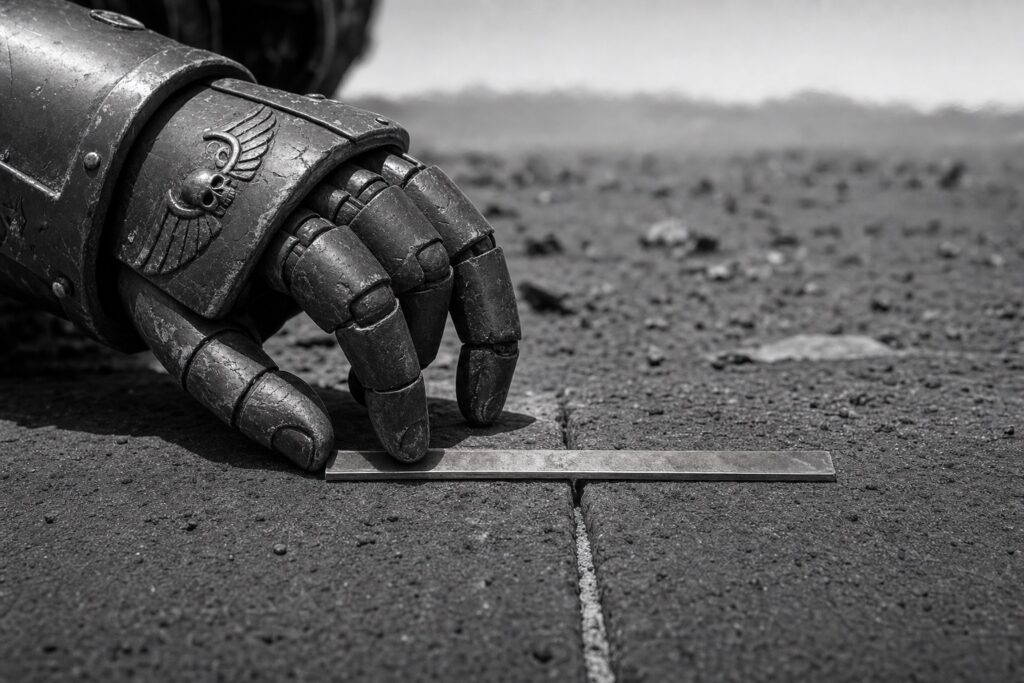
The Tolerance
The Fire Wardens of Nocturne · Adeptus Mechanicus
„A measure that no one can justify any longer is no longer a measure. It is a memory of a tool.“
I. Thirty-One Years
Mars gives one back, but not the same one.
Brother Tor'vak had gone away at twenty-one on a transport of the Adeptus Mechanicus, a Scout with freshly healed sutures, and came back at fifty-two, and in the time between he had lost the tongue of his home world so far that on landing on Nocturne the word for ash would not come to him.
The binary sign for it came to him. Fourteen impulses, descending. That was worse than not knowing it at all.
They did not come to meet him. That is no affront; a Techmarine does not come home, he is assigned, and the assignment had arrived three months before him and been noted in the Chapter book. He walked the eleven kilometres from the landing field to the fortress-monastery on foot, in the red armour that was not the colour of his Chapter and that he would wear for the rest of his life, and every two hundred metres he stopped and looked at something.
Not the mountains. The road.
In his youth it had been cast from molten basalt, in slabs four metres by four, and where two slabs met a finger's breadth of gap had been left, because Nocturne quakes and because a road that cannot give way breaks.
The gap was still there. Every four metres. Thirty-one years.
On Mars there were no gaps. On Mars there were ritual joints whose measure stood in a data sheet that came from the thirty-first millennium and had never been altered, and if one asked why the measure was so, one received the answer that it had been handed down so.
Tor'vak squatted down on the road to Nocturne and laid a finger in the gap and thought: Someone worked that out.
It was the first heretical thought of his life, and he needed more than a decade to grasp that it was one.
What a Techmarine learns on Mars can be said in three sentences, and all three are true.
The first: a machine has a spirit. That is no metaphor. In a bolter that has been in service for two thousand years there sits something that responds to treatment — to oil, to rest, to the same movements in the same order — and whoever denies it gets stoppages, and whoever honours it does not. Tor'vak tested that on three thousand weapons. It is true.
The second: the spirit is older than you. It has seen more, it will last longer, and your relation to it is not that of a master to his tool but that of a grandson to a grandfather who no longer speaks.
The third, and it is the one on which everything hangs: Understanding is not necessary, and the attempt does harm.
That is the sentence an aspirant of the forge worlds learns by heart in the first year. It has a good reason: in the thirty-first millennium the wanting to understand nearly wiped out mankind, and what has been handed down since has been handed down because no one touched it.
Tor'vak lived that sentence for thirty-one years. He soothed reactors that a mortal would not have been permitted to enter. He sang canticles until his throat bled, and he saw that the machine ran afterwards.
He never opened a casing he was not permitted to open.
That was his honour, and he was rightly proud of it.
Captain Bre'kar received him on the second day, briefly, standing, in a corridor.
"You are the new man."
"I am from here, Captain."
"You are the new man," said Bre'kar again, without harshness, the way one repeats a fact the other has failed to hear. "Sixty-five brothers in this monastery have never in their lives seen a Techmarine who comes from Nocturne. They will watch you, and most of them will like you, and it will not stop them saying everything twice when you are in the room."
"Why twice?"
"Once for you and once for Mars."
Tor'vak made no reply to that remark, because nothing occurred to him, and because it was true.
A Techmarine belongs to two masters. That is no secret, it stands in the compact of the Chapter's founding, and every child on Nocturne knows it: the Astartes get their technicians from Mars, and Mars gets a report for them. What stands in a Chapter's armoury stands in a register on a world none of them has ever seen.
It is a good bargain. Without it no Chapter would have tanks.
At the end of the conversation Bre'kar added:
"Ur'kesh is doing badly."
"Who is Ur'kesh?"
The Captain looked at him, and for the first and only time in that conversation something showed in him.
"Quite," he said. "You were away, of course."
II. The Venerable
The Venerable Ur'kesh was four hundred and nineteen years old and lay in the east wing in a chamber that had been built for him because he no longer fitted through the door of the Reclusiam.
He did fit through the door. They had widened it, in his two hundredth year, when he still walked. But they had built the chamber all the same, because a Venerable standing in a corridor gives the brothers the feeling that he is waiting, and Ur'kesh had for forty years not been waiting for anything that would come.
Tor'vak entered and stopped at the threshold, as is proper.
A Dreadnought at rest makes no sound one would call a sound. It makes an absence: one notices that a room is not as quiet as it looks, and if one stands long enough one finds it — a tick every eleven seconds that comes from the lower third of the sarcophagus and that in itself means nothing, because a coolant pump ticks.
Tor'vak stood four minutes and counted along, because on Mars he had learned that one counts before one speaks.
Eleven seconds. Eleven. Eleven. Twelve.
Eleven. Eleven. Eleven. Twelve.
"You are counting," said the Dreadnought.
The voice did not come from above, as Tor'vak had expected, but from the height of his own chest, from a grille in the lower area of the sarcophagus, and it was quiet and perfectly clear and sounded like an old man who is not hoarse but sparing.
"Yes, Venerable."
"Good. The last one prayed." A pause. "Praying is good too. But the twelfth comes all the same."
He was called Ur'kesh, he had been embedded for three hundred and twelve years, and he was the oldest living member of the Chapter.
They spoke for an hour that first evening, and Tor'vak retained almost nothing of it, because the whole time he was listening at the casing.
Only one piece has stayed with him.
"You are from here," said Ur'kesh at some point.
"Yes, Venerable."
"Where?"
"Sixth Valley. Below the basalt quarries."
"I know that," said the Dreadnought, and then came a pause that was distinctly too long. "No. I know the name. That is something else, and I confused the two for a long time."
What he lacked lay in the sarcophagus and was called in the records circulation unit, secondary, pattern Cawl-Pattern XI b, and what it did could be said in one sentence: it moved the amniotic fluid in which the Venerable lay past his heat exchangers.
If it failed, the temperature rose.
If the temperature rose, what was left of Ur'kesh — an upper body, two arm stumps, a head, one heart of the four he had once had — would gradually be boiled, and so slowly that he would not notice it at all for the first nine days.
Tor'vak laid a hand on the casing and let the sensorium of his servo-harness work and after twenty seconds got a figure he read twice.
"How long has this been going on?"
"The twelfth?" Ur'kesh thought; one heard that he was thinking, because the ticking briefly gained in regularity. "Four years. At first every hundredth. Now every fourth."
"Four years. And no one—"
"Yes," said Ur'kesh. "Vekan."
The requisition had been properly submitted. Tor'vak found it that same evening in the archive, in the folder for current matters, and it was a model example: completely filled in, correctly signed, with the correct pattern and the correct identification number, dispatched three years and seven months ago to the responsible forge world.
Beneath it lay two enquiries as to progress and two answers.
The first answer, after fourteen months, confirmed receipt and communicated that pattern Cawl-Pattern XI b was no longer in current production and would be supplied from stock.
The second, after a further nineteen months, communicated that the stock was exhausted, that a production release had been applied for, and that a decision was to be expected within the usual period.
The usual period was not stated in figures. Tor'vak knew it: for a resumption from the dormant stock it lies at eleven to forty years, depending on the world.
He sat in the archive chamber with the sheet in his hand and reckoned, and the reckoning was simple and could not be reckoned otherwise.
At every fourth beat: nine to fourteen months.
At every second: six weeks.
He knew the process from the Mars instruction. There was even a word for it that he had never heard in the tongue of the Chapter worlds and that was carried in the data sheet of the forge worlds as a sober category:
Extinguished by supply term.
It means that a machine was not destroyed and is not worn out, but stands still because the procedure that maintains it takes longer than it does.
On Mars that is an administrative term.
In the chamber in the east wing it was a four-hundred-and-nineteen-year-old man who noticed every twelfth beat and kept a record of it, because nothing else was left for him to do.
III. Vekan
The workshop lay beneath the firing range, and one did not find it by searching but by following the smell: hot metal and burnt plastic, and beneath that something sweetish that Tor'vak could not place and that later turned out to be beeswax.
Vekan was not waiting for him. Vekan said, without turning round:
"You are going to ask me whether I have already tried. I have tried. You will then ask why it did not work. Better ask the second straight away, that saves us both four minutes."
He was a small man, without the alterations that make a Magos half into a device — two legs, two hands, a back that had worked bent for too long. Above the right eye sat an implant, and the implant looked at Tor'vak before Vekan did: it turned in its mounting, stopped, adjusted, and somewhere within it something moved like an iris.
Tor'vak had worked for twelve years on Mars beside people who carried far more metal than this one.
None of them had looked at him like that.
"Why did it not work?"
"Because I cannot hold the tolerance," said Vekan.
In the middle of the workshop, on a trestle, stood the dismounted reserve unit — the same pattern, from the Chapter's stock, on the shelf for a hundred and sixty years, and Tor'vak saw at first glance why it lay there: the rotor had seized, the shaft had play, the unit was scrap.
What lay beside it was the interesting thing.
It was a shaft. It was new, it was hand-turned, it was of a material Tor'vak did not know, and it was, as far as he could judge with the naked eye, very well made.
"You have manufactured a spare part."
"I have manufactured four."
"That is—"
"No," said Vekan. "It is not. Do not say the word before you know the number. If you still want to say it afterwards, say it, and I shall not contradict you."
He laid down a sheet. It was a copy from the data sheet, the relevant page, with a line he had underlined.
The line gave the permissible deviation for the shaft seat: ± 4 μ.
Four micrometres. Four thousandths of a millimetre.
"What can you manage?"
"Eleven," said Vekan. "With the bench I have here, on a good day, with a steady hand and when there has been no quake for two days. Eleven. I have tried it a hundred and twenty times. I once got to seven and needed three weeks to understand that it was a measurement error."
"And with the Chapter's tools?"
"The Chapter has no tool for it. The Chapter never had one. This unit was never manufactured here, it was delivered, for three thousand years, and whoever delivers need set no bench up for anyone."
Vekan turned fully round for the first time.
"You will not manage it either, Techmarine. You have better hands than I do and a sensorium I do not have. You will get to six, perhaps to five. It says four in the sheet."
Tor'vak took the shaft in his hand and turned it in the light.
A Techmarine of Mars does not test a workpiece with his fingers. He lays it in a measuring device, and the measuring device says a number, and the number he compares with the sheet, and what does not lie within the sheet is scrap and is melted down, because a part outside the tolerance is an insult to the spirit in which it is to work.
That is the process. Tor'vak had carried it out for thirty-one years, several thousand times, without once thinking about it.
He stood in a workshop beneath a firing range on Nocturne, held a piece of metal against a lamp and found that a question stood in his way that he would never have asked on Mars and that, once asked, could not be cleared away again:
Why four?
Not: why can I not manage four. Rather: why does it say four there.
Four micrometres are very little. They are considerably less than a circulation pump needs that moves fluid in a circuit. He knew reactor feed pumps with twenty times the throughput and a permissible deviation of forty.
"You have thought it too," said Vekan.
It was no question.
"I have thought nothing at all."
"You looked at the sheet and then at the shaft and then at the sheet again," said Vekan. "That is the order. Whoever prays looks at the shaft and then at his hands. Whoever reckons looks at the sheet twice."
He wiped his fingers on a rag, very thoroughly, like someone buying himself time.
"I shall tell you something now, and afterwards you can go up and report it. I shall not deny it and I shall not ask you to let it be."
"Do not say it."
"The four does not stand in the sheet because the pump needs it," said Vekan. "It stands there because the tool with which this shaft was made in the thirty-first millennium could do four."
IV. The Oath
A Techmarine swears twice.
The first oath he swears as a Scout, before elevation, and it is to the Chapter. The second he swears at the end of the training on a forge world, and it is to the Omnissiah, and it is shorter, because it is sworn in binary and binary has no circumlocutions.
The second oath has four parts. Three of them are self-evident: preserve the knowledge, honour the equipment, sing the canticles.
The fourth runs, brought into Gothic, roughly thus:
What you find of knowledge that is not handed down is not yours.
For thirty-one years Tor'vak had taken this part for a warning against pride. It is none. It is a duty to report, and it is specified as such in the implementing provisions, clause nine: whoever as a Techmarine with a Chapter acquires knowledge of technical matter that does not stand in the registers of the Mechanicus reports it to the responsible forge world, without delay and in full, irrespective of who possesses it and for how long.
There is no exception for Chapter secrets. There is in particular none for the question whether the report harms the Chapter.
That is the bargain. Mars supplies the technicians and delivers the tanks, and for that Mars sees everything.
In the night after the workshop Tor'vak sat in his cell and made out the report form.
He filled it in completely. That is important, and he later insisted on it: he did not hesitate, he did not wrestle, he sat down and wrote the form as he had written three thousand others.
Subject: Unregistered manufacture, pattern Cawl-Pattern XI b, circulation unit secondary.
Facts: A technician belonging to the Chapter (Adeptus Mechanicus, personnel number to follow) has manufactured four shafts of the aforesaid pattern outside the production release. Material used not in the register. Accuracy achieved ± 11 μ against a specification of ± 4 μ. The technician further expressed the view that the specification of ± 4 μ does not arise from the requirement of the assembly but from the capability of the historical manufacturing tool.
At this point he stopped.
Not out of doubt. For a craftsman's reason: the form requires in field seven the statement whether the reported facts are accurate, and there are three answers to that — accurate, not accurate, not verified.
He crossed not verified, because that was the truth.
And then he sat with the finished form before him and found that he could not send it in that condition without working uncleanly.
A Techmarine does not report assertions. He reports findings. If he passes on a sentence he has not tested, he passes on talk, and talk does not belong in a register that lasts three thousand years.
He laid the form in the folder.
He deceived himself about nothing that night. He knew that he had just made a decision and that it was open to interpretation in two directions, and he never held the sentence with which he explained it to himself to be entirely honest:
I shall report when I have tested it.
The testing lasted nine weeks and consisted of three parts.
The first part was calculation, and it was finished in a week. Tor'vak calculated through the gap loss of a circulation unit of this construction at various shaft fits — a piece of work every Enginseer can do and that no one does, because the result stands in the sheet. At ± 11 μ the unit loses by calculation three point two per cent of delivery against ± 4.
Three point two per cent.
The assembly is laid out with a hundred and forty per cent reserve. That likewise stands in the sheet, two pages further on, and no one reads the two pages side by side, because they stand in different sections.
The second part was searching, and it took seven weeks. Tor'vak searched the archives of the monastery for every delivery of this pattern since the founding of the Chapter — three hundred and eleven units, recorded with date of receipt, date of installation and, in the cases in which someone had been careful, with the result of the incoming measurement.
In ninety cases the incoming measurement was recorded.
In ninety out of ninety it lay within ± 4 μ.
He needed three days to notice what was wrong with that, and he was ashamed of it, because it should have been the first thing to strike him: it is not a distribution. Ninety workpieces from three thousand years, from at least four different forge worlds, and not a single one lies at five or six.
A manufacture that can do ± 4 delivers parts at one, at two, at three and occasionally at four and a half, and then throws it away.
Ninety hits without scatter does not mean: they can do four.
It means: they measure, and what does not fit does not go into the book.
The third part of the testing was the one for which he had to enter the Reliquarium, and for that he needed a Chaplain.
V. What Is Not Catalogued
Chaplain Vel'Schwur listened to the request without interrupting it, which took about six minutes, and then asked a single question.
"To whom do you report it?"
"I report nothing before—"
"That was not the question." Vel'Schwur sat on a bench before the Reclusiam, his hands on his knees. "I did not ask whether you report. I asked to whom. You will report; that is your office and I do not hold you to be a man who breaks his office. I want to know to which desk the sentence goes that you find in there."
"To the forge world Kaledon Prime. Department for unregistered manufacture."
"And what does the department do with it?"
Tor'vak answered truthfully, because nothing else occurred to him.
"It tests. If the finding is significant, it is taken into the registers. If it is not significant, it is filed."
"And if it is inconvenient?"
"There is no category for inconvenient."
"That," said Vel'Schwur, "is the longest answer you have given me today."
He stood up and unlocked.
The Reliquarium of the Fire Wardens of Nocturne is not large. Whoever expects to enter a hall is disappointed: it is three chambers in rock, with shelves on three walls, and the shelves are two-thirds empty, because the archive does not collect but receives.
Every Chaplain is given access at his elevation, and every one lays something in before his death. Some lay in a book. Most lay in a sheet. One, in the fourth millennium of the Chapter, laid in a stone, without inscription, and no one knows any longer why, and no one takes it out.
None of that stands in a register of the Adeptus Terra. That is no defiance; simply no one has ever asked after it, and what is not asked for is not reported.
Tor'vak needed four days.
What he was looking for he found on the third, in a folder that a Chaplain named Zar'kel had deposited in the sixth century of the Chapter, and what lay inside were no records of the Chapter.
They were transcripts.
It is necessary at this point to say something that every child on Nocturne knows and that is dangerous outside Nocturne if one says it aloud.
Vulkan was a smith.
Not figuratively, not as an honorific — a craftsman who made workpieces one could touch, and who made them better than anyone else, and who, and this is the decisive thing, taught his sons how one makes them, and not how one prays around them.
There is one thing for which he has to this day no good name in the Mechanicus, and it concerns not machines but flesh: Vulkan, so it stands in the transcripts, worked on the gene-seed. He proceeded from the assumption that the progenoid glands are not rigid but formable — that a Chapter could adapt, to a world, to a task, to an enemy — and he did not assert that but investigated it.
The Mechanicus classified this work as heresy and placed it under seal, and from the Mechanicus's point of view entirely consistently: if the gene-seed is formable, then what has been handed down is not the highest but a stage.
What Zar'kel had laid in a folder in the sixth century were seventeen sheets from those works, copied out by hand, without indication of provenance.
Tor'vak did not read them for the gene-seed.
On sheet nine he found a sentence that did not deal with the gene-seed but was a marginal note — one of those remarks a working man writes in the margin when something general strikes him while calculating, and which then outlasts thirty millennia because someone copied it out along with the rest.
It ran:
A measure that no one can justify any longer is no longer a measure. It is a memory of a tool.
Tor'vak sat in the second chamber of the Reliquarium, on the floor, with a sheet in his hand that a Primarch had written on, and grasped three things one after another.
The first was that Vekan had not known this sentence. Vekan had arrived at it independently, in a workshop beneath a firing range, at a shaft for a pump.
The second was that he himself had had the same thought on the road from the landing field, at a gap between two basalt slabs, and had not thought it through to the end, because he was not permitted to think it through to the end.
The third was the hardest.
His oath required that he report this sheet. Not the shaft — the sheet. An unregistered document of a Primarch containing a statement about the bindingness of handed-down measures, in the possession of a Chapter, since the sixth century.
He knew the course of it. He had twice recorded it on Mars.
The finding goes to the department. The department classifies. What is classified as significant and at the same time as not fit for transmission does not go into the register and is not destroyed, because the Mechanicus destroys nothing.
It goes into the black libraries.
And the black libraries give nothing back.
VI. The Consent
He asked the Venerable, because it was his body.
That is not self-evident. A Dreadnought is in the administrative sense equipment of the Chapter, and the decision about a repair is taken by the Captain, not by the occupant. Tor'vak went the official way in this order all the same — first the chamber in the east wing, then Bre'kar — and when someone asked him about it years later he said that at the time it had not appeared to him as a decision.
"Venerable."
"You are counting again."
"Every third."
"Yes," said Ur'kesh. "For fourteen days."
Tor'vak laid it out for him. He did it completely, with the figures, with the ninety incoming measurements without scatter, with the three point two per cent and the hundred and forty per cent reserve, and with what he did not have to say and said all the same: that a repair outside the release cannot be undone and that the report about it does not lie with him but with his oath.
"And if you do not do it?"
"Then the release comes. In eleven to forty years."
"And I?"
"At every second beat, six weeks."
The Dreadnought was silent long enough for Tor'vak to count the ticking three times. It was every third.
"Do you know what holds me?" said Ur'kesh then. "Not the will. That has long gone, one no longer has it at three hundred, the young men tell each other that. It is curiosity, and it has grown very small. It reaches from about one spring to the next."
"Venerable—"
"Do it," said Ur'kesh. "And when they come for you, tell them that I ordered it. That is no lie; I hereby order it. They will not let it stand, because I am equipment and equipment orders nothing." A pause. "But you will have said it then, and then it stands somewhere."
Captain Bre'kar listened to the report standing, as he listened to everything standing, and at the end asked two questions.
"Does it violate Chapter law?"
"No, Captain. The compact with Mars."
"Then it is not my decision but yours." Bre'kar looked at him. "That is no evasion. I could forbid it to you, and you would obey, and then I should have taken your oath from you and the Venerable with it. I shall not do that."
"I should like an instruction."
"I know," said the Captain. "Everyone would."
He went two paces to the window and back again, which was the only thing anyone could have noticed about him in that conversation.
"I shall tell you what I will do, and that is all I can offer you. When they come, I shall not say that I knew nothing of it. I know of it now. From today that stands in my book, with a date, and it will stand there when it becomes inconvenient too."
Tor'vak said later that this was the second greatest help anyone gave him in this matter.
The greatest was Vekan's sentence about the tool.
They did not manage the four micrometres.
In eleven nights they got to six, and at six it stayed, and on the twelfth evening Vekan laid down the probe and said the sentence on which the whole matter turned:
"We are doing it the wrong way round."
"We are doing it by the sheet."
"Yes. And the sheet wants a shaft that fits into every bearing of this series. Into every one of three hundred thousand. That is why four." Vekan wiped his hands. "How many bearings do we have?"
Tor'vak needed a moment.
"One."
"One," said Vekan. "We do not need a shaft that fits into three hundred thousand bearings. We need one that fits into this one."
What they did in the following nineteen days is so old that on Nocturne there is no technical term for it, only a word from the forge: to lap in.
One manufactures the shaft deliberately too large — two hundredths oversize, far outside any tolerance. Then one applies lapping paste and sets it in its bearing and turns it, by hand, slowly, constantly changing direction, and shaft and bearing work each other down until every place of the one has found the place of the other.
It takes time. It is dull. One turns for eight hours and measures and has taken off four micrometres.
And at the end one has not a part to standard, but a pair.
On the nineteenth day they measured the play and measured three times, because Vekan did not trust the first figure and did not trust the second either.
One point nine micrometres.
Less than half of what the sheet required. Better than any of the ninety incoming measurements from three thousand years.
Vekan sat on a stool and looked at the thing and said nothing at all, for a very long time, and his implant stopped moving.
"Say it," said Tor'vak.
"What."
"The word I was not to say nine weeks ago before I knew the number. I know it now."
Vekan shook his head.
"It has become a different word," he said. "It is not worse than the regulation. They would have forgiven that, there are procedures for it, they call it emergency repair and one gets a reprimand and the matter is done with."
He stood up and laid his hand on the shaft.
"It is better. And it fits in here only. Do you know what a part is that fits in only one single place in the Imperium?"
Tor'vak knew it.
On Mars there is a term for it, it stands in the first year of training in the third chapter, and it is not meant as a reproach but as the description of a condition that mankind has left behind.
Irreplaceable.
The whole Imperium rests on nothing being so. A Guardsman, a bolt round, a Rhino, a regiment: every thing has a pattern, and every pattern has a supply, and that is why the Imperium can bear losses that would have broken any other civilisation.
In nineteen days they had made a thing for which there was no supply.
VII. Eleven Seconds
The installation took nine hours and was the least spectacular part of the whole affair.
A sarcophagus is not opened like a crate. One brings the amniotic fluid down to two degrees, which begins eleven hours beforehand, one puts the occupant into a state the records call the Deep and which is no sleep but a slowing, and then one releases seventy-two catches in a prescribed order, and at every eighth one stops and checks the pressure.
Vekan was not allowed into the room. That was no vexation; a mortal in the open sarcophagus of a Venerable is impermissible under Chapter law, and Tor'vak did not even try to obtain an exception for it.
He instead seated him in the chamber next door, with an open door and a measuring screen, and called a figure in every twenty minutes.
Brother Yavun, twenty-seven years old, elevated four years before, was assigned as assistant and later stated that the most remarkable thing about that night had been that the Techmarine had sung the canticles at every single movement of the hand.
Completely. In the right order. For nine hours.
Yavun took that for piety.
Tor'vak said later that it had been something else: he had known perfectly well that he was in the act of breaking the oath he had sworn to the Omnissiah, and he had not wanted anyone — himself included — to confuse that with carelessness.
One can be reverent and still do what is forbidden.
That, he said, is the real thing he learned on Nocturne and that they could not have taught him on Mars, because it does not exist there.
At 02:10 he had the old unit out.
He laid it under the lamp and looked at it, and what he saw he later wrote into the form, because it was the only part of the process about which he is not certain that he interpreted it rightly.
The shaft was not broken. It was not bent and not corroded. It had become round — at one place, over a length of perhaps nine millimetres, the material had worn away in the course of three hundred and twelve years so far that a play had arisen, and the play had produced a flutter, and the flutter had caused the pump to lose a stroke every twelve beats.
It was the normal, provided-for wear, described in every data sheet, of a component that has reached its service life.
Tor'vak held it in his hand and thought that this piece of metal had for three hundred and twelve years kept a man alive every eleven seconds without anyone ever having seen it, and that it had done so until it was used up, and that there is no word for that which one says about a tool.
He did not melt it down. It lies in the workshop to this day.
At 04:50 the unit started up.
For the first six minutes a circulation pump says nothing. It fills, it bleeds, it finds its point. Tor'vak stood with his hand on the casing and waited, and Yavun stood behind him and breathed too loudly, and from the chamber next door came no sound, because Vekan was looking at his screen and did not speak before he had a figure.
At 04:56 the ticking began.
Eleven seconds.
Eleven.
Eleven.
Eleven.
Tor'vak counted to forty, which takes seven minutes, and then to forty again, and at some point in the second round he noticed that Yavun was counting along behind him, aloud, without noticing it.
At eighty Ur'kesh said, without anyone having woken him:
"That is new."
"Venerable?"
"It was not so even before," said the Dreadnought. "Not before either. Not even when there was no twelfth." A pause in which one heard him thinking. "For three hundred years I believed that it belonged to it."
Vekan's figure came at 05:20 from the next chamber, and it was the only one he uttered that night.
"Delivery rate one hundred and seven point four per cent."
It took a moment before Tor'vak grasped what the per cent referred to.
Not to the old, worn unit. To the data sheet.
Seven point four per cent above the rated output of pattern Cawl-Pattern XI b, as it had been laid down in the thirty-first millennium and delivered ever since for three thousand years.
That is the figure this story is about, and it is important to understand it correctly, because almost everyone first understands it wrongly.
It does not mean that two men in a workshop were cleverer than the manufacture of a forge world. They were not. They had no better machine, no better knowledge and no better material.
It means that a manufacture which has to produce three hundred thousand interchangeable parts gives away something on every single one of them — and that this given-away amount, because for three thousand years it was the same size on every piece, at some point stopped counting as a loss and began to stand in the sheet as rated output.
The seven point four had never been gone.
They had simply never struck anyone, because no one had made a pair.
VIII. The Report
He reported it on the third day after the installation, of his own accord, without anyone having asked for it.
The form he dispatched ran to eleven pages and was the most careful work of his life. It contained everything: the requisition and its periods, the ninety incoming measurements without scatter, the calculation of the gap loss, the hundred and forty per cent reserve, the oversize, the lapping paste, the nineteen days, the play of one point nine micrometres, the delivery rate of one hundred and seven point four per cent. He named Vekan with his personnel number. He named himself as the one who carried it out. He named the Venerable Ur'kesh as the one who ordered it and added that under the administrative position this order was none, but that he recorded it for the sake of completeness.
In field seven he crossed accurate.
And he left one thing out.
The seventeen sheets from the Reliquarium did not appear in the form. Not the folder, not the Chaplain Zar'kel, not the sentence about the measure and the tool, not the existence of an archive that no register knows.
That was a violation of clause nine. It was deliberate and it was not to be justified, and in the forty years he still served afterwards Tor'vak never claimed that it had been.
He once explained it, very much later, to another Techmarine, and the explanation consisted of two sentences:
"The shaft is knowledge I acquired. The sheet is something someone else laid in a chamber sixteen hundred years ago so that it would lie there."
Whether clause nine distinguishes that, he did not claim. It does not.
Magos Karro-7-Sedd arrived a hundred and eleven days later, alone, with two servo-skulls and one piece of luggage.
Tor'vak had expected everything possible. In a hundred and eleven nights he had formulated three versions of a speech in his defence and discarded them again, he had reckoned with being led away in chains, and he had, which shamed him most of all, reckoned with the sarcophagus being opened again and the shaft taken out.
What actually happened was worse, because it was friendly.
The Magos needed four days. He read the papers, he re-measured, he had Vekan show him the lapping paste and the bench and the four discarded shafts, and in those four days he asked about thirty questions, not one of which had the character of a reproach.
On the fifth day he sat down with Tor'vak in the archive chamber.
"Your measurement is correct," he said. "I have reproduced it twice. Seven point four."
"Magos—"
"Wait." Karro-7-Sedd raised a hand on which three fingers were of flesh. "I shall tell you first what I think of it, and afterwards what will happen, and you will find that those are two different things. Bearing that is the part of the office one takes longest to learn."
He laid the form on the table.
"What you have found is no error in the manufacture. It is the price of interchangeability, and it is present in every assembly of the Imperium, and it lies, according to construction, between three and nine per cent. That is known in the Mechanicus. It stands in the fundamentals of manufacturing doctrine, second book, and every Magos has read it."
Tor'vak needed a moment.
"It is known."
"Of course it is known. It is the reason interchangeability exists: we pay seven per cent of performance and get in return that a shaft from Kaledon Prime fits into a bearing on Nocturne without anyone having to lap it in. That is no oversight, Techmarine. That is the best bargain mankind ever made."
"Then my finding is—"
"Your finding is correct and it is not new. That is the worst sort of finding there is."
Then he said what would happen.
The matter was classified as individual-case repair under supply failure. That category exists; it is meant for sieges and for worlds behind warp storms, and it covers the execution completely. There was no reprimand. There was, which embarrassed Tor'vak for a long time, a written commendation for the care of the documentation.
The shaft stayed where it was. No removal was ordered: it would have opened the sarcophagus a second time and would, with a four-hundred-and-nineteen-year-old occupant, have carried an expectation of mortality of about a third, and that third stood in no relation to the benefit.
The delivery rate of one hundred and seven point four per cent was taken into the appendix of the case and not into the register of the pattern.
They spoke longest about this last point.
"Why not into the register?"
"Because a register carries a rated output," said Karro-7-Sedd, "and because an altered rated output entails a reassessment of all delivered units of this pattern. There are four hundred and sixty thousand in the active stock. The reassessment is not feasible. It is not difficult, understand me correctly — it is not feasible. There is no procedure by which an administration of that size alters a figure that in three thousand years has entered eighty thousand sub-registers."
"So it stays wrong."
"It stays bearable," said the Magos. "That is not the same thing and it is not the opposite either."
IX. The Promotion
Vekan was promoted on the seventh day.
Magos Karro-7-Sedd read out the appointment in the inner courtyard, before the assembled technical personnel of the monastery — fourteen mortals, two Enginseers and one Techmarine — and the wording was honourable and accurate in every point: the technician Vekan was, in view of extraordinary craftsmanship, appointed Master Technician for Nocturne, with responsibility for all manufacture of the Chapter and authority to direct the workshops.
It was the highest position a mortal of the Mechanicus can reach on that world.
Vekan stood there and received it and his implant did not move a single time.
The second part of the appointment was not read out. It stood in the instrument, clause four, and Tor'vak read it three days later, because Vekan laid it out for him without saying anything.
The Master Technician shall keep a register of all manufacture, to be submitted quarterly. He shall train exclusively according to the released procedures. Deviating procedures require the prior consent of the responsible forge world.
"They have shut me down," said Vekan.
"They have promoted you."
"Yes," said Vekan. "Both. That is the art of it, and I needed two days to admire it." He sat down on his stool, in a workshop that now belonged to him and in which he would never again be allowed to do what he had done in it. "A man who can do something that is not provided for is a problem. One can remove him, and then he becomes a martyr and three others do it after him. Or one makes him a superior and gives him a register. Then no one does it after him, because he forbids it himself."
"Will you forbid it?"
Vekan looked at him.
"I have signed it."
On the evening before his departure Karro-7-Sedd sought out the archive chamber once more.
He had no business there. He asked a question that did not belong to the case, and he asked it in a tone Tor'vak would not have expected from a Magos.
"How many sheets did you leave out?"
There arose a silence in which Tor'vak noticed very precisely how his second heart was working.
"Magos?"
"Your form has eleven pages and is the most complete report I have read in ninety years. It answers questions I would not have asked. It names the personnel number of a man whom naming has harmed you." The Magos laid the three fingers of flesh flat on the table. "And it contains not one single word about where you had the thought that a handed-down measure might be the memory of a tool."
"I arrived at it when I—"
"You did not arrive at it. No one arrives at it. I did not arrive at it, and I have taught manufacturing doctrine." Karro-7-Sedd rose. "I shall not ask you again, and I shall not record it. I am only telling you that I know, so that you do not spend the rest of your life believing that you hid it properly. That is a bad way to live."
At the door he stopped.
"In ninety years I have three times found something the registers do not carry. Twice I reported it."
"And the third time?"
"I asked myself whether I owed it to the matter or to the procedure," said the Magos, "and then I reported it, because I came to the conclusion that I am not permitted to decide that. I still hold that decision to be right, Techmarine."
He went out and stopped once more in the corridor, without turning round.
"It has cost me more than anything else I have done."
The next day he departed, and the matter was closed.
It is so to this day. There is no current case, no condition, no observation. Brother-Techmarine Tor'vak served with the Fire Wardens of Nocturne for another forty years and in that time was never again mentioned in a report of the Mechanicus, apart from the usual inventory returns.
He never repeated the procedure.
He once nearly did, in the fourteenth year, on a gun breech of the Ashen Watch, and broke off in the middle of the preparation and instead wrote a requisition that ran for four years.
He did not later claim that this had been obedience.
He said: "I had done it once, and once was a man, and twice would have been a habit."
X. The Gap
Ur'kesh lived another sixty-one years.
That is the only figure in this story that no one predicted. The expectation lay at twenty to thirty; an occupant of that age usually dies not of an assembly but of himself.
He died sixty-one years after that night, on an afternoon, in battle on a world whose name by his own account he did not want to remember, because he found it ugly. In the second hour he went forward, because a company was pinned behind a wall, and he stood there and let it come down on him until the company was out.
Brother Yavun, by then a Sergeant, was there. He reported that the Venerable said nothing during that time that one could quote, and that once, when it briefly slackened, he murmured something that sounded like a count.
What could be recovered of him was recovered. The sarcophagus was torn open, the upper part was gone.
The circulation unit in the lower third was undamaged.
It lies today in the workshop beneath the firing range, on a trestle, dismounted and uncleaned, and there is no reason to keep it. It fits no other bearing in the Imperium. Vekan laid it down and never touched it again, and the Master Technician who came after him left it lying, and the one after him too.
It stands in no register.
Vekan died as Master Technician, forty-three years after his appointment, and in that time trained thirty-one technicians, all of them according to the released procedures.
He submitted his register every quarter. It was never objected to.
What he did alongside cannot be proved and is therefore not to be asserted here. It is merely to be noted that in the workshops of Nocturne there exists to this day a word for a procedure that was never taught there, and that apprentices who ask after its meaning are told that it is an old word from the forge and has nothing to do with their work.
The word is pairing.
Tor'vak did not train forty-one Techmarines.
That is no malice and no withholding; a Techmarine does not train Techmarines, Mars does that. In forty years he accompanied seven aspirants who went to the training, and he said the same thing to each of them on the evening before departure, and because there were seven of them and they spoke to one another, the sentence became known in the Chapter.
It ran: "They will teach you that understanding is not necessary. That is true. Learn it all the same as they say it — and remember that not necessary is something other than forbidden."
Five of the seven came back. Two remained on forge worlds, which is usual.
None of the five ever lapped anything in. Tor'vak checked that, quietly, over years, and he established it with relief and was put out enough about that to remember it.
Once a year Tor'vak walked the road from the fortress-monastery down to the landing field, eleven kilometres, on foot, in the red armour.
He did not do it as a devotion. He did it because a Techmarine keeps the ways of the Chapter in repair and because looking at them belongs to that office.
The slabs are four metres by four. Between two slabs lies a finger's breadth of gap, so that the road can give way when Nocturne quakes.
In the twenty-third year after his return he looked in the Chapter archives to see who had laid down the measure, and did not find out. The road is older than the monastery. There is no record.
Afterwards he measured himself for two years, at a hundred and forty joints, after every quake, and wrote down what he found.
The result stands in a notebook that lies in the workshop beneath the firing range, beside a dismounted circulation unit that fits no other bearing. It is written by hand, it has not been handed over to the Reliquarium, because a Techmarine is not permitted to lay anything in there, and it has not been reported to Mars, because it contains nothing a register could carry.
On the first page stands a sentence, and one does not know whether Tor'vak found it himself or copied it, because he did not put it in quotation marks:
A measure that someone worked out holds as long as the reckoning holds. A measure that no one can justify any longer holds as long as no one asks.
Beneath it, in the same hand, smaller:
The joints hold. I asked.
Download story as PDF or EPUB
Enter your email address. After confirming your subscription you'll get the download links immediately and by email.