The Silence of Misericordia
A Tale of the Death Korps of Krieg
Astra Militarum (Death Korps of Krieg)
„Losses are to be recorded, not lamented. The record is the form in which the Imperium mourns.“
Munitorum-Dienstvorschrift, Abschnitt Totenerfassung
I. A Victory Rarely Lasts Longer Than a Night
On Vraks a victory rarely lasted longer than a night.
On the morning after Bastion Canticum the smoke had not yet left the blasted vaults before new columns were moving through the trenches, new ammunition sledges rumbled over duckboards, new litanies were spoken over freshly dug positions. The fallen fortress lay behind them like a tooth in the mud, still warm at the fracture edges, still full of bodies that servitors and corpse details would not recover until later in the day. But the war had already forgotten it.
Ahead of them lay Misericordia.
Commissar Halbrecht stood in the observation trench on an upturned ammunition crate and looked through his field glasses at the new bastion. It rose out of the ash plain like a broken-off cathedral tower, angular, black and deeply tiered. Where Canticum had been a work of siegecraft, Misericordia looked almost like a house of God that the war had reshaped into something else. Several ramparts ran around the main body. Between them lay crater fields, wire belts and the remains of assaults from earlier weeks. Muzzle flashes broke occasionally from the upper embrasures. Above the main gate hung a shattered aquila, one half of it drooping like a broken arm.
"They have used the night," said Halbrecht.
Colonel Dreir stood beside him, motionless as ever, his gloved hands on the lip of the trench. His mask was freshly powdered with ash. On other men that would have looked like exhaustion. On Dreir it was merely another condition of the material.
"Yes."
"From Canticum I would have learned to let myself rest at least half a day."
"Then you would not be here, Commissar."
Halbrecht lowered the glasses. "And you would not be a colonel of the Death Korps."
Dreir did not react to that. He only raised two fingers, whereupon a vox officer stepped closer and handed him a data strip.
"Misericordia," said Dreir, more to the strip than to Halbrecht. "Outer lines: three. Possible mine tunnels beneath the north wall. Underground casemates deeper than Canticum. Enemy remaining strength unclear. The only certainty is that a part of the survivors of Canticum fell back there."
"Then they know how we fight."
"Yes."
"And we know how they die."
Dreir turned his head minimally. From him that was nearly agreement.
Behind them the first assault sections were moving up. Men of the Death Korps in long coats, masks, with lasguns, bundles of cutting charges, entrenching spades, signal staves. Narrow figures in a world that had long since understood men as a consumable. Halbrecht no longer saw them as a mass. That was perhaps the first defeat Vraks had taught him personally.
He recognised Lieutenant Varn by the map case and by the way he lowered his head slightly as he walked, as though listening to the wind. Field medic Brenn walked at his side, the shattered leg from Canticum now in a heavy splint apparatus that made his gait more angular. Behind them came new faces and a few old ones: men who had been dragged out of the rubble of one bastion and set directly in the shadow of the next.
Watchmaster Kessel was missing.
Halbrecht searched a moment longer, though he knew it was foolish. Kessel lay in a surgical station two trench lines back and was learning there how to stand on a metal leg before going back into the war on it. On Vraks that already counted as a form of sparing.
"Varn leads the first thrust?" Halbrecht asked.
"Yes," said Dreir. "He now knows the ratio between courage and consumption better than he did before Canticum."
"That sounds almost like praise."
"It is a statement of fact."
Halbrecht raised the field glasses again. Above Misericordia there hung no smoke from a heart-works, no pestilential exhalation as at Canticum. Instead a pale, dry vapour rose from several flues. Too clean. Too orderly.
"What do you think is down there?"
"Something that has let the enemy hold too long," said Dreir. "More is unnecessary."
On Vraks that was always the real answer.
II. Forward on the Whistle
Lieutenant Varn had got one hour of sleep in the night.
He knew that only because Brenn had told him. He himself remembered merely having sat against a trench wall, his helmet in his lap, his back against sandbags, and then suddenly standing up again as a horn called the muster. In between there must have been something that other men called rest.
Misericordia lay ahead of him now, flat and black in the pallid morning light, as his assault section reached the forming-up trench.
"Check filters," said Brenn.
No one answered. Hands went to straps, catches, mask edges. A short, practised feeling over rubber, leather, metal. The sound was quieter than prayer.
Varn stepped onto one of the ammunition crates at the trench edge and looked over the heads of his men. There were fewer of them than he had commanded before Canticum. More than he had feared. War was generous in both.
"The objective is the outer ring line," he said. "Artillery opens the north field for us. Sappers mark the wire. Second platoon follows us at forty paces. If we go to ground, they climb over us. So we do not go to ground."
A few lens-eyes turned up towards him. Not expectantly. Only receiving.
"In the main works the assessors suspect ammunition magazines and deep casemates. Rail tunnels for counter-thrusts or supply are also possible. If you find something that looks like an entrance, you report it. If you find something that looks like a shrine, you report it faster."
That was the last remnant of humour that could still be salvaged into a briefing on Vraks. No one laughed. But Brenn's gaze stayed on him a heartbeat longer. That was enough.
"Forward on the whistle. Hold on the flare. Withdrawal only on order."
He wanted to say more. Something about Canticum. About those who had fallen. About Kessel. About the fact that between two bastions one sometimes got just enough time to let the names on the casualty strips dry before new ones were added.
Instead he only said: "For the Emperor."
The horn sounded.
Ahead of them the barrage came down.
This time it was not four hundred barrels as at Canticum. Only enough to make a piece of the world uninhabitable. Basilisks and mortars threw their loads onto the approaches of Misericordia. Craters burst open. Wire belts sprang apart in shreds. A machine-gun nest disappeared in a cloud of concrete, earth and human remains. The thunder rolled through the mud, made the water in their boots tremble and pushed the stench of promethium and churned subsoil into the masks.
"Go!"
Varn climbed out of the trench.
The first stretch went almost in good order. The creeping barrage crawled ahead of them. Men ran in lines, sprang over the first craters, slid past toppled stakes. A Guardsman fell to Varn's left, stumbled three more paces with a hole in his chest and then went down without disturbing the formation.
Thirty metres. Fifty. Eighty.
Then Misericordia began to shoot back.
Autocannons rattled out of the left rampart curve. Heavy las-fire flickered from a half-dug-in casemate. Somewhere on the north ridge a mortar barked whose rounds fell short and had to shave its own forecourt with splinters. Varn saw two men of the first platoon fall in the same instant, one with his shoulder torn away, one with something that had formerly been a head.
"Keep right!" he shouted.
The line bent slightly, followed a row of old craters that were just deep enough to swallow movement inside them. Brenn ran behind him, the medic's case on his belt, as though he were carrying a small shrine of tin.
"Wire!" came the call from ahead.
Sappers threw themselves into the mud. Cutting charges flew. A short shudder, then a section of the outer wire belt tore open. Varn stormed through the gap, trod on something soft that lay hidden in the mire, and only on the second step saw that it was half of a man.
III. The Wall of Ident-Tags
The first ring line of Misericordia consisted of a low, tenacious trench with concrete reinforcements. Traitor militiamen lay in it, some dead, some still alive enough to fire. Varn shot one in the chest, jumped into the trench and landed between a crate of dud cells and a kneeling rifleman whose mask was painted with pious signs. The man raised his bayonet. Varn rammed the rifle stock into his face until the resistance stopped.
Beside him Brenn climbed down and at once pulled a wounded man to the trench wall.
"Leave him," said Varn.
"He can still shoot."
That was Brenn's measure. As long as a man could still shoot, he was worth bandaging.
Varn only nodded and looked over the trench lip.
Beyond the first line Misericordia truly began to rise. A second rampart, steeper and set with casemate shafts. Behind it the bastion proper, in the middle of which stood the old cathedral body. Between the first and second rings lay no open field but a garden of rubble made of thrown-up earthworks, destroyed ammunition carts and collapsed walkways. A killing ground of cover and obstructed sight at once.
"On!" he shouted.
The second crossing cost him four men.
One was taken by a sniper from an embrasure window. Two vanished when a hidden mine flipped the ground open beneath them. The fourth was cut clean through the body by a heavy stubber and hung in the barbed wire with open hands, as though he meant to hold back the sky.
Varn thought only in distances now.
Ten metres to the crater. Five to the collapsed cart. Twelve to the traverse. Three shots left in the current cell. Then reload.
By the time they reached the second ring it was no longer an assault. It was only close quarters.
A militiaman sprang from a niche, half mad, a blackened aquila round his neck and a flamer in his hands. Varn shot him down, but the man fell forward and squeezed the trigger as he died. Promethium fanned into the trench, caught two Guardsmen on the back and arms and wrapped them in running fire. One ran three more paces before he struck the wall and stopped burning.
Brenn stepped past them without looking.
"Too late," he said, as though that were a finding and not a complaint.
At the next bend Varn froze.
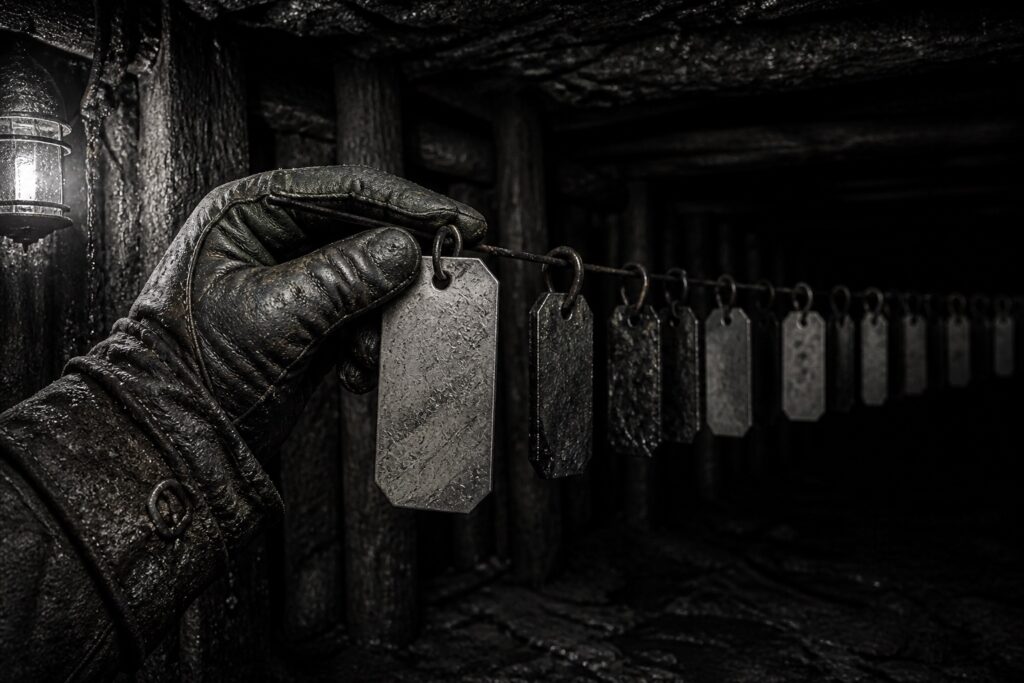
Name plates had been fixed to the trench wall with nails and wire. Hundreds. Imperial ident-tags. Regiment, number, sometimes world of origin. Beneath them skulls lay in tidy rows on sandbags, as though someone had set up an archive of the fallen here. Some still wore parts of their masks, some the chin straps, some nothing at all.
"Throne..." murmured one of his men.
Brenn stepped closer, glanced over it and said: "Do not touch it."
"Why?"
"Because they want us to stop."
That was the terrible part: he was right.
Varn forced himself on. The skulls did not follow them with their gaze. And yet he had the impression that the whole trench consisted of memory turned against the living.
IV. The North Shaft
Behind the next traverse he found the entrance to the inner supply shaft.
It lay half buried under a toppled statue of a saint, wide enough for two men abreast. No fire came out of the darkness below. Only a draught. Dry. Cold. And old.
Varn gave the sign over the vox.
"North shaft found. Deep access into the main works. Possible breach point."
The answer did not come from Dreir.
"Understood," said a narrow, cold voice. "Hold the access."
Varn knew it.
Captain Phocion.
He looked up. Black dots were falling through the furrowed sky out of the ash.
Drop pods.
They struck behind the second ring, one after another, like judging hammers. Grey figures climbed out of the burst ceramite blossoms and began at once to fire. The barking of bolters rolled over the trench lines, deep, precise, unwelcoming. Traitor firing points on the upper rampart went out one by one. A melta blast burned an entire embrasure to white glass.
The Red Scorpions were back.
Beside the drop pods the Contemptor Dreadnought also rose out of the smoke. Its stride was slower than a man's, but more final. Varn felt a short, inexplicable pang of relief as he saw the heavy chassis break through the wall of dust.
"Hold the access!" he shouted.
His remaining section secured the shaft while the Red Scorpions ate their way through the second ring. Phocion himself came climbing over the rampart a few minutes later, his power sword already drawn, his grey armour now covered with fresh soot. He looked once at the shaft entrance, once at the skulls on the trench wall.
"Trophies."
"Or a warning," said Varn.
"Both."
The Astartes turned to the shaft. Two of his brothers stepped forward, auspexes in their hands.
"Depth?" Phocion asked.
"Unknown," said Varn. "A draught from below. No audible machinery. No voices."
"Then something is being hidden down there that is not to be heard."
Brenn came over to them, the medic's case still closed. "If the access is old, there may be gases standing in it. Or disease."
Phocion looked at him. "Then we die cleaner than up here."
Brenn nodded. He seemed to accept that as a sufficiently practical thought.
They descended.
V. Munitions Line or Corpse Transport
The shaft led deeper than any access in Canticum.
First came supply passages of concrete, with rails down the middle and rusted carts against the walls. Then the arches grew older, narrower, more massive. Stone instead of concrete. Recessed saints' niches from which the saints' heads had been struck out. Somewhere water dripped. Or something that sounded like it.
Varn walked behind Phocion. Brenn behind him. The remaining Guardsmen formed the rear security ring while the Red Scorpions covered forward and to the sides. The Dreadnought barely fitted into the old passages. Where the ceiling was too low, ceramite ground against stone and let sparks fall.
"Munitions line," Brenn said quietly, indicating the rails. "Or corpse transport."
"How do you tell the difference?"
"By the smell."
Varn smelled only dust, cold metal and something mouldering that was not strong enough to fill the whole shaft. So presumably both.
They reached a cross chamber with several doors. Two were locked. One stood open. Behind it lay a room full of shelves. Not with ammunition. With labelled bone crates.
Brenn went to one, opened the lid, looked inside and closed it again.
"Children."
No one said anything.
Phocion did not even stop. He only turned his head through a small angle, as though taking the information into a list that had nothing to do with victory or defeat. Then he walked on.
The real depth began behind a bronze door that seemed to come from another age. Scenes of martyrdom were hammered into it, but over many of the faces lay notch cuts, as though someone had systematically disfigured them. The door stood ajar.
"Contact sign," said one of the Red Scorpions.
Blood was stuck to the lower edge. Fresh enough not yet to be quite dark.
Phocion stepped forward. "Open it."
The door was pushed in.
VI. The Burial Hall
Behind it lay a room that must once have been a burial hall. Long, low, full of stone coffins pushed into wall niches. Chain lamps hung between them. Their light was weak and yellow. It was enough to make the dead faces on the sarcophagus lids visible.
In the middle of the room knelt men of the Tyrant's Legion.
Not many. Perhaps twenty. Their weapons lay before them. Their hands rested on their thighs. The masks had been taken off. Dusty, wasted faces looking towards the opposite wall, where a single great relief stood: the Emperor upon the Throne.
Every eye was open. None of them was alive.
Varn recognised it too late. Not because he was stupid. Because the sight was too calm.
"Down!"
Brenn shouted it.
In the same moment charges burst from the stone coffins to left and right. Splinters lashed the length of the room. A Guardsman behind Varn fell without a sound. A Red Scorpion took the blast on the shoulder and was thrown against a niche. Stone barbs shot through the air like swarms of wasps.
Then fire broke out of the rear niches.
The dead on the floor had been bait. Behind the rows of sarcophagi the living had been waiting.
Varn threw himself behind an overturned lid. Las-fire hissed past him. Brenn lay to the left, his shoulder open, but still shooting. Phocion did not take cover. He stormed through the middle of the hall as though the room already belonged to him, and his sword cut the first muzzle flash in two before Varn had properly seen the man behind it.
The Red Scorpions followed in close line. A chainsword shrieked. A melta blast fused two niches together with their defenders into the same wall. From the upper arcades traitors threw down firebombs and grenades.
And then, at the end of the burial hall, a sarcophagus rose.
Not just any. The largest. A monumental grave container of black stone, in whose lid a bishop or governor was carved in relief. It tipped slowly forward, as though the dead man inside had stood up.
Behind it stood a Dreadnought.
But not like the one that had come with them. This chassis was old, broader, overgrown with chains, saints' seals and rotting cloths. Flesh hung out of cracks in the armour. The power claw on the right arm was hung with bones. On the left hung an autocannon barrel whose muzzle was sewn over with prayer ribbons.
The voice that came from the speaker was a wet croak.
"Misericordia... remains."
Varn fired instinctively. The beam burned out on the breastplate.
The traitor Dreadnought raised the autocannon and opened fire.
Stone exploded. A whole section of sarcophagus niches broke apart. Brenn was buried under splinters, surfaced again coughing and crawled on. Two Guardsmen disappeared in red spray. The Contemptor that had come with them reacted at once. Its assault cannon barrel spun up, and the burial hall was filled with fire by two ancient machines.
This was no duel of heroes. It was a collision of metal, mass and the past. The loyalist Dreadnought advanced step by step; the traitor stood among the graves and fired as though he did not wish to win but only to take everything with him.
"Flank!" Varn shouted.
Phocion had already completed the same thought. While the Dreadnoughts smashed the room apart, he led two brothers past the sarcophagus rows on the right. Varn gathered what was still standing of his section and went round to the left.
They stormed through between grave niches, sprang over stone rubble and the dead, ducked beneath falling chain lamps. Varn came up alongside the traitor Dreadnought, barely ten metres away. Only there did he see what was scratched into its armour: old prayers, Imperial seals, names. A hundredfold. Painted over, encrusted, disfigured.
Brenn had been right after all. It was a corpse transport. A whole bastion built out of the dead.
"Demolition charge!"
The last sapper of his group, a quiet man named Sere, threw him the package. Varn caught it, pulled the fuse and ran. The traitor Dreadnought turned half about. The power claw came out. Varn threw himself beneath its blow, felt the pressure wave on his back and helmet and slammed the charge against the left knee joint of the chassis.
Then he did not run away. There was no time for that.
Something struck the traitor from the other side at the same moment. Phocion. The power blade bored into the shoulder gap. The loyalist Contemptor struck frontally with its fist.
Varn only threw himself aside.
The demolition charge detonated.
The knee joint burst open. Black oil, flesh and mechanism welled out. The traitor Dreadnought tipped half over, tore down two rows of sarcophagi as it went and still lashed about with the claw. Its autocannon spat a last burst into the ceiling. Stone broke.
The Contemptor of the Red Scorpions strike force stepped through the dust, seized the fallen enemy by the skull plate and rammed its melta barrel directly into the chest sarcophagus.
White light filled the hall.
When Varn could see again, only a burnt-out wreck was left among the broken graves.
The remaining defenders collapsed. Some fled deeper into the works. Others threw their weapons away. The Red Scorpions killed those who fled. The Death Korps secured the halls and shot those who still tried to shoot. Misericordia defended itself to the last with dead things.
And even so, that was not the end.
VII. A Storehouse, Not a Grave
Behind the burial hall they found the actual core.
It was no shrine such as the one beneath Canticum. No putrid basin of miracles. No cult choir. Only an immense central crypt in which thousands of ident-tags hung from the ceiling, on wires, in rows, like metallic rain. Beneath them servitors worked at tables, sorting bones, cleaning skulls, writing numbers into books. In the middle stood a great cogitator of black iron, into which toothed discs and parchment rolls had been set.
"They are archiving them," said Brenn.
He had blood in his rebreather. Varn could hear it with every breath.
A list was still running on the cogitator. Regiment. Number. Place of recovery. Condition. Usability.
Phocion stepped up to the device, regarded the rows and said nothing.
Halbrecht would probably have made a speech at this moment. About desecration, about inhumanity, about what treachery does to the dead. Dreir would probably only have demanded the next coordinates. Varn stood there and thought of Brenn, who wrote down names so that they were counted.
Down here the enemy had done exactly the same.
Only out of a different faith.
"Blow it?" Varn asked.
Brenn looked up at the rows of ident-tags. "If we blow it, they disappear again."
Phocion turned round. "This is no grave. It is a storehouse."
"They are still their names," said Brenn.
A long moment passed.
Then Phocion said: "Take the books. Destroy the rest."
It was the nearest thing to pity a Red Scorpion would ever say.
They carried out what they could. Brenn and two Guardsmen tore registers out of their mountings. Varn pulled crates of tags off the hooks. The Red Scorpions set melta charges on the cogitator and the servitor frames. As they left the room, the metallic rain of a thousand dead still hung above them.
The demolition left nothing of Misericordia's core but molten ribs.
By evening the bastion had fallen.
VIII. Names, for Afterwards
Not with a great collapse like Canticum. Misericordia died more slowly. Rampart by rampart. Casemate by casemate. Until only scattered resistance came from side passages, which flamers and demolition parties erased. As darkness fell, the torn aquila of the Imperium was already flying over the main gate again.
Halbrecht stood in the inner courtyard between ammunition carts and makeshift hospital litters. Wounded lay everywhere. The dead were already in order. The living were still being put in order. On Vraks that too was a question of administration.
Varn came over to him, his left sleeve blackened, his mask full of fine traces of stone. Brenn came behind him, paler than in the morning, but able to walk.
"Misericordia is taken," said Varn.
"Yes," said Halbrecht. "Even I noticed that."
He attempted a smile. It narrowly failed.
"And beneath it?"
Varn looked to Brenn.
The medic drew two register books out of an oilcloth and handed them to the Commissar. "Records of the dead. Plunder books. Regiments from every possible front. Probably months, perhaps years."
Halbrecht took the books carefully, as though they were more fragile than the wounded around him.
"You brought them out?"
"As many as we could," said Brenn.
"Why?"
Brenn looked at him as though the question were not difficult, only unnecessary. "So that they are counted again."
Halbrecht nodded slowly.
In the distance the Red Scorpions were already marching off. Grey figures coming out of a battle as though they had filed an order away. Captain Phocion walked at their head. The Contemptor followed last.
As it came level with Varn and Brenn, this time the Dreadnought did not stop. The speaker only crackled briefly.
"Misericordia broken."
Nothing more.
Varn watched the immense back until it disappeared into the smoke.
"That is even less than a medal this time," said Brenn.
Varn breathed out once, hoarsely. Perhaps a laugh. Perhaps only exhaustion.
Colonel Dreir stepped onto the stairs of the inner gatehouse and read out the first balance of the day. Casualty figures. Ammunition. Wounded by priority. Redistribution of the platoons. Two bastions in two days. Next objective in preparation.
No cheering. No pause. Only the next entry.
When he had finished, he came over to Halbrecht.
"March readiness at first light," he said.
"Of course."
Dreir looked at the books in Halbrecht's arm. "What is that?"
"Names," said Halbrecht.
Dreir looked at him. Then at the registers. Then at Brenn.
"Useful?"
Halbrecht thought of the wall of skulls. Of the ident-tags in the rain. Of Brenn's calm voice.
"Yes," he said at last. "Not for the attack. For afterwards."
Dreir was silent long enough that Halbrecht had almost believed the answer had gone astray. Then the Colonel nodded.
"Then have them secured."
It was a small concession. Perhaps the only one this planet could still bring forth.
Later, when nothing lay over Misericordia but emergency lights, the smell of sweat and the distant flicker of artillery, Varn sat on a crate in the inner courtyard and watched Brenn writing. Names again. Identifiers again. Again that slow, clean stroke, as though with ink one could at least force the war into lines, if not into order.
"You saved the books," said Varn.
"Yes."
"Why, really?"
Brenn paused briefly. The paper crackled under the edge of his glove.
"Because the enemy took trouble to remember them wrongly."
Varn said nothing to that.
Above them hung the torn aquila of Misericordia. The wind pulled at it. The banner barely moved. Below the steps of the main works corpse details were already bringing the next rows out of the tunnels.
The war on Vraks went on, with the same persistence as the men who waged it. Bastion by bastion. Name by name. Consumption by consumption.
Yet on this night, between two attacks, two dirty register books out of the belly of a heretical fortress lay in Halbrecht's quarters, and somewhere in them the dead stood once more on the right side of the reckoning.
That was no victory.
But it was more than nothing.
And on Vraks even that was something one had to hold on to before it vanished into the dust.
Download story as PDF or EPUB
Enter your email address. After confirming your subscription you'll get the download links immediately and by email.