The Tenth Prayer of Vraks
A Tale of the Death Korps of Krieg
Astra Militarum (Death Korps of Krieg)
„A prayer is a request. A regulation is an answer. On Vraks the two have been confused for eight months.“
Kommissar Halbrecht
I. Names, As Long As There Are Any
On Vraks even the morning smelled of a mass grave.
The smoke of Misericordia still hung between the trench lines, as if the fallen bastion had refused to go into death. Grey haze rose from its burst embrasures. Beneath the remains of the walls, servitors with shovel-arms clicked through rubble and bone. The artillery fire in the east had never stopped. It was only far enough away to sound like weather.
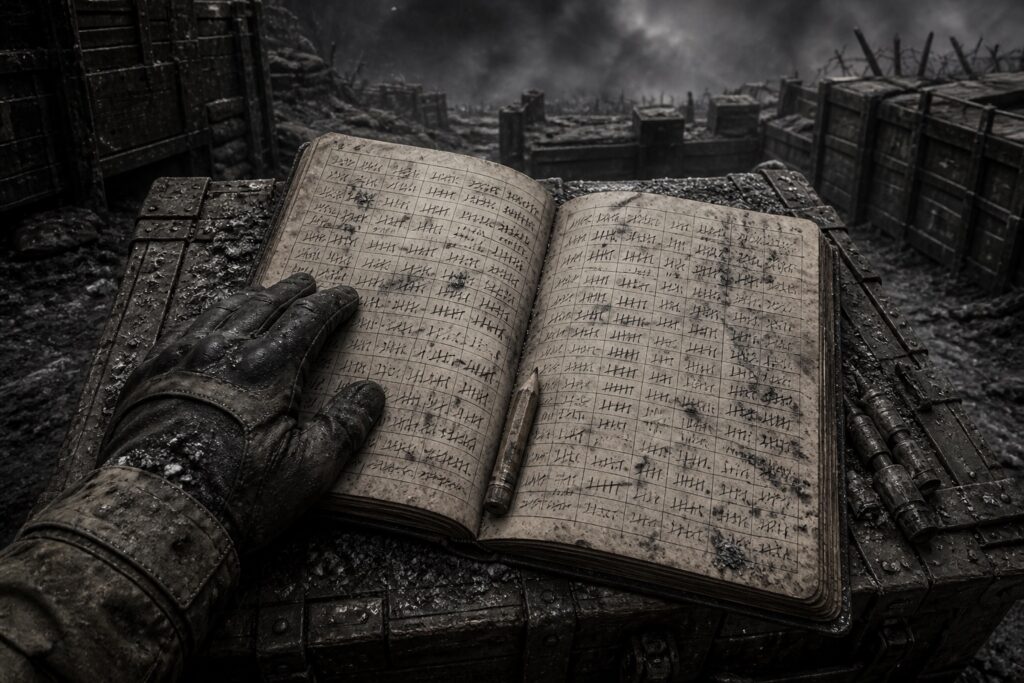
Field medic Brenn sat on an overturned ammunition crate in the inner courtyard of the captured bastion and wrote names.
Not many. Only those that had come into his hands today.
Regiment. Number. Place found. Condition.
Some lines were short. Some longer. Some ended with the same small note he had long wanted to break himself of and yet wrote again and again: identified by ident-tag. As if that were a comfort.
His left shoulder throbbed dully beneath the bandage. The rebreather tasted metallic. With every breath he heard the faint rattle of dried blood in the filter membrane. Before him lay two of the register books from Misericordia, wrapped in oilcloth and sealed with the mark of the Commissariat. The books looked innocent. Almost boring. That was exactly how the worst things in the Imperium often looked.
Someone stepped up beside him.
"You are writing again."
Commissar Halbrecht. The coat was full of dust at the hems, the gloves dark with old stains. His voice had lost something of its edge in the last two days, no mildness, only wear.
"Yes," said Brenn.
"You never sleep?"
"I do."
"When?"
Brenn looked up briefly. "When there are no more names."
Halbrecht did not answer. Lately he had more often acted as if he were testing a sentence for its usefulness before reacting to it.
From the main works of the bastion came Lieutenant Varn. The left arm was still in a sling, but his walk was once again that of an officer and no longer that of a wounded man. Behind him a man with a metal leg and a push-rod cane limped through the dust.
Watchmaster Kessel.
The makeshift of steel and leather squeaked at every step. Kessel seemed as little interested in that as in the glances that followed him. He did not sit down. He only stood beside Brenn's crate and looked down at the registers.
"The books?"
"Yes," said Brenn.
Kessel nodded. "Then at least Misericordia was worth it."
Varn snorted dryly. "That and the fact that we are still alive."
"For the time being," said Kessel.
It was the nearest thing that passed for humour with him.
II. Either Our Living Man or Our Dead One
Halbrecht picked up one of the registers. "I have looked through the first pages. Many entries come from regiments that have counted as destroyed for months. Some even from units that were never officially listed on Vraks."
"Double registration?" Varn asked.
"Or none at all." Halbrecht ran his thumb over the binding. "Misericordia was not only a bastion. It was an archive. And whoever ran it did not merely collect the dead. He sorted them."
Kessel looked at Brenn. "That bothers you more than it should."
"No," said Brenn. "It bothers me exactly enough."
The commissar drew another strip from his coat pocket. "That is the problem. One of the names in this book also appears in our living strength returns."
Varn looked at him. "A mistake?"
"Perhaps. Perhaps not."
Halbrecht handed Brenn the strip. On it stood an identifier Brenn knew.
19th Siege Regiment. 4th Assault Company. Guardsman Rhem.
Brenn raised his eyes. "Rhem is in the outer security ring. I saw him myself two hours ago."
"Then either our living man is wrong," said Halbrecht, "or our dead one."
No one spoke for a moment.
In the wall shadows of the bastion a field preacher somewhere was calling the Litany of Orderly Passage. Far out, guns howled. The war went on writing its lines, whether an identifier down here stood wrong or not.
"Where was the entry made?" Varn asked.
Halbrecht opened the page he had marked with a strip of leather. "Sub-sector Sepultura. Sub-Archive IX. According to the old plans that lies beneath the western munitions rampart."
Kessel looked towards the black silhouette of the main works. "Beneath Misericordia."
"Not in the destroyed core," said Halbrecht. "Deeper. Cut off. Probably not reached by the first demolition."
Varn's face hardened. "So down again."
"Yes."
"With how many?"
"With enough to finish the matter. Not enough to attract notice. Colonel Dreir is already moving the main force for the next attack. I am not getting a company for an archive problem."
"For an archive problem," Kessel repeated.
Halbrecht held his gaze. "For possible heretical infrastructure beneath a bastion that has just been secured."
"That sounds better already."
Varn looked at Brenn. "And you are coming."
Brenn closed the register. "Yes."
"Because of the identifier?"
"Because of the dead."
Kessel snorted softly. "Same reason. Different wording."
III. Give the Dead Not Rest, but Use
An hour later they descended.
This time not through the north shaft of Misericordia, but through a half-collapsed supply shaft beneath the western rampart. The entrance lay behind a munitions niche whose sandbags had been slit open by shell splinters. A servitor had already cleared the first stone slabs aside, until one could look down onto iron steps and deeper black.
The small assault group consisted of Varn, Brenn, Kessel, six Guardsmen of the Death Korps, two sappers and Halbrecht. No Space Marines. No Red Scorpions. No grey demigods clearing the essentials out of the way with cold force.
Only humans. As always, when it got unpleasant.
The descent smelled of dust and old lime. Further down something else joined it, not a smell of rot, but the dry aroma of bone rooms, of stores in which death had been kept long enough to become orderly.
Kessel led. The metal leg clacked on the steps, but the rest of his body moved as carefully as if he did not want to insult the new mechanism by using it for anything other than war.
"Wire, left," he said once.
One of the sappers knelt, felt along the wall and found a barely visible trigger between two stones.
"Old," he murmured.
"Does old work?" Varn asked.
"If it is Vraks, yes."
They crept on.
The steps ended in a corridor with low arches and niches for statues of saints. The statues were almost all missing. Some had been sawn off. Some lay smashed on the floor. In the empty sockets stood, in their place, numbered skulls, set on iron pins, as if someone had begun replacing the saints of the Imperium with the dead of its own wars.
Halbrecht noticed Brenn's look. "Not now."
Brenn nodded. Not in agreement. Only because he knew that outrage at the wrong moment was usually paid for in splinters.
They reached a bronze bulkhead door on whose surface a ten-line prayer was engraved. The first nine lines Brenn knew by heart. The Prayer of Orderly Sacrifice, as it was spoken in the field chapels of Krieg.
Not the tenth line.
It had been added afterwards, cut narrower and deeper into the metal.
Give the dead not rest, but use.
Even Kessel stopped for a heartbeat.
"That is new," said Varn.
"That is heresy," said Halbrecht.
"On Vraks the difference is seldom great," Kessel murmured.
IV. Sub-Archive IX
The sappers opened the bulkhead door.
Beyond it lay Sub-Archive IX.
It was no chapel. No shrine. No cathedral steeped in Chaos whispering as beneath Canticum. That was precisely what made it worse. The room was functional. Large, dry, laid out in rows. On metal racks lay skulls, upper arm bones, ident-tags, breastplates, neatly sorted by regiment, origin and condition. Between the rows ran narrow-gauge rails. Carts stood ready. On the walls hung writing boards with classifications.
In the middle stood a cogitator tower, connected to rows of servitors that cleaned bones, registered them and set them into brass frames. From the platform above hung a wreath of ident-tags, a hundredfold, a thousandfold, like a metallic choral.
And between the racks people were moving.
Not many. Twenty, perhaps. Men and women in worn uniforms of the Administratum, the Munitorum, the bastion militia. Some armed, others only with scribes' styluses and saws. They had heard the door. Too slowly. Too late.
Varn did not shout. He fired.
The first man fell from the cogitator dais. In the same moment fire broke loose from the rack aisles. Las-shots flickered between rows of skulls. One of the Guardsmen of the Death Korps went backwards with a hole in his throat, as if someone had pulled him by the collar.
"Cover!"
Kessel was already behind a cart. The sapper beside him threw a flash grenade into the left aisle. White light broke on bone and metal. Screams. Brenn dragged the fallen Guardsman to the edge, looked into the wound and let go of him at once.
Too late.
Halbrecht stood in the midst of them and fired his bolt pistol with a precision Brenn would not have expected of a commissar. Every hit was a verdict. No anger in it. Only execution.
"Cogitator first!" he shouted.
Varn nodded. "Kessel! With me!"
They broke through on the right.
Between the bone shelves the fight grew tighter. An archive scribe leaped at Varn with a butchering knife and got the rifle butt in the teeth. Kessel shot a militiaman's knee away and kicked him out of the aisle. Brenn followed more slowly, because he was dragging along a second wounded man who could still shoot.
Then Brenn saw him.
Guardsman Rhem.
He stood at the far end of a shelf, the mask half open, the lasgun levelled. Exactly the identifier that was listed in the register as dead. Exactly the same man Brenn had seen up above.
Except that his eyes were wrong.
No madness, no mutation. Worse than that: an emptiness in orderly form, as if someone had removed from him everything that was unnecessary to a human being and left only function.
"Rhem!"
The man did not react to the name. He fired.
The shot grazed Brenn's rib armour. Brenn stumbled against a rack full of ident-tags. Metal rattled like rain.
"Rhem!"
Again no reaction. Only a second shot.
Halbrecht came into the aisle from the side and took in the scene at a glance.
"Down!"
Brenn threw himself flat, more from reflex than obedience. Halbrecht's bolt pistol barked. Rhem was flung back against the shelf, hung in his straps for a heartbeat and then slowly folded in on himself.
Brenn crawled to him.
The identifier was right. The face too. The scars on the forehead. The cut along the jawline that Brenn had stitched himself weeks ago. All the same man.
Except that there had been no heartbeat in his chest even before Halbrecht hit him.
"How?" asked Varn, dropping down beside them.
Brenn pulled open the breastplate. Beneath it ran thin strips of metal under the skin, primitive conduits, connected to a mechanism anchored behind the breastbone.
"Servitorisation," Brenn said tonelessly. "Not complete. More like... reuse."
Kessel looked not at the dead man but at the shelves. "Then these here are not only registers."
No.
They were inventory lists.
V. The Archivist's Mathematics
At the cogitator tower a new figure now stepped onto the dais.
Old. Thin. The uniform once that of a Munitorum archivist, now stiff with stains and dusty grease. On his chest he wore more data-seals than insignia. Half his face had been replaced by a lens that glowed faintly red at every word.
"You do not understand it," said the man.
Of course he did. Of course such men always had exactly this tone, neither fanatical nor ecstatic, only tired and convinced that cruelty was administration.
"Vraks consumes more than Terra resupplies," he went on. "You keep lists. I create continuity. A body is material. An identifier is order. A fallen soldier is lost only when no one deploys him again."
Halbrecht raised his weapon. "In the name of the Emperor—"
"Do not speak his name if you cannot bear his mathematics."
Then he struck his hand on the cogitator tower.
All over the archive, locks clicked open.
Out of the racks tipped not only bones, but bodies. Some whole. Some supplemented. Dead in uniform remnants of the Astra Militarum, the Vraks militia, even in the filthy greatcoats of the Death Korps. On wires, clamps and primitive limb apparatus they raised their heads.
Brenn had seen many dead. But never how they rose as an administrative act.
The fight broke loose a second time.
The first of the Reused fell under concentrated las-fire. But they did not charge like madmen. They walked like soldiers from whom only the pain had been taken. One of the Guardsmen of the Death Korps was levered over the knee by a blunt entrenching tool and vanished screaming beneath three bodies. Kessel blew away an entire shelf. Bones, tags and dead bodies rained to the floor in a single filthy surge.
"Tower!" Varn screamed.
He and Halbrecht charged forward. Brenn lost them briefly behind a cart of skull crates.
Rhem still lay before him.
Brenn looked at the open chest. The primitive conduits. The ident-tag. The name. The same hand with which he had bandaged a wounded man two days before now reached for Rhem and closed his eyes, though it was pointless. Then he pulled off the ident-tag and pocketed it.
Something seized him from behind.
One of the Reused. Half a face gone, one arm held on only by wire. Brenn rammed the medic's knife up under its chin. No effect. Once more, deeper. Again none. Only when Kessel came in from the side and crushed the thing's knee with his new metal prosthesis did it tip over sideways.
"They answer only to central signals," said Kessel. "Or they simply have no good reason to fall down."
Brenn scrambled up. "Then the tower."
Varn had almost reached the dais. Halbrecht covered him. The archivist-magus — or whatever the man had become — now drew no bolter, no blade, but something smaller. A control rod, from which fine pulses of light ran into the cogitator. At every pulse, more bodies stood up.
Varn leaped onto the dais.
The archivist raised the rod, as if one could stop a lieutenant with a writing instrument. Perhaps he really believed that. Perhaps this hell had worked for too long.
Halbrecht's shot struck him in the side. Not fatal. Only enough to turn him.
Varn was there. He tore the rod out of the man's hand and split his face in two with the rifle butt. The archivist crashed against the cogitator. Wires tautened. Sparks flew.
"Charge!"
Kessel threw his last demolition charge up. Brenn caught it halfway up the climb, passed it on, Varn tore out the fuse and stuffed the packet into the cogitator's open service ring.
"Back!"
They jumped from the dais as the charge went off.
The explosion was small, but the room reacted as if its spinal cord had been smashed. The cogitator tower burst open. Ident-tags shot through the air like shrapnel. The servitors collapsed in on themselves. All over the archive the Reused stopped mid-step, shuddered once and then crashed back into the aisles, the shelves and the heaps of bone.
Silence did not come at once.
First the metallic rush of falling tags. Then the slow giving way of chains. Then only breathing, blood, and the distant thunder of the artillery far above them.
VI. Restored for Imperial Registration
Brenn stood for a long time among the dead, until Halbrecht came up to him.
"Report?"
Brenn looked at the rows. At the real bodies. The false ones. The half-registered. The sorted. The counted. The wrongly remembered.
"It was not a prayer," he said at last, and looked towards the bronze door with its tenth line. "It was an instruction."
Halbrecht nodded slowly. "Then it will not go into the official report."
"Will any report be true?"
The commissar looked up at the destroyed cogitator. "No. But some reports are at least useful."
Varn came from the dais with a blood-smeared sleeve. "Three dead. Two wounded. Tower destroyed. Facility unusable."
"The books?" Brenn asked.
Kessel lifted a sack of waxed linen. "Here."
Brenn took it. It was heavier than a sack of paper had any right to be.
"Then," said Halbrecht, "we climb back up."
"And these down here?" asked one of the Guardsmen.
Halbrecht looked around. There was no mercy in his gaze, but no longer any disgust either. Only administrative will.
"Mark. Seal. Have it cleaned out later."
Brenn stayed a moment longer beside Rhem. Then he took the ident-tag from his pocket and laid it on the dead man's chest.
So that he was counted again.
When they stepped out of the shaft hours later, the next night had already sunk down over Misericordia. The sky of Vraks flickered distant red with new impacts. In the inner courtyards of the bastion, munitions carts were already being loaded again. The war had left them exactly enough time to find one more form of treason, and not enough to mourn it.
Brenn sat down on the same crate as in the morning, opened the register and wrote the next name.
This time under a new heading.
Restored for Imperial registration.
No victory.
But a correction.
And on Vraks even that lasted only as long as someone wrote it down.
Download story as PDF or EPUB
Enter your email address. After confirming your subscription you'll get the download links immediately and by email.