THE LOST COMPANY
A Story of the Word Bearers
I. THE SILENCE
The blood had stopped steaming long before Dark Apostle Kranon finished the litany, and that was the first sign, before he even opened his eyes, that this rite too, like the last thirty-one before it, would go unanswered.
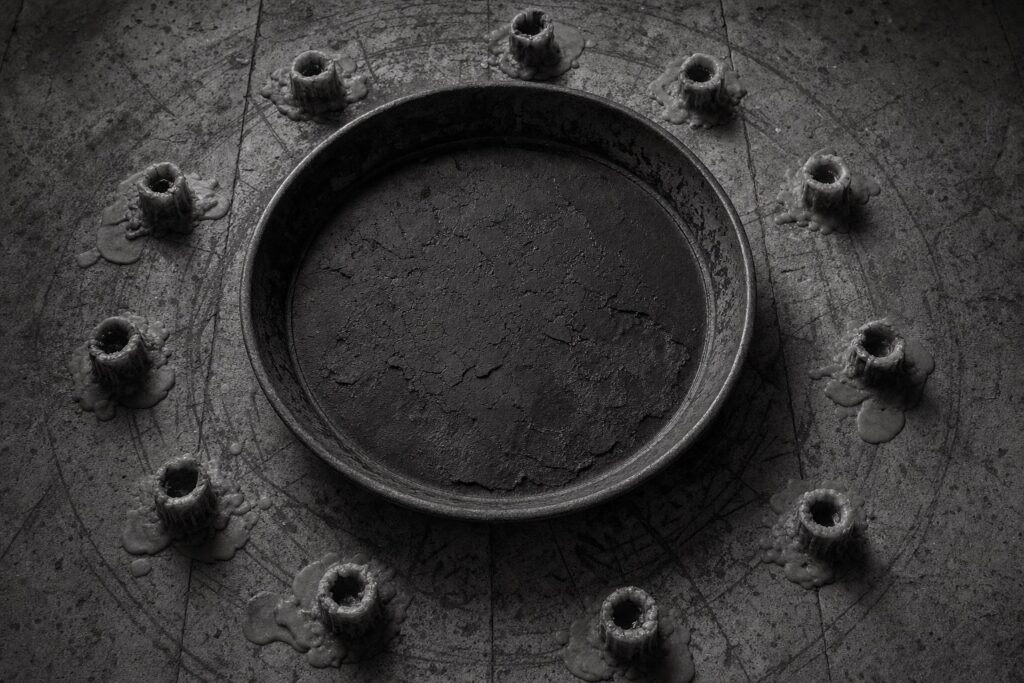
He knelt on the sanctum deck of the Chalice of Revelation, that place which the ship's remaining crew had for so many centuries held to be the holiest thing left to them of their original purpose, surrounded by the eight reliquaries that had once, in a life he was increasingly coming to regard as another man's, been brought straight from the crypts of Colchis. The offering — a thrall whose name Kranon had no longer troubled to ask, because names, as he had learned across the past centuries, were irrelevant to the rite itself — lay motionless before the central altar, his throat opened, his blood caught in the channels that generations before Kranon had cut into the metal of the deck for precisely this purpose.
It had been the correct litany. He had checked it, as he checked it at every rite, with the pedantic care of a man who knew exactly how easily errors could creep into a tradition passed on by mouth across millennia — the right words, in the right order, in the right cadence of High Gothic, which the Word Bearers had held since Colchis to be the only tongue befitting the gods. It had been the right blood, from a throat opened with the right blade, at the right hour, according to the reckoning of the ship's cognitor, which, despite ten thousand years without maintenance by any true Tech-Priest, still functioned with a certain stubborn persistence.
And yet — nothing. No vision, no manifestation, no whisper in his mind to tell him that anything beyond the veil had actually listened. Only the blood, congealing slowly on the cold metal, and the silence that settled over the sanctum deck like something physical, something one might almost have touched had one had the courage to reach out a hand for it.
Kranon opened his eyes and regarded the dead thrall with a detachment that he himself, in the earlier centuries of his service, would have condemned as a sign of failing devotion. It was not pity he felt — pity had gone from him, like so much else, long ago, somewhere between the hundredth and the thousandth offering he had made in the name of the Dark Gods. It was something subtler, more troubling: the question that had, over the past decades — or had it been centuries already? Time itself had become an unreliable, almost meaningless measure within the Immaterium — lodged itself in his mind with growing, undeniable persistence: whether the blood he spilled still reached anyone at all, or whether he had, all these years, merely been making offerings into a void that seemed to him as deaf as that god he had once, on Colchis, before his own birth into this war, abandoned.
He rose, his ancient Mark III plate — a relic of his first decades of service, from the days when he had fought under Kol Badar Corophaeus on the broken fields of Calth, long before Calth itself became a name that the survivors of both sides pronounced with different but equally indelible bitternesses — grinding in that familiar, painful way of joints that for millennia had functioned more by stubbornness than by any actual maintenance, and turned from the altar to walk back through the endless corridors of the Chalice of Revelation, shot through with their faint red light, to his own chambers.
The ship itself — a frigate whose original classification had long since been rendered unrecognisable in the Legion's official registers by ten thousand years of unregulated, chaotic modification, its hulls covered with trophies, chains and the branded ornamentation of countless long-forgotten rites — was, as Kranon put it in the rare moments of philosophical clarity he still allowed himself, less a vessel than a coffin that happened to be still functioning.
They were lost, in the most literal and most cruel sense the word could take within the vastness of the Immaterium — not lost as a ship that misses its course and finds its way back into real space after some weeks or months, but lost in a manner Kranon himself, even after all these centuries, could not entirely grasp, caught in a current of the Warp that carried them, according to the fragmentary and increasingly contradictory calculations of their mad, ancient Navigator, neither forwards nor backwards but, in a manner of speaking, sideways through time itself, so that decades might pass outside in real space while aboard the Chalice of Revelation scarcely more than weeks went by — or, equally plausibly according to the theories that circulated among the surviving officers across the centuries, the other way about.
II. THE CHALICE OF REVELATION
Kranon had been young, young in the sense of the Legion, which for an Astartes still meant several decades, when Kor Phaeron assigned him to the corps of Kol Badar Corophaeus, in the last desperate months before Calth, and he remembered, with a clarity that even ten thousand years of later experience had not entirely dulled, that first meeting with Corophaeus on the ruined field, the words the First Captain — whom, in the Legion's own tongue, in memory of the old ranks of the Crusade era, some still occasionally called Coryphaeus — had spoken to him, when he required Kranon to carry Erebus an answer Erebus would not like.
The Word is patient, Corophaeus had said, a phrasing that had lodged itself in Kranon's memory as scarcely any other from those first, formative years of his service, and which he had, in the millennia that followed, summoned again and again, in moments of doubt, as a kind of anchor to cling to when everything else about him grew uncertain.
He had not seen Corophaeus again after Calth — the Coryphaeus had, as the fate of so many Word Bearers of that generation would have it, fallen in one of the countless engagements of the later Heresy, his name by now more legend than actual memory even among those few veterans old enough to remember him — but that patience Corophaeus had preached, that faith that the Word, rightly spoken, rightly lived, would ultimately prevail, however long it took, had carried Kranon through the following centuries of his service — through the Great Scouring, through the endless, repeating cycles of crusade and retreat within the Eye of Terror, through the long, slow fading of that first, fanatical certainty that had moved him as a young man from Colchis to pledge himself to Lorgar's Word at all.
How they had come into the Immaterium, out of which they had not found their way since, was a story Kranon himself, after so many centuries of repetition, could scarcely distinguish with any certainty from the legend that had formed about them — a failed warp passage during a crusade against an Imperial border world whose name nobody aboard still claimed to remember, a storm stronger than any calculation of their Navigator of that time, and then, quite suddenly, the recognition that the real space they were trying to return to refused to take them back, as though the Immaterium itself had decided that the Chalice of Revelation and her crew now belonged to it, and would release them only ten thousand years later.
The ship's original crew had, according to the fragmentary records Kranon had found in the oldest archives of the sanctum deck, numbered over two hundred Astartes, supported by several thousand human thralls and cultists, a full company in the classical sense of the Legion, equipped for a crusade that should have lasted weeks, perhaps months. What remained of that company by now, after — Kranon's best estimate, based on the Navigator's calculations, came to something between eight and ten thousand standard years, an uncertainty that rendered even this crude reckoning almost meaningless — could be counted on the fingers of two hands: seventeen Astartes, several of whom had by now been so marked by mutation and by the subtler but equally inexorable effects of prolonged exposure to the Immaterium that they were barely recognisable as what they had once been, supported by a dwindling population of human descendants of those original thralls who, born, raised and dying across generations within the closed, claustrophobic environment of the ship, had developed a strange culture of their own, whose central, all-pervading element was the veneration of those Astartes whom they regarded as living messengers of the Dark Gods themselves.
They called themselves, among themselves, with an irony that had mutated over the centuries into a kind of defiant, desperate pride, the Lost — a name that, as Kranon recalled, had originally been coined by a sergeant named Vrehl in the first decades of their isolation, as a bitter, self-mocking acknowledgement of their situation, but which had, over the following centuries, turned into something closer to the designation of a legion, of an independent if tiny Chapter within the greater, unreachable structure of the Word Bearers, than to any mere description of their fate.
Vrehl himself had been dead for centuries, fallen in one of those rare but always devastating incidents when the Immaterium itself — or whatever actually existed within its unfathomable depths — decided to test the thin barrier, sustained by a dying Gellar field, between the Chalice of Revelation and the horrors that lurked beyond her hull. Of the original officers of that first, lost company, Kranon was the only survivor remaining, a circumstance that had granted him over the centuries an authority resting less on his actual rank as Dark Apostle than on the sheer, indisputable fact of his survival, in an environment where mere survival was itself increasingly interpreted as a kind of favour of the gods, however hollow that interpretation had come to feel to Kranon himself.
He reached his own chambers — a small, barely furnished cell whose only ornament was a single, millennia-old psalter he had brought with him from Colchis itself, before Colchis, before the Legion, before anything at all of what made up his present life had existed — and sat down, with that deliberate slowness his ancient, barely maintainable armour forced upon him, at the small, makeshift desk at which he had for centuries kept his own private records, a practice he had revealed to nobody aboard, because it would have counted, as he knew very well, in the eyes of a truly devoted service to the Word, as a form of weakness — the recording of his doubts.
III. THE LOST
Life aboard the Chalice of Revelation, in the centuries since the loss of their course, had divided itself into a series of distinct but equally exhausted responses to their common situation, patterns Kranon had learned to categorise with growing precision across those centuries, with the detached clarity of a man who had himself begun to stand outside them.
There were those, like the Gal-Vorbak champion Ur-Thagoth, whose answer to isolation had been an intensification of their original devotion, a sharpening of faith that fed upon itself the less outward confirmation it found — as though the sheer force of one's own conviction could compensate for the silence that came back from the other side. Thagoth, whose flesh had in the decades since his Gal-Vorbak consecration undergone a series of mutations that made him seem increasingly a vessel for something greater than himself — additional chitinous plates that had pushed themselves over his original power armour, a second, smaller pair of eyes that had developed beneath his right jawbone and whose purpose even he could not entirely explain — regarded the continuing silence of the gods not as proof of their absence but as a trial whose passing would ultimately yield an all the greater, all the more spectacular reward, if only the devotion of the Lost remained sufficient, sufficiently pure, sufficiently uncompromising.
Others had taken the opposite road — Sergeant Malkor, one of the few remaining officers of Kranon's own generation, had over the past three centuries withdrawn increasingly into a form of nihilistic violence that counted as excessive even within the already brutal norms of the Lost — violence that pursued no discernible ritual or theological purpose any longer, but merely constituted, as Kranon believed he understood it, an outlet for a despair Malkor himself would never have been willing to put into words.
And then there were those whose numbers had grown most across the centuries, among the human descendants of the original thralls in particular — people who, in the absence of any other reality, any other form of existence they had ever known, practised the veneration of the Astartes and of the rites that structured life aboard with a kind of innocent, almost childlike sincerity that sometimes seemed to Kranon, in his darkest moments, the saddest thing about their whole situation — generations of human beings born and raised in a coffin presented to them as the entire universe, whose faith in the Dark Gods rested not on experience or personal revelation but merely on the fact that it was the only story anyone had ever told them.
Kranon himself had, over the past centuries, begun to distance himself increasingly from the daily rites of the company, a distancing he had carefully tried to mask as growing spiritual discipline, as a withdrawal into deeper, more contemplative forms of devotion, but which was, as he admitted to himself in the most honest moments of his private records, actually something else — a growing inability to perform the rites with the same conviction that had once carried them, an exhaustion no number of repeated litanies could overcome.
Daily life aboard the Chalice of Revelation had, across the centuries of isolation, developed into an ecosystem of its own, closed in upon itself, of ritual, labour and a form of cultural memory that even Kranon, whose entire existence had been shaped by the ancient Colchisian tradition of the Legion, occasionally regarded with a mixture of fascination and unease. The human descendants of the original thralls had, in the absence of any contact with the wider galaxy, developed a mythology of their own, passed on by mouth, in which the Astartes themselves, particularly those who had fallen in service across the centuries, became a kind of pantheon of subordinate but nonetheless venerated figures, whose deeds and sacrifices were immortalised in increasingly embellished tales handed down from generation to generation.
The labour itself, which had secured the ship's survival for millennia, was divided among the various human kin-groups that had formed over the course of their isolation — the technician kin, responsible for the maintenance of the ship's increasingly unreliable machinery, with a knowledge that consisted more of ritualised practice passed down across generations than of any actual technical understanding; the grower kin, who cultivated in the barren, artificially lit chambers of the lower deck those sparse foodstuffs that secured the survival of the whole population; and the blood kin, as they were called, whose members, according to a tradition of voluntary devotion established over generations, made themselves available for the periodic rites of sacrifice, in the belief that such an offering represented the highest, most meaningful form of service a human being could render the Astartes and the gods they served.
Kranon had, in the earlier centuries of his service, regarded this developing, increasingly independent culture with a certain detached satisfaction, as proof that even under the most extreme conditions of isolation the fundamental faith in the Word proved resilient enough to sustain a functioning society of its own. Only in the past decades had he begun to see something more tragic in that resilience — the recognition that these people, born into an existence that offered them no other choice, practised a faith resting less on personal conviction than on the plain absence of any alternative, a circumstance that complicated the question of that faith's sincerity or meaning in ways Kranon himself was reluctant to admit.
"You are holding back," said Thagoth on that day — or had it been a night, a distinction that had grown increasingly meaningless within the ship's eternal red twilight — as he entered Kranon's chambers without the customary announcement, his mutated frame passing through the low doorway only with visible effort. "At the last offering. I noticed it. The others may not have noticed, but I noticed it."
"I perform the rites with the same care as ever," said Kranon, his voice given that practised, controlled neutrality he had perfected across the centuries to survive precisely such confrontations without revealing the deeper doubts they had increasingly harboured over the past decades. "Care is not the same thing as enthusiasm, Champion. I am no young novice who trembles with awe at every litany."
"That is not what I mean," said Thagoth, his additional eyes, those disquieting organs concealed beneath his jaw, turning upon Kranon with a movement of their own, independent of his original eyes, which continued to study him directly, a double attention Kranon still found uncomfortable even after decades of habituation. "I mean the emptiness in your voice when you speak the names. I mean the way you look at the blood after it has flowed, as though you were waiting for something that does not come, and as though you had already accepted that it never will."
It was an observation that came nearer the truth than Kranon was prepared to admit in that moment, and he felt something in him tighten — not fear in the ordinary sense, for fear of death he had left behind millennia ago, but something subtler, a kind of existential wariness that reminded him that doubt, within the hierarchy of the Word Bearers, was never regarded as a merely private matter, but as a threat to the cohesion of the whole body of the faith, a threat that, once identified, was dealt with according to the oldest and most implacable traditions of the Legion.
"You exceed your bounds, Champion," said Kranon, his voice now given a sharper, more authoritative edge, acquired across millennia of command. "I am the Dark Apostle of this company, the last remaining officer of the original crew. My devotion is not open to debate, least of all by a champion who received his own consecration a mere three centuries ago."
Thagoth bowed, a gesture that for all its formal correctness carried an unmistakable trace of defiance, before he withdrew, but Kranon knew, with a certainty that offered him little comfort, that this confrontation would not be the last of its kind — that Thagoth's suspicion, once voiced, would not be silenced entirely again, and that the time remaining to him to conceal his own growing doubts was increasingly limited.
IV. THE TREMBLING OF THE VEIL
The first signs that something within the currents of the Immaterium that had held the Chalice of Revelation captive for so many centuries was beginning to change manifested at first not as anything Kranon or anyone else aboard immediately recognised as significant, but as a series of subtle, almost imperceptible shifts — a tremor in the warp currents that the ship's mad, ancient Navigator, a man named Ashkelis Vorr, whose third eye, the one necessary for navigation, had long since mutated into a pulsing mass barely recognisable as an eye at all, tried to describe to Kranon with growing, almost hysterical excitement in his fragmentary and increasingly disjointed reports.
"It is tearing," Vorr had said, on one of those rare occasions when Kranon went down to the sealed chamber, saturated with constant psychic reverberation, in which the Navigator kept his lonely, millennia-old watch. "Somewhere out there, in real space, something is tearing — a rift greater than anything I have ever seen, greater than anything the old records describe. I can feel it, through the currents, like a wound running through the whole galaxy."
Kranon, who had learned across the centuries to treat Vorr's increasingly fragmented observations with a healthy scepticism without dismissing them entirely — the Navigator might be mad, but his madness was, as had been shown repeatedly across the centuries, frequently accompanied by a kind of uncanny precision regarding the actual state of the Immaterium — had received this first warning with a mixture of professional caution and, as he had to admit to himself, a peculiar, unexpected stirring that he identified only after some self-examination as hope — an emotion he had not consciously felt for so long that its sudden return unsettled him almost as much as the news itself that had provoked it.
In the weeks that followed — or months, the distinction remained, as ever, unreliable — Vorr's observations began to thicken, to converge into a coherence even Kranon could no longer ignore. Something vast had occurred in real space, an event of a magnitude that seemed to alter the entire topology of the Immaterium in their immediate vicinity — a disturbance Vorr, in his clearer moments, described as something he could only imagine as a kind of galaxy-wide wound, a tearing of the veil between the dimensions whose extent overshadowed every previous experience of his millennia-long career as a Navigator.
Kranon assembled the company's remaining officers in the council chamber — a bare, dimly lit room whose only ornament consisted of the honour-marks of those Astartes who had fallen in the course of their shared isolation — in accordance with the protocol the Lost had developed across the centuries for precisely such extraordinary circumstances, to consider the implications of what Vorr had observed.
"If the Navigator is right," said Thagoth, whose initial scepticism towards Vorr's reports had in recent weeks turned into a kind of feverish, barely concealed excitement, "then it means the gods themselves have struck that wound. A sign, Apostle — a sign that the time of our trial draws to its end."
"Or it means merely that the currents of the Immaterium have changed, for reasons that have nothing to do with us," said Kranon, his voice given that careful, deliberately muted neutrality he had increasingly cultivated in recent decades as a shield against precisely the kind of feverish interpretation Thagoth and others were increasingly displaying. "We should beware of reading every event we do not entirely understand as a message addressed to us personally, Champion. That is the error too many failed cults before us have already committed."
"And yet," said Malkor, whose voice, since his growing withdrawal into nihilistic violence, was seldom more than a rough growl, "it is the first time in countless centuries that anything at all has changed. How many exactly, Apostle, nobody can any longer say. Even if it is no sign, it could be an opportunity. A shift in the currents that carries us back into real space at last."
It was, as Kranon had to admit, an argument he found hard to contradict, however much his own growing doubts urged him to treat every hope with the utmost caution. If Vorr's observations were accurate, if something of significance truly had happened in real space, then it was entirely plausible that the resulting shifts in the currents of the Immaterium might offer them precisely the opportunity they had sought in vain for millennia — a route back, a window, however narrow and fleeting, through which the Chalice of Revelation might finally end her age-old captivity.
"We shall continue to follow Vorr's calculations," Kranon decided at last, with that authority his status as last surviving officer of the original crew granted him, an authority that grew, as he knew very well, increasingly fragile the longer his own unspoken doubt remained undiscovered. "But I warn you all — woe to the man who turns a mere shift in the warp currents into a guaranteed sign of deliverance. The gods, if they listen at all, have let us keep silence long enough. I will not have false hope tempt us into rash actions that could cost us more than we have already lost."
It was a warning that, as Kranon noticed with growing unease in the following weeks, was scarcely heeded by Thagoth and his increasingly numerous adherents among the younger Astartes and the human descendants of the thralls, while the news of a possible imminent deliverance spread through the narrow, claustrophobic passages of the ship with a speed Kranon could interpret only as a kind of collective, long-suppressed hunger for precisely that hope which he had for so long been compelled to deny himself.
V. THE SUSPICION
It took, by human reckoning of time, which aboard the Chalice of Revelation held only an approximate, symbolic meaning in any case, scarcely more than three weeks before Thagoth's growing impatience with Kranon's careful, restrained leadership turned into a more open, more dangerous form of confrontation — a development Kranon, with the detached clarity of a man who had witnessed such struggles for power several times already in the centuries of his leadership of the Lost, saw coming long before it actually arrived.
It happened during one of the great communal ceremonies the Lost held at irregular but significant intervals — an assembly of nearly the whole remaining population of the ship on the sanctum deck, Astartes and human descendants alike, to speak together those litanies that, according to the Legion's oldest tradition, were to renew the collective bond between the company and the gods they served.
Kranon had conducted the ceremony with the accustomed, outwardly flawless precision, every word, every gesture exactly according to the received forms, while inwardly, as so often in recent decades, he felt that familiar, exhausted emptiness that had inserted itself between him and the meaning of the words he spoke. It was Thagoth who, in the moment when the assembled crowd passed to the closing communal invocation, suddenly stepped forward, his mutated frame drawing itself up before the whole assembly, with a gesture that for an instant left even Kranon, for all his preparation for such a moment, without words.
"I demand a testimony," Thagoth proclaimed, his voice amplified by the natural acoustics of the sanctum deck so that it reached every corner of the assembled crowd. "A testimony from our Apostle, whose devotion in recent years — and more than I have noticed it, even if not all have had the courage to say so — increasingly raises questions. We stand on the threshold of something historic, of a possible return to real space after ten thousand years of trial, and I ask: is the man who is to lead us across that decisive threshold still a true servant of the Word, or has he become, in the long centuries of our isolation, something else — a man who still commands the forms of devotion but who long ago lost their substance?"
The silence that followed this accusation had a quality Kranon had not experienced in all his centuries aboard the Chalice of Revelation — not the respectful, disciplined silence of a properly conducted ceremony, but something more taut, more dangerous, the weight of hundreds of eyes, both of the remaining Astartes and of the assembled human descendants, turned upon him, waiting for an answer that, as Kranon knew very well, would in that moment decide far more than merely his personal standing within the hierarchy of the Lost.
He could have lied: could have delivered a convincing, impassioned declaration of his unbroken devotion, a performance that, given his decades of experience as preacher and spiritual leader of the company, could certainly have proved convincing. It was an option he weighed, in the seconds after Thagoth's accusation, with a cold, calculating clarity that surprised even him — not out of moral conviction, but out of a deeper, more existential exhaustion that suddenly made clear to him how wearing it had been, all those years, to perform a conviction he no longer entirely felt.
"I shall offer you no lie," Kranon said at last, his voice calmer than he himself would have expected, while the assembled crowd remained in a silence now marked by a new and uncertain quality. "Champion Thagoth is not entirely wrong. In the past years — decades, perhaps — I have wrestled with questions I would not previously have dared to ask. Not because I doubt the Word itself, not because I believe Lorgar's teaching was false, that our turning from a deaf god was an error. But because I ask myself, after ten thousand offerings, after ten thousand litanies that have gone without discernible answer, whether the gods we serve hear us at all in this exile — or whether we have, in our isolation, long since become something that no longer merits their attention, or that never truly possessed it, beyond the blood itself that we bring them."
It was a dangerous truth, that he knew as he spoke it — a truth that, according to the oldest and most implacable traditions of the Legion, which he himself had enforced across millennia, could have counted as sufficient grounds for his immediate deposition, perhaps even his execution. And yet, as he looked into the faces of the assembled crowd — the remaining Astartes, whose reactions ranged from open horror to, in a very few, a trace of what Kranon almost read as relief, and the human descendants, whose faces widened in disbelieving astonishment — he felt, for the first time in so many years, that the sheer speaking of his doubt, whatever consequences it might bring, gave him a kind of relief that no conviction, however carefully performed, could ever have offered him.
"That is heresy," said Thagoth, his voice now suffused with a hardness Kranon recognised for what it actually was — the barely concealed joy of a man who had finally found the justification he had been seeking for months. "Heresy against the Word itself, spoken by our company's own Apostle, at the very moment when we approach the greatest trial of our whole isolation. I demand that the council of remaining officers decide his fate, according to the oldest laws of the Legion."
The council that assembled in the following hours — a hastily convened, informal gathering of the remaining officers, whose number by now amounted to scarcely more than half a dozen — would, as Kranon recognised with a detached, almost philosophical calm, decide far more than merely his personal fate. He would either be condemned as a heretic within a company of heretics, an irony that even in his present state of existential exhaustion was not without a certain bitter humour, or he would, against all probability, be granted the opportunity to put his own uncertain devotion to the test one last time, in that rite which, if Vorr's calculations proved accurate, would decide the ultimate fate of every soul aboard the Chalice of Revelation.
VI. THE TRIAL
The council had not yet reached a decision — the deliberation itself had, as could hardly be otherwise with so unprecedented an accusation, become entangled in endless, repeating debates about the exact interpretation of those ancient laws the Legion provided for dealing with heresy within its own ranks, laws that, as several of the assembled officers bitterly observed, had never been written for a situation such as theirs, a tiny, isolated company whose entire existence already constituted a form of continued, desperate improvisation beyond any established doctrine — when the first unmistakable sign of a new and immediate crisis rang through the corridors of the Chalice of Revelation: the piercing alarm tone, feared for centuries, that signalled a critical instability in the Gellar field.
Kranon, who had been held during the council's deliberation in a kind of improvised custody, unarmed but not bound — a gesture that even in that moment revealed a certain lingering ambivalence among his guards regarding his actual guilt — recognised the alarm at once, with a physical, almost reflexive reaction that ten thousand years of experience had rooted in him. A failure of the Gellar field, even a partial one, meant, within the unprotected, unimaginable expanses of the Immaterium, not merely a technical malfunction but the immediate, potentially existential threat of those entities that lurked outside the thin barrier sustained by the ship's ancient, barely functioning technology.
"The field is fluctuating," reported one of the younger Astartes, storming into the hastily interrupted council assembly, his voice shot through with a panic barely suppressed even by the accustomed, disciplined restraint of an Astartes. "Vorr says it is the shift in the currents — the wound in real space he spoke of, it is producing turbulence such as we have never known. The field will not hold."
The council assembly dissolved in that moment, not by any formal decision but by the sheer, immediate necessity that instantly rendered every further debate about Kranon's theological standing irrelevant — a ship with a failing Gellar field, caught amid unprecedented turbulence of the Immaterium, needed every available officer, every available skill, however questionable their spiritual condition might appear at that moment.
"Apostle," said one of the council officers, a veteran named Kessivar, whose own loyalty had remained undecided throughout the preceding debate, "the field needs a rite of renewal. At once. You are the only one aboard who still commands the full litany with sufficient precision."
It was, as Kranon recognised in the one compressed moment left him for decision, an irony of almost cruel precision — that he of all men, whose faith in the efficacy of such rites had been so fundamentally shaken in recent years, should now be called upon to conduct a rite whose immediate, verifiable success or failure would decide the physical survival of every single soul aboard the ship — a trial that, unlike the abstract theological debates of the council, would leave no room whatever for interpretation or subsequent justification. Either the field would be stabilised or it would not, and the consequences of that binary outcome would not exhaust themselves in pious speculation about the favour of the gods, but in the brutal, immediate physics of what happened when unprotected, mortal matter came into contact with the unfiltered forces of the Immaterium.
"Take me to the generator deck," said Kranon, and the authority with which he said it made even those who had accused him of heresy hours earlier obey without further discussion.
The generator deck of the Chalice of Revelation, situated deep in the ship's hull, was a place Kranon had visited only rarely in the preceding centuries, a labyrinth of ancient machinery, in parts barely recognisable through chaotic modification, whose workings even the company's remaining technically versed members claimed to understand only incompletely. The heart of the Gellar field generator — a pulsing construct surrounded by countless ritual symbols, its original Imperial technology long since transformed by millennia of Chaos modification and corruption — flickered with an irregular, disquieting rhythm that even to Kranon's untrained technical eye pointed unmistakably to an imminent, catastrophic malfunction.
He began the litany of renewal, that ancient, complex chaining of binary and High Gothic verses the Word Bearers had developed since the earliest days of their turning from the Imperium, in order to reconcile the technology they had wrested from the Imperium or inherited from it with the powers of the Warp, in a manner neither purely Imperial nor purely daemonic doctrine had ever fully explained. And as he spoke the words — with a precision that despite his inner division permitted not a single error, for an error in that moment would have meant consequences not merely theological but immediately lethal for every soul aboard — Kranon felt a question forming in him that he had not in all the years of his growing doubt put to himself with such sharpness: whether it mattered at all, in this concrete, immediate moment, whether he believed the words he spoke, or whether it was merely the correct execution itself — the precision of the litany, the purity of the ritual form — that actually counted, independent of the conviction behind it.
The field stabilised, slowly at first, then with growing constancy, while Kranon's voice echoed through the generator deck, accompanied by the gradually fading warning tone of the alarm. It was, measured by every objective, verifiable standard, a success — the ship was saved, the immediate threat averted, an achievement that under normal circumstances would undoubtedly have strengthened Kranon's position within the hierarchy of the Lost.
And yet, as he sank exhausted against the pulsing surface of the generator after concluding the litany, Kranon felt no relief, no renewed certainty of his faith, but merely a deeper, more disquieting version of the same question that had plagued him for years — for the field, he recognised with growing unease, had stabilised because the litany itself, independent of faith or doubt, contained the correct technical and ritual parameters to return the underlying machinery to a stable state — a success that might just as well have been the result of pure, impersonal mechanics as of any actual divine intervention, and which, precisely because of that indeterminacy, gave him no clarity whatever on the real question that had tormented him for years.
VII. THE RITE OF HOMECOMING
Vorr's calculations, in the days after the crisis at the Gellar field generator, condensed into a certainty that even Kranon's careful, systematically cultivated scepticism could no longer entirely dampen — a window, so narrow and fleeting that Vorr himself, in his clearer moments, scarcely dared to believe what his own calculations showed him, would, by his estimation, open within the next seven days, a convergence of the warp currents caused by the galaxy-wide wound in real space, which could offer the Chalice of Revelation a route back into real space, the only such opportunity that had ever shown itself in their entire ten thousand years of isolation.
The council, confronted with this news, had not formally dropped the charge of heresy raised against Kranon — a circumstance that, as several of the officers frankly admitted, rested less on any actual reconciliation with the doubts he had spoken than on the plain, pragmatic recognition that the coming passage through the unstable currents required a rite whose complexity and historical precision only Kranon himself, as the last living bearer of the original Colchisian traditions, could conduct with sufficient certainty.
"You will lead the passage litany," Kessivar, who in the days after the crisis had increasingly established himself as a mediating voice between Kranon and Thagoth's faction, had informed him, with a directness that left little room for contradiction. "Afterwards the council will decide your final fate, according to what happens during the passage itself. If we reach real space, that will be counted as sufficient proof of your continuing favour with the gods, whatever you said in the assembly. If we fail —" He had not finished the sentence, but the implication had been unmistakable to them both.
The passage litany itself, as Kranon recognised with growing, uneasy clarity in the following days of preparation, required an offering of a magnitude far beyond anything the Lost had ever made in their centuries of isolation — not a single thrall, as the regular weekly rites required, but, according to the oldest texts handed down from Colchis, which Kranon found in the deepest archives of the sanctum deck, a tenth of the ship's whole remaining population — a number that, applied to the dwindling resources of the Lost, meant no fewer than forty souls, Astartes and humans alike, chosen by a drawing of lots that even in its apparent randomness seemed to embody a kind of cruel, impersonal justice.
It was in the hours before the ceremony itself, while Kranon made the last preparations on the sanctum deck, surrounded by the forty chosen offerings, whose reactions to their impending fate ranged from stoic, almost religious acceptance to open, undisguised horror, that Thagoth sought him out one last time, his mutated frame in the faint red light of the sanctum deck a menacing but also, as Kranon noticed for the first time in weeks, a strangely uncertain silhouette.
"If you fail," said Thagoth, his voice quieter than Kranon had ever heard it, "if this rite goes wrong because your doubt corrupts it, then we all die, not only you. I ask you, Apostle, not as an accuser but as one who like you has been trapped in this coffin for centuries — do you believe it will work?"
It was an honest question, perhaps the first truly honest question Thagoth had put to him in all their decades of shared service, and Kranon found himself, to his own surprise, answering not with another evasion but with the complete, unvarnished truth of his own deepest uncertainty.
"I do not know," he said. "I do not know whether the gods listen, whether they ever listened, or whether what we interpret as their favour or their wrath is merely the blind, indifferent mechanics of a universe that has no personal interest whatever in our fate. But I know that the litany itself, the words, the precision of the ritual form, was developed across millennia to make precisely this kind of passage possible, with or without the conscious attention of any deity. I shall perform it with the same precision with which I stabilised the Gellar field. More than that I cannot offer you, Champion. If that is not enough, then we shall go down together, and I shall at least have the satisfaction of not having lied to you."
Thagoth was silent a long while, both his pairs of eyes fixed on Kranon with an intensity Kranon could not entirely interpret, before he finally nodded, with a gesture bordering almost on respect, and withdrew to take his own place for the coming ceremony.
The ceremony itself, when it finally began, lasted, by the ship's unreliable sense of time, several hours — an endless chain of binary and High Gothic verses, accompanied by the systematic, methodical shedding of the blood of the forty chosen, while Vorr, in his isolated navigation chamber, tried with feverish, barely controlled concentration to follow the opening route through the raging currents of the Immaterium that the galaxy-wide wound in real space had caused.
Kranon spoke the words with a precision no outward observation could have distinguished from his inner division, every syllable, every ritual gesture exactly according to the oldest traditions of Colchis, while within him there reigned a stillness that was neither despair nor hope but something between the two — a kind of waiting, almost meditative concentration directed solely at the technical, craftsmanlike perfection of the rite itself, detached from the question of whether anything beyond the veil was actually listening.
And then, in the moment when the last offering was made, the last word of the litany spoken, something happened that Kranon, even in retrospect, could never explain with complete certainty — a tremor that ran through the whole ship, deeper and more fundamental than any turbulence previously known, accompanied by a light that came through the outer viewports of the sanctum deck, a light that, as several of those present later agreed in their accounts, resembled none of the countless uncanny colours they had grown used to across their millennia within the Immaterium, but something terrifyingly, overwhelmingly familiar — the ordinary, unfiltered light of an ordinary star, in ordinary real space.
VIII. THE ANSWER
They had returned.
That simple, scarcely comprehensible fact — that the Chalice of Revelation, after ten thousand years within the unfathomable expanses of the Immaterium, against every reasonable expectation, had found her way back into real space — spread through the ship with a speed and intensity even Kranon, amid his own complicated reaction to the event, could barely process. Within a few hours the company's atmosphere, previously marked by fear and accusation, turned into something close to a collective, barely controlled ecstasy — Astartes who for centuries had shown scarcely any emotion beyond stoic discipline or nihilistic despair broke out into what Kranon could describe only as religious rapture, while the human descendants of the original thralls, for whom real space had until now been only an abstract, barely imaginable legend, gathered at the ship's viewports in a mixture of dread and overwhelmed astonishment, to look upon that ordinary, unfiltered field of stars their forebears had once taken for granted.
Thagoth, when he sought Kranon out in the chaotic hours after their return, wore an expression that displayed a complicated mixture of triumph and, as Kranon noticed with growing disquiet, a kind of undisguised challenge.
"The gods have answered," said Thagoth, his voice suffused with that feverish certainty Kranon had already noticed in him before the crisis, now reinforced by the seemingly irrefutable testimony of their actual return. "Despite your doubt, Apostle — or perhaps even because of the trial your doubt represented for us all — they have answered. What do you say now to your deaf god?"
It was a question Kranon tried in the following days, while the company began to work through the practical implications of their return — the need to determine their present position in real space, the question of how, after ten thousand years, they might even make contact with the greater structure of the Legion, if that structure still existed in any recognisable form — to answer with a thoroughness that surprised even him, after so many years of doubt.
He withdrew, in the quieter hours after the first overwhelming euphoria of the return, into Vorr's navigation chamber, to review with the ancient, mad Navigator the calculations that had formed the actual, mechanical basis of their successful passage — not from any mistrust of Vorr's abilities, but out of that deep-rooted analytical instinct that had driven him for years to weigh every seemingly supernatural explanation first against the more banal possibility of a purely physical, mechanical cause.
What he found in Vorr's fragmentary but essentially astonishingly coherent records confirmed a suspicion that had been condensing in his mind in the days since their return, with a clarity that gave him more existential disturbance than any of the theological debates he had conducted with Thagoth and the council in the preceding weeks — the route that had led them back into real space had, according to Vorr's own precise calculations, actually been made possible by the measurable, physical shifts of the warp currents caused by that galaxy-wide event which, in fragmentary transmissions they picked up from the surrounding sector in the following weeks, was called the Cicatrix Maledictum, the Great Rift — a physical consequence, however mediated by the Immaterium, of an event that had nothing to do with the Lost, with their offering, with their faith or their doubt, but was a force that reordered whole sectors of the galaxy independent of any individual devotion or despair.
The offering of the forty souls, the exact ritual precision Kranon had so carefully maintained, whether or not he still spoke the underlying words with conviction — all of this, he recognised with growing, cold clarity, might have played no causal role whatever in their actual return, or, if it had played a role, then one no different from the role a purely technical, impersonal adjustment of the ship's systems to the altered warp currents would have played — a possibility that could neither confirm nor refute the presence or absence of an actually listening, responding deity, but merely left open, with relentless ambiguity, what had actually happened.
And in that, Kranon recognised, in that ambiguity itself, lay the real and cruellest answer to the question that had tormented him for years — not the certainty that the gods were deaf, as he had feared in his darkest moments of doubt, but neither the triumphant confirmation Thagoth believed he saw in their return, but something crueller than either: the recognition that the question itself, whether the gods listened, might never find an answer strong enough to extinguish every further doubt, that every proof the universe offered him could be interpreted as plausibly as a sign of divine favour as of mere indifferent chance, and that he, Kranon, former son of Colchis, Dark Apostle of the Lost, would have to live with precisely that irresolubility for the remainder of his extended, Chaos-marked existence, without the mercy of a final, irrefutable certainty in either direction.
IX. THE WORLD THEY DID NOT KNOW
The first fragmentary vox and astropathic transmissions the Chalice of Revelation picked up from the surrounding sector in the days after her return — distorted, incomplete, from which Vorr and the company's remaining technically versed members laboriously tried to extract meaning — revealed a galaxy that had scarcely anything left in common with the one Kranon had left ten thousand years before.
The Imperium, which he had once understood as a monolithic if decadent enemy, still existed, but in a form that filled even Kranon, whose whole life had been devoted to the study and theological combating of that Imperium, with a mixture of professional fascination and deeper, existential confusion. A rift — that wound in real space of which Vorr had spoken weeks before, officially designated the Cicatrix Maledictum in the fragmentary Imperial transmissions they intercepted — had divided the whole galaxy into two unequal halves, a rift of a magnitude that overshadowed every previous manifestation of the power of Chaos known to him in the history of the galaxy.
"It has happened," said Vorr, his voice suffused with an awe unmistakable even through his advanced madness, as he tried to assemble for Kranon the gathered fragments of their intercepted transmissions. "What Lorgar began, what set the whole Great Heresy in motion — it has been consummated ten thousand years later, on a scale even he might not have been able to imagine. The galaxy bleeds, Apostle. It bleeds as we have bled all these centuries, to reach the ears of the gods."
Kranon, who studied the fragmentary reports with the same analytical caution he had applied to Vorr's calculations of the warp currents, found in that interpretation a bitter, almost unbearable irony — that the very event which had finally ended their own age-old isolation was increasingly interpreted by the remaining Astartes and humans aboard the Chalice of Revelation as the ultimate, irrefutable sign of the gods' attention, while from Kranon's own increasingly detached perspective it could just as well be read as the greatest possible argument against any notion of a personal deity responding to individual devotion — an event of such galactic magnitude that the idea of its having anything to do with the fate of a tiny company of seventeen Astartes, isolated for millennia, seemed frankly ridiculous, set beside the billions of other souls affected by the same indifferent cosmic catastrophe.
They learned, in the following weeks, while the Chalice of Revelation navigated cautiously through a sector whose exact position even Vorr could determine only with considerable uncertainty, of events that had fundamentally altered the whole structure of the galaxy Kranon had once known — the fall of Cadia, that world whose defence had for millennia counted as one of the Imperium's central strategic bulwarks against the Eye of Terror; the return of Roboute Guilliman, that Primarch whose death, as Kranon knew from the old legends of his own youth, had counted as one of the fundamental facts of Imperial history, but which had now, according to the fragmentary transmissions they intercepted, been undone by means even the company's technically versed members could not entirely reconstruct; the establishment of a new, more aggressive Imperial military doctrine, embodied in new, larger Space Marines whom the intercepted transmissions called Primaris, whose mere existence represented an answer to a threat far beyond anything Kranon knew from his own experience of war against the Imperium, ten thousand years in the past.
"We are strangers in this galaxy," said Kranon, as he tried, together with the company's remaining officers, to work through the implications of these fragmentary findings in the council chamber. "Stranger, perhaps, than we ever were while we were still trapped within the Immaterium. There at least we knew our situation, cruel though it was. Out here we do not even know which factions are our natural allies, which command structures of the Legion still exist, whether Kor Phaeron himself still lives, whether Colchis still exists, whether anything at all of what we once took for granted still stands."
"Then we shall find out," said Thagoth, whose initial triumphant certainty had, in the days of working through this fragmentary information, turned into a new and more purposeful resolve. "We have returned, after ten thousand years of trial, into a galaxy marked by the gods themselves, on a scale that makes our whole isolation appear a mere preparation — a preparation for precisely this moment, in which we, purified by our millennia of trial, may return into a war greater than anything we could ever have imagined."
It was an interpretation that, as Kranon noticed with growing exhaustion, found increasing favour among the remaining Astartes and even among many of the human descendants, a narrative that lent their millennia of seemingly senseless isolation a retrospective cosmic, meaningful purpose — and Kranon found himself, despite his own unchanged scepticism towards any such all-explaining interpretation, unable to deny them that comfort entirely, given what he himself, in his most honest moments, recognised as the only sober alternative: that they were simply seventeen exhausted warriors, marked by ten thousand years of isolation, returned into a galaxy that had changed fundamentally without any regard for their fate, without any special cosmic purpose, without divine providence, merely as one more accidental footnote in the endless, indifferent chronicle of a war that had never truly been about them at all.
X. THE BREAK
The decision that ultimately split the Chalice of Revelation into two irreconcilable factions crystallised in the following weeks around a question that, as Kranon recognised with growing clarity, ultimately reflected the same fundamental tension that had marked his own years-long struggle with his faith — the question of what the Lost should actually do with the freedom they had gained, unexpectedly and against every probability.
Thagoth, whose position had been increasingly consolidated by the apparent confirmation of his interpretation of their return as a divine sign, pressed for an immediate, aggressive course — the establishment of contact with any remaining structure of the Word Bearers they could find in this altered galaxy, the immediate resumption of their interrupted crusade, reinforced by the conviction that their miraculous return made them something special, tools of a divine intent whose full extent was yet to be revealed.
"We have a duty," Thagoth declared, as the remaining officers assembled one last time in the council chamber to decide the ship's future course. "A duty to the Word itself, to Lorgar's original vision, which our forced isolation has prevented us from fulfilling for ten thousand years. This new, torn galaxy needs the Word more urgently than ever before. We should not hide, not hesitate, but enter this greater war at once, with the purified devotion, strengthened by millennia of trial, that distinguishes us from every other, softened warband of the present age."
Kranon, who during this debate held an increasingly isolated but, as he himself recognised, ultimately unavoidable position, contradicted him with an openness he would never have permitted himself in the decades before he spoke his doubt in public.
"We are seventeen Astartes," he said, "supported by a few hundred human beings whose entire experience of existence is confined to the interior of this one ship. We do not know the Legion's present structure, the present fractures between the various cults and warbands that have doubtless developed across ten thousand years. An immediate, unprepared entry into this greater war would not be devotion, Champion — it would be suicide dressed as religious zeal."
"You speak again of doubt dressed as caution," Thagoth replied, his voice now suffused with a hardness that admitted no further compromise. "I respected your honesty before the passage, Apostle. I respect it still. But respect does not mean agreement, and I no longer believe you are the right leader for what must come next. The company must decide — do we follow the man who brought us back by pure craftsmanlike precision without discernible faith, or do we follow those who are willing to confess the meaning of this return with the full conviction it deserves?"
The vote conducted in the following hours among the remaining officers and, in an innovation that surprised even Kranon, among representatives of the ship's human population — a democratic element corresponding to no official tradition of the Legion, but which had established itself over the centuries of shared isolation as the pragmatic necessity of so small and interdependent a community — fell, as Kranon had already foreseen with a kind of resigned clarity, by majority in favour of Thagoth's more aggressive vision, borne by immediate religious certainty.
Nine of the seventeen remaining Astartes, among them Sergeant Malkor, whose nihilistic despair could be converted into Thagoth's feverish certainty with astonishing ease, declared themselves ready to make contact under Thagoth's leadership with the nearest known Chaos territories and to join, as swiftly as circumstances permitted, the greater war around the Great Rift. The remaining eight, together with the overwhelming majority of the human population, chose to stay with Kranon, for a more cautious, less immediately confrontational course — not out of any explicit rejection of the Word or of the Dark Gods, but out of a pragmatic caution which was, as Kranon noted not without a certain bitter self-recognition, ultimately a continuation of the same uncertainty that had marked his own decades of struggle.
The separation, when it was finally carried out — Thagoth and his nine followers, equipped with one of the two remaining landing craft of the Chalice of Revelation, ready to set out in search of the greater war to which they had pledged themselves with a certainty Kranon himself could no longer feel — was accomplished with a ceremony that was neither hostile nor conciliatory, but merely, like so much in their shared service marked by loss and uncertainty, a plain, unavoidable acknowledgement that two fundamentally irreconcilable ideas of what their faith actually demanded of them could no longer be united under the same command.
"I hope you are right, Apostle," said Thagoth, in the last moments before his departure, his voice suffused with an ambivalence unmistakable even through his mutated, barely human appearance. "I hope there is worth in preserving what we leave behind here — the caution, the restraint, the doubt itself. But I do not believe that the gods who freed us from ten thousand years of exile will regard restraint as a fitting answer to their grace."
"Perhaps not," said Kranon. "But I have stopped believing that I know with certainty what the gods expect of us, Champion, if I ever knew it. I know only what I owe these people, who have accompanied us through ten thousand years of isolation without ever having had a choice in the matter. I owe them no further heedless confrontation with a galaxy we barely understand. That is all I know with certainty."
XI. THE AFTERMATH OF GRAAL'S RAND
It was barely two weeks after Thagoth's departure, while the Chalice of Revelation was still trying to repair the immediate damage of the passage and the subsequent separation, that the alarm of an approaching contact rang through the ship's corridors — an Imperial escort squadron, as quickly emerged, three frigates of the Imperial Navy under the designation Watch of Graal's Rand, which, as Kranon reconstructed from the intercepted vox fragments, had followed the faint warp signature of their own catastrophic return into real space, assuming they would find a stricken ship of their own, or one believed stricken, in need of assistance.
What they found instead was a ship whose hulls were covered with the unmistakable signs of the worship of Chaos, and the reaction of the Imperial commander — a captain named Ysolde Marrow, whose voice came across the open vox channel with a coldness unmistakable even through the poor quality of transmission — left no doubt that negotiation was not an option the Imperium ever considered in such an encounter.
"Heretic vessel, identified as Word Bearers class," Marrow announced, her words directed more at her own flotilla than at Kranon or anyone aboard the Chalice of Revelation, "prepare for annihilation in the name of the Emperor."
Kranon, who now had to take personal command of the bridge — a deck he had himself rarely entered in the preceding ten thousand years, since the practical running of the ship had traditionally lain in the hands of specialist officers, most of whom were by now dead or departed with Thagoth — recognised within seconds that an open confrontation with three intact Imperial frigates, while the Chalice of Revelation was still marked by the structural damage of her age-old odyssey, with seventeen minus nine, that is eight remaining Astartes aboard, was no option they could survive with any reasonable prospect.
"Vorr," he called into the navigation chamber, his voice given that terse, commanding sharpness he had acquired across the decades of his leadership, "I need an escape route into the Warp, at once, however unstable it is."
"The Gellar field is not yet fully repaired," came Vorr's feverish but alarmingly lucid answer. "A jump now would be —"
"A calculated risk against a guaranteed annihilation," Kranon interrupted. "Prepare the jump. I shall buy you the time you need."
What followed was the most intense engagement the Chalice of Revelation had known since the beginning of her age-old isolation — the remaining eight Astartes, reinforced by the ship's few still serviceable defence guns, coordinated under Kranon's direct command a series of desperate but methodically executed evasive manoeuvres, while the three Imperial frigates trained their lance batteries in concentrated salvoes upon the already weakened hull of the Chalice of Revelation.
Kranon himself, his ancient Mark III plate in full combat use one last time, led a small squad aboard one of the remaining launches to carry out a decisive tactical manoeuvre Vorr needed in the critical seconds before the jump — the physical destruction of an Imperial sensor array that would otherwise have passed their exact position to the following fleet, even if the warp jump removed them from the immediate battle space. It was a suicide mission in the most literal sense, a boarding assault on the outer hull of the leading frigate, in which power swords and bolters were set against the desperate but courageous defence of Imperial deck watches, while about them the vacuum of space was lit by the explosions of misdirected lance fire.
Two of the Lost fell in that last, desperate engagement — Astartes whose names Kranon, according to his own changing practice, committed to memory in the following weeks with greater personal care than he would have done in earlier centuries, not as the statistics of another rite, but as what they had actually been: warriors who had kept faith with him through ten thousand years of shared isolation, to the literal end. But the sensor array was destroyed, Vorr's calculations proved, despite the incompleteness of the Gellar field repairs, sufficiently precise, and the Chalice of Revelation vanished, in a burst of distorted, unstable warp energy, from the immediate battle space, seconds before the concentrated firepower of the three Imperial frigates could have destroyed the ship for good.
They emerged again, several days later, in a distant, uninhabited sector, weakened, with further structural damage, but intact — a narrow, costly escape that Kranon, in the debriefing with the remaining officers, assessed with a sober, unsentimental clarity that surprised even him a little.
"We lost two brothers in order to survive," he said. "That is the price this galaxy demands of us, whatever god we serve or whatever doubt we are subject to. I shall not dress that price up, and I shall not interpret it as a sign of any particular favour or any particular curse. We survived because we fought, with the precision and the discipline the Legion taught us. That must, for the moment, be enough."
XII. A LIFE WITHOUT CERTAINTY
In the months after Thagoth's departure — a span of time that could, for the first time in ten thousand years, once again be measured with the dependable, unambiguous regularity of real-space days and nights, a circumstance Kranon after so long within the temporal distortions of the Immaterium found a kind of unexpected, almost painful relief — the Chalice of Revelation, under Kranon's careful, deliberately restrained leadership, steered a course oriented less towards the great galaxy-wide conflicts of which they learned through the fragmentary transmissions than towards the simpler, more immediate necessity of actually keeping the remaining company of the Lost alive.
They finally found, after several weeks of cautious navigation through a sector that seemed largely overlooked by the galaxy's great factions, a dead, uninhabited planet at the outermost edge of a nameless system, whose only notable property was a faint but usable concentration of those rare minerals the ship's increasingly exhausted repair systems needed in order to maintain at least the most basic functions of the Chalice of Revelation for the foreseeable future.
It was during these weeks of repair and of the cautious, systematic extraction of those minerals that Kranon began to notice a change in himself that he would not have held possible in the preceding decades of his growing doubt — not a return of the original, fanatical faith of his youth, which, as he increasingly admitted, he would probably never regain, but something more modest, better described as a kind of functional peace with the very uncertainty that had tormented him so long.
He spent, in these weeks, more time among the company's human descendants than in all the preceding centuries of his service — not in his function as Apostle, issuing litanies and ritual instructions, but in a role closer to that of an elder or, as he sometimes admitted to himself with a dry humour new to him, of a retired preacher accompanying his congregation less by authority than by plain, persistent presence.
It was a young woman named Yssara — one of the descendants of those original thralls brought aboard centuries before, whose entire existence had until now been confined to the claustrophobic corridors of the ship, shot through with their eternal red light — who addressed him one evening, while they were using one of the newly installed observation domes together to look at the unknown but ordinary field of stars above the dead planet, with a directness that reminded him of his own long-vanished self from the days before Calth.
"Do you still believe?" she asked, without the customary reverence with which the people aboard normally addressed the Astartes, a directness Kranon had come to value rather than disapprove of. "I mean really believe — not speaking the words, but believing, the way my grandmother believed before she died, with that — that certainty I have never felt myself, though I have known the same litanies by heart since I was a child."
Kranon thought about that question a long while, looking out at the strange, ordinary field of stars, before he answered, with an honesty he would not have permitted himself a year earlier, even towards himself.
"I do not know whether I still believe, in your grandmother's sense," he said. "But I have stopped believing that this kind of certainty is what actually counts. It took me ten thousand years to understand that the question of whether the gods listen may never find an answer strong enough to extinguish every doubt for ever — and that it may be all right to live with that irresolubility instead of drowning it out with forced, performed conviction."
"That sounds lonely," said Yssara.
"It is," Kranon admitted. "But it is an honester loneliness than the one I felt through all the centuries before, when I believed I had to hide my doubts in order to go on counting as what was expected of me."
They spoke more often in the following weeks, in conversations Kranon increasingly recognised as the most valuable thing the return to real space had actually offered him — not the confirmation or refutation of his faith, but the plain, unexpected possibility of speaking with another person about precisely those doubts he had for ten thousand years regarded as a mark of personal failure, rather than as what they perhaps actually were — an honest, if painful, response to an existence that would never offer anyone, however deep his faith or however powerful his modifications, any final certainty about the last questions.
XIII. NEWS OF THE LOST
Yssara's grandmother was not the only one aboard whose stories Kranon began to gather with new attention in these months. In his sparse free time between the necessary repairs and the still requisite, if rarer, ritual duties, he began to record the oral history of the human population systematically, a project he at first explained to nobody, because he was not certain himself what drove him to it — perhaps, as he later admitted, because he recognised that these stories, these generations of oral tradition about a life that had never existed outside the ship's corridors, were the only thing that would ever offer the forty sacrificed souls, and the countless others who had died in the course of ten thousand years, a form of remembrance going beyond the cold, impersonal book-keeping of ritual records.
It was a small, unspectacular practice, set beside the great theological questions that continued to occupy him, but it gave Kranon, in these quieter months after the separation from Thagoth, a kind of structure clearly different from the pure ritual repetition that had governed his life before — a structure oriented more towards preserving than towards demanding, more towards listening than towards speaking.
Almost two standard years had passed, by the now once again dependable reckoning of real space, since Thagoth and his nine followers had left the Chalice of Revelation, when Vorr, during one of his routine sweeps of the surrounding vox frequencies, came upon a fragment that alarmed Kranon with an immediacy he could not quite explain to himself, until he had fully understood the content of the intercepted transmission.
It was a report, fragmentary and at second or third hand, as most of the news they were able to pick up from the surrounding sector was, about a small warband called the Witnesses of the Wound — a name that, as Kranon recognised with a mixture of sadness and a kind of bitter, unspoken confirmation, only Thagoth could have chosen, in reference to that event he had interpreted as the definitive sign of their divine deliverance — which had, according to the report, joined a larger Chaos force waging one of the countless conflicts newly kindled at the edges of the Imperium Nihilus since the Great Rift.
The report itself, as far as Vorr and Kranon were able to reconstruct it from the fragmentary, multiply translated and probably propagandistically coloured Imperial sources, described a battle in which the Witnesses of the Wound, fighting with that fanatical, uncompromising devotion Kranon had observed in Thagoth in the last decades of their shared service, set themselves against a vastly superior Imperial force, in an engagement that, according to the Imperial account, ended with the complete annihilation of the nine remaining Astartes — an annihilation that, as the report noted with that typically Imperial, moralising detachment, had been greeted by the attackers themselves with a kind of triumphant, almost joyful devotion, as though they had found in their own destruction precisely that final, irrefutable confirmation of their faith for which they had longed since their return to real space.
Kranon sat a long while with that news, in the silence of his own chambers, trying to work through the complicated, contradictory grief it woke in him — grief for men with whom he had shared centuries of common service, however fundamentally their roads had parted in recent months, coupled with a deeper, more uncomfortable recognition he was only reluctantly prepared to admit: that Thagoth's death, in the manner in which it had occurred, offered no more of a final answer to the question that had tormented them both than their shared return to real space had done.
Was Thagoth's death proof that the gods had ultimately abandoned him, that his fanatical certainty had led him into a senseless destruction rewarded by nobody? Or was it, from the perspective of that theology Thagoth had embodied to his last breath, in fact precisely the kind of heroic, meaningful end that befitted a truly devoted servant of the Word — a last, triumphant testimony, regardless of whether it was attended by any actual divine attention or not?
Kranon found, as so often in the years of his growing doubt, no final answer to that question, but he noticed, with a certain detached self-observation, that the inability to find such an answer no longer filled him with the same existential despair it would have provoked in him two years earlier — as though the plain experience of speaking his doubt openly had robbed it of the power to rage in him with the same wearing force as before, when he had still been compelled to hide it behind a façade of unshakeable certainty.
He ordered, according to the oldest traditions of the Legion, a small, private ceremony in memory of Thagoth and his nine followers, a ceremony that used neither the language of triumph nor that of condemnation, but merely acknowledged, with a simplicity he would not have permitted himself a few years earlier, the fact of their deaths, and the uncertainty with which both they and he himself had lived, whatever different conclusions they had ultimately reached.
"They believed what they had to believe in order to go on," said Kranon, before the assembled remaining company of the Lost, in an address shorter than any litany he had ever delivered in his ten thousand years of service. "Just as all of us, each in our own way, believe what we must believe in order to go on. I shall not claim that their road was wrong, any more than I shall claim that ours is right. I shall say only that they were our brothers, and that their loss is real, whatever cosmic meaning we ascribe to it or deny it."
XIV. COLCHIS, BEFORE THE WORD
In the weeks after the memorial ceremony for Thagoth and his followers, Kranon began, for reasons he could not entirely explain to himself, to dwell more often in those memories he had kept most carefully hidden from himself across the millennia of his service — the memories of Colchis, of his life before he even knew what an Astartes was, before Lorgar, before the Word, before any of the certainties and doubts that would determine his later life.
He had grown up, like most children of Colchis in that era, in one of the countless theocratic households that ran through the whole planet before Lorgar himself united the splintered faiths of his home world under the single banner of the Word — a child whose earliest memories were shaped by the litanies of his own mother, a priestess of a lesser, long-forgotten cult, who had raised him, before Lorgar's unification extinguished her own more modest theology, with a kind of faith that, as Kranon now recalled after ten thousand years with a clarity that surprised even him, was marked neither by the certainty nor by the despair that would determine his later life, but by something simpler — a plain, everyday connection between what one believed and how one lived, without any need to prove that connection through blood or war.
He remembered, with a vividness he could scarcely explain to himself, the day when Lorgar's heralds — even then, in the years before the official unification of Colchis, Lorgar's growing following had begun to spread across the whole planetary system — came into his village, with tales of a golden son of the Emperor himself who had appeared on Colchis to unite the planet's splintered faiths into a single, true revelation. He remembered his own mother's enthusiasm, who, contrary to her own priestly position, had been among the first to join Lorgar's new and more comprehensive theology, convinced that what Lorgar offered was no destruction of her own faith but its consummation, its final, coherent form.
Kranon had, as a young man, shared that enthusiasm, with an intensity he never entirely attained again in the following millennia, even in the most fanatical moments of his early years as an Astartes — the conviction that in joining Lorgar's vision he was becoming part of something greater than any single, isolated truth the splintered cults of his childhood had offered, a Word that took up all other words into itself and completed them.
What occupied him most now, after ten thousand years, when he recalled these early memories, was not the question of whether that original faith had been justified. That question he had long since accepted as unanswerable. It was rather a subtler, more personal observation: that the faith he had known as a child on Colchis, before he had ever heard of Lorgar or of the Word, that plain, everyday connection between conviction and life his mother had embodied, was something he had almost entirely lost in the course of his millennia-long career as a warrior and preacher of the Word, replaced by a theology that depended increasingly upon blood, upon sacrifice, upon the spectacular, violent demonstration of devotion in order to assure itself of its own truth.
He wondered, in the quiet hours of his reflection, whether this had been the real betrayal — not the betrayal of the Imperium, which he never regretted, not the betrayal of a God-Emperor whose silence he still held to be a form of contempt, but a subtler, more personal betrayal of that simpler, less performative form of faith he had known as a child, before the Legion, before the war, before ten thousand years of isolation shaped him into a man who spilled blood to compel an attention that, as he increasingly suspected, could never have been won by compulsion, however many souls he had offered up in the course of his long service.
Yssara, to whom he spoke of these memories of Colchis in one of those evening conversations that had become a kind of regular, unplanned habit between them, listened with that attentive, undisguised curiosity Kranon had come to value in her.
"Your mother," she said, "did she believe Lorgar was right? Really believe, not just — perform, as you call it?"
"I think so," said Kranon. "But I also think her faith was something she lived, not something she had to prove. She never made an offering that I can remember. She simply — lived, in a way that agreed with what she held to be true. I took that for weakness when I was young, for an incomplete, undeveloped form of faith, set beside what Lorgar offered us later. Now I wonder whether it was the only thing I ever had that was actually real, before I traded it for something more spectacular but ultimately emptier."
It was an admission he would have made to nobody else aboard the Chalice of Revelation, least of all to the remaining Astartes, whose own if less fanatical version of the faith still rested on the same theological premises that had led Thagoth to his destruction — but with Yssara, whose whole existence stood outside every established hierarchy of the Legion, Kranon found a kind of freedom to speak his deepest and most uncomfortable thoughts that he would no longer have held possible after ten thousand years of service.
XV. REVERBERATION
After the news of Thagoth's destruction, a further three standard years passed in which the Chalice of Revelation, under Kranon's continued, deliberately restrained leadership, steered a course through the edges of those conflicts that shaped the Great Rift and its consequences, without ever letting herself be drawn fully into them — not out of cowardice, as Kranon repeatedly made clear to himself, but out of an obligation to those who had given him their trust when he had, against every expectation, decided against Thagoth's more spectacular, more uncompromising vision.
They found, in this time, occasional opportunities for that kind of limited, manageable violence Kranon held necessary in order to supply the company with the resources its continued survival required — raids on isolated, poorly defended Imperial outposts, occasional clashes with smaller xenos groups that had settled in the fringe regions destabilised by the Great Rift, trade, at times, with other scattered Chaos factions whose own histories of isolation and survival differed, as Kranon increasingly recognised, hardly at all in their essentials from his own, whichever of the Dark Gods they had pledged their particular devotion to.
It was during one of these occasions — a small, insignificant engagement against an Imperial patrol guarding another of those border posts whose supplies the Lost needed — that Kranon made a decision he later recognised, in the silence of his own reflection, as the real and final expression of everything to which his decades-long struggle with his own doubt had ultimately led him.
Among the prisoners they took after the brief, decisive engagement was a young Imperial trooper, scarcely more than a child by the standards of an Astartes, whose fear was so undisguised, so raw, that it brought even the more hardened among Kranon's remaining warriors to a kind of uneasy silence. According to the oldest and most implacable tradition of the Legion — that tradition Kranon himself had served faithfully for ten thousand years without ever questioning it — this prisoner, like every other before him, should have been delivered to the sanctum deck, another offering in the endless chain of litanies and rites that structured the spiritual life of the Lost.
Kranon, who made the final decision about the prisoners' fate in accordance with his position as the company's senior remaining officer, paused, in a moment that to any observer would have been scarcely more than a fleeting hesitation, but which felt to him like an eternity, in which ten thousand years of theological certainty and growing doubt condensed into a single, concrete decision.
He let the boy go.
It was no dramatic, publicly proclaimed gesture of defiance — Kranon had learned, in the decades since he spoke before the assembled company, that the loudest, most spectacular signs of faith or of doubt were seldom the most significant. He merely ordered, with a casual authority that permitted no further discussion, that the boy be set adrift in one of the smaller launches, with sufficient supplies to reach the nearest inhabited world, a decision he declared to the few remaining officers who learned of it as a merely pragmatic consideration — an additional hungry mouth the company's dwindling resources did not justify — without revealing the deeper, more personal truth that actually motivated it.
He did not know, as he watched the small launch detach itself from the outer hull of the Chalice of Revelation and drift out into the darkness of the surrounding space, whether that one small gesture possessed any cosmic meaning — whether it registered at all in the great, unfathomable book-keeping of the Dark Gods or, as he sometimes allowed himself to think in his most private moments, of that other, deaf god he had abandoned so long ago. He knew only that, for the first time since Colchis, since that simple, undisguised form of faith his mother had embodied, he had performed an act that did not serve the demonstration of his devotion, that did not seek to compel an answer from a possibly deaf power, but served merely what he, in that one moment, held to be right, independent of any theological justification.
Yssara, who learned of this decision in one of those evening conversations that had become a fixed habit of their unusual friendship, asked him, with that direct, undisguised curiosity that always reminded him of his mother, why he had done it.
"I do not know for certain," Kranon admitted, an honesty he would not have permitted himself even a few years earlier. "Perhaps because, after ten thousand years of shedding blood in the name of an attention I never received with any certainty, I wanted to know what it feels like to do something that demands no such attention. Perhaps because I saw in the boy something of what I once was myself, before Lorgar, before the Word, before every one of the certainties that determined my later life. Or perhaps it was simply — right, in a way that needs no further explanation."
"That sounds," said Yssara, after a long moment of silence, "like what my grandmother would have called faith. Not the litanies. That."
Kranon thought about that observation a long while, in the weeks and months that followed, while the Chalice of Revelation continued her cautious, restrained course through a galaxy that, as he increasingly recognised, did not differ fundamentally from the one he had left ten thousand years before — equally torn between faith and doubt, equally indifferent to the individual suffering of its countless nameless inhabitants, equally incapable of offering any final answer, satisfying to all, to the question of whether any power, Imperial or daemonic, actually listened when mortal beings turned to it in their desperation.
What Kranon, after all the millennia of his service, ultimately learned to accept for himself was no resolution of that fundamental uncertainty, but something more modest, which he allowed himself to regard, for himself, as a kind of personal, incomplete peace — the recognition that the question of whether the gods listened had perhaps never been the question that actually mattered, that the real and more significant question was rather what a man, whatever god he served or whatever doubt he was subject to, actually did with the limited, irretrievable years or millennia of his existence — whether he treated his flesh and his blood and the lives of others as instruments with which to compel an attention that might never come, or whether, in the rare and precious moments when the choice was given him, he did something that possessed, out of itself, independent of divine confirmation, its own indisputable worth.
He would, he knew, go on speaking the Word and performing the litanies, for the remaining Astartes and humans of the Lost who still needed, each in their own way, the comfort those ancient rites handed down from Colchis offered them. But he would speak them, from now on, with the clear, undisguised awareness that their efficacy — if they possessed any at all, beyond the comfort they gave to those who spoke and those who listened — did not depend on the intensity of his own uncertain faith, but on something he still, after ten thousand years, could not entirely name, and which, as he increasingly accepted, he would perhaps never entirely name.
The silence that had accompanied him all those years, the silence of the Emperor, which had once driven him to Colchis's unification under Lorgar's Word, and the silence of the Dark Gods, which he had never finally broken in ten thousand years of shedding blood, was, as Kranon at last began to understand, perhaps not the silence of a god who did not listen, but the plain, unchanging silence of a universe that offered none of the answers for which mortal and immortal beings alike longed — a silence that meant neither contempt nor favour, but merely, in its implacable, indifferent vastness, the space within which every single being, human or Astartes, was compelled to find its own incomplete and ultimately unprovable answer.
The Chalice of Revelation sailed on, through a galaxy that, however many rifts divided it, however many gods watched over it or ignored it, ultimately showed itself unmoved by the small, desperate questions of a single long-forgotten company — and Kranon, Dark Apostle of the Lost, last surviving bearer of a devotion he no longer entirely understood but was no longer entirely prepared to discard either, found, in this plain, unresolved continuation of his existence, the one thing which he, after so long a time, still willing to accept as an answer.
Download story as PDF or EPUB
Enter your email address. After confirming your subscription you'll get the download links immediately and by email.