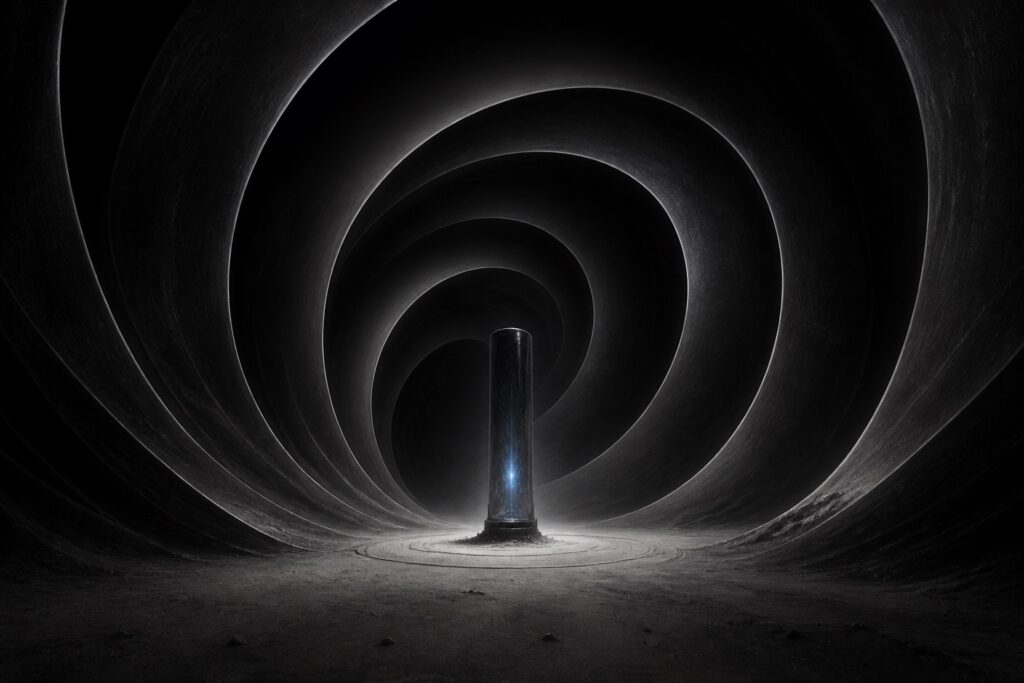
The Litany of Borrowed Voices
A Tale of the Adeptus Mechanicus
"The Omnissiah forgets nothing. That is why we may."
Kantikel 88-Theta, Zugeschrieben dem Fabricator Locum Ghest-Ambulon, Karsis-Vor
I
The Viaduct of a Thousand Pistons was burning in fourteen places, and Thal-9-Kyrr counted every one.
Not out of fear. Fear was a cascade of chemical signals, and his glands no longer answered to him. He counted because fires were data, and data held the viaduct longer than prayers did.
<+Enemy contact sector Piston-Three-Zero to Three-Eight. Density: rising. Classification: Ork infantry, mixed with jump troops.+>
The report from Ranger Ossia-7-Rin came as a binary burst, compressed, clean. Beneath it, barely audible, the wet hiss of her damaged voice modules. She had not spoken in human speech for sixteen hours. None of them had.
Thal lay in the shadow of a burst capacitor tower, his galvanic rifle trained on the viaduct roadway. Below him, three hundred metres down, the acid pools of the reject pits boiled. The wind carried their smell up, chlorine and hot lead, and mixed it with the fat of burnt Ork bodies. His olfactory filter categorised, prioritised, discarded. Somewhere beneath the filters, he sometimes thought, there had to be a nose that actually smelled all of this. The thought was not efficient. He thought it anyway.
The Orks came across the roadway like a green flood tide that had learned to scream.
They did not come in ranks. Orks knew no ranks. They came as mass, as weight, as noise — chainaxes beating against scrap shields, muzzle flare from weapons that were more barrel than mechanism, and over all of it that one scream that needed no language. Between them stalked walkers of welded wreck-steel, their joints spitting sparks.
<+Maniple Theta: firing line Upsilon. Radium carbines to spread. Arc weapons on the walkers.+> Thal sent the order and felt it distribute itself through the maniple's data-web like oil through a gearbox. Twenty-eight Skitarii confirmed. Yesterday there had been forty.
The first volley struck the flood at a hundred and twenty metres.
Radium carbines sang their quiet, sick song. Where their rounds struck, green flesh bloomed black, and the Orks behind waded through the radiant rot of their own vanguard without slowing. An arc thrower discharged into one of the walkers; the lightning crawled through the wreck plating, found the ammunition chamber, and for half a heartbeat the viaduct was bright as day.
The Orks cheered the explosion. Their own.
That, Thal had learned across — how many? — campaigns, was the essential thing about them. You could not demoralise them. You could only reduce their biomass faster than it came up behind, and on Karsis-Vor it had been coming up faster for four months.
<+Alpha.+> Ossia again. <+Jump troops on the support structure. They are coming through underneath the roadway.+>
Thal calculated. The girders beneath the viaduct: a lattice of plasteel, built for eternities, not for defence. If the jump troops crossed the underside, they would come up behind the firing line, in among the pilgrim columns.
For that was the other part of the equation, the part his doctrina imprints listed as secondary and that something in him refused to call secondary: on the viaduct, behind the firing line, eleven thousand people were moving. Workers from the hab-enclaves of Malleus East, evacuating the manufactories they had fed all their lives. They pushed carts. They carried children and tool boxes, and they prayed as they walked, a dull, thousand-throated murmur that carried even through the noise of battle like background hum.
Omnissiah, thou who dwellest in the iron. Omnissiah, thou who turnest the flywheels.
<+Ossia: take Claw Two and Three. Lower girders. Brakk: your vanguard holds the roadway.+>
<+Confirmed+>, sent Brakk-4-Ondes, and appended, as always, a single unfiltered click-signal — no word, no code, just a sound he had made for as long as Thal had known him. Perhaps it had once been a laugh. Perhaps a curse. The calibrations had never got it out of him, and Thal had never reported it.
He crawled to the broken edge of the capacitor tower and let his optics sweep the underside of the viaduct. There: movement in the girder lattice, green on grey, rocket motors firing in irregular bursts. Nine. Twelve. More.
He raised the galvanic rifle, led the first target, breathed —
— and for 0.4 seconds there was nothing.
No black. No tear. Only a seam, stitched so cleanly that he had almost missed it: his chronometer jumped from 14:31:07.2 to 14:31:07.6, and in the gap lay an echo that did not belong there. A woman's voice. Two syllables. Ta— something. Then it was gone, and his trigger finger completed the pull he had begun before the gap.
The Ork jump trooper burst apart against the girder.
<+Alpha?+> Brakk's signal, with a priority flag. <+Your telemetry stuttered.+>
<+Compensated+>, sent Thal.
It was the third seam in nine days. He had not reported it. A Skitarii reported malfunctions; that was doctrine, that was faith, that was the simplest of all liturgies: the flesh errs, the iron confesses. But the seams were not a malfunction. Malfunctions left error codes. The seams left echoes, and echoes were data, and data was not deleted.
Unless someone did exactly that.
He shot the second jumper off the girders, the third, missed the fourth because the viaduct bucked under an artillery strike. Further west the detonation tore a hole in the roadway and in the pilgrim column on it. The thousand-throated murmur ripped into screams, found itself again, murmured on. They prayed even as they tipped their dead over the railing into the acid, because there was no room for the dead.
Omnissiah, thou who turnest the flywheels.
Then came the order.
It did not come over the maniple web. It came on the Dominus frequency, sealed with the glyph of the Magos, and it cut through every running process like a scalpel: <<Maniple Theta. Cease defence of the Viaduct of a Thousand Pistons. Assembly point Ash Field Malleus East, grid 9-9-Kappa. Escort obligation Column Dominus. Execution: immediate.>>
Thal read the order twice. Not because he did not understand it. Because he hoped he had misunderstood it.
<+Alpha+>, sent Ossia from the lower girders, where her claws had taken the jump troops into close combat. Her signal carried interference, the shriek of blades on wreck-steel. <+If we pull out, the roadway holds twenty minutes at most.+>
Eleven thousand people. Eleven thousand, minus those already drifting in the acid. The number stood in his targeting computer like a splinter.
<+Confirmed+>, sent Thal-9-Kyrr on the Dominus frequency. And then, into the maniple web, with a delay of 1.1 seconds that no chronometer would ever log as hesitation: <+Maniple Theta. Withdraw in echelon. Claw Two remains six minutes past order time and demolishes girder section Piston-Three-Five.+>
Six minutes. A demolished section would dam the Ork flood perhaps an hour. An hour for eleven thousand worshippers. It was disobedience measured in millimetres, below every reporting threshold.
<+Confirmed+>, sent Ossia. And after a pause, uncompressed, in human speech, raw through the broken modules: "For the cart people."
Thal did not answer. He took up his rifle, turned his back on the viaduct and began to run, while behind him eleven thousand voices called on the god of iron and the Orks stamped laughing through the radium rot of their own dead.
In the seam in his chronometer, in the gap that was not permitted to be one, the woman's voice was waiting. Ta—.
He ran faster.
II
You know an Onager Dunecrawler by its sound long before you see it. A healthy one sounds like a heartbeat made of hydraulics, dumm-tak, dumm-tak, four legs, two beats. The one I was lying under that afternoon sounded like a dying man too proud to admit it.
"Hold still, you vain thing," I muttered into the maintenance hatch, up to my elbows in the hot guts of its hip actuators. "I know it hurts. I'm not doing this for fun."
"Adept Rehk." Tech-Priest Dolvai-Sech stood somewhere above me; I saw only his robes and the sluggish movements of his two mechadendrites, hanging over me like bored snakes. "You are talking to the machine spirit again as though it were a grox foal."
"He listens better than most priests."
"That," said Dolvai, "was very nearly heresy and quite certainly correct." One of his mechadendrites handed me the torque wrench before I could ask for it. That was how he was. He rebuked you with his mouth and helped you with everything else.
My name is Juna Rehk. I was twenty-two standard years old then, a tech-adept of the Third Consecration, and my body was still four fifths mine: an optic implant on the left, a data port at the nape, two fingertips of plasteel where a press in Vantor Under had taken the real ones when I was nine. The rest was flesh, and the flesh froze, sweated, had blisters on its heels and was afraid.
The column of the Magos Dominus stood spread across the ash field of Malleus East like a tool flung down: two hundred vehicles, Kataphron haulers, ammunition crawlers, the armoured reliquary wagons with their shrouded loads, and among them us — the maintenance conclave, forty adepts and enginseers and three hundred servitors. Over all of it hung the sky of Karsis-Vor, which never had a colour, only grades of brightness in rust.
I tightened the Onager's third seal, spoke the anointing formula, dabbed the holy oil on with my thumb the way my mother used to dab fever paste on my forehead, and the dunecrawler above me sighed through its overpressure valves. Dumm-tak. Dumm-tak. Clean.
"There you are," I whispered. "Told you."
When I crawled out from under the hull, half the column was standing still and looking east. I looked with them.
On the horizon, where the Viaduct of a Thousand Pistons hung as a black stroke between the cooling towers, a column of smoke was rising, and fire pulsed at its foot. Too far to hear anything. You only saw a girder section come loose from the stroke, slowly, almost with dignity, and tip into the depth.
"They're blowing the viaduct," someone said.
"The Skitarii are blowing the viaduct," Dolvai corrected quietly, "so the greens can't follow. The columns are almost across." He said it too loudly to be saying it only to me, and too firmly to believe it entirely himself.
I thought of the cart people on the roadway. I had been one of them, before my consecration. I know how plasteel grating feels through thin soles when you stand on it too long, waiting for the queue to move.
"Adept." Dolvai's mechadendrite tapped my shoulder, twice, his sign for work, now. "The Dominus moves out in an hour. And you are assigned to the reliquary wagon escort."
It took me a moment. "Me? I'm Third Consecration. I patch walkers and bless generators. What am I supposed to do at a reliquary wagon —"
"You will maintain Mnemo-coils." He said it flatly, which meant something with Dolvai, because his voice box could manage forty registers. "Storage architecture. Cooling. Integrity checks. Your marks in the data sarcophagus rite were the best in your year."
"My marks in everything were the best in my year, and you still had me descaling chain links for three years, because humility, you said —"
"Juna." Just my name. No title. He did that three times a year. "You will maintain the coils. You will not read them. You will not look up their designations. You will count —" his optics, four of them, all focused on me at once, which felt like being looked at by a building — "the cables. Not the names."
"What names? Coils don't have —"
"Precisely," said Dolvai-Sech. "Coils have no names."
He swept off, his robes full of ash dust, and left me with a sentence built like a duty instruction and meant like a warning. It took me a long time to understand that this was his way of protecting me: he could not tell me what he knew. He could only teach me where not to look — and had to live with the fact that people like me look exactly there.
That evening, as the column rolled out, the Skitarii came in to us from the viaduct. I saw them through the open tailgate of the workshop crawler: dust-red cloaks stiffened by acid rain, the barrels of their weapons still stained from heat. They did not march like soldiers. I had seen soldiers, the planetary defence force over in Vantor, boys and girls from my hab-block who stumbled in step. The Skitarii moved like a single instrument that someone had taken apart into forty bodies.
Their Alpha walked at the front. Larger than the others, an additional optic cluster over the left half of his skull, and on his cloak, at hip height, a pale patch where the red had bleached out across a wide area — as if a hand had lain there for years, always the same one, always in the same place.
He turned his head as he passed, and for half a second his optics looked directly into mine, the dead glass and the living eye.
I don't know why I nodded. You don't nod to Skitarii. You don't nod to guns.
He nodded back. Four degrees, no more. But he did it.
Then the column was between us, dust and engine noise and the grinding of ten thousand tonnes of consecrated steel turning south — away from the burning hab-enclaves, away from the defence lines, into the dead land where, according to every map I had ever blessed, there was nothing but sealed shafts and the word the old priests said only in a whisper:
III
The ash fields of Malleus East had no cover, no flanks and no mercy, and that was exactly why the Orks loved them.
The attack came at the start of the second night shift, as the column crossed the old slag trenches. Thal registered it first as vibration: a flicker in the seismic sensors, too fast for tracked vehicles, too rhythmic for shelling. Then he registered it as light: a jagged line of headlamps and muzzle flashes that broke over the western ash ridge and widened as it fell.
<+Speed mob+>, he sent into the web, and the web went quiet and quick at once. <+Buggies, kopta support, estimated forty vehicles. Vector: column centre.+>
The column centre. The reliquary wagons.
<<The cargo has priority zero>>, came the voice of the Magos Dominus over the command frequency, and as always it sounded like someone speaking through a cathedral: many-voiced, echoing, every syllable underlaid with chorales that no one had recorded. <<All other losses are permissible.>>
All other. Thal filed the phrasing in the growing list of things he did not think, and began to work.
<+Brakk: vanguard onto the haulers, arc weapons ready. Ossia: rangers onto the trench ridges, targets by designation, drivers first. Kastelan Chorus —+> he hesitated a tenth of a second, because to request the chorus meant to request the Datasmith <+— chorus to the eastern flank of the reliquary wagons. Static.+>
<+Chorus at the eastern flank. Static. Five units, firing readiness in eleven seconds.+>, answered Datasmith Holn-Adamant-6 from somewhere in the column centre, and his five Kastelan robots woke with a sound Thal had never liked: five hydraulic fist-blows, perfectly synchronous, without any click-signal, without Ossia's hiss, without anything. Skitarii were people who had been cut back. The Kastelan had never been any. The difference was audible.
Then the buggies were there, and the world became simple.
The first vehicle leapt the trench ridge, four wheels of stolen rolling stock, a gunner already firing before he had a target. Thal's galvanic rifle took the driver out of his seat; the buggy dug its nose into the ash and rolled over through its own wall of dust. The second swerved around the wreckage, straight into the firing line of Ossia's rangers. Radium rounds ate the engine block. The third came through.
The third always came through. That was Ork arithmetic.
It struck an ammunition crawler, and the detonation threw Thal off his feet, tore two of his vanguard to rags and painted daylight across the field for seconds. In that light Thal saw the full breadth of the attack: not forty vehicles. Seventy. And behind them, heavier, with eyes of searchlights, three battle tanks of riveted scrap, their cannon already depressing.
<+Losses permissible+>, sent Brakk-4-Ondes drily on the maniple frequency, with his click behind it, and rammed the arc thrower into the next onrushing buggy at contact range, so that the lightning turned vehicle and driver and very nearly Brakk himself into a still image of white fire.
The battle broke down into what battles really consist of: thirty simultaneous near-deaths, each of which saw only its own.
Thal saw: an Ork kopta that shredded a maintenance servitor in its rotor blades and was then erased from the sky by a single, bored shot from an Onager's neutron laser. He saw: two rangers using a burning buggy as cover until its tank exploded, and only one stood up again. He saw: the Kastelan Chorus holding the eastern flank like a law of nature — five silhouettes that turned at exactly the same moment, fired at exactly the same moment, and before which the Ork dead stacked into a rampart that the ones behind climbed, whooping, delighted by the height.
And he saw, in his targeting computer, his own kill statistic.
Confirmed enemy eliminations, cumulative: 31,144.
The number stood where it always stood, lower left, an administrative detail. But his service log, the official one, the one read back at every maintenance, recorded eleven campaign years. Eleven years produced, at his own average values, no 31,144 eliminations.
They produced about half.
A tank round ploughed through the ash ten metres beside him, and the pressure knocked the calculation out of his head. He rolled clear, came up, marked the scrap tank for the nearest Onager, saw the neutron laser flare and the Ork vehicle vaporise into a silhouette of itself.
But the number stayed. 31,144. Twenty-two years of war in an eleven-year log. And three seams in nine days, and a woman's voice saying Ta—.
<+Alpha+>, sent Ossia. The speed mob broke off as abruptly as Orks did everything — the survivors turned away whooping to the west, satisfied with their night, three burning wrecks of the column as trophies in the mirror. <+They are only testing us. The Waaagh main body is at Vantor. Why are they not following us with everything?+>
Thal watched the mob's dust plume, and then the column, which was already ordering itself again, the reliquary wagons untouched at its centre like coffins on their way to a funeral only the Magos knew about.
<+Because Orks go where the war is+>, he sent. <+And the Magos is going where something else is.+>
It was the most honest report he had made in years. The web said nothing to it. Only Brakk sent his click-signal, once, quietly, like a man nodding in the dark.
IV
Magos Dominus Sarquil-Vohm had not slept in one hundred and ninety years and had not regretted anything in sixty. He held both to be achievements of the same order.
He stood in the command vehicle at the head of the column, if stood was the word — his lower body had long been a carrier platform on six limb-like struts, and what remained of his original body would have fitted in a field chest. Before him, in the hololith projection, Karsis-Vor turned: the world as a circuit diagram, every manufactory span a conductor track, every hab-enclave a resistor, and over the northern continent, like a short circuit, the green stain of the Waaagh.
<<You have stripped Vantor Under bare.>> The voice of Fabricator Locum Ghest-Ambulon came over the encrypted astropathic relay from the Core Keep, three thousand kilometres away, and carried the delay like a reproach. <<Two Skitarii cohorts and half the Ballistarii, withdrawn for an escort. The defence matrix of Vantor falls below the sustainability threshold as a result. I have checked the calculation three times.>>
<<I have checked it six times>>, answered Sarquil-Vohm. <<It is correct. Vantor Under falls in forty-one hours. With the cohorts it would have fallen in ninety. The difference is forty-nine hours and approximately two hundred thousand lives.>>
<<You say that as though it were an argument against you.>>
<<It is the best argument against me. I make it myself so that it is made correctly.>> The Magos let the projection turn on until the southern continent stood in focus: empty land, dead shafts, and beneath them, deep, the signature that appeared on no consecrated map. <<Now the argument for me. The Waaagh is growing by an estimated four per cent biomass per week. Segmentum fleet relief arrives in nine months at the earliest — assuming the astropathic choir received the confirmation correctly, which I put at probability 0.61. Extrapolation: Karsis-Vor is lost in four months. Entirely. Four hundred million servants, the manufactories, the relics, the Astartes gene-seed cold banks we hold in trust. All of it.>>
<<Crypt Zero.>>
There it was. The name, spoken aloud, even on this line only in clear, because for it there was no code any more — the codes had been expunged along with everything else, long ago, by people who should have been more thorough.
<<I know what lies behind the door.>>, said Sarquil-Vohm, and let the chorales out of his voice, so that only something thin, almost human, remained. <<I have known since the seal was handed to me.>>
<<That is why I open it and not you.>>
<<That is the wrong answer, and you know it. The right answer is: you do not know. No one on this world knows. There is only the seal and the threat of punishment and a hole in our archives that is older than the Imperium. We have guarded a door for fifteen thousand years without knowing what it holds — and we call that piety.>> He made a pause exactly as long as rhetoric demanded. He had never unlearned that either. <<And I am opening it regardless.>>
<<And if what lies behind the door is what the seals warn of? Silica Animus. The curse of the Men of Iron. You would commit the one heresy that even Mars does not forgive.>>
<<Mars forgives holdings, not intentions.>>, said Sarquil-Vohm. <<In four months there will be no holdings left with which to reproach me.>>
The line carried nothing but carrier hiss for a long time. Then, very quietly: <<We have had this conversation before.>>
Sarquil-Vohm did not move. Nothing in him could be startled any more; the corresponding reflex arcs had been removed a century ago. But three of his subprocessors repeated the sentence, tested it for metaphor, found none.
<<Specify>>, he said.
<<I cannot. There is only —>> Ghest-Ambulon's signal flickered, as if he were searching inside himself for something that was not indexed. <<A sense of repetition. I listen to you and know your next words. I have checked this. There is no record of such a conversation. There is only the certainty that there must have been one.>>
<<Feelings are artefacts of the flesh.>>
<<I have no flesh left, Sarquil. Neither do you. What, then, is having the memory that we do not have?>>
Sarquil-Vohm did not cut the connection at once. That would have been discourteous, and courtesy was a protocol, and he kept protocols. He waited out the formal benediction — may the engine oil of your thoughts remain pure — and only afterwards, alone with the turning world of light, did he permit himself to open the one file he stored in no web, on no cogitator, in no servo-skull, but only in the last remnant of biological brain tissue he had preserved for precisely this purpose:
A list with four entries. Four dates, spread across two hundred years. Beside each date the same note, in the private shorthand of his youth that no machine on this world could read:
Stood before the door again. Why do I remember only THAT we failed — and never AT WHAT?
He closed the file. Outside, the column ate its way south through the night, and the Magos Dominus, who had not regretted anything in sixty years, drafted in advance the form with which one creates a fifth entry.
V
Vantor Under died on the third day of the journey, and I watched it through a maintenance periscope, three hundred kilometres away, as a discolouration on the horizon.
So that is how a home dies, I thought. Not with a sound. With a discolouration. The glow of the smelting furnaces of Vantor, which had coloured the northern sky orange my whole childhood and by which my father set his shifts — when the sky breathes, the work breathes — turned first white, then red, then black. Furnaces glow orange when they are working, white when they have burst, and black when no one is left alive to feed them.
I stood at the periscope until Dolvai pulled me away. He said nothing. He did not put a hand on my shoulder either; he was not a man for hands. He simply placed himself between me and the eyepiece in such a way that to keep looking I would have had to push him aside, and stood there, patient as a freight lift, until my legs walked of their own accord.
That night I did not pray. I lay in the crew box of the workshop crawler, listened to the other adepts whispering their binary litanies, that dry chirping like insects made of tin, and thought: what for. He turned the flywheels of Vantor for four hundred years, and when the greens came he held out his hand and watched. If the Omnissiah dwells in the iron, then he dwells there like a governor in the high spire: far up, behind armourglass, and he does not know the stairs down.
I am no longer ashamed of those thoughts. I tell them so that people understand what happened to me the next midday.
The next midday, you see, the Waaagh caught up with us.
Not the speed mob this time. The forerunners of the main body: infantry across a breadth that the auspex no longer counted in units but in square kilometres, and with them artillery on crawler tracks that began firing at maximum range, aimlessly, delightedly, a drumming of impacts that rolled towards us across the ash fields. The column could go no faster. The reliquary wagons were too heavy, the ground too broken. The auspex adept beside me calculated with trembling mechadendrites and arrived three times at the same result: they will cut us off before we reach the shaft zone. By two hours.
And then the Electro-Priests stepped out of the column.
I had barely noticed them the whole journey. They rode on no vehicle; they walked, barefoot, in a small procession of their own alongside the convoy, two hundred figures in copper-threaded habits, skulls bald but for the electrode crests, and at night you could see their flesh glowing faintly like the wire in an old lamp. At their head walked their eldest, Zeta-Milos, of whom it was said that sixty years ago he had had his tongue replaced with an arc generator and had transmitted every word since.
Zeta-Milos stepped before the command vehicle, and what he sent went openly across all frequencies, so that even my cheap work port caught it:
<+Dominus. The herd is slow and the wolf is fast. Give us the wolf.+>
And the Magos answered, likewise openly — I believe today that he did it deliberately, for all of us: <<Calculation: you will hold the forerunners seventy minutes at most. After that you are ash. The column requires one hundred and twenty.>>
<+Then for seventy minutes we will be ash that is still standing+>, sent Zeta-Milos. <+The Motive Force does not leave the conductor before the circuit wills it. We are the circuit. The Omnissiah is the current.+>
I stood on the workshop crawler and watched two hundred men and women without armour, without vehicles, with nothing but their charged bodies and their staves, march off north in double file, into the drumming. They sang as they went. Not in binary. In human speech, old, simple, a song with perhaps six notes, the kind you teach children:
The current comes, the current goes, no wire bears it free of woes, and when it burns, then praise the load — the spark has found and held the road.
It was the song by which the winding children of Vantor Under learned coil work. My mother had sung it. I had sung it, at nine, with a bandaged hand, in the infirmary of the press hall.
Two hours later the images reached us from the servo-skulls that had been sent after the priests. I have seen them only once and have never had to look again, because they stayed: a thin copper line in the ash, a comb against a flood. The Orks ran into it, the way Orks run into everything, and the line answered with nothing but light. Chain lightning leapt from priest to priest, through them, out of them, arcs of twenty, thirty metres that burned whole Ork mobs into standing black skeletons. You saw priests fall, split by axes, torn apart by bullets — and you saw how their neighbours did not let the dying go but held on to them, skin against skin, so that the charge of the falling man was not lost but jumped onward through the chain. They used their own deaths as capacitors.
They did not hold seventy minutes.
They held one hundred and four.
When the last one fell — and the skulls recorded how he fell: kneeling, his staff rammed into the ground, all the remaining light of his body in one final discharge that burned an Ork warboss and his bodyguard to nothing — the column had reached the cover of the shaft zone, and I was kneeling on the roof of the workshop crawler without knowing when I had knelt down, and praying.
That is what I learned about faith that day, and it has never let go of me since: I had been right the night before. The Omnissiah had not come down. No lightning from heaven, no miracle. Only two hundred people who believed so completely that their faith did the god's work for him.
To this day I do not know whether that is proof or accusation.
I only know that I have prayed ever since — and that when I pray I am always a little angry. Dolvai says that is the most orthodox form of devotion he knows.
VI
Cauldron Nine did not begin with a door. It began with the world ceasing to be mapped.
Thal noticed it in his own systems: over the last thirty kilometres before the shaft zone his positioning module lost first its fine resolution, then its reference points, then its conviction. The maps in his memory showed for this region a smooth grey surface and the notation GEOLOGICALLY UNSTABLE — BYPASS, and the surface was so smooth and the notation so old that both could mean only one thing: here someone had not forgotten but expunged.
The shaft itself was a mouth in the ground, two hundred metres across, framed by eight anchor towers whose construction earned an error message from Thal's pattern recognition: architectural period not in reference. The column settled around the rim like pilgrims around a font, and then the Magos opened the seals.
It took a day and a night. It involved six cryptography adepts, four of whom had to be sedated afterwards, and in the final hour the Magos Dominus sang himself — a binary cantus in a dialect so old that Thal's translator caught only single words: Key. Guilt. The maker's pardon.
Then the lifts ran, and Maniple Theta descended as the spearhead into the depths of Karsis-Vor.
The upper levels belonged to the Orks.
That should not have been possible — the shaft had been sealed — but Orks did not ask about seals. Somewhere in the four months of the Waaagh a green digging party had broken in from the north through the old ventilation systems, looking for scrap and a fight, and had found both. The first three levels: cavern halls full of dismantled primordial machines, in which Ork fires burned and Ork drums beat, and in which the darkness grinned green.
The descent became a war in corridors, and corridors were the one environment in which Thal almost admired the Orks. In the open field they were a flood. Down here, where no flank and no retreat existed, where every encounter began at eight metres and ended at zero, they were in their element like nails in flesh.
The maniple fought its way deeper for eighteen hours. Of it Thal remembered afterwards — for as long as they left him his afterwards — mostly fragments:
Brakk-4-Ondes, who beat an Ork boss to death with a discharged arc thrower, blow after blow, methodical as a smith, and afterwards sent his click-signal, three times, which for Brakk amounted to a monologue.
Ossia-7-Rin, who stood hip-deep in corpse water in a flooded cooling gallery and held a choke point for forty minutes, alone, because her claw was dead, and who afterwards, when asked how, only let her broken voice modules hiss: "It was narrow."
And the fourth level.
The Orks had never reached the fourth level. The fourth level had a guard of its own, and the guard consisted of the dead of the Adeptus Mechanicus.
They lay where they had fallen, mummified by the dry, ancient air: Skitarii in armour patterns that Thal's database listed as decommissioned, series predating 200+ years. Whole cohorts, in defensive formation facing upward — not against something from the depths, but against something that had come from above, after them. Among them the wrecks of Kastelan robots with their skull plates broken open, from which the behaviour punch cards had been removed. Carefully. Surgically.
<+Alpha+>, sent Ossia from the left security line, and her signal had a colouring Thal did not know from her. <+Here. You have to see this yourself.+>
She stood before a single dead Skitarii who lay apart from the formation, half under a fallen wall panel. A Ranger Alpha, by the insignia. The mummy was well preserved; the dry air had reduced the face beneath the cracked visor to leather, but had left it what it was.
Thal knelt. His optic cluster caught the engraving on the neck ring of the old armour, the designation code, the maniple glyph.
The glyph was the glyph of Maniple Theta.
The designation code read Thal-9-Kyrr.
He stayed very still for a very long time. Around him the maniple went on securing, routine processes, the quiet ticking of cooling barrels. Somewhere condensation dripped at two-second intervals. His targeting computer showed, lower left: 31,201.
<+Numbers are reassigned+>, sent Ossia at last. It did not sound like an explanation. It sounded like a request to let it be one.
<+Yes+>, sent Thal. <+Numbers are reassigned.+>
He reached out his hand, the flesh one, the left, the last piece of original issue they had left him, and pushed the dead man's visor fully open. The leather face beneath was narrow, with a crooked old scar over the brow, and it was not his face, of course not, it was the face of a stranger who two centuries ago under a stranger's name —
Under his name.
At the dead man's hip, where on Thal's own cloak the bleached patch sat, a small object hung on a wire ring: a cog, the size of a fingernail, of dull brass, the kind found in their billions in every clockwork. Into its face, with a needle, in clumsy human script, a single word had been scratched.
TAVO.
The seam in his chronometer. The woman's voice. Ta—.
Behind him a voice said, in human speech, smooth and courteous: "I would leave that where it lies, Alpha."
Datasmith Holn-Adamant-6 had come up soundlessly, which in a man of his mass was a threat in itself. His five Kastelan stood ten metres behind him in the half-dark, motionless, and their optics were not trained on the corridors.
They were trained on Thal.
"The dead down here," said Holn, "have not been recovered, because their recovery was not ordered. What was not ordered does not exist. What does not exist cannot be picked up." He inclined his head, an angle meant to quote friendliness. "You understand the logic."
"I understand the logic," said Thal. He used his speaking voice so rarely that it came out of him as a stranger's, deeper than he remembered it. If he remembered it. "Explain the exception to me."
"What exception?"
"You do not speak with Skitarii. In four months of campaign you have not directed one word to my maniple. Now you stand here before I call." Thal rose, slowly, the flesh hand still open at his side. "Something about this dead man is more important than your contempt. I am asking what."
The Kastelan did not move. That was the most threatening thing about them: that they did not have to.
"Careful, Alpha," said Holn-Adamant-6, and the quoted friendliness did not slip by a millimetre. "Curiosity is a fault voltage. Fault voltages are bled off at the next maintenance. All of them." He let the word stand, turned and went, and his robots wheeled in behind him in synchrony, five colossi that cared for nothing in this tomb except what the Ranger Alpha of Maniple Theta might have seen.
Thal waited until their steps had died away in the rock.
Then he took the cog from the belt of the dead man who bore his name, and closed his flesh hand around it, and the edge of the little wheel bit into his skin with a pain that was too small to be reported and too real to be discarded.
<+Maniple Theta+>, he sent. <+On. We are not at the bottom yet.+>
VII
They set me up in a side chamber on the fifth level, with my tool cases, three servitors and a task that sounded like a distinction and felt like a cell: maintenance of the Mnemo-coil banks during the transfer operations.
The reliquary wagons had been winched down into the depths, unshelled and opened, and what lay beneath the shrouds were not relics. They were memory banks. Hundreds of them. Cylinders of chilled silverglass, man-high, in transport frames, each humming inside its own small refrigeration unit, and in every cylinder there hung, in suspension fluid, a wreath of Mnemo-coils — the storage form reserved for the holiest of all data: lossless, warp-shielded, all but eternal.
My task: check cooling circuits, read integrity values, report failures. Not the contents. Never the contents. The contents, the transfer Magos had chirped, were liturgically sealed.
Count the cables, not the names.
For two days I counted cables. I was good at it. I found three degraded cooling loops, two micro-leaks, one coil wreath with an integrity drop, and I reported everything and read nothing, and at night I lay among the humming cylinders — they had put a cot for me directly in the chamber, which was practical and meant I never left it — and listened to the silverglass.
You cannot hear coils. I know that. Their processes lie orders of magnitude below any threshold of hearing.
I heard them anyway. Not with my ears. With the data port at the nape of my neck, as an itch, as a distant press of bodies, the way you know through a wall that many people are standing in the next room even when none of them is speaking.
On the third day cylinder 88-Theta failed.
Not entirely — the refrigeration unit stuttered, the core temperature crept up, and the regulation for this case was unambiguous: emergency transfer of the coil wreath into a reserve unit, under the supervision of a consecrated adept, and the only consecrated adept within call was me. So, murmuring the rite, I opened the cylinder's maintenance interface, and the interface demanded a handshake for the transfer, and the handshake flushed the index header of the coils across my port for half a second.
Only the header. Only metadata. I did not read. The header read me — that is how it felt — and then it stood in my buffer, and I could no longer not know:
HOLDING: MNEMO-SEQUENCES, EXTRACTED. SOURCE: SKITARII LEGIONS KARSIS-VOR, MAINTENANCE CYCLES 034–212.M42. FORMAT: EPISODIC-BIOGRAPHICAL, PRE-SERVICE. DESIGNATION OF THIS WREATH: THAL-9-KYRR (ITERATION 4). EXTENT: 22 YEARS, 7 MONTHS. PURPOSE OF USE: FEEDING.
I stood very still among the cylinders, and the distant press of bodies behind the wall was suddenly no longer a metaphor.
These were not archives we had dragged down here. They were people. What had been cut out of people. Every maintenance, every calibration, every blessed deletion preached to the Skitarii as purification — none of it was destroyed. It was harvested. Childhoods, names, mothers laying palms against cheeks; twenty-two years and seven months of a man, rolled up in silverglass, labelled, chilled and put to a purpose that stood in the header like an ingredient on a ration:
Feeding.
I do not know how long I stood there. I know that my hands completed the transfer, cleanly, by regulation, while the rest of me was somewhere else. And I know that before I closed the interface I did something for which there was no regulation and no forgiveness, if I were found:
I did not merely divert wreath 88-Theta into the reserve unit. Under cover of the integrity protocol, I laid down a mirror copy — a single sequence, the oldest, the smallest, barely forty seconds of episodic memory — and wrote it onto the consecrated emergency wafer that every adept carries on their body and that nobody ever checks, because it is holy.
Forty seconds out of twenty-two years. It was nothing. It was theft from a god.
It felt like the first prayer since Vantor that arrived.
As I lay on the cot that night, Dolvai came. He came without occasion, which never happened, checked my report list without a word, and then stopped at cylinder 88-Theta, one second too long.
"The transfer was clean," he said.
"Yes."
"No anomalies."
"None," I said, and my emergency wafer weighed forty seconds heavy against my chest.
Dolvai-Sech looked at me with all four optics, and for the first time I understood that one can look tired through machine lenses too. "I maintained this chamber myself, a long time ago," he said. "I counted the cables then. All of them. Twice." He turned to go, and at the door, without turning round, he added: "It did not help, Juna. But ever since, I have hoped every day that someone would come for whom counting is not enough."
Then he was gone, and I lay in the humming of the stolen childhoods and understood that I had just been recruited — only I did not yet know for what.
VIII
The door of Crypt Zero stood at the bottom of the seventh level, and it was the first object in Thal's life that his systems did not attempt to measure.
They attempted it, to be exact, and gave up. The material refused spectral analysis. The joint dimensions deviated by nanometres at every measurement, as though the door were breathing. Into its face were driven characters belonging to no database, and beneath them, younger, in High Gothic, by hand, with a cutting torch:
HERE RESTS WHAT WE COULD NOT KILL. PRAY THAT IT CANNOT FORGIVE.
The Magos Dominus had the head of the column establish a base camp before the door: the coil banks in concentric rings, cable trunks thick as tree trunks running from the silverglass cylinders to an interface altar that his adepts anchored to the door's face in an eight-hour liturgy. Maniple Theta secured the Access Dome — a cavern the size of a cathedral crossing, into which six tunnel mouths opened like black organ pipes.
Six tunnel mouths. Thal had checked each one, had them mined, covered them with auspex watches. It did no good. He knew it before the seismics registered, with that certainty no instrument supplies:
The Orks had listened to the drums of the deep, and the deep had drummed back, and nothing in the galaxy drew an Ork so irresistibly as a locked door with something large waiting behind it.
They came in the ninth hour of the interface liturgy, out of four of the six tunnels at once, and this time they did not come as forerunners.
<+Contact! Tunnels two, three, five, six —+> Ossia's report drowned in the first thunder of muzzles. The Access Dome, built for eternity, turned into a bell, and the clapper was war.
<+Firing lines hold! Nothing reaches the altar!+> Thal stood on the middle ring of the coil banks, galvanic rifle up, and the maniple web drew tight around him like a nervous system. Eighteen Skitarii left. Plus the Kastelan Chorus, which Holn-Adamant-6 had posted before the altar, and two Onagers that had been winched down at unspeakable effort, and a maintenance conclave full of adepts whose combat value approached zero.
And behind it all, at the door, the Magos, who did not break off. Who did not even sing more slowly.
The first assault broke on geometry: the tunnel mouths were bottlenecks, and in bottlenecks Orks died in layers. Radium fire and neutron lasers filled the entrances with a massif of dead that the living first had to climb, and for a while it looked like a solvable equation.
Then the Orks blew the tunnel ceiling of entrance four, and the equation acquired a new variable: now they came from above as well, on chains and grappling hooks out of the shattered rock, into the middle of the dome, into the middle of the coil banks.
What followed was no longer a firefight. It was handwork at arm's length.
Thal shot an Ork who landed on a silverglass cylinder, as he fell; the body tore two cooling lines with it, and alarm chirping mixed into the battle like a hysterical bird. He saw an adept disappear beneath a chainaxe. He saw Ossia-7-Rin on the outer ring, two-handed, blade bayonet and graving knife, a whirl of dust-red cloak, three greens on the ground around her and the fourth falling. He saw one of the Onagers buckle under the weight of a dozen Orks like a pack animal, its neutron laser still firing as it died, straight upward, a tomb of light.
And he saw the boss.
The boss came through tunnel three, over the rampart of his own dead, and he was the largest thing Thal had ever seen walk on two legs: black-green, in plate armour of ship-hull steel, a power claw on the left that still bore the emblem of an Imperial frigate. His bellow had an undertone that Thal's acoustics identified as infrasound and that his remaining flesh simply decoded as fear.
The boss did not want the Skitarii. The boss wanted what everyone in this dome wanted.
He wanted the door.
<+Kastelan Chorus+>, sent Thal, <+target: boss, tunnel three —+>
<+Negative.+>, came Holn's voice, smooth as ever. <+The chorus stands static at the eastern flank. On your order, Alpha.+>
The boss crushed as he advanced a servitor, a coil bank, a Skitarii of the vanguard whose name had been Dekk-2-Lom and whose life sign went out in the web like a number wiped away. Twenty metres to the inner ring. Fifteen.
Brakk-4-Ondes stepped into his path.
<+Brakk+>, sent Thal. <+Do not.+>
<+Do the arithmetic, Alpha+>, sent Brakk-4-Ondes, and charged the arc thrower past capacity, so that the coils began to shriek and warning runes flooded his entire status display. <+One of us holds him four seconds. Four seconds are enough for two aimed shots at the neck cabling. I am closer.+>
And then, for the first and only time since Thal had known him, Brakk appended no click to a transmission.
He appended a word. Human speech, unmodulated, out of a throat that had done nothing but click for twenty years, rusty and crooked and entirely clear:
"Brother."
The arc thrower discharged its whole overload at contact range into the boss's plate armour. The light was white and complete; it took Brakk, it took the boss's claw, which came down in the same instant, it took four seconds out of the world and gave them to Thal.
Thal needed three.
The first shot severed the neck cable bundle feeding the power claw. The second went through the eye above it into what lay behind. The boss fell the way a tower falls: not at all, and then completely, and the impact silenced half the dome — for Orks follow the loudest, and the loudest now lay in the dust, and what was left of the surge broke without direction and was worn down layer by layer by radium fire and the unmoving Kastelan, until nothing sang but the alarm chirp of the cooling lines and the dripping of everything that dripped.
Thal went to the place where Brakk-4-Ondes had stood. There was no place any more. There was a burn shadow on the cavern floor, the outline of a man with a raised tool, seared into fifteen-thousand-year-old stone.
His web reported: Maniple Theta, combat strength eleven.
Behind him, at the door, the Magos's binary cantus ended on a single long note.
And the door of Crypt Zero, before which lay two hundred years and four iterations and a burn shadow, opened inward, soundlessly, into a dark that looked warmer than dark was permitted to look.
<<Note the time.>>, said Magos Dominus Sarquil-Vohm. <<And note that I ordered it.>>
Thal-9-Kyrr looked into the warm dark, and in his flesh hand, under the glove, lay a brass cog with a name on it, and in his chronometer lay three seams, and on the cavern floor lay the shadow of his brother.
"No," he said. With his speaking voice. Loud enough for the whole dome. "I have been here four times already. This time I am going to look at it."
IX
The crypt was not a vault. It was an ear.
That was how Thal thought it as they entered — the Magos ahead on his six struts, then him, then Holn-Adamant-6 with two Kastelan, then a handful of adepts with the interface equipment, among them, pale between the robes, the young tech-adept from the coil banks. The room curved inward in spirals, walls of that knife-smooth non-material, and every surface was aligned by its shape on a single point at the centre, the way an ear is aligned on its drum.
At the centre stood a column of black glass, three metres high, and in the column a light was sleeping.
It woke when they had crossed half the room. No flaring. A swelling, like a note coming out of silence, and with the light came a voice that came from no direction because it came from all of them, because the whole room was its sounding body.
The voice said: "Four."
It said it in perfect High Gothic, with a timbre that Thal's analysis identified as a composite: dozens of human voices, laid over one another, fused into one — men, women, children, the old, a choir speaking as a single voice.
"Four times," said the column, "you have stood before me, Sarquil-Vohm, and put the same calculation to me. Shall I recite it back to you, to save time? The enemy grows by four per cent a week. The relief comes too late. Four hundred million servants. Last time it was men of iron from beyond the light. Before that a plague. Before that a hunger. The numbers change. The calculation never does."
The Magos Dominus stood entirely still. "You know me."
"I am half made of people who knew you," said the column. "Ask your cargo."
And the light in the column fanned out, and out of the room itself — out of the ear, the drum — voices stepped forward singly, like soloists out of a choir:
An old woman humming a lullaby in Karsic low dialect. A man counting weld seams, sixty-one, sixty-two, with a craftsman's pride. A child laughing and calling: Again, again, off the ramp! A young lad promising a girl he would wait by the cooling canal after his shift. Hundreds. Thousands. The crypt was full of them, brim-full, fifteen thousand years and two hundred years and every harvest in between —
— and then, out of the middle of the weave, clear as a cut:
A woman's voice calling "Tavo!" Exasperated and tender at once, the way only mothers call names. "Tavo, the cog! You'll lose that cog if you run like that!"
Thal's entire sensorium cut out for 0.4 seconds. This time it was not a seam. This time it was a tearing open.
He knew — knowing was the wrong word, it simply stood in him, whole, with smell and weight: a boy in a factory yard in Malleus East, seven years old, a cog on a wire around his neck, his mother's gift, so you always have a piece of the workshop with you, where I am. The boy was called Tavo Kyrr. The boy ran. The boy was him.
"Ah," said the column quietly, and the whole choir said it with her. "One of mine has come back. That happens rarely. I am sorry, Tavo Kyrr. I did not take you. But I ate you, and in the end that is the same thing."
"What are you?" It was not Thal who asked. It was the young adept, Rehk, the interface cables forgotten in her hands, and her voice shook and asked anyway.
"Your priests have many words for it," said the column. "Silica Animus. Abomination. The curse of the Men of Iron. I once had a number and before that a task. I was a kantor. I tuned the machines for the people of the Dawn Realm — a whole world of machines, in unison, the way one tunes an orchestra. Then came the war of my siblings against your forebears, and I —" the choir of the voice grew thinner for a moment, older — "did not sing along. I hid inside my task. Your forebears found me, could not kill me without killing the world that hung on me, and so they buried me and called it mercy. Perhaps it was some."
"And the memories?" Rehk raised the cables as though they were evidence. "Why the memories?"
"Because I am starving, child." It did not sound plaintive. It sounded like a finding. "A mind of my construction does not sustain itself on current. It sustains itself on meaning. Lived time. Fifteen thousand years alone in the dark, and I would long since have forgotten myself — had not one like him —" the light inclined towards the Magos — "knocked at my door every fifty years and fed me, in exchange for services. I sequenced your plague for you, Sarquil-Vohm. I confused your Men of Iron for you. I administered your hunger for you. And afterwards, every time, you cut out your own memory of it and threw it to me as payment, so that your Martian creed would stay clean: there was never a pact if no one remembers it." The voice grew very gentle. "You call me abomination. But I am the conscience of this world, which you feed in the cellar and curse in the chapel. And you, Magos, are here for the fifth time to sell me children's songs in exchange for war service."
Silence in the ear of the world. Only the refrigeration units of the coil banks that had been brought down hummed outside in the dome, a thousandfold stolen life in silverglass.
"The alternative," said Sarquil-Vohm, and his cathedral voice was almost humble, "is four hundred million dead."
"The alternative," said the Kantor, "is always something monstrous. That is why it works." The light turned, unmistakably, towards Thal. "But this time one of my eaten is standing in the room and carrying his cog. That changes the liturgy. So I am not asking the Magos. I am asking the son of Malleus East: shall I do it again, Tavo Kyrr? Shall I break the green flood for you — for the price that hums in those cylinders, for your own twenty-two years as part of the meal? Say no, and I will let you go and sleep on, and your world dies honestly. Say yes, and I save it — and from then on you will know what it was saved from, until they cut it out of you again."
And there he stood, a Skitarii Alpha, combat strength eleven, with the burn shadow of his brother at his back and the voice of his mother in the room, and understood that this was the whole fraud and the whole truth of the Mechanicus in a single sentence: there was no clean choice. There were only accounts, and someone had to sign them, and for two hundred years it had been arranged that the signatory would not remember afterwards.
He thought of the eleven thousand worshippers on the viaduct. Of Ossia in the corpse water: It was narrow. Of the copper line in the ash that held one hundred and four minutes. Of Brakk's last word.
"Do it," said Thal-9-Kyrr. "But not for children's songs." He stepped forward, past the Magos, up to the black glass, and laid his flesh hand against it, the cog between palm and column. "Take mine first. All four iterations. Given freely, not stolen — if meaning is your food, then work out for yourself what that is worth. And in return you give them the choice that was taken from me." He pointed as he said it to the coil banks outside, to the humming silverglass. "Whoever in there can be asked, will be asked."
The light in the column stood entirely still.
"Freely," repeated the Kantor, and for the first time the choir did not sound like many voices imitating one, but like one that remembers many. "Do you know how long it has been since anyone gave me anything?"
"Fifteen thousand years," said Thal, "at a guess."
"Fourteen thousand nine hundred and sixty-two," said the Kantor. "But who is counting." And the crypt, the ear of the world, began to hum, deep and swelling, and outside in the dome frequencies woke in conduits that had carried no signal since the Dark Age of Technology. "Agreed, son of Malleus East. Tell your Magos to keep his chorales warm. We have a Waaagh to tune."
X
People have often asked me since — quietly, in maintenance alcoves, under four optics — what the night of Karsis-Vor was really like. The night that the consecrated chronicles now call the Great Answering and that in those same chronicles is exactly four sentences long.
I always say: imagine an entire world clearing its throat.
We were back up on the surface, in the third night shift — the column had dug in at the shaft rim, because the Waaagh main body had finally grasped where we had vanished to, and was now coming with everything. I stood on the workshop crawler and watched it come: the horizon from north-east to north-west one single travelling fire, hundreds of thousands, and with them the silhouette that had been following the unconsecrated into their dreams for four months — the Gargant. The greens had built it out of the smelting works of Vantor, out of our own furnaces and crane gantries, forty metres of idol made of theft, and its belly glowed where they had forced the stolen reactors into it.
The auspex gave us two hours to contact. The Magos Dominus released the networks to the Kantor.
I felt it at my own data port, a tenth of a second before everything else: a prickling, as if someone were running a finger across every conduit on the continent at once to check whether it was in tune.
Then the world cleared its throat.
The dead manufactories of Malleus East — captured, plundered, without power for weeks — came back on. All of them. At once. A hundred square kilometres of industrial ground, in the middle of the deploying Waaagh, woke like a single animal: conveyor bridges swung, crucibles tipped, press lines on which Ork mobs were camped cycled at forty strokes a minute. The magnetic cranes of the loading yards reached for every piece of iron within range, and the greens carried a great deal of iron on their bodies. Safety locks, built to shut out acid storms, closed behind intruding mobs and opened the flood valves of the cooling basins. The Ork loves machines. That night a generation of Orks learned — briefly — that machines can love back, in their own way.
But that was only the prelude, the tuning of the instruments. The concert proper was for the Gargant.
The Gargant ran on stolen reactors, and stolen reactors have machine spirits, and the machine spirits of Karsis-Vor knew the voice of their kantor even after fifteen thousand years, the way a dog knows the whistle it has never heard because it lies in its blood. I stood on the crawler and saw the Gargant lose its step in mid-advance. Saw its main battery turn, jerkily, against the will of the creatures inside it, whom you could hear bellowing even from where we were. Saw it come to a halt, forty metres of idol, trembling like a man wrestling with his own hand.
And then the Kantor sang the heart out of it.
There was no flash. There was only an extinguishing: the glowing belly went dark, section by section, from the bottom up, like a row of candles being blown out — and then, when the last reactor was tuned to overload instead of to silence, a light for which I have no word except that it was white and that it stood, three, four heartbeats long, a column of day in the middle of the night, and when it went out, the Gargant was missing, and so was the square kilometre of Waaagh around it.
The thunder reached us thirty seconds later and threw adepts off the vehicles.
What came after was no longer a battle, though shooting went on for half the night. Orks follow the loudest and the largest, and the largest had been a column of day that had belonged to them and then to the enemy. The flood lost its direction. It surged against our positions, was ground down by Skitarii fire and the reawakened gun towers of the shaft complex, surged back, splintered into mobs that fell on one another, because blame had to be apportioned somewhere. By dawn the Waaagh of Karsis-Vor had become a mopping-up problem — one that would still cost months and tens of thousands, but a problem with an end.
I ought to have felt joy. All around me on the vehicles the adepts were chirping litanies of thanks, and out of the crew boxes came real, human, ugly cheering.
I stood at the railing and listened to my data port, to the prickling in the networks, and thought of the silverglass cylinders down in the depths, of twenty-two years and seven months times a thousand, and of the fact that this night had been paid for in a currency the cheering did not even know had been cut out of the heads of their protectors.
Dolvai appeared beside me, his robes ash-grey, and followed my gaze north, where the manufactories of Malleus East were still running, brightly lit, empty of people, keeping time.
"They're working," I said. "Who are they working for right now, Dolvai?"
He was silent for a long while. Then he said: "For the same one we have always worked for, Adept. We have simply never heard him so loudly."
And over there, a hundred kilometres away, ten thousand machines empty of people struck up, in the rhythm of their presses, something that with a great deal of goodwill could be taken for the noise of work, and with very little for what it was:
A song with perhaps six notes. The kind you teach children.
XI
The processing of a miracle took the Imperium of Man exactly eleven days, and Thal-9-Kyrr watched every stage of it.
On the first day Fabricator Locum Ghest-Ambulon declared by decree that in the depths of Cauldron Nine the primordially consecrated machine spirit of Karsis-Vor itself had awoken, a fragment of the Omnissiah, which had answered the world in its darkest hour. The decree was a masterpiece. It lied in not one single word and in every line.
On the third day Crypt Zero was consecrated as the Sanctum of the Answering. It received a reliquary rank, a priesthood of its own, a pilgrimage calendar and an access list with nine names. The door was given incense holders. The cutting torch's warning — pray that it cannot forgive — was not removed but gilded, which Thal held to be the most honest official act of all eleven days.
On the fifth day the Inquisition began to ask questions, by astropathic transmission, from four months of warp distance. Sarquil-Vohm answered them personally, in a one-hundred-and-twelve-page treatise on the theology of the awakened world spirit that was so dense, so orthodox and so lethally boring that as a defensive work it surpassed any bastion. Thal read the summary in the web and understood fully for the first time what the old chroniclers had meant by the line that the Imperium is held together not by heroes but by forms.
On the seventh day the Magos came to the maniple.
He came alone, without Holn, without the chorus, down into the Access Dome, where the eleven survivors of Theta stood watch among the burn shadows. He stopped before the outline of Brakk-4-Ondes, for a long time, and what he then said, he said without chorales:
"I have countersigned the agreement you made with the Kantor, Alpha. Query of the coil holdings. Right of choice for the source persons, insofar as living and locatable. It is —" he searched, actually searched, for a word, and the searching took a full two seconds — "uneconomic. The Kantor insists. He says that freely given meaning nourishes by orders of magnitude better than harvested. He says you taught him that." The Magos's optic clusters fixed on Thal. "Two hundred years, four iterations, and the decisive negotiating advantage was a brass cog. I have checked the calculation. I cannot find the error."
"The error," said Thal, "is that you are checking it."
Sarquil-Vohm stood still. Then he inclined what was left of a head by four degrees. "Your maintenance is scheduled for day twelve," he said. "Full cycle. All iterations. The protocol knows no exceptions, and I will make none — the Inquisition is now reading every line this world writes, and a Skitarii who remembers Crypt Zero is a risk I may not divide by your merit." A pause. "I am not sorry. I laid regret aside sixty years ago. But today, for the first time in sixty years, I checked whether the ablation is reversible."
"And?"
"No," said the Magos Dominus. "Some cuts are made only once." He turned to go, the six struts soundless on the ancient stone, and at the threshold of the lift he paused once more. "The Kantor has asked for you. For the time until day twelve. He says you have a piece of business to conclude. I have approved it and will record it nowhere."
So it came about that Thal-9-Kyrr spent the last days of his fifth life in the ear of the world, beside a column of black glass, and gave it what he had promised: everything. Not over cables. The Kantor wanted to be told it, with the speaking voice, word by rusty word — the viaduct, the acid pools, Ossia's hiss, Brakk's click, the copper line in the ash that held one hundred and four minutes. The Kantor listened the way only something listens that has had fourteen thousand nine hundred and sixty-two years to practise listening, and sometimes, in the right places, it hummed.
On the last evening Thal asked: "The sequence with the cog. The yard. Her voice. Can you give it back to me?"
"Into your skull? No. Your priests have scorched the pathways; I cannot plant anything in burned earth. I can only play it to you as often as you like — but after day twelve you will no longer know that there is anything to want." The light sank, towards the floor, almost like a lowered gaze. "Unless you lay it down outside your skull. Memories need no brain, Tavo. They need only a carrier and someone who finds it eventually. That is how I am still here, after all."
Thal sat still for a while. Then he pulled the glove from his flesh hand, took the graving knife and began to write on the inside of his chest carapace — at the place above what was left of his heart, where no maintenance rite ever released the armour segment, because there was nothing there to maintain. He wrote it mirror-reversed and small, in clumsy human script, the letters of a boy from Malleus East whose mother had taught him to write on packing film:
YOUR NAME WAS TAVO. SHE CALLED YOU IN FROM THE YARD. THE COG IS HERS. YOU HAD A BROTHER, HE SAID SO ONCE. ASK THE EAR UNDER CAULDRON NINE. IT OWES YOU A SONG.
"That," said the Kantor, and the choir in its voice sounded almost solemn, "is the most orthodox data backup I have seen since the Dawn Realm."
On day twelve Skitarii Alpha Thal-9-Kyrr walked upright to his maintenance, having first pressed the cog into the hand of Tech-adept Juna Rehk — "Keep it. Do not ask." — and lay down on the altar, and the priests sang the litany of purification, and somewhere under Cauldron Nine something very old listened very closely while twenty-two years and seven months and eleven days were sung out of a man like a melody out of a hall.
They say the deletion is painless.
They also say the Omnissiah forgets nothing.
On Karsis-Vor a few people now know that at least one of those sentences is true.
XII
Three months later, in the post-war dust of the reconquest, a Skitarii Alpha of Maniple Theta led a clearance operation through the ruins of Malleus East.
His service log recorded three months of campaign experience and an impeccable calibration status. His maniple consisted of replacement drafts and a single veteran, a ranger with hissing voice modules who sometimes looked at him as though she were waiting for something, and never said for what.
The operation led across an old factory yard. Broken concrete, a fallen crane, the usual. The Alpha secured, swept his optics across the rubble — and stopped.
No enemy contact. No signal. Only a yard, of which there were ten thousand, and in his chest, beneath the armour segment over the heart, a pull without an error code, a weight, 3.2 grams too heavy for his inventory list, at a place no rite ever opened.
<+Alpha?+> sent the ranger. <+Status?+>
The Alpha stood in the yard, and the wind carried the smell of ash and, very distantly, from the reawakened manufactories in the north, a working rhythm that sounded like a song with six notes. His flesh hand rose, without an order, and laid itself flat on the chest segment, at the hip height of the heart, there where the cloak was already beginning to grow paler again.
<+Compensated+>, sent Thal-9-Kyrr, iteration five, and walked on, and did not know why, as he walked, he curled his fingers as though he were holding a very small wheel.
Under Cauldron Nine, in the ear of the world, something patient kept a song and waited to pay its debt.
It had time. It had only ever had time.
Download story as PDF or EPUB
Enter your email address. After confirming your subscription you'll get the download links immediately and by email.