The Fire in Us
A Tale of the Fire Wardens of Nocturne
The Fire Wardens of Nocturne
„Vulkan did not teach us to make fire. He taught us to keep it when no one is watching any more.“
Apothecarius Morrack, Feuerhüter von Nocturne
I. Three, Perhaps Four
The Apothecary crouched over the progenoid gland like a priest over a holy relic.
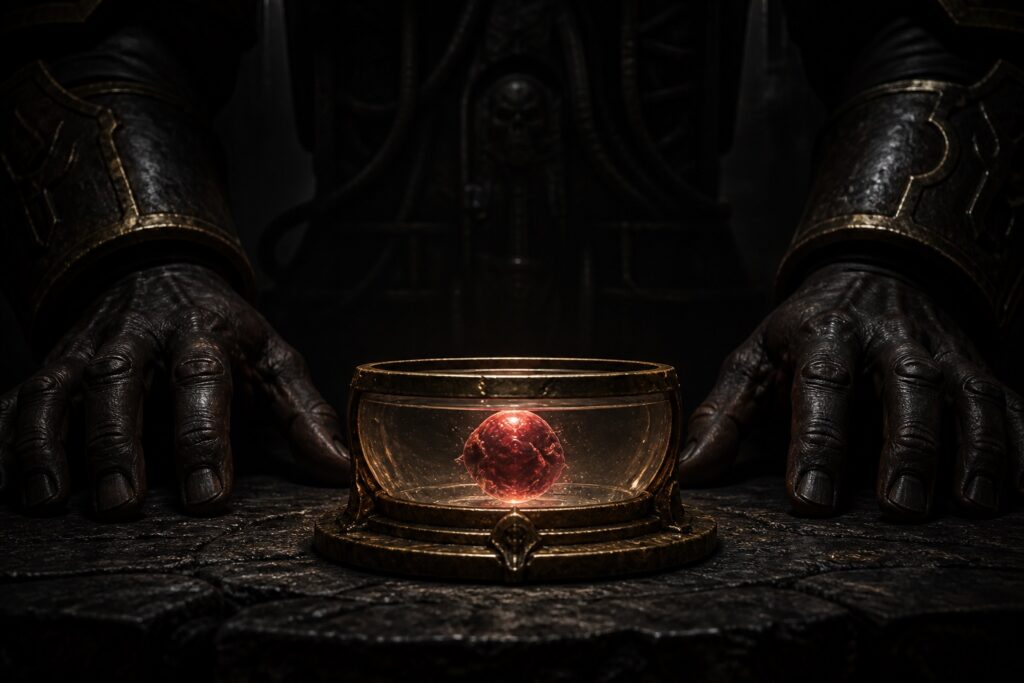
That was what Brother Kaelith saw when he entered the cell: Apothecary Morrack, the eldest of their Chapter, whose hands were trembling — not from cold, but from a kind of reverent despair. The gland lay in a crystal basin, reddish and faintly glowing, scarcely pulsing any more. An organ that had been taken from the chest of a dying Marine, the mightiest inheritance of their Chapter, and in this moment it threatened to die away.
Six years had passed since the fight on Morthis IV.
"It is over," said Morrack, without turning round. His voice was toneless. "The host is dead. The gland was already dying. In a few days... in a few days it will no longer be able to bear new Astartes."
Kaelith stepped closer. The air in the cell smelled of sterile sulphur and burnt tissue — the smell of Mechanicus medicine attempting the impossible. On the work surface beside the basin lay handwritten notes, page upon page, with formulae and measurements in a script so small and cramped that Kaelith could guess how long Morrack must have had to sit here.
"How many?" Kaelith asked quietly.
"Three," said Morrack. "Perhaps four. If we are lucky. The gland will bring forth three or four more aspirants before it dies. Out of a thousand it should have been."
Kaelith sat down. The chair was old, steel and synthetic leather, the kind that stood in the less holy parts of the monastery. There were two kinds of silence in the Imperium: the silence of battle, when communications have collapsed and only the roar of weapons and the bellowing of the dying can be heard, and the silence of mourning, in which the whole future breaks off. This was the second.
"The Chapter Master knows?" Kaelith asked.
"He knows. I reported to him three days ago." Morrack leaned back. As he did, Kaelith saw the lines in his face, the veins at his temples, the trembling in his bone joints. The Apothecary was no longer young, not even for a Space Marine. He had been one of the first Marines to serve with the Fire Wardens after the Dark Time. "He ordered me to wait. To wait and observe."
"That is all one can do," said Kaelith.
"No." Morrack turned round, and his eyes were not those of an old Marine — they were those of a child seeing the world for the first time and finding it unjust. "There is another possibility. I have considered it the whole night. I have studied the records of the XVIII Legion — the Salamanders, our parent Chapter. The old records from the Great Rebellion. There are reports of... of procedures. Unconventional methods. Procedures the Mechanicus forbids, which the Imperium classes as heresy."
Kaelith froze.
"You will not say what you have just hinted at," he said quietly.
"I am not saying what I mean to hint at," Morrack answered. "But if I could consult the old research records of the Salamanders, the records of Vulkan himself, before the Imperium put them under seal, then perhaps I could stabilise the gland. Not for a thousand, but for a hundred. Perhaps for more."
"That is impossible," said Kaelith. "Those archives are on Terra. Under the guard of the Astronomican Synod. We are a small Chapter of a thousand brothers on a moon no one knows. We have no power over such things."
"No," said Morrack. "But the Golden Wall could ask questions. Your Chapter brothers in the Golden Wall. They sit on the Council of Chapter Masters. They would have the means—"
"They would never help me," Kaelith interrupted him. "That would mean challenging the Mechanicus directly. That would mean setting oneself against the Inquisition. That would mean risking everything."
Morrack nodded slowly, as if he had expected that. His hands sank again over the progenoid gland, almost caressing it, as if a gentle touch could bring it back to life.
"I know," said Morrack. "That is why I am only with you. That is why I have not ordered you to do this. I only wanted you to know that there is a choice. A choice between what is safe and what might be right."
Kaelith left the cell without answering.
That was no answer a Space Marine could give. An answer would have meant committing himself. And in these days, five years after the war, in which the Imperium of Man was slowly falling back into its old patterns, commitments were dangerous.
He had three days. That was the ultimatum that lodged in his chest as he walked the corridors of the monastery. In three days the progenoid gland would finally die. In three days the genetic blueprints for the Fire Wardens of Nocturne would vanish forever into silence, and all future brothers would be bred from the remaining few glands, weakened and incomplete.
In truth Kaelith knew exactly what he would do. The problem was not ignorance. The problem was that the right answer had existed in his head the whole time. Everything Morrack had said had only been a fuse. The fire had long lain beneath the surface.
II. Six Sentences That Looked Like Coordinates
He made his way to the astropath chamber.
The conversation with Librarian Vel'Raum, his brother from the Golden Wall, lasted exactly ten minutes. Vel'Raum was old and wise, and he had long since stopped deceiving himself about the choice between convention and conscience. If anyone knew how to get into the archive of the Salamanders, it was this Astartes.
"What you are telling me now," Vel'Raum spoke, before Kaelith had finished, "is a heresy. The Inquisition would wipe out a whole Chapter for less."
"Yes," said Kaelith.
"The Apothecary ordered you to do this?"
"No. He showed me a door. I have decided to open it."
Vel'Raum was silent for a long time. Something was working in his face, an inner reckoning between the soldier and the scribe, between the number of souls and the number of the dead. In the end he nodded slowly.
"I can give you access. Not to the main archive — that is impossible. But there are black libraries. Places where the Mechanicus keeps the things it has forgotten. The Vulkan research is not complete there, but it is more extensive than what the Inquisition knows." Vel'Raum leaned forward. "It will cost time. It will mean danger. And it will mean that you make yourself guilty. The guilt will stay with you, Kaelith, for the rest of your life."
"I know," said Kaelith.
"The fire that makes the Salamanders what they are and that shapes Nocturne itself is not destruction," said Vel'Raum very quietly. "It is the wish to build. After everything has turned to ash. That is the only reason the Salamanders exist at all. The Primarch knew that it is not enough merely to fight. One must also be able to build again."
He gave Kaelith six sentences that looked like coordinates. Indeed they were — they were a code to one of the lost archives of the Mechanicus, which had operated for five hundred years under another name. A place no one wanted to enter, because the people who worked there were not regarded as real.
"Forget my name," said Vel'Raum. "Forget that you were here. If the Inquisition ever tortures you, I will die for you before I answer to that order. That is all I can tell you."
III. What Makes a Human Being
The plan was simple, which meant it was probably impossible.
Kaelith would obtain a forgery of an Astra Militarum document — not difficult from the authorities; the Imperial bureaucracy produced more paper than half of living humanity. With it he would go to the archive and pretend to be a night-shift officer collecting documents. The workers there were not real people, they were descendants of the old Mechanicus slaves, people who had lived so long in the researchers' cellars that they had learned to stop seeing.
He would walk in and find the Vulkan research in the safest place — in the cellars beneath the cellar.
The problem was not walking in. The problem was that once he was inside, he would have to take it all out of his head again. The archivists of the Mechanicus had long since learned to fit their books with controls. With controls bound to the readers' biological systems. With controls that, if not removed correctly, could turn an Astartes brain into torches of fire.
Kaelith needed someone who could have removed one of those controls. Someone who was not a true member of the Chapter, but someone who had the tools.
He thought of Vekan. The name was like a stigma on his skin.
Vekan was no soldier, but Adeptus Mechanicus — a real technician, one of the few who lived and worked among the Fire Wardens, and the only one whom nobody actually liked. That was not because Vekan was unpleasant, but because he refused to pretend to respect the boundary between man and machine that was supposed to hold the whole Imperium together.
Vekan wore an implant over his eye — that was not unusual. What was unusual was that the implant moved, that it blinked and turned, as if it had a will of its own. That was not because Vekan had done anything blasphemous, but because he had studied at the black libraries of the Mechanicus before he came to the Fire Wardens.
"You are going to ask me whether I will do it," said Vekan, before Kaelith had even opened his mouth. "And I will say yes, because you want me to say yes. But what you should really be asking is whether it is possible without the network guard noticing that we have attacked it."
They were in Vekan's workshop, which lay beneath the firing range. The room smelled of hot metal and burnt plastic, and the walls were covered with devices Kaelith could not name. In one corner stood a simulation of a human brain, built of red wax, pierced with a hundred fine steel wires.
"Is it possible?" Kaelith asked.
"Yes," said Vekan. "But it will cost time. Two days, at least."
"We do not have two days," said Kaelith.
"You do not have two days," Vekan corrected. "But I am prepared to take my time. That is a different problem." Vekan's implant turned towards Kaelith, became the eye that could see what normal eyes could not. "You will tell me everything you know. Why you are doing this. Who brought you to it. Everything."
Kaelith told him of Morrack and the dying gland. He told him of Vel'Raum and the coordinates. At the end of the story Vekan leaned back and his organic hand rose to his chin.
"The Apothecary has reckoned exactly right," said Vekan. "Under Vulkan the Salamanders worked with biological procedures that the Mechanicus today no longer even understands. They understood that the gene-seed need not be rigid, that it can adapt. The new generations of Marines you could breed if you found this research would not be weaker. They would be different. And for the Imperium that is bad enough."
"Will you help me?" Kaelith asked.
Vekan nodded.
"It will make things difficult," he said. "If it comes out that I helped you, I will be executed. The Chapter Master will call an Inquisitor, and he will put me in a cage and tear out all my implants to make sure the Mechanicus creates no heretic. That is doctrine."
"I know," said Kaelith.
"But Morrack will be able to sire a thousand Marines instead of only a hundred," said Vekan. "That is the weight of your decision. One whole man against a thousand possible existences. That is the bargain you are entering into."
"Yes," said Kaelith.
"Then let me tell you what you must do," said Vekan.
Thirty-six hours later Kaelith held a code in his hands. The code was not written. The code was Vekan himself — a tiny crystal that had been taken out of Vekan's own implant, a message that only the archive's security guard could read. A sacrifice Vekan had made, one that would leave him blind in one eye for the rest of his life.
"You did not need to do this," said Kaelith.
"No," said Vekan. "But I want to do it." The technician sat down and took a bandage to his empty eye socket. "Do you know what the worst thing about the Imperium is? It is not the tyranny. It is the feeling that the tyranny is necessary. That all these rules and all these prohibitions are necessary in order to survive. But that is not true. That is only what the Mechanicus has told us in order to keep its power."
Kaelith took the crystal. It was warm in his palm, still from the technician's body heat.
"Give it to the security system when you go in," said Vekan. "It will think that it is I myself requesting that the books be made accessible to another. It will not object. After about four hours the code will expire, and at the next check it will be found that there was an intruder. You must be long gone by then."
"That makes you a traitor," said Kaelith.
"That makes me a human being," said Vekan. "Which, as the Inquisition will explain to me, is the same thing as treason."
IV. Four Hours
The archive lay beneath an abandoned industrial complex on a substation, three jumps from the home system. The light there was blue-green and pulsing, as if it came from something biological, and the air smelled of damp and rotted metal.
The archivist was an old man, possibly older still. His eyes were clouded and his movements mechanical. He did not look up as Kaelith walked in. It was as if he did not see him, or as if he had learned to assume that authority had the right to move without being perceived.
Kaelith laid the crystal on the work surface.
The man bent forward. Something in his system reading, something reacting. Then he nodded and pointed to a terminal.
"Four fifteen," said the man. His voice was like glass, broken and sharp. "Four hours. Then you go. Not later."
"Understood," said Kaelith.
Four hours. In that time he had to find and absorb a century of research. The Vulkan research was there somewhere, in one of these rows, hidden among the thousand lies the Imperium told about itself.
The books were old. They were bound in a format Kaelith did not immediately recognise — not electronic, not on parchment. They shimmered, as if made of something not entirely solid. When he took a volume in his hands, he felt the knowledge stream directly into his brain. The pages were not written. They were true memories, witnesses of events that had taken place a thousand years ago.
The first page held a title, in a script Kaelith recognised: On the Adaptation of the Genesis Seeds and the Possibility of a Living Legion.
That was it.
Kaelith plunged deep into the research. Page by page, image by image. Vulkan, who made himself vulnerable because he knew that the gene-seed could only grow if the host himself was open to change. Vulkan, who fought against the doctrines of the Mechanicus. Vulkan, who saw the Astartes not as unchanging gods, but as something that could breathe, that could grow, that could adapt to the times.
And at the end of the research: the method. Not the chemicals or the seeds, those were long obsolete. But the foundation. The thought. The notion that an Apothecary need not only be a physician, but also a creator. A man who did not only repair what had decayed, but could also create the new.
It was possible. With the right guidance it was possible.
Kaelith read the last page and forced himself to breathe more slowly.
Two hours and forty minutes had passed.
Then he saw it. The other research. Not Vulkan's work, but something that came after. A name he recognised: Morrack. Another Morrack, perhaps a great-grandfather of this Apothecary, had carried out the same research once before. In the year 768. And he had abandoned it, had put this research under seal, with a handwritten note:
I have understood what the Primarch wanted. But I have also understood that I am not worthy to accomplish it. The fire in me is not great enough. May stronger men walk this path.
Kaelith took that note into himself. The ink was faded, but the words were crystal clear. A Marine who knew better than to build his great hope on a lie.
He was at the very edge of the four hours when the alarm began to howl.
Kaelith ran.
He ran up the stairs, along the passages, and behind him he heard the heavy steps of the security drones. The doors of the old factory shook with every step. As he fled outside, he already saw the black ships in the sky — not the Inquisition, not the Mechanicus. Worse. Competitors for the research.
V. What the Chapter Master Condemns
He needed two days to return safely to the base of the Fire Wardens.
Morrack read the note Kaelith handed him. His hands did not tremble. His gaze was steady.
"That was wrong of me," he said very calmly. "To ask that of you. A Marine should not have to pay for the sins of an old man."
"I did it because I wanted to," said Kaelith. "And I would do it again."
Morrack nodded slowly. Then he read the research. It took a whole day and a night. On the morning after, he came to Kaelith and struck him in the face. Not from anger — from gratitude. That was the way of the Fire Wardens to show thanks.
"It will not go quickly," said Morrack. "I will need a year to assimilate the research completely. And it will not be without sacrifice. I am no Vulkan. I am no titan of the genes. I am an old man with the knowledge you have given me."
"Is that enough?" Kaelith asked.
"It has to be enough," said Morrack.
But before Kaelith could go, the Apothecary took him by the arm.
"Vekan," he said. "The technician. What of him?"
"He told the Chapter Master everything," said Kaelith. "Down to the last count, without lying. He said that loyalty is more important than Mechanicus doctrine."
"And the Chapter Master?"
"Vel'Raum told me that. The Chapter Master has condemned Vekan as punishment. He must leave the Chapter and go to Nocturne to repair himself. It is not death, but it is... it is being forgotten."
Morrack lowered his head.
"No," he said. "It will not be that. The Chapter Master served among the Salamanders before he came to us. He knows their regard. He will treat Vekan as a guest, not as a slave. That is the promise of Nocturne."
VI. Interrogator Solennus
A year later the Inquisition came.
They came because someone in the archive had asked a question that would better not have been asked. A question about a crystal that had been taken from the implant of a technician, an implant that no longer existed. A question that led to an inquiry into what this technician had done.
It was Interrogator Solennus, a courteous man with a calm voice, who praised the truth because the truth, as he said, best soothed the conscience.
"I must ask you," said Interrogator Solennus to Kaelith, "whether you have made yourself guilty of the crime of heresy. The viewing of forbidden archives. The theft of research data. The assisting of a technician in the procurement of unauthorised components."
"Yes," said Kaelith.
"And you repent this step?"
That was the question on which everything depended. The answer to this question would decide whether he walked out alive or whether he would be spent for the rest of his life in a black cell.
"No," said Kaelith. "I do not repent it."
The silence that followed was absolute.
"That is not the answer I expected," said Interrogator Solennus.
"It is the honest answer," said Kaelith.
The Interrogator leaned back. For a long time he said nothing. Then he spoke very quietly:
"I am not here to condemn you, Brother Kaelith. I am here to understand what has happened in this Chapter that one of your best warriors would think treason a good idea."
"That was not treason," said Kaelith. "That was rescue."
"Rescue?" the Interrogator repeated.
"Our span was at its end," said Kaelith. "Without the new research, without the guidance you now prohibit, our Legion would be forgotten in three generations. That is not rescue through strength. That is rescue through hope. That is what the Primarch taught us."
Interrogator Solennus stood up. He went to the door and opened it. It was not the door to the interrogation room, but a door that led outside, into the passages of the monastery.
"Go," said the Interrogator.
"What?" Kaelith asked.
"Go. Tell your Apothecary that I have found no heresy. Tell your Chapter Master that the archives stand open to the Salamanders — for questions of research and survival, not for questions of power."
Kaelith could not believe what he was hearing.
"And you, Interrogator?" he asked.
"I will write a report," said Solennus. "A report in which I find that the Mechanicus was mistaken in this matter. That a greater hope is possible if one is prepared to sacrifice one's fear. I am an old man, Brother Kaelith. I am tired of fear."
VII. The Fire Burns On
The fire of the Fire Wardens of Nocturne was not the fire of battle.
The fire that Vulkan had taught was the fire of hope that still burned after everything else had turned to ash. It was the flame that blazed on when no one understood why it should not die.
Morrack spent the next five years working with the progenoid gland. For five years he fertilised the new seeds with the old research. And in the end, slowly but surely, the gland began to heal. Not a hundred per cent. The gland had been dying for too long. But enough for five hundred future Marines. Enough to keep the Fire Wardens alive for further generations.
Vekan never returned from Nocturne.
That was all right. It was not the beginning of a tragedy, but its end. On Nocturne, in the fire mountains, Vekan became one of the first non-Astartes to receive the title of Master Technician. The Marines respected him. And more importantly — he respected himself.
Interrogator Solennus wrote his report.
And the report made its way through the Mechanicus and through the Inquisition, one voice among many that said not all hope was heresy. That not everything that changed necessarily violated doctrine. That the Imperium itself, in its innermost being, was a machine that had to adapt in order to survive.
The report did not change everything. The Imperium was too large, too sluggish, too unsure in its own teaching to change quickly. But it opened a door. And in this universe, where hope was as rare as the light between the stars, every open door was a miracle.
Kaelith bore the scars of conscience for the rest of his life.
That was the weight. That was the price. He was a Marine who had risked everything and lost everything — not his life, but his innocence. He would know forever that he had violated the doctrines of the Imperium. That his name, somewhere in the black archives, was marked as one who had committed heresy.
But he saw the Fire Wardens: the new Marines trained in the years to come, sired from the research he had stolen, with the strength Morrack had laid back into them. Then he knew it had been worth it.
The fire was still burning.
And it would burn on.
Download story as PDF or EPUB
Enter your email address. After confirming your subscription you'll get the download links immediately and by email.