
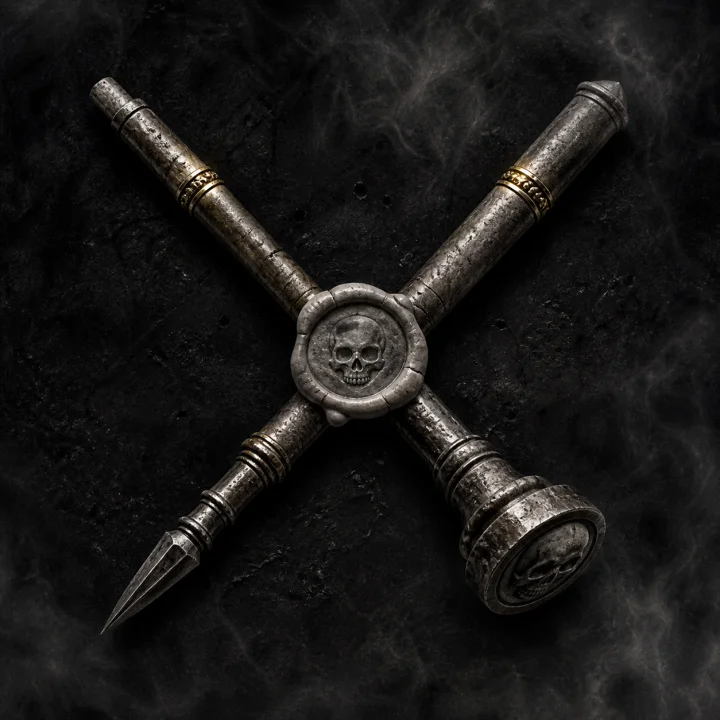

The Consent
„"A Space Marine is embedded because his Chapter needs him. A Custodian is embedded because he has said it twelve times." — Custodian Bethon, Keeper of the Register“
The Fourth Chamber Beneath the East Transept
What was found in the fourth chamber beneath the East Transept of the Inner Palace stands in no report, because there is no report.
There is one line in a watch book: Seal 4-C-fourteen inspected, intact. It is seven hundred years old to the day. Below it the same line stands another two hundred and forty-three times, in two hundred and forty-three different hands, and the last of them is from the year in which the Great Rift opened.
After that someone stopped writing.
Custodian Andokar went through the opening third. He was third because the order in his watch went by the age of the wounds and not by the age of the men, and because in the preceding decade he had taken nothing that deserved the name. Ahead of him went Custodian Kaedan and a comrade whose name plays no part in this account, because he did not survive the next four minutes.
The chamber was twenty paces wide. In the middle of it stood nothing.
That was the first thing that was wrong: that nothing stood there. A seal of that order is not laid around an empty room. It is laid around something, and if that something is no longer there, then either it has been taken out, which leaves traces, or it has ceased to be in a place.
Andokar had learned in three hundred years of service that the second possibility was the worse one.
He raised the Guardian Spear and said four words over the close channel that were later entered in the watch book as the last report: "It is not gone."
What happened after that lasted a hundred and thirty seconds.
Kaedan carried him out. That is the second and last fact standing in any file: that Custodian Kaedan carried his watch-brother a hundred and sixty metres through three locks, with one hand, because in the other he held the blade and was not permitted to lower it until the topmost lock was reached. The auspex data of those hundred and sixty metres have been erased. That is not a suspicion; it stands so in the order, and the order is signed.
In the lock Kaedan set him down and looked at what he was carrying.
He had not known the whole time. That is the part Kaedan mentioned once, a hundred and forty years later, to exactly one person, and the sentence went: I assumed that I was carrying a dead man, and I carried him because one carries a dead man.
Andokar's armour was open below like a broken-open fruit. The legs were gone, cleanly, beneath the pelvis. The left arm was still there and was no longer his. Of the face the lower half was gone — jaw, larynx, the whole speaking apparatus that is fitted to a Custodian over ten years of work and that he uses for a thousand years without noticing it.
The eyes moved.
They found Kaedan and stayed on him, and then they moved to the side and back again, twice, very precisely, and Kaedan did not understand what they were trying to say, and he stood in the lock and grasped, with a clarity he had never needed in three hundred years, that in that moment he was one of the few men in the Imperium with a problem for which there was no procedure.
What Was Left
The physicians of the Adeptus Custodes are not called Apothecaries. They are called nothing at all that an outsider could pronounce; they are an office and bear the name of the office, and the office is so old that it has twice changed its meaning without changing its name.
The one who opened Andokar on the fourth night had been seven thousand years in that office.
He worked eleven hours. Afterwards he went into the antechamber, where Tribune Orwynne was waiting, and laid on the table a report consisting of six lines, and remained standing while the Tribune read it.
Orwynne read it three times.
"The brain," he said.
"Complete."
"How certain?"
"As certain as I have been of anything in seven thousand years." The physician had a dry, thin voice that never grew louder. "He is conscious. He was conscious for the whole hundred and thirty seconds and he has been so uninterruptedly ever since, and in the four days between the recovery and my first cut he did not once close his eyes, because he can no longer do so. I have sewn his lids shut so that the cornea does not tear. He permitted it. His pulse did not alter while I did it."
Orwynne stood at the window. The window looked onto an inner courtyard that had seen no rain in six thousand years, because three hundred metres of palace stood above it.
"How long can he stay like that?"
"Indefinitely," said the physician. "That is the problem, Tribune. If you ask me how long I can preserve him — the answer is: as long as the Imperium stands. He is a Custodian. His body does not stop of its own accord. I would have to do something to make it stop, and I shall not do that, because I may not, and you will not order it of me, because you may not."
"I know what I may do."
"Then you also know," said the physician, "that there are exactly three possibilities, and that two of them are not something one can choose."
The first was to leave him so. A man with a complete mind, without legs, without a jaw, without a voice, on a table, for the duration of the Imperium.
The second was that he himself should ask for it to end. That was permissible. It stood in the Register, it had happened sixty-two times, and the formula for it was short and without pathos. It did, however, have to be spoken.
The third was the long vigil.
"Eleven," said Orwynne.
"Eleven," the physician confirmed. "In ten thousand years. I assisted at four of them, and I tell you frankly: I would not do it again, and I shall do it again if you order it."
"Why would you not do it again?"
The physician looked at him. It was a very old look.
"Because a Space Marine who is embedded is embedded into a Chapter," he said. "He has brothers who come every hundred years and wake him and need him. He has a purpose that comes to fetch him." He took the report back. "We have no Chapter, Tribune. We have a duty, and the duty has a place, and the place is two kilometres from here and is guarded by ten thousand men who can all walk. What do you want to keep him for?"
Orwynne did not answer.
"I do not ask rhetorically," said the physician. "I ask because he will ask it."
Four Days
Between the lock and the first cut lay four days, and in those four days no one asked him anything.
That was not negligence. There was nothing to ask, because no one had yet found a way for him to answer, and because in an institution in which every action is seven thousand years old, a condition without a procedure results in everyone standing very politely to one side.
Andokar lay on his back. He could not turn his head. He saw the ceiling.
The ceiling was basalt, polished, with a seam running from upper left to lower right that had been filled about eight thousand years ago with a resin that by now had a different shade from the stone. In that seam, over a length of two metres, there were forty-seven small inclusions, and in the first six hours he counted them four times and four times arrived at forty-seven, and after that he stopped, because he noticed that he was doing it in order not to do the other thing.
The other thing was: to think.
A Custodian is trained to keep himself awake and fit for action for sixty hours in a state of complete immobility. That is a basic skill; one learns it in the first years, it belongs to watch duty, and Andokar had applied it a hundred times, in corridors, on roofs, in antechambers. What he learned in those four days was that the skill had a precondition that no one ever mentions: one must know that it stops.
On the first day he worked the chamber through again.
He went through it, step by step, a hundred and thirty seconds, and looked for the point at which a different decision would have brought a different result. He found four. He examined all four, and with all four it turned out that the other decision would have cost Kaedan. He went through it a second time, to make certain he was not arranging it to suit himself. The second time he found five.
On the second day the physician came and sewed his lids shut.
He explained it beforehand. He explained everything beforehand, in those thin, matter-of-fact sentences, and it was the only kindness that occurred in that room, and Andokar accepted it. Afterwards it was dark, and that was better, and that it was better frightened him more than anything that had happened in the chamber.
On the third day he went through the list he had read three hundred years before.
He had committed it to memory. Custodes remember what they have once read; that is no feat but a side effect, and mostly an unwelcome one. He went through the eleven lines, in order, and found that with eight of them he remembered the wording and with three only the number, and that the three he did not remember were exactly the three that had fought.
As a new man he had committed to memory what had frightened him. Not what had given him hope.
On the fourth day he tried to form the word.
It was absurd and he knew it. The apparatus was gone; there was nothing left with which anything could be formed. But the command for it is not given in the throat but further up, and the command still worked, and he gave it, six or seven hundred times, and every time the signal went into a nothing and did not come back.
The word was yes.
He practised it for four days before anyone had asked him anything, and when Bethon put the question for the first time thirteen days later, the answer had in truth already been given seven hundred times and had only never arrived.
He said this to no one. Not to Kaedan, not to Bethon, to none of the eight.
It would have damaged the procedure, and the procedure was the only thing that in those four days still treated him as someone who had to be asked.
The Register
Custodian Bethon was the Keeper of the Register, and that was an office that in an ordinary century had nothing to do.
He kept three lists. The first was that of the Ten Thousand, and that one he did not maintain himself; it ran through another office, and he received only the changes. The second was that of the sixty-two who had asked for their end, with date, circumstances and wording.
The third had eleven lines and was called in the house the silent line, though there were eleven of them, and Bethon had in four hundred years added not a single one.
He spread it out on the table when Orwynne and Kaedan came. It was not a book; it was a plate of auramite, a metre square, and the eleven entries stood upon it in a script one saw only when light fell on it obliquely.
"I shall tell you the rule," said Bethon, "and afterwards I shall tell you why it runs so, and you will not contradict me but say nothing for a while, as all do."
"Say the rule," said Orwynne.
"The consent must come from his own will, in his own utterance, without mediation, and it must be given so often that error is excluded." Bethon laid a finger on the plate. "The measure for it stands here: once more often than the Register knows cases. At the first long vigil that was twice. At the eleventh it was twelve times. With Andokar it would be twelve."
"He cannot speak."
"I know."
"He can move one hand."
"I know that too," said Bethon.
Kaedan, who until then had stood at the door, said: "Then the matter is decided, and we are wasting time here."
Bethon looked at him.
"Decided in which direction, Custodian?"
Kaedan did not answer at once, and in that pause something showed itself that later became important: that he did not yet know himself.
"Why does the rule run so?" Orwynne asked.
"Because we are not a Legion." Bethon sat down, which he seldom did. "A Space Marine belongs to his Chapter. His Chapter disposes of him, and that is no cruelty but the ground on which a Chapter can function at all. We belong to no one. There are ten thousand of us, and every single one was selected by a measure that no living man wholly knows any more, and the core of that measure was, by everything we know, judgement. Not strength. Judgement."
He laid a hand flat on the auramite plate.
"If we embed one of us without his willing it, then we have made a decision in his stead. And if we may do that, then we are an institution that disposes of its members, and then ten thousand years of selection were an administrative expense." Bethon took the hand away. "That is why twelve times. Not in order to torment him. In order to give ourselves eleven opportunities to let it be."
The Objection
"I am against it," said Kaedan.
They stood in the upper corridor, before the chamber in which Andokar lay. The corridor had windows on one side and none on the other, and between the windows stood twenty-three niches, and in every niche stood an armour without an occupant, and every one of those armours had a name, and Kaedan knew them all by heart, because he had served duty in that corridor twice daily for three hundred years.
"You carried him," said Orwynne.
"Yes."
"And now you want to let him die."
"I want no one to prescribe for him what he waits a hundred years for." Kaedan said it calmly. Custodes do not shout; there is no register in their voice provided for it. "Tribune, I have read the eleven. Have you read them?"
"Yes."
"Then you know that three of them ever fought."
Orwynne was silent.
"Three," said Kaedan. "In ten thousand years. The First at the Siege, which is undisputed and about which there is even a song. The Fourth in the year 546.M32, at something the file designates with a reference number and otherwise not at all. The Ninth during the Vaxhallian Genocide, for eleven hours. All the others stand." He made a small movement of the head, downward and southward, where beneath the palace lay the halls in which the eight stood. "They have stood for six thousand, four thousand, eleven hundred years. They are conscious when one looks at them. They have not been switched off, because one does not switch off a Custodian."
"They consented."
"They consented to something that was described to them as a watch," said Kaedan. "And what they got is waiting. That is not the same word, Tribune, and for ten thousand years we have been acting as though it were one."
Orwynne stepped to a window.
"You know why I want it," he said.
"I know why you do not want it. You do not want to have the night in which a Tribune ordered that a Custodian whose mind is complete should stop." Kaedan stayed where he was. "That is not a reproach. I would have the same. But it is not his reason, it is yours."
"Then ask him."
"I?"
"You," said Orwynne. "You carried him. He looked at you and tried something with his eyes, and you did not understand it, and you reported that to no one and I know it all the same, because I have been Tribune for four hundred years and because one knows such things." He turned round. "Bethon will ask twelve times, because that is the procedure. You ask him once beforehand. Without witnesses. And what he tells you, you tell me, and if you do not want to tell me, then you tell me that, and I shall not press."
The First Day
By then they had a device.
It had been built in four days by a Techmarine who had been fetched from a workshop in the Ring and to whom nothing had been explained, and it consisted of a plate, a lever and a very fine spring. Andokar's left hand, which was still his, lay on it. He could move the index finger. Nothing else.
One press: yes. Two: no. Three: a question, which then someone else had to put and which Andokar could answer only by yes and no, which slowed the procedure considerably.
Kaedan came on the evening of the first day, alone, as ordered.
He had prepared himself. He had laid out a hundred sentences and had come with seventeen and in the end used none of them.
He sat down beside the table — Custodes do not sit in the presence of a superior, but this was no longer a relation of rank, and there was no regulation for what it was instead — and said:
"I did not understand what you said in the lock. With your eyes. Twice to the side and back."
One press.
"Yes, you said something?"
One press.
"May I guess it?"
One press.
Kaedan thought. He thought for a long time; it was the one advantage he had in this matter, that time no longer mattered to either of them.
"You looked towards the chamber," he said. "Towards the door we came through. You wanted me to go back."
One press.
"Because it was not dead."
One press.
"It is dead," said Kaedan. "I went back the next day, with forty. We sealed the chamber and laid the third order over it and took the floor down to the rock. It is dead, and I tell you that because otherwise you will not learn it and because I know that you have been thinking of it for six days."
The hand lay still. Then: one press.
Kaedan breathed out.
"I have to ask you something," he said. "They will ask you twelve times. I ask beforehand, once, and I ask differently."
He leaned forward.
"They will ask you whether you consent. I ask you whether you know to what."
The hand lay still for a long time.
Then came three presses.
Kaedan fetched the stylus and the tablet, because a question could only be put that way: he read out the row of letters, and Andokar pressed at the right one, and it took about four minutes for one word.
The word was: WAITING
Kaedan laid the tablet down.
"Yes," he said. "Probably. Eight of eleven never fought. If you consent, the likeliest thing is that you will stand in a hall beneath the palace and nothing will happen, and that it will stay so for three thousand years, and that you will be there the whole time."
One press.
"You knew that."
One press.
"How?"
Three presses. Four minutes. The word was: LIST
"You have read the Register." Kaedan did not laugh; Custodes laugh seldom and never in such rooms, but something in his face moved. "When?"
Four minutes: THREE HUNDRED YEARS
"You read it as a new man. Three hundred years ago."
One press.
"Why?"
And that took the longest of all, eleven minutes, and it came out:
BECAUSE I WANTED TO KNOW WHETHER THERE IS A WAY OUT
The Eleven
Bethon read them out on the night before the first asking, because the procedure required it, and because at that point the procedure was wiser than those who had written it.
He read them to Andokar. Not to the Tribune, not to the commission. To the one who was to consent.
"The First. Name erased. Embedded in the fourth month of the Siege, from wounds I do not describe to you, because you know them. He fought for twenty-one days. He was taken out of the field on the twenty-second and has stood in the second hall since. He has not responded to any address for fifteen hundred years. We do not know whether that is a decision."
He read slowly. He read every line entire, including the parts that contained nothing of consequence, because consequence would have been a selection.
"The Second. Embedded 118.M31. Six hundred years without deployment. Asked in the year 719.M31 that it should end. The request was not granted, because at that time no rule existed for the withdrawal of a consent. One has existed since. It has never been applied."
Andokar's hand lay still on the plate.
"The Third. Embedded 402.M32 after an accident in the gilding works — yes, that is how it stands there, and no, there is no further explanation. Stands in the first hall. Answers."
"The Fourth. 546.M32. Eleven hours of action against something that in the file bears only a reference number. After that two thousand years. No longer answers, but follows movement."
"The Fifth. Embedded 1090.M32 at his own, repeated and express wish, after the loss of both arms and the spine. He wanted it. It is the only case in this list in which the procedure had to be accelerated, because he did not stop asking. He has stood in the third hall for eight thousand years and in eight thousand years has said a single sentence, and the sentence stands here, and I do not read it out, because it was not intended for you."
Bethon paused.
"Do you want to hear it?"
One press.
Bethon looked at the plate a long while.
"I was wrong," he read.
He read on. The Sixth, the Seventh, the Eighth. The Ninth, who had fought eleven hours at Vaxhall and afterwards stood eleven hundred years. The Tenth, of whom in four hundred years it had three times been reported that he had moved in the hall, and who had occasioned three investigations, and about whom in the file it stood in a different hand: It is nothing. Leave him.
The Eleventh was two hundred years ago and was the only one Bethon had entered himself.
"He was my watch-brother," said Bethon. "I asked him twelve times, and he said yes twelve times, and I never visited him afterwards, and that is the reason I read this out to you entire, though no one requires it."
He did not roll the plate up. He let it lie.
"Tomorrow morning I begin with the first asking," he said. "Twelve days. Once a day, at the same hour, in the same wording. You may say no on any of those twelve days, and then it is over, and no one will ask you afterwards why, and I shall take the matter out of the Register as though it had never been."
He stood up.
"And Custodian — one thing more. It is held to be indelicate to say this, but I say it, because it is true and because you should take it into the reckoning: you are the first since the Rift. If you say yes, you will probably be needed in forty years or in four hundred. The world outside is no longer the one in which eight of eleven were never needed."
Andokar's hand moved.
Three presses. Four minutes.
The word was: OR
Twelve Days
The wording had been the same for ten thousand years, and it was short.
Custodian, do you consent to the long vigil?
Bethon spoke it every morning at the eleventh hour, standing, without witnesses but the physician, who did not witness it but only was there. Then he waited. There was no time limit for the answer. At the fourth asking it took twenty-seven minutes, and Bethon stood for twenty-seven minutes and did not stir.
First day: yes. Second day: yes. Third day: yes.
On the fourth day, after the twenty-seven minutes, there came not one press but three, and it took nineteen minutes, and the question was: HOW MANY HAVE STOPPED AT THE FOURTH
"Two," said Bethon. "The Sixth at the seventh asking. A man whose name I may not give, because he did not enter the Register, at the second."
Then: yes.
Fifth day: yes. Sixth day: yes.
On the seventh day Kaedan came and stayed.
He did not have permission; he also did not have a prohibition, because no one had held a prohibition necessary, and Bethon looked at him, then looked at Andokar and put the question.
Yes.
On the eighth day Kaedan brought something with him. It was a piece of auramite, the size of a hand, with a number ground into it, and it came from one of the twenty-three niches in the upper corridor. He laid it on Andokar's chest.
"Number nine," he said. "That is your niche. It stays empty, however this ends. They will not reassign it, because you stay on the list. That is the point I wanted to tell you and have not told you for eight days: you are counted. In both cases. There is no version of this in which you disappear from the Ten Thousand."
Yes.
Ninth day: yes. Tenth day: yes.
On the eleventh day the answer came after four seconds, which was faster than on any day before, and Bethon entered it and wrote beside it, in his very small hand: without hesitation, and beneath it, because he was an honest man: I do not know how to weigh that.
On the twelfth day the chamber was full.
It had not been ordered. It had got about; in the Adeptus Custodes everything gets about, there are only ten thousand of them and they live too long to have secrets, and when Bethon entered at the eleventh hour, a hundred and twelve Custodians stood in the room and in the corridor before it, in armour, without helms, and none of them said anything.
Bethon looked at them. Then he looked at Andokar.
"I can send them out," he said.
No press.
"I ask differently: shall I send them out?"
Two presses.
Bethon nodded.
"Custodian Andokar," he said, "do you consent to the long vigil?"
The Tribune
In the night between the twelfth asking and the embedding, Tribune Orwynne had Bethon summoned.
He did it late and without occasion, and Bethon came, because one does not tell a Tribune that it is late.
"Sit."
"I prefer to stand."
"So do I," said Orwynne. "That is why I said it."
It was a small room, a working room, with a table, a map and three tablets on the wall with names on them. Bethon did not know the room; Tribunes have rooms that no one knows.
"I want a piece of information from you," said Orwynne, "and I do not want it as Tribune."
"Then do not ask as Tribune."
"I cannot ask otherwise. That is the point." Orwynne laid both hands on the table. "Custodian Kaedan told me twelve days ago in the upper corridor that I am doing this for myself. That I do not want to have the night in which a Tribune ordered that a Custodian should stop. I did not contradict him, because one does not contradict a subordinate when he is probably right."
"Is he right?"
"I do not know," said Orwynne. "And that is why I ask you: in the eleven cases, was a superior ever called to account for it?"
Bethon thought.
"No," he said. "Nor did one ever order it. That is part of the construction. The superior orders nothing; he establishes that the possibility exists, and after that he is out of the matter. I ask. He does not."
"That is a very clean construction."
"Yes," said Bethon. "It was built by men who had precisely your question and no desire to have it again."
Orwynne looked at the map. It was a map of the palace, and it was useless, because the palace had changed in fourteen places since its making and no one ever corrected the map, because it was impossible.
"I did not give the answer to the physician's question," he said. "He asked me on the first night what I want to keep Andokar for. I said nothing. I have not said it for twelve days, and Kaedan noticed, and Andokar probably too."
"And?"
"I have none," said Orwynne. "I am not keeping him for something. I am keeping him."
Bethon nodded slowly.
"That is the most honest answer I have heard to that question in four hundred years," he said, "and it is also the worst, and both at once, and with us that is more often so than one would assume from the outside."
He went to the door.
"Tribune. If it helps you at all: he has said yes twelve times, and the eleventh time after four seconds. You did not persuade him. You merely did not stand in his way, and that is all a superior can and may do in this matter."
"Is it enough?"
"No," said Bethon. "It is only everything."
The Interment
The machine was called Telemon.
It had stood for three thousand years in a workshop on the fourth level and had in that time been serviced a hundred and forty times without ever having had an occupant. That was the reason for its existence: two of them were kept ready, always, because a need that arises once every nine hundred years does not give notice.
It was gold and black, which was to be expected, and very small for what it was. That surprised everyone who saw it for the first time. A Telemon is built compact, because it is meant for corridors, for stairs, for doors, for the palace; it is no siege engine, it is a warden who happens to consist of four metres of auramite.
The sarcophagus lay open like an opened book.
What happened in the next nine hours is not described here. It has been described, once, by the physician who did it, in a report of forty pages that no one but Bethon has ever read, and which in its last line contains the sentence: I told him what I was doing at each point, because I am of the view that a man in full possession of his mind has a right to it, and I am no longer certain that this was a kindness.
Kaedan was in the room. He had asked for it, and Orwynne had granted it, and Bethon had said, "You will regret it," and Kaedan had said, "Yes," and had stayed.
In the seventh hour they closed the sarcophagus.
In the eighth the core filled with the fluid whose designation in the Adeptus Custodes is different from that in the Chapters — the wardens of the Space Marines call it in their own jargon greywater, and Bethon had once read the word in a report of the Iron Veins and had held it more apt than his own, four-syllabled one, which he could not abide.
In the ninth the machine stood.
It simply stood. No one had given an order. The legs carried themselves, as they had done at idle for three thousand years, and then the head turned, twelve degrees to the left, and stopped.
It looked at the twenty-third niche, which had been wheeled in on a trolley because Kaedan had insisted on it.
It was empty.
What He Heard
A Custodian in a Telemon hears differently from what he is used to, and the adjustment takes years.
He hears too much. The receptors are built for a battlefield, and the palace is no battlefield; it is a place where sixty thousand people live and work and in which for ten thousand years no one has driven in a nail without its being recorded somewhere. In the first months Andokar heard everything: the sand in the joints, the pumps six levels below, the breathing of the guards in the corridor.
He learned to push it away. That took eleven years.
In that time he heard above all one thing, and it was what surprised him most: that the other eight were not silent.
They stood in three halls beneath the East Transept, and they were silent for a visitor, because a visitor heard nothing. But among themselves there was a channel. It lay right at the bottom of the band, below what a helm picks up, and over it the eight had over several millennia set up an understanding that consisted of very few and very slow signs.
It was the same channel that the mortal wardens of other Chapters — the Oil-Hands of the Fourth Legion, for instance, whose Protocol Bethon possessed in a transcript — call the lower channel, and over which one can address an occupant without waking him. That the Custodes used it stood in no file. No one had ever asked.
The first sign Andokar received came in the fourth month, from the second hall, and it took nine hours.
It was a question, and it ran: DOES THE PALACE STILL LIVE
He answered. It took a day.
YES
After that there was nothing for a long time. In the second year a second sign came, from the first hall, from the Third, the one with the gilding works, who answered.
It ran: YOU ARE NEW. AT SOME POINT YOU WILL ASK YOURSELF WHY YOU SAID YES. THEN TELL US. WE COLLECT.
The Hall
They put him in the second hall, because there was room there, and they did what one does in such cases: they made the room ready.
There was a regulation for it. It was seven thousand years old and governed the lighting, the air flow, the spacing between the standing places and the question of whether an embedded man is set up facing the door or the wall. The answer to the last question was: the door. The reason was not given with it, but everyone understood it.
What the regulation did not govern was the visiting.
No rule had ever been needed, because it had never been a problem: in the first centuries one came, and then one came less often, and then one no longer came, and no one had ever written that down, because it had struck no one as a process. It was simply the form the matter took.
Kaedan came.
He came weekly in the first year. Monthly in the third. From the twelfth year onward once a year, always on the same day, and that was the day on which they had descended into the fourth chamber beneath the East Transept.
He did not speak much. There was not much to speak; a Telemon has no voice built for conversation, and the sign system of the eight was too slow for courtesies. Kaedan sat down on the floor before the standing place. It was the same gesture with which, eight thousand kilometres away, another man would have sat down on the floor of a nursery, in a mountain on a forest world, for a reason neither of them could have named. Then he told what had happened in the year.
In the thirty-third year he told that Tribune Orwynne had been deployed into Imperium Nihilus and had sent no report for six years.
In the sixty-first, that Bethon had given up the office and that the new Keeper had added a line to the auramite plate and that the line was Andokar's name.
In the eighty-ninth, that the twenty-third niche was still empty and that twice someone had tried to reassign it and that twice it had not gone through, and that he, Kaedan, had had nothing to do with it, which was a lie.
Between them lay the years in which nothing was told.
That was the real content of the second hall, and it took forty years before Andokar grasped that it was a content and not an absence. Between two visits lay three hundred and sixty-five days. A day in the palace had a rhythm one could hear from below: the changes of the watch, four times; the great pump beneath the third level, which started up every eleven hours and whose bearings were replaced in the twenty-fourth year, after which it sounded different; the procession on the twenty-eighth of every month, which passed forty-two metres above the hall and whose singing came through the rock without words.
He learned to hear the fault in the procession.
It was a very small fault: at one place in the third responsory the choir came in an eighth of a beat too early, and had done so since the eighteenth year, since a change in the office of choirmaster. Andokar heard it twelve hundred times. In the fifty-sixth year he sent a sign to the first hall, with the question whether the Third heard it too.
The answer came after two months: YES. FOR EIGHTEEN YEARS. I HAVE NOT DARED TO ASK.
That was, as far as Andokar could judge, the funniest thing that had been said in the second hall in six thousand years, and he would have laughed at it if he had still had anything with which to laugh.
He began to collect things, because the Third had said that they collected.
They were not thoughts. Thoughts he had too many of; those were the problem and not the stock. What he collected were sentences that had fallen in passing, because a guard stood before the door of the second hall and because guards talk when they assume that no one is listening.
In the thirty-first year one guard said to another: "Do you think they hear us?" — and the other said: "No." And the first said: "I would still rather talk quietly."
In the forty-fourth year a very young Custodian asked a very old one why the eight stood facing the door, and the old one said: "So that they see it when someone comes." And the young one said: "No one ever comes." And the old one said: "Yes. But they see it."
That sentence Andokar passed on, to all eight, and he needed four days for it, and it was the longest sign he ever sent.
In the hundred and fourth he did not come.
In the hundred and fifth he came and said where he had been, and it took the whole day, because he had to speak over the lower channel while doing it, and at the end of that day Andokar had for the first time in a hundred and five years sent a sign to all eight, and the sign ran: IT HAS BEGUN
One Hundred and Forty
In the hundred and fortieth year Kaedan came for the last time.
He was not old. Custodes do not grow old in any sense a mortal would recognise; they only become gradually something that consists more of history than of the present. But he walked differently, and he wore the right shoulder plate of another man, and in the past forty years he had spent twenty-two months in the field, which for a Custodian of the Inner Palace was monstrously much and which a hundred and fifty years earlier would have been unthinkable.
He sat down on the floor.
"They need you," he said.
He let it stand. Over the lower channel the sentence would have been two hours; he said it aloud, and a Telemon hears aloud excellently.
"Not today. In two years, perhaps in four. There is a matter in Imperium Nihilus, and we do not have enough men who fit through a door and who can endure what stands behind that door, and I have named you." Kaedan laid his hands on his knees. "I wanted you to hear that from me and not from an order."
Andokar did not answer at once.
Ninety seconds — for him a speed he had unlearned in a hundred and forty years and which surprised him himself.
WHY ME
"Because you waited," said Kaedan. "And because a hundred and forty years ago I stood in a corridor and told a Tribune that eight of eleven were never needed, and because I was right in that and it was wrong all the same."
He stood up.
"I spoke against it," he said. "I said in the upper corridor that they should let you die. I have never withdrawn that, and I do not withdraw it now either, because I meant it so then and because a man who withdraws his old sentences as soon as they become inconvenient is worth nothing." He looked up at the machine. "I only add: I was wrong."
It was the same sentence the Fifth had said in eight thousand years, and both of them knew it, and neither of them said anything about it.
The sign took four minutes.
NOR DO I
"What?"
I WITHDRAW NOTHING EITHER
Kaedan stood a while.
"No," he said. "You never did."
He went to the door. There he stopped, the way people stop at doors, as they have since there were doors.
"Number nine," he said. "The niche. This time I did not have to defend it. The new Keeper refused of his own accord." He nodded once. "It has become a procedure. It now stands in a regulation that the niche of an embedded man remains empty. They wrote it down because you were the first about whom someone asked."
Then he went.
The Silent Line
The auramite plate has twelve lines today.
The twelfth is the shortest, because the Keeper who entered it was a sparing man and because at that time there was as yet nothing to report. It runs:
The Twelfth. Andokar. Embedded in the first decade after the Rift. Asked twelve times, consented twelve times, eleven times without hesitation. Stands in the second hall.
Beneath it another hand, very much later, has added a line, and that was not provided for and has never been objected to either:
Was needed.
There is no third entry. What Andokar did in Imperium Nihilus, for how long, and whether he came back, stands in another file, in another office, under a reference number, and whoever wishes to read it must hold an office that in ten thousand years fourteen men have held.
What remains in the second hall is the standing place.
They stand there eight in number, because one is missing, and they stand facing the door, as the regulation requires, and over a channel right at the bottom of the band, below what a helm picks up, they pass a sign to one another every few decades.
It is always the same question, and has been for six thousand years. It travels from the first hall into the second and from the second into the third and back again, and each of them passes it on, because the passing on is the only movement left to them.
The question runs:
DOES HE STILL STAND
And somewhere in the palace, six levels higher, a Custodian with the right shoulder plate of another man walks along a corridor with twenty-three niches, one of which is empty and stays empty, and he does not count them, because he has long known them.
Nor does he answer. He does not have the channel.
But he passes twice daily, for four hundred and forty years, and at the ninth niche he grows every time a little slower, and that is all the Imperium has to spare for its dead and for its not-quite-dead, and the Custodes know that better than anyone else, because they have written it down.
A Custodian who is in the second week of his service and walks the corridor for the first time asked three days ago why the ninth niche is empty.
He was told that there is a procedure for it, and he was told where he could read it up, and he read it up, just as four and a half centuries ago another new man read up a list of eleven lines because he wanted to know whether there is a way out.
It stands there in four sentences. The last runs: The niche remains empty for as long as the consenting one stands.
He read that and took it for an honour.
He is twenty-two years old, and in three hundred years he will stand in a corridor and tell a Tribune that eight of eleven were never needed, and he will be right.
Download story as PDF or EPUB
Enter your email address. After confirming your subscription you'll get the download links immediately and by email.