The Colonel Holds
Astra Militarum (14th Hochtarn Mountain Jaegers) Munitorum (Valmark South reconciliation chancellery) Renegades (Colonel Dreyer)
“The mountain gives nothing up. Neither do we.”
Colonel Anselm Aschbach, evening address, regimental order archive, Reel 112
I. Day Two
VOX LOG · Regimental net, 14th Hochtarn Mountain Rifles · Ormund Saddle
Day 02 · 06:00 · HQ to all: Order of the Colonel. Hold positions. Not one step back.
Day 02 · 13:52 · South Battery to HQ: Three salvoes fired, target Hill 1140, effect good.
Day 02 · 14:07 · Observation Post East to HQ: Counter-fire, that is meant for us. Colonel is with us. We are —
Day 02 · 14:07 · Transmission ends.
Day 02 · 14:09 · HQ to Observation Post East: Post East, please report. Post East, please report.
Day 02 · 14:36 · HQ to all: Colonel unwounded. Orders of the Colonel stand unchanged. Signed Weller, Major.
Kuhrt had never touched the colonel until he was dead.
He carried him on his back, the dead man's arms crossed in front of his chest, the head against his neck, and he counted the steps, because otherwise he would have had to think. The sunken lane behind the observation post was a dried-out stream bed of scree that led down the slope to the west, and behind him the renegades' shells struck the post as if they meant to make sure. At a hundred he stopped paying attention to the impacts. At three hundred he had snatched the colonel's hat from the ground without breaking step and stuck it in his belt, and the chamois beard tickled his hip with every stride. The colonel's heels struck against Kuhrt's calves, regularly, like a man keeping time with his feet.
Seventy kilos, he thought. Plus the coat the Old Man wore even in summer.
It was six hundred and twelve steps to the steel door of the headquarters bunker. There he stood and could not knock, because he needed both hands, and in the end he kicked at it with his boot.
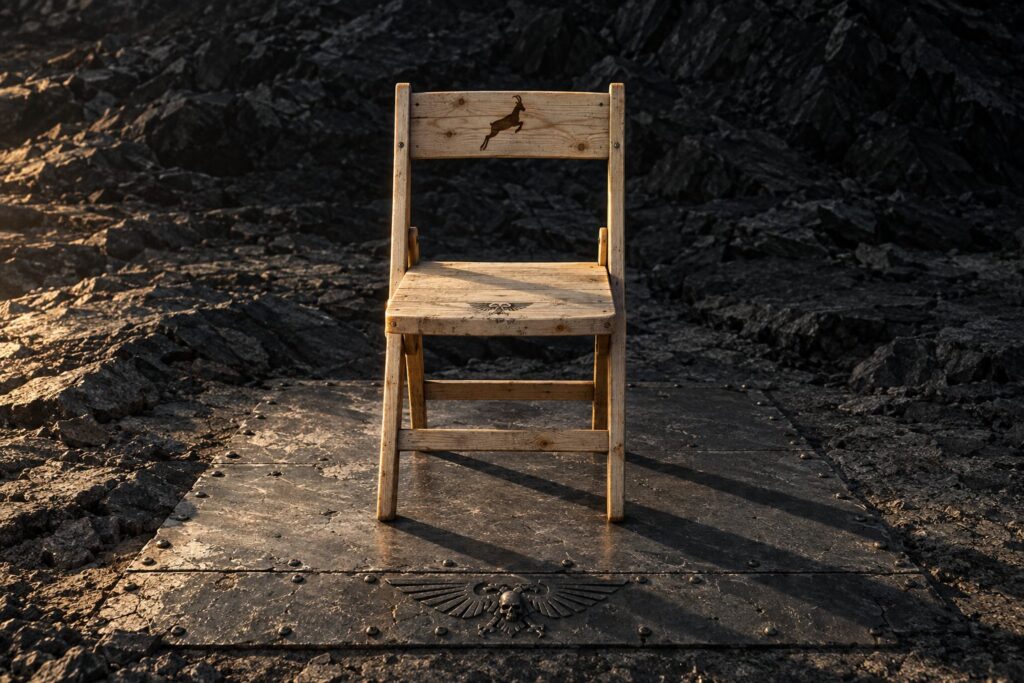
HQ had dug itself into the rock, where the slope opened a maw: three rooms, a vox room, a map table as big as a barn door. In the corner stood the colonel's chair, a folding chair of pine with a chamois burned into the backrest, in which nobody had ever sat. The Old Man had it carried along everywhere and never sat in it, because a man who sits has time. Major Weller sat at the edge of the table over a stack of stock lists. He looked up when the door opened, and he looked at the clock, as he always looked at the clock. Fourteen twenty-one. Then he saw what Kuhrt was carrying, and his hand stayed on the list.
Weller knew him, as he knew everyone who had ever ordered anything from him. Trooper Kuhrt, Headquarters Company, Second Platoon, shoe size forty-two, resoled twice.
"Major," said Kuhrt. "The colonel."
"Wounded?"
"No, Major."
Commissar Gerlinde Vorsch stood at the head of the table with her back to the door and did not turn round. She had heard it before anyone said it, from the sound a body makes when it is laid on a table and no longer helps. Kuhrt laid the colonel on the map of the Saddle, his head on the East Saddle, which he had wanted to hold. A splinter no bigger than a thumbnail had found him under the left ear. Nothing more had been needed.
Vorsch laid two fingers to his neck, as one is taught to, and took them away again, as one is taught that too.
"Command passes to you, Major."
"I know."
"The duty to report applies at once. The senior officer announces the death of the commander to the regiment. The wording is unambiguous."
"I know the wording, Commissar. I filed it."
It was not one of Weller's good jokes, and nobody laughed. He stood up. He was a tall, stooped man of forty-eight who wore his collar open because it choked him, and who in seventeen years of regimental service had never given an order he had not first written down. He went round the table and stopped in front of the map on which the colonel's head lay, and calculated. He calculated with his lips.
"Three thousand one hundred men," he said. "Against nineteen thousand. Behind us a hive with seven million people and no second line. And the only man who ever talked these men out of doing the sums lies on the map table."
"That is a situation, Major. Not a justification."
"The death of a colonel is an order to retreat that nobody has given."
Vorsch looked at him for the first time. She was fifty-four, slight, with a face like a well-ironed cloth, and her pistol sat in its holster like an argument she had not yet needed to use. "You are proposing that I lie to a regiment."
"I am proposing that you give it a day. Then another."
"How many?"
"I don't know."
"And this?" She indicated Kuhrt with her chin, who still stood in the doorway, his arms empty and held slightly away from his body, like someone who has forgotten what to do with his hands.
"The post is gone," said Kuhrt. "Twelve men, Commissar. I am the only one who saw it."
"Then you are also the only one who has to keep quiet."
"I'll say nothing."
"I have heard that from better men," said Vorsch. "With two of them I did not have to hear it again afterwards."
"Yes, Commissar."
She looked at the dead man again. Outside a shell struck the slope, and dust sifted from the ceiling onto the map, onto the coat, onto the colonel's face, which was strangely peaceful and had its eyes open and looked past Weller at a point where there was nothing. Vorsch stepped up to the table and closed them with the flat of her hand, without haste.
"I will write it down," she said. "With time and place. It goes into my file, and when this is over it goes into the proper one."
"Do that."
"I hate this, Weller."
"I know."
"No. But you will learn it."
They took him, the three of them. Weller had pulled the coat collar over the dead man's face and taken the legs, Kuhrt the shoulders, and Vorsch went ahead and opened the doors. A service passage connected HQ to the medical bunker, a passage for stretchers and plasma crates, and it ended in the cold chamber, behind the last door, which no doctor opened without need. It was a tiled room in which breath stayed where it was. On the shelves lay blood bags, and above the door hung a clock that the medical captain had put there so that freezing times could be read off. They laid the colonel on the steel slab at the back wall. Vorsch folded his hands. It took a long time, because they did not want to.
Kuhrt fumbled at his belt and held the hat out to Weller. "This is his, Major."
Weller looked at the chamois beard. The beard was singed and smelled of stone.
"Keep it," he said. "The colonel will need it again."
Vorsch turned her head. She said nothing, but she looked at him as if he had spoken a sentence that did not belong to him and was right all the same.
In the vox room Lenz sat at her console, the headphones round her neck, and had called Post East five times. Weller gave her the slip of paper. She read it. She read it a second time, longer, and then looked at his sleeves, on which there was no blood, and at the slip, and then at nothing.
"Unwounded," she said. It was not a question.
"Send it."
She sent it. The clock on the vox wall jumped to fourteen thirty-six.
It had taken a quarter of an hour to lie to a regiment. At thirty-six past two Colonel Anselm Aschbach was unwounded, and it was to go on for thirteen days.
II. The Voice
VOX LOG · Regimental net, 14th Hochtarn Mountain Rifles · Ormund Saddle
Day 02 · 19:40 · Colonel to all (evening address). Source: order archive, reels 112, 340, 2291.
Day 02 · 19:44 · Station without call sign to Colonel: Neither do we, Colonel.
Day 03 · 05:30 · Colonel to all: Hold the East Saddle until nothing is left. Source: order archive, reels 77, 1904.
Day 03 · 09:12 · 3rd Battalion (Major Teuber) to HQ: First wave in the approaches, strength about two battalions. We are holding.
Day 03 · 13:40 · 3rd Battalion to HQ: Third wave repulsed. Ammunition short.
Day 03 · 16:52 · 3rd Battalion (Major Teuber) to Colonel: We are holding, Colonel. Tell the regiment it was a good place.
Day 03 · 16:53 · HQ to 3rd Battalion: Please report. Please report.
The colonel had recorded every order since he had been colonel.
He did not trust memory, least of all his own, and so the regiment's order archive held seventeen years of his voice in tin boxes, labelled by campaign and year, spoken onto tape, every march order and every briefing and every evening address, three thousand hours that the adjutant had filed because the colonel demanded it, and that nobody had ever listened to because nobody would have had the time. Weller carried the first six boxes into the vox room himself and set them down beside the splicer.
Lenz looked them over. She was twenty-eight and had become a vox-operator because her father had been a watchmaker, and she cut tape the way he had filed gearwheels, with her thumbnail as a gauge.
"The evening address," said Weller.
"He never said the same thing twice."
"He said the same words. In a different order."
"That is your opinion."
"That is seventeen years of keeping the minutes."
Lenz drew a reel from the box, held the label up to the light and put it on. She did not look up as she asked the next question, and she asked it the way one asks the time. "How long?"
"I don't know."
"Then I need more reels."
She worked for three hours. She found the beginning on a reel from Karthos, the end on a reel from the time when the regiment still lay in barracks, and in between she glued one word to the next until the colonel's voice spoke again, rough and even, like someone reading out a list. The whole sentence was on the Karthos reel, but with gunfire behind it, and so she took only the first half. The second she fetched from a quieter recording, a briefing four years ago in which he had answered a divisional staff's offer of reinforcements: Neither do we. Dry, a little heavier on the Neither than on the We. Otherwise he had always sat on the We.
"The Neither is heavy," she said.
Weller listened to it twice. "I hear no difference."
"Then we are in luck, Major."
At twenty to eight Kuhrt stood in the trench below the Ridge with his mess tin in his hand, and did not eat. Weller had sent him back to his platoon with the instruction to eat, sleep and keep his face still, and Kuhrt had managed to attempt the first two things. The face was harder.
The loudspeakers hung every hundred metres on the trench posts, tin horns that sounded of cold. At nineteen-forty sharp they crackled, and the trench went quiet. The men put down their mess tins. One took off his cap without knowing why.
"Men."
It was his voice. It was the voice Kuhrt had heard since the day he came to the regiment, every evening, through tin, a dark speaking without haste.
"Two days. They have fired everything they had, and we are still standing. Tomorrow they fire again. The mountain gives nothing up. Neither do we. Good night."
Then the trench broke open. A roar went down the line, from post to post, three hundred throats, and Kuhrt saw men who clapped each other on the shoulders and men who wept, and all of them shouted the Neither-do-we as if it were the only thing they had ever said.
"The Old Man!" Pfeil bellowed beside him. He was nineteen, had his father's sticking-out ears and knew neither fear nor patience. "Told you! He'll still be alive when we're all dead!"
Kuhrt nodded.
He had heard the sentence a thousand times. He knew the breath the colonel took before it, and the small cough after it, and he knew that neither of them had been there. But that was not what knotted his stomach. It was the Neither. The Old Man had never sat on the Neither. It was a small difference, and he heard it so clearly that he wondered how a whole trench could roar straight over it.
"What's the matter?" asked Pfeil. "You're white as chalk."
"I'm cold."
"You're always cold, you lowlander."
In the night, when the flares painted the slope white and let it go dark again, Kuhrt said something to Pfeil. It was short. Pfeil listened without turning his head. Afterwards he sat very still for a long time.
On the morning of the third day the colonel ordered the East Saddle held until nothing was left.
Weller had chosen the sentence because it was the only one he knew for certain the colonel would have said. Lenz had built it from two reels, and it sounded exactly as it had sounded when the colonel said it at Karthos, over a knoll nobody ever needed again afterwards. It was Aschbach's method, and it was simple: A position was given the order to hold. It received no reinforcements, because a man who knows help is coming waits for it. It received no permission to withdraw, because a man who knows he may go back, goes. It held until nothing was left, and the enemy, having seen what it cost, thought twice the next time.
At the East Saddle the method had assigned the third battalion the heaviest place. Six hundred and twenty Hochtarners under Major Teuber, in snow holes and stone hollows at the lip of the pass, with the whole valley floor before them.
Weller sat in HQ and heard it through the rock. For seventeen years he had accounted for battles and never fought one. He knew them as consumption figures, rounds per man, dressing packs per hour, and now he learned that there was a figure that stood in no list and that one could read all the same: the sound a battalion makes when it grows fewer. It grew quieter. It did not grow calmer. At midday Vorsch pushed a chair up next to his and sat down, and they did not speak.
"Third wave repulsed," Lenz reported at twenty to two. "Ammunition short."
"We have ammunition," said Weller. "Two companies in reserve."
"He never sent a reserve," said Vorsch.
"I know what he never did."
He sent none. It was the hardest order he had ever not given, and he knew he was withholding it not for the sake of the Saddle but because he did not know what else to say. The colonel would have known. The colonel had always known where a man belonged, and he had never given reasons, and so people had believed him.
At eight minutes to five Teuber called once more. His voice was hoarse and very calm, the voice of a man who saw an end before him and regarded it with a certain courtesy. He addressed the colonel, not HQ. He said they were holding, and that they should tell the regiment it had been a good place. Then there was only static, and Lenz called him three times, and after the third time she took her hand from the transmit button.
The third battalion did not answer again. Of six hundred and twenty men, nine came back over the crest in the evening, and none of them spoke.
Weller wrote the figure in the ledger. Six hundred and eleven. He wrote it in his own hand, not the colonel's, and for the first time in seventeen years it looked like the handwriting of a stranger.
"It worked," said Vorsch behind him.
"That was always the part of him I did not like."
III. Gone Soft
VOX LOG · Regimental net, 14th Hochtarn Mountain Rifles · Ormund Saddle
Day 06 · 23:12 · Tooth Point (Captain Falk) to HQ: Attack in the dark, without bombardment. They are at the wire.
Day 06 · 23:19 · Colonel to Tooth Point: Evacuate. Second line, at once. That is an order. Source: direct speech, vox room.
Day 06 · 23:41 · Tooth Point to HQ: Second line reached. One hundred and thirty-eight men, all present.
Day 06 · 23:50 · Slope mortar platoon to HQ: Fire on Tooth Point, enemy in the position.
Day 07 · 19:40 · Colonel to all (evening address). Source: order archive, reels 112, 801, 2291.
Day 07 · 19:44 · Station without call sign to Colonel: Neither do we, Colonel. Only a piece.
The renegades came without a single gun.
That was what occupied Weller most, later. The night was clear and cold, the snow gave light enough to show shadows, and still none of the sentries heard them until they lay before the wire, hundreds of them, flat in the snow below the Tooth Point, with knives between their teeth and lasguns they did not fire. Dreyer had hammered the regiment with artillery for six days and had accustomed it to that. Now he saved it, because he knew the sentries were waiting for noise.
"Tooth Point reports attack in the dark," said Lenz. "They are at the wire."
Weller was already on his feet. He had slept in the chair, his cheek on the edge of the map table, and the map had pressed a pattern into his skin: the slope, the ridges, the Tooth Point, a rock spine at the southern edge of the East Saddle that looked like a broken tooth. There lay the Second of the First, one hundred and thirty-eight men under Captain Falk, and the colonel had ordered them four days ago to hold it. He had justified it with a sentence Weller knew by heart because he had copied it down: The Tooth Point is not given up. Give it up, and you give up the hand, and then the arm.
One hundred and thirty-eight men. Six hundred and eleven.
He looked at the map and for the first time saw not the tooth but the hole beside it. The Tooth Point was a maw. Whoever took it stood in a funnel of rock, a hundred and fifty metres below the Slope, and the Slope belonged to the mortar platoon, and the mortar platoon had had every gully and every trench of this position ranged since the first day, because an adjutant who keeps ammunition lists also keeps firing tables. He was the only one on the staff who knew how many shells the regiment had and where each of them would fall.
"Vox-operator," he said. "I need the word Evacuate."
Lenz looked at him. "There is no Evacuate."
"Look."
"I have looked, Major. This noon already, just in case." She had her hand on the box in which seventeen years lay. "He never said it. Not once. He evacuated wounded, he evacuated crates, but he never ordered a position to do it."
"Then I have none."
"Then you have none."
Vorsch stood against the wall with her arms folded. She said nothing, and it was the loudest thing in the room.
Weller sat down at the microphone. For seventeen years he had had the colonel's letters dictated to him, sometimes for hours a day, and he had, without ever telling anyone, practised the voice for them in the mirror in his quarters, the way some men sing in secret. It was a small talent that he had been ashamed of. He lowered his chin. He let the voice fall into his chest and took his breath more slowly than he needed it.
"Tooth Point, this is Colonel."
It was a man imitating a man, and the throat was too tight. But it was enough, and it went out over the net into the night like something that had always hung there.
"Evacuate. Second line, at once. That is an order."
It stayed silent. Then Falk's voice, breathless, with noise behind it. "Colonel? Evacuate?"
"Evacuate, Falk. You heard me."
The pause was short and long at once. Weller heard shots in the background, the first ones, and the sound of someone swallowing something down.
"As ordered, Colonel."
It took twenty-two minutes. Weller did not count them, he watched them on the clock. At twenty-three forty-one they came through the gully on the slope, singly and in groups, with wounded in their arms, a stream of shadows washed up against the headquarters bunker, and Falk counted them at the entrance, aloud, with numb lips. One hundred and thirty-eight. The renegades needed minutes to open the wire, and they were the minutes Falk needed. When they reached the Tooth Point they found it empty and warm and narrow, and they pressed in, hundreds of them, into the funnel that someone had so kindly left open for them.
Then the Slope spoke.
Weller heard it through the wall, a very even coughing, like a table someone was pounding with a fist, again and again, always in the same place. He had the figures in his head, every single one, the firing table for the Tooth Point, tube by tube, and he saw them fall without looking. Vorsch stood beside him. She still had her arms folded.
"That was stolen," he said. "The voice."
"That was good," she said. "Both can be."
In the morning he stood in the queue outside the kitchen and listened to what the men said.
He stood among them because as adjutant he had always done so, to check the quality of the soup, and nobody saw a major when he stood in a queue. They spoke quietly, and they spoke of nothing else.
"Evacuated. The Old Man. He's never done that."
"Going soft."
"He's not going soft, he's getting old. I saw my father, at sixty …"
"The Old Man's gone soft, I'm telling you."
It was what he had expected, and yet it was something else. It sounded less like grumbling than like a sentence that has been said often enough for it to be true.
"Shut it."
Sollbach stood at the cauldron with the ladle in his hand. He was a broad, short-necked man in his mid-fifties, with a scar over his right eye, and he had beaten the regiment into shape, back then on the barracks square at Hochtarn, three thousand woodcutters and herdsmen and mine boys in six months, and he spoke of it the way a carpenter speaks of nails. When he opened his mouth, the queue stood straight.
"The colonel has done the sums," he said. "You have not done the sums. That is why you stand in the queue and he sits on the staff. Eat."
The men ate. Sollbach looked over their heads at Weller, nodded to him briefly, his eyes on the open collar and not on the face, and filled the next bowl.
Weller went back to HQ. He carried the soup in both hands, carefully, the way one carries something one must not spill, and thought about the fact that a colonel who had gone soft explained every deviation he would allow himself in the coming days, and that the regiment had given him this explanation as a gift, without his having asked for it.
He was not sure whether he should be glad of it.
IV. Dreyer
VOX LOG · Regimental net, 14th Hochtarn Mountain Rifles · Ormund Saddle
Day 08 · 05:10 · Open frequency, opposing side, to Colonel: Anselm. Can you hear me?
Day 08 · 05:11 · Vox room to HQ: Open frequency, speaker unknown, calling the colonel by his first name.
Day 08 · 05:12 · Recording running. No answer from the regiment.
Day 08 · 05:19 · Colonel to open frequency: The mountain gives nothing up. Neither do we. Source: order archive, reel 112 (Karthos, ninth day).
Day 08 · 05:20 · Open frequency, opposing side: Laughter, duration thirty-one seconds.
Day 08 · 19:44 · Station without call sign to Colonel: Neither do we, Colonel. Good night.
Lenz heard him first, because she was the only one who still sat on the open frequency in those nights.
She had taken the watch without anyone asking her to. The enemy talked in his sleep if you listened to him, in figures and marching directions and place names, and nobody else on the staff had ears for it any more. So she had listened for six nights to static, broken by the sing-song of foreign vox-operators, until at ten past five on the eighth day a voice entered the static that did not sing.
"Anselm. Can you hear me?"
It was a man in his early sixties, with a voice that did not shout because it had never had to. He spoke slowly and a little too kindly, like someone who knows the other is listening and does not hold it against him.
Lenz stood up and woke the staff. Weller slept sitting up beside the map table, and Vorsch did not sleep. She had her cap on, and when Lenz stood in the doorway she only nodded, as if she had been waiting for that sentence. The two of them came into the vox room, Weller in shirtsleeves, and stopped behind her chair. Lenz turned the loudspeaker up.
"I know you are there, Anselm. You have the vox-operator on the line, a good girl, I can hear her breathing. You never let her sleep, you did that at Karthos already, with your people."
"Dreyer," Vorsch said quietly.
"I am sitting on an ammunition crate looking up at your knoll. Do you remember the bench outside the war college? We swore there that none of us would ever take a step back. You kept it. I did not. But you know that."
He spoke like a man telling of a room in which they had both lived. Lenz did not dare to look at Weller.
"You evacuated the Tooth Point the night before last," said the voice. "You have never done that. Not at Karthos either, and at Karthos you should have, Anselm, eleven hundred men for a knoll that nobody needs today. Afterwards they took my regiment from me. You they gave a medal. I thought for a long time about which of us was right, and I came to no result. But I noticed one thing."
He let a pause fall. The loudspeaker hissed.
"For days you have said nothing you had not already said once. I have taken the trouble to listen to you. Every evening, Anselm. It is always the same words. Good, old words, I know them all, but that is not your way, you were never a man who repeated himself, unless …" He laughed briefly. "Tell me something new. I am waiting."
Weller looked at Vorsch. Vorsch looked at him and shook her head, barely perceptibly. Lenz looked at her hands, which lay on the console, calm and strange like the hands of someone else.
"Do not answer," said Vorsch. "Silence is no answer."
"Silence is the only one he already has." Weller bent over Lenz's shoulder. "Reel one hundred and twelve. Karthos. The sentence."
"The original is noisy, Major. There is fire behind it."
"Play it."
She put the reel on. It took three breaths for the tape to run in, and then the colonel spoke again, not out of the archive, not from the tin of a trench, but out of a day that no longer existed: The mountain gives nothing up. Neither do we. Behind it lasguns crackled, a mortar cut out and in again, and somewhere a man screamed a name. The weight lay on the We, as always. She had forgotten how much.
Dreyer was silent. Then he laughed.
It was a long laugh, from far down, the laugh of someone who finds something old in his pocket. Thirty-one seconds, the log said later. Lenz did not count along. She only heard how it gradually faded, and how the voice, when it spoke again, had not grown the least bit coarser.
"That is Karthos. That is knoll four hundred and twelve, on the ninth day, I stood beside you, Anselm. I hear the rifles. I even hear Ladner calling for his mother, he fell that afternoon." A pause. "You are repeating yourself. You only do that when you are tired, or when you are no longer there. I do not know which of the two I would prefer."
"He is not saying it," whispered Lenz.
"He is not saying it because he does not know," said Vorsch.
"I am coming when I am ready," said Dreyer. "Not today. Give the vox-operator my regards. She should sleep."
Then the static took the frequency back.
Nobody in the room said anything. Weller stood with his hands on the back of Lenz's chair, his head lowered, and his shirtsleeves were still rolled up, as if he had meant to lift something heavy.
"He knows," he said.
"He suspects," said Vorsch. "That is something else."
"It is the same thing if he is right."
Vorsch went out without answering. Weller followed her. Lenz stayed alone at the console, with the reel on the turntable and the headphones round her neck.
It was a bad morning, and she was thinking of something else.
Of the station without call sign. Every evening, four minutes after the address, someone spoke on the net, a man who held the transmit button too long and answered quietly. Neither do we, Colonel. She had looked for him, on the second evening and the third, and had stopped. One could not be angry for long with a man who answered the colonel.
She wound the tape back. She let the sentence run once more, the real one, with the weight on the We and the fire behind it, and she listened to it until it was over and the tape played only snow. Then she put the reel into its box and wrote the source in the log, as she wrote every source in the log, exactly and with the reel number, because she was a vox-operator and could not do otherwise.
V. The Valley
VOX LOG · Regimental net, 14th Hochtarn Mountain Rifles · Ormund Saddle
Day 10 · 03:30 · Armoured Company (Captain Sandner) to HQ: Slope nests evacuated. Fourteen Leman Russ on the march to the Gully and the Fork. Dummies in place.
Day 10 · 04:00 · Colonel to all: Hold. Not one step back. Source: order archive, reels 77, 1904. Repeat every fifteen minutes.
Day 10 · 06:12 · Open frequency, opposing side, to Colonel: Anselm. I am coming now.
Day 10 · 07:52 · Armoured Company to HQ: Opposing spearhead on the valley floor, distance nine hundred metres. Awaiting order.
Day 10 · 08:07 · HQ to Armoured Company: Open fire.
Day 10 · 10:30 · Armoured Company to HQ: Losses five Leman Russ. Opposing side withdrawing.
Day 10 · 19:44 · Station without call sign to Colonel: Neither do we, Colonel. That was good.
The colonel would have dug the tanks in.
Weller knew it as surely as he knew where the stock lists were. Aschbach would have put the fourteen Leman Russ into the slope nests, the hulls sunk to the turret rings in the rock, the barrels over the rim to the east, and he would have waited until the enemy walked into them, and he would have left them there until the last barrel fell silent. That was how he had done it at Karthos and on every campaign before. Dreyer knew it too. Dreyer had witnessed it twice.
So on the evening of the ninth day he had had the slope nests evacuated.
He had calculated. If you knew what the opponent expected, and knew he expected it for certain, then the opposite was not daring but bookkeeping. He had explained it to Vorsch, who listened like someone sitting in a court who cannot contest the bill. He had explained it to Sandner, the captain of the Armoured Company, a stocky man with black fingernails and the humour of a shipwreck survivor. The man had first laughed in disbelief and then said not a word for two hours. And then Sandner had rolled the fourteen tanks out of the rock in the dark, seven into the Gully and seven into the Fork, the two rock clefts that opened on the south flank of the valley floor like two jaws, and the sappers had set up seven dummies in the empty nests, fir wood and tarpaulin and a bit of stovepipe for a cannon.
The dead man held. He spoke every fifteen minutes from the loudspeakers of the Slope, Hold, not one step back, into the empty nests, and the living left.
Weller sat in the command Chimera, at the entrance to the Fork, the hatch open a crack. Kuhrt drove. Weller had taken him along without knowing why, and Kuhrt had asked nothing. He sat with both hands on the controls and looked straight ahead, and sometimes his lips moved.
At twelve past six Dreyer said: "Anselm. I am coming now." There was no triumph in the voice, only the patience of a man who expects a guest.
Then the artillery began. It hit the Slope, as Weller had foreseen, the empty nests and the dummies and the trenches behind, for an hour and a half. He saw the fir-wood tanks burn. Seven small, clean fires on a slope of snow. From the loudspeakers, every fifteen minutes, through the smoke, came the voice: Hold.
At ten to eight the renegades rolled onto the valley floor.
Weller counted them because he could not do otherwise. Twenty-four Leman Russ in two echelons, the barrels up the slope, the flanks turned toward the Gully and the Fork, and between them Chimeras with infantry that had not yet dismounted. It looked like a deployment for a parade.
"Nine hundred metres," Sandner reported. "Awaiting order."
"Wait."
Kuhrt breathed audibly. Weller held his thumb on the transmit button. Six hundred metres. Five hundred. He had fourteen tanks with eighteen rounds each, two hundred and fifty-two shells, and he did not know how many of them would hit. He knew only that the number did not grow if he waited longer, and that the four hundred metres he wanted to give them was the range at which a Leman Russ, hit from the side, no longer shrugged the shell off.
At four hundred and twenty metres the first enemy echelon turned its turrets.
Too late. He had not known it, he had hoped it. He said: "Open fire."
It was his own voice. It sounded worse than he had expected, rough and a little too high, but nobody heard it, because in the same breath fourteen barrels spoke.
He had never heard anything like it. It was less a bang than a blow to the chest that took the air out of his lungs, and then a second, and the snow on the valley floor rose in a single white curtain, out of which red glowed. The first echelon lay with its flanks to the Gully, and the Gully fired at two hundred metres. Seven tanks burned before the others had turned the turret the last bit. One went up in one piece, the turret rose into the air like a hat being lifted, and fell three vehicle-lengths away into the snow.
Then they answered.
Dreyer's tanks were not scarecrows. They fired on the move and standing, at the muzzle flashes in the rock clefts, and the shells struck the slope left and right of the Chimera and threw stones as big as heads. Kuhrt ducked. Weller saw through the slit how a Leman Russ of the Fork, the Chamois Buck with the white horn on its turret, took a hit in the bow plate and stood still, smoke coming from the hatch, and how the turret turned all the same and fired once more.
"Sandner!" he called. "Sandner, report!"
"The Fork holds." It was the captain's voice, calm and too loud, someone who puts his hands over his ears and goes on speaking all the same. "Two losses. I am pulling numbers four and five forward, we will cut them off. Get off the line, Major."
He got off the line. It was the cleverest thing he did that day.
By half past ten the valley floor was quiet. Seventeen of the twenty-four were burning, the other seven drove backwards to the east, leaving the Chimeras behind, and the dismounted infantry ran between the wrecks into the snow without looking round. Five of Sandner's tanks were lost. Sandner himself sat on the turret of the Chamois Buck, his helmet in his lap, coughing black.
Weller climbed out of the Chimera and found that he could not stand.
He sat down on the track. Kuhrt handed him the canteen without a word, and Weller drank and handed it back and looked at his hands, which were shaking.
The vox set in the Chimera crackled. "Vox room here," said Lenz. "Open frequency, Major. He wants to speak to you. He says, the colonel."
"Put him through."
The static stopped. Dreyer spoke, and the friendliness was still in his voice, but it had grown thinner, like a cloth that has been washed too often.
"You did not hold the nests."
Weller said nothing.
"You never left them. Not at Karthos, not at Eldrach, not on the day they wanted to give you the order for it. I shot my tanks onto every position in which you would stand. You were not there." A pause. The wind carried smoke across the valley floor. "That was not your hand, Anselm. I have known every move of it for forty years, and that was another's."
Weller looked at the snow between his boots. Kuhrt stood very still.
"I do not know who you are," said Dreyer. "But that was good."
Then the static took him again.
Weller stayed seated on the track until the fires below grew smaller. It was the first time since the second day that he had given an order in his own voice. The dead man had not helped, and nobody had noticed, and that was, so it seemed to him, the worst of it. He had not copied the colonel. He had overtaken him, and there was nobody he could tell.
Behind him Kuhrt cleared his throat. He said nothing. He held out a hand, a little way, like someone who wants to help another up and does not know whether he may.
Weller took it.
VI. Sollbach
VOX LOG · Regimental net, 14th Hochtarn Mountain Rifles · Ormund Saddle
Day 11 · 02:15 · Medical bunker to HQ: Power failure, cooling unit stopped. Generator South damaged.
Day 11 · 02:41 · Medical bunker to HQ: Repair completed. Cold chamber back at minus four degrees.
Day 11 · 19:40 · Colonel to all (evening address). Source: order archive, reels 112, 1530, 2291.
Day 11 · 19:44 · Station without call sign to Colonel: Neither do we, Colonel. We are tired.
At fifteen minutes past two the power failed, and Vorsch sat in the dark.
She heard the cooling unit grow quieter, the way an animal grows quieter that lies down. It was nothing new that she sat here. She had come since the first night, ten minutes or twenty, on the upturned blood crate beside the steel slab, and she had never asked herself why, because the answer would not have been good enough. Every evening she wrote in her notebook, one page a day, with time and place and witnesses, and read it to no one. And then she came here and told the dead man what she could tell nowhere else.
"We dug your tanks out, Colonel," she said into the dark. "Weller turned your method round and destroyed seventeen of twenty-four. You would have demoted him for it."
The colonel did not answer. He had become a good listener.
"Twelve years ago I had a captain shot," she said, "because he concealed from the regiment that the reinforcements were not coming. I thought it right at the time. I still think it right." She listened. "That is the worst of it."
Footsteps.
They came from the service passage, heavy and even, the steps of a man used to walking under load. She stood up without noticing. The door opened, and a cone of lamplight cut into the room, across the tiles, across the shelves with the blood bags, and came to rest on the steel slab.
The dead man's face lay at once in the light, grey and peaceful, the folded hands beneath it.
Vorsch had the pistol in her hand. She did not know when she had drawn it.
In the light stood Sergeant Sollbach, his cap in his left hand, the lamp in his right. He had stopped just inside the threshold and looked at the colonel, not at the weapon. He looked at him the way one looks at a man whose address one has had and who was never at home.
"Close the door," she said.
He closed it. The lamp showed her his face from below, the scar, the short neck, the cheekbones like two fists. It was not a face that admitted anything. But the mouth had changed. It stood open, as if it had begun a sentence and not got it any further out.
"I have known since day three," he said.
She had expected him to ask something. To be appalled, or at least to pretend surprise. Instead he said it hard, with no reproach in the wording, but with something beneath it that she had learned to read as rage in thirty years of service: the rage of a man who had known something for eight days and had had nobody he was allowed to tell. She did not lower the pistol.
"Since day three," she repeated. "Who told you?"
"Nobody."
"Then you guessed."
"Yes."
The word had no give in it. She had interrogated men who lied and men who did not, and she had learned that there was a tone at which one did not ask further. He had it. She did not ask further.
"Who else?"
"No one I know."
She looked at him. Sollbach knew every man in the regiment by name, three thousand names, and he knew the names of their fathers and the smells of their sleeping bags. If he said no one he knew, then there was no one.
"And you kept silent for eight days."
"I dished out soup." He said it without anything stirring in his face. "And waited to see whether you would tell me."
"That was not foreseen."
"You can tell."
She thought that she would have to shoot him. That was the wording of the regulations and her trade. For thirty years she had been that: a person who knew what had to be done and did it before asking herself whether it was right. She raised the pistol a little further and saw that he noticed and did not flinch, and she understood that all along she had wanted to do something else, namely sit down.
She put the pistol away.
"He always said he would go not one step back," said Sollbach.
"He did."
"And?" He nodded toward the steel slab. "He hasn't taken one."
It was a black joke, and he said it so seriously that she could not laugh.
"Dreyer is coming," said Sollbach. "In three days, perhaps four. With everything he has."
"How do you know?"
"Because I would. Yesterday he saw that the Old Man is no longer the Old Man. He will not let that stand. He needs three days to gather the battalions."
"We took seventeen tanks off him."
"They have seen victories." He turned the cap in his hands. "The lads. They have seen victories, but that is not courage. Courage comes from what one holds on to, and they are holding on to a voice. A voice is a rumour." He spoke slowly, like someone who has carried it around with him for a long time and is saying it aloud for the first time. "I made them, Commissar. I know when they break. They are empty. If Dreyer comes in three days, they will break halfway down the line unless they see something."
"Him."
"Him."
"He is dead, Sergeant."
"He is frozen," said Sollbach. "That is a difference. In the bearing."
Vorsch opened her mouth and closed it again. She wanted to say that it was desecration of a corpse, that it was a breach of six paragraphs, that it violated everything she had signed. She said: "He has to stand."
"Yes."
"How?"
"The major knows. He is the man with the lists."
She looked once more at the colonel's face, which lay peaceful and strange in the darkness, a face she had known for six years and never much liked.
"When it is over I will write it down," she said. "With the right date."
"You should," said Sollbach.
He put his cap on and left. She heard his steps go down the service passage, heavy and even, until the rock swallowed them.
At forty-one past two the unit started up again. The lamp on the ceiling flickered and then stayed bright. The colonel lay in the light, grey, with folded hands, and looked at the ceiling as he did by day and by night. She put the lamp out again.
VII. The Upright One
VOX LOG · Regimental net, 14th Hochtarn Mountain Rifles · Ormund Saddle
Day 14 · 04:20 · Observation Post Ridge to HQ: Opposing artillery, all barrels. Target Ridge and Slope.
Day 14 · 06:31 · HQ to all: Colonel is driving the length of the line.
Day 14 · 06:38 · Colonel to all: The mountain gives nothing up. Source: order archive, reel 112. Repeat every three minutes.
Day 14 · 06:39 · Channel 0: Chanting chorus, strength not recorded, level overdriven. Neither do we.
Day 14 · 17:10 · Centre Sector to HQ: Enemy giving way. Line holds.
Day 14 · 19:44 · Station without call sign to Colonel: Neither do we, Colonel. Thank you.
Kuhrt gave the colonel his hat back.
He did it at three in the morning in the cold chamber, in front of four people, and he had worn the hat at his belt for twelve days, until the chamois beard smelled of cold and of the hand that had stroked it smooth again and again. He put it on the dead man as one does for a living one, with two fingers at the brim, and moved it a little to the left, because the Old Man had always worn it a little to the left. It was the most exact thing he had ever done.
"A bit higher," said Vorsch.
He moved it higher.
Weller had wrung the rig out of the Munitorum, with a request that needed three stamps, and he had applied all three himself. It was a loading rig for gun crews, a scaffold of steel tube with two hydraulic arms and straps for hip and chest, in which a man could lift shells into a gun without bending. They had set it beside the steel slab, and then they had lifted the colonel into it, five of them, his back against the tubes, his face to the ceiling. He was hard as a board. There was something indecent in how easily he let himself be straightened.
Sollbach pulled the straps tight. Lenz held the lamp. Weller stood at the door, his hands behind his back, and looked the dead man in the face like a man rereading a bill before he sends it. Then he said: "Done." He said it very quietly.
The colonel stood. The arms held the coat open at the front, as he had done when he was counting something, and the hat sat a little to the left, and the face was calm. He looked at a point above their heads.
"He never stood crooked," said Vorsch, and it was the only thing anyone said.
At twenty past four the artillery came.
It was no longer the hammering of the first days. Dreyer had drawn together everything he owned and aimed it at the Ridge and the Slope, and it fell without pauses. The rock shook. Dust came out of the cracks in the bunker, and Kuhrt, who sat in the driver's seat waiting for Weller, heard his own teeth knocking together.
At six twenty-seven it stopped.
He heard the silence that came after, and saw in the vision slit the line of the renegades come in across the snow, two kilometres wide, men in black and grey and in the remains of three regimental uniforms, and he saw the Hochtarners in the trenches raise their rifles. There were still about two thousand. He saw them from behind, backs bowed, and he saw what Sollbach meant. In the course of the days something had been cut out of them, one piece after another, until they consisted of nothing but bearing.
"Drive," said Weller, behind him in the dark.
He drove.
Chamois One slid out of the shadow of the Slope, turret first, and on the turret stood the colonel. Kuhrt did not see it, he saw only the trench through the vision slit, but he heard it: The loudspeakers on the Chimera spoke. The mountain gives nothing up. It came across the whole line, loud and rough, the voice from reel one hundred and twelve, and then again, and then he saw the heads.
They turned to the turret, one after another. He saw them seeing. They looked up at the one who stood on the vehicle, the hat a little to the left, the coat open. Then they looked at the man beside them. It was a very short look.
"Neither do we," someone said.
It was a single man, left of the Chimera, somewhere in the trench, and he did not say it loudly. Then the man beside him said it. Then all of them.
It went through the trench like a wave that does not break, and it grew louder the farther the Chimera went, a Neither-do-we, a Neither-do-we, two thousand times. Kuhrt heard it through armour plate and engine noise, and he heard that the weight lay on the We, as always.
He held the controls tight, because otherwise he could not have mastered his hands.
The renegades came. They came to three hundred metres and then to two hundred, and the Hochtarners fired as men fire who did not know beforehand whether they still could, and he heard the hits on the Chimera, splinters and glancing shots, dull as fists on a door. They fired at the turret. Of course they fired at the turret. In those hours the colonel took more hits than in thirty years of service, in the coat, in the sleeve, once in the shoulder, and he did not bleed, and the men saw that too.
At twenty past eleven the left track snapped. There was a blow that slewed the Chimera sideways, and Weller shouted for the driver, and Kuhrt said: "It still runs." He drove on one track. The Chimera drew a half circle in the snow, crooked and ponderous, the running gear grinding, and the rig on the turret bent under the shocks, and the hat fell.
He saw it through the vision slit, tipping off the turret, chamois beard first, into the snow at the edge of the trench.
"Hold," he said. He did not say it to Weller. "Hold, Major."
He tore open the hatch and climbed out. The body decided it for him. He jumped into the snow, into the fire, a hundred paces from the renegades, and picked up the hat. Dirt and ice on it, the beard half torn out. He knocked it against his trousers. He climbed onto the track, onto the turret, to the side of the dead man, into the hail of bullets that struck the armour plate left and right of him, and put the hat on the colonel. With two fingers at the brim. A little higher. A little to the left.
It grew very quiet.
He stood on the turret, beside a dead man, in the fire, and two thousand Hochtarners watched him. Then they roared. He had not believed that a human being could roar like that. There was nothing left in it but the We, and it rolled across the Ridge to the Slope and back.
The renegades did not get through.
They tried four more times. At thirteen hundred Dreyer broke a piece out of the line in the North Sector, two hundred metres, and Sollbach himself stood in the trench and shouted, and the Chimera drove past the gap, as heavily as it could, once and once again, until it closed. At ten past five they gave way. The snow before the Ridge was black with them.
At eighteen-oh-two the vox set crackled.
"Open frequency," said Lenz quietly. "He wants to speak to you, Major."
"Put him on."
"Anselm." There was only the static and a voice that was very tired. "I saw him. This noon, through the glass, on your turret. He stood very straight. The way he used to."
Weller said nothing. Kuhrt, who had laid his head back, looked up through the open hatch at the man on the turret, who was still standing, the hat a little to the left, the coat riddled and open, and the head, so it seemed to him, tilted a little, as if listening.
"Whoever typed his letters for him," said Dreyer, "has held him well. I am pulling out. There is no point in fighting one who can no longer fall over."
A pause.
"Give him my regards."
Then the static was back, and out in the darkness somewhere in the trench someone began to sing, very quietly, something old from the mountains, and then more sang.
VIII. The Count
VOX LOG · Regimental net, 14th Hochtarn Mountain Rifles · Ormund Saddle
Day 14 · 19:02 · HQ to Division: Saddle held. Colonel Aschbach dead. Command assumed by Major Weller. Particulars at audit. Signed Weller.
Day 17 · 09:00 · Valmark South reconciliation chancellery to HQ: Subadjutrix Marlow arriving. Audit assignment: transfer of command, closure of the file.
Day 17 · 09:50 · Audit note Marlow: Vox log Day 02 to Day 14 received. Keeping of the log unusually careful.
Day 17 · 10:15 · Audit note Marlow: Time of death of Colonel Aschbach, per finding of the medical captain, Day 02, not Day 14.
For the death of a regimental commander the Munitorum had Form 14-B, for the assumption of command Form 14-C, and for the case in which the commander went on giving orders for twelve days after his death, nothing.
Subadjutrix Marlow knew this because she knew the catalogue by heart. She was thirty-one, gaunt, with a document case that held forms, stamps and a thermos flask, and she had come up the Saddle from the Valmark South reconciliation chancellery with the first relief column, because the Division regarded the regiment's change of command up there as a formality. She had thought so too. Until she saw the muster ground.
It lay behind the Slope, a hollow in the rock where roll calls were held, and in the middle of it stood a Chimera, the left track snapped, the hull pitted by impacts, with a rig of steel tube on the turret. Beside the Chimera stood a folding chair of pine, empty, with a chamois burned into the backrest, which someone had placed there without anyone explaining it. In the rig stood a man in a coat. He wore a hat, shifted a little to the left, with a singed chamois beard. The coat had been shot through in many places.
All around, the Hochtarners were working. They carried wounded and water cans, they mended tents and lined up ammunition, and none of them looked toward the Chimera. It was more conspicuous than if they had.
"Major Weller," she said.
"Subadjutrix." Weller was a tall, stooped man with an open collar. He had rings under his eyes like saucers, and he stood before her as if he had been waiting for her and at the same time hoping she would never come. "This is Colonel Aschbach."
"Since when has he stood there?"
"Since day fourteen, six thirty-one."
"And since when has he been dead?"
He looked at her for a long time, like someone setting down a load who does not yet know whether he will have to pick it up again.
"Since day two. Fourteen-oh-seven."
Marlow took her pen and wrote it down. She wrote longer than was necessary, because she began the number three times. The sun stood low over the Ridge, and the man in the rig threw a long shadow across the muster ground.
"Twelve days," she said.
"Thirteen. Counting the day he fell."
"The medical captain says the splinter under the ear is old. He says the hits in the coat did not bleed."
"No."
"Who knew?"
"Commissar Vorsch. Trooper Kuhrt, who carried him. Vox-operator Lenz, who cut his voice." Weller faltered. "And I. Nobody else."
"Four."
"Four, Subadjutrix."
"And you let three thousand men be led by a dead man for thirteen days without anyone noticing."
"Yes," said Weller.
She looked at the Chimera again, then at the men who did not look. Something about it was not right, and she did not find it, because she was not looking for it. She was looking for a paragraph.
"I will ask every platoon," she said.
"That is your right."
It took two hours to have them fall in. They stood in the hollow, arranged by platoons, in rows that were not straight, because no one had the strength left to stand straight. There were seventeen hundred and forty-eight men. She counted them again later, because she could not do otherwise. Before day one there had been three thousand one hundred.
Marlow climbed onto an ammunition crate. She was not tall, and the crate helped little. She had not prepared a speech, she had never made speeches, but she had one sentence, and she spoke it as loudly as she could without her voice breaking.
"I am Subadjutrix Marlow, Valmark South reconciliation chancellery. I will ask each platoon individually. Who knew that the colonel was dead?"
The wind went across the muster ground.
It was very quiet. She heard a tent sheet flapping and in the back rows a cough that was stifled at once. She waited. She had learned to wait, in a profession that consisted of nothing else.
"First Battalion, First Company, First Platoon?"
"No, Subadjutrix," said the platoon leader. He said it very clearly, his eyes straight ahead.
"Second Platoon?"
"No."
She went on asking, platoon by platoon, through the companies, through the battalions. Thirty-five times she got the same word, in different voices, high and low and hoarse, and each time it was the word she could have been made to expect, and still it did not sound like a lie. It sounded like something one carries so as not to drop it. She looked into the faces. Men who did not look up. Men who looked at her and showed nothing in it. An old soldier with a grey beard who wept very quietly without anything moving in his face.
When she reached the Headquarters Company, Weller stepped forward before she had asked the question.
He did not step far. Two paces, heels together, collar open, and he looked up at the crate like a man looking at a staircase.
"I," he said. "Since day two, fourteen twenty-one. I sent the message and ordered the voice and the rest, and it was my decision. The commissar covered it because I left her no other."
Vorsch stepped out of the rank, one pace behind him. "Me too."
"Trooper Kuhrt, Headquarters Company, Second Platoon," said Kuhrt, without anyone asking him.
"Vox-operator Lenz."
Four people stood in the hollow, before seventeen hundred and forty-eight men, and the wind went over them. Marlow looked at her notebook. She wrote Four, and she underlined it, and she felt that something about it did not work, like a number one has copied that does not add up in the total, without one's finding the mistake.
She climbed down from the crate.
Epilogue. Asked Twice
VOX LOG · Regimental net, 14th Hochtarn Mountain Rifles · Ormund Saddle
Day 17 · 15:20 · Audit note Marlow: Channel 0, Day 02 to Day 14. Thirteen replies to addresses of the colonel, sender without call sign. Sets: thirteen different ones, from all parts of the regiment.
Day 17 · 15:24 · Audit note Marlow: Day 14, 19:44. Reply without preceding address.
Day 17 · 16:05 · Audit note Marlow: Question is repeated.
Day 19 · 11:00 · HQ to all: Burial of the colonel. Fall in on the muster ground.
When Marlow did not understand something, she went to the numbers.
Lenz still sat at the console. She had not resisted when the Subadjutrix demanded the boxes, the reels and the log, she had only asked whether she might be present, like someone who wants to watch his house being searched. Marlow read. The log was the most unusual thing she had ever held in her hands: Every transmission was in it with time, sender, recipient and source, every reel number, every composition, as if someone had kept books for a trial he would not himself conduct.
"You wrote the sources down," said Marlow.
"I am a vox-operator." Lenz raised her shoulders. "One writes down where something came from. Nobody asked me to stop."
"Has anyone ever read this log?"
"You, Subadjutrix."
Marlow leafed through it. There was a transmission that recurred every evening, four minutes after the address, without call sign, a sentence of always the same wording with a small addition that changed from day to day. Neither do we, Colonel. Lenz had also written down the set numbers, because the set supplied them, and they stood in the right-hand column that nobody read. Marlow read them. Set 0412, Second Battalion. Set 1108, First. Set 3340, Fourth. She laid the slips side by side like cards. Thirteen evenings, thirteen different sets, none twice.
And one last line. On the fourteenth day there had been no address, and yet at forty-four past seven a reply stood there. Thank you.
"Who replies to nothing?"
Lenz looked at her hands. "One who knows that nothing is coming."
Marlow sat still for a long time. She was not thinking of forms. She was thinking that to reply to the colonel on thirteen evenings from thirteen places one needed more than four who knew, and that there had been too much silence on the muster ground for four.
She went out and climbed onto the crate again.
They were still standing in the hollow. Nobody had dismissed them, and nobody had gone. The shadow of the Chimera had spread across the whole muster ground, up to the boots of the front rank.
"Four people have confessed," said Marlow. "The vox log says there were more. It names thirteen sets from all over the regiment and a reply to an address that was never given. I will read the question a second time."
She drew breath.
"Who knew that the colonel was dead?"
For a while nothing happened. Then Sollbach, who stood in the front rank of the Headquarters Company, said in his dark voice: "Day three, Subadjutrix."
"Day three," said a man behind him.
"Day four."
"Day three."
"Day five. We were lying out on the Tooth Point until relief."
"Day three."
It ran across the muster ground, hesitantly at first, a single man, then two, then rank by rank, platoon by platoon, as they had said their No a while before, only that now it was a different word and from all of them at once. Day three. Day three. Day four. Day five. An old soldier with a grey beard said "Day four" and began to weep, and not a soul turned his head toward him. Marlow stood on the crate and listened. She had expected a number. She got three thousand.
"Who told you?" she asked Sollbach.
"I'll keep that to myself."
"Trooper Kuhrt."
Kuhrt stepped forward once more. He spoke quietly. "I told the man next to me on the second evening, in the trench. Pfeil. I could not bear it. I said: Tell no one."
"And Pfeil?"
"Pfeil fell on the Ridge. On the fourteenth." Kuhrt swallowed. "He told the next one, he told me. In the same words."
"In what words?"
"Tell no one."
Behind him a man said: "I had it from Pfeil." Beside him another: "I from that one there." And a third: "I said I'd heard it. Tell no one, I said." It came from all sides, in all the dialects of the highlands, and it sounded the same every time, a sentence that had passed through three thousand mouths and lost nothing.
Then nine men stepped out of the rear rank, in rags of uniforms, and the eldest of them said: "Third Battalion. Day three, before sunrise." They stood side by side, and the eldest said, without anyone asking: "We say it for six hundred and eleven."
Marlow did not know what she could have said to that, and there was nothing to say.
Seventeen hundred and forty-eight living men named their day. For the one thousand three hundred and fifty-two dead spoke those who had lain beside them, and they knew it, because everyone knew from whom he had had it and to whom he had given it, and the chain closed to every name in the books. It lasted until evening.
Those who had lain in the forward holes or in the tunnels or on the Tooth Point learned of it with the relief, on the third day, on the fourth, on the fifth. Each had taken it for a secret that only he knew, he and the one man who had given it to him. Each had slipped it to the next like a burden that could only be shared, and then had stood in the trench the next evening and cheered the colonel so that his neighbour would not notice that he knew. Three thousand one hundred men had for thirteen days pretended before Weller and before Vorsch that they believed in a living colonel, and each had thought himself the only one who kept silent to spare the others.
The line had not held for the dead man, but for itself.
In the evening Marlow opened the Field Service Regulations of the Astra Militarum in her tent, section Command, paragraph fourteen, and read it until she knew it by heart. It knew the senior officer, the adjutant, the commissar and the witnesses, who were not permitted to conceal it, and it knew for each of them the same penalty. It knew, if one read it rightly, at most a dozen people in the know. For three thousand one hundred it had nothing. It had never occurred to anyone that so many could keep silent.
She searched in the appendices, in the implementing provisions, in the models for court-martial proceedings, and she found no paragraph that shot a regiment that had held a pass.
The next morning she laid the casualty list before Vorsch, the last page, on which the commanders stood. Form 14-B required the commissar's signature.
Vorsch took the pen. She stood a while over the sheet, the nib in the air, and Marlow saw that the hand did not tremble, but that it took her a long time to decide to lower it. Then she wrote.
Colonel Anselm Aschbach, fallen on the fourteenth day in the battle for the Ormund Saddle.
"That is not true," said Marlow.
"It says so now."
"I am here to close the file."
"Then close it." Vorsch gave her the pen back. "My own is complete. With time and place and witnesses, day by day. It lies in my case, and I will not open it."
Marlow looked at the line. In her case she had a form and a stamp for every contingency, and for what she was doing now there was none. She set the stamp. It struck the paper with a dull sound, and so it stood in the files.
On the nineteenth day they buried him in the hollow beneath the Ridge, in a coffin of pine wood that the sappers had knocked together in a night. Kuhrt undid the straps on the rig, one after another, and took the hat from him, and then carried him across the muster ground with seven others whom nobody had appointed.
On the muster ground stood a folding chair of pine, with a chamois on the backrest. It was empty. It had always been empty.
Seventeen hundred and forty-eight men stood before the chair in the hollow, in rows that were not straight, and when the bugler blew the call, they raised their hands to their caps, all at once, and saluted him.
Download story as PDF or EPUB
Enter your email address. After confirming your subscription you'll get the download links immediately and by email.