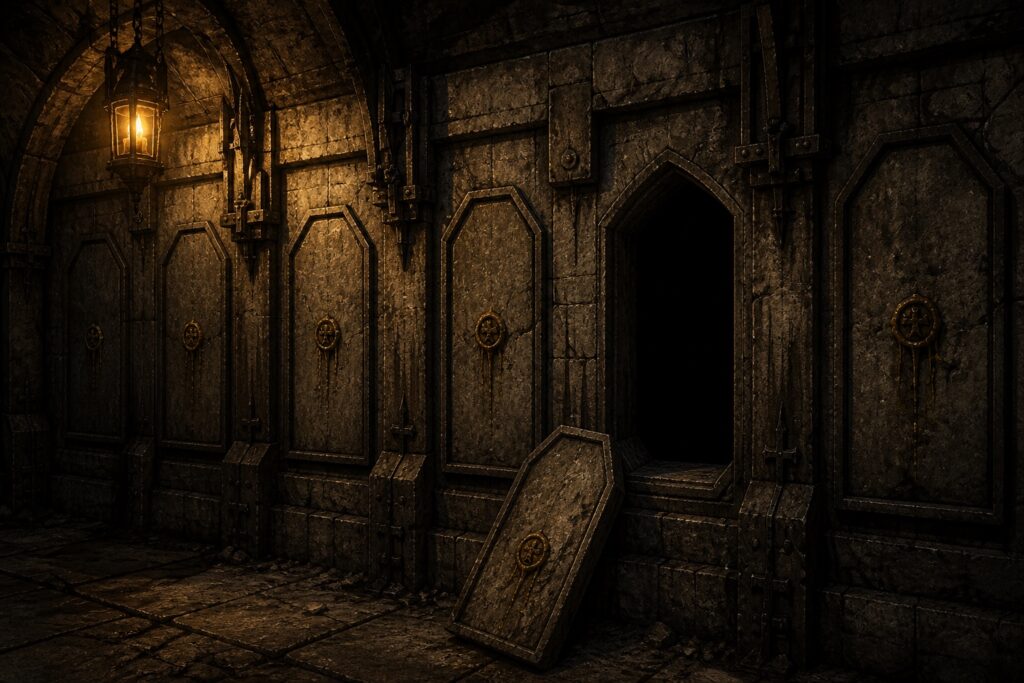
THE CHAMBER OF SHAME
A novella from the Anvil of War universe
Salamanders · The Fire Wardens of Nocturne
„A wall is not its strongest stone. A wall is as strong as the mortar between its stones.“
Ordensmeister Rogalus Vel'Caar II
I. CHAINHOLD THIRTY-SEVEN
The alarm had no sound. That was the first thing Captain Threnn Vel'Kaddar learned that day, although he had really suspected it already: on Chainhold Thirty-Seven there were no sirens. There was only the light — a pulsing red that ran through every corridor of the fortress like blood through a vein, soundless, unstoppable, while two hundred metres beneath his boots the first void shield generators spun up and the fortress braced itself like a body before a blow.
He stood on the Upper Rampart Platform, there where ceramite met the bare rock of Ossilar, and watched the sky tear open.
No meteor shower. No storm. Something more deliberate.
The first contacts came out of the warp transit beyond the third moon — seven points, then eleven, then too many to count singly, each a point of light that became a shadow that became a ship. Their hulls were overgrown with spikes like scar tissue that had turned into weapons. Iron Warriors silhouettes, unmistakable in their brutal geometry. And among them, smaller but more numerous: Word Bearers transports, their shells covered with symbols the eye did not want to look at for long.
"Brother-Sergeant Kell." Vel'Kaddar's voice was calm. On the rampart platform calm was a weapon one wielded before one's own men before one wielded it against the enemy. "Status of the void shields."
"Eighty-four per cent, Captain. Rising." Kell stood two paces behind him, the build of a man who had spent half his life in that armour, which with an Astartes was to be taken literally. "Techmarine Vorr reports full capacity in six minutes."
Six minutes. Vel'Kaddar watched the fleet grow and knew that six minutes was a figure that held just as good for the other side.
Chainhold Thirty-Seven was young. Two years old, counted from the day on which the last block of ceramite was set and the last oath sworn — young for a fortress of the Golden Wall, young enough that most of the brothers who served here still called it "the new one" when they were among themselves. One of thirty-seven installations the Chapter was raising along the Nihilus border worlds since the Great Rift had redrawn the charts of the Imperium. Neither the largest nor the most important among them, yet it was a fortress of the Golden Wall, and that meant that a law was walled into it, as firm as the rock on which it stood.
Not one centimetre back.
Vel'Kaddar had never questioned this law. It had never occurred to him to question it — as little as a man questions his own heartbeat. He had sworn it at the age of twenty, with his hands in raw stone, building a wall that he had then defended alone against a wave of scout attackers until his palms were torn open and his voice was hoarse. The wall had held. He had held. That was the only way he knew.
"How many ships, do you reckon?" asked Kell.
"Enough." Vel'Kaddar let his gaze travel over the formation, looking for the pattern that every Chaos fleet possessed despite the chaos in the name. "This is no raid. This is a siege."
Below them, beyond the rampart platform, beyond the three concentric rings of defence that Vel'Caar himself had drawn up as a blueprint two hundred standard years ago, the light fell on Ossilar. A border world, barren, covered in manufactorum smoke and mining dust, with a single city of consequence — Skara, a hive settlement that ate its way into the rock face of a dried-out sea basin, three hundred thousand souls who lived off what the fortress above them held out of orbit.
And between the fortress and the city, vertical as a needle drawn through both planes of the world: the shaft.
Orbital Shaft Ossilar-One. The Ladder, as the workers called it. Twelve kilometres of lift tube of reinforced steel mesh, anchored directly in the foundation of the Chainhold, at whose lower end Skara hung like a fruit on a branch. It had never been intended as a defensive structure. It was an artery of trade, built to bring ore up and supplies down, long before the Golden Wall had resolved to raise its fortress at exactly this strategic point — because the shaft itself, as every brother grasped who had served even a year in this company, was a weak point one had to control in order not to let it become a weapon against oneself.
Vel'Kaddar had heard this fact in a hundred tactical briefings. He had never connected it with a face.
"Civilian evacuation?" he asked.
"Under way. Skara Control reports that the first transports are already using the shaft." Kell hesitated a moment — barely perceptible, but Vel'Kaddar had known his sergeant for forty years, well enough to notice it. "There will be thousands, Captain. Perhaps more before it is over."
Vel'Kaddar said nothing. He looked at the advancing fleet, at the shaft, at the city beneath, and for the first time in his life as a warrior of the Golden Wall he felt something he could not immediately name, because he had never had to name it before.
It felt like the weight of a wall that had not yet been built.
II. THE CITY BENEATH THE LADDER
Captain Bre'kar knelt in the dust of Skara's third district and laid his hand on the shoulder of a man who was too old to run as fast as he had just been trying to.
"Breathe," said Bre'kar. His voice, amplified by the helm-vox, came out gentler than his armour suggested — green ceramite plates, weathered by a hundred campaigns, with the flame device of the Fire Wardens that looked almost alive in the light of the burning streaks of sky above the city. "Your family is already at the lock. I saw it. You have time."
The man, a foreman from the ore-sorting works to judge by his clothing, nodded without really understanding, and Bre'kar let him go, because one could not spare a man in panic another second of attention when a hundred more stood behind him who needed the same attention.
Protection of the civilian population over tactical advantage. That was no slogan for the Fire Wardens of Nocturne. It was the air they breathed, as was the green colour scheme they shared with their progenitor forebears — identical, deliberately identical, because the first Fire Wardens had sworn never to put one centimetre of distance between themselves and the inheritance they held in honour. Other Chapters wore symbols of distinction. The Fire Wardens wore the memory that they wanted to be nothing other than what they were: wardens.
He raised his eyes to the sky, where the rampart platform of the Chainhold showed as a tiny golden stroke against the tearing darkness, twelve kilometres above him, and thought, not for the first time in the two years since the Golden Wall had taken station here, that there was something uneasy about a Chapter that fixed its honour to a stone rather than to the people who lived beside that stone.
"Captain." Sergeant Ashek stepped beside him, a bolter over his shoulder, the features under his open helm drawn tight. "Evacuation lock three is full. We could open a fourth, but that would mean clearing the eastern corridor."
"The eastern corridor leads straight to the shaft."
"Yes."
Bre'kar looked at the crowd of people packed before the lock — men, women, children with bundles too heavy for them, old people half carried by younger relatives, the whole cruel panorama of an evacuation in which nobody had time enough to decide what mattered and what stayed behind. He had seen such scenes on a dozen worlds. He had learned that in them one did not hesitate.
"Open the eastern corridor," he said. "Put two squads at the junction. Nobody is pushed, nobody is left behind for being too slow."
"Understood." Ashek hesitated. "And the Chainhold? If the shaft is overloaded —"
"Then that is a problem for the Chainhold." Bre'kar heard the hardness in his own voice and moderated it deliberately before he went on. "Our task is below us, Sergeant. Not above us."
It was not an entirely honest answer, and both of them knew it. The shaft was both things at once — the artery through which the civilian population could flee, and the artery through which, if it were not controlled, the enemy would flow into the fortress that was the only real defence of this world against a Chaos invasion fleet. Bre'kar knew that. He had read it in the reports the Techmarines of the Golden Wall had shared on the arrival of the Fire Wardens, politely but without the least readiness to discuss them. The shaft was a structural weakness. It would, if matters came to the worst, have to be secured.
He had wondered at the time what "secured" meant in the language of the Golden Wall. He had not asked. It had sounded then like a question for another day.
A child, perhaps eight years old, with the dirt-crusted face of an ore-worker's child, detached herself from the crowd and stopped in front of him, her head laid back to look up at him. She said nothing. She only looked.
Bre'kar knelt down once more, more slowly this time, so that his armour should not seem like a falling rock.
"What is your name?"
"Mira." The voice was small, but not trembling. "Are you one of the fire men?"
"I am."
"Papa says you don't leave anybody behind."
Bre'kar looked into her eyes and thought of the shaft, of the golden stroke in the sky, of the calculation he suspected was already beginning somewhere above him.
"That is right," he said. "We do not leave anybody behind."
He hoped, as he said it, that it was a truth he would be able to keep.
III. THE OATHKEEPER
Chaplain Vel'Schwur had taken the oath of this fortress himself.
He remembered every moment of it — not because his memory was extraordinary, but because a Chaplain of the Golden Wall forgot nothing that had to do with an oath. Two years ago it had been. He had stood in the still freshly cast seal chamber of the Chainhold, the stone death's-head helm lowered over his face, and listened to the forty brothers who one after another spoke the words that bound every fortress of the Golden Wall: This position will not be given up. Not through exhaustion. Not through loss. Not through doubt.
He had kept the book. He kept it still, in an inner pocket of his robe, its pages grown heavy with two hundred years of service, with names and oaths of which most would never be mentioned again, because they were simply kept, day after day, without anybody outside the company ever noticing. That was the quiet truth about oaths that Vel'Schwur had learned in two centuries: most were not broken, because they were never really put to the test. One swore, one served, one died or one served on. The oath itself remained abstract, a foundation one did not have to look at so long as the house stood.
He stood now in the armoury, below the rampart platform, and watched brother after brother arming himself for what was to come, and thought of the Chamber of Shame.
He had visited it often, on Castellum Primum, in the rare years in which he returned to the home world between deployments. An empty room. No altar, no symbol, only smooth, unadorned stone, built by Vel'Caar himself as part of the original monastery, for the day on which a fortress of the Golden Wall would fall. He had always understood that room as a kind of insurance — not as expectation, but as humility. We build as though we should never fall. But we prepare the room, in case we do after all.
In two hundred years the room had remained empty. Vel'Schwur had begun to believe in secret that it would remain empty as long as the Chapter existed — not out of arrogance, but because he knew the statistics. No held position had ever fallen. Not one.
But he had also never before seen a fortress that stood above a shaft through which three hundred thousand civilians were fleeing.
"Chaplain."
Vel'Schwur turned round. Techmarine Vorr stood in the doorway, his right eye replaced by the reddish lens of a servo-ocular, in his hand a data-slate whose surface was covered with schematics.
"Speak, brother."
"I have completed the structural analysis of the orbital shaft." Vorr held the slate up, although he knew that Vel'Schwur did not need the details to understand the significance — only the conclusion. "If the Iron Warriors employ their siege patterns as expected, the shaft becomes a breach point into the third plane of defence. Not a possible breach point, Chaplain. The one that would justify their position."
"How long until it must be sealed?"
"That depends on the civilian clearance. If it runs on at full capacity — six, perhaps eight hours before the structural anchor points become critical. After that —" Vorr hesitated, which for a Techmarine was unusual. "After that the question is no longer whether we seal. Only how many are still in the shaft when we do."
Vel'Schwur looked through the narrow view-port of the armoury, downward, to where the shaft disappeared as a slender silver thread into the darkness, down to a city he had never entered, because that was not the task of a Chaplain of the Golden Wall. His task was to guard the oaths. Not the people below.
But he had learned in two hundred years that an oath that no longer had in view the people for whom it had once been spoken had ceased to be an oath and had begun to become something else.
"Bring me Captain Vel'Kaddar," he said. "And call the Fire Warden liaison officers together. If this is the night on which we must make a decision, then we do not make it in secret."
Vorr nodded and went. Vel'Schwur remained behind alone, his hand on the inner pocket of his robe, on the Book of Oaths, and for the first time in his service as Oathkeeper he wondered whether tonight he would write something in that book that he would rather never have had to write.
IV. FIRST CONTACT
The Iron Warriors batteries opened fire ninety minutes after first contact, and they did it with the methodical patience of a people who had raised siege warfare to a religion.
Vel'Kaddar felt the first impact through the soles of his boots before he heard it — a tremor that ran through two hundred metres of rock and ceramite like a heartbeat, followed by a dull thunder that set the rampart platform itself vibrating. The void shields held. But they held with a flicker that every brother on the platform noticed and none remarked upon.
"First salvo absorbed," reported Kell. "Shield capacity at ninety-one per cent."
"They are testing us."
"They are testing us," Kell agreed, and in his voice lay something that sounded almost like respect — the professional respect of one siege specialist for another. "A single attack vector, precisely concentrated on the north-west quadrant. They are mapping our shield response."
Vel'Kaddar had heard the tales, as every brother of the Golden Wall knew them, long before he wore ceramite himself: the story of the siege of Castellum Primum, in which the Iron Warriors, the masters who had broken Rogal Dorn's own fortresses, had failed at Vel'Caar's walls. It was the most important line in the Chapter chronicle. He had heard it repeated a hundred times, in training, in sermons, in the quiet moments before a battle when an older brother wanted to give a younger one heart.
He had never expected to live it himself.
"Captain." Vorr's voice came over the vox, more urgent than before. "Second contact wave. Word Bearers landing ships, course for the southern ring of defence. And —" A pause that with a Techmarine was heavy with meaning. "Warp signature anomalies. They are rising."
"Describe."
"A ritual, Captain. On a large scale. I cannot determine the exact intent, but the energy signature corresponds to no known pattern of a simple invasion. They want more than this fortress."
Vel'Kaddar looked at the sky, where the silhouettes of the landing ships stood out like black insects against the burning background, and felt for the first time in this engagement something that went beyond tactical concern. A ritual meant time. Time meant that this siege would not be measured in hours.
And time was the one resource the shaft did not have.
"Connect me with Skara Control," he ordered.
It took a moment for the connection to hold, a civilian channel protocol, unfamiliar in its clumsiness compared with the precise military frequencies he was used to.
"Chainhold, this is Skara Evacuation Control, we receive." A human voice, tense but composed — a voice that had learned to function under pressure, because the alternative was no option.
"This is Captain Vel'Kaddar. Status of the civilian evacuation through the orbital shaft."
"We have put eighteen thousand through since the alarm. Estimated remainder in the whole city area: two hundred and seventy to three hundred thousand, Captain, depending on how many in the outer districts are still fighting their way to the lock. At current capacity —" A short, uncomfortable pause, while somebody at the other end evidently performed a calculation he would rather not have had to perform. "At current capacity we are speaking of fourteen, perhaps sixteen hours to clear the city completely."
Sixteen hours. Vel'Kaddar thought of Vorr's report. Six to eight hours before the shaft became critical.
"Understood, Control. Keep me informed of your progress."
He ended the connection and stood a moment still, while below him the void shields flared up once more and somewhere deep in the mountain the building company — the wall-builders who had raised this fortress with their own hands — had already begun to prepare the structural reinforcements that in an emergency would seal the shaft on command.
He knew, without seeing the figures, that they did not fit together.
"Kell." His voice was still calm, but the calm now cost something it had not cost before. "Bring me Chaplain Vel'Schwur. And send runners to the Fire Wardens. If we find a solution, then not separately from one another."
V. IN THE SHAFT
The eastern corridor was a narrow channel of blackened stone, lined with the remains of two centuries of mining history, and about the noon hour — although nobody was any longer sure whether that word still meant anything on Ossilar, now that the sky was darkened by burning ships — there flowed through it a stream of people so dense that Sergeant Ashek stood at the junction like a rock in a river mouth.
Bre'kar moved through the crowd with the care of a man who knew that his armour alone was enough to set off a panic if he did not deliberately work against that effect. He walked slowly. He kept his flamer lowered, not ready. He spoke to everyone who looked at him, a word, a glance, a confirming gesture — small acts that in sum made the difference between an evacuation and a stampede.
"Captain, the Ladder reports overload at the lower lock." Ashek came towards him, his face wet with sweat under the open helm visor. "The Chainhold Techmarines have limited the through-flow rate to preserve structural integrity. It is backing up."
"How far back?"
"To the third district. Perhaps further."
Bre'kar swore quietly, a Nocturnean word that had no direct translation but that every brother of his company knew. He had hoped to have more time. He had hoped that the Chainhold would keep the shaft open as long as at all possible, and he had — he admitted it to himself now — assumed that "as long as at all possible" meant the same thing to the Golden Wall as it did to him.
He was no longer sure.
A cry, further ahead in the crowd — not panic, but real pain. Bre'kar moved before he thought, his bulk parting the stream of the fleeing like a rock a river, and he found the source: a woman, heavily pregnant, who had collapsed, ringed by people too exhausted and too frightened to do more than fall back.
"Room." His voice over the helm-vox was an order that brooked no contradiction, but carried no cruelty either. The crowd fell back.
He knelt down. Even kneeling he stood more than half a metre above the woman lying there.
"How far along is it?" he asked, and his voice was now as gentle as his armour permitted.
"I — I don't know," she gasped. "It is too early, it shouldn't yet —"
"Apothecary," Bre'kar ordered over the company channel. "To the eastern corridor at once, third district."
He stayed with her, his armoured hand on her shoulder, not because he knew what was to be done, but because it was clear to him that presence was sometimes the only medicine one could give immediately. Around them the stream of the fleeing went on backing up, second by second, while twelve kilometres above them Techmarines of the Golden Wall carried out a calculation whose variables he did not know, but whose result, he felt with the certainty of a man who had survived too many sieges, would run directly towards this corridor, towards this woman, towards every human being around him.
"How long can we keep the corridor open?" he asked Ashek, without looking up.
"As long as you order it, Captain."
It was the right answer, the answer a Fire Warden sergeant had to give his captain. But Bre'kar heard in it also the question that neither of them spoke aloud: And if the order comes from somewhere else?
The Apothecary arrived, knelt beside the woman, began to work with practised, efficient movements. Bre'kar rose slowly, his gaze travelling along the corridor, back to the shaft, up to the golden stroke in the sky that could no longer be seen from down here, because the smoke of burning buildings had swallowed it.
"Get me a link to the Chainhold," he said. "In person. Not by runner."
VI. THE COUNCIL OF WAR
They met in the armoury, because it was the only room in the Chainhold large enough for a hololithic display of the situation and at the same time close enough to the rampart platform that nobody had the feeling of moving away from the front. Vel'Kaddar stood on one side of the flickering map table, Vel'Schwur at his right hand, the stone helm taken off and carried under his arm — a sign every brother of the Golden Wall understood: the Oathkeeper was speaking now as witness, not as judge.
Bre'kar appeared as a hololithic transmission, larger than life, his green armour almost black in the blue light of the projector. Beside him, smaller in the projection, stood Colonel Dessa Vann of the planetary defence militia, her uniform creased and soot-blackened from the work of the last hours.
"Techmarine Vorr," said Vel'Kaddar. "The figures."
Vorr stepped forward and let the projection of the shaft appear above the map table — a slender, vertical structure, marked at three points with red markers that blinked in pulses.
"The orbital shaft runs directly through the third plane of defence of the Chainhold, anchored here, here and here." He pointed at the markers. "These anchor points are at the same time the only structural elements preventing the shaft itself from becoming an approach for enemy boarding teams — particularly if the Iron Warriors, as is to be expected, employ breaching charges to open the outer shaft wall and use it as a vertical assault corridor. As soon as the progress of the Word Bearers' warp ritual reaches a critical threshold — estimated in nine to eleven hours — the void shield capacity will no longer suffice to neutralise both threats at once."
"Which means, in plain terms?" asked Colonel Vann, her voice tense but direct.
"It means, Colonel, that this fortress either seals the shaft at those three points — which makes it unusable for any further civilian passage — or takes the risk that the enemy uses it as a breach point and the entire third plane of defence is compromised. Should that happen, not only does this fortress fall. Every defence that stands between the Chaos invasion fleet and the rest of the sector falls."
Silence settled over the room — the kind of silence that arises when everyone present already knows the figure that will be spoken next and nobody wants to say it first.
"How many civilians are currently in the shaft or immediately waiting for it?" asked Vel'Kaddar at last.
"At current throughput, at the moment of the critical threshold: an estimated forty to sixty thousand," answered Colonel Vann. Her voice did not break, but she chose the words with the care of somebody who knew that every figure she spoke had a face she did not see. "Out of three hundred thousand."
"And if we keep the shaft open until all are through?" asked Bre'kar. His hololithic figure did not move, but his voice carried a weight the distance of the transmission could not damp.
"Then we risk the enemy gaining access to the third plane before the evacuation is complete," said Vorr. "And in that case, Captain Bre'kar, we are no longer speaking of forty to sixty thousand losses. We are possibly speaking of the loss of the whole city, of the fortress, and of every civilian still on this world."
Vel'Schwur, who had been silent until now, stepped a pace closer to the map table.
"There is a law," he said, and his voice carried the calm authority of two hundred years of service as Oathkeeper. "Not one centimetre back. That law is not negotiable for the Golden Wall, Captain Bre'kar, just as your protection of the civilian population is not negotiable for the Fire Wardens. I do not say this to end the discussion. I say it so that we all know what we are actually speaking about. Not about which position is tactically the wiser. But about which law must be broken if both cannot be kept at once."
Bre'kar's hololithic figure turned towards him, and even through the blue distortion of the projection the intensity of his gaze was palpable.
"Then let me say it plainly, Chaplain, so that nobody in this room can hide behind abstraction: if you seal this shaft at the time laid down, tens of thousands of people will die who could still be alive at that moment if you wait. That is not a question of tactics. That is a question of whose lives you are prepared to sacrifice for a stone."
"And if we do not seal," replied Vel'Kaddar, his voice hard now, although he was trying not to let it be, "then perhaps we sacrifice not tens of thousands but every human being, every fortress, every life between this world and the next fortified system — for the hope that we have more time than the calculation grants us. That is not a question of honour, Captain Bre'kar. That is a question of arithmetic."
"There is always an arithmetic that justifies inaction."
"There is always a feeling that takes calculation for heartlessness."
The words hung in the room, sharper than either had intended, and for a moment nobody said anything.
Colonel Vann broke the silence, her voice quieter than before but no less firm. "With respect, gentlemen — while you argue, the hours run on. Is there a third option? Anything that neither of you has already named?"
Vel'Kaddar looked at Vorr, who seemed already to have worked the figures through a second time, without anybody having ordered him to.
"There is a possibility," said Vorr slowly, "of delaying the sealing without postponing it indefinitely — by partially clearing the third plane of defence and concentrating the defence on the second plane, by which we gain a safety buffer. It would mean giving up a position we currently hold."
The sentence fell into absolute silence.
Vel'Kaddar grasped, without looking at Vel'Schwur, what those words meant. Give up a position. Not the whole fortress. Not final capitulation. But a position that was already being held — and the law in its pure form knew no difference between a centimetre and a plane.
"How much time would that gain?" he asked, his voice barely more than a whisper.
"Three to four hours," said Vorr. "Perhaps five, if the Fire Wardens are willing to support the released plane with ground troops to cover the withdrawal of the defensive line."
Every eye in the room turned to Vel'Kaddar.
He looked at the projection of the shaft, at the three red markers pulsing like wounds over an artery, and thought of the Chamber of Shame on Castellum Primum, of the empty stone that had waited two hundred years for this day without anybody having believed it would ever come.
"I need a moment," he said.
It was the hardest request he had ever spoken.
VII. WHAT THE STONE CARRIES
Vel'Kaddar found Vel'Schwur alone in the seal chamber, there where the walls were densely covered with names — not enemy names, as in the home fortress, but the forty names of the brothers who had sworn the oath of this Chainhold two years ago. His own name was among them, in small, precise script, the thirty-fourth line from the top.
"Chaplain."
Vel'Schwur turned round. He still had the helm under his arm, and in the weak light of the chamber his face looked older than Vel'Kaddar had ever seen it — not through lines, for Astartes age otherwise, but through something in the eyes that looked like the weight of a book that had stayed closed too long.
"You have come to ask whether you may break the law."
"I have come to ask what the law means at all if it betrays its own purpose." Vel'Kaddar stepped closer, his voice quieter than it had ever been on the rampart platform. "Vel'Caar built the first wall to protect people. Not to honour a stone. If I give up this plane to save forty thousand lives — do I then betray the law, or do I fulfil it for the first time in earnest?"
Vel'Schwur was silent a long time. When he spoke, his voice was not that of a judge, but of a man who was himself looking for an answer.
"I have kept the Book of Oaths for two hundred years," he said. "I have seen brothers die to hold a position that had no strategic meaning any more, because the law demanded it. I have never questioned whether that was right. I have believed, and I believe still, that a Chapter that breaks its oaths when they become inconvenient ceases to be a Chapter with oaths. It becomes a Chapter with suggestions."
"But?"
Vel'Schwur looked at the wall, at the forty names, at his own blessing carved in stone above them.
"But I have also never before spoken an oath that would sacrifice people below us who have sworn no oath, chosen no law, and whose only crime is to have been born on the wrong day in the wrong place." He looked Vel'Kaddar directly in the eye. "I guard oaths, Captain. I have never claimed that every oath I guard is infallible. That is the burden of the office that nobody explained to me when I took it up, and that in two hundred years I understand fully only tonight."
"What are you telling me, then?"
"I am telling you that I cannot free you from the decision by making it for you." Vel'Schwur put the helm on, the stone death's-head lowering over his face like a judgement not yet spoken. "I am telling you that whatever you decide, I will write it in the book, truthfully, without palliation. And I am telling you that the Chamber of Shame has stood empty for two hundred years not because no captain ever stood before an impossible choice, but because until now none stood before this one."
"That does not help me."
"No," said Vel'Schwur, and for the first time in the whole exchange there was something in his voice that sounded like compassion. "Nor is it meant to. Some decisions are not there to be made easier, Threnn. They are there to be carried."
Vel'Kaddar stood a long time in silence in the seal chamber, his gaze on the forty names, while somewhere above them the sky went on burning and somewhere below them a child named Mira pressed through a crowded corridor with her father, not knowing that her life at that moment hung on a decision made by a man she would never meet.
"Call Captain Bre'kar back," he said at last. "I will tell him my decision in person. Not as a hologram. He shall look me in the face when I speak it."
VIII. TWO HONOURS
Bre'kar arrived at the Chainhold an hour later, escorted by a transport shuttle of the Golden Wall that had brought him up out of the burning sky above Skara. He stood now facing Vel'Kaddar on the rampart platform, two captains in differing green and gold, while below them the third plane of defence already showed the first signs of an orderly but irreversible withdrawal.
"You have decided," said Bre'kar. It was not a question.
"I have ordered the third plane to be given up and the defence concentrated on the second." Vel'Kaddar's voice carried the tension of a man holding a wound open because he was aware that it had not finished being cut. "That gives us three to five hours more for the evacuation. It is not enough to save everyone. But it is more than we had."
"And the law?"
"The law is broken." Vel'Kaddar said it without evasion, without justification in his voice. "For the first time in two hundred years a brother of the Golden Wall has given up a held position, not because he was forced to, but because he ordered it. If you have come to hear that I took it lightly, you will be disappointed."
Bre'kar was silent a moment, his gaze travelling over the rampart platform, over the brothers working in the red alarm light to fortify the new line of defence.
"I did not come to hear that," he said at last. "I came because I wanted to say something to you that I could not have said an hour ago."
"Speak."
"I took your law for pride." Bre'kar's voice was calm, but every word carried weight. "For the kind of honour that takes itself more seriously than what it is actually supposed to protect. I served beside this fortress for two years and believed that your loyalty belonged to a stone while mine belonged to a human being. I held myself the better man, without ever saying it aloud."
"And now?"
"Now I have seen what it cost you to break the law." Bre'kar looked at him directly, the green eyes under the open helm visor grave. "It would have been easier for you to keep the law and lay the responsibility on the enemy, on time, on arithmetic. Instead you chose to carry the burden yourself. That is no weakness, Threnn Vel'Kaddar. I was wrong when I believed it was one."
Vel'Kaddar looked down at the city, at the shaft, at the tiny points of light of the evacuation transports rising now at closer intervals, thanks to the additional hours he had bought — with a coin whose true price he did not yet know.
"And I believed that your way was weakness," he said quietly. "That a Chapter which measures every decision by the question how many people it saves eventually finds no boundary at which it says: here, no further, whatever it costs. I was wrong in how I described it. But perhaps not entirely in the concern itself."
Bre'kar nodded slowly. "Perhaps we are both right. And perhaps that is the only honest place at which two Chapters like ours can ever stand — not agreement, but the knowledge that the other acts out of real conviction, even when that conviction contradicts one's own."
They stood side by side in silence for a while, while below them the fortress re-formed and above them the sky went on burning, and neither of them felt the need to fill the silence.
Then a new alarm broke the stillness — not the red pulsing of the first warning, but a sharper, more urgent light that ran through every corridor of the Chainhold.
"Captain." Kell's voice over the vox was tense in a way Vel'Kaddar had seldom heard in forty years. "The Word Bearers signature has reached the critical threshold earlier than calculated. Vorr says — Captain, they have accelerated something. We no longer have the hours we thought. We have minutes."
IX. THE HOUR WITHOUT TIME
What happened after that would never be fully rendered in any report, because no report could capture the speed with which a siege turned from a calculation into a chaos.
The Word Bearers ritualists on the southern ring of defence had, as Vorr would later reconstruct it, never intended to exhaust the full time frame of their ritual — they had read Vel'Kaddar's withdrawal from the third plane as weakness, as a sign that the fortress was already beginning to crumble, and in that misjudgement had sacrificed their own caution. A Dark Apostle named Nehmoth, whose voice over an intercepted vox transmission sounded like breaking glass, had spoken the last verse of his ritual hours before its planned completion.
The consequence was a warp rift, small, unstable, but real — a sore point in reality itself that opened two kilometres south of the Chainhold and out of which crawled things for which no Imperial field manual had adequate words.
"All companies, full mobilisation," Vel'Kaddar ordered over the open channel, his calm now a weapon he literally wielded against the panic he heard in the voices around him. "The Slingstones take the front line at the rift. The Bastionaries secure the second plane of defence. Techmarine Vorr — the shaft, now."
"Captain, we have —" Vorr's voice broke off briefly, overlaid by a dull crash in the background. "By the latest count we have twenty-seven thousand civilians in the shaft or immediately waiting for it."
Twenty-seven thousand. Not sixty thousand, as it would have been without the bought buffer of time. But twenty-seven thousand people who were, precisely now, at this moment, caught between a city that would burn and a fortress that might fall.
Vel'Kaddar looked through the view-port of the rampart platform down at the rift, where the first creatures were already eating their way into the second plane of defence, where brother after brother of the Slingstone company was taking up position to lead a counter-attack whose timing was exactly what their doctrine required — not to wait until the enemy had established himself, but to strike at the moment of his greatest vulnerability.
And he saw the shaft, and he knew that the calculation he had made an hour ago had just been overtaken by reality.
"Captain Bre'kar." He turned to the Fire Warden standing beside him, his flamer already off safety, his bearing that of a man aware that the next order he heard would steer his life and the life of his company in a direction from which there was no way back. "I can keep the shaft open another twenty minutes, perhaps thirty, before the structural integrity of the second plane itself is endangered. After that I must seal, whether civilians are still inside it or not — not out of law, but because a collapsed second plane will save nobody any more, neither civilians nor Astartes."
"Twenty minutes," repeated Bre'kar. He was already reckoning; that was to be seen in his eyes, in the way his jaw tightened. "At the current through-flow rate we manage perhaps half."
"Then you need a higher through-flow rate."
"That means sending every available brother into the shaft itself. Not as guards. As —" Bre'kar searched for the word and found none that did justice to the truth. "As carriers. As Astartes carrying people, who can run faster than any civilian ever could."
"Then do it."
Bre'kar looked at him, a long moment in which both knew what had to be said next and neither wanted to say it.
"And when the twenty minutes are up, and there are still people in the shaft?"
Vel'Kaddar looked at the rift, at the advancing creatures, at the fortress trembling around them both like a living organism under fire.
"Then I carry that decision too," he said. "But I will not make it earlier than it has to be made. Go, Bre'kar. Save whom you can save. I give you every minute I have."
Bre'kar nodded once, briefly, and turned to the shuttle, followed by a dozen of his brothers who were already securing their weapons and preparing for another kind of battle — not against the enemy, but against time itself.
Vel'Kaddar stayed behind, turned to the rift, and drew his chainsword.
"Slingstones," he said over the company channel, his voice now with the full force of a captain leading his company into the counter-attack their whole doctrine demanded. "We hold this line, not because a law requires it. We hold it because every minute we gain is a life saved below. For Vel'Caar. For the Wall. For Ossilar."
He leapt from the rampart platform into the fighting, and behind him his brothers followed like a golden flood.
X. THE LADDER
Bre'kar reached the shaft with eleven brothers behind him, and what he found there was a scene he would never forget in any of his hundred years of service.
The lift tube was no longer a lift tube. It was a vertical river of people, stacked in transport capsules that raced upward at close intervals and back down again empty, while beneath them the floor of Skara's third district already felt the first tremor coming from a distant warp rift whose extent nobody down here really grasped.
"Increase capacity," Bre'kar ordered, as he stepped into the control chamber himself and moved the technicians aside, not by force but by the sheer physical presence of an Astartes who knew that time now mattered more than courtesy. "Every capsule, every available centimetre. If people have to stand, they stand."
"Captain, the safety tolerances —"
"Are not the limit that stops us tonight." He looked at the technician, an old man with trembling hands who had stayed at his post despite everything, where a hundred others would have fled. "What is your name?"
"Harn, Captain. Pit Master Harn."
"Pit Master Harn, you have understood this shaft better than any Techmarine who ever surveyed it. Show me how we get the last twenty minutes out of it."
Harn looked at him for a moment, and something in his face changed — not hope, it was too late in the night for that, but something close to it.
"We could bypass the safety locks on every third level," he said slowly, while his hands were already running over the controls. "It would increase capacity by forty per cent. It would also mean that if a capsule fails —"
"Do it."
Outside in the corridor Sergeant Ashek was coordinating the last streams of the fleeing, while Astartes brothers, Fire Wardens whose green armour acted like fixed points in the chaos, began literally to carry people, two, three at a time, their armoured arms full of civilians, running to the lock at a pace no unarmoured human could ever have reached.
Bre'kar found the pregnant woman from before again, now on an improvised stretcher, ringed by her family, with the Apothecary running beside her.
"How is she?"
"Stable, Captain. But she must get through before —"
"I know." Bre'kar lifted the stretcher himself, with a gentleness that made his massive frame look almost absurd, and carried her personally to the next capsule, pressed through, secured a place that was really meant for three adults, now for five.
He found Mira, the girl from before, her hand tight in her father's, both marked by dust and fear, but alive, waiting in the queue.
"You are still here," he said, kneeling beside them.
"The queue is so long," said Mira, her voice small but not panicked. "Papa says we might not make it."
Bre'kar looked at the next capsule, calculated the time remaining that Vel'Kaddar had given him, the number of people still ahead of them in the queue, and made a decision that corresponded to no tactical manual and that he would never regret.
"Come with me," he said, and lifted Mira up with one arm while he held out a hand to her father with the other. "I will carry you myself."
Over his helm-vox he heard Ashek: "Captain, fifteen minutes."
"Understood." He ran, Mira pressed against his breastplate, her father beside him gasping but alive, while around them raged the chaos of an evacuation that had no more time for order, only for speed.
"Ten minutes," reported Ashek.
Bre'kar reached the capsule, pressed Mira and her father inside, saw the door close, saw the capsule race upward, towards a fortress that for a moment had stopped being a symbol of a law and had begun simply to be a rescue.
"Five minutes," said Ashek, his voice now barely more than a tense whisper. "Captain, how many are still —"
Bre'kar looked at the queue that still ran the length of the corridor, far more people than would fit through the shaft in five minutes, and felt for the first time in his long service a despair he could not push aside.
"Chainhold, this is Bre'kar," he said over the open channel, his voice now no longer that of a commander but that of a man asking for something he knew might not be given him. "I need more time. Not much. Five minutes. Perhaps seven."
On the rampart platform, in the middle of the mêlée of the counter-attack, his chainsword deep in a Chaos cultist whose distortion was barely human any more, Vel'Kaddar heard the request over the vox, while at the same time Vorr's voice reported over a second channel: "Captain, the second plane of defence is approaching critical structural load. If we do not seal now, we risk a collapse that endangers the whole fortress."
Two voices. Two truths. And a decision that was his, and his alone.
XI. WHAT A CAPTAIN CARRIES
Vel'Kaddar drew his chainsword out of the last cultist and stood still for a heartbeat in the middle of the battle, while around him his brothers held the line, while beneath him the fortress trembled, while in his ear two irreconcilable truths wrestled over the same answer.
He thought of the Chamber of Shame. Of the empty stone that had waited two hundred years. Of Vel'Caar, who had built a wall to protect people, not to furnish a proof of his own infallibility.
He thought of Mira, a girl he had never met and never would meet, who was perhaps at this moment arriving safely in the fortress, while others whose names he would never learn still stood in the queue.
And he made a decision that neither wholly honoured the law nor wholly betrayed it — a third possibility that he found only in that moment, because only in that moment did he need it.
"Vorr," he said. "Seal the shaft at the outer anchor points, but not at the central one. Concentrate every available structural reserve on the second plane to stabilise it while the central anchor point stays open."
"Captain, that would mean that the second plane is protected at a single point only — if that point is breached —"
"Then concentrate every brother we can spare on precisely that point. I will move the Slingstones there as soon as the rift is contained. We do not hold the whole plane, Vorr. We hold a single centimetre, with everything we have, for as long as possible."
It was not the law. Neither was it a complete capitulation before the law. It was something new — an interpretation that Vel'Kaddar invented in that moment because none of the existing answers sufficed, and which he knew would cost him dearly, in blood, in brothers, perhaps in his own standing within the Chapter.
"Bre'kar," he said over the open channel. "You have your seven minutes. Perhaps ten. But I cannot give them to you without its costing. Every brother who holds the second plane at that one point holds it with his life, not with a calculation."
"Understood," came Bre'kar's answer, and in his voice lay something that went beyond gratitude — something that sounded like the first foundation of a new understanding between two Chapters that had served side by side for two years without really seeing each other.
Vel'Kaddar turned to his company, to the Slingstones standing around him, bloody, exhausted, but unbroken.
"We go to the central anchor point," he ordered. "We hold it until the last civilian is through, or until we can no longer. This is no order of the Golden Wall tonight, brothers. This is my order. If it was wrong, I carry it alone."
Not one brother hesitated. They moved as a single body, golden in the red alarm light, while behind them the rift was slowly contained under the control of the defenders left there, and before them a single point in an enormous fortress became the place where it was decided whether a city lived or died.
The battle at the central anchor point would later be described as one of the most intense in the short history of Chainhold Thirty-Seven — not for its size, for it was small, confined to a single structural core, but for its purity. No tactical manoeuvre. No withdrawal. Only a line of brothers who held, while second by second another capsule full of civilians raced through the shaft, while Bre'kar down in Skara moved every remaining human being with the desperation of a man who knew that every second counted.
Seven minutes became nine. Nine became twelve.
At the end of the twelfth minute, when the last civilian — an old man who could barely keep his feet, carried literally into the last capsule by a Fire Warden brother — left the shaft, the Slingstones had lost seven brothers to hold that one point.
"Seal now," said Vel'Kaddar, his voice hoarse with exhaustion. "All points. At once."
The shaft closed with a thundering echo that ran through the whole fortress, and for a moment, amid blood and smoke and the reverberation of a decision that was neither wholly law nor wholly its breaking, there reigned something that sounded almost like silence.
XII. THE EMPTY CHAMBER
The siege of Chainhold Thirty-Seven lasted another fourteen days before an Imperial fleet formation arrived to throw back the Chaos invasion for good — fourteen days in which the fortress held, in which the warp rift was closed by the combined effort of Astartes forces and a desperate but successful ritual counter-attack by the few Librarians on the ground, in which Skara, destroyed, bled out, but not extinguished, lived on.
The figures that were finally gathered would never be quite satisfactory, as figures in such reports never were. Two hundred and sixty thousand civilians evacuated. About forty thousand who had not made it — dead in the city itself, in the outer districts, in the moments before the shaft closed, or after it, in the chaos that followed. A figure that neither of the two captains would ever call a victory, and neither a complete defeat.
Chaplain Vel'Schwur sat alone in the seal chamber, the Book of Oaths open before him, the pen in his hand, writing down the events of the last fourteen days in a language that was neither justification nor condemnation — only truth, as exactly as he could grasp it.
Captain Threnn Vel'Kaddar gave up, on the day of the siege, a held position of the third plane of defence, contrary to the law Not-One-Centimetre-Back. He did this not out of weakness, but out of a calculation for which he alone answered, in order to preserve a greater number of civilian lives. Later, at the central anchor point of the orbital shaft, the same captain held a position until the last possible moment, at the loss of seven brothers, in an interpretation of the law that was neither complete fulfilment nor complete breach, but something third, for which this Chapter has as yet had no name.
He paused, the pen over the paper, and thought of the empty chamber on Castellum Primum, which would remain empty after this day as well — for no position had fallen, not really, not in the last sense that counted. But something else had happened, something no word in the Book of Oaths had so far had to grasp.
I write this not as judgement, he added. I write it as testimony. What happened here was neither the pure fulfilment of our law nor its betrayal. It was a man who carried a burden that no law alone could carry, and who carried it all the same, to the end.
On the rampart platform, fourteen days after the first alarm, Vel'Kaddar and Bre'kar stood side by side one last time, before the Fire Warden company departed for its next deployment — a call from another border world, another battle that left no time for farewells.
"Will you be called to account for it?" asked Bre'kar, his gaze on the rebuilt third plane, whose ceramite still bore the scars of the battle.
"I do not know." Vel'Kaddar looked into the distance, to the city that was slowly being rebuilt, to the lights burning again in Skara, not as fire but as life. "Vel'Schwur has written everything in the book, without palliating anything. What the Chapter makes of it — that no longer rests with me."
"Would you do it again?"
Vel'Kaddar thought of Mira, whose name he had learned from Bre'kar, of a girl who now lived somewhere in Skara because a Fire Warden captain had carried her personally through a dying shaft, while a captain of the Golden Wall held a line that no law had ever provided for.
"I do not know," he said once more, more honestly this time. "I only know that I do not regret it, although I do not know whether I would do it again. Perhaps that is the only honest answer there is."
Bre'kar nodded, held out his hand — a gesture rare between two Astartes, but right in that moment. Vel'Kaddar took it.
"For Ossilar," said Bre'kar.
"For Ossilar," answered Vel'Kaddar.
They let go of each other, and the Fire Warden turned to the shuttle that would carry him to his next battle, while the captain of the Golden Wall remained behind on his rampart platform, where he belonged, at a fortress that had not fallen although it might have fallen, held by a law that on that day had been broken and fulfilled, in a way that nobody could fully explain, and that perhaps nobody had to explain.
Two hundred kilometres away, on Castellum Primum, the Chamber of Shame remained empty.
But for the first time in two hundred years, everyone who heard of that day knew that it no longer stood empty out of certainty.
It stood empty because a man had decided to leave it empty — and that decision, not the law itself, was what remained carved in stone from that day on.
THE END
Afterword: This novella deliberately leaves open whether Captain Vel'Kaddar's decision was approved, sanctioned, or left in a grey zone by the Chapter council of the Golden Wall. That is intentional. Some conflicts in Warhammer 40,000 — as in life — find no clean resolution. They leave only an echo that one carries with one.
Download story as PDF or EPUB
Enter your email address. After confirming your subscription you'll get the download links immediately and by email.