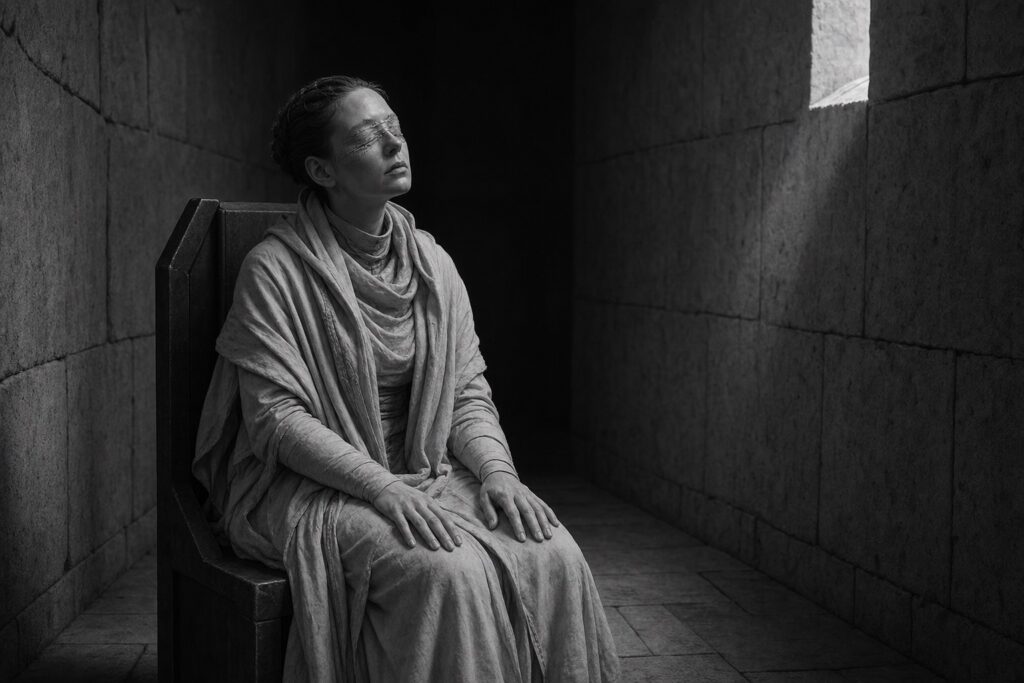
Knock Signals
"Reporting is not sending. Reporting is writing down."
— Astropathin Ruve Alant, Horchstation Terzin
I. Reception One Thousand One Hundred and Four
The reception came four minutes early, and that was the first thing about it that troubled Marlein Guss.
She was already seated. She was always already seated, a quarter of an hour before the hour, because the chair of the second chamber had a screw in the left rear strut that worked loose if one sat down too quickly, and because in eleven years she had never got round to reporting it. The floor beneath her soles was warm. The floor was always warm; it was heated from below, because an astropath who is cold shakes during reception, and a shake displaces the measure. So it stood in the code of procedure, section four, and it was one of the few regulations Marlein took for care, until somebody explained to her that it was about the measure and not about her.
It smelled of brass and of fish oil. The lamps in the choir hall burned with real flame, oil from the depths of Halvest, because promethium fumes cloud the reception and because an adept of the Astra Telepathica, the astropathic relay service, on Terra had written eight hundred years ago that the soul needs smoke in order to remember where down is. Marlein had never understood the sentence. She knew the smell better than her own.
Then it came, four minutes early, and pushed her teeth apart.
That was how she described it. There was no better word. The reception did not begin in the ear and not behind the forehead, where the examiners liked to have it, but in the jaw, a pressure from within against the molars, as though someone were pressing a hand against her face from the wrong side. After that came the message.
The message was routine. It was nearly always routine.
Kel-Vantor to Terzin Listening Station, confirmation Tithe forty-six-three, ore delivery accepted, shortfall twenty-two tonnes, shortfall demanded. No image with it, only the taste of cold oil and metal filings that the forge world gave every transmission like a seal of wax. Marlein had received Kel-Vantor's shortfalls sixty times. They tasted the same every time.
She raised her right hand, two fingers, the sign for intake running.
Beside her, half a step to the left and one back, she heard Jarek Bihn's pen set down. Jarek read aloud everything he wrote, half aloud, a murmur just below intelligibility — his own deletions too, the commas too. He was twenty-one and thought nobody heard it. In a hall where eight blind people sat waiting for pressure in their teeth, everybody heard it.
"Kel-Vantor," she said. "Tithe forty-six-three. Accepted. Shortfall twenty-two tonnes, demanded."
"…twenty-two tonnes, demanded," Jarek murmured back, and then the scratching.
And then, as in one thousand one hundred and three receptions before it, came the attachment.
It belonged to the craft that a message brought something with it that did not stand in it. The warp is not a pipe. What goes through it brushes what lies beside it and brings fibres along. An experienced receiver learns to recognise the fibres and leave them out: the hymn that clings to a message from the auxiliary system because vespers were being held there; the rust on a report from a shipyard; once, in her third year, the feeling of sun on the inside of a wrist, out of an order about grain quotas, and she had needed three nights to fall asleep again without that wrist.
Fibres one left out. So it stood in section nine.
This attachment was not a fibre. This attachment had been coming for eleven years.
First the air. Always first the air, and the air was wet, was wool, was the smell of people who had sat too long in the same clothes in the same cold, and beneath it, very faint, something sweetish that she had never been able to place and about which she had stopped thinking, because in this profession one learns to stop.
Then the iron. Cold, unpainted, damp.
Then the blows.
Eight.
Eight blows against something thick. Not knocking — knocking is a request. This was work: the full fist or a tool, with the whole body behind it, eight times, in a rhythm Marlein could have kept with if she had been permitted to. In eleven years she had never kept with it. She was not sure why not.
And then, half a heartbeat too late, always half a heartbeat too late, the ninth.
The ninth was different. It was quieter. It came from another direction — and she knew that "direction" was not an admissible category in a reception; she could not have said it to any examiner without his making notes. But it came from another direction. It was smaller. It was, and she had permitted herself that word in her sixth year and never struck it out afterwards, courteous.
Then it was over, and the pressure went out of her jaw, and she tasted fish oil again.
Marlein Guss sat still for a time. In the choir hall seven others breathed. Two chambers along, Choir Elder Sivert Kroos coughed, as he coughed after every reception, three short bursts, always three.
Then she said: "Addendum to the intake."
Jarek's pen stopped. She heard him raise his head; she heard it in the air.
"Addendum," she said again. "Unconfirmed single reception. Attachment, series continuing. Wet wool. Cold iron. Eight blows, even, heavy. A ninth, delayed, weaker, deviating origin." She considered. "Strike 'deviating origin'."
"…strike deviating origin," Jarek murmured. The pen scratched, paused, scratched back.
"And the number."
"One thousand one hundred and four," he said. He said it very quietly, and he said it without looking it up.
Marlein drew her daybook towards her, her own, the second one, the private one, which stood in no register. Then she laid the writing rule against it. It was a piece of brass, two fingers wide, with notches along the edge, one notch per line. One felt for the notch, set the pen in the groove and wrote straight ahead, and if one did it every day for eleven years, one had a furrow in the left middle finger, smooth as an old ring.
She counted down to the thirty-first notch and wrote, in her large, slow, even blind script of one who had once seen — she had learned to write before they took her eyes, and she had not unlearned it, because she had not wanted to unlearn it:
1104. Eight and one. Air: old, scarcely any sweetness. Cold.
Then she closed the daybook and pushed it into the compartment beneath the seat, where a screw in the left rear strut worked loose if one sat down too quickly.
II. The Listening Station Terzin
Terzin Listening Station was not a place but a procedure with a shell around it.
It hung in the shadow of a gas giant without a name — it had a number, and the number stood on no plate, because nobody on Terzin ever looked out. Fourteen people, two dozen servitors, eight chambers in the choir hall, a reactor, a kitchen, a chapel in which the floor was not heated. Its task consisted in accepting, ordering, passing on and forgetting the Imperial Tithe of the messages of Sector Mordacis. Terzin transmitted to four nodes and received from nine. In two hundred years Terzin had never produced a message that was not the passing on of another.
Muster was at the sixth hour.
Marlein found her place at the wall, as always, third position from the door, where the wall heating came through the uniform and one stayed awake. Beside her Ruve Alant, who hummed three notes before every sentence, always the same three, the first of the Twenty-Eighth Psalm, to find her pitch before she spoke. Ruve was twenty-seven, had been here four years, and in those four years had never rendered a report incorrectly.
"Mm-mm-mmh. Good morning, Guss."
"Alant."
"You smell of oil."
"You smell of soap. One of us has slept."
Curator Bendicta Nauheim entered the hall at the sixth hour and not one second later, and read the order of the day with her index finger on the line. Marlein knew that because one heard it: the dry stroke of the fingertip across the paper, line by line, a habit from thirty years of transcription service that she had kept although her eyes were flawless and although it made her look slower before the assembled choir every morning than she was.
"Forty-six-three is confirmed," said Nauheim. "Kel-Vantor demands twenty-two tonnes. That is not our problem, but it becomes our problem if we pass it on three times and the fourth time wrongly. Guss."
"Curator."
"Your intake is clean. Your addendum is the one hundred and forty-seventh this year."
The hall was very quiet. Eighteen ears, thought Marlein, and no eyes that could look away.
"Yes, Curator."
"I do not say it as a reproach." The finger stroked on. "I say it so that you have heard the number. It is my duty that you hear the number. Nothing else." A pause in which paper was turned. "Alant, you take the third chamber for the fourteen-hundred series, Kroos goes to rest. Kroos, that is not a request."
"Four," said Choir Elder Sivert Kroos from the other wall. His voice sounded like something being dragged across stone. "Four days until rest, it was said. It has become six."
"Six, yes. And now go."
Kroos never named a number without saying what it was a number of. In her second year Marlein had believed it was the obstinacy of age. She was by now of the opinion that it was a precaution, and she had stopped asking herself against what.
After muster Ruve took her by the elbow. On Terzin one did not do that unasked; Marlein flinched, and Ruve let go.
"Forgive me."
"What is it."
"Mm-mm-mmh." Ruve found her pitch. "One hundred and forty-seven," she said. "In one year."
"That is how it is counted."
"I have three," said Ruve. "In four years. Two of them were weather-light out of the nebula at Thorvar, that was a beginner's mistake, and one I withdrew." She left a gap into which something could have been put. Marlein put nothing into it. "I am not asking what you hear."
"Good."
"I am asking whether it is always the same."
At the other end of the corridor a servitor clattered with the lamp trolley, and somewhere below it, deep in the body of the ship, the reactor changed to the day rhythm, a sound like a very large animal turning over in its sleep. In her first month Marlein had taken that for menacing. Now she slept badly when it did not come.
"Alant," she said. "How many chambers does the choir hall have?"
"Eight."
"And how many of them are occupied?"
Ruve actually thought about it. That was the good thing about her. "Six."
"Six," said Marlein. "When I arrived here there were eight. Do not ask me that again."
She went. She needed no stick on Terzin; she knew the corridor by the way the warm air from the floor grilles struck her calves, a grille every eleven paces, and at the ninth grille a screw had fallen out, and there it sounded hollower. She counted the grilles, as she counted everything.
Behind her, much too quietly for a person with eyes and much too loudly for that corridor, Ruve Alant hummed three notes and said nothing about it.
III. Section Nine
From the code of procedure of the Adeptus Astra Telepathica for listening and relay stations, twenty-seventh edition, section 9: On the unconfirmed single reception.
9.1 — A reception counts as confirmed if it is rendered independently by at least two receivers of the same choir in the same series. Everything else is an unconfirmed single reception.
9.2 — The unconfirmed single reception is not an offence. It is to be reported. The report is not a confession and will not be treated as one.
9.3 — Unreported single receptions are an offence. The distinction is essential and is to be explained to the receiver on entering service in the presence of a witness.
9.4 — The Curator keeps a running count for every receiver. The count is communicated to the receiver on request and made known to him unprompted at least once a year.
9.5 — If a receiver's count exceeds three times the choir mean within twelve months, a purity examination is to be arranged. The examination is conducted by an examiner who does not belong to the choir.
9.6 — The purity examination takes place in the presence of the full choir. Absence is permissible only for reception duty. The attendance is not a spectacle but part of the examination: a choir that does not know what is being examined cannot know what it has to report itself.
9.7 — The result of the examination is one of three findings: unobjectionable; under observation; no longer in service.
9.8 — The third finding is not a punishment. It is a finding.
Editor's note to the twenty-seventh edition: the earlier wording of 9.8 read "The third finding is final." The alteration was made at the suggestion of forty-two Curators and changes nothing about the matter.
IV. The Order of the Air
It had begun in her fourth year that Marlein Guss wrote down the air.
Not the blows — the blows had stood in the daybook from the start, because one could count blows and Marlein liked counting. But the air she had at first taken for incidental, for what one leaves out. Then it had struck her that the air was not always the same.
There were receptions with incense in them. Cheap incense, the sort burned in pilgrim chapels, which smells of lemon and dust when it is fresh and only of dust when it is old. There were receptions with food: gruel, boiled root vegetables, once (she had checked it three times because she did not want to believe it) roasted meat. There were receptions in which the wool was wet and receptions in which it was only clammy. There were some in which it smelled of unwashed people, very many unwashed people, and there were some in which that smell was almost gone and instead something else lay beneath, the sweetish thing, and in her seventh year Marlein had stopped pretending to herself that she did not know what that was.
So she wrote down the air. Four characteristics, every time: incense yes or no. Food yes or no. Wool wet or clammy. Sweetness strong, weak, none.
Eleven years. One thousand one hundred and four lines.
On the nights when she did not sleep — and she did not sleep on about every third, which was below the choir mean and which she was proud of — she sat in the compartment beneath the desk of her chamber and ordered them.
It went like this: she had transcribed the daybook into strips, each line on its own strip of paper, the edge of each line furnished with needle pricks, because one can read needle pricks in the dark and because Marlein always read in the dark. One prick for incense. Two for food. Three pricks in a row for wet wool, two for clammy. And along the lower edge, unmistakable, a long tear for strong sweetness.
One thousand one hundred and four strips fitted into four tin boxes from the kitchen in which there had once been salt gruel.
For eleven years she had sorted them by date, because one sorts things by date.
By date they yielded nothing. Incense came and went. The food vanished in the third year, reappeared in the eighth, vanished again. The sweetness had been strong in the fifth year, almost gone in the ninth, back again in the tenth. Marlein had read out of it what anyone would have read out of it: that it was nonsense, that it was noise, that for eleven years she had been writing down fibres like a woman counting raindrops.
On the night before the fourteenth day of the month — she knew the day, because the day before she had received the shortfall from Kel-Vantor, twenty-two tonnes, and because twenty-two was a number that stuck — she reached into the second box and drew out a strip and felt it over, without checking which it was.
One prick. Two pricks. Three pricks. No tear.
Incense, food, wet wool, no sweetness.
She knew that strip. It was from her second year, reception one hundred and nineteen, and she remembered it because it had been the first at which she had wept, which had embarrassed her and which she had not reported.
Then she reached into the fourth box, right at the back, and drew out another.
One prick. Two pricks. Three pricks. No tear.
Marlein Guss sat for a very long time on the floor of her chamber and held two paper strips in two hands, and between them lay nine years.
She laid them side by side. She drew a third, a fourth. She tipped out all four boxes, and because she was blind she could do that without making light, and because she was blind it took until the second watch.
She did not sort by date. She sorted by air.
Right at one edge: incense, food, clammy wool, no sweetness. Then: incense, food, wet. Then: no more incense, food still there. Then: no food. Then: the sweetness, weak. Then: the sweetness, strong. Then: the sweetness weak again, and nothing else any more, nothing at all, only iron and cold and wool that had been wet so long that it had stopped smelling like wool.
It was a series. It was a perfectly clean series, as clean as any series Marlein had seen in eleven years, and it went from beginning to end and could be read in both directions and had not a single gap.
And it had nothing, nothing whatever, to do with the dates on which the receptions had come in.
The strip right at the rear end of the series bore the number two hundred and six: iron, cold, dead wool, the end of everything. Her third year.
The strip right at the beginning, incense and gruel and a ship full of people who still ate, bore the number one thousand and ninety-one. Seven weeks ago.
Marlein sat on the floor among eleven years that somebody had shuffled like a pack of cards, and grasped two things one after another, and the second was worse than the first.
The first was: it does not arrive in the order in which it happens.
The second was: then I do not know where in the series the now lies.
V. Alant Reports
Nine days later Ruve Alant reported an unconfirmed single reception.
She did it by regulation. She did everything by regulation. She went to the Curator after the fourteen-hundred series, in the presence of a witness, as section nine provided, and the witness was Marlein Guss, because Marlein happened to be sitting in the anteroom and because Ruve had asked and because one does not refuse such a thing.
The Curator's anteroom smelled of paper and of cold ersatz coffee. Nauheim let them both stand, because there was only one chair and because she did not offer it.
"Mm-mm-mmh," went Ruve. "Reception two thousand four hundred and eleven, fourteen-hundred series, sender Hyrne node, content cargo-space allocation, clean. Attachment: a voice."
The Curator's fingertip stopped on its line.
"Go on."
"A woman's voice. It says a name."
"Which."
"Mine."
Marlein heard the Curator lean back, and heard the leather of the chair do it differently from usual, more slowly.
"Alant," said Nauheim. "You know that I must now put a question to you."
"Yes, Curator."
"Is it a voice you know?"
There arose a pause in which Ruve did not hum. In four years Marlein had never known Ruve to speak without humming first, and she noticed that she had pressed her hands into the cloth of her skirt.
"It sounds like my mother," said Ruve. "My mother has been dead nineteen years. I know what that is called. I report it all the same, because nine-three says that I must report it, and because nine-two says that the report is not a confession."
"Nine-two says that, yes."
"Then I report it."
Again the stroke of the fingertip, three lines, four. Nauheim was reading something that already stood there.
"Your count stands at four," she said. "The choir mean lies at twenty-one. You are as far from an examination as any human being in this sector. I tell you that so that you have heard it."
"Thank you, Curator."
"Do not thank me. It is regulation." Paper was turned. "Guss."
"Curator."
"You were witness. Confirm the proceeding."
"I confirm the proceeding."
"And you will not speak with her about it."
That stood in no section. Marlein knew it, and Nauheim knew that Marlein knew it, and that was why she had not said it as a regulation either, but in the same tone in which she had sent Kroos to rest.
"No, Curator."
Outside in the corridor, at the third floor grille, Ruve stopped.
"Guss."
"I said that I would not speak with you."
"You said you would not speak about it. I am speaking about something else." Ruve hummed, briefly, half. "How did your mother die?"
"I do not know."
"I know with mine. Very precisely, in fact." A sound Marlein could not place, perhaps it was the hand on the rail. "It is not her voice. I have not heard it in nineteen years, I could not possibly recognise it. I said that because it is what one says when one wants somebody to take one seriously."
"And what is it really?"
"It is a woman who says my name. Not calls. Says. The way one reads a name off a list." Ruve let go of the rail. "One does not read names off lists when nobody is supposed to answer."
Marlein heard her own voice say something, and it took a moment before she noticed that it had been her.
"Do not report the next one."
Eleven paces. A grille. Warm air at the calves.
"You did not say that," said Ruve.
"No," said Marlein. "I did not."
VI. The Examination
Ruve Alant reported the next one. And the one after that.
By the end of the quarter her count stood at seventeen. In the quarter after that at forty.
The choir mean lay at twenty-one. Three times that lay at sixty-three. Ruve reached sixty-three on the eleventh day of the third month, between the ten-hundred series and midday, and Marlein knew it in the moment she knew it, because Jarek Bihn in the anteroom stopped reading along.
Purity Examiner Cordt Deeg came with the supply tender. He had no ship of his own. Examiners have no ships of their own; that is deliberate, so that they do not come when they wish.
He apologised as he entered the choir hall.
"Forgive the disturbance," he said. He had a pleasant voice, high for a man, a little hoarse. "I know that the attendance is unpleasant. It is unpleasant for me too. We will get it behind us."
The choir sat in full. Six chambers, six receivers. Nauheim stood at the door. Jarek sat at the desk.
The examination lasted two hours and eleven minutes.
Marlein had thought she knew what a purity examination is. She had experienced two, both in her first years, both with the result unobjectionable. She remembered them as an interrogation.
This was not an interrogation.
Deeg sat down in the empty seventh chamber. He was not an astropath. He was something else, and what that was stood in no section Marlein had read.
He opened the choir.
That was how it felt. Not pressure in the jaw — an opening, as though a door one had not known was a door were being pushed inward. Six people in six chambers, and suddenly the same thing sat in every one of them.
Marlein heard Ruve Alant.
Not her voice. Ruve said not a word during the whole two hours and eleven minutes. Marlein heard what was inside Ruve, and it was the interior of a room in which somebody had been very tidy for a very long time.
There was the woman who said the name. She was exactly as Ruve had described her. She read it off. She read it off a list, and behind her was a room with many people in it, and none of them answered, and she read on.
There was other matter. A brother. A hand holding a neck. The Twenty-Eighth Psalm, the first three notes, a thousand times, ten thousand times, behind everything, beneath everything, a metronome made of fear.
Marlein wanted to raise her hands. One does not raise one's hands during an examination.
The choir was open. The choir was wide open, six chambers wide, and therefore it was not a question whether Marlein's eight blows and her courteous ninth lay within it.
They lay within it.
And Cordt Deeg went past them.
Marlein felt it the way one feels in a dark room that someone reaches out a hand towards something and draws it back. He brushed it. He paused. He went on.
Two hours and eleven minutes.
Then the door was shut again, and the floor was warm, and it smelled of fish oil.
"I thank you," said Deeg into the hall. "I am sorry."
He stood up. He had a leg that cracked when he rose.
"Astropath Alant. Under observation."
Ruve breathed out. It was the loudest sound in the hall.
"Astropath Guss."
Marlein did not stand up. One does not stand up.
"Unobjectionable."
Later, when she thought about it — and in the following fourteen days she thought about little else — it came to her that he could have done one of two things.
He could have found it and covered it.
Or he had found it, looked into it, and it had been none of his concern, because eight blows and a ninth are not a name on a list and not a mother and not a voice, but only noise — and one does not examine a choir for noise.
Marlein did not know which of the two she should wish for, and in those fourteen days that did not become an answer but only a habit of no longer asking the question.
VII. A Line That Is Not Written
On the third of the fourteen days Marlein Guss did not write down a reception.
It was the one hundred and seventy-sixth of the year and the one thousand one hundred and sixty-third in all, and it was as ordinary as these receptions could be: incense, no food, wet wool, sweetness weak. Eight blows. The ninth, delayed, courteous.
She did not raise her right hand. She said "Intake complete", and Jarek Bihn wrote Intake complete, and then he read it half aloud, and then he did something he had not done in four years: he stopped writing and waited.
He waited eleven seconds. Marlein counted them.
"Is that all?" he asked.
"Yes."
"…is that all," Jarek murmured, and the pen went across the paper, and Marlein knew that he had not written it, because the scratching was too short.
She went to her chamber and sat down too quickly, and the screw in the left rear strut gave way, and the chair sank two fingers' breadth backwards and stayed crooked.
She drew out the daybook. She laid the writing rule against it. She counted down to the fourth notch, because a new page had begun, and set the pen in the groove.
Then she sat there.
It is a small thing not to write a line. It costs nothing. It does not even take time; the not-writing takes exactly as long as one lets it take.
Marlein Guss sat for one hour and thirty-seven minutes with a pen in the groove of a brass rule and did not write a line.
Then she took the pen away without ink having come onto the paper (that is harder than it sounds; one must draw the pen straight up), and laid the rule crosswise over the page and left it lying there, so that the next day she would know where she had stopped, and because she did not know whether she would ever take it away again.
That night she went into the chapel in which the floor was not heated.
She was not devout. Astropaths are seldom devout; whoever has once met the Emperor from within has a different relationship to candles afterwards. But the chapel was the only room on Terzin in which the reactor could not be heard, and Marlein wanted one sound fewer.
On the third bench somebody sat and coughed. Three short bursts.
"Kroos."
"Six," said Choir Elder Sivert Kroos. "Six nights I have sat here, and you are the first."
"I did not know that you sit here."
"That is the point of it." The wood creaked. He shifted, as an old man shifts, in three movements. "Sit down, or go. Standing makes me nervous, and I do not see it, I only hear it, and that is worse."
Marlein sat down at the other end of the bench.
For a while nobody said anything. In the chapel it smelled of cold stone and of the cheap wax the Munitorum issued as candles, which in burning smelled of nothing that had anything to do with bees.
"You reported nothing today," said Kroos.
"No."
"For the first time."
"How do you know that?"
"One thousand one hundred and sixty-two," said Kroos. "One thousand one hundred and sixty-two reports in eleven years. I keep no list. I remember it." He coughed, three bursts. "You have a small voice, Guss, but you report with a very level one. When you say nothing with that voice, one hears it."
"There was nothing to report."
"Yes," said Kroos. "That is how it begins."
VIII. What Kroos Stopped Doing in His Fourth Year
She needed nine nights in the cold chapel to ask the question, and when she asked it she asked the wrong one.
"Kroos. How long have you been here?"
"Sixty-one," he said. "Sixty-one years on Terzin. Four of them in the first chamber, the rest in the fourth, because the first draughts and because at thirty I was still of the opinion that one says nothing."
"And how many reports?"
The old man breathed through his nose. It sounded like paper.
"Ask properly, Guss."
Marlein laid her hands flat on the cold wood of the bench.
"Do you hear it too."
"Yes."
For eleven years she had imagined what it would be like to hear that. She had imagined relief. It was not relief. It was as though the floor had been taken away from her and another pushed under it that looked exactly the same and was made of something else.
"Since when?"
"Since the second month of my service." Kroos coughed, three bursts. "Fifty-nine years and ten months. Eight blows. Then the ninth, half a blow too late, and quieter, and from a direction that does not exist in a reception."
"You reported it."
"For four years. Four hundred and eleven times."
"And then?"
"And then no longer."
Somewhere far beneath them the reactor turned over in its sleep. In the chapel one could not hear it, but one felt it through the bench, and in eleven years Marlein had not noticed that she had always felt it.
"The choir," she said. "How many?"
"All of them."
"Kroos."
"All of them," he said again. "All who ever sat here. Seventy-two receivers in sixty-one years, I have counted them, because I count numbers. There is not one who has not heard it. There are only some who gave it up earlier and some who gave it up later, and two who never gave it up, and we will talk about them in a moment, if you still want to."
"Alant did not report it."
"Alant reports a woman who reads a name off a list. That is something an examiner makes notes about." He made a small, dry movement with his hand; Marlein heard the sleeve. "Eight blows are noise. Whoever reports noise is thorough. Whoever reports noise for eleven years is something else, and what he is, is not for him to decide."
"Why has nobody told me?"
"Because nobody says it," said Kroos. "That is the whole proceeding, Guss, there is no deeper one. Nobody ever decided to keep silent. It is only that in the first year you think you have something special. In the second you ask yourself whether the others have it too, and you do not ask, because the question makes you into somebody who asks such a thing. In the third you have a count. In the fourth somebody watches you report, and you watch him watching." Again the paper breathing. "And then you no longer report it, and after that you are one of those who do not say it. You cannot say it at all any more. You would have to begin by explaining why you said nothing for seven years."
Marlein sat very still.
"The two," she said.
"Are you sure?"
"No."
"Good." Kroos shifted, three movements. "The first was called Torbe Meel. Ninth intake before my time, I know him only from the chamber book. He reported it two thousand three hundred times in seventeen years. Finding three. They fetched him with the supply tender."
"And the second?"
"The second was called Idun Wesch, and she sat in the chamber in which you sit."
Marlein noticed that she was holding the edge of the bench.
"Fourteen years," said Kroos. "She did not only report it. She submitted an application. For an investigation. Through the proper channel, clean, with appendices, thirty pages. She wrote down the air, the way you do."
"How do you know that I —"
"Because you are the one who smells of salt gruel when you have not slept, and because four tins are missing from the kitchen." He let it stand, without satisfaction. "Her application was answered. That was the remarkable thing. An application from a listening station to the Pilgrimage Directorate, and they answered, after six years, with two sentences. I read the answer, because I kept the record at the time."
"What did it say?"
"That the pilgrim ship Saint Anwen was struck from the rolls in the year 758.M41. And that strikings contain no information about persons."
The chapel was silent. Marlein counted her own pulse and could not keep up.
"Saint Anwen," she said.
"Nine thousand four hundred aboard," said Kroos. "That does not stand in the answer. That stands in the departure register of Bregge, which anyone can read who knows that it exists. Nine thousand four hundred pilgrims, a captain, twelve crew, a Navigator. Vanished in the warp on the way to Terra. Ninety-two years ago."
"What became of Idun Wesch?"
"Finding three," said Kroos. "Two months after the answer. Not because of the answer — that interested nobody. Because of the count."
He stood up. His leg did not crack; he was not Deeg; with him nothing cracked at all, he was only slow.
"I do not tell you this so that you will stop," he said at the door. "That would be presumption. I tell you so that you know that you are discovering nothing. You are the seventy-third who hears it, and the third who cannot leave it alone, and the difference between you and the other seventy is not a virtue, Guss. It is a property. Like a bad hip."
"Kroos."
"Yes."
"You said all of them hear it. All who ever sat here."
"That is what I said."
"In fifty-nine years." She stood up. She noticed that her voice was not level. "If one thousand one hundred receptions in eleven years come to me, and the same to you, and the same to seventy-two others — how often has that ship knocked?"
Sivert Kroos stood a while in the doorway.
"That," he said, "is the first question anyone has put to me here in sixty-one years to which I have no number."
IX. Outgoing Collective Dispatch
Terzin Listening Station — collective dispatch outgoing, month six, series three. Departing with the monthly sending. Confirmed: Curator B. Nauheim. Record: J. Bihn.
01 — To Kel-Vantor (Adeptus Mechanicus). Tithe forty-six-three, reception confirmed. Shortfall twenty-two tonnes noted. Query from the station: none.
02 — To Hyrne node. Cargo-space allocation quarter three, passed on unaltered.
03 — To Sector Administration Mordacis, Personnel Department. Astropath R. Alant, under observation, basis 9.7. Observation period twelve months. No application.
04 — To Sector Administration Mordacis, Personnel Department. Complement choir Terzin: six of eight chambers occupied. Request for replacements, submitted for the fourth time. Reference: requests from months nine, seventeen and twenty-nine.
05 — To Halvest Works (oil delivery). Requirement choir hall for twelve months, unchanged.
06 — To Thorvar III, Prefecture. Weather-light in the nebula still unstable, passing on only under reservation. Fourth communication of this kind.
07 — To Morthis IV, Prefecture. Tithe reconciliation, year seven outstanding. No confirmation for twenty-four months. Note from the station: recipient does not answer; the line continues to be served in accordance with instruction, since a striking may be made only by the Sector Administration. Eighth communication of this kind.
08 — To Saint Anwen Pilgrimage Directorate, Bregge. Query concerning ship's list, submitted by Astropath M. Guss, proper channel observed, approved by the Curator. Wording: "Request confirmation whether the pilgrim ship 'Saint Anwen', struck in the year 758.M41, was struck with persons aboard." Note from the Curator: the query is admissible. It will not be answered.
X. The Interval
The error lay in the word weaker.
Marlein had written it into the daybook in her second year and had copied it out one thousand one hundred times afterwards without looking at it again, the way one copies out one's own name. A ninth, delayed, weaker. She had taken it for a description. It had been an explanation, and she had put it in herself: weaker, because more tired, because the arm no longer, because the end is near.
On the night after Kroos she tipped out the four tins a second time.
This time she did not sort by air. The air had given her the series; the series stood, she had glued it into a carton, in the order in which it belonged, and the needle pricks in it were now a landscape her fingertips knew like a road.
This time she went along the series and asked only one thing: the interval.
She had never written it down. One does not write down what is always the same. But she had felt it one thousand one hundred times, and a person who sits blind for eleven years in a warm room waiting for a pressure behind the molars has a memory for such a thing that has nothing to do with paper.
She went along the series from front to back and let every reception take place in her once more. It took three nights. At the end of the third she knew it.
The interval was not always the same.
Right at the beginning of the series — incense, gruel, clammy wool — the ninth blow came almost at once. A blink behind the eighth, so close that in her first years she had sometimes taken it for an echo of the eighth.
In the middle of the series it lay further back. Half a heartbeat. The interval she took for the interval.
And at the rear end of the series, there where the wool had stopped smelling like wool, the ninth blow came two full heartbeats after the eighth. It came so late that it could have belonged to another reception.
Marlein Guss sat on the floor of her chamber and held her hands out before her in the air and struck eight times against nothing.
Then she waited two heartbeats and struck a ninth time.
She did it again. And again. And the fourth time she stopped, because she could not bear it any longer, and because it was no longer a question but only a thing one had to say aloud so that it would stop standing in one's head.
A tired arm becomes slower at striking. It does not become later at answering.
An interval that grows is not a slackening. An interval that grows is a road that is getting longer.
There were two of them.
There had been two of them the whole time. Eight blows, that was one, with the fist or a tool, with the whole body behind it, against something thick. And the ninth, quieter because it came from further away, and courteous because it was not calling but answering — that was another, behind another wall, in another part of a ship that had been struck from the rolls for ninety-two years.
And the interval between them was growing larger, because one of the two had to walk further to reach his wall.
Marlein drew the carton with the series towards her and laid her palm on it. Eleven years in paper strips, twenty-eight inches long.
For eleven years she had thought she was hearing a cry for help.
Nobody had ever called for her. She had come into the middle of a conversation.
Two people, or two groups of people, or a group and a single man, separated by so much steel that neither would ever reach the other, and they had given themselves a rhythm. Eight and one. I am here. So am I.
And at some point in those ninety-two years, which for them were perhaps nine months or four hundred years, for in the warp time is not a measure but an opinion, one of the two had gone further away and had gone on answering all the same, every time, with a longer road to the wall.
Marlein sat until the light came on, which she noticed because the heating changed over.
Then she stood up, did not straighten the crooked chair, took the writing rule off the page on which it had lain crosswise for fourteen days, and wrote down the reception she had not written down, with the correct date and the note entered subsequently.
Then she wrote down the next one.
And then she went to the Curator.
XI. Two Hours of Paper
Curator Bendicta Nauheim had her lay the carton on the table and read it for two hours.
She read with her index finger on the line. Marlein heard it: the dry stroke across paper, then the lifting, then the next strip. Twenty-eight inches of paper. Two hours. Nauheim read everything.
When she had finished she said nothing at first, and then she said something Marlein had not reckoned with.
"That is good work."
"Curator —"
"No. Listen. It is good work, and I say it because it is true and because you should hear it from somebody before the rest comes." Paper was ordered, carefully, in the order in which it had lain. "I transcribed for thirty years before they set me here. I know what an order looks like that somebody has found, and what one looks like that somebody wanted. This is the first kind. Sit down."
There was only one chair. Marlein heard Nauheim stand up and push it towards her and lean herself against the edge of the table.
"Now the rest," said the Curator. "I put three questions to you. Answer honestly, there is no point preparing; I have been putting them in this order for eleven years."
"Yes."
"Where is the ship?"
Marlein opened her mouth.
"No," said Nauheim. "Not in the warp. Where. A place I can write into a report. A reference point. A jump edge, a tidal corridor, anything a Navigator can take hold of."
Marlein said nothing.
"Second question. When is what you have there?"
"I do not know where in the series the now lies."
"Nor do I, and nobody does, because that question does not exist in there." Nauheim's voice was not cold. That was the bad thing about it. "Your series can mean that at this moment two people are striking a wall. It can mean that they did it eighty years ago and have been dead for seventy-seven and that we will go on receiving the echo of it for another three hundred years. Both look exactly the same in your carton. Contradict me if I am wrong."
"You are not wrong."
"Third question." A paper was turned over. "What am I to do?"
Marlein had prepared for that question for three nights and discovered, in the moment it came, that she had prepared for a different one.
"Pass it on."
"To whom?"
"To the Sector Administration."
"The Sector Administration Mordacis," said Nauheim, "has not answered four requests for replacement receivers. It has not answered eight communications concerning Morthis IV, and Morthis IV is a world with a name and a number and a tithe that it owes. They will answer you, certainly. They will answer that a listening station does not apply for an investigation but passes on messages, and then they will ask who submitted the report."
"I did."
"Yes. And then it will stand in a file in Mordacis that Astropath M. Guss, count one hundred and forty-seven in the year, three times the choir mean exceeded for eight months, has submitted an application for an investigation into a pilgrim ship struck ninety-two years ago, supported by a self-kept second daybook that stands in no register." The Curator made a pause in which Marlein heard her breathe. "You have kept a second daybook, Guss. That alone is nine-three."
"I reported every reception."
"I know. I checked before you came in. All but one, and that one you entered subsequently." Nauheim walked three paces and came back. "It will make no difference. Deeg will come again in four months, because Alant is under observation, and when he comes again he will no longer be able to go past eight blows, because by then something will stand in a file."
The reactor turned over beneath them.
"You have heard it too," said Marlein.
"I am not a receiver."
"You did not say no."
Bendicta Nauheim laughed, once, briefly, without joy, and it was the first unplanned sound Marlein had heard from her in eleven years.
"I transcribed for thirty years," she said. "Do you know what one transcribes when one transcribes at a listening station? One transcribes the chamber books, once every twenty years, because the paper down here spots. I transcribed the chamber books of Terzin from 612 to 791, by hand, line by line, and in doing so I heard nothing, Guss, I read it. Seventy-two receivers. I know how often the word eight stands in those books."
She pushed the carton back across the table. Marlein felt the edge at her fingers.
"I make you an offer, and I make it exactly once," said the Curator. "Give me the carton and the second daybook. I will burn both in the chapel, where the floor is not heated and where nobody goes, and I will write nothing about it. Afterwards you go on reporting what you hear, every time, as is your duty, and your count will rise, and in four months Deeg will establish that you are thorough. More I cannot do. It is not much, but it is what I have."
Marlein laid both hands on the carton.
"And if I keep it?"
"Then you keep it," said Nauheim. "And I have never seen it. That too is all I have."
XII. Alant, Under Observation
Four months under observation had made Ruve Alant a very quiet woman.
Marlein noticed it first in her walk. Ruve had always walked quickly, with a small scrape at the right heel, and now she walked the way one walks on Terzin when one knows that everyone hears: evenly, down the middle, without intent.
She found Marlein in the kitchen from which four tins were missing.
"Guss."
No humming.
Marlein set down the bowl. "Alant."
"I have reported nothing for eleven weeks."
"That is your affair."
"It is not my affair, it is nine-three." Ruve sat down opposite her; the chair scraped. "I report nothing because there is nothing there. I have got rid of it."
Marlein waited.
"Do you want to know how?"
"No."
"I will tell you anyway, for you are the only person here I can tell without it becoming a report." Ruve laid something on the table — a spoon, on its edge. "One receives with the expectation. That is the whole craft. One makes a place inside oneself in the shape of what is to come, and then it comes and fits into it. That is why the first reception of a day is the hardest and the fourth the easiest."
"Yes."
"If one does not make the place, it comes all the same. But it finds nothing it can lie in. It is then like a word in a language one has not learned: one hears that somebody is speaking, and one does not even know where the word ends." Ruve turned the spoon over. "For eleven weeks I have made no place. My mother goes on saying my name. I know it. I no longer understand it."
"And that is better."
"My count stands at zero," said Ruve. "In eleven weeks. Deeg comes in eight days." She let it lie. Then: "It takes four weeks until it works. The first two are very bad. I could show you."
And there it was, the reason she had come, and it lay in a sentence that was an offer and none.
Marlein saw the road before her, the way one sees a corridor one has walked a thousand times. Four weeks. Two of them very bad. And afterwards a woman who sits in a warm room and smells wet wool and cold iron and hears eight blows and a ninth, and no longer knows that it is a conversation.
It would not be forgetting. That was the precise thing about Ruve's description, and Marlein was grateful for it. It would not be forgetting. It would be sitting beside it.
"Alant," she said. "You once asked me whether it is always the same."
"I know."
"You did not ask what it is."
"No."
"Why not?"
Ruve Alant sat still for a while. In the kitchen something dripped, as it had dripped for eleven years.
"Because I might have known," she said.
Then she stood up and took the spoon with her, because one takes spoons with one, and went to the door with the even, middle walk.
"Guss."
"Yes."
"If you do not want to get rid of it." Ruve held on to the frame; Marlein heard the sleeve against the metal. "Then at least get it out of your head. Somewhere. Anywhere. For four years I believed the worst thing about this profession was what comes in." She was already half outside. "It is that there is no way out. Everything you have heard in eleven years is still inside you, every single time, because you reported it but never sent it. Reporting is not sending. Reporting is writing down."
She was gone.
Marlein Guss sat in the kitchen from which four tins were missing, and heard something drip, and at some point she noticed that she was laying a rhythm on the tabletop with her right hand, eight times, and then waiting, and then once more.
XIII. A Direction That Does Not Exist in Reception
She kept it. And then she lay awake nine nights and did not know what for.
That was the part nobody took from her. Nauheim's three questions had not been unkind; they had been right. There was no place. There was no time. There was no authority that sends a ship into the warp on the strength of a report to investigate ninety-two-year-old blows, and it would have made no sense either, for where to.
Marlein had listened for eleven years and understood for three nights and now stood before the recognition that understanding is not an action in this profession.
On the ninth night she thought of the word she had wasted on Kroos.
From a direction that does not exist in a reception.
She had spoken it twice in her life and both times taken it back at once, because it was an inadmissible category. A reception has no direction. One learns that in the first week: the warp is not a space, and what comes through it does not come from somewhere, it is simply there, the way a sound is there in a head.
That is true for reception.
For sending it is not true.
Marlein sat up in the dark and thought of the training, of the single year of her life in which she had still been able to see, of a hall on Bregge and of an adept with a voice like gravel who taught nineteen young people how to send something away.
One does not send to an address. There are no addresses. One sends to a counterpart: to the conception of a particular person in a particular place, so firm and so precise that it acts in the immaterium like a weight. One learns the recipients by heart. Marlein knew the four nodes to which Terzin sent as well as she knew her own hands: the taste of cold oil and metal filings that was Kel-Vantor; the dry heat of Hyrne; the bell-ringing of Bregge; and Thorvar, which smelled of wet stone and always slipped a little.
She knew her counterparts not because she had been told. She knew them because she had received them a thousand times.
And she had, in eleven years, received wet wool and cold iron and eight blows and a courteous ninth one thousand one hundred and ninety times.
She knew this counterpart better than Kel-Vantor.
She knew it better than any person she had ever touched.
Marlein Guss sat in the dark and discovered that for eleven years she had been learning an address by heart and had not noticed that she was learning one.
She did not stand up. She made no light, because she never made light. She sat on a chair that had been crooked for fourteen weeks and went through the matter like a tithe reckoning.
First: a sending outside the monthly dispatch is noticed. The reactor releases load for a sending, and the load stands in the engine book, and the engine book is read by the Curator.
Second: a sending within the monthly dispatch is not noticed, because then all six chambers send at once and the load is released for six.
Third: after the monthly dispatch a receiver is fit for nothing for two days. He has nosebleeds, he does not eat, he hears badly. That stands in the code of procedure, section six, and it counts as normal.
Fourth, and this was the point at which she sat for an hour without moving: she did not have to say anything. Not a word, no message, no request for a position, nothing a person behind two hundred metres of steel could not decipher anyway.
She had only to send what she had received.
Eight blows. And a ninth.
It was the only language of which she knew for certain that both sides spoke it.
Towards morning, recognisable by the heating, something else occurred to her, and on it everything almost failed.
A ninth blow is an answer. Whoever answers says: I hear you.
She did not want to answer. She did not want to be the third who confirms that two people hear each other. She wanted the two of them to learn that they were not two.
So not eight. And not nine.
Ten.
Eight, like him. One, like the other. And one more.
XIV. The Monthly Dispatch
The monthly dispatch began at the twentieth hour.
Six chambers. Six receivers. The floor too hot, as always at the dispatch, because cold feet cost the sending.
Nauheim read the list. Eighteen points. Kel-Vantor first, Bregge last.
Jarek Bihn sat at the desk and wrote along and read along.
"Chamber two," said Nauheim. "Guss. Points one to four."
"Chamber two confirmed."
Marlein laid her hands on the armrests.
Kel-Vantor. She took the taste, cold oil and metal filings, and held it until it was a weight. Then she pushed the tithe into it: Terzin to Kel-Vantor, forty-six-three confirmed, shortfall noted. It went easily. It always went easily with Kel-Vantor.
Point two. Hyrne. Dry heat.
Point three. Mordacis, Personnel. She sent the complement of the choir, six of eight, fourth request, and she did it exactly as levelly as ever.
Point four. Morthis IV, Prefecture. Tithe reconciliation still outstanding, no confirmation, ninth communication of this kind.
"Chamber two finished," she said.
"Noted," said Nauheim. "Chamber three."
And then Marlein Guss sat for twelve minutes in an open sending line for which the reactor had released load, and nobody looked at her, because nobody here looked at anybody.
She let Kel-Vantor go.
She let Hyrne go and Bregge and Thorvar, she let go every address that had been taught her in a hall on Bregge, and that was harder than she had thought, for a sender without a counterpart is a person opening their hand in a storm.
Then she took the other.
Wet wool. Cold, unpainted, damp iron. The incense of Bregge, cheap, of lemon and dust. Nine thousand four hundred people in a ship that had been on its way to Terra.
It came at once. It came so quickly and so completely that she almost raised her hands.
Eleven years. She had learned it by heart for eleven years.
Marlein struck.
One.
The pressure did not go into her jaw. It went out, and that is not the same, and nobody had ever told her that it hurts.
Two. Three.
Something tore in her nose. She tasted it.
Four. Five. Six.
The floor was gone. Not hot, not cold. Gone.
Seven.
She heard Jarek's pen. Very far away. He was reading along.
Eight.
Wait. Two heartbeats. She had no heartbeats any more, she had to guess, and she guessed long, because too late was better than too early.
Nine.
And now.
Something in her said that it was enough. That eight and nine were enough, that it had arrived, that a tenth blow was the difference between a woman who gets up tomorrow and a woman who does not.
Marlein Guss had listened for eleven years to two people telling each other that they are there.
Ten.
Then floor. Then fish oil. Then Jarek's voice, very near, and the Curator's hand at her neck, which was forbidden.
"She has a nosebleed," said Jarek.
"At the dispatch everyone has a nosebleed," said Nauheim. "Chamber two finished?"
Marlein got her teeth apart.
"Chamber two finished."
"Noted." The hand stayed a moment longer at the neck. Then it was gone. "Chamber four."
XV. The Tenth
After that nothing came.
For two days Marlein lay in her chamber and heard badly, and that was normal. On the third she got up and went into the choir hall and took the ten-hundred series, and Hyrne reported a cargo-space allocation, and in the attachment there was nothing.
On the fourth there was nothing.
On the ninth there was nothing.
She wrote it down. She wrote down every day on which there was nothing, in the daybook that stood in no register, with the rule, in the furrow in her left middle finger, and the lines were short and all the same, and after thirty lines the page looked like a comb.
In the third week she began to make the reckoning she did not want to make.
An astropath who sends reaches out. One learns that in the first week and forgets it, because one sends to nodes that can bear the grip, to people in heated halls with full stomachs. She had reached for two people who had been sitting for ninety-two years in a wreck in the warp, and she had struck ten times, and she did not know what a blow from that direction does on the other side.
Perhaps nothing. Perhaps it had arrived like a word.
Perhaps it had arrived like a hand coming through a wall.
Kroos found her in the fourth week in the chapel, on the third bench, where he otherwise sat.
"Twenty-six," he said.
"What."
"Twenty-six days on which I have heard nothing." He sat down, three movements, and coughed, three bursts. "In fifty-nine years and ten months the longest pause has been eleven days. That was the year the nebula at Thorvar opened."
Marlein said nothing.
"I am not asking what you have done," said Kroos.
"Good."
"I am only telling you that I notice it, and that I am not the only one who notices it, and that none of us will report it, because one cannot report something that is not there." He sat a while. "It is very quiet, Guss. I would not have thought that I would miss it. For fifty-nine years I wanted it to stop."
"And now?"
"Now it has stopped," said Sivert Kroos, "and I sit here every night waiting for it, and this is the first day in my life on which I hold myself to be a stupid man."
On the thirty-second day, in the fourteen-hundred series, four minutes before the hour, it pushed her teeth apart.
Marlein did not raise her right hand. She forgot it.
The message was routine. Kel-Vantor to Terzin Listening Station, Tithe forty-six-four, ore delivery accepted, no shortfall. Cold oil. Metal filings.
Then the attachment.
First the air: wet, wool, no incense, no sweetness.
Then the iron.
Then the blows.
Eight. Heavy, even, with the whole body behind them.
Marlein waited.
Two heartbeats. The ninth, quieter, from a direction that does not exist in a reception.
Marlein went on waiting, and she noticed that she was holding the armrests, and she noticed that in eleven years she had never waited beyond the ninth, because there had never been anything one could have waited for.
The tenth came so late that she almost took it for a new reception.
It was not heavy and not quiet. It was unpractised. It did not sit in the rhythm, it came a shade too early and slowed halfway, the way a person strikes who is trying for the first time in his life to say something that consists of ten parts, and counting along while he does it.
Then it was over, and the pressure went out of her jaw, and it smelled of fish oil, and the floor was warm.
In the choir hall five others breathed. Two chambers along, Choir Elder Sivert Kroos coughed, three short bursts, and then, for the first time in sixty-one years, a fourth.
"Addendum to the intake," said Marlein Guss.
Jarek's pen set down.
"Unconfirmed single reception. Attachment, series continuing. Wet wool. Cold iron." Her voice was not level. She let it be uneven. "Eight blows, even, heavy. A ninth, delayed, quieter. A tenth."
It stayed quiet.
"Write it," she said.
"…a tenth," said Jarek Bihn.
The pen went across the paper, and it was the long scratching, the scratching of something that is really being written, and Marlein counted the characters along and came out at all of them.
"And the number."
"One thousand one hundred and eighty-one."
He said it very quietly. He said it without looking it up.
Then he wrote the number down, and Marlein waited for him to read it along, as in four years he had read along every word and every comma and every deletion of his own.
Jarek Bihn did not read it along.
Download story as PDF or EPUB
Enter your email address. After confirming your subscription you'll get the download links immediately and by email.