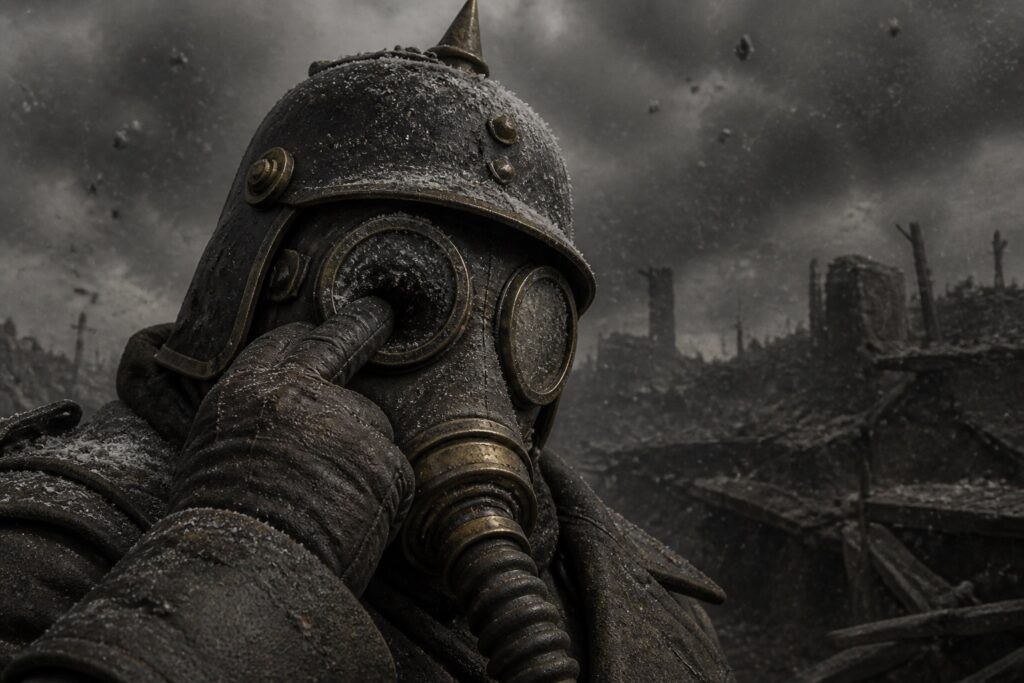
Beneath the Ash of Vraks
A Tale of the Death Korps of Krieg
Astra Militarum (Death Korps of Krieg)
„Vraks has yet to learn what enough means.“
Oberst Dreir, 19. Belagerungsregiment des Todeskorps von Krieg
I. Four Hundred and Thirty-Six Barrels
The sky over Vraks was no longer a sky.
It was a ceiling of ash, oil vapour and old fire in which the light died before it touched the ground. Even the stars seemed to have avoided this place. Where other worlds lived under sun, moon or the cold gleam of distant heavens, Vraks existed now only under the recurring flash of artillery. Every impact painted the land for the fraction of a heartbeat in hard whites: trenches, barbed wire, overturned transports, rows of half-buried corpses that had taken on in the dust of death the same colour as the earth.
Commissar Halbrecht stood on the step of a shattered command dugout and looked out into no man's land.
Before him lay the ninth forward line of the Death Korps of Krieg, a geometrical marvel of trenches, ammunition niches, plasteel bracings and filth. Nothing about it was beautiful. Everything about it was functional. It was a machine of earth, and in it men moved like cogs: faceless silhouettes in mud-grey greatcoats, with their round helmets, the respirators, the dead, round lens-eyes. When they spoke they sounded through the rebreathers like ghosts of metal.
Halbrecht had seen many regiments. Cadians, Vostroyans, Steel Legionnaires of Armageddon. All of them had kept something human, even in the mud and in the hell. A laugh. A curse. A charm on the weapon. A picture in the breastplate.
The men of Krieg carried nothing but duty.
A dull blow went through the earth. Then another. Then there were so many that the ground beneath his boots began to tremble like the skin of a dying animal.
"Beginning of the barrage," said a voice beside him.
Halbrecht turned. Colonel Dreir stood there, motionless as a monument. The uniform of the regimental commander scarcely differed from that of his soldiers. Only the greatcoat was heavier, the breastplate covered with scores, and on the shoulder lay a collar of dust that looked like cemented corpse-ash. The lenses of his mask were black.
"Bastion Canticum?" Halbrecht asked.
Dreir nodded. "Four hundred and thirty-six barrels. Three phases. First deep strike. Then breaking of the rampart crown. Then creeping barrage before our assault companies."
He recited it like a prayer.
Before them the world began to break open.
Behind the lines of the Death Korps stood batteries in rows kilometres long: earthshaker mortars, Medusas, Basilisks, ponderous siege guns whose barrels threw themselves back under the recoil like the necks of ancient beasts. The thunder became one single, all-devouring voice. In the distance Bastion Canticum vanished behind mushrooming clouds of dust, stone and flesh.
Halbrecht had seen the target plans. Canticum was a heretical redoubt, a vast concrete fortress with underground magazines, bunker chambers and a hidden chapel of the Plague Lord deep in its body. For eight months it had blocked the advance of the siege regiments. Three frontal assaults had perished in the wire and in the fire of its macro-batteries. A whole trench section had suffocated in putrid gas when the traitors pumped a cloud of chemical pestilence through the assault galleries.
Today Canticum was to fall.
Or the men of Krieg were to die before it in sufficient number to improve the equation for tomorrow.
Halbrecht hated how easily that thought now came to him.
"The assault companies?" he asked.
Dreir raised a gloved hand and pointed to the left, where figures were rising out of the trench openings. They climbed ladders, checked bayonets, adjusted charge pouches, lifted their lasguns. No voices. No shouting. No encouragement. Only readiness to march.
At their head walked Lieutenant Varn.
Halbrecht knew Varn better than most others in the regiment, if on Vraks one could claim to know anyone at all. Varn was young, so far as one could judge behind mask and dust. His movements had not yet taken on the complete economy of old Krieg officers. He wore a map case over his chest, a signal pistol at his belt and an entrenching spade on his back, as though even a lieutenant was at any moment only another man in the filth. Beside him marched Watchmaster Kessel, who led the assault section of the sappers: men with demolition charges, flamers and the heavy shields of the storm squads.
"Varn takes the left breach," said Dreir. "Kessel goes beneath it. His task is the inner gate."
"And if the inner gate no longer exists?"
"Then he will find something that can be blown."
Halbrecht almost laughed. Instead he only drew his greatcoat tighter as the wind drove a gust of dusty cold up out of the craters.
Another officer stepped out of the dugout. Major Serev, artillery coordinator, lean as wire, a slate of calculations under his arm. He saluted curtly.
"Confirmation from assessment," he said. "The rampart crown is breaking open at seven points. Secondary detonations in the northern magazine. Enemy counter-battery reduced by forty-three per cent."
"Only forty-three?" Halbrecht asked.
Serev looked at him as though the rest of the question were unnecessary. "Enough to advance."
That was the language of Krieg. Not victory. Not hope. Enough.
A brass horn called somewhere in the line. Varn raised his fist. Hundreds of men paused for a heartbeat while above their heads the creeping barrage crawled forward like a burning door of earth and steel.
Then they climbed out of the trenches.
They did it without haste. Without drama. In ranks. Every step at the same interval. As though they were marching across a parade ground instead of through the shot-through body of a dead world.
Halbrecht watched them until dust and fire swallowed them.
"They trust you," he said, without quite knowing why.
Dreir turned his head barely perceptibly. "No, Commissar. They obey."
That was worse.
II. The Left Breach
Varn went in the second wave.
The first wave was there to mark the wire, to set off the hidden nests, to betray the exact fire of the survivors. It fell in pieces. Varn saw bodies in greatcoats stumble, break apart, vanish into craters, without the formation behind them losing the beat. The creeping barrage fell too short, then too far again, and every time the earth shook, filth shed from his helmet onto his respirator.
"Third marking left!" called his vox-man.
"Seen," said Varn.
He saw almost nothing. Only shadows in the smoke. Wire stakes jutting out of the earth like broken ribs. A man of the Death Korps who ran on without a left arm, as though his body were still looking for an order before it finally collapsed. Through the filter the air tasted of chemicals, iron and the burnt bitterness of promethium.
"Forward," said Varn, though no one had stopped.
Ahead of him went Guardsman Lho. Behind him field medic Brenn. To the right two sappers carried a demolition pole, longer than a man, wrapped in cloths against sparks. Watchmaster Kessel was nowhere to be seen, until Varn suddenly saw him emerge from the smoke, shield up, head lowered, while las-shots peppered the metal plate with red points.
"Wire clear in twenty metres," Kessel reported.
"Too slow," said Varn.
"Then we die faster."
That was neither irony nor complaint. Only a statement. In other men Varn would have hated it. In Kessel it was merely the form in which truth came to him.
The bastion now took shape out of the dust: a grey tooth of concrete, craters, bent bracings and half-blasted merlons. The wall was open in several places, but behind every breach lay another line, more embrasures, more ramparts. Canticum had been built to go on killing even while dying.
Then the bastion answered.
Heavy machine cannon woke. Autocannons thrashed into the mud. Mortar shells burst too short and spat splinter-rain. Down from the remains of the rampart crown rose shells with green trails, burst in the air and let putrid mists sink into the craters.
"Check mask seals!" shouted Brenn.
Varn did not have to repeat the order. Men of the Death Korps checked their catches at a run, tapped filters, drew leather straps tight and marched on into the green cloud. One stumbled, retched into his rebreather and stayed behind on his knees, while two others stepped over him without turning round.
"Left breach!" called the vox-man.
Varn saw it clearly now. A burst-open section of the outer rampart crown in which ceramite plates stuck slantwise in the concrete like torn teeth. Before it lay a belt of wire, mine remnants and the bodies of the first wave.
He raised the signal pistol and fired a white flare.
Behind him the sappers went to their knees. Cutting charges flew into the wire. A moment of silence, then a hard, short crack. Metal lashed apart. Varn was first through the opening, slipped on clay and blood, caught himself on a half-shot stake and landed in the dead angle of the breach.
Two of his men were with him. Then four. Then eight.
The first defender came up out of a hollow in the wall, in the stained uniform of a Vraks militiaman, his face behind a coarse respirator, his eyes inflamed and feverish. He raised a lasgun. Varn shot him through the throat. The man folded up as though a prop had been pulled away.
Then the close fire broke out.
Brenn went down at once. Not dead. Only knocked over, as a splinter shattered his knee. Lho threw himself over the medic and fired blindly into an embrasure. Varn heard rounds bursting on concrete, the wild shriek of a heavy bolter deeper in the bastion, the dull bark of flamers.
"In!" he shouted.
His squad plunged into the outer trench line of the bastion. In there it smelled different from outside. Less of ash. More of mould, oil, excrement and old incense. The walls of the trench were reinforced with sandbags, many burst open, their filling dark with damp. Above an ammunition niche hung a yellowed image of a saint whose face had been smeared out with brown fingers.
A militiaman sprang out of a traverse with fixed bayonet. Varn parried with the rifle barrel, felt the blow into his shoulders and drove his pistol under the man's mask. When he pulled the trigger, something warm spattered over his gloves.
Behind him Kessel threw a stun grenade into the next bend. The flash filled the trench with white hardness. Sappers stormed after, shields foremost, shot charges in their hands.
"Secure right!" called Varn.
No one answered. They followed.
They fought their way forward trench length by trench length. No heroic run. No broad front. Only ten metres of filth, a bend, two dead, a niche, three shots, on. Varn lost all sense of time. He knew only that he was breathing, aiming, reloading, jumping, ducking and going on.
At an ammunition post he found Guardsman Mern leaning against the wall. The respirator was torn open, the filter gone, the face beneath grey and full of small black spots. Mern still held his lasgun at the ready, though his hands were already still.
Varn took his charge pouches.
For that no litany was needed. Krieg had a practical piety.
When they reached the inner forward trench, the first real counter-fire came.
Heavy stubbers covered the crossing. Behind it lay the bastion proper: a second wall, lower, thicker, black with burn scars. Above the gate hung a relief of the Emperor whose face had been ruined with chainsword cuts. In the niches above it stood statues of saints, wrapped in nets of putrefaction and filthy banners of treachery.
"Gate intact," said Kessel.
"Blow it?"
"Not under this fire."
"Then find another way."
Kessel nodded. He never looked as though he hoped for a better task.
He beckoned four sappers over and disappeared with them into a half-buried side stair.
Varn stayed with the rest in the forward trench.
The minutes after that belonged to waiting under fire. An ugly, crooked state between attack and dying. Men pressed themselves into the mud, fired at embrasures, threw fragmentation grenades into windows, dragged wounded back where it was worth it. Brenn was still alive somewhere behind them. Lho was not. A hit had torn his chest open while he was in the act of passing along Varn's last spare power cell.
"Lieutenant," said the vox-man. "Report to the rear?"
Varn looked at the gate, the embrasures, the crumbling statue of the saint, the black smoke welling from an upper fissure.
"Outer line taken," he said. "Inner gate under fire. Sappers working. Losses heavy."
"Figures?"
Varn looked out across the forward trench. Some bodies were still recognisable. Some were not.
"Later," he said.
III. A Request One Does Not Like to Make
In the command dugout Halbrecht waited for answers that came too slowly and yet always had the same form.
Forward line reached. Left breach open. Right breach lost. Sappers in the inner area. Gas disturbance in assault gallery five. Ammunition resupply delayed. Field preacher dead. Artillery effect satisfactory.
He sat at a rough field table of crate wood on which lay maps, speaking-skulls and damage lists. Above him dust trickled from the ceiling at every impact. A hook held a dead lamp that swung back and forth all the same, as though hesitating whether it was still part of the world.
Colonel Dreir stood at the vox set and listened without a stir.
"The right breach?" Halbrecht asked.
"Lost," said Dreir.
"And you say it like that?"
"It is still within the area of reuse."
Halbrecht pushed air out through his teeth. "By all the Throne worlds, Colonel, were your people ever once human beings?"
Dreir was silent so long that Halbrecht believed he would not answer.
Then he said: "Yes."
Nothing more.
A new officer entered. Artillery Major Serev, this time smeared with blood at the sleeve.
"Counter-thrust from the north works," he said. "Not only militia. Auspex shows heavy armour in the inner courtyard. Astartes biometrics indeterminate."
Dreir took the report as though weighing something in his hand. "Death Guard?"
"Possible."
Halbrecht looked up. "Confirmed?"
"No."
"Then do not say Death Guard."
Serev nodded, but only out of formality. On Vraks some names did not have to be spoken aloud to carry their presence into the room.
Dreir turned to the vox officer. "Signal to the fleet element."
Halbrecht raised an eyebrow. "You have not..."
"I have made provision."
"With what?"
"With a request one does not like to make."
Halbrecht wanted to ask further, but at that moment another note howled up above in the ash. Not artillery fire. Deeper. Sharper. The sound of heavy engines plunging down from a great height and then braking abruptly.
The dugout vibrated.
Serev looked at the ceiling. "Drop pods."
No one spoke for a moment.
Then Dreir said: "Good."
IV. Grey Armour, Red Heraldry
Halbrecht stepped into the open just as the first drop pod struck.
It crashed beyond the bastion into a furrowed rampart ditch, threw up dust and bodies and then stood steaming in the middle of the bombardment. Its ceramite petals sprang open.
Out of the smoke stepped Space Marines in grey armour with red heraldry.
Red Scorpions.
Halbrecht had seen them before at a distance, never so close. They seemed neither like men nor like saints. Rather like an answer to a question one had better not asked. Their movement had nothing hurried about it, not even under fire. Every step was economical. Every shot final. Bolters barked, and where they struck, bodies lost their shape.
More drop pods came down. A Contemptor Dreadnought rose out of one of them like a walking sarcophagus of enmity, its power fist sooted, its assault cannon barrel already spinning. Behind it came a captain without a helm, the narrow, pale face unmoved, as though he were stepping onto a drill yard instead of into the antechamber of hell on Vraks.
Dreir placed himself in his path.
Halbrecht followed, more from instinct than from a sense of rank.
The Astartes captain looked first at the Colonel, then at Halbrecht. His eyes were bright and unpleasantly sober.
"Captain Phocion," he said.
"Colonel Dreir," Dreir answered. "19th Siege Regiment, Death Korps of Krieg. Bastion Canticum is on the point of falling."
"On the point of falling," Phocion repeated. "You have asked us to cut the matter short."
Halbrecht heard the cold reproach in it.
"We have asked," said Dreir, "that you neutralise the inner resistance before it consolidates again."
Phocion nodded. "Auspex confirms tainted architecture and warp contamination in the central sanctuary. My brothers will take the core. Your men will open the way."
"The way is being worked on."
"Then they are working too slowly."
Dreir looked at him without moving. "Then your brothers will have to practise the patience of the Emperor."
Halbrecht threw him a glance. For a human being Dreir had an astonishing instinct for how far one might provoke a Space Marine without dying.
Phocion did not answer at once. Then he looked towards the bastion, where Varn's company was still stuck in the forward trench.
"The left breach," he said. "In there."
He did not give the order by vox. He did not have to. The Red Scorpions set themselves in motion like a grey blade.
Halbrecht watched them go. "They do not like your kind."
"No one likes our kind," said Dreir.
"And that does not trouble you?"
"It would be inefficient to be influenced by another's discomfort."
Halbrecht would gladly have contradicted him. But over Vraks efficiency had long since become a form of faith.
V. Kessel Has Found a Way
Varn heard the bolters first.
Not the ordinary staccato of heavy weapons. This was deeper, denser, more resolved. A sound that did not suppress but erased.
Then he saw the first Red Scorpions jump into the forward trench.
One landed not three metres from him, rolled off the impact, was already up and firing again and drove three bolt rounds into the embrasures above the inner gate. Where a moment before there had been muzzle flashes, black holes now gaped and something ran down over the wall.
The Red Scorpions pushed past his men without regarding them. Their captain walked in the middle of the fire. A Vraks officer sprang up on the rampart crown, his uniform full of filth, a chainsword raised. The Space Marine shot his ribcage away before the man could finish his cry.
"Lieutenant," said a voice to Varn's left.
He turned. Captain Phocion stood before him.
"Status."
Varn swallowed dryly, though his mouth was dusty. "Outer line taken. Sappers seeking access to the inner gate. Counter-fire from embrasures and probably from deep positions. Possible Chaos contamination in the core works."
Phocion looked past him, as though reading the wall itself. "Possible?"
Varn thought of the banners, the putrid nets, the scratched-out face of the Emperor. "Probable."
"Better."
One of the Red Scorpions, recognisable as an Apothecary by the white markings of his helm, stepped closer to a corpse in the forward trench and regarded the discoloured patches of skin around the torn-open mask.
"Signs of plague," he said.
Phocion nodded barely perceptibly. "Then time is no longer your ally."
Varn almost asked when it ever had been.
Instead he pointed to the side stair into which Kessel had disappeared. "Down there my watchmaster is working. He should any moment—"
The bastion lifted.
Not as a whole. Only the area beneath the gate. An inner swelling of concrete and earth, as though the fortress itself had breathed in. Then fire shot through the joints, stones burst out, an embrasure tipped askew, and a row of corpses on the rampart slid like puppets into the trench.
A heartbeat later came the crack.
Varn was thrown against the wall. His helmet struck concrete. Something warm ran into his collar. Everywhere metal screamed. Dust filled the forward trench so densely that light existed only as a grey smear.
When he picked himself up, he could no longer see the gate.
There was only a black fissure in the wall and above it a gaping cleft out of which smoke and dark bellowing welled.
Kessel had found a way.
The Red Scorpions did not hesitate for a moment. They stormed into the fissure. Phocion first. His sword was drawn now, a hard blade of blue light that cut the dust into cold shreds.
Varn gathered what was still standing of his squad.
"With them!"
They went into the bastion.
VI. What Breaks Out of the Chapel
Behind it lay no courtyard, as Varn had expected. Rather a field of rubble of collapsed casemates, burnt ammunition wagons and a crooked chapel whose bell tower was half torn away. The inner area of Canticum had once been meant to possess Imperial dignity. Now it was a sick ward of the war. Walls breathed mould. Statues bore stains like corpse-skin. Among heaps of rubble lay defenders and attackers, many still twitching.
The sappers had torn the gate open from below. Kessel stood in the smoke, a piece of his greatcoat burnt away, his arm bloody to the elbow. Of his four men two were still alive. One held his belly. The other wore no mask any more and breathed rattling through a red-smeared dressing.
"Way open," said Kessel.
"You are bleeding."
"Yes."
Varn looked into the black cleft of the chapel. From there came the bellowing, deeper now, nearer, accompanied by a grinding metallic note.
"What is in there?"
Kessel glanced briefly. "Something large."
Then it broke out of the chapel.
It was a Space Marine, but only in the sense in which a burst carcass is still a man. The armour had once been that of a traitor legion, green, heavy, with thick plates and rotting seals. Now it was sewn over with rust, dents and growths of flesh. Out of a torn-open shoulder gap hung something wet and lung-coloured. The helm had no eyes any more, only narrow poisonous glimmer-points.
Death Guard.
Varn recognised the name only after his body had already reacted. He fired. The las-beam ate into one of the putrid plates and vanished without effect. Others did the same. The air between them and the traitor flickered red.
The Chaos Space Marine raised a heavy bolter that looked as though it had been glued together with bones, and fired.
A Guardsman beside Varn burst open. A Red Scorpion took the salvo on his breastplate and was thrown back a step, caught himself at once and went on.
Phocion hit the Death Guard warrior with two bolt rounds in helm and throat. The traitor staggered. Then the captain was upon him.
The sword of blue light went once across the putrid breastplate. Not deep enough. The traitor struck back with his elbow as though wielding a battering ram. Phocion ducked under the blow, stepped into his opponent, and now two more Red Scorpions came from the side. Chainsword teeth ate into rotten ceramite. A melta charge struck the left arm. The thing gave out a sound, more wet coughing than rage.
Then Phocion rammed the blade through the swollen helm grille.
The Death Guard warrior stayed standing a moment longer, as though his body first had to be convinced that it was dead. Then he toppled. Where he struck, a cloud of thick flies burst out of the cracks of his armour and spread over the courtyard.
Kessel watched the carcass a second too long.
"On," said Varn.
They went into the chapel.
Inside it was warmer. Not living warm. Mouldering warm. The air stood full of sweet putrefaction, rank clouds of incense and the stench of damp cloths that had lain too long on flesh. The walls were covered with prayers, written one over another in brown paint, some with blood, some with excrement, some with something that had become both.
At the altar someone had thrown down the Emperor and replaced him with a raw, swollen thing of bone and tallow. Candles melted in green pools of fat. Beneath the altar a stair led further down.
"There," said the Apothecary of the Red Scorpions. "The contamination is beneath."
Phocion gave short orders. Two of his brothers stayed above to secure the chapel entrance. The rest went down into the depth.
Varn followed with Kessel and what was left of his squad. The courtyard behind them was not yet taken, but that no longer mattered. Such places always had a heart. And often it did not beat with flesh.
The stair led into underground magazines, then into older passages, then into something that had been here long before the bastion. The architecture changed. Coarse military galleries became masonry corridors with relief arches and reliquary niches. Damp warmth hung everywhere. Water dripped. Sometimes it was water.
VII. Not the Man, the Basin
Kessel discovered the first trap.
A wire, almost invisible in the dark. Behind it a row of shrapnel charges in a saint's niche. He held up his fist. The column stopped. One of the sappers crawled forward, cut the wire through with a tool and held his breath.
Nothing.
"On," said Kessel.
They went deeper.
Soon they found the first wounded.
Not their own. Bastion defenders leaning in niches or against walls. One had no legs left and was humming a chorale that Halbrecht knew from his time at a Schola. Another held his entrails in his belly with both hands and grinned behind rotted teeth as the column went past. A Red Scorpion shot him without breaking stride.
Varn said nothing against it.
Then came the voices.
Quietly at first. A multitude of whispering throats rising out of a room lying further below. Not singing. More the damp murmur of a crowd that has long forgotten what praying sounds like without hunger.
Kessel looked at Varn. Even behind the mask he looked tense.
"If there is a reactor down there," said Varn, "we blow it."
"If there was something holy down there, it is not that any more."
"Is that comfort?"
"No."
The last gate stood open.
Behind it lay an underground shrine whose dome was held by thick flying buttresses. In its centre a cracked aquila relief rose above a sunken basin that had once held holy water and was now filled with black broth. On chains above the basin hung bodies in priestly robes, many still living, their bellies swollen, their mouths sewn shut, thin tubes fastened at their wrists from which fluids dripped into the channel of the basin. Around them knelt dozens of Vraks militiamen, many without weapons, their heads lowered, their masks laid in their laps, as though praying to the air itself.
And at the other end of the basin stood the man who directed the whole thing.
He wore what he seemed once to have worn as the vestments of a cardinal-general or a fortress prelate. Gold embroidery hung in shreds from his chest. The skin of his face was in several places greenishly translucent. One eye was missing and had been replaced by a grille of brass. In his right hand he held a crozier with an aquila whose wings had been bent into putrid hooks.
He looked across at them.
"More of them," he said.
His voice was soft. Almost exhausted. That made it worse.
"You give and give," he went on. "For eight months. Trenches, bones, hours, names. And always you believe that only one last blow is wanting."
Phocion strode forward. "In the name of the Emperor—"
"No," said the prelate calmly. "Do not speak his name here if you are not prepared to hear it with us."
Varn felt the hairs on the back of his neck rise, although the rebreather blew cool over his skin. The air in the shrine had grown thicker. In the black basin circles drew through the broth, as though bubbles were rising from a depth recorded in no ground plan.
The kneeling militiamen raised their heads at the same moment.
Phocion did what Space Marines did best. He ended the speech with a bolt round.
The prelate was hit in the shoulder, turned half round and did not fall. Out of the wound welled no normal bleeding. Only dark fluid and something white that drew back again.
The whole shrine exploded into movement.
Militiamen leapt up, many with knives or rusted lasguns. Others threw themselves blindly under the bolters of the Red Scorpions. From the side galleries fire broke out. Varn shot at a marksman ducking behind a reliquary chest. Kessel stormed to the left, where a row of tubes opened into the black basin.
"Not the man," he shouted. "The basin!"
Varn understood only a heartbeat later.
Phocion did not. Or perhaps he understood and decided otherwise all the same. The captain was already on his way to the prelate, sword before him, while his brothers cleared the galleries. The Chaos priest raised the staff. The chains above the basin began to swing. One of the hanging bodies burst open and poured out a cloud of black fluid.
A Red Scorpion was struck by it. His grey armour hissed. The ceramite discoloured. The Space Marine staggered, raised the bolter all the same and fired on until his brother seized him and dragged him out of the cloud.
Varn leapt over an overturned bench and slid to the edge of the basin. It stank of fever, dung and something that had once been human fat. In the broth floated pieces of bone, candle stubs, teeth.
"Charge!" he called.
Kessel threw him a demolition charge. Varn caught it, almost too late. His gloves slipped with wet. Behind him someone screamed into a rebreather. Before him a mound of bubbles rose in the surface of the broth, as large as a head.
He pulled the fuse.
On the other side of the shrine Phocion reached the prelate. The power sword cut his staff in two, then a hand, then an arm. Yet the man still did not fall. He only smiled, as though every wound reminded him that he had long since become something else.
"You are too late," he said.
Varn threw the charge.
It struck the basin, slid in and vanished.
"Down!"
The explosion was muffled but brutal. Black broth shot up to the dome. Chains tore. The hanging bodies crashed down. The basin broke open at one side, and out of its interior came not only fluid but breath-a deep, putrid exhalation, as though something beneath the floor had waited too long for this opening.
Cracks ran across the stone slabs.
Kessel stepped beside Varn and hurled a second charge into the cleft.
"Back!"
This time the floor lifted.
The middle part of the shrine collapsed in on itself and took half the basin, the statues and the kneeling militiamen with it. Out of the opening beneath it a black, steaming shaft rose up out of which putrefaction came like wind. For a moment Varn saw something move in it. Too large for a man. Too formless for anything else that had ever deserved a name.
Then Phocion sprang at the prelate and struck his head from his body.
The body stayed standing a moment longer. Then it too fell into the torn-open shaft.
The whole shrine began to quake.
"Out!" the captain ordered.
No one needed a second summons.
They fought their way out of the collapsing vault, through passages in which clouds of dust ate every light. A sapper was crushed by falling stones. One of the Red Scorpions stayed behind to carry his corroded brother. Kessel was limping badly now. Varn noticed only halfway up the stair that his left sleeve had become dark and heavy.
Up in the chapel the air was cold and sharp. The floor beneath them went on quaking. Somewhere in the bastion courtyard a wall came down. Bells crashed. Shouting, vox hiss and the distant hammering of new artillery filled the world.
"Is it over?" Varn asked.
Phocion looked at him as though he had asked something childish. "No."
Of course not.
VIII. An Account of Consumption
In the courtyard the real battle now raged.
The bastion was not dead, only dying. Out of side casemates and rear works new defenders pushed forward, more fanatical than before, some with putrid banners, some in thick chemical suits, some merely in rags and with axes. On the half-collapsed walls autocannons opened fire. The courtyard became a shredder of dust, stone splinters and short lines of sight.
But now the Red Scorpions were in the centre.
The Contemptor Dreadnought stamped through a collapsed arcade and swept a whole platoon of militiamen out of the world with its assault cannon. Where it directed its melta beam, walls burst open. Behind it grey Astartes went stoically forward and pressed the enemy together on both flanks.
The Death Korps followed not like heroes of a legend. It followed like infantry that had at last recognised a point in the wall at which effort could be translated into ground.
Varn gathered twenty men. Then twelve. Then seventeen, when survivors of another company joined him from some side alley. No one asked for names. He set them to the left of the Astartes, had them take an ammunition niche, then the entrance to a rearward casemate passage.
There he found Brenn again.
The medic had tied off the shattered knee, had raised himself with a piece of cable and was now treating a Guardsman who had no lower jaw left.
"You are alive," said Varn.
"For the present."
"Can you walk?"
"Yes."
"Can he?" Varn pointed at the wounded man.
Brenn looked at the man briefly. "No."
The Guardsman with the missing jaw tried to say something. Only a rattling sound came out.
Varn waited for the request to be left behind. It did not come. Men of Krieg did not ask for that mercy. They expected others to do the reckoning for them.
Brenn laid his hand on the wounded man's shoulder, pressed him gently back into the shelter of the niche and took his remaining charge pouches from him.
Then he stood up again.
The man remained sitting and held the lasgun across his knees, as though he would stand watch until the fortress or the universe finally knocked off.
Varn went on.
In the command dugout Halbrecht received the report of the breach into the core works and at first did not believe it.
"Confirmed?"
"From the Red Scorpions vox and from Lieutenant Varn's remaining signal," said the officer.
"And the bastion?"
"Internal tremors. Heavy structural failures. But it is still holding."
Colonel Dreir listened, his hands on the map table. Then he issued new orders, cold and precise. Reserves forward. Second wave onto the left breach. Artillery barrier shifted a hundred and sixty metres. Medical depots forward. Flame tanks at readiness. The language of the Death Korps was the language of cogs meshing, no matter how much flesh had got between them.
Halbrecht regarded the map.
"If the core works is broken," he said, "Canticum will now either collapse or throw the last counter-thrust."
"Yes."
"And?"
"And we must be faster than its dying."
Halbrecht let out a sound that was almost a laugh. "I used to believe that siege warfare was a game of patience."
"No," said Dreir. "It is an account of consumption."
"Of ammunition?"
"Of everything."
Halbrecht was silent.
Then new thunder sounded from the entrance. He stepped out and saw the third wave of the Death Korps climbing out of the trenches. New men. New numbers. The same greatcoats. The same lenses. The same wordless readiness to go into the smoke that others had opened for them.
He wondered whether the Emperor ever grew tired of not seeing so many faces.
IX. Today They Are
In the courtyard of the bastion the counter-thrust began.
Not everywhere. Precisely where it hurt most. A hidden side door sprang open and spewed out a reserve: traitors in heavy trench armour, accompanied by two plague-ridden ogryns whose skin welled under brands. Behind them a chemical projector team with long tanks on their backs. They struck the left flank of the advancing Krieg regiments and tore a hole in the freshly won line.
Varn saw it too late.
The gas came low and yellow-green over the ground, crept under shot-up wagons and bit into every weak point. The first men fell retching as their filters failed. An ogryn seized a sapper and struck him so hard against a wall that blood sprayed up in a fan.
"Anti-tank charges forward!" shouted Varn.
"Those are not tanks," said Brenn.
"Today they are."
Kessel was already on his way. He still had three men. One carried satchel charges, one a flamer, one only a pistol and an entrenching spade. They ran low through the rubble, using every heap of debris, every piece of wall, while the gas wound itself round their boots.
A Red Scorpion sprang from a collapsed gallery straight down onto the first ogryn and rammed his combat knife up to the elbow into its throat. The monster struck blindly about it, caught the Space Marine on the shoulder and was in the same moment riddled by three las-salvoes and a bolt burst. It fell to its knees, still living, until Kessel's flamer-bearer burned its face away.
The second ogryn almost reached Varn's position. It threw two Guardsmen aside like rags and only then got Kessel's charge strapped under its belly.
"Down!" Kessel bellowed.
The detonation tore the giant's legs away. The torso struck the ground before Varn's feet and still reached for him, until Brenn drove the bayonet through one of its eyes.
The chemical projector team turned the jet. Phocion saw it too. He was too far off.
Varn fired first at the tank. Missed. Fired again. Nothing. Then the bearer suddenly went up in a melta beam, white and violent, and the whole chemical tank burst in a cloud of burning poison.
Behind the vapour stood the Contemptor Dreadnought.
Its voice rumbled over an external speaker, deep and distorted. "Advance."
It was the first word Varn heard from it.
It was also enough.
With the third wave at their backs the Death Korps broke the counter-thrust. Not quickly. Not elegantly. But completely. Kessel lost another man. Brenn took a splinter in the shoulder and worked on all the same. A nameless Guardsman with a torn sleeve took up the banner of a fallen assault section and stuck it in a heap of rubble, as though the courtyard needed some sign of whom it now belonged to.
By the afternoon Canticum had almost fallen.
Almost.
The last resistance held out in the north works. A half-collapsed munitions hall connected by rubble passages with the remains of the bastion. From there the defenders still fired at every movement in the courtyard. It was enough to keep the victory open and the casualty lists long.
Colonel Dreir came to the front himself.
Halbrecht accompanied him, for at that point his presence belonged either to morale or to punishment. He was not sure what the men of Krieg understood by the word morale at all.
They found Varn in the shadow of a shattered loading platform. The lieutenant now had a dressing round his arm and blood down to the hem of his greatcoat. Kessel sat beside him and leaned with closed eyes against an ammunition crate, as though he were merely resting.
"Report," said Dreir.
Varn stood up. "North works holding. Enemy has at least two automatic guns, staggered trenches in the interior and remaining forces in the upper passages. Ammunition critical in many squads."
"Sappers?"
"Four able to walk."
Dreir looked at Kessel. "Watchmaster?"
Kessel opened his eyes. "Demolition access possible. By way of the side foundations. But someone has to carry the charge in."
Halbrecht looked at the munitions hall. The north works had partly collapsed. A long fissure ran through the masonry, but not deep enough to break it of itself. Bolter and stubber fire came from embrasures and from the shadow behind them. A normal assault would cost another hundred men.
Dreir regarded the hall, then the men before him.
"You will carry the charge," he said to Kessel.
"Yes, Colonel."
"You will open the way," he said to Varn.
"Yes, Colonel."
Then he turned to Phocion, who had stepped behind them with two Red Scorpions, almost soundlessly despite the rubble under his boots.
"When the hall is open, the core is yours."
Phocion nodded. "And the outer edges?"
"The Death Korps'."
That was the truth. Space Marines often decided battles at one point. The rest ordinary men had to fill out and hold, until history had material enough to forget it.
X. Canticum Has Fallen
The last attack began in the twilight.
The sun had never properly appeared behind the ash, but the light grew thinner and more metallic as the day died. The courtyard lay full of smoke. Fires ate their way into beams and remnants of cloth. Everywhere hot ammunition crackled.
Varn led the remaining section round to the left, along beneath a half-collapsed wall, then through a supply passage whose floor was strewn with fallen icons and casings. Kessel and his three sappers carried the charge, heavy and unwieldy, as though they were dragging a second, metallic coffin.
They came almost unnoticed as far as the side foundation.
Then a hidden machine gun woke.
The first sapper was lifted by the fire clean across the chest. The second fell over him. Varn threw himself against the wall, shouted targets into the vox and in the same moment heard the cold onset of the Red Scorpions' bolters from the courtyard. Shots hammered into the embrasure. Concrete sprayed. The machine gun broke off, only briefly.
"Now!"
Kessel and the last sapper sprang forward. The man with the charge slipped in the rubble, fell to his knees, picked himself up again and pushed the package with both arms into the dark cleft of the foundation. A shot struck him in the throat as he did it. He stayed bent over the charge a moment longer, as though praying. Then he slowly sagged.
Kessel pressed the fuse into the hollow of the package, seized the dead man by the jacket and tried to drag him back with him. In vain.
"Away!" Varn bellowed.
They threw themselves into cover.
The blast tore the side foundation open like rotten bonework. The munitions hall lifted with an ugly metallic shriek, a wall broke out, and glowing clouds of dust shot into the courtyard.
Through the fresh fissure the Red Scorpions stormed.
Phocion in front. The Contemptor after him. Varn saw only fragments of the slaughter within: bolter flashes tearing the darkness open in rhythmic strokes. A traitor heavy stubber that suddenly fell silent, because the whole firing platform with its crews was torn backwards. The shadow of a second Death Guard warrior coming down from the upper passages, only to be seized at the hip by the Dreadnought and beaten into the wall until armour and body could no longer be distinguished.
Then came the echo of the internal detonations.
First one. Then two. Then a deep booming that ran through the whole courtyard.
The munitions hall broke for good.
Part of the north wall tipped slowly outward, as though it had to assure itself once more that gravity was really a law and not a rumour. Then it fell. Stones, girders, gun parts, corpses and banners crashed into the courtyard.
Varn threw himself over Kessel. Dust beat over them both. Something heavy crashed down close beside them. For some seconds everything was only noise and darkness.
When the world came back, the north works was gone.
Where a moment before there had been resistance, there now stood a smoking hill of rubble.
The firing fell silent.
Not gradually. Entirely.
Even the men of Krieg raised their heads for a moment, as though they could not at once place the silence.
In the sinking dust Captain Phocion stood on the rubble of the north works. His armour was flecked with soot and another's blood. The power sword had gone out. Beside him the Contemptor Dreadnought rose out of a cloud of plaster and smoke like a monument that had been erected only afterwards.
Phocion looked out over the courtyard, then across to Dreir, who had now likewise come forward.
"Canticum has fallen," said the Space Marine.
There was no triumph in it. Only conclusion.
Colonel Dreir nodded. "Confirmed."
Halbrecht noticed that he had been holding his breath. He let it stream out, slowly, and smelled in doing so ash, blood, explosive and the stinging remnant of the destroyed chemicals.
"And now?" he asked quietly.
No one answered him at once.
XI. Almost a Medal
Night came early over Vraks. Or perhaps it was only more smoke.
Servitors were already creeping into the ruins to recover ammunition, sort wounded and gather the first figures. Field preachers walked between rows of the dead. Not to save them. Only to fulfil their duty before them while they still had faces. Medics cut greatcoats open, drew tourniquets tight, gave morphia where a future was still economic.
Varn sat on a block of stone and let Brenn redress his arm. Kessel lay a few metres away on a stretcher. Not dead. But paler than the dust.
"They will have to take the leg," said Brenn.
Kessel nodded. "Which one."
"The left."
"Good."
Brenn worked on in silence.
Varn looked out across the courtyard. Among the smoking ruins the survivors of his company moved. One was still collecting intact power cells from the dead. One knelt beside a comrade and wrote something on a tin tag. Another only stood and looked at the collapsed chapel, as though trying still to hear the noise beneath it.
Commissar Halbrecht came over to him.
"Lieutenant."
Varn made to stand up.
"Stay sitting," said Halbrecht.
Varn stayed sitting. That felt strangely like mercy.
Halbrecht glanced briefly at Brenn's work, then at Kessel. "He opened the hall."
"Yes."
"And you?"
"I was there."
Halbrecht was silent. Then he said: "That is more than many can claim of themselves."
Varn was too tired for answers that should have sounded careful. "Is that a commendation, Commissar?"
"No," said Halbrecht. "Only a circumstance."
He did not sit down. Commissars rarely sat among soldiers, unless they meant to say something from a nearness more dangerous than distance.
"I understood today," said Halbrecht after a while, "that I have long been trying to read the Death Korps wrongly."
Varn looked up at him. "In what way?"
"I took you for broken men. Then for fanatical ones. Then for empty ones. But none of that is quite right." He looked out into the night work of the regiments. "You are tools of a faith that others only speak. That does not make you less human. Perhaps it only makes you harder to bear."
Varn thought about it. It was a strange kind of respect.
"We are soldiers of the Emperor," he said at last.
"Yes," Halbrecht answered. "But today you were also the men who took this fortress. Someone ought at least once to say that aloud."
Varn did not know what to say to that. He was relieved when Dreir called them.
The Colonel stood on the remains of an ammunition platform and read the first casualty figures from the data-tag strip. Around him gathered the surviving officers, medics, field priests and vox clerks.
"Bastion Canticum," said Dreir, "has fallen. Objective achieved. Own losses: provisionally sixty-two per cent in the leading assault companies. Sapper sections seventy-eight per cent. Artillery losses sixteen barrels. Confirmed enemy destruction in the bastion: incomplete."
He paused. Not out of pathos. To leave room for entries.
"Reorganisation begins at once. Ammunition distribution in thirty minutes. The dead to be laid in row North after marking. Wounded of first and second priority to the surgical stations. Third priority receives morphia and pastoral care. New attack planning for objective Misericordia at first light."
A gust of wind went over the courtyard and whirled ash over their boots.
No one protested. No one asked for rest. No one for victory.
Canticum had fallen, so the next works was already waiting.
Halbrecht closed his eyes for a moment.
When he opened them again, the Red Scorpions were already standing ready to march off. Captain Phocion spoke briefly with Dreir. No handshake. No thanks. Only two officers of different kinds recording that a necessary point of the campaign had been ticked off.
Then the Space Marines turned away.
The Contemptor Dreadnought went last. As it came level with Varn, the sarcophagus helm turned minimally in his direction. Perhaps chance. Perhaps perception. Perhaps merely mechanism.
Out of the speaker came again that deep, distorted voice.
"Well held."
Then the Dreadnought walked on.
Varn watched it go until the grey figures vanished into the smoke.
Kessel had heard the words too. Despite pain and fever, something like a crooked shadow drew through his bearing.
"From a Dreadnought," he said.
"Yes."
"That is almost a medal."
Varn laughed hoarsely. It was the first sound in hours that sounded as though it belonged to a living man.
XII. So That They Are Counted
Later, when night lay completely over Vraks and only fires, signal lamps and the distant flashes of further fronts cut the darkness, Halbrecht walked along the row of the dead.
They lay neatly ordered on tarpaulins. Numbers at the boots. Greatcoats smoothed where possible. Respirators over the faces, even on those who no longer had faces. A clerk of the Munitorum sat on a crate and read out identifiers while another transferred them into tables.
At the end of the row knelt Brenn.
Before him lay Lho. Beside him Mern. Beside them men whose names Halbrecht had never learned. Brenn wrote every one of them on a strip, even those who could be identified only by regimental number.
"It is late," said Halbrecht.
"Yes."
"Others could take that over."
Brenn shook his head. "I was with them."
Halbrecht watched the medic write on. Slowly. Cleanly. As though every line were a suture with which one drew reality makeshift together again.
"Why do you do it?" Halbrecht asked.
Brenn laid the pen aside for a moment. "So that they are counted."
He said it so plainly that Halbrecht suddenly no longer knew whether he had ever heard a truer form of dignity on this world.
At the edge of the courtyard distant artillery fire was already barking again. Not their barrels. Further east. Someone else was already dying for tomorrow's plan.
Halbrecht looked at the black silhouette of the fallen bastion. Canticum was still smoking from a hundred fissures. Above the collapsed bell tower hung a cloud of sparks and ash that in the wind looked like a flock of dark birds.
He thought of the prelate in the shrine, of his soft voice, of the repellent calm in his words. You give and give. Perhaps the heretic had believed he had found a reproach in it, where in truth one of the oldest truths of the Imperium had spoken.
There was no ending that was not paid for with more consumption.
Colonel Dreir stepped beside him.
"The first march order for Misericordia is ready," he said.
"Of course."
"The reserve companies will move up at first light."
Halbrecht nodded without really listening. Then he asked: "Colonel. Do your men believe in victory at all?"
Dreir regarded the smoking bastion.
"No," he said after a while. "They believe in the task."
"And you?"
This time the answer took longer.
"I believe," said Dreir, "that some worlds can be forced back into order only by the quantity of their dead."
Halbrecht looked at the rows of the dead, at Brenn, who was still noting names, at Varn, who had fallen asleep sitting up while a medic drew his dressing tight, at Kessel, whose left leg was already being prepared for the surgical table.
"Then Vraks is almost redeemed," he said.
Dreir turned his head. Perhaps that was with him something like sorrow. Perhaps only exhaustion.
"No, Commissar," he said. "Vraks has yet to learn what enough means."
In the east a new flash flickered over the horizons of the trenches.
The night on Vraks was long. The war longer.
And beneath the sinking dust of the fallen bastion the survivors of the Death Korps stood up, adjusted greatcoats, reloaded lasguns and prepared themselves in silence for the next deployment.
Download story as PDF or EPUB
Enter your email address. After confirming your subscription you'll get the download links immediately and by email.