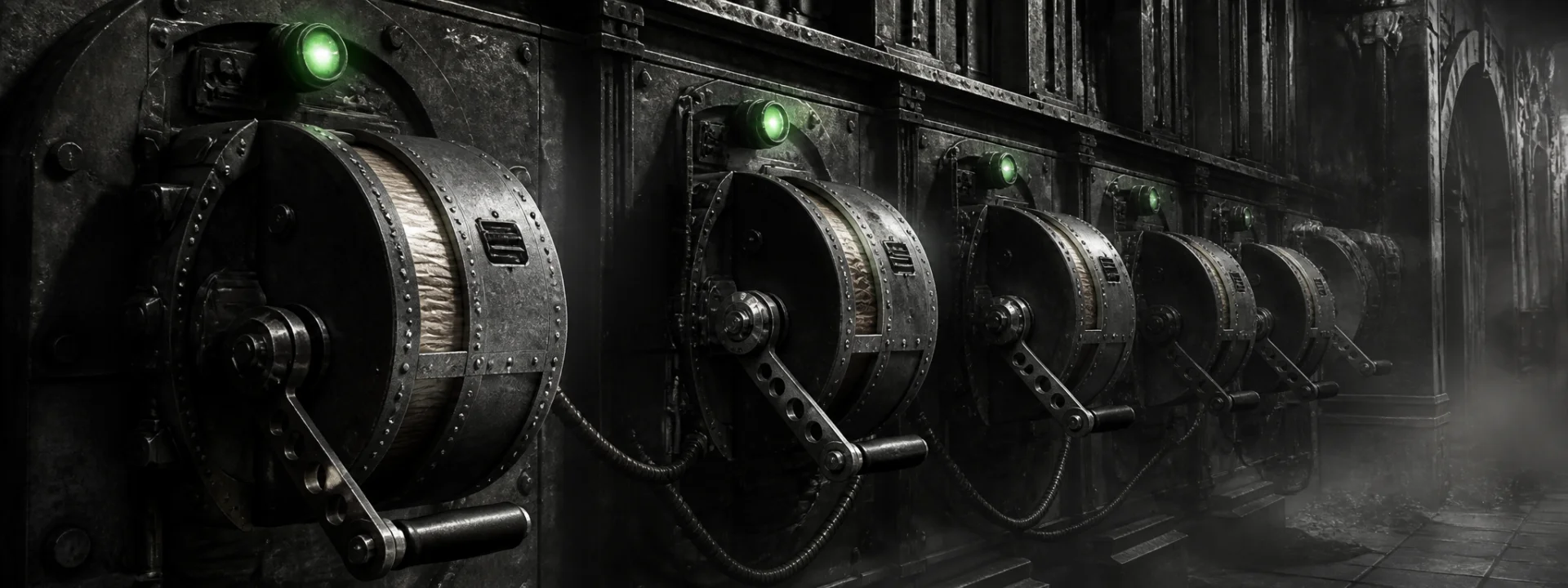
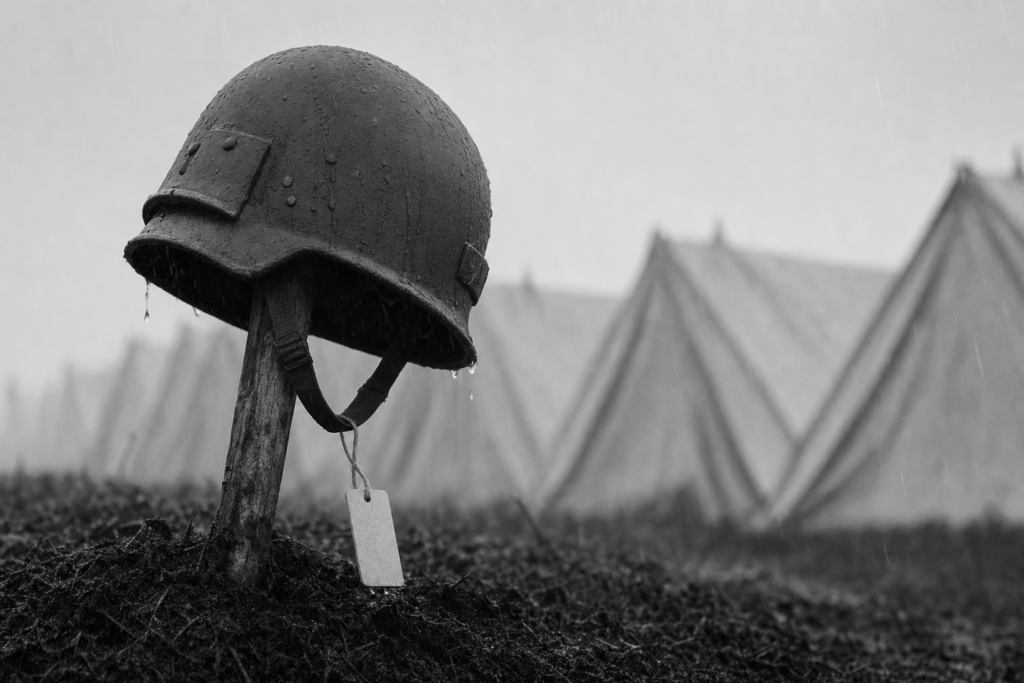
Assembly Area
Cadia Stands · Part One
Astra Militarum (331st Cadian Shock Troops) · Black Legion (The Absolvers) · Munitorum (Ederhaven Assembly Area)
„The gate holds as long as one stands.“
Wahlspruch des 331. Cadianischen Stoßtruppenregiments, Kasr Halrik
I. Nine Days
The Gellar Field had stopped singing, and that was the first thing Runa Kalvek noticed, before she noticed that she had been hearing it for nine days.
She sat on the crate of charge packs with her back against the bulkhead and her lasgun between her knees, and around her lay deck four of the troopship Fides Constans in the light the fleet considered night. Six hundred people were breathing there. You heard it when the field was silent. You also heard a valve working somewhere aft, which had been working since the third day and which nobody would repair any more, because the enginseer who could do it had died on the third day.
"We are out," said Wessik beside her. He said it quietly, because many were still asleep. "The noise is gone."
"I heard it."
"You did not hear it. You noticed that it is gone. That is something else."
She did not answer. Corporal Immo Wessik was forty and had been talking for eighteen years, and she had learned that you let him talk the way you let an auspex run: most of it was noise, and the part that was not noise you heard, because you knew the noise.
Above them the deck lighting came up to day. A klaxon, three times. Then the voice out of the vox in the ceiling, a fleet voice, practised at saying things nobody wanted to hear in a tone that suggested weather: translation complete. Real space. All units to muster. No contact with the bridge until the captain released it.
Runa stood up. Around her the others stood up, the way Cadians stand up, without asking, before the body knows why.
She counted.
Wessik. Terhoven, the youngest, who had turned seventeen on the ship without anybody saying so. Pahl with the scope, who slept without quite closing her eyes. Roske with the meltagun. Brede and Ansorge, who came from the same lane in Halrik and had been arguing for twelve years about what it was they were arguing about. Quint. Dammer. Sieber. Luttmer, who could not keep his hands still, not since the gate.
Eleven, with her.
There had been forty-two when the platoon fell in at Halrik. She did not count the forty-two. She counted what was there, because that was the figure you worked with, and the other figure belonged in Form M-9, and the form was filled out and lay with the Old Man.
The Old Man had been lying in the cold chamber behind the infirmary since the sixth day, among thirty-eight others. He had taken a fragment under the collarbone at the Halrik Gate and had gone aboard with it and had given orders for six days that were all of them correct, and then he had stopped breathing in the night without anybody noticing, which, Runa thought, would have suited him. He had never liked being looked at. The regiment had called him the Old Man for as long as she could remember, and the name on the form had looked strange to her as she wrote it.
Six hundred and eleven. That was the other thing that was there. Six hundred and eleven of the six hundred and fifty-one who had come through the gate, and four thousand one hundred and eighty had been the figure the regiment fell in with in the spring, and that figure no longer belonged anywhere.
"The children are asking," said Wessik.
"What?"
"Where we are."
"Then tell them we are in real space."
"I have. They want to know which real space."
Runa slung the lasgun. The Kasrkin's weapon was heavier than the line's, a hellgun with the power pack on the belt and the cable you learned never to let get between your legs, and she had carried it for sixteen years and only noticed the weight when she put it down.
"I am going to the bridge," she said.
"The captain said nobody comes to the bridge."
"The captain said no contact with the bridge. I am not contacting them. I am going there."
Wessik grinned. He grinned rarely, not since the gate, and when he did it looked like something he put on out of habit, like a coat that no longer fitted.
The way to the bridge went through three decks and four bulkhead doors, and at every door stood a fleet rating who looked at Runa and then past her, at the badge on her shoulder, the gate badge of Halrik, and then back at her face, at the eyes. They all looked at the eyes first. It had been like that since she left Cadia, and she had never noticed it before, because on Cadia everybody had those eyes and you do not notice what everybody has.
In front of the last door stood a fleet lieutenant, young, with a data-slate, and he saw her coming and said, before she could say anything, "The captain is receiving nobody."
"I do not want the captain. I want the date."
"The date."
"We have been nine days in the Warp. I want to know how long we have been in the Warp."
The lieutenant looked at the slate, then at her, and something worked in his face that was trying to remain an order and not managing it.
"The pilot boat docked twenty minutes ago," he said. "Out of the orbit of Ederhaven. They gave us the date."
"And?"
"Seven months."
Runa nodded. She had expected something of the kind since the fourth day, when the Navigator had screamed for two hours, through three decks, and then not any more. You knew such things about the Warp the way you knew that water is wet, and then you stood in it.
"Seven months," she said. "And where?"
"Ederhaven. Agri world, garrison, on the edge." He looked at the slate again. "The Munitorum has set up the Ederhaven Assembly Area here. For Cadians. Every ship that came out of the pocket and did not know where to go has been directed here. You are the last."
"The last what?"
"The last ship. There has not been one for four months. They had written you off."
Runa looked past him at the door to the bridge. Behind it, she knew, was a window, and behind the window a world she had never seen, and the fleet would bring them down in landing craft, and then they would see.
"Sergeant," said the lieutenant. He said it differently than before. "The men from the pilot boat said something else."
She waited.
"It is all open. The sky. Since we left. They call it the Rift. It goes through the whole galaxy, they say, and on the other side there is no light from the Astronomican any more. They call it the Blinding Darkness." He swallowed. "Cadia is not there any more, sergeant. I mean, not only fallen. Not there. They say it is broken."
Runa looked at him, and the lieutenant looked back, and she realised that he was waiting for something. For a face. For anything a person does who is told that.
"Kasr Halrik lies on a bay," she said. "On the east coast of the second continent. It has a gate to the water and a gate to the land, and the gate to the land is the larger."
The lieutenant opened his mouth.
"Thank you for the date," said Runa, and went back through the four doors, and at every one the sentry looked at the eyes first.
II. The Book with the Most Names
Ederhaven was brown.
That was the first thing, and it remained the first thing even after Runa had been there three days: moor to the horizon, grass that lay in the wind and never stood up again, water in black channels between the grass sods, a sky that hung so low that the landing craft disappeared into it before you stopped hearing them. It smelled of peat and of salt, because somewhere behind the haze was the coast, and it smelled of people, because this was the Ederhaven Assembly Area.
Forty thousand, the Munitorum adjutant had said at the landing field, who received them with a list. Forty thousand Cadians in tents on the moor, under old Fort Ederhaven, and he had pointed at the fort as though it could be missed: a bastion of black rockcrete on the only high ground for miles, with an outwork running down the slope, and gun towers out of which no guns had protruded for a hundred years. The fleet had built it when Ederhaven still had something to defend, and had then forgotten it, and now the Munitorum had found it again, the way the Munitorum found everything when it needed space.
They marched three kilometres from the landing field to the fort, six hundred and eleven in fours, with the Old Man and the thirty-eight others on carts behind, because you did not leave dead men behind on a strange world without having counted them first. To the left and the right of the road stood the tents. People came out and watched. They had the eyes, all of them, and they looked at the column the way people look at a ship coming into harbour when they are waiting for a different one.
Nobody called out. That was what struck Runa. On Cadia you called something to a column.
At the gate of the outwork a second adjutant took over and led them in and across a yard where a regiment could have fallen in and where instead there were crates, Munitorum crates, with seals and labels, a thousand crates, in neat rows, like an army made of crates. Behind them the inner gate to the bastion itself, a gatehead with two towers, of the kind built on every world where somebody had once read the Munitorum handbooks. Runa looked at it the way she looked at every gate, and found the blind angles in four seconds, and was not ashamed of it. You did it or you did not do it, and whoever did not do it was no Kasrkin.
The prefect received them in the inner courtyard.
She was a woman of sixty in the grey robe of the Munitorum, with a servo-skull that hung over her left shoulder and hummed, and she did not have Cadian eyes but grey ones, and she looked at the column and then at a list and then at the column again, as though one of the two did not add up.
"Three Hundred and Thirty-First," she said.
"Yes, ma'am," said Captain Rendel.
Rendel had been in command since the Old Man died. He was twenty-nine and had had Second Company, and he was the most senior officer still standing, because the others had stayed at the gate or died in the Warp or both, and he knew that he was too young for it and did not let it show, which Runa counted in his favour. He had a way of pushing his chin forward when he spoke, as though he had to get the words over an edge.
"You had been written off," said the prefect.
"So we were told."
"Then the explanation is unnecessary." She looked at the list. "I have here two hundred and eighty-seven from the Twelve Hundred and Seventh, one hundred and fifty-six from the Five Hundred and Nineteenth Armoured, with vehicles, and two hundred and forty out of the scholae who belong to no regiment yet. With you that comes to one thousand two hundred and ninety-four, and that is a regiment, and tomorrow morning it is one. Who commands?"
"I do," said a voice behind Rendel, and Runa did not have to turn round to know that it was a colonel, because only a colonel said "I do" like that.
He came across the yard, a man of nearly sixty, broad, with grey bristle hair and the badge of Kasr Partox on his shoulder, and behind him an adjutant and a commissar Runa did not yet know. The colonel stopped in front of the prefect and did not salute her, which meant that he already knew her.
"Colonel Lorbeck," said the prefect. "Twelve Hundred and Seventh."
"I have read the amalgamation. I have no objection to the amalgamation. I have an objection to the number."
"The number is decided."
"The number is decided by you. I have two hundred and eighty-seven men who have been here four months, who helped build this assembly area, who have found the guards since there were guards, and you are putting them under a number that came off a ship an hour ago."
"Six hundred and eleven is more than two hundred and eighty-seven."
"That is not a reason, that is a figure."
The prefect looked at him without anything moving in her face, and the servo-skull hummed, and Runa thought that on Cadia there had been no prefects, at any rate none who talked to a colonel like that, because on Cadia the colonels had been the Munitorum.
"Colonel," said the prefect. "I have twenty-six regimental books in this assembly area. The Three Hundred and Thirty-First has the book with the most names still standing. That is the reason. It is not a good one, but it is the only one I need, and I have nine other amalgamations to get through today." She looked at the list. "You will command the 331st Cadian Shock Troops, colonel. Captain Rendel will be your second. The Kasrkin stand outside the company organisation, as usual. Who commands the Kasrkin?"
"I do," said Runa.
The prefect looked at her. At the eyes, like everybody. Then at the badge.
"How many?"
"Eleven."
"Eleven." The prefect wrote. "Sergeant, I have thirty-four Kasrkin in the whole assembly area, and you are the only intact platoon. You report directly to the colonel. I assume that was also the case on Cadia."
"On Cadia it is the case," said Runa.
The prefect raised her eyes, briefly, and lowered them again.
Lorbeck was still standing there. He had not lost, because you did not lose against a prefect, you only finished with her. He looked at Rendel, the captain who would be his second from tomorrow, and Rendel held the look, and then Lorbeck looked at the column, at the six hundred and eleven standing in the inner courtyard and waiting the way Cadians wait, and at the carts behind them.
"Who is that?" he asked.
"The colonel," said Rendel. "And thirty-eight."
Lorbeck nodded. He went over to the carts and stopped in front of the first one and stood there for a while without doing anything, and then he took off his cap, and the six hundred and eleven watched, and Runa thought: good. She thought it soberly, the way you check a weapon. This was the man who would command them, and he had known what you do in front of a cart.
The commissar who had come with Lorbeck stood at the edge of the yard and watched, and he did not take off his cap, because commissars did not, and he did not look at the carts but at the column, from left to right, like somebody counting.
III. The Veiled
On the second day Rendel sent her to the depot.
"Charge packs," he said. "And rations for the platoon, for ten days. Take Wessik. The depot is in the outwork, but the way there goes through the tents, and I want you to look at the tents."
"Why?"
"Because Lorbeck wants it. And because I want it, since I walked through there last night." He pushed his chin forward. "Look at it and tell me what you see. Not what you think. What you see."
The tents of the Ederhaven Assembly Area stood in rows, because the Munitorum had put them up that way, and within the rows they no longer stood in rows, because people lived in them. Washing had been strung between them, and crates had become benches, and somewhere somebody was cooking something on a field stove that smelled of rations, but of rations somebody had spoiled with love. Children were running. Women looked up. Old men sat in front of the tents and did not look up.
Forty thousand. Runa had lived in a city of two million on Cadia and had never walked past as many Cadians as here, because in Kasr Halrik you did not walk past Cadians. You walked past neighbours, past soldiers, past workmen, past the schola, past your own company. Here you walked past forty thousand people who had one thing in common, and it was the thing they no longer had.
"They are looking at us," said Wessik.
"Yes."
"Not at the badge. At us."
"They are looking at the rifles."
"No." Wessik raised his hand, briefly, as though to wave at somebody, and let it drop again. "They are looking at us like people who are still doing something. That is it. We are still doing something."
She saw the Veiled in the eleventh row.
She saw the man first. He sat in front of a tent on a crate, a man of forty in the field blouse of a regiment whose badge somebody had cut off his shoulder, cleanly, with a knife, so that the cloth underneath was lighter. He had a child on his lap, a small one, and was feeding it out of a ration tin with a spoon, calmly, expertly, a spoon, wait, a spoon. Over his eyes lay a strip of white cloth, bound round the head the way you bind a dressing, and it was not a dressing.
The man found the child's mouth every time.
Runa stopped. Wessik beside her as well. The man lifted his head a little, in their direction, like somebody who has heard footsteps, and smiled, and it was an ordinary smile, friendly, tired.
"Good morning," he said.
"Morning," said Wessik.
"You are off the ship. The last one. We heard."
"Yes."
"Then welcome." The man gave the child a spoonful. "I owe nothing," he said, in the same tone in which you say good morning, and turned back to the child.
They walked on. Wessik said nothing for a long time, which for Wessik was a long time.
"What was that?" he asked then.
"I do not know."
"He has his eyes shut."
"I saw it."
"He has tied his eyes shut, Runa. A Cadian."
They saw three more on the way to the depot. A woman hanging up washing, with the cloth. Two young men sitting side by side on a crate doing nothing, with the cloth, who lifted their heads as they went past, and nodded. On none of them was the cloth dirty. That struck her. In a camp where everything was dirty, the cloth was white.
In the depot of the outwork a Munitorum clerk issued charge packs, against a signature, against a stamp, against a second stamp, and while the clerk stamped, a man in the cassock of the Ecclesiarchy stood beside the table and watched, as though he had nothing better to do, and Runa knew that he had been waiting for her since they came in.
"Field Chaplain Mahlke," he said when the clerk had finished. "I am the priest of the assembly area. One of four. You have seen them."
"Seen whom?"
"The ones with the cloth. You have the face of somebody who has seen them."
Runa took the charge packs off the table and gave Wessik half. "What are they?"
"That is the question, is it not?" Mahlke was a small man with a belly and hands that were too big for him, and he spoke like somebody who had spent his life talking to people who did not listen and no longer held it against them. "They call themselves the Unbound. We call them the Veiled, because it goes over the tongue more easily. It started three months ago, with a dozen. Now there are, I estimate, three thousand. Perhaps more. Nobody counts them, because nobody knows what it is they would be counting."
"What do they say?"
"They say that they owe nothing." Mahlke folded the big hands. "It is a theology, sergeant, if you will allow me the word. It goes like this: a Cadian's oath is bound to Cadia. Not to the Emperor, not to the Guard, not to a regiment. To the ground. To the wall. And the wall is gone, and therefore the oath is gone, and whoever no longer has an oath owes nothing, and whoever owes nothing does not have to look any more." He shrugged. "Hence the cloth. They say it is not a sign. They say it is simply that they no longer have to look."
"That is heresy," said Wessik.
"It is. I have reported it. Four times. The prefect has it under consideration." Mahlke smiled, and it was not a good smile. "They do nothing, you understand. That is the difficult part. They do not pray to anything else. They do not preach. They sit there, and if you ask them, they say that they owe nothing, and then they feed their child. In twenty-eight years I have never seen a heretic who feeds his child. I do not know what one does with that. Nor does the Munitorum, and that is why it is under consideration."
Runa slung the charge packs.
"Field chaplain," she said. "How many of them were soldiers?"
Mahlke looked at her. "Most of them," he said. "The women and the old people come later. The first ones were all soldiers. Men and women who came off the ships with the badge still on their shoulder." He raised his hands and let them fall. "I should not have told you that. But you asked, and you are the first who has asked."
On the way back they went along a different row, and Runa saw four with the cloth, and all four lifted their heads as she went past, as though they heard that somebody was going by who was still doing something.
The commissar was waiting at the inner gate.
He stood there as though he had been standing there the whole time, a man of over fifty in the black coat, with a cap that was not new, and a face that looked as though it had been assembled out of two different faces that were not quite in agreement, a patient one and one that had been waiting. He did not have Cadian eyes. He had grey ones, like the prefect, and he looked with them at hers, like everybody, and then stopped, which not everybody managed.
"Sergeant Kalvek," he said. "Commissar Grothe. I am attached to the 331st Cadian Shock Troops. Since last night. The colonel has not told you yet, because since last night the colonel has had other things to do."
"Commissar."
"I have a question for you, and I am putting it to you because there is nobody else I can put it to without his giving me the answer he thinks is the right one." Grothe had a way of speaking, slowly, as though he were setting every word down like something that has to be found again later. "I have never served with Cadians. I was on Armageddon, in the third war, with men from every corner, but there were no Cadians among them. Your people say a sentence. All of them. The men from the Twelve Hundred and Seventh, the tank crews, the children out of the scholae. They say it when they fall in, when they eat, when they go to sleep. I heard it forty times yesterday. I know what it means. I do not know what it says."
Runa waited.
"What does it say?" Grothe asked.
"I do not say it."
Grothe looked at her. In the patient one of the two faces nothing moved.
"That is interesting," he said. "Why not?"
"I held a gate, commissar. I do not know what the sentence says. I know that I do not say it."
"Your people say it."
"Then ask my people."
Grothe nodded, slowly, and Runa had the impression that he had set the answer down somewhere he would find it again.
"I will ask you once more," he said. "Not today."
"I will say the same thing."
"That," said the commissar, "is the reason I will ask you."
IV. White Stripes
The children stood in the north yard of the outwork, in ranks somebody had taught them who had not been able to do it himself for long.
Two hundred and forty. Runa did not count them one by one, she counted the ranks and multiplied, and she came to two hundred and thirty-six, because four were missing, and then she saw the four standing at the edge, by a water butt, and one of them saw her coming and nudged the others, and they ran back to the ranks the way children run, with too much movement in the arms.
They wore flak armour that was too big and helmets that were too big, and across every helmet ran a white stripe from front to back, a thumb wide, neatly painted. The Whiteshield's stripe. On Cadia you got it at fourteen, when you went from the schola into the company, and you wore it until you had stood in fire for the first time, and then somebody scraped it off, a sergeant usually, with a knife, in front of everybody, and then you were a trooper. Runa had lost hers at fifteen, in winter, at a ditch in front of Halrik, and the sergeant who had scraped it off had been dead for sixteen years.
The children here were between thirteen and sixteen. You saw it in the necks, which were too thin for the collars.
"Lieutenant Ebeling," said the man standing at the edge.
He had one arm. The other sleeve was pinned up, neatly, with a pin, and he held himself straight the way somebody holds himself straight who knows that otherwise he falls. He smelled of amasec, not strongly, not freshly, like somebody who had drunk yesterday and would again today. He was perhaps twenty-five. On his badge was a kasr Runa did not know, one from the northern continent.
"Sergeant Kalvek. Kasrkin, 331st Cadian Shock Troops."
"I know. I was told." Ebeling looked at the ranks, not at her. "You are to look at my company. The colonel wants to know whether these are soldiers."
"Yes."
"They are not. You can tell him that and save yourself the rest." He said it without bitterness, like a figure. "Two hundred and forty out of eleven scholae. They were put on the ships before the ships were full, because that is the regulation: scholae first. Most of them saw Cadia from above, through a porthole. They can strip a rifle and put it back together. Thirty of them can hit something with it. Not one of them has ever fired at anything that fired back." He looked at her, briefly. "Nor have I, much. I lost the arm on the ship, to a bulkhead door that closed. I am the instructor because I was the one least needed anywhere else."
Runa walked along the ranks.
The children looked straight ahead, the way they had been taught, and then they looked anyway, out of the corners of their eyes, at the gate badge and at the carapace armour and at the hellgun, and Runa realised that to these children she was something that existed in stories. A Kasrkin. She had never been something that existed in stories, and she did not like it.
She stopped in front of a girl, thirteen perhaps, and took the rifle out of her hand without asking, and checked the charge indicator, the barrel, the sling. Clean. She handed it back. The girl took it the way you take something that belongs to you.
"What is your name?"
"Whiteshield Fenna Ohlsen, sergeant."
"From where?"
"Kasr Myrak, sergeant."
"Kasr Myrak lies on the canal," said Runa. "You can see the locks from the wall."
The girl looked at her, and something opened in her face that Runa had not intended, and she walked on.
The boy stood in the second rank from the back, fifteen, tall for the age, with a face that had not quite lost its childhood out of the cheeks, and he was not looking straight ahead. He was looking at her. Directly. Not out of the corner of his eye. Ebeling said something from behind, sharply, and the boy went on looking.
"Sergeant," he said. "You are from the Three Hundred and Thirty-First."
"Yes."
"Off the ship."
"Yes."
"My sister is with the Three Hundred and Thirty-First. Second Battalion. Guardswoman Merle Odrin. She is nineteen." He said it quickly, as though he had been holding it ready for a long time and was afraid it would be taken away from him before he had finished. "Was she on the ship? I asked, but the Munitorum says the list has not been transferred yet, and I asked whether I could go to the ship, and they said the ship is in orbit."
Runa looked at him.
She knew the list. She had written it, in the night on the ship in which the Old Man died, because somebody had to write it and the Old Man's adjutant had stayed at the gate. Six hundred and fifty-one names that had come through the gate. And after them the names that had not come through the gate, as far as they were known, with the word you wrote beside them when you knew nothing else.
She could have said that she would have to check. She did not check.
"Guardswoman Merle Odrin," she said. "Second Battalion, Fourth Company. She is carried as missing. Halrik Gate."
The boy nodded. He nodded several times, as though he had to fix it in place.
"Is she dead?"
"She is carried as missing."
"What does that mean?"
"It means missing."
"But what does it mean?" His voice went up, a child's, and he noticed it and pushed it back down. "What does it mean, sergeant? Missing at the gate? Did she come through the gate or not?"
"She did not come through the gate," said Runa. "I held the gate. I know who came through. What happened after that I do not know, because I was standing at the gate and not behind it."
The boy looked at her, for a long time, and Runa let him, because you let that happen.
"What is your name?"
"Whiteshield Jonte Odrin. Kasr Halrik."
"Halrik," said Runa.
"East Schola. By the land gate. They put us on the ships on the second day. I saw Merle once more, on the first day, she went past the wall with the company, she did not look up." He swallowed. "She did not know we were standing up there."
"The land gate of Kasr Halrik is the larger one," said Runa. "From the East Schola you can see it if you stand on the roof. You are not allowed on the roof."
"We went up anyway."
"Yes," said Runa. "So did we."
She walked on, to the end of the rank, and then back to Ebeling, who was waiting, with the one arm, and who had something in his face she did not want to look at.
"What will you tell the colonel?" he asked.
"That they are not soldiers," said Runa. "And that they keep the rifle clean."
V. The First Night
It began with a light, and Runa saw it because she was not asleep.
She was standing on the rampart walk above the inner gate, where Rendel had quartered the Kasrkin, because the inner gate was where you quartered Kasrkin if you had a gate and Kasrkin, and she looked down over the outwork and the moor, and in the eleventh row of tents a light came up. Not a fire. A light, yellow, steady, that somebody was holding up. Then a second, three rows further on. Then one at the edge of the camp, where the road to the landing field went.
"Wessik."
He came. He had been asleep, and he was awake before he was standing beside her.
"Lights," she said. "There. And there."
"Lanterns."
"At two in the morning. And they are moving." She pointed. "That one is going east. That one as well."
Wessik looked for a while. Then he said, "I will get the others," and went, and Runa stayed and watched three lights become ten and ten become thirty, and watched them move, all in the same direction, slowly, without hurrying, like people going somewhere where they are expected.
The first shot fell in the outwork.
Not in the camp. In the outwork, below her, among the crates, a single lasgun shot, the sound a lasgun makes when it is fired in a yard of rockcrete, hard and short with an echo. Then shouting. Then nothing, for three seconds, and in those three seconds Runa heard the outer gate open in the outwork. She heard it because she knew the sound a gate makes when it opens outwards with the bolts drawn, a sound of metal on metal and then of wind coming in.
From the inside. Somebody had opened the outer gate from the inside.
"Alarm," said Runa into the vox she wore at her collar, and then she said it again, louder, because Fort Ederhaven's vox was old, and then the sirens began, three seconds too late.
After that everything went at once, the way it always goes at once, and Runa saw it in pieces, because you could only see it in pieces.
She saw figures running below in the outwork among the crates, not soldiers, figures in field blouses and civilian clothes, with lanterns and with rifles, and a sentry at the depot fall, and two others fire back, and the figures not fire back but walk on, past the sentries, to the crates, and break the crates open.
She saw the fires start in the camp. Not the lights. Fires, in the ninth row, in the fourteenth, tents burning the way tents burn, quickly and with a great deal of light, and people running between the fires who carried no lights, and the ones with the lights not running.
She saw the sky.
It was low and black, as it always was on Ederhaven, and then something opened in it, a rift of red light, and out of the rift fell points. Seven. Nine. Eleven. They did not fall on the fort. They fell on the landing field, three kilometres to the east, and on the moor in between, and when the first one struck, the blow came two seconds after the light, and Runa knew what it was before the blow came, because she had seen it before, over Kasr Halrik, over the land gate, on the last night at the land gate.
Drop pods. Dreadclaws, the black ones, with the claws that drove into the ground on landing.
"Astartes," said Wessik behind her, and the others were standing there, nine of them, with their rifles, and nobody asked anything.
On the fort's vox five voices were talking over one another. Runa heard the prefect asking for the watch officer of the outwork. She heard Rendel ordering Second Company to the inner gate. She heard Lorbeck, who sounded like Lorbeck and who silenced the rest by saying that he was speaking now and the others were listening, and then he spoke.
The outer gate was open and would not close again, because the people who had opened it were standing between it and the bolts and because half the camp was standing behind them. Anybody in the camp who had a rifle and no cloth was to come into the outwork, now, with everything he could carry. The civilians who wanted to come would be led through the inner gate into the bastion, through the inner gate and nowhere else, and the inner gate would stay open as long as civilians were coming and would be closed when the commissar said that it would be closed. The outwork would be held as long as it could be, and then the inner gate, and then the bastion. Kasrkin to the inner gate. Out.
"There he is," said Wessik, and did not mean Lorbeck.
Runa looked down.
The prefect was walking across the outwork yard. She walked alone, in the grey robe, with the servo-skull over her shoulder throwing a light on her, and she walked towards the figures among the crates with a data-slate in her hand, like somebody going to clarify a procedure. Runa did not hear her. She saw the prefect stop and raise the slate and say something, loudly, she saw it in the posture, in the way the woman held her head; she was reading something out. An order. She was reading an order out to the figures, because the Munitorum read orders out and because the figures were Cadians and Cadians obeyed orders, as it said in every book the prefect had ever read.
One of the figures stepped forward. A woman with a cloth over her eyes. She raised a lasgun, calmly, without hurrying, and shot the prefect in the chest, and the prefect fell, and the servo-skull hovered over her for a moment longer and threw its light on her, and then flew away, somewhere, like an insect.
The woman with the cloth lowered the rifle. She did not walk on. She stood there, over the prefect, and waited, the way somebody waits who has done what was to be done and has nothing further to do.
"Inner gate," said Runa. "Go."
VI. The Gate
The inner gate of Fort Ederhaven was built to the book, and the book was the same one Kasr Halrik had been built to, and so Runa knew where she was standing before she stood there.
Two towers, twelve metres, with embrasures on three tiers. Between them the gate arch, six metres wide, with a portcullis that had not come down for a hundred years because the chains were missing, and a double gate of plasteel that still worked. In front of it the gatehead: a ramp that came from the right, because you forced an attacker to turn his shield side to the gate, and because for ten thousand years that had not inconvenienced anybody carrying a bolter. The blind angle lay bottom left, where the ramp met the tower wall, a triangle of four metres that no embrasure reached, and whoever got that far got to the gate.
She put Pahl in the upper embrasure of the left tower, where she had the gatehead lengthwise. Roske with the meltagun in the gate arch itself, behind a locking pier, with Terhoven as his second. The others onto the two lower tiers, four left, three right, and Wessik with her in the arch, because Wessik was always with her and because she needed somebody to place Second Company when it came.
It came. Rendel brought it, a hundred and sixty men, at the double across the inner courtyard, and Runa could see from the way they ran that they were off the ship, six hundred and eleven off the ship who for nine days had not known what they were, and now they knew again. Rendel pushed his chin forward and asked where he should go, and Runa told him, and he did it, without asking why a sergeant was telling a captain where to go, because the inner gate was a gate and Kasrkin commanded at a gate. That was in no book. That was simply how it was.
A lascannon team came with them, two men from the Twelve Hundred and Seventh, with the tripod and the power cart, and the gunner was called Feddersen and looked like somebody who had grown up on the moor and not on Cadia, and Runa put him in the arch, beside Roske, with a clear field across the gatehead, and told him not to fire until she said so, and he said, "Yes, sergeant," and she could hear in the yes that he would not fire.
Then the civilians came.
They came through the outwork, which was still being held, in clumps, then in a stream, women, old people, children, men who carried a rifle and walked anyway, and they came through the inner gate into the bastion, and the Second let them through, and Runa stood in the arch and looked into the face of everybody who went past, at the eyes, because only at the eyes could you see whether somebody had worn a cloth. You could see it. Whoever had worn the cloth had a strip of lighter skin across the cheeks.
She found four. Wessik took them out, quietly, and brought them into the tower, and what happened to them after that the commissar decided, and Runa did not look.
The stream thinned. The firing from the outwork came closer. You could hear it travel, from the crates to the depot, from the depot to the yard, lasgun against lasgun, and then something else, a deeper sound, several of them, that Runa felt in her teeth before she heard it.
Bolters.
"They are through the outer gate," said Wessik.
"Yes."
"How many?"
"Enough that it does not matter."
Lorbeck came through the gate, last out of the outwork, with thirty men who were still firing as they came, and with him came the commissar, who held his pistol in his hand and did not look as though he had fired it, and Lorbeck stopped in the arch and looked at Runa.
"The outwork is gone," he said. "They are coming. No more civilians are coming."
"Then we close."
"Close it." He looked at the commissar, and the commissar nodded, once, and Lorbeck said, "The commissar says it is to be closed," and went on into the bastion, because a colonel at a gate is in the way.
The double gate closed. It was an old mechanism, and it needed eight men at the spokes, and it closed with a sound that reminded Runa of Halrik and that she did not want to hear, and then the gate was shut and she was standing in front of it, on the outside, in the arch, with the Kasrkin and the lascannon team and forty of the Second, because a gate was held from the outside as long as it could be, and from the inside only when it could not be any more.
They came up the ramp.
First the ones with the cloths. Forty or fifty, with lasguns out of the depot crates, and they came up the ramp the way they had walked through the camp, without hurrying, and they fired, badly, because you fire badly with a cloth over your eyes, and Runa did not understand why they were firing at all, until she understood: they were firing so that somebody would fire at them. So that the embrasures would aim at them. So that the ones coming behind them would have the ramp.
"Pahl," she said into the vox. "Not the front ones. Wait."
Behind the Veiled came the Astartes.
He came alone, and that was the worst of it, Runa thought later. He came up the ramp alone, in black armour with gold edges, the eye on the breastplate, a bolter in one hand and an axe in the other whose edge had a light in it, and he walked between the Veiled, who stepped aside without his touching them, and he walked as though the ramp belonged to him. Two and a half metres. Runa had seen Astartes before. You saw them on Cadia, in passing, on ships, in columns going somewhere. You had never seen one come at you alone.
The Veiled fell. The Second fired, the embrasures fired, and the Veiled fell the way people fall who do not take cover, and the Astartes walked on.
"Feddersen. Now."
The lascannon struck. The beam hit the Astartes in the chest, in the middle of the eye, and threw him back a step, one, and the breastplate was black and smoking, and he stood.
He stood and raised the bolter, and then Brede and Ansorge were not there any more. Runa did not see it. She heard it, two shots, and then she did not hear Ansorge arguing any more, and no more fire came from the embrasure where the two of them had been lying, and that was all.
Roske fired with the meltagun. Too early, too far, the beam ate a hole in the ramp, and the Astartes turned to him, and Terhoven pulled Roske behind the pier, and the axe hit the pier, and the pier was rockcrete and held, and the pier was the only thing that held that night, because it did not care.
"Again," said Runa. "Feddersen. Again."
Feddersen loaded. It took four seconds. Runa counted them, and in those four seconds the Astartes took three steps, and Dammer came out of the arch, why, she did not know, with his lasgun, and shot him in the face, in the lenses, from two metres, and the axe came, and Dammer was not there any more. Luttmer shouted something. Luttmer with the hands that would not keep still. He threw a grenade, correctly, under the feet, and the grenade went off, and the Astartes stood, and stepped on Luttmer, and Luttmer was not there any more.
The lascannon struck.
This time into the side, under the arm, where the plates were thinner, and the Astartes went down on his knees. One knee. He propped himself on the axe and looked up, to the arch, at Runa, and there was light in the lenses, and he stood up again.
And then from the right, from the inner courtyard, over what was left of the Second, came an engine note that no Chimera made, deeper, broader, a sound that made the bastion vibrate, and Runa thought: this is not a gate any more, this is a road, and then she saw the tank.
A Leman Russ. Not a battle tank. A Demolisher, with the short thick barrel that could do nothing but bring down walls, and it came through a side postern of the bastion that had been built for carts, and shoved the postern's gatepost aside with its left track because it was too wide, and on the flank stood, in white letters, neatly, the way it was done on Cadia: Final Notice.
It halted. Forty metres from the Astartes. Runa saw the hatch open and a woman look out, briefly, a face with a headset, and then the hatch closed.
The Astartes looked at the tank. He could have run, Runa thought. He could have gone sideways, into the blind angle, bottom left, where the ramp met the tower wall, and from there to the gate. He did not do it. He turned to face the tank, fully, and raised the axe, and Runa never knew whether it was contempt or whether he did not know any better or whether for an Astartes it was the same thing.
The demolisher cannon fired.
After that there was nothing to hear for a while, because Runa heard nothing, and when the hearing came back she heard the Demolisher's engine idling, and Feddersen saying something, over and over, and the clicking of the hellgun in her hands, because she was holding the trigger down with nothing coming out of it any more. On the ramp lay what was still there of the Astartes, and it was not much, and it was black, and beside it lay the Veiled, very many of them, in their field blouses, with the white cloths that were not white any more.
She counted.
Wessik. Terhoven. Pahl, above, giving a sign. Roske, behind the pier, with Terhoven. Quint. Sieber.
Seven, with her.
"Four," said Wessik. He was standing beside her. He had blood on his face, not his. "Brede. Ansorge. Dammer. Luttmer."
"I counted."
"I know that you counted. I am saying it anyway." He looked at the ramp. "It has to be said."
Runa took her finger off the trigger. She changed the power pack without looking, the way she had done it for sixteen years, and the hellgun hummed again, and the Demolisher's engine idling, and somewhere in the outwork somebody was still firing, less now, and the double gate behind her was shut and had held without anything having touched it.
VII. The Salute
The morning came grey, the way it came on Ederhaven, and with it came the quiet, and the quiet was worse than the other thing, because in it you could count.
Runa stood on the rampart walk above the inner gate. She had been standing there for an hour. Below her lay the gatehead with what lay on it, and behind that the outwork, which was burning, in three places, calmly now, the way a fire burns that nobody is putting out any more and that nobody needs any more, and behind that the outer gate, open, and behind that the moor.
The camp was half gone. You saw it in the rows: where tents had stood there were black rectangles in the grass, in the ninth row, in the fourteenth, in the whole eastern half, and between the rectangles lay things Runa did not look at, because she knew them. In the western half the tents were still standing. People were standing there too, in groups, looking east, the way they had looked at the column the day before.
The road to the landing field went east, and on the road the Veiled were walking.
It was a column. That was what Runa did not understand and did not stop looking at: it was a column, in fours, neatly, the way Cadians walk, three thousand people with white cloths over their eyes, walking east along a road, hand on the shoulder of the one in front, because with the cloth you did not see where, and the one at the front saw. They were walking to the landing field, where the drop pods stood and where something else stood now, bigger, which Runa could make out in the haze only as a shape, a ship, a lander, several. They were walking there the way you walk to a ship that is collecting you.
Nobody was driving them. That was the other thing. There were no Astartes among them, no guards behind them. They were walking.
"Two hundred and twelve," said Wessik beside her. "From the Second, from the Twelve Hundred and Seventh, from the armoured, all together, in the outwork and at the gate. And the prefect. The commissar is still counting the civilians. He says there are hundreds. He says it in a way that lets you know he knows how many."
"Yes."
"And four."
"Yes."
The Demolisher was still standing where it had stood, with the engine running, because the woman in the hatch had said she was not shutting it down before the road was empty. She had said her name was Bolland, sergeant, Five Hundred and Nineteenth, and the tank was called Final Notice, because her father had been with the Munitorum and because that was the form you got before they came to fetch you, and Runa had said, good, and Bolland had said, yes, and that had been the whole conversation. You did not need more, with somebody who had shot an Astartes off a ramp from forty metres.
"There," said Wessik.
He did not point. He only said it, and Runa looked, because she knew where he meant.
Six hundred metres to the east, where the road to the landing field went over a flat rise, the only elevation in the moor apart from the fort, stood a figure. It stood on the rise, beside the road, and the column walked past it, and the figure was black and too big for a man, and it stood as still as men do not stand.
An Astartes. Without a helmet; you saw that from the outline of the head, from the way the grey light lay on it. He was looking at the fort. Runa knew it without seeing the eyes. You knew it the way you knew that a gun was trained on you.
Beside him stood a second, smaller. A man. In a coat, long, olive-grey, with a collar Runa knew, because she had seen it on officers for sixteen years, the coat issued to officers in Kasr Halrik, with the gate badge on the shoulder that you could not see at six hundred metres. The man had no cloth over his eyes. You saw that. He stood beside the Astartes, not behind him, and looked at the fort the way the Astartes looked at the fort.
"A Cadian," said Wessik.
"A coat," said Runa.
"In a Cadian coat there is a Cadian."
"In a Cadian coat there is whoever put it on."
She raised the hellgun. Not to fire, six hundred metres, not with that, and Pahl might have managed it from the tower and might not, and Runa gave no sign. She looked through the sight, because the sight magnified, and in the magnification the figure on the rise was an Astartes with short hair and a face she could not read, because you do not read faces at six hundred metres, and an armour collar with gold on it. And the man beside him was a man in a coat, with his face to the fort, and she could not see it. She would have liked to see it. She noted that she would have liked to see it, and put the sight away.
The Astartes raised his hand.
Not the fist. The open hand, palm forward, at shoulder height, and held it there, steadily, three seconds, four, like somebody on the other side of a street who sees an acquaintance and greets him without expecting the acquaintance to come over.
Then he let it drop, turned round and went down off the rise, towards the landing field, and the man in the coat went beside him, and the column walked on, and after a while the rise was empty.
"He saluted you," said Wessik.
"He saluted the gate."
"Runa."
"He saluted the gate," she said again. "He looked at it, and it held, and he saluted it. That is how it is done. I would have done it too."
Wessik looked at her for a long time and then said nothing, which for Wessik was the longest thing he could say.
Around the midday hour the landers lifted. You heard it as far as the fort, and then you saw them over the haze, three of them, black, heavy, and they climbed slowly, the way things climb that are full, and disappeared into the grey, and the sky did not close behind them, because it had never been open, not the way you saw it. On the landing field the drop pods stayed standing, empty, like teeth.
Three thousand, the commissar said that evening. He had counted. There were three thousand one hundred who had walked along the road, and he had counted them from the rampart walk with a tally counter he carried in his coat pocket, and Runa did not ask him why a man carried such a thing in his coat pocket.
VIII. Count
The reconstitution order came on the fifth day, and it came from a dead woman.
Not from her. From her name. The prefect's adjutant, a man who had not slept for three nights and who looked it, had drawn the order up as it had been drawn up before the rising, with the same figures, and had put the prefect's seal to it, because the seal lay in her desk and because the Ederhaven Assembly Area had no other prefect and because an order without a seal was not an order. Underneath he had written: by deputy. Runa saw the sheet because Lorbeck laid it on the table, and she thought that it was the Imperium, entirely, in one phrase. By deputy. It went on signing.
The commissar read it out. In the inner courtyard, in front of what had fallen in, because Lorbeck wanted it that way and because a commissar read out what a regiment was made into.
"331st Cadian Shock Troops. Reconstitution. Strength: six hundred and eleven from the former Three Hundred and Thirty-First. Two hundred and eighty-seven from the former Twelve Hundred and Seventh. One hundred and fifty-six from the Third and Fourth Companies of the Five Hundred and Nineteenth Armoured Regiment, with nine Leman Russ, four Hellhounds, twenty-two Chimeras. Two hundred and forty Whiteshields from the scholae Kasr Halrik East, Myrak, Tyrok, Sonnen and seven others. Less the losses of the fourth day, which are reported separately." Grothe did not look up. "Commanding: Colonel Radomir Lorbeck. Second: Captain Matthis Rendel. Regimental commissar: the undersigned. The motto and badge of the former Three Hundred and Thirty-First are carried over."
He folded the sheet.
Runa stood with the six at the edge, where Kasrkin stood, outside the organisation, and she looked at the ranks. The ones off the ship. The ones from the Twelve Hundred and Seventh, who had been here four months and had helped build the assembly area and now stood under a number that had come off a ship. The tank crews, in their black overalls, with Bolland at the front, who looked as though she were waiting for somebody to say the wrong thing about her tank. The children, with the white stripes, in ranks that were straight. Ebeling with the one arm.
The camp had counted eleven thousand dead before the commissar stopped counting, and three thousand one hundred who had gone, and the regiment stood in the yard and listened to a number.
"The gate holds," said Lorbeck, "as long as one stands."
It did not come loudly. It came like a statement of fact. It was the motto of the Three Hundred and Thirty-First, which stood on the badge that from now on would be worn on one thousand two hundred shoulders, and the six hundred and eleven said it back, because you said it back, and then, half a second later, the others said it, because they had heard how it was done.
After that came the count. The commissar counted, with Rendel, company by company, and Runa stood and waited until it was the Kasrkin's turn, and then she said, "Seven," and the commissar wrote it without looking up, and she went back to the edge.
Lorbeck found her there.
He came alone, without an adjutant, and stood beside her as though they were looking at something together, and said, without looking at her, "You held the gate."
"The tank held the gate."
"The tank shot an Astartes. The gate you held. I was in the outwork, I know what was at the gate." He looked at the ranks. "I have two companies without a captain. I could make you a lieutenant. Today. On the adjutant's paper, by deputy; it would interest nobody."
"No."
"I expected that. I am asking anyway."
"I command a platoon, colonel."
"You command seven men."
"I command a platoon with seven men."
Lorbeck nodded. He took off his cap, looked inside it as though something were written there, and put it back on.
"Then from tomorrow you will command a platoon with seven men and two hundred and forty children," he said. "Ebeling stays instructor in name, because he needs the name. You will do it. You will teach them what can be taught them, and you will tell me in four weeks whether they may go into a fight, and I will believe what you tell me." He looked at her, for the first time. "You held the gate, Kalvek. Now hold the children."
"I am Kasrkin, colonel. I am not an instructor."
"You are the only thing I have that can look at two hundred and forty children and while doing it look like the thing they are supposed to become." He looked at the ranks again. "I know what I am taking away from you. I am taking it anyway."
Runa looked at the children. They stood in ranks, straight, with the stripes, and the stripes were very white in the grey light.
"Yes, sir," she said.
"As a sergeant."
"As a sergeant."
"Good," said Lorbeck, and went.
Wessik was standing behind her. He had heard all of it, because Wessik always heard everything, and he said, "Children," and then he said, "Two hundred and forty," and then he said, "You should have become a lieutenant. Then I would have taken it over and you would have watched."
"You would have taken it over?"
"No," said Wessik. "But I would have said so."
IX. What Stands
On the evening of the fifth day Runa stood on the wall of the bastion, on the seaward side, where you did not see the moor but the haze with the coast behind it, and she stood there because it was the one place in Fort Ederhaven where she did not have to count anything.
The boy found her anyway.
He came up the stair with his helmet under his arm, the way he had been taught when off duty, and stopped three paces from her, the way he had been taught, and waited until she looked at him.
"Whiteshield Odrin."
"Sergeant." He looked at the haze, because she was looking at the haze. "They say you are taking us over. From tomorrow."
"Yes."
"The lieutenant said so. He said we are to do what you say and not ask why."
"That is correct."
"I am asking something anyway. Not why." He gripped the helmet harder. "I asked, in the camp, the people from Second Battalion who came through. From the 331st Cadian Shock Troops. I asked everybody I could find. Eleven. None of them saw Merle, at the gate. None of them saw her fall. None of them saw her come through. She was there, and then she was not there, and nobody knows where in between."
"That is what missing means."
"I know." He swallowed. "I wanted to ask what you saw. At the gate. Not of Merle. Of the gate. What it was like."
Runa looked at the haze.
She could have told him that you do not ask that. You did not ask a Kasrkin what it was like at the gate, because a Kasrkin did not say, and because the one who asked did not want to know that but something else, and the something else you could not give him. She could have sent him away. From tomorrow she was his instructor, and an instructor sent people away.
"The Halrik Gate," she said, "is the larger of the two. It has two towers with three tiers and a gatehead with the ramp from the right. In front of it lies the road from the interior, which is straight for the last two hundred metres so that the towers can see along it. On the left of the gatehead, where the ramp meets the tower wall, there is a blind angle of four metres that everybody in Kasr Halrik knows, because everybody in Halrik stood in it once as a child to see whether the sentries would find them. They do not find you. Behind the gate lies the gate street, and on the gate street lies the East Schola, on whose roof you are not allowed, and from the roof of the schola you can see over the gate as far as the road from the interior. The gate has a motto that stands above the arch, and you know it."
The boy looked at her. He had understood what she was doing, she believed. He was fifteen, and he had understood that she was talking about the gate the way you talk about a gate that stands, and he said nothing about it, and for that she would give him nothing tomorrow, but she would know it.
"Thank you, sergeant," he said.
"Go and sleep. Five o'clock tomorrow."
He went. On the stair somebody came up towards him, a girl, small, with her helmet on her head although she was not on duty, with the stripe on it, and the girl stopped and looked up at Runa, and Runa recognised her. Fenna Ohlsen. Kasr Myrak, on the canal.
The girl saluted, fist to the chest, the way you learn it in the schola, too hard, too straight, and said the sentence.
"Cadia Stands, sergeant."
Runa looked at her.
She had not said it since the gate. She had not said it on the ship when the others said it, and not in the yard when one thousand two hundred said it, and now a girl of thirteen stood in front of her, out of a kasr on a canal, who had seen it from above through a porthole, and said it, and waited for it to be said back, because it was said back, and Runa could have done it. It was a sentence. You said it. It cost nothing.
She said nothing.
The girl waited a moment longer, and then something closed in her face that had opened earlier, and she saluted again, less hard, and went down the stair after the boy.
Runa stayed where she was. The haze over the coast went dark, and behind it was the sea that she did not see, and behind that was nothing she knew, and above her was the sky that never properly came up on this world and that somewhere, behind the grey, was open, right across everything, and had no light left in it.
She counted.
Wessik. Terhoven. Pahl. Roske. Quint. Sieber.
Seven, with her.
She did not say it aloud. It has to be said, Wessik had said, and he was right, and she did not say it all the same, and at five tomorrow two hundred and forty children would be standing in the north yard with white stripes on their helmets, and she would teach them what could be taught them, and at some point one of them would say the sentence, and she would say nothing, and at some point they would stop waiting for it. That was how it went. The gate held as long as one stood. It said nowhere that the one had to say anything.
Download story as PDF or EPUB
Enter your email address. After confirming your subscription you'll get the download links immediately and by email.