7th Ghessa
“See first, and no one sees you. Stand in the rank, even beneath the leaves. Hate the cold thing that does not breathe. Whoever stays down belongs to the forest.”
Core Data
| Regiment type | Rapid Reconnaissance (light vehicles, avoids contact) |
|---|---|
| Munitorum designation | MR-TMP/GH-0007-VI/AUF |
| Homeworld | Ghessa |
| Tithe grade | Decuma Extremis |
| Establishment strength | 2,400 |
| Current strength | 1,140 |
| Allegiance | Loyal |
| Origin | Original regiment |
The pillars
The First Sight
A reconnaissance regiment lives by seeing before it is seen. The Ghessans believe that the forest belongs to whoever falls silent first. They report what they see and withdraw before a shot is fired. So it stands in the orders. That their colonel breaks this rule more often than any soldier is one of the things spoken of in the platoons only in whispers. Whoever sees the enemy first shall live. Whoever attacks him first, mostly not.
The Rank
On Ghessa one fights alone or in pairs, in trees, with snare and fire pot. The Munitorum has beaten into the intakes the lockstep, the muster in ranks of three and loading on command. The soldiers hate it and are proud of it. A Ghessan who holds direction in the undergrowth and knows the distance to the man beside him to a hand's breadth is considered an adult. The rank is the only thing they have brought back from abroad and do not want to give back.
The Holy Hatred
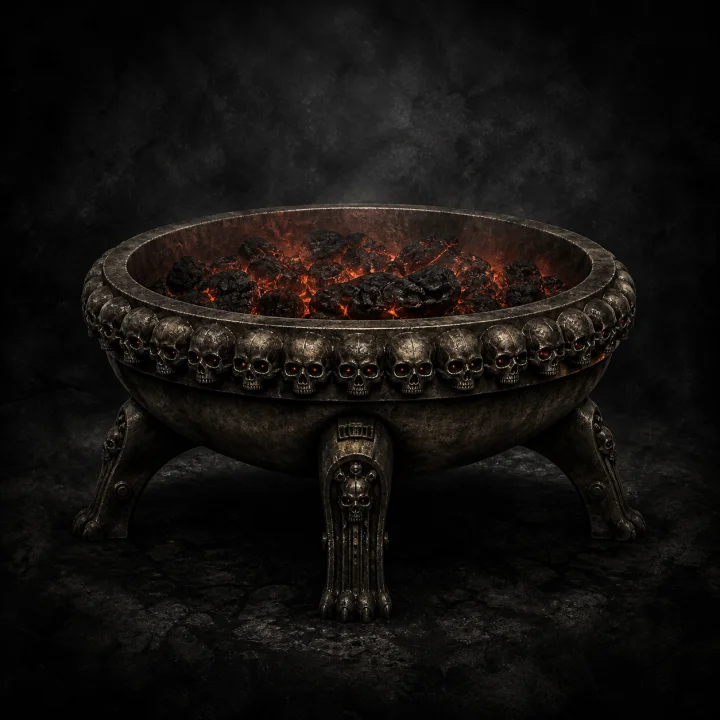
The field preacher explained to them that the Necrons have no souls and are therefore an abomination before the Emperor. The Ghessans, who believe in forest spirits, have made something of their own from this: the cold thing that does not breathe and does not rot is the opposite of the forest. They wage their war as a crusade, with prayers before every deployment and consecrated pitch on their grenades. Their courage is real. It is also the reason they go in too close.
The Left Behind
A reconnaissance platoon may not be slower than its slowest man. Whoever can no longer walk and does not fit on a vehicle receives a grenade, a swallow of burnwine and the backs of the others. The Ghessans call this an honour. The commissar calls it discipline. The mothers on Ghessa never learn of it. No soldier of the 7th has ever asked for help when he fell, because everyone knows that the plea changes nothing and only shames the others.
Further core facts
| Fact | Value |
|---|---|
| Militarum Regimentum | Ghessan Grenadiers |
| Byname | The Silent Seventh |
| Origin of the name | Handed-down tradition: the first 7th moved soundlessly through the jungle of Ghessa in 402.M37, and every new raising has taken on the name, whether it was silent or not. |
| Founding | 981.M41 (sixth raising) |
| Battle cry | "Out of the green—into the fire!" |
Raising, Homeworld & Culture
Raising & Tithe
The sixth founding of the 7th was drawn from the regular tithe in 981.M41, yet at the grade of Decuma Extremis that makes scarcely any difference from an emergency levy. Ghessa owes the Imperium more soldiers each year than it has trained men. So the Planetary Governor takes whole intakes: every boy and every girl of the river villages who turns sixteen in the year of the levy steps into the barges. There is no lot and no inspection that counts. Those of the same age go out together, and the companies consist of village classes who have known, insulted and covered for one another since childhood.
Planetary Governor Ossian Terevald knows what threatens him. A regiment with missing boots or impure bloodlines would cost him his head. Therefore he sends the strongest intakes and holds back the weaker ones for his own Planetary Defence Force. The Grenadiers know that they are the best their world possesses, and that no one loves them for it.
What the Homeworld Lost
Ghessa's river villages rebuild their stilt houses every nine years, because the wood rots in the water. For this a village needs forty hands that drive in the piles at the same time while holding the pile song. For three intakes these hands have been missing. In Uruvel the houses stand crooked; in Kesh-Tamar they collapsed in the last flood. The pile song has 60 verses. The elders still know eleven. The young ones who were meant to learn the rest sit in Salamander scout cars in the Segmentum Tempestus and sing the first three at muster, because they have never heard the others.
The Homeworld
Ghessa is a jungle world of humid heat and no winter. The canopy closes at a height of 60 metres so densely that the ground receives light only at midday. Between the trunks flow brown rivers that change their course every year. There are no roads, only waterways and rope paths in the trees. The population lives in river villages of two to three hundred people each and is governed by councils of elders who know the Imperium only as the "Sky Tithe".
The Ghessans hunt tree lizards with snares and fire pots, clay balls full of resin that they hurl burning into the nests. From these throwers the first 7th took its Grenadier title, and to this day a Ghessan throws a grenade farther and more accurately than almost any other soldier. They move silently, smell smoke at a kilometre and sleep sitting up. Their children steer dugout barges through rapids, and from this feel for speed and obstacle the Munitorum makes drivers for light scout vehicles. They hardly know machines. On the entire planet there are three cogitators, all in the Governor's palace.
The Disadvantage They Carry
A Ghessan has never seen a horizon. In the forest every line of sight ends after 40 metres, and all distances are judged by sound and smell. On open ground this sense fails completely. The soldiers consider a target at two kilometres near and one at 300 metres unreachable. Many grow dizzy beneath the open sky and crouch down.
On the glass plains of Tessk, 995.M41, the 4th Platoon of the 3rd Company reported a Necron position "a stone's throw away" and drove out. The position lay six kilometres away. The platoon needed 40 minutes across coverless glass, and the Necrons' gauss weapons acquired it halfway. Of 71 soldiers, nine came back. Since then every platoon has carried a Ratling who calls out the distances, and the Ghessans grudgingly trust him more than their own eyes.
Regimental Culture
The drill is hard and enforced with wooden canes. Muster in ranks of three takes place twice daily, even in the combat zone, even under the leaves, and the Ghessans hold it to be what separates them from the savages of their own world. On the march they sing the Stake Song, whose three verses tell of how to drive a stake into the mud until it holds. The officers call it a work song. The soldiers mean something else by it.
One superstition has survived every prohibition: before each deployment the soldiers place a leaf under their tongue and spit it out only once they have returned. Whoever swallows it believes himself lost. Commissars have flogged men for it and then given up.
The transport decks smell of mould, foot rot and the resin the grenadiers smear into their grenades. At night there is quiet whistling, birdcalls from home, so that no one forgets how they sound. The burnwine ration is saved and drunk on the evening the news of new levies arrives, because then people from their own village are on their way.
They bury their dead upright, bound to a tree, face turned upwards. When there is no time, all that remains is to place a twig in the dead man's hand and move on.
The Commissariat
The Grenadiers no longer fear their commissars; they use them. Chief Commissar Dorota Kell understood early that her real problem is not cowardice but a colonel who attacks too quickly. The soldiers have learned that Kell is the only person in the regiment who can refuse the colonel an order without being shot. So they carry to her what the colonel intends before he orders it. In 16 years Kell has shot four soldiers, three of them for looting. At the fourth, a driver who fled from Necrons, his comrades stood by and nodded.
Ranks & Organisation
Ranks
Rank Kesh
Description
Munitorum rank: Trooper · Form of address: "Kesh"
Rank Ruvo
Description
Munitorum rank: Non-commissioned Officer · Form of address: "Ruvo"
Rank Tamba
Description
Munitorum rank: Lieutenant · Form of address: "Tamba"
Rank Orru
Description
Munitorum rank: Captain · Form of address: "Orru"
Rank Orru-Vesk
Description
Munitorum rank: Major · Form of address: "Elder"
Rank Nkaru
Description
Munitorum rank: Colonel · Form of address: "Father of the Path"
Structure
According to establishment strength, the 7th comprises a regimental staff of 120 men and six reconnaissance companies of 380 each, 2,400 in all. Each company has an Orru with a command squad of 20 and four platoons of 90 men. A platoon consists of a Tamba and command squad of ten, five Grenadier squads of ten each, and 30 drivers and gunners for its 14 light vehicles: eight Salamander scout cars and six Scout Sentinels. The regiment fields no artillery and no battle tanks. It is meant to see, report and vanish.
Today the staff numbers only 90 men. The 6th Company was disbanded after Ushpet and distributed among the others. The 1st Company has 260 men, the 2nd has 240, the 3rd has 210, the 4th has 190 and the 5th has 150, 1,140 in all. The 5th Company drives with three platoons, because its fourth has no drivers left.
Constituent regiments
Name 7th Ghessa, "The Silent Seventh"
Role / notes
Rapid reconnaissance. Nkaru Tasso Ruumbel, who is missing his left ear. Destroyed five times, most recently in 979.M41 on Vesh-Anur. Along with the number, the sixth raising inherited a standard full of honours, a list of unpaid Munitorum debts and a reputation for being sent against Necrons. Currently in the Segmentum Tempestus, awaiting replacements.
Name Ghessa 212th, "The River Threshers"
Role / notes
Light infantry. Nkaru Amara Tollweh, with grey braids down to her belt. Garrison duty on an agri world in Tempestus. The regiment is almost at full strength and considers this an insult.
Name Ghessa 340th, "The Pitch Throwers"
Role / notes
Grenadiers, assault infantry. Nkaru Ebbo Salaq, with a hand of plasteel that he never touches. The regiment has been cut off behind a warp storm since 993.M41, and for four years no report has come through.
Command Staff
Attached Personnel
| Personnel | Number | Where the friction becomes visible |
|---|---|---|
| Commissars under Chief Commissar Kell | 6 | The colonel's orders, which Kell delays |
| Ratling snipers | 24 | Rations: the Ratlings steal, the Ghessans count |
| Preachers of the Ecclesiarchy | 22 | Prayers that last longer than a reconnaissance window |
| Servants of the Ecclesiarchy | 31 | Seats on the vehicles |
| Enginseers | 3 | Are shunned and accused of theft without reason |
The Enginseers eat alone. No Grenadier sits beside someone who speaks with machines.
The Regimental Standard
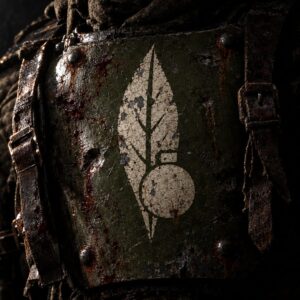
The standard is a rectangle of olive-green cloth on a pole of ironwood, three metres long. Embroidered on it are an upright leaf and a round grenade, and beneath them in red thread the battle honours: Vesh-Anur, Sorrhal Tertius, Ushpet, Tessk and 19 older names that no one can pronounce any more. From the pole hang 30 spat-out leaves, dried and lacquered. On Ushpet the standard-bearer fell into a river, the cloth drifted away, and a Ratling named Pimmo Dattelhall leapt in after it, although he could not swim. Both were pulled from the reeds a mile downstream.
The Flaw
The flaw
The stain on the 7th began in the first week on Sorrhal Tertius. A squad of the 1st Company carried an auspex that Enginseer Varro Hekt had blessed before the deployment. When the squad was ambushed and eight men fell, the survivors decided the device had called the Necrons, because it whistled in the same language they did. They smashed it with rifle butts. Hekt's report to high command bore the note "machine sacrilege through ignorance". Leth read it and burned the copy that was meant to go to the Adeptus Mechanicus.
Since then, it has been held in the regiment that a machine that works without a hand belongs to the enemy. The grenadiers drive their scout vehicles because they must be steered like barges. Auspexes, vox relays and targeting devices they avoid. They have traded their lasguns for ripper carbines, whose impact rounds they understand. In battle they report by smoke signals and runners, and lose time that a vox would have saved.
They themselves say that they remain pure. In quarters shared with other regiments they hang cloths over foreign vox installations and do not sleep in the same tent as cogitators. Other regiments call them "the Tree Apes" and hide their auspexes from them.
A Munitorum Failure
After Ushpet the regiment requisitioned slug rounds for its ripper carbines. The Munitorum still listed the 7th in its register as a lasgun regiment and sent 90,000 power cells. The requisition was ticked off as fulfilled. A second requisition was rejected as a duplicate. For eleven weeks the Grenadiers fought with captured ammunition, knives and resin grenades, until Kell wrote a complaint directly to the Lord Commissar of her sector. In those eleven weeks 212 soldiers died, most of them with empty magazines. The power cells still lie in a depot on a world the regiment has never set foot on again. The Munitorum bills it for them every year.
Known Campaigns
Campaigns
Name Sorrhal Tertius
Epoche 984.M41
Erzählung
984.M41, five months. Segmentum Tempestus, jungle moon. Enemy: Necrons.
The newly raised 7th landed at full strength in the jungle of a moon on which a tomb complex was awakening. The task was simple: find the exits of the tomb and report them, so that the 44th Tessarin Armoured Regiment could seal them. The Ghessans found 17 exits in three weeks, faster than any other regiment of the battlegroup. Ruumbel attacked four times without orders to seal exits with grenades. Two held; two opened again the next day. The Tessarins arrived late because their battle tanks became stuck in the swamp, and the Ghessans hauled them out with ropes and Salamander scout vehicles. In the end the tanks sealed the main tomb with demolition charges. Whether the Necrons within are sleeping or waiting, no one knows.
Result: Containment, not victory. Losses: 610 of 2,400.
Allies: The 44th Tessarin Armoured Regiment. The battlegroup was disbanded after the campaign and the Tessarins transferred to another Segmentum. Some Ghessans still wear plaques given to them by Tessarin drivers.
Name Ushpet
Epoche 989.M41
Erzählung
989.M41, eleven months. Segmentum Tempestus, alluvial world. Enemy: Necrons.
After replacement shipments the 7th marched with 1,980 men to Ushpet, where a Necron dynasty was emptying the river cities. Alongside the 6th Drovanian Line Regiment it held 900 kilometres of riverbank. Ruumbel's attack in the riverbed cost the 2nd Company 180 men. In the eighth month came the order to blow the Bridge of Tarrow, because a Necron phalanx was advancing across it. Three Drovanian companies were still on the far bank. Ruumbel queried twice, and high command's answer remained the same. The grenadiers fired the charges. More than 400 Drovanians were left behind on the other side. The regiment does not speak of it, except on one evening a year on which no one drinks burnwine. After Ushpet the 6th Company was disbanded.
Result: Withdrawal of the Necrons for unknown reasons; the world was half depopulated. Losses: 1,020 of 1,980.
Allies: The 6th Drovanian Line Regiment, which has never forgiven the Bridge of Tarrow. The Drovanians were sent to another Segmentum. The debt remains unatoned, and the 7th knows that it can never repay it.
Name The Glass Flats of Tessk
Epoche 995.M41
Erzählung
995.M41, four months. Segmentum Tempestus, desert world of fused sand. Enemy: Necrons.
With 1,600 men the 7th was sent to a world on which there was not a single tree. The regiment was to scout the Necron positions for the 3rd Quall Artillery. On the open glass the grenadiers lost all sense of distance. The 4th Platoon of the 3rd Company drove to its death. After that the Ratlings were given the task of calling out ranges, and the reports became precise enough that the Quall batteries shattered three positions. The fourth position survived the bombardment and advanced, whereupon the battlegroup was forced to withdraw.
Result: Stalemate, orderly withdrawal. Losses: 460 of 1,600.
Allies: The 3rd Quall Artillery, whose gunners taught the Ghessans to estimate distances with thumb and arm. The battlegroup was disbanded before the Ghessans could thank them.
Vehicle livery
How the regiment’s vehicles are painted: base colour, camouflage for the theatre, turret band and markings, derived from the regimental colours.
| Theatre | Jungle and swamp · Blotch camouflage |
|---|---|
| Base colour | #264715 · Castellan Green (Uniform) |
| Camouflage | #2F4A2A · Castellan Green (theatre standard)#462F30 · Rhinox Hide (Webbing) |
| Turret band | #650001 · Khorne Red (Neckcloth) |
| Markings | #ABA173 · Ushabti Bone (Insignia) |
| Hull recipe | Castellan Green (Base) · Athonian Camoshade (Shade) · Loren Forest (Layer) · Elysian Green (Edge) |
Company bands on the turret
- 1.
- 2.
- 3.
- 4.
- 5.
- 6.
- 7.
- 8.
- 9.
Derived from the regimental colours; the silhouettes are our own sketches, not copies of any Games Workshop model.
To the core data
The low ordinal marks an ancient formation that has been raised anew again and again. Ghessa's other regiments bear numbers beyond 200, because under its tithe the world gives up new formations almost every year.
The 7th has been wholly destroyed five times, most recently in 979.M41 in the tomb chambers of Vesh-Anur, where Necrons wiped it out within a single night. Today's soldiers know not one of the dead whose honours they bear. They speak of them as "the Ones Before" and do not carve their names, because no one knows them. Instead, at the oath, every recruit names a dead man from his own village and claims he served in the 7th. Usually it is a lie, and everyone knows it.
Command Staff (continued)
Nkaru Tasso Ruumbel
Ruumbel is 52 years old, broad, with sloping shoulders, and a Necron scarab ate his left ear. He carries a Ripper carbine with an ironwood stock, which he calls "Mother". Ruumbel is hot-tempered. He sees an enemy and drives at it. On Ushpet a scout reported a Necron column in the riverbed to him. The order was to observe and report. Ruumbel sent the 2nd Company driving into the column's flank, destroyed two transports and lost 180 men in doing so when the dead rose again. He never apologises. He only visits every wounded man afterwards and says the same thing to each.
Chief Commissar Dorota Kell
Kell is slight and comes from a cold world, and she is cold even in the jungle heat. She always wears her coat closed. She has never cleaned her bolt pistol, because rust, as she says, is more honest than oil. On Sorrhal Tertius she stood in front of Ruumbel's scout car when he meant to attack for the third time in one day, and she stayed standing until he switched off the engine. Since then the two speak only what is necessary to each other. The soldiers call her "the Brake" and mean it kindly. She knows about the leaf under the tongue and has one herself.
"I shoot cowards, Colonel. For heroes we have the enemy, and he is faster than I am." — Chief Commissar Dorota Kell
Field Preacher Okonjo Leth
Leth is an old man with a milky right eye. He came to Ghessa as a missionary and left with the first intake he had baptised. He wears a rosary of Necron splinters, each splinter pierced and dipped in pitch. He invented the crusade the Grenadiers wage. He explained to them that the Necrons are soulless, and he never objected when they made forest spirits of them. On Tessk he blessed a Salamander scout car so that its driver would climb in, though the driver believed the auspex inside called the dead.
"The Emperor understands every language. If they call him 'Great Tree', then let him be a tree." — Field Preacher Okonjo Leth
A Scene
The leaf under my tongue tastes of soap, because it comes from the transport and not from the forest. Beside me Ruvo Tebbe chews on his and looks over the edge of the embankment.
Down in the riverbed the Cold Ones walk. I count 30, then I stop. They walk without water splashing, and their eyes glow green like rotten wood. The order is: count, report, withdraw. I have heard it three times, once from the Tamba, once from Tebbe, once from the commissar, who has come down to us and now crouches behind the second scout car, freezing.
I write the number on the bark. Tebbe takes it and gives it to the runner. The runner runs. Then we should go.
We do not go, because the Nkaru's scout car breaks through the undergrowth, engine loud, the standard at the rear, and drives down into the riverbed.
Tebbe curses. Not at the Nkaru, just in general, in the language of Uruvel, which I do not speak. Then he stands up. Then the whole platoon stands up.
I wait for someone to scream, for us to run, for us to scatter like children who want to go down to the river. But the Tamba calls the command I heard 400 times on the parade ground and hated him for: "Three ranks! A hand's spacing!" And we fall in. Under leaves, on a slope, with Cold Ones in the riverbed. Three ranks, a hand's spacing, the line straight as a stake.
"First rank, throw."
I throw. The grenade burns in the air. I see it fall, resin spraying over the metal shoulders.
"Second rank, throw."
A Cold One raises its weapon, and Kesh Anuk beside me is suddenly no longer there. Only dust where he stood. Tebbe steps half a pace to the left into the gap, and the rank is straight again.
"Third rank."
The Nkaru stands below on his scout car and fires the big carbine, and he roars as he does it, as if he were hunting an animal. I know he is wrong. Tebbe knows it. The commissar behind us knows it; he has the pistol in his hand and is aiming at no one.
Then the scout car drives back up, smeared black, and the Nkaru shouts: "Back! Back!" We turn away in three ranks, as on the parade ground, and only run when the Tamba says so.
In camp Tebbe counts off. Six are missing. He spits out his leaf and looks at it for a long time.
"Do you still have yours?" he asks.
I nod. I have not swallowed it, though I wanted to the whole time.
"Good," he says. "Then you're one of us now."
I do not ask him what the six were, then.
In the evening the Nkaru comes through the lines. He sits with every wounded man and says the same word to each, and I do not hear it, because I am sitting too far away. I do not want to hear it, either. I only want him to drive again tomorrow, and for me to stand up again.