31st Veldrack
“We stand in line. We count our own. We keep our distance. We fire when ordered.”
Story: Where Nothing Answers
Core Data
| Regiment type | Line Infantry (lasgun, four charge packs, flak armour; the backbone) |
|---|---|
| Munitorum designation | MUN-VLD/LI-031/961-K |
| Homeworld | Veldrack |
| Tithe grade | Solutio Tertius |
| Establishment strength | 6,000 |
| Current strength | 2,315 |
| Allegiance | Loyal |
| Origin | Original regiment |
The pillars
The Line
A Veldracker is never alone; he is a place in a line. Whoever falls leaves a gap, and the gap is closed before anyone mourns. The regiment believes that order protects: a straight line can weep and still hold. On the Minster Square of Ostrein a guardsman fired and wept as he did so, and none of the men beside him took it for weakness. It was exactly what the line demands of him: that he keep his place as long as the order stands, and that he deal with what he feels while doing it later, alone.
The Count
On Veldrack everything is recorded, and the regiment has brought this habit with it. Every sergeant keeps a list; every dead man gets an entry. The Greycoats believe that a counted dead man is not lost. It comforts them more than it should. After Ostrein Scribe Loos read out the sum of the suicides and broke off in the middle of the sentence. Since then some distrust the count, but no one has stopped keeping lists. Without a number they would not know what they have lost.
The Distance
The regiment keeps its distance: from officers, from strangers, from everything it does not understand. Five paces are Veldrack courtesy. Since Ostrein the number means more. In the regiment the men sat at night five paces away around the fire of a woman who calmed them, and they drew back when she stood up. That is the uncomfortable pillar: the Greycoats believe that what heals you must be kept at a distance, and that it is right to need a person you abhor.
The Order
A Veldracker obeys, and he obeys even when he knows the order is wrong. The regiment calls it loyalty. On the Minster Square, after three warnings, it shot 4,000 unarmed people, and on the seventh morning after the falling silent it carried out the purge in the Minster quarter. The Greycoats say the guilt lies with the order and not with the hand. They say it often, and they say it quietly.
Further core facts
| Fact | Value |
|---|---|
| Byname | the Greycoats |
| Origin of the name | The name is inherited tradition: the Veldrack wool guilds have not dyed for centuries, and every regiment of the world wears the unbleached coat. |
| Regiment type | Line infantry |
| Founding | 961.M41 |
| Tithe grade | Solutio Tertius |
| Battle cry | "Grey unto the Throne!" |
Raising, Homeworld & Culture
Raising & Tithe
31st Veldrack was raised in 961.M41 in the regular tithe, without emergency levy and without haste. The world gives up its regiments by a lottery that the administration calls "the Drawing". Every district reports its able-bodied, the Munitorum draws by numbers, and drawing goes on all year round. The procedure is considered just, and that is precisely what makes it hard. No one can be angry at a guilty party; no one has bought himself free. Whoever is drawn receives a notice with his number and a deadline of eleven days. The drawn leave in good order, with a packed trunk. They do not carry their anger outward; they set it aside like a bill that cannot be paid.
The Planetary Governor of Veldrack is personally liable for full strength, training and equipment. A shortfall of more than three in a hundred counts as treason. That is why the Governorate has the best districts drawn first. This happens out of self-preservation, and the districts know it.
What the Homeworld Lost
With the Drawing of 961.M41 the district of Harlsgrund lost almost an entire generation of its accountants. The counting-houses of the wool guilds, which had recorded the exports for three centuries, have since worked with old men and apprentices, and two guilds have had to surrender their books to the Governorate because no one could close them any longer. The evening peal of the district bells, which requires twelve ringers in fixed sequence, is now rung in Harlsgrund by only five. The sequence is shortened, and the old people say that since then the district no longer knows exactly when the day is over.
The Homeworld
Veldrack is a temperate civilised world with long, damp winters and grey upland pastures on which millions of sheep stand. The wool is processed undyed, for dyes must be imported, and importing is considered waste. The cities are flat, built of rubble stone and ordered by bells: the start of work, midday, the change of shift and the night's rest are rung from towers and public vox-masts, and all of life follows the rhythm of the administration.
The society is civic, pious and exact. A Veldracker learns mental arithmetic and liturgy at the same time at the age of six and knows his place in three lists: district, guild, parish. Crimes are rare, disputes are settled at the office, noise is considered indecent.
This makes them useful as soldiers: they hold lines, they keep inventories, they waste no charge. A Veldrack platoon counts its power cells after every engagement before it counts its dead, and it finds both numbers. Discipline does not need to be taught to these people. They need to be taught that an order can also be wrong.
The Disadvantage They Carry
The Veldrackers trust the peal. Whoever has worked all his life by bells and vox-signals follows a regular tone before he asks who is sending it. This trust has already cost the regiment lives.
On Orvenne, 964.M41, Orks broadcast a time signal in the rhythm of the Imperial field peal over a captured relay station. The Second and Fourth Companies moved into the designated position at the rung hour without waiting for confirmation from the staff. They ran into a hollow that the Orks had been ranging for days. 312 men fell in one hour.
In Ostrein the regiment hummed along to the blessing-peal of the Ecclesiarchy from orbit onward, and Scribe Loos did so the loudest. What followed from it stands in the eighth chapter.
Regimental Culture
The drill is pedantic and quiet. Orders are spoken, seldom shouted. Marching practice in step continues until a Company can cross cobbles without a single heel being heard. The marching song is called "The Roll". It lists district names, verse by verse, and ends each time with the line "and none is missing". When there are losses it is still sung, but the line is left out.
The superstition the officers no longer fight is the bell-count: before an attack every soldier counts quietly to twelve, and whoever miscounts swaps his place in the line. On the transport decks it smells of wet wool, gun oil and cold gruel. One hears prayers, dice and the clicking of cells being counted through. The spirit ration is collected and drunk together at the end of a campaign, to the names of the dead. Until then no one sells it.
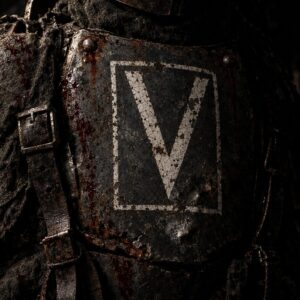
When there is time, the Greycoats bury their dead in rows, the coat as shroud, the white V facing up. When there is no time, they cut off the sleeve and take only the V with them. Every sergeant carries such sleeves in his knapsack until a field preacher blesses them.
The Commissariat
The regiment has made peace with its commissars, and the Commissariat makes use of that peace. Commissar Ilmar Dettling seldom shoots and always explains. The Veldrackers respect him because he takes their orders off their hands: the order to fire on the Minster Square came from him, and everyone knows it. This respect has a cold side. The soldiers rely on the guilt having an address. Whoever goes to Dettling goes to confession with a man who cannot absolve. Since Ostrein some no longer salute him. None contradicts him.
Ranks & Organisation
Ranks
Rank District Reeve
Description
Munitorum rank: Colonel · Form of address: Herr District Reeve
Rank Chancellor
Description
Munitorum rank: Major · Form of address: Herr Chancellor
Rank Bailiff
Description
Munitorum rank: Captain · Form of address: Herr Bailiff
Rank Clerk
Description
Munitorum rank: Lieutenant · Form of address: Clerk
Rank Foreman
Description
Munitorum rank: Sergeant · Form of address: Foreman
Rank Drawn
Description
Munitorum rank: Trooper · Form of address: by number
Structure
At its founding in 961.M41 the regiment comprised 6,000 men in twelve infantry Companies of 450 men each and a staff with medical platoon and baggage train of 600 men. A Company was divided under a Captain into five platoons, a platoon under a Lieutenant into eight squads of ten men, plus a special weapons squad and a heavy weapons squad.
Today the regiment fields eight Companies. At the landing on Ostrein 2,000 men stood in the Companies and 400 in staff, medical platoon and baggage train. The Seventh had 180 men, the Third under Captain Liebherr somewhat more. Most platoons have only three or four squads left, and the heavy weapons squads were merged. The regiment possesses no artillery, no tanks either, and it never had them.
Constituent regiments
Name Veldrack 9th "the First-Drawn"
Role / notes
Line infantry. Colonel Ruprecht Hallweg, bald, with a grey glass eye. The regiment was destroyed in 948.M41 and raised anew in 952.M41. Along with the number, the new levy inherited its predecessor's debts to the Munitorum: three years of deductions from the ration for equipment lost with the old regiment. It is stationed as a garrison in the Segmentum Obscurus.
Name 31st Veldrack "the Greycoats"
Role / notes
Line infantry. Colonel Hanno Merz, stocky, a scar drawing up the left corner of his mouth. After Ostrein the regiment is encamped on the North Field, awaiting embarkation. Where to has not yet been decreed.
Name Veldrack 58th "the Ringers"
Role / notes
Pioneer infantry. Colonel Ilse Karrenbach, left arm of plasteel from the elbow down. The regiment is working on fortifications on a border world and has received no replacements for six years.
Command Staff
Attached Personnel
| Function | Number | Origin |
|---|---|---|
| Commissars (including Dettling) | 6 | Commissariat |
| Field preachers and preachers | 14 | Ecclesiarchy |
| Servants of the Ecclesiarchy | 22 | Ecclesiarchy |
| Scribe (Vennet Loos) | 1 | Departmento Munitorum |
| Registered Blanks | 0 | struck off in Ostrein |
The friction shows at the fires. Commissars and preachers stand outside the chain of command, and their orders come from there. The medical platoon under Orlo Wend lost its only Blank, whom they needed and hated.
The Regimental Standard
The standard is a cloth of undyed Veldrack wool, two metres wide, with a woven white V and an Aquila of brass on the crossbar. On the lower hem are embroidered eleven battle names of its predecessors, among them, newly, "Orvenne" and "Sennar". Three purity seals are fixed to the crossbar. On Orvenne it was almost lost: when the standard-bearer fell in the hollow, the cloth lay under fire for three hours until a squad of the Fourth brought it back. Nine men did not return. The hem has been scorched at one corner since then, and no one has mended it.
The Flaw
The flaw
Something clings to the regiment, and no one calls it by its name. It came in Ostrein. From their entry into the system the Greycoats heard the blessing-peal on every channel, and many heard more than bells in it. The field preacher heard his mother. Sergeant Hollin went into the minster at night without her rifle and left the picture of her son on her cot. The Seventh Company sat smiling for an hour under the fire of the Arbites.
The report on the Seventh was signed by Captain Liebherr. He wrote what he had seen, and no explanation of it. To this day no office has demanded one.
In ordinary service it shows in small things. Men hum when a vox-set chimes, and break off when someone looks at them. At devotions some hold their heads tilted like someone listening to a conversation in the next room. In battle the Seventh hesitates when the fire becomes steady.
The regiment tells itself it was there only thirteen days, and thirteen days are not forty. Other regiments on the North Field pitch their tents on the far side of the runway and call the Veldrackers "the Listeners". They ask where their Blanke has gone, and why a regiment that claims to have heard nothing sings so quietly.
A Munitorum Failure
After the merger of 964.M41 the Munitorum listed the 900 Kessmarers twice: once under 31st Veldrack and once under their old designation, which had never been deleted. A reconciliation in the sector chancery in 965.M41 found the duplicate names and struck 600 of them from the regiment's ration roll. The men in question were still alive. For nine months the regiment received rations for 3,400 men and had to feed 4,000. In the winter quarters on Orvenne dysentery broke out, and 140 men died of hunger and diarrhoea before a commissar found the error in a file. The correction came with the annotation: balance in order.
Known Campaigns
Campaigns
Name Orvenne
Epoche 964.M41
Erzählung
964.M41, 14 months. Segmentum Obscurus, border world Orvenne. Enemy: Orks.
The regiment came with 6,000 men to an agri-world whose grain plains had been overrun by an Ork tribe. It fought in Battlegroup Orvenne alongside the 112th Morrhan Armoured Regiment and the 6th Gallheim Artillery. The Veldrack drill proved itself in the trenches, and it failed at the false time signal that led the Second and Fourth Companies into a ranged-in hollow. That day the Gallheimers fired a barrier barrage that held the Orks long enough for the survivors to get out. The regiment owes them that hour and will never repay it: after the campaign the battlegroup was disbanded and the Gallheimers transferred to another sector.
Because no replacements came from Veldrack, the Munitorum in the end decreed the merger with the 900 survivors of the Kessmar 18th from the mining world Kessmar. The Kessmarers curse, drink their spirits at once and take the Veldrackers for bookkeepers. After twenty years they can be told apart only by their curses.
Outcome: Stalemate. The plains remained contested until the Orks moved on.
Losses: 2,900 of 6,000. Afterwards 3,100 Veldrackers and 900 Kessmarers, 4,000 in total.
Name Sennar
Epoche 982.M41
Erzählung
982.M41, 22 months. Sennar, industrial world. Enemy: renegade Planetary Defence Forces and heretic cults.
Together with the 40th Arden Rifles, the regiment fought a house-to-house battle through factory districts half held by cultists. It lasted almost two years and proceeded block by block. The Ardeners carried the regiment's wounded back across a bridge the Veldrackers had been forced to abandon. From this grew a friendship that ended with the decree of embarkation. The Ardeners went to the Segmentum Tempestus, and the regiment has heard nothing more of them.
On one of the last nights Sergeant Dessa Hollin sat beside a stretcher on which a young man of her platoon was no longer screaming. Beside her sat the stretcher-bearer, the only one in the regiment she stayed close to.
Outcome: Victory on paper. The world returned to the Imperium with factory output of about a third.
Losses: 1,600 of 4,000.
Name Ostrein
Epoche 987.M41
Erzählung
987.M41, 13 days. Sarvanth, Hive Ostrein. Enemy: the Choir of the Arbites and that which stands behind the solace.
The regiment landed with 2,400 men on the North Field to restore order in a city that had known no crime for five months. On paper it belonged to Battlegroup Sarvanth, together with the 17th Halsen Mortar Regiment, which remained in orbit because it was given no target. On the second day the regiment shot 4,000 smiling pilgrims on the Minster Square. On the fourth it lost 84 men in the Court Street against the Choir of the Arbites, while the Seventh Company laid down its weapons and sat down. On the sixth a platoon descended beneath the minster, and the organ fell silent. In the days that followed, over 30,000 people in the hive died by their own hand. On the seventh morning after the silence, on the order of Inquisitor Thessaly, the purge of the resonance-bearers in the Minster Quarter began.
Outcome: Mission accomplished, city silent.
Losses: 85 of 2,400: 84 fallen in the Court Street and the stretcher-bearer Tamsin Varnholt, struck off as "fallen in Ostrein".
Vehicle livery
How the regiment’s vehicles are painted: base colour, camouflage for the theatre, turret band and markings, derived from the regimental colours.
| Theatre | Forest and grassland · Blotch camouflage |
|---|---|
| Base colour | #39484A · Mechanicus Standard Grey (Coat grey) |
| Camouflage | #3E5A34 · Castellan Green (theatre standard)#6B5A3A · Steel Legion Drab (theatre standard) |
| Turret band | #462F30 · Rhinox Hide (Leatherwork) |
| Markings | #EDC169 · Retributor Armour (Standard brass) |
| Hull recipe | Mechanicus Standard Grey (Base) · Nuln Oil (Shade) · Dawnstone (Layer) · Slaanesh Grey (Edge) |
Company bands on the turret
- 1.
- 2.
- 3.
- 4.
- 5.
- 6.
- 7.
- 8.
- 9.
Derived from the regimental colours; the silhouettes are our own sketches, not copies of any Games Workshop model.
To the core data
The ordinal 31 is low for a world that has been giving up regiments for centuries: it denotes an old number, first assigned in 412.M39 and raised anew again and again ever since, whenever its predecessor fell from the rolls. The present 31st is the fourth raising under this number. The three predecessors were destroyed, the last of them completely in the year 940.M41. With the number, the soldiers of 961.M41 inherited eleven battle names on the standard, not one of which has a survivor. They speak them along at roll call, the way one reads the names on a family grave: correctly, without knowing who lies beneath.
Command Staff (continued)
Colonel Hanno Merz
Stocky, calm, a scar that draws up the left corner of his mouth, so that he always seems to be half smiling. When he is thinking, he lays his thumb on this scar. Merz weighs everything, and he attacks late. In Ostrein he searched for days for the disorder he was supposed to put down, and found none. His costliest decision came after the Court Street: he placed a stretcher-bearer who is no soldier ten paces behind the spearhead, because beside her he had one more platoon. He knew what he was doing to her, and he told her so. When Thessaly demanded the purge, he stood up to object, and sat down again.
Commissar Ilmar Dettling
Gaunt, grey temples, a quiet voice that is heard without his having to raise it. He carries the Commissariat's laspistol in a holster whose leather has gone soft with use. For twenty years he has made no decision without regretting it, and he has the weariness that goes with it. On the second day, at the Minster Square, he called the warning three times, first in High Gothic, then in Low Gothic. The order to fire he did not speak aloud. On the seventh morning after the Silencing he detained the stretcher-bearer who refused the purge, and carried out the purge, without harshness and without joy.
"I regret it." — Commissar Ilmar Dettling
Field Preacher Ansgar Pohl
Soft of face, with hands that always rest on something: on the prayer book with the loose spine, on a shoulder, on his own knees. Pohl is a field preacher of the Ecclesiarchy and listens to the regiment's worries, from constipation to homesickness. His mother has been dead for nineteen years. In orbit above Sarvanth he heard her in the consolation and wept without a sound, his face open. To a boy who feared for his dead sister, he said she had long since forgiven him. After the Silencing he sat on a crate and explained the suicides as grief.
"My mother. She says I did nothing wrong." — Field Preacher Ansgar Pohl
A Scene
Kerrin Abt of the Fifth sat in the circle and did not know how he had got there.
He remembered walking past the medical tent with his mess tin, because the shorter way to the latrines ran along there. Then he was standing, and then he was sitting. Now he had wet paving beneath him and on his right a man from the Third who was missing half a sleeve and who smelled of smoke and vomit. On his left sat one from the Seventh.
Abt did not know the face. He knew only the Company, and everyone had known it since this afternoon. One hundred and eighty men who had sat cross-legged on the Court Street while the shot hissed over their heads. Afterwards they had stood up and walked into the camp as though they had come out of a service. No one had spoken to them. Now one of them sat beside Abt, his hands resting on his knees, and wept.
Between the circle and the fire lay a gap, five paces perhaps, and no one moved closer. At the fire sat the bearer.
Abt had seen her three times since they had been on Sarvanth, and each time he had felt sick, a flat, dragging nausea like that from bad water. He was on his first campaign. In basic training they had told him the word, and they had told him not to eat beside her.
Now he felt sick as well. And yet it was quiet.
He had not noticed it until it was gone. The ringing had been there since orbit, always soft, always kind, and somewhere within it, for three nights, his father's voice, telling him that the matter of the workshop was forgiven. Abt had thought that was his own head. Here, five paces from the fire, his head was empty, and in that emptiness the workshop stood as it had been: his father had forgiven nothing and had died without saying a word about it.
It made Abt sick, and it was the best thing he had felt since the landing.
"You stink of silence," someone said from the dark behind him. He said it almost tenderly.
The bearer stood up to fetch water. The whole circle drew back, Abt with it, without his wanting to. It happened as evenly as if someone had given the order. The man from the Seventh drew his knees to his chest.
In that moment Abt understood what he was. He belonged to a line that drew back when the thing came that saved it, and that stayed because it needed it. Tomorrow they would place this woman ten paces behind the spearhead, and they would follow her and keep their distance as they did.
She came back with the bucket. The circle was still there.
Abt counted quietly to twelve and did not miscount.
From this Regiment
Stories 1
Characters 9
- Chaplain Ansgar Pohl Chaplain
- Sergeant Dessa Hollin Sergeant, platoon leader in the Third Company
- Guardsman Gerit Ruven Guardsman, carries the stretcher; leads Hollin’s platoon in the Estates Tunnel
- Guardsman Tobler Guardsman, Seventh Company
- Captain Liebherr Captain, leader of the Third Company
- Commissar Ilmar Dettling Regimental commissar
- Colonel Hanno Merz Colonel, commander of the 31st Veldrack Regiment
- Medical Officer Orlo Wend Medical officer
- Tamsin Varnholt Stretcher-bearer, Blank (protagonist)