213. Vessmark Ironsides
“The angle is prayer. The barrel has a soul. The debt is fired off. What we do not see, the Throne bears.”
Core Data
| Regiment type | Artillery (Basilisks and mortars, never fights at visual range) |
|---|---|
| Munitorum designation | MUN/TEMP-VSM/213-ART/772 |
| Homeworld | Vessmark |
| Tithe grade | Decuma Tertius |
| Establishment strength | 3.600 |
| Current strength | 1.140 |
| Allegiance | Loyal |
| Origin | Original regiment |
The pillars
The Angle Is Prayer
The field preachers of Vessmark taught the recruits that ballistics is a form of devotion. Every calculation begins with an invocation, and every elevation is counted aloud like a rosary. Whoever miscalculates has prayed badly. This makes the gunners slow and precise, and with every missed shot it awakens a fear that reaches far beyond the military. A barrel chief who has missed three times makes confession before he is allowed back to the laying gear.
The Barrel Has a Soul
Every Basilisk bears a name, a purity roll and a list of the salvoes its machine spirit has already endured. The crews sleep beside their guns, rub the breeches with consecrated oil and talk to them. Abandoning a gun is held to be graver than leaving a comrade behind. The Enginseers did not order this. It simply came to be, and no one is ashamed of it any more.
The Debt Is Fired Off
Since Ketterhain the regiment has believed that its shame can be paid off in shells. Every salvo is recorded in a book the gunners call "the Reckoning". No one knows how large the sum is. The belief keeps them upright and at the same time leaves them unable to endure a ceasefire: whoever does not fire does not pay, and whoever does not pay remains in debt.
What We Do Not See, the Throne Bears
No gunner has ever seen what he kills. The regiment has made a doctrine of this: responsibility for the target lies with the observer, with the order and, in the end, with the Emperor. After Hallgrabe this doctrine saved men from madness. But it also means that no one in the regiment has ever asked who stood beneath the impacts. That is intentional.
Further core facts
| Fact | Value |
|---|---|
| Origin of the Name | Earned in battle: after the bombardment of Hallgrabe in 774.M41, a tank regiment named them so because they had destroyed a city that none of their gunners ever saw. |
| Founding | 772.M41 |
Raising, Homeworld & Culture
Raising & Tithe
The 213th was raised outside the regular tithe. When Drukhari kabals depopulated three neighbouring systems in the Tempestus fringe in 771.M41, the Munitorum demanded a complete artillery regiment from Vessmark within a single year. Vessmark had already given up its training cohorts. It therefore took serfs from the fief villages, smithy hands and church servants, gave them eight months of drill instead of the usual two years and sent them off.
Even so, four times more volunteers came forward than there were places. On Vessmark, service is the only way out of serfdom. Those turned away stayed behind in shame, and those chosen departed with the feeling of having won, and with the anger of people sent too quickly into a war. The planetary governor, Baron Odo Castran, had the required strength counted three times over. A missing uniform or an impure recruit would have cost him his head. He gave up the finest gunsmiths of his world, and he did so out of fear for himself.
What the Homeworld Lost
Vessmark lost its founders. Half the apprentices from the bell foundries of Brandholm went into the 213th, for whoever can cast bronze also understands a gun breech. Since 773.M41 eleven bells of the Cathedral of Brandholm have cracked and not been replaced. The morning peal, which required forty-two bells in fixed sequence, is now played with thirty-one, and every child hears the gaps. With the founders went their guild song as well. It was sung only during casting, and today only men counting shells aboard warships in the Segmentum Tempestus still know it.
The Homeworld
Vessmark is a knight world with short, wet summers and long winters full of fog. Hilly farmland is cut through by basalt ridges on which the castles of House Corvane stand. At the very top stands the House with its Imperial Knights, beneath it the landed nobility, beneath them the serfs who grow the grain, fire the castle forges and haul the Knight armour on their backs across the ridges.
The serfs of Vessmark have been auxiliaries all their lives. They have tended machines larger and holier than themselves, learned litanies while reloading and obeyed orders they did not understand. An Imperial Knight requires forty hands for every day of battle. This is why Vessmarkers are patient gunners. They can haul shells for eighteen hours without asking where they will fly, and they treat a Basilisk with the same reverence as their liege lord's Knight.
On Vessmark the Cult of the Machine has grown closely entwined with faith in the Emperor. The House's Tech-Priests and the Ecclesiarchy share the chapels, and every serf knows the prayers of both.
The Disadvantage They Carry
Vessmarkers obey the coat of arms, not the rank. All their lives the word of a noble has carried more weight than any logic. An order from someone in a surcoat is carried out at once; a warning from a common soldier or a Ratling counts as idle talk.
At Sorrow Weir in 782.M41 the Ratling observer Jemmet Querl reported over vox that the Drukhari were outflanking their position. The squire on duty, a noble son of eighteen, overruled him because the report had "not been transmitted befitting rank". The battery stayed where it was. An hour later Raiders were over the guns. Forty-nine gunners died, three Basilisks were lost, and Querl was carried off as a prisoner. Since then a note has hung in every fire-control post: "The report has no rank." The older men laugh at it. It is still not reliably obeyed.
Regimental Culture
The drill is partly liturgy. Loading, laying and firing are counted in antiphonal chant between barrel chief and crew. On the march and while hauling shells they sing "The Bell of Brandholm", a founders' song about an apprentice who falls into the mould and rings on as a bell. The officers consider the song morbid. The gunners sing it anyway.
It has long since ceased to be suppressed: before every readiness to fire, each gunner lays a pebble from home on the breech and pockets it again afterwards. Whoever loses his pebble is shunned during the night.
On the transport decks it smells of gun oil, cordite, wet felt and the preachers' incense. One hears dice, quiet prayers and the constant tapping of the Enginseers at the breeches.
The spirit ration goes to the guns. Each crew pours a mouthful over the barrel and drinks the rest in silence. The dead, when there is time, are buried facing the direction of fire, and a shell cap is placed on the grave. Without time, they are entered in the Reckoning, "paid", and the column moves on.
The Commissariat
The 213th has come to terms with its commissars, and not out of affection. Since Ketterhain the regiment has believed itself watched, and the commissar is, to its mind, the visible watcher, preferable to an invisible one. The commissars exploit this need. Executions are rare, because the gunners report one another before a commissar notices anything. What they lack are advocates. At Sorrow Weir no one spoke for the Ratling spotter Querl. Since then Hauptkommissar Holm has carried the note bearing his name in his breast pocket.
Ranks & Organisation
Ranks
Rank Warlord
Description
Munitorum rank: General · Form of address: "Your Highborn Grace"
Rank Reeve
Description
Munitorum rank: Colonel · Form of address: "Lord Reeve"
Rank Steward
Description
Munitorum rank: Major · Form of address: "Lord Steward"
Rank Banneret
Description
Munitorum rank: Captain · Form of address: "Banneret"
Rank Squire
Description
Munitorum rank: Lieutenant · Form of address: "Squire"
Rank File-Master
Description
Munitorum rank: Non-commissioned officer · Form of address: "Master"
Structure
The required strength of 3,600 men was divided among twelve companies: six Basilisk batteries of three platoons each with three guns, making 54 Basilisks; four mortar companies of four platoons each with four mortar squads of ten men; plus two baggage companies for ammunition, recovery and provisions. Infantry for its own protection is practically non-existent, only one guard squad with lasguns per battery. The Division Doctrine saw to that.
With 1,140 men, three batteries with 23 Basilisks between them remain in the field today, four fewer than the required 27. Added to these are two mortar companies, one of them made up almost entirely of Kaddrener men, and a baggage company at half its intended strength. The batteries therefore fight without reserves. If a gun falls out, its platoon falls silent.
Constituent regiments
Name 211th Vessmark Ironsides, "The Fief Guard"
Role / notes
Light infantry on garrison duty on Vessmark itself. Colonel Ansgar Thule wears a brass eyepatch bearing the Corvane arms. The regiment guards the Knight castles and has not left its home world since 760.M41. This makes it hated by the others.
Name 212th Vessmark Ironsides, "The Second-Born"
Role / notes
Mortar regiment. In 779.M41 it was completely destroyed on Drannoch, and in 784.M41 it was raised anew under the same number. Along with the number, the new recruits inherited seven honour ribbons, a frozen pay chest and a hatred of Drannoch's governor. Colonel Mirelle Dask limps on a wooden leg. The regiment is stationed in the replacement depot on Tiver.
Name 213. Vessmark Ironsides, "The Blind of Hallgrabe"
Role / notes
The artillery regiment of this dossier, under Colonel Brannoch Vael. It is currently deployed in the Kelvarsrand region.
Command Staff
Command staff
Name Colonel Brannoch Vael
Titel / Rolle Reeve of the 213th
Beschreibung
A broad man with a red face. The scar of a burn runs across his neck and darkens when he is angry, and he is angry often. He carries a brass pocket watch set to Vessmark time. He winds it again and again and never looks at it. At Pellenfurt in 797.M41 he ordered counter-battery fire on a Drukhari Razorwing before the Ratlings had confirmed the target. In doing so he betrayed the position of the Second Battery. Raiders pushed in, and nineteen gunners died. Vael entered their names in the reckoning with his own hand. Then, at the next Razorwing, he fired too early again.
Zitat
"To wait is to bare your throat. Fire!"
Name Hauptkommissar Gerrit Holm
Beschreibung
Gaunt, grey and quiet, with spectacles of which one lens is cracked and has never been replaced. He carries a prayer book of the Ecclesiarchy, in which he writes the names of the executed. In twelve years there have been four. At Pellenfurt he placed himself between Vael and the fire-control post and kept his hand on his bolt pistol, but without drawing it. Vael thereupon waited thirty seconds. That was enough.
Zitat
"I am here so that your Reeve does not decide over you when he is angry. That decision is mine."
Name Enginseer Ysolde Kark
Beschreibung
Short and stocky, with a bronze throat from which a faint hum comes when she speaks. Her servo-arm has three fingers, because she lost two to a breech. She carries a small copper case of sacred oil for every single gun-spirit. Once she refused for three days to release the Basilisk "Corvane's Wrath", and Vael raged. On the fourth day the breech burst during a test firing and would have killed the entire crew.
Zitat
"The barrel does not wait on your anger, Lord Reeve. It waits on oil."
Attached Personnel
| Group | Number | Origin |
|---|---|---|
| Commissars | 6 | Commissariat |
| Field preachers | 24 | Ecclesiarchy |
| Church servants | 30 | Ecclesiarchy |
| Enginseers | 9 | Adeptus Mechanicus |
| Sanctioned psykers | 2 | Scholastica Psykana |
| Ratling observers | 48 | Auxiliaries |
There is friction between the preachers and the Ratlings. The preachers call the observers unclean, but without observers no battery fires. Since Sorrow Weir the Ratlings have received a double ration of spirits, and no preacher learns of it.
The Regimental Standard
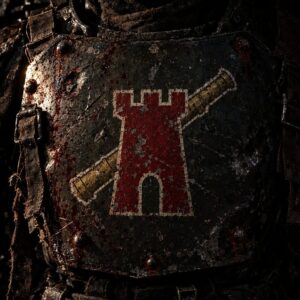
The standard is a banner of unbleached linen. It is quartered with the red tower of House Corvane and the Aquila, and screwed onto the pole is the regiment's reliquary: a glazed casing holding the finger bone of the Blessed Hesper of Brandholm, patron saint of the founders. From ribbons hang the honour names Ondrecht, Hallgrabe, Kaddren Valley and Pellenfurt. Ketterhain received no ribbon, but in the place where it would hang there is a black knot. In 788.M41 Drukhari fell upon the baggage train and cut open the standard-bearer. A Kaddren mortarman, Aurel Benk, dragged the banner two kilometres through a fen. The reliquary was cracked, the bone unharmed.
The Flaw
The flaw
On the 9th day of the autumn manoeuvres of 776.M41, the 213th was exercising on Vessmark together with House Corvane. The scenario was a practice target on the ridge of Ketterhain. A section chief misread a coordinate from the fire plan, and four Basilisks fired live rounds into the valley where the Knight "Ironwatch" stood in its assembly position. The pilot was Sir Aldous Corvane, heir of the house. He died in his throne. The report was written by Commissar Lennart Oswy, who wrote to the Munitorum that an error had been "foreseeable in a hastily trained emergency regiment". The house demanded twenty heads. It received one, that of the section chief, and the shame of the entire regiment.
In daily life it is felt everywhere. No Vessmark noble eats at the same table as the officers of the 213th. Wherever the regiment is quartered alongside another, it finds every time a foreign pulpit that has preached on Ketterhain before the 213th arrived.
In battle it shows as fear of its own shot. The batteries check everything twice and fight an enemy that never holds still.
The regiment itself says: We are paying it off. The others say, when no Vessmarker is listening: They once shot a Knight while it stood still, and ever since they have not dared to fire at anything that moves.
A Munitorum Failure
After the merger of 788.M41, the Reconciliation Office on Tiver listed the 31st Kaddren Mortars as "disbanded" and struck off their supply line. But no one recorded the amalgamation. The 410 Kaddreners therefore appeared on no roll of the 213th. For fourteen months the Munitorum delivered rations, winter clothing and mortar shells for the Vessmarkers alone. The Kaddreners lived by sharing, and the sharing was not enough. In the winter camp on Kaddren, 61 of them died of cold and dysentery. The correction arrived in 790.M41 with a winter consignment that came twice: once for the 213th and once for the no longer existing 31st, to an address that no longer existed.
Known Campaigns
Campaigns
Name Hallgrabe
Epoche 774.M41, seven months
Gegner Drukhari Kabal
Dauer seven months
Ausgang The Kabal withdrew; Hallgrabe is dead. Losses: 1,380 of 3,600, most of them through Raider assaults on the batteries. Afterwards: The Brennwald tankmen gave the 213th its call name, and then the formation was dissolved. The Thessiners had twice placed their infantry between the Raiders and the guns. That is a debt the 213th will never repay, for no one knows, …
Erzählung
| Era | Theatre | Enemy | Duration |
|---|---|---|---|
| 774.M41, seven months | Hallgrabe, Kelvarsrand | Drukhari Kabal | seven months |
The 213th stood in formation with the 44th Thessin Grenadiers and the 9th Brennwald Armoured Regiment. The Drukhari did not hold the hive city of Hallgrabe in the usual sense. They used it as a pen and had herded some 60,000 prisoners together there in order to carry them off through the Web of a Thousand Gates. Lord General Ivo Sarrand ordered the city shelled until no pen remained: what the enemy cannot take with him escapes him. The 213th fired for nineteen days. No gunner saw the city. Afterwards the Thessiners went in and came out with grey faces. The regiment obeyed the order, as a loyal regiment does, and the fourth pillar was born in those weeks.
Outcome: The Kabal withdrew; Hallgrabe is dead. Losses: 1,380 of 3,600, most of them through Raider assaults on the batteries. Afterwards: The Brennwald tankmen gave the 213th its call name, and then the formation was dissolved. The Thessiners had twice placed their infantry between the Raiders and the guns. That is a debt the 213th will never repay, for no one knows in which war the Thessiners stand today.
Name Kaddren Valley
Epoche 788.M41, eleven months
Gegner Drukhari and corsairs
Dauer eleven months
Ausgang Stalemate. Kaddren Valley remained occupied, and the raids ceased only when the Kabal moved on. Losses: 850 of 1,900. Afterwards: The Orsiners went to another war. The 213th bears a grudge against them to this day, because their withdrawal was felt as betrayal, although an order had commanded it.
Erzählung
| Era | Theatre | Enemy | Duration |
|---|---|---|---|
| 788.M41, eleven months | Kaddren, Tempestus fringe | Drukhari and corsairs | eleven months |
On the agri-world of Kaddren, the 213th lay with the 31st Kaddren Mortars and the 6th Orsin Fusiliers in a valley basin from which the Drukhari took prisoners by night. There was scarcely any infantry that could have protected the batteries, for the Orsiners were withdrawn after two months. In the end both artillery regiments together had too few men for a single one. The Munitorum folded the 410 surviving Kaddreners into the 213th; no regiment of their own came of it again. The Kaddreners come from a pious farming world without nobility and mock the precept of honouring the coat of arms. The Vessmarkers think them insolent. Benk's rescue of the banner has softened this grudge; it has not ended it.
Outcome: Stalemate. Kaddren Valley remained occupied, and the raids ceased only when the Kabal moved on. Losses: 850 of 1,900. Afterwards: The Orsiners went to another war. The 213th bears a grudge against them to this day, because their withdrawal was felt as betrayal, although an order had commanded it.
Name Pellenfurt
Epoche 801.M41, four months
Gegner Drukhari Kabal
Dauer four months
Ausgang The ford was held, and a quarter of Pellenfurt was evacuated. Losses: 320 of 1,460. Afterwards: the Varrowmoor regiment was transferred to the Segmentum Obscurus.
Erzählung
| Era | Theatre | Enemy | Duration |
|---|---|---|---|
| 801.M41, four months | Pellenfurt, Segmentum Tempestus | Drukhari Kabal | four months |
Alongside the 17th Varrowmoor Line Regiment and a Company of Knights from another house, House Telvane, the 213th defended a ford-town. The Telvane Knights refused to take up position beside "the murderers of Ketterhain" and occupied their sector eleven kilometres further away. The Drukhari exploited the gap between them. Vael's premature salvo betrayed the Second Battery, as Chapter 6 recounts. Afterwards the regiment held out for three more months, and it has never counted its performance there as glory, rather as repayment.
Outcome: The ford was held, and a quarter of Pellenfurt was evacuated. Losses: 320 of 1,460. Afterwards: The Varrowmoor regiment was transferred to the Segmentum Obscurus.
Vehicle livery
How the regiment’s vehicles are painted: base colour, camouflage for the theatre, turret band and markings, derived from the regimental colours.
| Theatre | Forest and grassland · Blotch camouflage |
|---|---|
| Base colour | #39484A · Mechanicus Standard Grey (Coat Grey) |
| Camouflage | #3E5A34 · Castellan Green (theatre standard)#6B5A3A · Steel Legion Drab (theatre standard) |
| Turret band | #650001 · Khorne Red (Corvane Red) |
| Markings | #ABA173 · Ushabti Bone (Banner Linen) |
| Hull recipe | Mechanicus Standard Grey (Base) · Nuln Oil (Shade) · Dawnstone (Layer) · Slaanesh Grey (Edge) |
Company bands on the turret
- 1.
- 2.
- 3.
- 4.
- 5.
- 6.
- 7.
- 8.
- 9.
Derived from the regimental colours; the silhouettes are our own sketches, not copies of any Games Workshop model.
Notes on the core facts
The high ordinal betrays a world that has been giving up regiments for millennia: Vessmark has raised over two hundred formations, and most of the numbers now stand only in the muster rolls. The number 213 was once borne by a regiment that vanished with its transport in the warp storm over Ondrecht in 640.M41. The present 213th is an emergency levy of 772.M41 and was itself never entirely wiped out, but it inherited the honour ribbons of those dead together with their loss. The gunners speak of "the First" as of distant relatives whose debts one pays without ever having known their faces.
A Scene
The vox crackled, and Tobbin Mürbeck pressed himself deeper into the hollow, because he took the crackle for a sound that could be heard. Down by the river the Raiders moved between the warehouses, narrow and black, without a sound. He counted them twice, the way the gunners had taught him, and passed on the coordinates.
"Repeat," said the voice. It was old File-Master Kesse of the Third, who repeated every number aloud, as if they were singing a song together.
He repeated.
"Confirmed. What else is in the grid?"
That was the question they otherwise never asked. Tobbin had been with the 213th for fourteen months and had learned in that time that the gunners never wanted to know what was down there. They wanted numbers.
"Warehouses," he said. "And a pen. Behind the third building. People."
For a while nothing came through the static. Then another voice, deeper and faster, with a fury in it that could be heard beyond the hills. The Reeve.
"How many?"
"Don't know, sir. A hundred. More."
"They'll go through the gate as soon as it's dark," said Vael. "Kesse, ready to fire."
Tobbin heard, six kilometres behind him, the breeches closing. He did not really hear it; he only knew it was happening now, because he had watched it too often. The pebbles on the breeches. The antiphonal chant. A swallow from the canteen poured over the barrel.
"Sir," he said. "Sir, those are ..."
"I know what those are." The voice cut out and came back. "I know what this is, observer. Is the coordinate good?"
The coordinate was good. He had calculated it twice.
Then a third voice came onto the net, quiet and a little nasal. The Commissar. "Reeve. Thirty seconds."
"Then take ten."
Tobbin lay in the wet grass and counted. At seven, at the front of the pen, one of the black figures slid up to the gate and opened it, and the people came out, stooped, on a chain, towards the river. Away from the buildings.
"Target moving," he said. "They're leading them out. Pen is empty. The Raiders are staying by the buildings."
"New coordinate."
He gave it. Then once more.
"Confirmed," said Kesse, and her voice trembled as he had never heard it before. "For the reckoning."
The shells came over him with a sound like linen tearing. The warehouses lifted into the air. Down by the river the prisoners threw themselves flat, the chain drew taut, they stayed down and lived.
Behind him, six kilometres away, no one saw anything. Tobbin understood that he was the eyes of twelve hundred people who never wanted to know what they hit, and who had now, for the first time, listened to him. He took his finger off the vox and wept, quietly, so that no one on the net would hear.