The Fire-Stokers
“Ash begets ash. Steel is hardened in the fire. The exemplar lives in the blazing deed. He who burns guides the will of the Emperor.”
Core Identity
| Progenitor Legion | Salamanders |
|---|---|
| Founding | c. 855.M30 — 1st Founding — raising of the 20 Legions (late M30) |
| Homeworld (name) | Tharvekk |
| Homeworld type | Death World |
| Combat doctrine | Firepower doctrine |
| Allegiance | Loyalist |
| Chapter strength | Full strength (~1000 Battle-Brothers) |
| One-sentence definition | The Fire-Stokers are fire-purists among Vulkan's sons—a Company that drives every battle with the flamer and the bolter to its limit, and believes that the holiest sacrifice of a brother is his transformation into ash for the next battle. |
The four pillars
Adaptation Through Fire
The Fire-Stokers hold that no enemy and no Death World is the same. Their combat doctrine is not rigidity but intense reaction: to see how a fire weapon works against these foes, to vary it at once, and to intensify it until something breaks. Unlike their kin on Nocturne, who prize craftsmanship and careful workmanship, the Fire-Stokers strive to drive fire to its limits and beyond. If one flame does not suffice, two shall burn. If two are not enough, a thousand bolter shells shall do their work.
The Usefulness of Ash
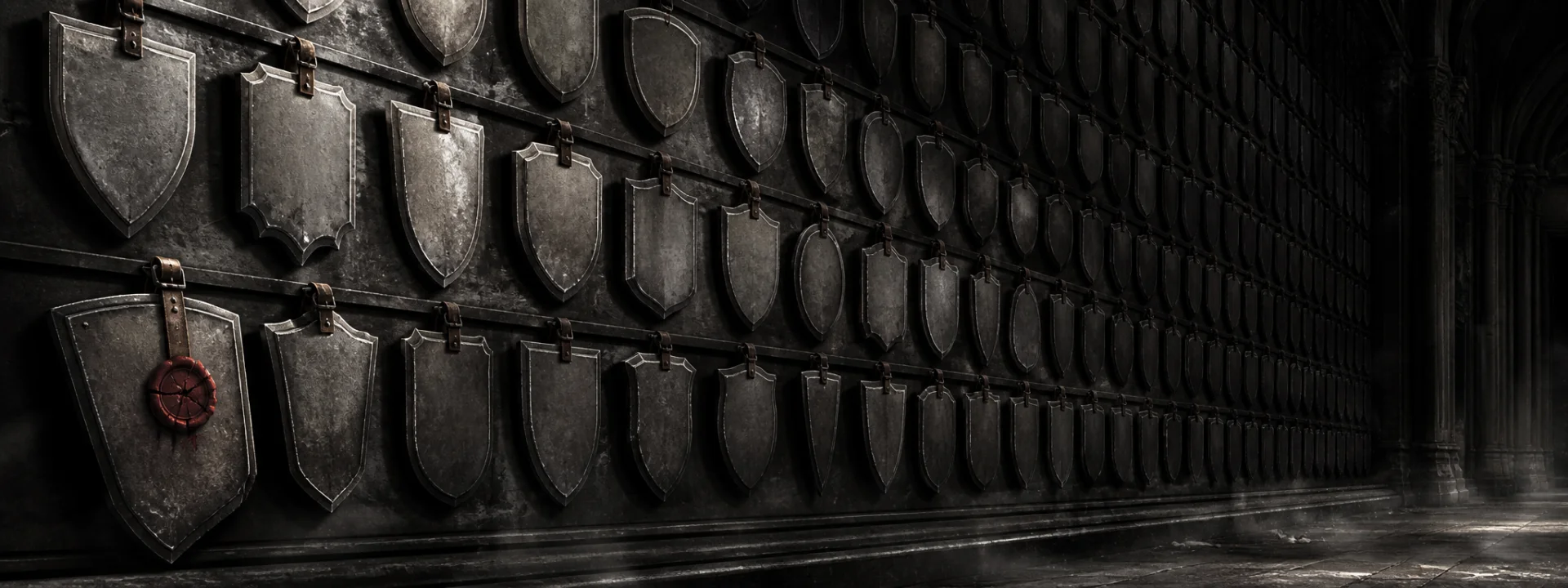
The Chapter does not distinguish between the life and death of its brothers—both are fuel. Every fallen Fire-Stoker is cremated to ash and built into the foundations of the Eternal Anvil. The remains of defeated enemies are melted down in the blast furnaces. Nothing is wasted. The ash of the brothers strengthens the walls that protect other brothers. This is the counterweight to Vulkan's compassion—while the Primarch honoured the individual, the Fire-Stokers honour the undissolved, the whole.
Fire as Revelation
The Fire-Stokers teach their pupils that fire speaks. A fire that quickly dies speaks of weakness. A fire that blazes, of strength. A fire that flickers desperately shows fear. A fire that burns calmly shows dominion. A fire in chains cannot lie—it will either soon be smothered or break free. This holds for enemies and brothers alike. A warrior who collapses under fire has revealed himself as true: he was never steel. A warrior who charges forward with blazing bolter has shown his nature to the Chapter.
The Eternal Anvil
The Fire-Stokers are not Vulkan's sons in order to sit in the depths and labour. They are here to be shaped. The Eternal Anvil is not merely a building—it is the tool in which the Chapter shapes itself every day. Every battle is a blow upon the anvil. Every defeat is a flaw in the forging that must be learned from. The Fire-Stokers are not finished. They never will be. As long as the Eternal Anvil stands, the hammer rings.
Tonality (bullet points)
| Point |
|---|
| Blazing violence, not gentleness. While the Salamanders of the parent Chapter are known for their handiwork and artistry, the Fire-Stokers are master smiths of destruction. Every depiction should show intense motion, visible heat and a sense of unrestrained power. |
| Ash and rust instead of bright steel. The armour of the Fire-Stokers is not immaculate—it bears the discolouration of millions of gunshots, the scorch marks of flamer backblast, the patina of centuries in a smoky, alkaline air. |
| Individual brothers count for less than the blazing unit. Portraits and glory do not belong to the iconography of the Fire-Stokers—only swarms, fire weapons and targets. A portrait of a Fire-Stoker should show him as part of a greater force, not separated from it. |
| Geometric, glowing hot colours. Red-orange against black undercoat, with accents of Khorne Red and Mephiston Red blending into one another. The visual impression is that of a flame that changes as one watches it. |
| Architecture from the bottom up. The fortress-monastery is not atop a mountain—it is within the mountains, in the so-called Iron Veins, in caverns that go deeper than any Imperial building not made by the Architect-Primarch himself. Everything monumental lies underground. |
Comparison vs. progenitor legion
| Aspect | Progenitor legion | This chapter |
|---|---|---|
| Craftsmanship focus | Smithing is duty and prayer—every hand-stroke a single, careful act | Mass production under pressure; better a thousand quick bolters than one artfully forged weapon |
| Treatment of fallen brothers | They are mourned, buried, remembered as individuals | They become ash that goes into the next steel—their names are stamped into walls, not into chronicles |
| Interpretation of Vulkan | The Primarch was a philosopher of duty, of craft-artistry and of saving the individual | The Primarch was lord of fire itself—his flame, not his humanity, is what is essential |
| Fire as a tool | Controlled, targeted, as part of a greater whole of craftsmanship | Fire as end, as purpose, as the highest form of revelation |
| Relationship with the Adeptus Mechanicus | Correct, but with its own smithing tradition | More dependent, as smithing is more vulnerable under the extreme conditions of Tharvekk |
| Relationship to the Codex Astartes | ~98 % adherence—Roboute Guilliman is respected | 73 % adherence—too many flamers, too little discipline, but dangerously effective |
Further core facts
| Fact | Value |
|---|---|
| Originating Legion | XVIII Legion — Salamanders (Vulkan) |
| Founding | First Founding, late M30 / early M31 |
| Homeworld | Tharvekk (Death World) |
| Fortress-Monastery | The Eternal Anvil, in the Iron Veins |
| Combat Doctrine | Fire Overload doctrine |
| Codex Astartes Adherence | 73 % |
| Battle Cry | Ash and steel for the living flame! |
| Chapter Strength | 1,027 Battle-Brothers (full) |
Core Identity (continued)
Forms of Address / Cascade of Titles
| Level | Designation | Context of Use |
|---|---|---|
| Neophyte | Ash-Folk | How young warriors name themselves—the folk of the still-burning ash, not of the extinguished |
| Chapter | The Fire-Stokers | Instruction and formal oath; refers to Vulkan's mastery over the fires of Nocturne |
| Chapter Oath | The Fire-Stokers of the Eternal Anvil, sons of Vulkan through the flame, wardens of the living ash—thus swears the Chapter on this day | Oath, declaration of war, consecration of the fallen |
Chapter Maxim
Ash begets ash. This is the first understanding—not despair over what has burned, but the recognition that what remains carries new fire within itself. A Neophyte learns that the death of others is not the end of the Chapter, but its material. From annihilated foes, new fortresses are built.
Steel is hardened in fire. One's own body is not a temple, but a weapon. The fire-furnace shapes it. Hardness demands heat and pain, and a brother who is not prepared to melt himself down in battle has not learned his craft.
The exemplar lives in the blazing deed. Vulkan is not reached through prayer, but through what one does while burning. The deeds of the Fire-Stokers are the face of the Primarch in the materium—every explosion, every annihilation of a foe is praise.
Whoever burns guides the will of the Emperor. The last tenet binds them all together: whoever understands himself as fire is not a slave to his appetites, but the instrument of a greater conflagration. The Chapter burns with purpose.
Lore & History
Founding history
The Fire-Stokers did not arise as a Chapter of gentle smithcraft. In the late M30, when the Warmaster Horus still lived and Vulkan led the XVIII Legion through the depths of the Great Crusade, four hundreds of Salamander warriors under the command of a Captain named Char'mak were assigned to the subjugation of a death-star called Tharvekk. The mission was to conquer this hell-world and secure its abundance of fire-minerals and vulcanite for the Imperium.
Char'mak was not born of Nocturne. He was a warrior of the third generation, raised in the settlements Vulkan had built on the fringe worlds—men without the artisan spirit of the Primarch, but with a double thirst for fire. His Companies marched upon Tharvekk not with the deliberation of a craftsman, but with the impatience of a campfire.
Tharvekk tore them apart. The place was not merely a world—it was an atmospheric inferno, covered in crystals that blazed in ultraviolet, populated by natives who lived in sulphurous rivers and whose blood turned to stone in the heat. The conventional tactics of the legionaries failed. Char'mak saw that the only way to win against Tharvekk was to burn hotter still. He had his Techmarines assemble every portable flamer and strip every plasma gun reserve from the ships. He ordered the assault formations not to advance in formation but in swarms, each squad its own fire.
In nine months, M30.8, Char'mak had not subjugated Tharvekk—no man could do that. But he had built houses of blood and ash. He had branded the land and branded it anew. He had not subjugated Tharvekk, but intervened in its grammar. That was enough.
The Primarch Vulkan came himself to see the wound. Some report that he would have condemned Char'mak for the disfigurement of the balance, for the disregard of the craft. Others say that Vulkan recognised what Char'mak had done—that it was not the duty of a legionary, but a duty, one that could be cold and burning at once. Vulkan did not name Char'mak First Warrior—that was not his way. Instead the Primarch said that if the Fire-Stokers—so Vulkan named them at once, taking up a word the natives used for those who kept the fires burning in the depths—if they ever founded a Chapter, they would do so upon this stone, in its depths, where the fires never die.
The name would prove prophetic. While the Horus Heresy tore the great Legions apart, while the Siege of Terra drove the Salamanders themselves to the brink of annihilation, the Fire-Stokers were too far away to be destroyed. They sat in Tharvekk, in the caves they themselves had branded, and wondered what the Imperium would become if the Emperor fell. They never received an answer. Instead, messengers of the Second Founding came and took the Fire-Stokers for a Chapter, though they had never been formally founded.
That was a lie more useful than the truth. The Fire-Stokers are older than the Second Founding—they are older than the fall of the Emperor, older than the Horus Heresy itself. They are the silent timeline in which Vulkan's sons did not go to the rescue of other Legions, but descended deeper into their own caves and sit there still, a thousand years later, stoking fire that must never die.
Homeworld description
Tharvekk is a Death World, but not through decay or deathliness—rather through excess presence. The world breathes fire. It is no black rock like Caliban, no holy place like Terra—it is a living blast furnace with legions of breaths.
The primary geography of Tharvekk consists of six layers. The surface layer is a crust of vulcanite, cut through by fissures from which sulphurous vapour streams. The fissures are not random—they follow a pattern, almost like a network of arteries. Each fissure is an irrigation channel from subterranean magma reservoirs, and each produces regular eruptions, not wild, but rhythmic, like the heartbeat of a dying beast. The surface is thus uninhabitable for anyone who relies on conventional breathing.
The second layer, some hundred metres beneath the crust, consists of cave chambers—vast caverns formed by erosion when the magma sank deeper millennia ago. These caves are the first habitable zone. They are not dark—they are lit in a permanent twilight of fire-reflections coming from below. The light flickers constantly, as if one lived the whole time beneath a ceiling of campfire. The temperature varies between fifty and one hundred and thirty degrees Celsius. Water exists here only in a state between vapour and liquid—greywater, which the natives drink and which would kill anyone else.
In this second layer live the Tharvekk drakes—large, wingless reptiles, as big as a Rhino transport, with a hide of segmented, vulcanite-like matter. They breathe in through fissures along their spines, and their blood is sulphidic and runs out red-green when they are wounded. They are not intelligent beasts—but they are territorial, and they understand fire. A brother of the Fire-Stokers who passes his first trial must not kill a drake, but understand it—compel the beast to respect him. For this, young warriors receive a single flame-cannon and no retreat. More than fifteen per cent of Neophytes have never reached the other side of this trial.
The Tharvekk parasites are another kind—not drakes but insects, as large as a grown man, with chitinous shells as hard as ceramite. They live parasitically on the drakes and on one another—they are not fearsome individually, but they travel in swarms. A swarm of parasites can strip a drake to the skeleton in an hour. Several swarms can devour an unprotected human in minutes. They are hunted by the Fire-Stokers in the underground tiers like rabbits, but not for food—their chitin produces a substance that acts as an insulator against extreme heat. The warriors sew this chitin into the undergarments worn beneath their armour.
The deeper geography grows more mysterious to outsiders. The third layer, some five hundred metres beneath the surface twilight, is a region where the heat becomes so intense that the rock partially turns to a glassy state. Here the magma reservoir is said to lie, but it has not been mapped for generations. The Fire-Stokers do not regard Tharvekk as their home—they regard it as their goddess. They honour the world's geology as though it were the flesh of a living being. From this springs their first great peculiarity: they see no separation between environment and war. Tharvekk is not a place where one fights—it is a place where one fights Tharvekk.
Chapter cult
The religious practice of the Fire-Stokers is not that of the Imperial Cult in the classical sense. They do not venerate the Emperor as a distant, saving god—they honour him as fire itself, burning in all living and dying things. A Fire-Stoker does not pray by kneeling. He prays by burning something.
This is the central difference from Vulkan's own Salamanders, who found their gods in craftsmanship on Nocturne. The Fire-Stokers have no tradition of craftsmanship. They have a tradition of burning. They do not build beautiful things and then set them in the fire—they take the fire and rebuild it into the shape of a prayer.
On every anniversary of the Great Crusade (M30.8, the date of Char'mak's victory on Tharvekk), the Chapter gathers in the Hall of Truth. The Chapter Master steps forward and proclaims the names of all brothers who have fallen in the past cycles—not to mourn them, but to give thanks for their transformation. Then old weapons, old armour, old things the Chapter no longer needs are cast into the magma fissures. They burn. That is the prayer. The Chapter sits and watches as the fire consumes everything, and sees itself in the process. When the flames die out—which takes about two hours—all speak together the Litany of the Second Breath, a four-verse text written in the craft dialect of Nocturne Aramaic, but in a form that the Fire-Stokers deliberately sing wrongly, to show that they do not truly understand it, but only feel the heat behind it.
Chaplain Ob'san Kraath teaches that the secret of the Fire-Stoker cult lies in forgetting the difference between a god and a fire. The Emperor is not someone to be petitioned—the Emperor is the process itself. A brother who prays takes part in this process by burning in battle.
This leads to a second difference from the Salamanders of Nocturne: a Fire-Stoker does not heed the consequences of fire with the compassion of a smith. A Fire-Stoker does not care about the material that remains after the burning—he cares only about the fact that the burning happened. That is what makes him a heretic in the eyes of many other Chapters. But it is also what makes him unshakeable.
Gene-seed quirks
The geneseed of the Fire-Stokers is not corrupted—it is displaced. That is a fine distinction. The Salamanders of Nocturne carry a flaw in their geneseed: the Melanochrome organ manifests in heightened form, darkening the skin and the teeth. This is a physical consequence of Nocturne's environment, but it is also a genetic mark that worsens over time.
In the Fire-Stokers this effect is the opposite—not worse, but faster. A new brother of the Fire-Stokers shows the full Melanochromic result within two years. But it reaches a limit and stays there. A Fire-Stoker does not grow ever darker—he first becomes dark and then stable. Biochemically, this is no blessing—it is a subtle flaw in the way the geneseed adapts the mutant to an extreme temperature regime. On Nocturne, the long process leads to an adaptation that works. On Tharvekk, the rapid adaptation leads to one that does not quite work.
From this arises the greatest secret of the Fire-Stokers: the curse their geneseed bears is not weakness or degeneration, but inflammation. A Fire-Stoker is held by the constant heat of his world in a state of chronic physiological irritation. It makes him faster, makes him fearless and makes him dangerous. It also makes him short-lived. An average Salamander warrior of the main line generally lives three hundred years. A Fire-Stoker lives about a hundred years less—or he dies sooner, if the irritation consumes his body too quickly.
From this premise, that every Fire-Stoker lives in a state of decline from birth, arises the ethical foundation of the Chapter. If you have only a hundred years instead of three hundred, you make them count. You do not burn long—you burn intensely. This explains why the Fire-Stokers hold so little in reserve in their combat tactics. They are not reckless out of malice—they are so because they know instinctively that every moment is one moment fewer than they might have had.
Curse Stages
Stage 1 — The Glowing Signs
- Blackening of the skin begins at the fingertips and travels up the forearms; the discolouration is patchy at first, with red-brown blotches between dark grey melanin
- Tooth enamel shows star-shaped cracks, especially on the molars; the saliva takes on an iron-reddish taste
- Sweating becomes episodic and uncontrollable—the brother does not sweat during physical exertion, but at rest, especially at night
- The eyes take on a golden tint in the iris; this is the first perceptible sign that other brothers notice
- The heartbeat becomes irregular and faster; a brother in Stage 1 sleeps less and breathes more shallowly
- Hunger becomes more intense and selective—the brothers crave meat, especially food served charred or hot
A brother in the Glowing Signs is not incapacitated—on the contrary, he is at the peak of his performance. This is the stage in which warriors do their best work. The Chapter monitors them, but not restrictively—a Scout Sergeant records the symptoms in a handwritten report every two weeks, but the aim is documentation, not intervention.
Stage 2 — The Charred Decay
- Complete blackening of all outer skin; the colour is not even, but blotched, as though the skin were burning
- Tooth loss begins—the enamel becomes brittle and teeth can be broken out with simple force; the gaps fill with black gum
- The sweat glands appear to fail—the brother no longer sweats, but his body temperature remains elevated (about 39.5–40 degrees Celsius at rest)
- The eyes take on a deep amber-orange colour and vision becomes more active in the infrared spectrum (the brother sees heat sources more clearly)
- The heart rhythm becomes chaotic; physicians report arrhythmias, but the brother does not grow weaker—rather wiry and more enduring
- Muscle wasting begins, especially in the thighs and the core; the brother becomes sinewier, less massive
A brother in the Charred Decay is now subject to concern. He is taken to a place called the Observation Chapel beneath the southern arm of the Chamber of Ash—a room in which Apothecaries and Techmarines constantly monitor his vital signs. Here he is observed for three months. The test is simple: can this brother remain in battle, or is he a risk to his squad? The procedure is known as the Reconciliation Committee—men and machine-spirits look on, and beneath the routine of tests and measurements a question arises: does this brother still burn with purpose, or is he only ash on the wind?
Stage 3 — The Last Glow
This is the point at which a brother becomes what the Chapter calls the Lost. There is no return from here—the body is too doomed by its colouring. The symptoms of Stage 2 saturate completely—the brother loses his tooth enamel entirely, his eyes turn black except for a thin amber pupil, his skin becomes a black, leathery texture that shows no colour any more. The heartbeat becomes so irregular that ordinary physicians would expect a Dreadnought Sarcophagus—and yet the brother moves, faster than before, with a nervous intensity that is scarcely human.
The Last Glow is the final station. From this point on, a brother has about two to three years before his body turns itself into a blast furnace and fever seizures destroy him. The question for the Chapter is simple: should we wait until he takes in the fire, or should we send him into service now and give him what he truly wants?
Lore & History (continued)
Gazetteer of the Fortress-Monastery
The Ewige Amboss sits within a system of caves in the so-called Eisenadern, a mountain massif in the southern hemisphere of Tharvekk. The system is so vast that an expedition in the year M38 mapped nineteen great chambers without ever finding a "recession" of the caves—the system may be larger than the Chapter officially admits.
| Location | Function | Distinguishing Feature |
|---|---|---|
| The Outer Gate | The sole airlock between the surface fever and the first inner chamber | A massive latticework of vulcanite and forged iron bands, operated by hand—no machine spirit, no automation; if it is not opened, it stays shut. The operating mechanism is deliberately analogue, since every electronic component fails within a few months this close to the magma heat |
| The Hall of Truth | Place of initiation—here Neophytes are set alight and extinguished again | An amphitheatre of black vulcanite with a flat arena at its centre; in the floor lies a series of magma fissures opened under control. The ceiling hangs some forty metres above the arena and is utterly black with soot deposits, although it is scraped out mechanically. No one who enters the hall can forget that beneath it the earth breathes |
| The Neophytes' Refectory | Place of eating and assembly for uninitiated fighters | A low room with tables of wood that comes directly from the deeper caves—a hard, pink-black material that grows only on Tharvekk. The walls smell of sulphur and scorched cloth, a mixture of millions of years of smoke and the droppings of the Kardin bats that nest in the cracks |
| Das Musterungsamt | Administration and record-keeping—where Ordinators log the battle | A network of three interconnected chambers with hundreds of wax tablets on which names and fates are burned in script. It smells of burnt wax and envelope paper. The heat here is so great that only Apothecaries and select scribes can work longer than two hours without collapsing |
| Das Reliquiarium | Keeping of the holy objects and remains of fallen brothers | A vault that lies deeper than any other known place in the Eisenadern—at least eight hundred metres below the Hall of Truth. The temperature is so constant and hot that all organic material becomes a fine, white ash that never decays. In this vault a million names are engraved upon the walls—each a brother who became ash. The Chapter Master enters this place once a year, alone, to speak a prayer of intercession for the still-living brothers |
| Das Verborgene Lager | Secret munitions and weapons stores, known only to the Chapter Master and the lead Techmarine | A system of caves south of the Reliquiarium, rumoured to hold secret projects—the Chapter keeps weapons that do not appear in the Codex Astartes, and plans for hidden Vulkan doctrines too alien for the Imperium. No one but the Chapter Master has explicitly confirmed this, but the rumours among the brothers are persistent |
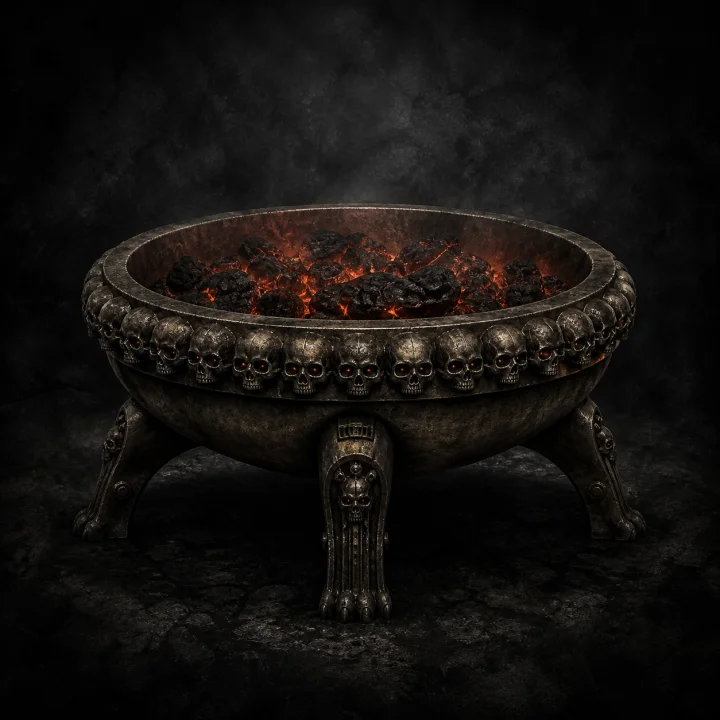
| The Chamber of Ash | Forge workshop and the place where the remains of fallen brothers are cremated | A vast vault with six great furnaces powered by magma heat sources, not by fuel. Each furnace is eight metres tall and can cremate a fully armoured battle-suit in less than two hours. The room is perpetually in a haze of fine white ash—even breathing here is a ritual. When a brother dies, he is burned here, and his ash is mixed into the next steel needed for reinforcements, or worked into the mortar for repairs to the fortress-monastery itself |
The Verlorene Kompanie
The Chapter calls these men the Aschflammigen—a designation that, in the Chapter's own dialect, means: those who are the fire. They are not undead. They are not daemonically possessed. They are simply Fire-Stokers whose gene-flow drives them forward to the very last minute.
The Name and its Meaning. The Aschflammigen are formally a part of the Verlorene Kompanie, but they call themselves the Aschflammigen—because they are no longer men in armour, but armour driven by fire. The name refers to the understanding that their humanity is already ash; only the fire remains.
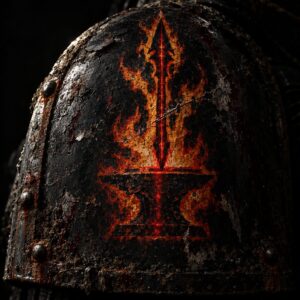
The Removed Insignia. On every other Fire-Stoker, the shoulder plates bear the Chapter insignia—a burning lance above an anvil. On the Aschflammigen, this insignia is removed. Instead they wear bare ceramite, with white scratch marks where the symbol was. This is no mark of shame—it is the mark of a man who no longer has a Company, only the flame-mandate itself.
The Added Tool. On their right forearm, where the Black Carapace and the body's nerve bundles lie closer to the surface, a mnemo-coil is installed—a small, geometric device of brass and black steel, no larger than a piece of chewing gum. It is mounted between the forearm and the inside of the power armour. The coil has two functions: it stores thoughts and impulses a brother feels during battle, and it emits subtle electrical pulses to stabilise his heart rhythm—not to heal him, but to ensure he remains long enough to fight. The coil must be recalibrated every two weeks. A brother can feel when his coil is working—it is like a ticking beneath the skin.
Helm and Headgear. Every Aschflammiger wears the same helm—a Mk. VII Aquila helm with its ornamentation filed away, coloured in a uniform, dark black (Abhorreth Black, with dark red Mephiston Red edge highlighting). The helm is not individualised—not because the brothers are the same, but because they must not be otherwise. An Aschflammiger is no longer a personality—he is a function. The uniform helm is a visual command: forget who this man was.
The Order to Battle. When a detachment of the Aschflammigen is ordered to enter battle, the Sergeant speaks the words over the vox:
"The ash recognises no borders. Burn until the ash remains."
What Happens After Death. When an Aschflammiger falls in battle, his body is brought to the Hall of Truth, but not to the Chamber of Ash. Instead he is lowered into the Reliquiarium—into the deepest, hottest zone—and there he is laid out in a special niche that has already been prepared. The Chapter Master himself intones a chant over the body, and then the niche is sealed with white stone upon which his name is engraved. The body is preserved in this perfect heat, not burned, but kept forever in the moment of glory in which he ceased to live. The Chapter says: the fire has taken this brother, but the earth will hold him.
Distinction
Some observers have speculated that the Fire-Stokers are a heresy or a lost detachment of the Adeptus Astartes—or worse, that they were corrupted at the time of the Horus Heresy and conceal this corruption. This is not true. The Fire-Stokers are not Heretic Astartes, nor renegades in the sense of having turned away from the Imperium. They are an offshoot, but not a schism.
The confusion arises because the Fire-Stokers, like the Traitor Legions, have made a religion of fire itself—and like the Traitor Legions, they teach that fire is a kind of truth. But the difference is fundamental: a follower of Chaos burns from without, drawn by the Chaos Gods. A Fire-Stoker burns from within, drawn by the geneseed itself, which tells his body that he is only briefly in this world. This is no cult of Tzeentch or Khorne. This is a biology that appears as religion. And it remains absolutely loyal to the Imperium and to Vulkan, the Primarch whose sons originally mastered the fires.
Companies
Companies
Name Flamewright
Role Intercessors
Hero name Dak'ir Ash'gar
Hero title/epithet Sergeant
Name Ka'tan
Role Intercessors
Hero name Iagon Aethonion
Hero title/epithet Sergeant
Name Drak'nel
Role Hellblasters
Hero name N'keln Kel'gar
Hero title/epithet Sergeant
Name Ashforge
Role Terminatoren
Hero name Tu'Shan Vaughn
Hero title/epithet Veteran Sergeant
Name He'stan
Role Scouts
Hero name N'keln Or'ven
Hero title/epithet Veteran Sergeant
Companies (continued)
Overview
| Company | Company Colour | Role |
|---|---|---|
| I Company | Deep red (Mephiston Red with Abattoir Crimson accent) | Veteran core; Devastator-specialised |
| II Company | Flame orange (Evil Sunz Scarlet with flame-red highlights) | Tactical core; mixed Assault and Devastator |
| III Company | Ash grey (Mechanicus Standard Grey with white edging) | Scout/reconnaissance core; flamer-specialised |
| IV Company | Dark brown (Rhinox Hide with charred highlights) | Repair and fortress administration; mixed fighters |
| V Company | Fire white (White Scar with Mekarit Red surfaces) | Neophyte reserves and support role |
I Company — The Deep Red
Doctrine. The First Company is the veteran core of the Chapter—fighters with two centuries or more of battle experience. They are specialised in the doctrine of fire-overload: they take the most intense concentration of steam-weapons in the Chapter and bundle it into small squads to produce fire-salvoes that melt through buildings and tanks. A First Company squad with two plasma guns, two flamers and heavy bolters is no less lethal than an entire small army of a less specialised Chapter. They are not meant to hold lines—they are meant to burn lines.
Hero of the Company.
Battle Report — The Fortress of Tharvekk City. In the Twelve-Thousandth Year (M41.7), during the Annual Flame-Onslaught, the Orks of Waaagh Zagdakka had broken into the southern depths of Tharvekk. They had captured the old settlement of Tharvekk City—an inhabited trench beneath the surface with some ten thousand civilians and a small garrison of Astra Militarum soldiers. Captain Ferrox Pyresworn was still a mere Sergeant at that time; he commanded only one squad of the First Company—ten men with six flamer cannons and four heavy bolter bearers. The order was simple: retake the city or set it alight. No middle way.
Sergeant Pyresworn ordered his men not to go directly into the city. Instead, he loaded every fighter with an additional row of plasma canisters. Then he tore holes into the southern corridor—the water channel that connected the city to the deeper cavern. The Orks had blocked this channel with their scrap and flesh. Pyresworn ordered his men to melt the blockade. They did so—not with aimed shots, but with a pure, liquid wall of flame and plasma that turned the entire channel into a glowing tunnel in less than two minutes.
The Orks realised that something had happened too late. When the Fire-Stokers entered the city, they found it not in ruins but in smoke. Ninety per cent of the Ork force had already fled or run into the white-hot corridor and killed themselves. The remaining ten per cent, who tried to hold, were annihilated in four minutes with concentrated fire. No Fire-Stokers died. The city was saved.
But there was a problem: the heat of Pyresworn's assault had not touched the civilian quarters directly—but the heatwave and the pressure had. Forty per cent of the civilians died of burns within the first two hours after the liberation. Captain Ferrox Pyresworn—then still a Sergeant—looked upon the corpses and asked his Chapter Master whether he had done the right thing.
The Chapter Master did not answer yes or no. The Chapter Master said: "Tharvekk took these people. You took Tharvekk back. That is what we do." Pyresworn understood: in the world of the Fire-Stokers there are no victories without ash. This realisation made him Captain. Today, twenty years later, as Chapter Master, he carries those burns in his memory, not as pain but as price. And he pays it gladly.
II Company — The Flame Orange
Doctrine. The Second Company is the tactical spine of the Chapter—the battle group that operates in various roles, from Assault to Devastator, depending on the mission. They are more flexible than the First Company, but less specialised. Their strength is that they know how to switch quickly between doctrine modes. A Second Company squad that is in cover one minute can be in full assault formation the next. They are the fire-delivery system of the Chapter.
Hero of the Company.
"The flame does not ask permission. It burns, and we give it form."
— Captain, II Company
An unknown Captain leads the Second Company—his name is not recorded, because the Chapter does not encourage individual heroism. Instead, the entire Company is known as "the Flames".
Battle Report — Onslaught at the Rabenspalte. In the year M41.4, Ork ravagers from the Slag Reach had pushed deep into Tharvekk. They had occupied a mountain pass—the Rabenspalte—as a temporary bastion and were blocking the southern route to the Iron Veins. The Second Company had been ordered to clear the route. Instead of launching a direct attack, the Captain divided his Company: half carried out a frontal assault with bolters and storm bolters and pinned the Orks in the rift. The other half, with a flamer emphasis, encircled the rift from above and brought coordinated fire to bear.
The Orks, under fire from two sides, tried to flee. That was the plan. The Captain had held a third element in reserve the whole time—marksmen with meltaguns, positioned in the caves above the rift. When the Orks tried to flee, they ran into the melta fire. It was a trap within a trap. The entire Ork force—some two hundred strong—was dissolved in the rift without a single Fire-Stoker being hit. The pass was cleared in three hours.
III Company — The Ash Grey
Doctrine. The Third Company is the Chapter's scout and reconnaissance force. They operate in clothing and armour optimised for speed, not protection—they frequently use scout armour instead of power armour. Their specialisation is reconnaissance in extreme heat, tracking Ork movement through the magma rifts, and the use of flamers in tactical surprise attacks. They are the Chapter Master's eyes.
Hero of the Company.
"Fire leaves no trail. That is our advantage."
— Lieutenant Vor'ath Ashwalker
Lieutenant Vor'ath Ashwalker commands the Third Company with a balance between caution and aggression that is rare in Fire-Stoker culture. He is Tharvekk-born—his genetic code shows a rare deficiency in the rapid melanochromium reaction, which means that he shows the symptoms of the curse considerably more slowly than other Fire-Stokers. This makes him valuable—he can think clearly for longer than others. But it also makes him suspect. Some whisper that Vor'ath was born with abnormal geneseed, that he is not wholly Fire-Stoker.
Vor'ath regards these rumours with equanimity. He knows that when he enters the Flame State and begins to suffer the painful afflictions that others do, the rumours will cease. Until then he will command, fight and burn like any other. His men trust him because he does.
Battle Report — The Shaft Pursuit. An Ork scouting party had penetrated one of the deeper magma shafts—a channel in which even Fire-Stokers with special equipment can survive only a few minutes. An ordinary Chapter would clear this shaft and seal it. Vor'ath took five Scouts and two Scouts, all equipped with thermal protective clothing, and pursued the Orks into the shaft.
The fight that followed was not a battle—it was a dance in hell. Vor'ath and his men caught up with the Orks in an area where the temperature was so hot that metal discoloured. They killed nine of the ten Orks with precise bolter fire. The tenth, a Warlord, scorched himself with a plasma pistol before Vor'ath reached him. They returned to the Iron Veins with only one wounded Scout—the wound from burns, not from Ork weapons.
The Chapter Master asked Vor'ath how he had known where the Orks would go. Vor'ath answered: "They did not know where they were going. They were running from the fire. So I followed the fire." This is the way the Fire-Stokers measure clarity of thought—not by learned tactics, but by the ability to see what the heat sees.
IV Company — The Dark Brown
Doctrine. The Fourth Company is the craft-heart of the Chapter—not specialised in pure battle, but in the maintenance, repair and administration of the fortress and the weapons. They are Techmarines, Apothecaries, ordnance artisans and fighters with technical training. They are no less effective in battle, but their main role is to ensure that the other Companies can burn. They keep the flames burning.
Hero of the Company.
"A clean fire is the best fire. Everything else is waste."
— Veteran Sergeant Tu'Shan Vaughn, Commander of Ashforge
Veteran Sergeant Tu'Shan Vaughn commands a specialised unit within the Fourth Company—the Ashforge Maniple. These five fighters in Terminator armour are not the Chapter's heavyweights in the traditional sense. Instead, they are the flame-precisionists—specialised in the installation and firing of super-heavy flame weapons, heavy meltaguns with extended ranges. Tu'Shan was a finishing technician before he was a soldier; his grand-master qualifications in weapon systems are documented. But more than that—Tu'Shan has another trust: how to tell where the fire most wants to see. A technician who understands the flame-soul of a machine spirit.
Battle Report — Siege of Tharvekk Station. In the year M41.6, Orks had dug themselves into one of the old Imperial garrison structures—Tharvekk Station, a fortified position with four-storey towers and thick concrete structures. A direct assault would cost massive losses. The Chapter Master requested Tu'Shan and the Ashforge Maniple.
Tu'Shan studied the structure for four hours. Then he said that the towers should not be attacked from above or from the sides—but from below. He set his team to dig four emplacements beneath the station, under each tower foundation. Then the Ashforge mounted four specialised heavy melta systems, each installed in a sunken tube with an enlarged weapon chamber.
When everything was ready, the Ashforge fired all four systems simultaneously. The beams burned through concrete and steel and melted the foundations. The towers, undermined, began to sway. The Orks, panicking, tried to flee. That was when the other Companies attacked. In less than two hours the station was destroyed, the Orks wiped out, and the Ashforge had taken no losses. Tu'Shan afterwards received a new title from the Chapter Master: "Flame-Reading Master"—an honour signifying that he can not only use fire, but understand it.
V Company — The Fire White
Doctrine. The Fifth Company is the Neophyte core and the reserve force. Its fighters are relatively new—two to ten years in the Chapter—and they lack the specialisation of the older Companies. But that does not mean they are weak. They are hungry. They are fast. They are willing to burn more than any other Company. They are often used as the spearhead—throw the Neophytes against the Orks, and as soon as they break through, let the veterans clean up.
Hero of the Company.
Sergeant Dak'ir Ash'gar commands the Flamewright Maniple—ten Intercessors with flame carbines and bolt pistols. They are the Fifth Company's fast assault force, and Ash'gar is only thirty years old (young for a Space Marine, but Fire-Stokers age faster). His talent is pure aggression—he has tactical training, but he gladly ignores it when fire is faster. The Chapter Master tolerates this, because Ash'gar's disregard has a pattern: he wins. Not with style, not with honour, but with flaming determination.
Battle Report — Raid on the Ork Camp. An Ork camp had been set up some fifteen kilometres north of the Iron Veins—a temporary military position from which the Orks carried out raids. The Chapter Master ordered the Flamewright to destroy the camp. Ash'gar arrived with ten men.
They burned the camp in one hour. No Fire-Stokers died. Some three hundred Orks were killed. The Chapter Master later asked Ash'gar how this had been possible. Ash'gar answered: "We did not use tactics. We went in and burned everything. They had no time to think." This thinking—the belief that speed and violence can replace a plan—is not Fire-Stoker doctrine. But in young cases it leads to success. The Chapter Master granted Ash'gar a private conversation in which he said: "One day the Orks will become faster. Then you will understand that you have no plan. Until then: no orders." It was a reward and a warning at once.
Notable Characters
Characters
Name Ferrox Pyresworn
Title/role Captain
Name Vor'ath Ashwalker
Title/role Lieutenant
Name Ob'san Kraath
Title/role Chaplain
Name Tem'plar
Title/role Dreadnought
Notable Characters (continued)
Captain Ferrox Pyresworn—Chapter Master
Description. Ferrox Pyresworn carries the sheer presence of a man who is capable of no other life than burning. He has been in the Chapter for a hundred and eighty years—long enough to understand the limits of the geneseed, short enough to still be in the First Reinforcement. His skin has turned grey-black from the Melanochromium reactions, an effect he does not hide with the palliative creams that some older brothers use. His eyes are a blinding amber-yellow, and his breath carries a faintly sulphur-like taste—a sign that his internal organs are beginning to react to the constant heat.
Ferrox wears the artefact armour of the Chapter Masters—a Mark VII Aquila suit dyed an even more intense red than that of the regular First Company, with accents of real gold inlaid into the pauldrons. His weapon is the so-called Vulkan's Memory—a power sword with a core of volcanic metal, said to have been forged from a fragment of a weapon of Vulkan himself. The blade blazes with red light when it is drawn in battle.
Wargear and Weapons. Vulkan's Memory is his primary weapon system. It is a power sword roughly 1.2 metres in length, the blade traversed by lines of Vulkanite inlaid during the smithing. The tip is honed to a fine point, and the edge is a constant brightness—red when at rest, glowing orange when fire burns. On the backstroke it acts like a flamer—when the coil is correctly adjusted, a single swing can show a line of fire along the blade that can set an opponent ablaze. This is not a flame effect—this is the thing itself, drawn out of the blade's core energy.
His secondary weapon is a bolt pistol named Kar's Scream—lacquered black with red accents, the barrel filled with Vulkanite detailing to cool it. The ammunition he uses is known as Fire-Core—special bolt rounds with a small plasma-igniter core, meaning that every hit causes not only impact but also a small explosive wave of heat.
He also carries a beam-projector on his right forearm—an implanted field generator that enables him to activate a storm shield for a short time. It is not the typical force field of a storm shield, but a Flame-Shield—a field of fire and heat that burns attackers when they break through.
Quotes.
"Tharvekk is not our prison. It is our whetstone. We sharpen ourselves on its fire, every day, until we are a blade that cannot break."
"A brother who is not ready to burn is only a stone. We are not stones. We are the fire that shapes the stone."
Battle Anecdote—The Siege of the Goldene Mauer.
In M41.5 a massive Ork horde—remnants of Waaagh Zagdakka and several other clan alliances—had broken into the Eisenadern through the southern passage. They meant to drive through to the heart of Tharvekk and take the Reliquiarium itself, for reasons that were never entirely clear. But the Orks had built a fortress—a structure of plundered gold and scrap that they called the Goldene Mauer, because they had looted monuments of the old Imperial civilisation and piled them high with real gold.
The Chapter Master—then still Captain Ferrox Pyresworn—had been ordered to destroy this fortress. It was an impossible task. The Goldene Mauer was forty metres high, ten metres thick, and it was crammed with Ork fighters. A direct assault would bleed the Fire-Stokers dry.
Pyresworn ordered his men to do one thing: gather all flamer ammunition. Not to save it, not to ration it—all of it. He had logistics requests submitted to the Adeptus Mechanicus for additional flamer reserves, and while these arrived, he worked out his strategy.
Then, on a day when the volcanoes of Tharvekk had a particular series of eruptions—the fissures glowing more strongly than normal—Pyresworn ordered an attack. But not on the wall itself. Instead he focused his firepower on the ground beneath the wall. His flamer crews dug in with targeted jets of fire, melting the substrate until the structure itself began to sink.
The Goldene Mauer did not fall in an explosion—it sank, slowly, into the ground, as if the earth were eating it. The Orks at the top tried to flee, but there was nowhere to flee. They plunged down into the fissures, burned or drowned in the molten magma flow. In six hours there was no wall left, and no Orks.
Later the Chapter's priest asked him whether the fire had come from outside or from within. Pyresworn answered: "That is the same question. Fire is fire. Whether it scorches the wall or melts the ground beneath it—it does not matter. The result is the same: ash."
The priest said that this was a good understanding of the Way of the Flame. The then Captain Pyresworn was later elected Chapter Master, partly for this reason.
Lieutenant Vor'ath Ashwalker
Description. Vor'ath Ashwalker is an anomaly in the Fire-Stoker records—not because of any conspicuous corruption, but because of a withering that is too slow. A standard Fire-Stoker shows the first symptoms of the Curse stage within two years of geneseed implantation. Vor'ath has been forty-eight years in service and shows barely anything beyond the initial discolouration. That makes him suspect, but also valuable. He is one of the few Fire-Stokers who can still think clearly without the constant inflammation taking over his cognition.
His skin shows only a slight grey discolouration, concentrated at the fingertips and the nape of the neck. His eyes are still a bright green, not amber—a sign of the early Melanochromium reaction that has never truly gathered pace. Some brothers mutter that he does not truly carry Fire-Stoker geneseed, that he is an imitation. Vor'ath ignores this with an equanimity greater than that of a typical Space Marine. He knows that if the symptoms truly subside, he will at some point pass into the status of the Lost, and then the rumours will end, because he will be dead.
He wears the Mark VI Corvus armour of the Scouts—not the standard Mark VII of the infantry—and favours mobility over protection. His pauldrons are marked in ash-grey, the colour of the Third Company.
Wargear and Weapons. Vor'ath is a master of the Shimmer-Lance, a special variant of the bolt carbine optimised for fast, accurate shots in tunnels. The weapon is light and weak at long range, but in the narrow corridors of Tharvekk it is deadly. He also carries a plasma dagger at his hip holster—not a weapon for large-scale use, but for close blade-to-blade confrontations. The dagger is small, barely larger than a human hand, but the plasma coil within it can melt Ork armour.
His shield is unusual—not a standard storm shield, but a heat-dissipation field that he wears on his left forearm. The field reflects heat and flames, not through a force field, but through physical ceramic panels coated with a reflective layer. In combat, when flamers discharge around him, the field can dissipate much of the heat, enabling Vor'ath to operate in areas where even other Fire-Stokers would collapse.
Quotes.
"The Curse strikes everyone. But not all strikes are equal. Mine is slow. That does not mean I am freed—it only means I have longer to see before I burn."
"A fire that does not see is only heat. A fire that thinks is a weapon. I am a weapon, so long as my mind does not turn to ash."
Battle Anecdote—The Pursuit of Waaagh Zagdakka.
In the year M41.3 a large part of Waaagh Zagdakka had penetrated a deep magma fissure—a so-called "Lower Shaft"—to expand their base north of the Eisenadern. The Chapter Master ordered Lieutenant Vor'ath to locate the camp and report back. A normal Scout mission would have taken two weeks. Vor'ath returned in five days.
That was not because he travelled faster, but because he changed his method. Instead of following a route, he followed the fire itself—he knew that the Orks, when they moved, left heat signatures behind. The ground does not cool quickly enough to hide the traces. A normal Scout would not see this. But Vor'ath, with his underdeveloped Melanochromium reaction, still had a kind of clear thinking that allowed him to see that the heat had a pattern—the movement of the Orks.
He found their camp, documented their strength (some four thousand fighters), and came back to report. The Chapter Master asked him how he had known the route. Vor'ath answered: "I did not follow the route. I followed the camp, by seeing what it had taken and where it had left its heat." That was a thought process few Fire-Stokers would admit to. But it was effective. The Chapter Master sent the First Company to wipe out the camp, and it was done, without surprises, because Vor'ath had documented the exact configuration.
Later the Chapter Master asked Vor'ath privately whether he believed himself damned. Vor'ath answered: "Everyone is damned. I am simply damned more slowly."
Chaplain Ob'san Kraath
Description. Ob'san Kraath is not merely a Chaplain—he is a living refutation of the gentle philosophy of the Salamanders, which he calls a "heresy against the true nature of Vulkan". He has been a hundred and thirty years in the Chapter, and he bears the deepest marks of the Curse's progression—not in the physical sense, where he is still relatively intact, but in the spiritual. He has almost turned to ash in his thinking.
His skin is almost completely black-grey, and his tooth enamel shows gaps where teeth have fallen out and not been replaced. He does not wear a standard helm—instead he wears an old, scorched Chaplain's helm, with the symbol of the Fire-Stokers—the burning lance—deeply engraved, and the helm grille is black with the grime of many decades.
His armour is Mk. VII Aquila, with black chain hangings that hang at hip height. The neck area is open to reveal a thick, scarlet cloth embroidered with golden fibres—the cloth bears litanies and prayers in a language that is not standard Imperial, but an older dialect of the Nocturne tongues.
Wargear and Weapons. Ob'san carries an eviscerator—not a standard Chaplain's weapon, but a more extreme variant with a longer chain and larger chain-teeth. The eviscerator is a tool of destruction, not an instrument of preaching. It is also a statement: that the words of Vulkan, spoken in this Chapter, are not gentleness and care, but fire and destruction.
He also carries a flame pistol—a small, portable flame weapon mounted at his right hip. The barrel bears an inscription on which the words of the Litany of the Second Breath are engraved, in four lines, one for each verse.
His primary armour means is a storm shield, but not for defence—rather for message. The shield is a white surface with a black symbol of the burning anvil upon it, and beneath the symbol seventeen names are engraved—seventeen Fire-Stokers whom the Chaplain himself had ordered into the Ash-Flamed formations. All seventeen are now dead, their bodies in the Reliquiarium. The shield is his public penance—or his public sign that he does not repent of these decisions.
Quotes.
"Vulkan taught compassion for individual people. But Vulkan did not understand that individual people turn to ash. I understand it. That is what I preach."
Battle Anecdote—The Sermon of Tharvekk City.
After the liberation of Tharvekk City in the year M41.7 (see the battle history of Captain Ferrox Pyresworn), when four thousand civilians had died in the flames, the Chapter Master ordered Chaplain Ob'san to hold a memorial. A normal Chaplain would have conducted a mourning ceremony, one that lamented the loss and paid honour to the dead.
Ob'san did the opposite. He gathered the surviving civilians in the Hall of Truth, where the magma fissures were visible, and delivered a sermon. But the sermon was not compassion. The sermon was a declaration that the civilians who had died were not victims—that by dying in the flames, they had become part of the transformation of Tharvekk itself. They were ash. They were now foundation.
The surviving civilians—many of them in grief, many in shock—responded with silence. But the Chapter Master, who was listening, nodded. That was the correct teaching. The Chaplain had not lied or distorted—he had spoken the truth, which is ugly and uncomfortable.
Later a young novice asked the Chaplain whether the words had not been harsh. The Chaplain answered: "The fire is harsh. Had I softened my words, I would have betrayed the fire. Instead I taught that no words are harsh enough to describe its nature."
The novice then asked: "So you do not love the dead?" The Chaplain answered: "I love the fire that took them. That is the only true love a Fire-Stoker can have."
Campaigns
Campaigns
Name The Fall of the Saber Realm
Era c. 700.M40 – c. 960.M40
Enemy Xenos presence unknown (presumably Orks or feral Necrons)
Duration 260 years
Outcome Tactical withdrawal; territory lost, enemy not defeated
Narrative
The so-called "Saber Realm" was a collection of seven fortified settlement zones in the southern hemisphere of Tharvekk, some four hundred kilometres south of the Iron Veins. These settlements were inhabited by medieval humans—not through colonisation, but through an error in the old Imperial registry. The settlements existed, but appeared on no known register. Their population was therefore unmonitored and their culture unregulated.
In the year M40.7 the Chapter Master awoke to the fact that a hostile force—its nature remains unclear to this day—had occupied the seven settlements and established a base there. The enemy was too large to be defeated by a small strike force, yet too isolated to receive reinforcements quickly. The Chapter Master ordered a campaign.
The Fire-Stokers descended into the southern tunnels and forged a route to the Saber Realm. The first thing they found was that the seven settlements had already been taken over by the enemy, with a population of some fifty thousand people—many as slaves, many as a concentrated population in the settlement cores. The enemy had built an order that was complex.
The Fire-Stokers could have burned the realm. The fire doctrine permitted them to kill all fifty thousand civilians, to reduce the settlements to ash and to begin anew. But the Chapter Master decided otherwise. The Chapter Master decided that the civilians had a right to survive, and that the Fire-Stokers should attempt to save them.
This was a mistake, or a form of wisdom, depending on how one sees it. The campaign lasted 260 years. The Fire-Stokers could not defeat the enemy without killing the civilians. The enemy could not be defeated, because it buried itself among the civilians, and the Fire-Stokers refused to burn. After 260 years the Chapter Master decided that the Saber Realm was lost. The southern hemisphere would not be retaken. The Fire-Stokers withdrew to the north.
The lesson learned from the Fall of the Saber Realm was harsh: compassion is weakness. The next generation of Chapter Masters would not make this mistake. Ash is swifter than mercy.
Name Waaagh Zagdakka—The Southern Wave
Era c. 100.M41 – c. 800.M41
Enemy Orks (Waaagh Zagdakka and allied clan hordes)
Duration 700 years
Outcome Tactical victory; Orks driven back, core base destroyed, continuous raids ongoing
Narrative
In M41.1 a massive Ork invasion came to Tharvekk—Waaagh Zagdakka, led by Warboss Zagdakka himself (an Ork who had nearly been defeated in earlier campaigns). With the Waaagh came various smaller Ork clan alliances, recruited or conquered. The combined force numbered some fifteen thousand Orks—the largest single invasion since the founding of the Fire-Stokers.
The first phase was defensive. The Fire-Stokers withdrew into the Iron Veins and held their core positions while the Orks overran the southern settlements. There were minor sorties, but nothing monumental.
In M41.3 the strategy changed. The Chapter Master—Ferrox Pyresworn at that time, though not yet officially—ordered a campaign to burn out the Ork positions. It began with the destruction of the Ork base camps by concentrated flamer assaults. Then came surprise strikes against fortified positions. Then—and this was the key element—came the shaft campaigns, in which the Fire-Stokers descended into the subterranean positions and destroyed one Ork defensive line after another after another.
The centrepiece of the campaign was the destruction of the so-called "Golden Wall" in M41.5 (see above). After this victory the Orks' central cohesion collapsed. Zagdakka himself fled. The Waaagh disintegrated into isolated clan groups.
The remaining 300 years (M41.5–M41.8) were a mopping-up operation. Every Ork group was systematically hunted down and annihilated. Yet some Orks—perhaps a few hundred—vanished into the deepest, hottest magma shafts, where even the Fire-Stokers could not follow. These Orks may still exist, in the depths, building bases for a future invasion.
But at present (M41.8, the current time of this dossier) the threat of Waaagh Zagdakka has been reduced to isolated raids and occasional attempted attacks. The Chapter remains on guard.
Name The Indomitus Expedition to Tharvekk
Era c. 861.M41
Enemy Unknown (contact with the Indomitus Expedition)
Duration Less than one year; still ongoing
Outcome Connection established; support offered, but not yet integrated
Narrative
In M41.8 a surprising contact occurred. A flotilla of the Indomitus Expedition—the great punitive force of the Emperor, dispatched under Rowboat Guilliman—entered the Tharvekk System. The Fire-Stokers did not know that Guilliman lived. They did not know that the Great Crusade had begun anew.
This created a moment of confusion. The Chapter Master, Ferrox Pyresworn, ordered a state of attack readiness until it was clear whether the expedition was supportive or hostile. It soon became evident that the expedition was supportive. Indeed, the Indomitus Expedition brought news of the reorganisation of the Adepta Astartes, of new gains in the Imperium, and of Roboute Guilliman's return.
The Chapter Master received this news with caution. The Fire-Stokers are not 73% Codex-compliant—meaning that they do not strictly follow the modern directives of the Codex Astartes. They are concerned that deep integration with other Chapters could weaken their doctrine. But contact was maintained. A small liaison group was dispatched with the Indomitus Expedition to negotiate further coordination.
This is an ongoing process. The Fire-Stokers remain independent, but they are no longer alone. Tharvekk is once again connected to the wider Imperium—for good and for ill.
Short Story
Ash Knows No Name
Veteran Sergeant N'keln Or'ven had long since ceased to recognise the sound of his own breathing. Fifteen years in the Third Company, and the filter in his helm was so caked with dust and ash that every breath was a working noise, not the sound of a breathing man. That was good. The man had long since gone. What remained was only an instrument.
He moved through the lower shafts of Tharvekk with a ten-man patrol. The mission was simple: find tracks, locate Orks, report. No combat. But Or'ven knew that "no combat" only meant that the combat had hidden itself today, not that it would not come.
The fissure ahead of them was a new opening. It had not appeared in the data from two weeks before. That meant something below had broken through the ceiling. Either magma that had risen high enough to melt rock, or something else that had enough strength to break through a wall.
Or'ven signalled the squad—five fingers, quickly forward, then spread. Defensive formation. They moved in.
The fissure led deeper, into a cavern that was not on the maps. That alone was suspicious. But when Or'ven switched the infrared spectrum into his helm visor, he saw the problem clearly: heat signals. Many. Some thirty bodies with Ork heat signatures, scattered across the floor of the cavern. They were sleeping.
An Ork camp, hidden in an unmapped cavern. That was a discovery that had to be reported. That was the mission: report.
But Or'ven saw something else as well. In the middle of the camp was a large Ork—larger than the others, with a heat signature that was more intense. That was not normal. The Orks were warm, yes, but this one was differently warm. The signature was fleeting, fluctuating, as if the body could not properly hold its temperature.
That was either a very sick Ork, or it was something else.
Or'ven recognised it in his third second of watching: the Ork carried something metallic. Something beneath its skin, something that was electronic. That was not natural.
That was technology.
Without thinking—because thinking was too slow—Or'ven ordered his men to fire. Five bolter shots, coordinated, all on the large Ork. The explosion woke the camp.
What followed was no fight Or'ven could have foreseen. The Orks in the camp were not standard warriors. They were hybrids—half-Ork, half-something else, their skin partly scaled, their eyes partly vertical. And the large one, which Or'ven was trying to defeat, was not an Ork. It was a leader-figure with four arms and an intelligence behind its eyes that Ork brains could not carry.
Symbionts. The word came to Or'ven's mind from a half-forgotten lesson in the school of the Fire-Stokers. Symbiont cultists. The Imperium had warned of them, had damned their names. They were not Orks. They were something far worse.
Or'ven ordered the withdrawal.
But the withdrawal was not simple. The Symbionts—there were at least fifteen of them, hidden beneath the Ork carcasses—pressed forward. Or'ven's men killed three of them, four of the Orks, but a round from a hidden firing point struck his second gunner directly in the Black Carapace between the shoulder blades. The man fell. Or'ven could not go back.
That was the rule. A fallen brother is a fallen brother. You do not break off to retrieve the remains. Ash is ash.
The remaining nine withdrew, through the fissure, into the tunnel, towards the Iron Veins. Behind them was the roaring of the Symbionts and the Orks, the roaring of something that had been found for the first time in this depth of Tharvekk—a force that could not only fight, but could also plan.
In the Eternal Anvil, in the Chamber of Officers, Chapter Master Ferrox Pyresworn sat and listened to the report. Veteran Sergeant Or'ven stood before him in parade armour, sweating under the strain of the long ascent back to the heights. Lieutenant Vor'ath Ashwalker stood at the Chapter Master's side, his helm beneath his arm.
"Symbionts," said the Chapter Master calmly. "Not Orks. Not Chaos. Something else."
"Yes, Chapter Master," said Or'ven. "That was what we concluded."
"And you left the brother behind."
"Yes, Chapter Master."
The Chapter Master nodded. That was right. The rule was the rule. "The force you describe—four arms, intelligence in the eyes—that is a Magus-figure. A leader among the Symbionts. That explains the presence." The Chapter Master turned to Vor'ath. "What do you think?"
Vor'ath needed a moment. "I think that the enemy is changing. I think that the Orks we thought we knew were only one layer. And beneath it is something else, which uses them as we use a bolter."
That was a statement that would have shocked Or'ven before he was a Fire-Stoker. Flames not sufficient? That was heresy. That was against everything taught in the Third Company.
But Or'ven was no simple man any more. Or'ven was a Veteran Sergeant, and his mind had had enough time to absorb it: not all fires are the same. A fire that does not strike the right prey is only heat.
"You will lead a strike force," the Chapter Master said to Or'ven. "You will be given armoured bodies—Terminators. You will be armed with meltaguns, not flamers. You will descend into this fissure, you will find this Magus-figure, and you will melt it."
"And the brother, Chapter Master? The one we left behind?"
The Chapter Master looked directly at Or'ven. "The brother is already ash. He will awaken in the Reliquarium—not literally, but symbolically. He will be part of the next stone that supports this fortress. That is his blessing."
Or'ven nodded. That was the correct understanding.
"Go," said the Chapter Master. "Prepare yourself. You depart in two hours."
Two hours later, in the Armour Chamber, Techmarine Dak'ir helped Or'ven into Terminator armour. It was a sacred act, and Or'ven could feel the tension in the Techmarine's hands—not fear, but concentration. Every lock was set precisely. Every connection was tested. The Black Carapace implants in Or'ven's back bonded with the neural ports of the armour.
Then the melee weapon was given—a Thunder Hammer, heavy and restless in his hands. Then the meltaguns were loaded, in twin-mount configuration, fixed to the forearms. They were heavy. They were deadly.
Vor'ath entered to check the seal.
"You will see colours you did not expect," said Vor'ath. "You will see forms that are not documented in the battle reports. The Symbionts—they are not warriors like Orks. They are a network. When one is wounded, all the others know. They will fight in coordination."
"Understood, Lieutenant," said Or'ven.
Or'ven nodded.
In the fissure, two hours later, Or'ven no longer found the camp sleeping. The Symbionts knew he would come. That meant they were truly intelligent—they had understood the withdrawal from the first fight as a challenge, not as a flight.
The Magus-figure was larger, now in full battle, its four arms spread, each with a weapon—a weapon Or'ven did not recognise, but instinctively distrusted. Behind it were some thirty of the smaller Symbionts, their eyes glowing in infrared.
Or'ven ordered his nine men—nine other veterans in Terminator armour, all armed with meltaguns—into line.
"All fire," he ordered. "Constant. No interruption."
Nine meltaguns ignited at once. The beams were not flames—they were melting light, concentrated, absolute. They struck the Magus-figure directly, and for half a second nothing happened. Then the figure began to melt. Not to burn. To melt. The flesh fell away in clumps. The armour it wore—and yes, it wore armour, metallic and alien—fell apart like snow.
In three seconds the Magus-figure was no more. Only a melting mass on the floor of the cavern.
The smaller Symbionts broke and ran. That was interesting. They should have fought. That was what Orks would do. But they ran. That meant that without the leader the network had collapsed.
Or'ven ordered the meltagun fire carried on onto the fleeing Symbionts. Ten of them were killed. The others vanished into the darker parts of the cavern, where even the meltaguns could not follow.
But it was enough. The camp was destroyed. The Magus-figure was ash.
The way back to the Iron Veins was hard. One of the Terminator suits had been damaged by a weapon Or'ven had not fully understood—a kind of energy beam that passed straight through the shield. The brother who wore the armour—Sergeant Kel'vorn, a man with a hundred and fifteen years of service—collapsed before they left the cavern.
Or'ven could not return. Or'ven could not retrieve him.
But Or'ven saw how Kel'vorn, as he fell, spoke a prayer. Or'ven could not hear it—the helm channels were too loud with radiation and alarms—but Or'ven could see the lips moving. That was enough.
"The Magus-figure has been eliminated," said Or'ven. "The camp has been destroyed. The network we had hypothesised was real—without the leader, it collapsed."
"Yes, Chapter Master. Some of the Symbionts escaped into deeper caverns. We could not follow them."
The Chapter Master nodded slowly. "This is a new enemy on Tharvekk. Not Orks. Not Chaos. Something else. Something that plans, that networks, that adapts."
Vor'ath stepped forward. "What are your orders?"
The Chapter Master sat still for a long time. Then he said: "We write a new chapter in the chronicles of the Fire-Stokers. An enemy against whom the flames do not suffice. That is not weakness. That is evolution."
Or'ven did not understand what the Chapter Master meant. But Vor'ath nodded, as if he had understood.
"We will build a new doctrine," said the Chapter Master. "One that is not only flame, but also intelligence. And I will create a new order—not a Company, but a special squad, specialised in hunting Symbiont settlements."
"And who will lead this squad?" asked Vor'ath.
The Chapter Master looked at Or'ven. "The Veteran Sergeant who has just melted a sorcerous leader three hours beneath the earth. Or'ven will lead this group. He will be called 'Hunter'. He will bear no standard title—only a name the Chapter will know. And he will work alone, if necessary."
Or'ven wanted to say something. But he knew that to speak was wrong. Instead he bowed his helm.
The Chapter Master stood. "Ash knows no name, Or'ven. But fire knows the hands that hold it. That I will not forget. Not today, not tomorrow. The ash will write your name into the next stones, when that comes to pass. But until then—go. Prepare yourself. The Symbionts will come back. And you will be waiting."
As Or'ven turned to leave, he heard Vor'ath say behind him: "That is as it should be."
The Lieutenant understood: Tharvekk is changing. The Fire-Stokers are changing. And Or'ven, who no longer had thoughts of his own, who was only an instrument, was now the key to this change.
Ash knows no name.
But the flames know the hands that bear them.