The Contrite Masons
“We owe the stone. We bear the load. We read the crack. We do not leave.”
Core Identity
| Progenitor Legion | Imperial Fists |
|---|---|
| Founding | Unstated Founding — a dated wave with no official number (ca. 314.M37) |
| Homeworld type | Penitent (origin, not a world class) |
| Combat doctrine | Siege warfare |
| Allegiance | Renegade chapter (fell after the Heresy) |
| Chapter strength | Unknown / kept secret |
| One-sentence definition | A Chapter of penitent builders who were shown how every wall in the galaxy will fall, and who chose to keep watching. |
The four pillars
The Debt Is Inherited
No brother is innocent. Each one takes up the sentence of the penitent line he was drawn from. No war he fights is ever counted as paying it off.
The Wall Is the Brother
A brother is measured by what he holds, not by what he kills. Honours go to the sergeant whose sector never moved, never to the warrior with the most kills.
The Crack Is Scripture
Every fortification is read for the point where it will fail. Since the Keystone came to them, the Masons believe that this reading is granted to them, and that whatever grants it is owed obedience.
No Ground Returned
No position the Chapter has paid for in blood is given up, even when holding it ends the force inside. Retreat is filed as a demolition, never as a withdrawal.
Comparison vs. progenitor legion
| Aspect | Progenitor legion | This chapter |
|---|---|---|
| Allegiance | Loyal to the Emperor | Renegade, bound to Tzeentch |
| Siege philosophy | The wall must not fall | Every wall will fall; know when |
| Recruitment | Varied Imperial worlds | Hereditary penitent labour gangs |
| Primarch's legacy | Rogal Dorn, builder and defender | Dorn is honoured as the unfinished builder |
| Pain rituals | Pain Glove, endurance | The Load Rite beneath a lintel |
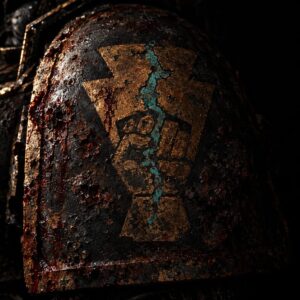
| Colour | Yellow | Weathered sandstone and turquoise |
| Sacred relic | The hand of Dorn | The Keystone of Myre Deep |
Further core facts
| Fact | Value |
|---|---|
| Progenitor | Imperial Fists |
| Founding | ca. 314.M37, the unnumbered wave the Adeptus Terra filed as the Quiet Muster |
| Homeworld | Gravmorrow, a world settled by penitent labour gangs |
| Fortress-Monastery | Scarp Penitence |
| Combat Doctrine | Siege warfare: the building, holding and unmaking of walls |
| Codex Compliance | 35% |
| Battle Cry | “Stone remembers!” |
| Chapter Strength | Undisclosed; counted only in nines |
Core Identity (continued)
Forms of Address / Title Cascade
| Level | Designation | Context of use |
|---|---|---|
| Battle-Brother | Course-brother | Among themselves; a brother is one course of stone in the wall |
| Chapter | The Mortar of Dorn | Before outsiders and in their own chronicles; it names the Primarch as the builder whose wall they claim to finish |
| Ceremonial | Contrite Masons, Keepers of the Unfallen Lintel, Debtors of the Ninth Course | Oaths, the sealing of a breach, declarations of siege |
Chapter Maxim
We owe the stone. This line carries penance. Neophytes are taught that their ancestors were sentenced to build, and that the sentence passed to the Chapter rather than ending with the dead.
We bear the load. This line carries endurance. A neophyte stands beneath a loaded lintel until his knees shake, and he learns that the weight is the lesson rather than a test.
We read the crack. This line carries foresight. Once it meant the craft of the sapper. Since the fall, it is taught as a sacrament: every wall shows its ending to those who look.
We do not leave. This line carries constancy. A neophyte who steps from the line during the Load Rite is sent back to the labour gangs, and his name is never spoken.
Lore & History
Founding history
The Masons were raised in ca. 314.M37, in a wave the Adeptus Terra recorded without a number. Their gene-seed came from Imperial Fists stock, and they were set on Gravmorrow, a world of convicts sentenced to wall in its own capital. The Chapter took its aspirants from the labour gangs and its creed from their sentence. For four thousand years it built and held the eastern marches against Orks, renegades and, from the eighth century of M41, the tendrils of Hive Fleet Sorrowmaw.
In 744.M41, about 4,430 years after its founding, the Chapter took a crystalline keystone from a xenos-gutted citadel at Myre Deep. Through it, the Masons' sappers saw where every wall would break. Tzeentch is never named in the Chapter's rites. The Masons call the voice inside the stone the Architect, and they believe it is the same mind that taught Dorn to build.
Homeworld description
Gravmorrow is a cold limestone world. Its capital, Sentence, is wrapped in 81 concentric walls that the convicts have never finished. Lime-gulls nest in the mortar joints, and their guano is ground into the Chapter's ritual mortar. Kerf-hounds are blind cave canids that hear stone shifting. Neophytes are paired with them to learn listening, and the first Masons to fall were the ones whose hounds began to howl at sound walls.
Chapter cult
The Imperial Fists revere Dorn as the man who held. The Masons' Chaplains teach that Dorn knew all walls fail, and that holding means choosing the hour of the failure. Their prayers are measurements. Every brother carries a plumb-bob, and devotion is the reading of stress in stone, offered to the Architect.
Gene-seed quirks
The Masons lack the Betcher's Gland and Sus-an Membrane, like their progenitors. Their Ossmodula overbuilds, so a veteran's skull carries ridged plates. Every brother's Lyman's Ear is acute enough to hear rock settling at forty metres.
Curse Progression
Stage 1 — The Listening:
- He presses his gauntlet flat to every wall he passes.
- He chalks hairline cracks on ceramite and rockcrete that others cannot see.
- A turquoise fleck appears in the iris of his left eye.
He is logged by the Apothecarius, rotated to the line, and asked nothing. Most brothers stay at this stage for decades.
Stage 2 — The Settling:
- His helm stays pressed to the wall; he speaks only through the contact.
- His chalk lines cover his own armour plates, marking where they will break.
- The left eye turns fully crystalline and catches light like quartz.
The Chaplain watches such brothers in the Course of Names, where they must touch each warm block and recite the dead it holds. If he forgets a name, the Chaplain records the date.
Stage 3 — The Keystone Sight: He sees the ending of every structure, his brothers included, and can no longer see them standing.
He is walked to the Spoil Yard by his own squad. No one strikes him. The gate is sealed behind him.
The Lost Company
The name. They are the Spoil: the rubble left over when a wall is shaped, unfit to bear load and too heavy to throw away.
What is removed. The sandstone mortar-line band across the helm brow is ground away to bare ceramite. On a brother in good standing, that band says he is part of the course. Its absence says he no longer bears load.
What is added. A fist-sized crystal plumb-bob is sunk into the backpack's upper vent. It is wired to the power-plant coupling and glows turquoise, and it hums when it faces a wall it predicts will fall.
Founding
Distinction
Their siegecraft leads some to suspect Iron Warriors blood. That resemblance is convergent development and not gene-seed kinship. The Masons descend from Rogal Dorn's sons, and they still lay stone in the patterns of the Imperial Fists.
Homeworld and Fortress-Monastery
Fortress-Monastery Locations
| Location | Function | Distinctive feature |
|---|---|---|
| The Load Hall | Initiation: the Load Rite | A single basalt lintel on chains, loose grit falling from it, the smell of hot iron |
| The Course of Names | Remembrance | One sandstone block for every dead brother, each still warm from buried heat pipes |
| The Plumb Shaft | Training of sappers | A bottomless well where a brass bob on a plaststahl cable hums in a draught that never stops |
| The Lectern Below | Hidden; houses the Keystone | Turquoise light through cracked flagstones and a tick like masonry settling, never steady |
| The Spoil Yard | Quarters of the Lost | Rubble heaps behind a sealed gate; the floor is chalked over with plumb lines |
The Sacred Number
Overview
The Masons count in nines, the number of the Architect. A course is nine brothers, a Bastion is nine courses, and nine Bastions make the Chapter, though no one outside the Lectern Below knows how many of the nine still stand. A tenth brother in a course is a flaw in the stone. Doctrine says he must be set to the Spoil or killed in the breach. Captain Ludwig Garadon's Bastion refuses this. It still musters in tens and fives, the Codex numbers of its dead, and the rest of the Chapter is watching it.
| Name | Leader and title | Number of warriors | Role |
|---|---|---|---|
| The Ninefold Wall | Master of the Ninth Course | 9 | Command and rite |
| Bastion | Captain, Castellan of the Bastion | 81 | Field force |
| Course | Sergeant, Foreman | 9 | Line squad |
| Breach Circle | Veteran Sergeant | 9 | Terminator assault |
| Sapper Gallery | Veteran Sergeant | 9 | Scouts and mining |
| Iron Choir | Techmarine | 9 | Engines and Dreadnoughts |
The Ninefold Wall
The Master and eight officers kneel in a ring at the Lectern Below and read the Keystone together. Lieutenant Markus Frostner, Chaplain Volkmar Vosskar and Librarian Efried Dornfeld sit here when they are not in the field.
Champion: Chaplain Volkmar Vosskar, Keeper of the Plumb. At Tessarin he walked a breach the Keystone had marked and stood in it until it held.
“The stone told me I would die here. I asked it what hour.” — Volkmar Vosskar
Bastion
A Bastion swears its oath with its gauntlets pressed into wet mortar and owns one wall until it is ordered to unmake it. Garadon's Bastion fields the Intercessor squads Hartmann under Sergeant Otto Vandergard, Kaltenbrunn under Sergeant Fafnir Wintermark and Hohenfels under Sergeant Anselm Diaz.
Course
A Course is a firing line set and sealed like masonry. The Hellblaster squads Hallgrim under Sergeant Vladimir Wachters and Eisenwald under Sergeant Sigismund Zitadell hold the plasma courses.
Breach Circle
The Circle enters the breach the Keystone names, at the moment it names.
Champion: Veteran Sergeant Anselm Felshammer, Hammer of the Lintel, of Lysander. He held a collapsed gate on Myre Deep for nine hours while the roof settled onto his pauldrons.
“If it falls, it falls on me first.” — Anselm Felshammer
Iron Choir
The Choir sings binary over the Masons' war engines and the Dreadnoughts Isbrand and Torwald, with the Predator Falkenrath and the Land Raider Weissberg alongside.
Champion: Techmarine Ulrich Brandhorst, Choirmaster. He drove Weissberg into a Tyranid tunnel mouth on Tessarin and brought the roof down on its own hull.
“The machine knew the fall-point too. It went anyway.” — Ulrich Brandhorst
Hold to it
The Masons count in nines, and their nine-count governs every page that follows. The Chapter is commanded by the Master of the Ninth Course.
Companies
Companies
Name Hartmann
Role Intercessors
Hero name Otto Vandergard
Hero title/epithet Sergeant
Name Kaltenbrunn
Role Intercessors
Hero name Fafnir Wintermark
Hero title/epithet Sergeant
Name Hohenfels
Role Intercessors
Hero name Anselm Diaz
Hero title/epithet Sergeant
Name Hallgrim
Role Hellblasters
Hero name Vladimir Wachters
Hero title/epithet Sergeant
Name Eisenwald
Role Hellblasters
Hero name Sigismund Zitadell
Hero title/epithet Sergeant
Name Lysander
Role Terminatoren
Hero name Anselm Felshammer
Hero title/epithet Veteranen-Sergeant
Name Wallmann
Role Scouts
Hero name Magnus Steinmark
Hero title/epithet Veteranen-Sergeant
Name Taelos
Role Scouts
Hero name Kastor Krieger
Hero title/epithet Veteranen-Sergeant
Notable Characters
Characters
Name Ludwig Garadon
Title/role Captain
Name Markus Frostner
Title/role Lieutenant
Name Volkmar Vosskar
Title/role Ordenspriester
Name Efried Dornfeld
Title/role Librarian
Name Ulrich Brandhorst
Title/role Techmarine
Name Isbrand
Title/role Redemptor-Dreadnought
Name Torwald
Title/role Ballistus-Dreadnought
Notable Characters (continued)
Berengar Holt, Master of the Ninth Course
Holt was a sapper when the Keystone was found, and he is the only brother living who touched it first. Both his eyes are crystalline. He wears artificer plate scored with chalk lines no one else is allowed to erase, and he carries a thunder hammer cut from the Myre Deep keystone's matrix stone. He rarely leaves the Lectern Below.
“I know the hour this Chapter ends. I have chosen not to say it.” — Berengar Holt
On Myre Deep, Holt ordered the citadel's own eastern wall dropped onto the attacking swarm. Eleven Masons were still on it.
The First Castellan, Founder
The First Castellan's name was cut from every record. He set the Chapter's hereditary debt and raised the Load Hall. Relics say he carried a storm shield of Gravmorrow limestone bonded to ceramite. Chronicles keep one line of his:
“A penitent who stops building is only a prisoner.” — The First Castellan
He fell walling a hive gate against Orks with his own body. The Masons left him in the mortar.
Ludwig Garadon, Captain
Garadon commands the force drawn for the Masons' wars beyond Gravmorrow. He is unmarked by the Listening, which his Chaplain finds suspicious. He wears Mark X plate, carries a master-crafted bolt rifle and power sword, and keeps his squads at ten. He was born in the labour gangs.
“I will not cull a brother to make my arithmetic holy.” — Ludwig Garadon
At Tessarin he sent the Keystone's reading to the Imperial garrison rather than his own Master.
Efried Dornfeld, Librarian
Dornfeld bears the Keystone's sight most heavily. He is already at the Settling, though he hides it, and his left eye is pure crystal. He carries a force stave topped with a brass plumb-bob.
“It does not lie. That is what frightens me.” — Efried Dornfeld
Lieutenant Markus Frostner guards him in battle, on orders from Garadon that Holt has never countersigned.
Campaigns
Campaigns
Name The Holding of Calder's Reach
Era 741.M41
Enemy Hive Fleet Sorrowmaw
Duration Seven months
Outcome Pyrrhic Imperial victory
Narrative
The Masons held a mountain hive for seven months against Sorrowmaw's vanguard. Brothers fought until their walls were rubble and then fortified the rubble. When relief came, the Chapter had lost a third of its line strength. Holt, then a sergeant, swore that the Masons would never again be blind to where a wall would break.
Name The Siege of Myre Deep
Era 744.M41
Enemy Hive Fleet Sorrowmaw
Duration Nine weeks
Outcome Victory; the Chapter's fall
Narrative
In the cellars of an ancient citadel, Holt's sappers found the Keystone. Its readings let the Masons drop walls on the swarm at the exact moment of greatest killing. Myre Deep's population died in the collapses. The Inquisition named the Chapter Excommunicate Traitoris eighteen months later, and the Masons did not contest it.
Name The Unwalling of Tessarin
Era 993.M41
Enemy Hive Fleet Sorrowmaw splinter
Duration Four months
Outcome Inconclusive
Narrative
Garadon's force made landfall uninvited on an Imperial world under Tyranid assault. The garrison fired on them for a week, then took their readings. Tessarin's capital held, but its outer districts were brought down on the swarm by Masons' charges. The Planetary Governor has requested the Masons' destruction and their return in the same communiqué.
The Flaw
The Masons cannot leave the Tyranids alone, and the Keystone has never once shown them a Tyranid wall that falls. Hive Fleet Sorrowmaw builds no fortifications. Its swarms do not have a fall-point, because they were never standing. Against every other enemy the Chapter wins by reading the crack. Against the one enemy that made them reach for the Keystone, they are as blind as they were at Calder's Reach, and their sappers' charges have killed more Imperial citizens than xenos on each of the last three worlds they fought for.
Holt knows. Garadon knows, and says so in council. Dornfeld suspects the Architect wants it this way: a Chapter forever hunting the one foe it cannot read, forever dropping cities on it, forever being shown the fall of human walls instead. The cost is written in the Course of Names, where the stone blocks for Tessarin's dead civilians stand beside the brothers' and are kept just as warm. No officer has proposed abandoning the war. No officer has found a reason to continue it that the others accept.
Short Story
Load-Bearing
The garrison commander of Tessarin had a voice like gravel in a pipe, and he used it to tell Ludwig Garadon to leave.
“You are excommunicate,” he said, over the vox from his bunker under the Spirewall. “I have the Inquisitorial warrant on a slate in front of me. I am required to fire on you.”
“You have been firing on us,” Garadon said. “Six days.”
“Then I am required to continue.”
Garadon looked out from the breach his Bastion had cut in the outer district. Rain sluiced down the faces of hab-blocks that had been cleared of people a month ago and still held their furniture. Beyond them, three kilometres off, the ground moved. Not quakes: the swarm, packed so densely it seemed a single hide rolling over the low country.
“Commander,” Garadon said, “your eastern wall fails in nine hours. The third buttress north of the gate. It is shearing at the footing.”
A pause. “How would you know that?”
Garadon did not answer. Behind him, under a sheet of plaststahl that hissed in the rain, Efried Dornfeld knelt with his gauntlet on the shattered rockcrete. The Librarian's left eye was a lump of crystal now, catching what little light there was and turning it blue-green. He had not spoken for an hour except to say where things would break.
Volkmar Vosskar came up the rubble, crozius in his fist, chalk-white streaks on his black plate where he had marked the stone of his own armour, and squatted beside his Captain.
“The Master has read it too,” the Chaplain said quietly. “He sent the order an hour ago. We drop the eastern district on the swarm when it reaches the canal. All of it.”
“There are forty thousand people in the eastern district.”
“There are forty thousand people in the eastern district,” Vosskar agreed. “The Keystone shows them dead either way. It shows the canal choked with xenos if we drop it. It shows the Spirewall breached if we do not.”
“It shows us that,” Garadon said. “It has never once shown us the Tyranids.”
Vosskar did not reply to that. He had his own count of the Course of Names, every warm block of it, and Garadon knew the Chaplain had touched the Tessarin stones in his sleep.
Dornfeld lifted his head. “Captain.”
Garadon went to him. Up close, under the plaststahl, the Librarian smelled of hot quartz and ozone.
“The buttress,” Dornfeld said. “I said nine hours. It is eight now. But that is not what I see.” He swallowed, and the crystal in his eye clicked like a stone cooling. “If the commander shores the footing tonight, it does not fall. The Spirewall holds. The eastern district stands.”
“And the swarm?”
“The swarm comes over the eastern district instead. Through the habs. It does not stop at the canal.” Dornfeld's hand flexed against the rockcrete. “The people die anyway. Slower.”
Lieutenant Markus Frostner had been listening from the rubble's edge. “That is what the Architect wants, then,” he said. “For us to choose which way they die, and call the choosing holy.”
Nobody told him to be silent. That, Garadon thought, was its own kind of answer.
He keyed the vox. “Commander. Shore the third buttress tonight. Use rockcrete, not ferrocrete; the ground is too wet. Pin it with the old rail track from the north depot. Then evacuate the eastern district to the Spirewall's inner courts.”
“The inner courts hold eleven thousand.”
“Then fill them with eleven thousand.”
Another pause, longer. When the commander spoke again, the gravel in his voice had gone very quiet. “Why are you telling me this?”
Garadon thought of Gravmorrow, of the labour gang he had been born into, of the wall his grandmother had died building and the wall her grandmother had died building before that. He thought of the lintel in the Load Hall, and of how long he had stood beneath it, and of the fact that no one had ever told him what the weight was for.
“Because we owe the stone,” he said, and cut the link.
Vosskar was watching him. “The Master will ask why the eastern district is still standing.”
“Then tell him it is standing.”
“He will ask why your squads are still ten.”
Garadon looked down the line. Sergeant Vandergard was setting Hartmann's ten into the broken habs, and the rain ran in the chalk lines on their pauldrons and did not wash them away.
“Tell him I have not finished counting,” he said.
They held the outer district through the night. The swarm reached the canal at the fourth hour, did not stop, and broke instead against the Masons in the habs. Weissberg went into a tunnel mouth with Brandhorst singing the hull's last canticle over the vox. Isbrand stood at the canal bridge until something with too many jaws dragged him into the water, still firing.
At dawn the commander's people were packed into the inner courts, eleven thousand of them, and the eastern district stood empty and broken, and the swarm was in it.
Dornfeld had not moved from his place under the plaststahl. His other eye had begun to cloud. When Garadon knelt beside him, the Librarian turned his head with a slow grinding sound.
“I can see the Spirewall,” Dornfeld whispered. “I can see where it falls. Captain, I can see where you fall.”
“When?”
The Librarian opened his mouth to answer, and Garadon put his gauntlet gently over it.
On the Spirewall, someone had raised the aquila. Through the rain, it looked like it was already breaking.