
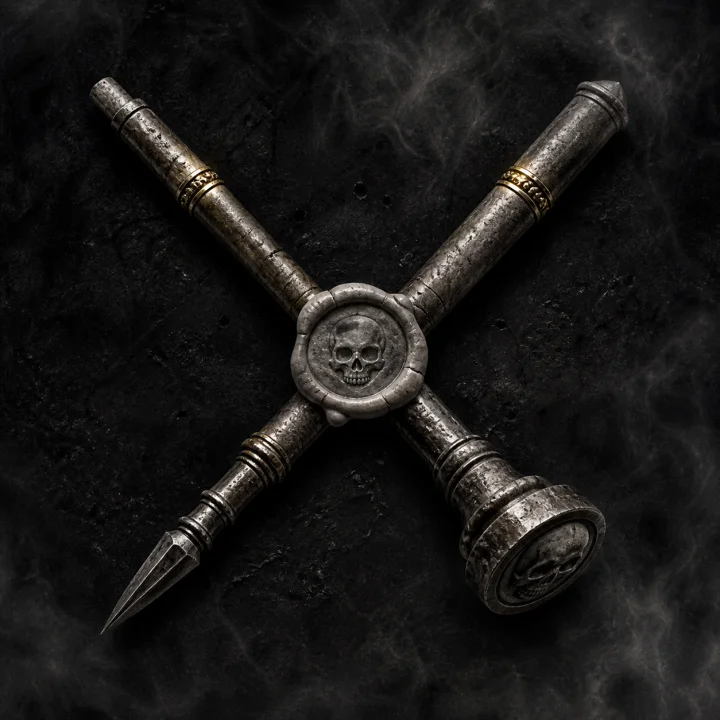
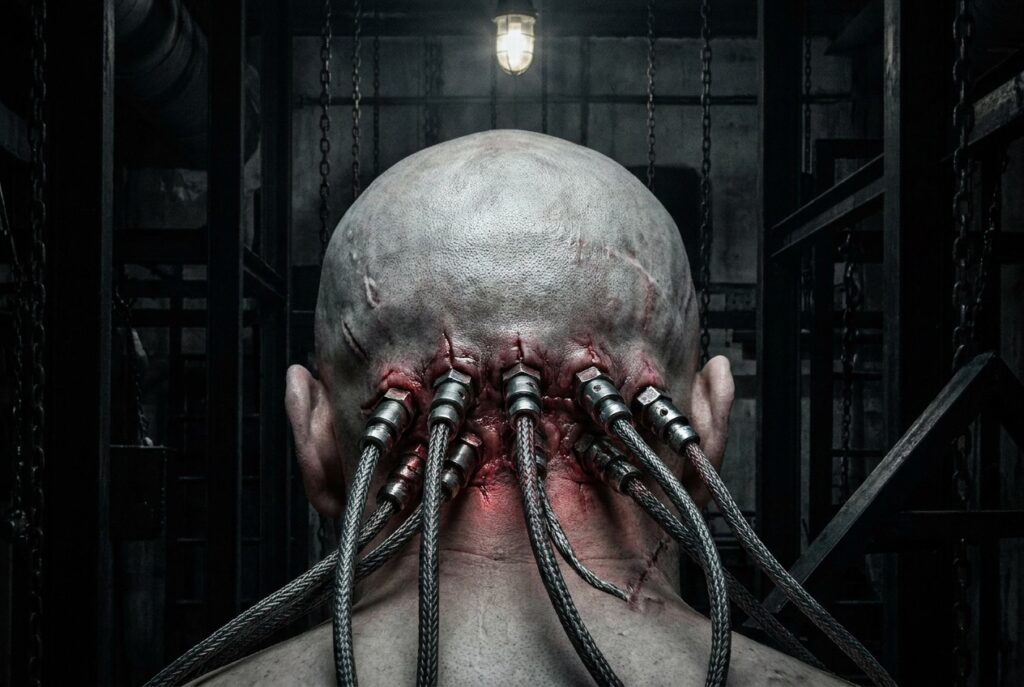
The Silence Before the Wrath
A novella from the years after the Heresy
World Eaters · Blood Angels
„I am often asked which is worse — a man who chooses evil, or a man on whom evil is forced while he screams that he does not want it. I have no answer. I have only known a brother who was both, at the same time, for the rest of his long, tormented life.“
Zugeschrieben einem ungenannten Chronisten der Großen Säuberung
I. The Silence Before the Storm
It began, as it always began, with a sound no ear ever really heard — a drawing, deep in his skull, as though something cold and metallic were boring through the folds of his brain, although the Nails themselves had sat in the same place for thirty years, immovable, waiting.
Draedus stood on a hill of rubble that had once been the outer line of defence of Karthax Secundus, and felt the world around him lose its colour. Not literally, his eyes still worked, still registered light and form, but something behind them, something that allowed him to recognise meaning in those forms, began to fade, replaced by a single, all-consuming clarity: there. Movement. Flesh. Target.
"Not now," he whispered, his voice through the helm-vox barely more than a growl. "Not now, not now, not —"
The Nails did not listen. They had never listened, not in thirty years, since the day on which Apothecary Skarr Nyx had driven them into his skull with trembling hands while two brothers held him down, because he had struggled against what was being sold to him as a gift. Thirty years, measured in Imperial standard years, although Draedus himself had long ago stopped counting time in that way — thirty years, measured instead in the faces of the dead he could no longer count, in the moments of clarity that grew rarer with every further year, in the slow, unstoppable erosion of what he had once regarded as his own inalienable identity.
He saw the Imperial defenders below at the foot of the hill, an improvised militia of Karthax Secundus's last survivors, armed with weapons scarcely older than their own desperate hope of surviving the siege. Karthax Secundus had once been an insignificant agri world, before the war reached it — a planet whose only strategic significance lay in its happening to sit on one of the few stable warp routes still reliably navigable out of the expanding chaos of the post-heresy galaxy. The people who lived here had had little to do with the war itself, until the shattered remnants of Draedus's warband, in flight from larger Imperial forces, had decided that a short, brutal plundering of this world would supply the resources necessary to secure their own increasingly precarious existence. He saw their faces, still recognisable as faces at this distance — fear, resolve, the small human stirrings of a people fighting because it had no other choice.
Then he saw only targets.
He remembered fragments afterwards — the weight of his chainaxe in his hand, the feel of hot blood seeping through the joints of his power armour, a scream that was not his own and yet came out of his own throat, mingled with a laughter he did not control, that he did not even recognise as his own, although he knew, with the last desperate corner of his consciousness that still belonged to him, that it came out of his own mouth.
He remembered a moment in which he believed he had stopped — a child, perhaps eight years old, hiding behind an overturned cart, its eyes wide with terror. He remembered how his hand rose, the axe already in its swing, and how something, deep in him, fought against that movement, with a strength he would not have thought possible in himself.
He did not remember whether the child lived or died.
He remembered other fragments of that day too, scattered like the shards of a broken mirror — the sound of doors bursting, the echo of screams that mingled with his own uncontrolled laughter, the sensation of resistance under his blade, followed by its sudden yielding. He remembered a man who tried to protect his family, his bare hands raised against power armour and chainaxe, with a courage that in other circumstances would have deserved admiration. He did not remember what happened to that man, but he knew, with the bitter certainty of a man who had studied the patterns of his own frenzy over decades, that the outcome was seldom other than the one his worst fears suggested to him.
When the clarity returned, Draedus stood alone on a field of the dead, his chainaxe dripping, his whole body trembling with an exhaustion that went deeper than mere physical effort. It always returned, that was the cruellest truth of the Nails: they never extinguished him entirely, but left him behind instead to look at the wreckage of what they had wrought in his absence.
He did not look round to search for the child. He had learned, in thirty years, that some truths were not worth finding. Instead he stood motionless for a long time among the dead, his breath still irregular from the after-effect of the rapture, while the wind over Karthax Secundus carried the smell of blood and burnt flesh to him — a smell he should have grown used to after thirty years, and that filled him every time anew with the same ineradicable nausea.
II. What the Nails Leave Behind
He found the way back to their improvised camp only hours later, after the sun of Karthax Secundus had disappeared behind the jagged mountain ranges in the west, his body so exhausted by the after-effect of the Nail-rapture that every step felt like wading through thick, resisting mud.
Vorn found him first, the youngest of their small scattered warband, barely fifty years in his power armour, his eyes still holding that remnant of innocence most other World Eaters had long since lost. "You survived," he said, his voice a mixture of relief and a wariness Draedus understood only too well.
"I survived." Draedus let himself sink against the wall of a collapsed building, letting his chainaxe fall beside him as though he could no longer bear the mere nearness of the weapon. "How many did we lose?"
"Two brothers. Karnak and Ossian." Vorn hesitated before giving up the next piece of information, with the caution of a man who knew that some news did more damage than the enemy himself. He had known Draedus long enough to know that the news of dead brothers, painful as it was, never weighed as much as the question that would inevitably follow. "The defenders did not survive, Draedus. Not one of them."
Draedus briefly closed his eyes. Karnak had been a veteran, older even than Draedus himself, one of the few remaining brothers who still remembered the time before the Fleshing, shared battles during the Great Crusade, long before Angron had even been freed. Ossian had been younger, barely older than Vorn, a man whose wit had sometimes been able to draw a smile even in the darkest moments of their shared, desperate existence. Both deaths would accompany Draedus in the coming nights, together with all the others whose names he could no longer count.
"How many?"
"Four hundred. Perhaps more."
Draedus closed his eyes, although the darkness behind them brought no relief — only the same fragmentary images the Nails left him, like rubble after a storm he had not seen himself, although his own body had caused it. "The child," he said quietly. "By the overturned cart, at the eastern edge of the market square. Did you see it?"
Vorn was silent for a long time, and that silence told Draedus more than any answer could have.
"I buried it," Vorn said at last. "Together with the others. I thought you would want to know rather than wonder."
Draedus nodded, unable to give more than that one mute acknowledgement, while something inside him broke that he had stopped trying to repair years ago, because every attempt had led only to new and deeper pain. He thought of the words he said to himself after every such massacre, that he had said to himself for thirty years without their ever becoming easier: That was not me. That was the Nails.
He knew, with the bitter clarity of a man who had wrestled with himself long enough, that this distinction was a lie he told himself in order to go on living. The Nails were in his skull, yes. But the hand that swung the axe was his own. The body that killed was his. And however much he wished it were otherwise, there was no way of denying that truth entirely without lying to himself more deeply than the Nails ever could.
Vorn sat down beside him, his younger, not yet fully blunted figure a quiet, unwelcome reminder of what Draedus too had once been, before thirty years of the Nails had hollowed him out. "I have heard the others talk about you when they think I cannot hear," he said after a while. "Some call you weak because you still torment yourself, where others long ago stopped asking what their hands have done."
"And what do you think, Vorn?"
"I think I would rather fight beside a man who still torments himself than beside one who no longer does." The young warrior looked at the ground, his voice growing quieter. "I am afraid of it, Draedus. Of the day on which I stop tormenting myself. I believe that will be the day on which nothing is left of me that is worth saving."
Draedus laid his hand on the younger man's shoulder, a gesture rare between them, in a warband that had long since learned to despise tenderness as weakness. "Then hold on to that fear, Vorn, as long as you can. It is perhaps the only thing that still distinguishes you from the beasts we are all slowly becoming."
III. Draedus the Silent
He had not always been so. That was the memory he guarded most carefully, hidden deeper than any other, because it was at once his greatest comfort and his cruellest torment — the memory of the man he had been before the Nails changed him for ever.
Before the Heresy, in the last golden years of the Great Crusade, they had called him Draedus the Silent — a name he had not chosen for himself, but that had been given him by his brothers, with a respect that went beyond mere fighting strength. He had been a duellist, a master of the single blade, whose style was marked by precision and control rather than by the raw, uncontrolled rage that even in those early days already defined a part of World Eaters culture. He had not been recruited from Nuceria itself, as had been the case with the earliest members of the Legion — he came from a distant feudal world whose name had in the decades since been struck from almost every available record, a son of a local warrior chieftain whose own skill with the blade set him apart from his contemporaries early. The Imperium's recruiters had found him at the age of fourteen, during a tournament that was actually meant for the entertainment of a local nobleman, and had recognised in him something that went beyond mere physical gift — a discipline, an inner calm in the midst of combat that even experienced veterans seldom possessed.
He remembered Angron, the first years after the Primarch's liberation from Nuceria — a man whose wrath was real, whose grief over the lost comrades of his gladiator days was genuine, but who nevertheless, in those early years, still had room for honour, for a code of battle that was more than mere slaughter. He remembered duels fought by strict rules, victories that ended with respect for the defeated rather than with his dismemberment. He remembered one particular fight, against a champion of a rival company, fought not out of hatred but out of the pure, almost meditative wish of two masters of their craft to measure their skills against each other — a fight that lasted hours, that brought both men to the limits of their endurance, and that ended not with the death of the loser but with a shared, exhausted laugh as they helped each other up, their weapons lowered, their honour visible to all in the way they treated each other rather than in the number of dead they left behind.
He remembered his brother Kaelen, with whom he had fought for thirty years before the Nails came — a man whose friendship he had valued more than any honour the Legion could ever have conferred on him. Kaelen had been one of the first to resist the Fleshing, when Angron, broken by his own ineradicable wrath at his fate as a Primarch, decided that his entire Legion should bear the Nails that had destroyed him.
Kaelen had been one of the first to die for it.
Draedus had watched his death, held by two other brothers who had themselves not been prepared to resist the Primarch's order, while a third brother — a man whose name Draedus refused ever to speak again — cut Kaelen's throat, for the crime of having asked whether there was another way.
"There is no other way," Angron himself had said, his voice shot through with a grief that Draedus was only to understand fully years later — the grief of a man who knew that he was imposing on his sons the same fate that had broken him, because he saw no other way of strengthening them for the coming war. "We shall all bear wrath, my sons. It is better to bear it together than to break on it alone."
Draedus had carried those words with him for thirty years, unable to forget them entirely, unable to accept them entirely.
He remembered too the hours afterwards, the quiet, shaken silence that settled over their whole company while they prepared Kaelen's body for the last honours — not the honours of a fallen hero, for there was no longer a ceremony for that in a Legion that was already beginning to lose its own code of honour, but the quiet, desperate gestures of men who did not know how to mourn a brother whom they themselves, out of cowardice or despair, had not dared to save. Draedus had sworn that night that if he ever survived the Fleshing, he would never entirely forget who Kaelen had been, and what he had died for. It was an oath he had, despite everything the Nails had taken from him, never broken in thirty years.
IV. The Fleshing
They came for him three days after Kaelen's death, at night, while he sat alone in his quarters, his thoughts caught between grief and a growing, desperate fear. Apothecary Skarr Nyx led the small group, his expression marked by a burden that had been perceptible even then, although Draedus in that moment found no room for compassion for the man who had come to force on him the same fate that had cost Kaelen his life. Draedus had spent the three days since Kaelen's death sitting alone, his weapons uncleaned, his armour unmaintained — small, meaningless acts of refusal towards a Legion that had suddenly become foreign to him, although he had spent his whole adult life in its ranks. In those three days he had several times considered choosing the way Kaelen had chosen: open resistance, in the knowledge that death would be the only possible consequence. But every time something had held him back, a quiet, desperate voice telling him that his death would change nothing except to increase the number of mourners by one more person.
"It need not be as it was with your brother," said Skarr Nyx, his voice quieter than Draedus would have expected from a man of his rank. "If you submit, you will live. If you fight —"
"Then I shall die, as Kaelen died, for the crime of remaining a man instead of becoming a tool of our Primarch's wrath." Draedus stood up, his hand reaching instinctively for his blade, although he knew that resistance against four fully armoured brothers was hopeless. "Tell me, Apothecary — do you yourself believe that what you are doing is right?"
Skarr Nyx's answer did not come at once, and in that hesitation Draedus saw something that he was later, in the years of reflection that followed, to recognise as the first proof that he was not the only one in his entire Legion who doubted what was being made of them.
"I believe that I have no choice, any more than you do," said Skarr Nyx at last. "I believe that our Primarch sees a war before him that we shall not survive unless we are prepared to sacrifice everything that makes us men in order to become weapons that can win it. Whether that is right —" He stopped, his voice breaking under a burden Draedus did not fully understand in that moment, but which, thirty years later, he could follow with painful clarity. "I do not know, Draedus. I know only that I have to do it, and that I would rather be the one who does it with a last remnant of care than somebody to whom your torments are a matter of indifference."
The fight that followed was short and humiliating — Draedus, overwhelmed by four brothers he had once regarded as friends, pressed to the ground, while Skarr Nyx with trembling hands prepared the instruments that would change the whole of his remaining life.
The pain, as the Nails were driven into his skull, exceeded everything Draedus had ever experienced in his whole life as a warrior. It was not only physical pain, although that too was well-nigh unbearable. It was a deeper, more fundamental level, on which something in himself, something that made up the essence of who he was, was forcibly pushed aside to make room for something else: something older, hungrier, that had only been waiting for the last barriers of his humanity to fall.
"I am sorry," whispered Skarr Nyx while he worked, his words barely audible over Draedus's own screams. "I am so sorry, brother. I hope that one day you will be able to forgive me for what I am doing to you tonight."
Draedus had never forgiven in thirty years. But neither had he ever entirely stopped asking himself whether forgiveness was even the right measure for a deed that had arisen out of the same desperate, helpless love for his brothers that had also motivated Kaelen's resistance.
He remembered the first waking afterwards, the feeling of waking in a foreign body that happened to be his own — the way in which even the most familiar sensations, the weight of his own armour, the sound of his own voice, suddenly seemed foreign, overlaid by something new and hungry that he had not invited. He remembered how in the first weeks afterwards he tried to feel with his fingers where exactly the Nails sat, as though he could pull them out again by mere touch, before he understood that they were anchored deeper than any blade or tool could reach — not only in his skull, but in the architecture of his own nervous system, inseparably woven into everything that kept him alive.
V. Skarr Nyx
Draedus found Apothecary Skarr Nyx the following morning in the improvised infirmary their small warband had set up in the ruins of a former administrative building of Karthax Secundus, his hands still busy with the care of the few wounded who had survived the previous day's attack.
"I lost control again," said Draedus without preamble, his voice hoarse from the after-effect of the previous day.
Skarr Nyx did not look up, his hands going on working with surgical precision. "You always do, brother. That is the price we all pay, since that night thirty years ago."
"I killed a child."
Those words made the Apothecary stop, his hands motionless for a moment over the wounded brother he was treating. When he finally looked up, his eyes — so much of his face as was still visible beneath the decades of augmentation and improvement — carried an exhaustion that went deeper than mere physical tiredness.
"I do not know it with certainty," said Draedus, his voice breaking under the weight of that admission. "I do not remember with certainty. But I remember how my hand rose, how the axe began to move, and I do not know whether any part of me stopped it before it was too late."
Skarr Nyx laid his instruments aside, his full attention now on Draedus. "Why are you telling me this?"
"Because I believe you are the only one who can perhaps help me." Draedus stepped closer, his voice quieter, more urgent. "You put me into this state, Skarr Nyx. I believe you are also the only one who might know a way to undo it — or at least to ease it."
The Apothecary was silent for a long time, his thoughts visibly wrestling with something he had evidently kept to himself for a long time. "There is a rumour," he said at last, his voice barely more than a whisper, as though he feared being overheard, even here, in their own hastily secured camp. "An old tradition from Nuceria itself, from the time before Angron's elevation — techniques the gladiator masters used to calm their fighters after the most brutal fights, to control their aggression instead of simply suppressing it. I have found fragments of those techniques in old records that we salvaged from the ruins of Nuceria itself, before the planet was finally destroyed." Skarr Nyx's voice now carried a wistfulness that seldom showed through his otherwise controlled, clinical manner. "I found those records over ten years ago, during a plundering that had nothing to do with them — a coincidence I have never since been able fully to explain, except as a kind of irony of fate. I have carried them with me all these years without knowing what to do with them, unable to destroy them, but also unable to find the courage actually to use them.
"Can you apply them?"
"I do not know." Skarr Nyx's honesty carried a weight that convinced Draedus more than any false confidence could have. "The fragments are incomplete, the techniques themselves dangerous, untried on anybody who has borne the Nails as long as you have. It could work. It could also kill you, or worse — put you into a state in which even the last remnants of your own control are lost for ever."
"I am prepared to take that risk."
Skarr Nyx looked at him for a long time, his eyes marked by a complicated mixture of hope and fear. "Then let us find a way together, brother. But I warn you — the place where I believe the complete records are to be found lies deep in an area that is dangerous even for us. An old Nucerian reliquary, saved by loyal servants before the destruction of our home world, hidden in a place only a few still know."
"Why did you not share this knowledge with me sooner?" asked Draedus, a touch of bitterness in his voice asserting itself against his will. "How many years have I wasted, how much innocence have I destroyed, while you kept this knowledge to yourself?"
Skarr Nyx looked at him for a long time, and in his gaze lay an exhaustion that betrayed decades of quiet, unspoken guilt. "Because I was afraid, brother. Afraid that I would lead you into further, pointless suffering, should the fragments prove incomplete or wrong. Afraid that Kroth or another of our brothers would execute me for the betrayal that this search in itself represents, before I even had the chance to carry it through. I have carried that fear with me for thirty years, together with the guilt of having put you into this state. I do not know whether that is an excuse, Draedus. I know only that it is the truth."
VI. The Hunt Begins
They set out three days later, a small group of six — Draedus, Skarr Nyx, the young Vorn, and three further brothers of their scattered warband, whose loyalty to Draedus personally, rather than to an abstract notion of Khorne's wrath, made them unlikely allies in this dangerous undertaking.
Among them was Kroth, a veteran whose devotion to the Blood God had developed in the years since the Fleshing into a kind of religious zeal that increasingly disquieted Draedus. He had brought Kroth not out of trust but out of necessity — their warband had become too small to afford the luxury of leaving fighting strength behind, however much that fighting strength was laden with ideological baggage.
"Where are you really leading us, Draedus?" asked Kroth, while they marched through the devastated outer districts of Karthax Secundus, his voice with an undertone of mistrust that did not surprise Draedus. "Skarr Nyx speaks of old relics, but I smell something else in this mission. Something that smells of weakness."
"We are looking for knowledge that could be of use to us in the coming war," Draedus lied, with an ease that surprised even himself. "Nothing more."
Kroth looked at him for a long time, his eyes marked by a sharpness that reminded Draedus how dangerous it was to deceive a man whose whole existence revolved around the detection of weakness and betrayal. "I hope that is true, brother. For if I ever came to suspect that you were trying to free yourself from the gift our Primarch gave us all, I would not tolerate that betrayal — even if it meant fighting a brother I once respected."
The threat hung between them, unspoken but unmistakable, while they marched on, deeper into an area that was exceptionally dangerous even by the standards of a war-torn planet — irradiated ruins whose exact cause even Skarr Nyx's advanced sensors could not fully explain, remains of an Imperial defence installation whose automated systems, decades after the original siege, still became sporadically active to attack anyone who ventured too close.
They came through three such automated attacks in the following days, each of them a test of their ability to fight as a coordinated unit instead of dissolving, as the nature of the Butcher's Nails brought about in many of their brothers, into uncoordinated individual frenzy. The second of these attacks proved the most dangerous — an automated defence gun whose sensors, despite decades of neglect, still functioned with frightening precision, and which fired three salvoes at them before Skarr Nyx found a way to break through its primitive logic and silence it. One of their remaining brothers, a man named Threxus, was severely wounded in that attack, his left arm destroyed beyond use — an injury he accepted with stoic indifference, one more scar among countless others his body had accumulated over the decades. Draedus noticed, with growing concern, how close he himself came several times to losing control, every fight a new test of his fragile, laboriously preserved self-command.
"You fight differently from the others," Vorn remarked while they took a short rest, after the third of these automated attacks. "I see it when the Nails threaten to take you over. You fight against it, in a way I have observed in no other brother, except perhaps in Skarr Nyx himself."
"It is a fight I have been fighting for thirty years, Vorn. Sometimes I win it. Mostly not."
"Do you believe that we shall find what we are looking for?"
Draedus looked into the distance, at the jagged mountains behind which, if Skarr Nyx's information was correct, the hidden Nucerian reliquary waited for them. "I do not know," he admitted honestly. "But I know that I cannot stop searching, however small the chance of success may be. The alternative — simply to accept what I have become, without ever trying again to become something better — is an alternative I can no longer bear."
They marched on, while the dusk of Karthax Secundus passed into a poisonous orange night, the distant rumbling of automated defence installations echoing through the ruins like a steady, ominous heartbeat. The remaining brothers of their small warband kept clear of this conversation, each of them sunk in his own quiet thoughts — except Kroth, whose gaze, whenever Draedus looked in his direction, carried a growing, undisguised watchfulness that said more than words ever could have.
VII. The Prisoner
They found him on the fifth day of their journey, bound and severely wounded in the ruins of a crashed landing craft whose Imperial markings were still clearly recognisable through the soot and the wreckage — a single Astartes whose red armour, shot through with the symbols of a Chapter Draedus had not fought directly since the Heresy, identified him at once as a Blood Angel.
The wreck itself told its own silent story of desperation — a small reconnaissance craft, evidently separated from its original fleet and crashed in a dive, its outer hull scattered over hundreds of metres, while inside the remains of a pilot and two other crew members bore witness that not everybody aboard had survived the landing.
"A loyalist," spat Kroth, his hand already reaching for his weapon. "A gift from our god that we should not refuse."
"Wait." Draedus stepped forward, his hand raised to stop Kroth's advance, although he himself could not say with complete certainty why he felt that impulse. "He is captive, wounded, no immediate threat. Let us at least understand why he is here before we kill him."
The Blood Angel looked up at them, his eyes despite his obvious weakness marked by a defiant, unshakeable calm that involuntarily reminded Draedus of something he himself had possessed a very long time ago, before the Nails took it from him. "You will learn nothing from me, traitor, except my death, if you grant it to me."
"What is your name?" asked Draedus, ignoring Kroth's growing impatience behind him.
"Corvantes." The Blood Angel spoke the name with defiant clarity, as though even in that helpless position he insisted on being acknowledged as an individual rather than as a mere target. "Of the Twelfth Company. Whatever you intend with me, do it quickly. I have no wish to spend my last hours with traitors who pretend to take an interest in my story."
"We do not intend to kill you at once," said Draedus, making his decision with a certainty that surprised even himself. "Not before I understand what a single Blood Angel is doing here, so far from any known loyalist operation."
Kroth stepped forward, his voice now marked by undisguised rage. "That is weakness, Draedus. The Blood God demands sacrifice, not interrogations that lead to nothing but wasted time."
"The Blood God will have his sacrifice, Kroth, when I decide that the time for it has come." Draedus spoke with an authority he had seldom shown so directly in recent years, a quiet reminder that, despite everything he had lost, he was still the highest-ranking warrior of their small warband. "Until then he stays alive, under my personal responsibility."
It took two more days before Corvantes was prepared to give up more than mere defiance — two days in which Skarr Nyx treated his wounds with the same care he gave to every wounded brother of their own warband, despite the Blood Angel's repeated and increasingly feeble protests. "My landing craft was shot down by an Imperial defence battery that had transmitted its own coordinates wrongly," he confessed at last, his voice marked by the bitterness of a warrior who had nearly died through the failure of his own allies. "An irony that even you will appreciate, traitor — that in the end it was not you but the incompetence of my own side that nearly killed me."
"War seldom makes distinctions between enemy and friend when it comes to its cruellest accidents," said Draedus.
"No," Corvantes agreed, his voice now quieter. "It does not."
VIII. The Curse of the Red Thirst
They carried Corvantes with them, his wounds roughly tended by Skarr Nyx, despite the Blood Angel's own repeated assurance that he would rather die than be treated by a World Eaters Apothecary — an assurance that grew weaker with every further day of their shared journey, while the plain, undeniable reality of his own mortality fought against his initial defiance.
The first days of their shared journey passed in tense, almost complete silence — Corvantes, who limited every interaction with his captors to the absolute minimum that his own dignified bearing still allowed him, and Draedus, who could not fully explain to himself why he had kept the Blood Angel alive at all, except through an instinct he was not prepared to speak aloud. Kroth watched this silent tension with growing suspicion, his remarks to the other brothers increasingly barbed, while Skarr Nyx, as was his way, concentrated on the practical tasks of care without involving himself in the more complicated emotional undertones of their unusual situation.
It was on the seventh day, during a nocturnal rest, that Draedus, unable to sleep, found Corvantes awake, his eyes on the distant artificial stars that glimmered faintly through the permanent smoke of Karthax Secundus's war destruction.
"You are fighting against something," said Corvantes unexpectedly, without turning to Draedus. "I have observed it, in the days since you took me prisoner. You are fighting against something in yourself, with the same desperation with which I fight against something in myself."
"What do you know about my fight?"
"Perhaps more than you expect." Corvantes finally turned to him, his eyes marked by an honesty rare between enemy and prisoner. "My Chapter bears its own curse, traitor, since the Heresy, since the death of our Primarch. We call it the Red Thirst — a craving for blood that slumbers in every one of us, that at some point consumes some of us entirely, until nothing is left of the man we once were, only a beast in consecrated armour."
Draedus sat down slowly beside him, his own curiosity overcoming the wariness he normally felt towards any loyalist. "How do you fight against it?"
"With discipline. With brotherhood. With the knowledge that even if I lose the fight in the end, as many before me did, the fight itself is meaningful — that every day on which I hold back the beast in me is a day on which I am still the man I wish to be, instead of the monster I could become." Corvantes looked at him directly, his voice now quieter, almost compassionate, despite everything that stood between them. "Is that not the same fight you are fighting, traitor, with your own Nails?"
The words struck Draedus with a force he had not expected — not because they were new, but because they came from a source he would never have expected to reveal to him the same truth he had himself been trying to understand for thirty years. "The difference is," he said at last, "that you at least have the hope that your fight means something in the end. Mine —" He stopped, unable to speak the full bitterness of his own situation. "Mine has already made me a murderer of children, Blood Angel. What meaning could such a fight still have, after it has already cost so much innocence?"
Corvantes was silent for a long time before he answered, his own voice now carried by a heaviness that entirely lacked his initial defiant distance. "I too have done things, in the moments when the Red Thirst took me over, for which I shall never find complete forgiveness. That does not make the fight meaningless, traitor. It only makes it harder to bear."
"Tell me about one of those moments," said Draedus, his request carried by a genuine, unexpected curiosity.
Corvantes was silent for a long time, his gaze on the distant, smoke-veiled stars, before he began to speak, his voice barely more than a whisper. "It was during the siege of Hesperus Tertius, three years after the death of our Primarch. I had lost a brother, in the same battle in which the Red Thirst took me over completely for the first time. When I came to myself again, I stood over the corpses of an Imperial garrison that had already surrendered, their weapons laid down, their hands raised. I had killed them all, every one, without remembering a single moment of it." He looked at Draedus, his eyes marked by the same burden Draedus himself knew. "My own Chaplain later called it a tragedy of war. I never called it anything but what it was — a murder, committed by my own hands, on men who no longer had any right to die for their capitulation."
Draedus was silent for a long time, recognising the parallels between their two stories with a clarity that surprised even himself. "How do you go on living with it?"
"I live with it by reminding myself every day of what I could lose, should I stop fighting against it." Corvantes's voice now carried a resolve that overlaid his earlier grief. "That is all any of us can do, traitor: not to forget, not to forgive, ourselves least of all, but to go on fighting every single day."
IX. Kroth's Suspicion
The growing, unexpected connection between Draedus and their captive Blood Angel did not escape Kroth, and in the following days of their journey his mistrust grew into something Draedus increasingly recognised as an open threat.
"You speak with him as with a brother, not with a prisoner," said Kroth one evening, when Draedus returned from another of these nocturnal conversations with Corvantes, his voice with an accusation that permitted no further excuse. "I am beginning to understand what this whole journey actually means, Draedus. You are not looking for knowledge for the war. You are looking for a way to refuse your own gift."
"And if that were so?" asked Draedus directly, tired of the necessity of maintaining a deception that was crumbling in any case.
Kroth's reaction was immediate and unmistakable, his chainaxe already half drawn from its housing. "Then you would be a traitor, not only to our Primarch but to every brother who bears the gift of the Nails with pride instead of regarding it as a curse one tries to be rid of."
"It is a curse, Kroth." Draedus's voice carried a hardness he seldom used towards one of his own brothers. "I killed a child, a few days ago, without even noticing it until it had already happened. If you believe that is a gift one should bear with pride, then we already now have nothing left in common that would justify a shared warband."
"I believe that Khorne demands strength, not weakness dressed up as conscience." Kroth stepped a pace closer, his bearing now undisguisedly threatening. "I believe that you are about to betray us all, for a hope that was never real — the hope that we could ever again become what we were before the Fleshing."
"And if that hope were real, Kroth?" asked Draedus, his own voice now equally hard. "Would you refuse it, out of loyalty alone to a god who offers you nothing but endless, meaningless slaughter, until one day you too die without anybody remembering the man you once were?"
"I would refuse it because I believe there is no return, for none of us, and that anybody who claims otherwise is either a fool or a liar." Kroth's voice carried a bitterness that went deeper than mere religious zeal, a personal, unhealed wound that Draedus in that moment truly perceived for the first time. "I once hoped myself, Draedus. In the first years after the Fleshing, before I learned that hope is only one more way of tormenting oneself without ever receiving a reward for it."
For a moment Draedus saw something behind Kroth's anger that he had not expected — not pure, unreflecting cruelty, but a deep, hardened despair, born of the same torment that plagued him too, only worked through in a fundamentally different way.
"What happened, in those first years, when you still hoped?" asked Draedus, his voice gentler now, the confrontation giving way for a moment to a genuine interest.
Kroth was silent for a long time before he answered, his bearing changing almost imperceptibly, as though he were opening a door he had kept shut for decades. "I had a wife, on my home world, before I was recruited. I swore to myself, in the first years after the Fleshing, that one day I would find a way to return to her, that the Nails were only a temporary burden I could overcome if only I fought hard enough." His voice grew harder, colder. "I found out later that she had died long before, decades before I even thought of returning. Time means nothing to us, Draedus, but it means everything to those we leave behind. In that moment I learned that hope is only one more form of cruelty we inflict on ourselves."
The confrontation that threatened to build between them in that moment was interrupted only by the sudden intervention of Skarr Nyx, whose voice spoke with the authority of a man who had himself carried the burden of this whole journey since its beginning. "We are almost there," he said, his words addressed to both, but above all to Kroth, in the hope of at least temporarily averting the impending conflict. "The reliquary lies less than a day's march away. Whatever has to be settled between you two can wait until we know whether this whole journey had any point at all."
Kroth slowly lowered his weapon, without, however, taking his eyes off Draedus. "This is not over, Draedus. But I will wait until we see what lies at the end of this road before I pass a final judgement."
X. The Truth About the Nails
The Nucerian reliquary proved to be a small, carefully concealed chamber, hidden deep in a natural cave system whose access had been protected by generations of loyal servants who even after the destruction of their home world had held fast to preserving the last cultural treasures of Nuceria.
What they found in it was neither the complete solution Draedus had dared to hope for, nor the complete disappointment he had secretly feared — but something more complicated, something that set his whole journey in a new and unexpected light. The chamber itself was small, scarcely larger than a modest set of quarters, its walls covered with faded frescoes showing scenes from a long-past age — gladiators fighting in the sand, not with the wild, uncontrolled rage that dominated Draedus's own memories of Nuceria, but with a grace still perceptible after millennia. In the middle of the chamber stood a single stone altar on which rested the ancient data cores and parchments that the last servants of Nuceria had saved before the destruction of their home world, their surface covered with dust that had lain undisturbed for decades.
"There is no technique that removes the Nails," said Skarr Nyx, after he had spent hours studying the ancient, fragile records, his voice marked by a disappointment that struck Draedus with a force he had not expected. "I feared that, but hoped I was wrong. The gladiator masters of Nuceria did not remove their fighters' aggression. They taught them to channel it, to shape it, to make it a tool they controlled instead of the reverse."
"What does that mean for me?" asked Draedus, his voice caught between hope and growing despair.
"It means that there is no easy way back, brother. No operation, no ritual that takes the Nails out of your skull and makes you the man you were thirty years ago." Skarr Nyx looked up at him, his eyes marked by a mixture of compassion and a hard, inescapable truth. "But the techniques I have found here point to something else — a discipline, a method of widening, of slowing the moment between the first drawing of the Nails and the complete loss of control. No cure, Draedus. But perhaps a tool with which you could learn to win more often than to lose."
Draedus stood silent for a long time in the small chamber, his thoughts caught between the bitter disappointment of what he would not find and the fragile but real hope of what actually lay before him. He thought of Corvantes's words, of the Red Thirst, of a fight that was never completely won and yet remained meaningful, precisely because it was continued, day after day, without any guarantee of final victory.
"Show me these techniques," he said at last. "Whatever they are, whatever they cost — I am ready to learn them."
Skarr Nyx led him to the last, best-preserved fragments of the old records, their surface covered with a script that even to Draedus, who had spoken Nucerian in his youth, seemed barely more than vaguely familiar. "The first technique is called, so far as I can translate it, the eye of the storm," the Apothecary explained, his fingers gliding over the ancient signs. "A state of meditative concentration that the gladiator masters taught their fighters before they entered the arena — a kind of inner point of rest that one had to find in oneself before the chaos of battle even began, so that one had a place to return to when the frenzy threatened to consume everything else."
"How do I find this place?"
"That, I fear, everyone must discover for himself. The records describe only the state, not the exact way there. But they suggest that it is often bound up with a single powerful memory — an anchor strong enough to hold even against the Nails." Skarr Nyx looked up at him, his question more a supposition than a real uncertainty. "Do you have such a memory, Draedus? Something that could be strong enough to bring you back, even when everything else seems lost?"
Draedus thought of Kaelen, of the last shared laughter after that long, honourable duel, of a time in which he still knew who he was without having to doubt it. "I believe so," he said quietly. "I believe I know where I have to look."
XI. Betrayal
It was Kroth who made the decision that changed everything, on the night after Skarr Nyx had begun to teach Draedus the first fragmentary techniques of the old Nucerian discipline — a decision born of a mixture of religious zeal and personal betrayal that Draedus, even in hindsight, was never fully to understand.
The attack came without warning, while Draedus remained in deep concentration, following Skarr Nyx's instructions in order to fight consciously, for the first time in thirty years, against the first quiet drawing of the Nails, instead of simply ignoring it until it was too late.
"Enough of this betrayal," roared Kroth, his chainaxe already levelled, as he threw himself not at Draedus but at the defenceless, still weakened Corvantes, who lay bound apart from the improvised camp. "If I cannot prevent our leader from giving in to his own weakness, I will at least see to it that this loyalist no longer exists as a symbol of that weakness."
Draedus reacted before his conscious mind had fully processed the whole import of the situation, his body throwing itself between Kroth's blade and Corvantes's defenceless form, with a speed that surprised even himself.
"You will not kill him," he said, his own chainaxe now raised against a brother he had once regarded as an ally.
"Then you are indeed the traitor I suspected in you." Kroth's voice now carried a rage that went far beyond mere ideological difference, the personal, wounded rage of a man who believed himself betrayed by a brother he had once trusted. "I shall kill you for this betrayal, Draedus, and then I shall kill the loyalist you are trying to protect, and then I shall return to our remaining warband to report to them how their former leader became a coward."
Vorn, torn from sleep by Kroth's shout, arrived just in time to witness the confrontation, his face marked by horror as he looked back and forth between the two fighters, unable to decide which of them he should go to help, unable even to grasp that two brothers whom he had regarded his whole short life as an Astartes as inseparable were now prepared to kill each other.
The fight that followed was the most brutal Draedus had experienced in years — not against an enemy but against a brother whose abilities he had come to know over decades of shared fighting, every blow as precise as only two men could deliver who had once fought together, before that one unbridgeable difference arose between them.
Draedus felt the Nails begin to draw in this fight, as they always did when blood and danger came together — but this time, for the first time in thirty years, he consciously tried to use the techniques Skarr Nyx had only just taught him, to widen the moment between the first drawing and the complete loss of control, instead of simply surrendering to the surge.
It was incredibly hard. It was almost impossible. But it was, for the first time in his whole life as a World Eater, not entirely impossible.
He found, in the middle of the chaos of the fight, for a single precious heartbeat, that place Skarr Nyx had described to him — the eye of the storm, a still, unshakeable core in himself, anchored to the memory of Kaelen's laughter, to a time in which honour had still meant more than bloodshed. In that one moment, while Kroth's blade raced towards him, Draedus saw the attack not through the red veil of the Nails but with the clear, calculated precision of the duellist he had once been.
XII. The Eye of the Storm
The fight lasted longer than either of them had expected, both warriors fighting at a level rare even among the most elite Astartes of the whole Imperium, while Skarr Nyx and Vorn, unable to intervene directly without risking wounding one of the two fighters by accident, watched helplessly as the fate of their whole small warband was decided in that one desperate duel. Skarr Nyx held his own weapon ready, his fingers closing uncertainly round the grip several times as he weighed whether an intervention would save the situation or only make it worse — a decision he never quite dared to make, as he would later admit to himself, for fear of choosing the wrong moment and thereby becoming himself the cause of a catastrophe he was trying to prevent.
Draedus felt his control almost break entirely several times, felt the familiar, all-consuming clarity of the Nails reaching for it, to take him over, to turn him into the same uncontrolled tool that a few days before had killed an innocent child. But every time he felt control threatening to slip away, he thought of Corvantes's words, of a fight that remained meaningful even when it could not be completely won, and found, deep in himself, the strength to wrest one more moment of clarity.
The decisive moment came when Kroth, in a last desperate attack, tried to break past Draedus to Corvantes, his blade carried in an arc that, had it succeeded, would have killed the defenceless Blood Angel instantly.
Draedus threw himself between the blade and its target, feeling the chainaxe cut deep into his own shoulder, a pain that burned even through the numbing clarity of his battle rapture. But the blow that had almost brought Kroth victory also opened a gap in his own defence — a gap that Draedus, with the last desperate precision that thirty years of training had anchored in him, used to drive his own blade deep into Kroth's unguarded side.
Kroth collapsed, his eyes marked by disbelief as he sank to the ground, his blood mingling with that of Draedus himself, streaming from the gaping wound in his shoulder.
"You could have —" Kroth began, his voice breaking under the force of his own mortal wound, "you could have been a true warrior of our Blood God, Draedus. Instead —"
"Instead I have chosen to remain a man, as well as I still can." Draedus knelt beside his dying brother, his own voice marked equally by exhaustion and grief. "I am sorry, Kroth. Not that I made this choice. But that we both came to a point at which this choice set us against each other, instead of uniting us, as it once did."
Kroth died without giving any further answer, his face in his last moments marked by a mixture of rage and, perhaps, a tiny fragment of that humanity he too had once possessed, before the Nails and Khorne's call had almost entirely extinguished it.
Vorn knelt beside the body of their fallen brother, his hand trembling as he spoke the old, scarcely practised rites that had once accompanied every death within their Legion, before Khorne's call began to displace even these last remnants of their humanity. "He was not always like that," said Vorn quietly, more to himself than to anybody else. "I remember how he protected me, in my first years after the Fleshing, when I myself hardly knew how to deal with what I had become."
"None of us was always like that," said Draedus, his own wound roughly tended by Skarr Nyx, while he watched his young brother mourn a man who minutes before had tried to kill them both. "That is perhaps the cruellest truth of this whole war, Vorn. We were all once something better, before we became what we are today."
XIII. What Remains
They spent the following days tending their wounds, both the physical ones and the deeper, more complicated wounds that Kroth's betrayal and death had left in their small, scattered warband. Corvantes, whose own wounds were slowly improving under Skarr Nyx's continued treatment, spent those days in a peculiar, never fully resolved state between captivity and something that increasingly felt like an unlikely brotherhood in arms.
"You saved my life at the cost of your own blood," said Corvantes, as they sat together one evening at the edge of their camp, his voice carried by an honesty he could never have imagined towards a traitor before this whole unlikely journey began. "I do not know how I am to reconcile that with everything I was taught about what you and your kind represent."
"Perhaps you do not have to reconcile it entirely," said Draedus. "Perhaps it is enough to know that there are moments, exceptions to every rule we tell ourselves about the world in order to understand it more simply than it actually is."
"What will you do now? Now that you know there is no complete cure?"
Draedus was silent for a long time, weighing the implications of that question with a clarity he had worked out only in the last chaotic days. "I shall go on fighting, Corvantes. Not against an enemy I can defeat, for the Nails will accompany me for the whole of my remaining life, without prospect of final victory. But I shall go on fighting, every day, to win more often than I lose, as you described it to me, with your own curse."
Skarr Nyx came over to them, his own face marked by a quiet, complicated relief that thirty years of guilt could not entirely extinguish, but that was genuine all the same. "I shall stay with you, Draedus, as long as you need me," he said. "I put you into this state. It is only right that I help you find a way to live with it, even if that way never leads to a complete cure."
"And the others?" asked Draedus, turning his gaze to the remaining brothers of their decimated warband, who had gathered at a respectful distance, their own thoughts about the events of the last weeks visibly not yet fully ordered.
"They will have to decide, each for himself, whether they want to walk this road with us," said Skarr Nyx. "I shall force nobody to share a hope he is not prepared to carry himself."
"That sounds like a lonely road."
"It is the only road I have left." Draedus looked at the distant stars glimmering faintly through the permanent smoke of Karthax Secundus. "I cannot return to the Imperium, Corvantes. Even if they believed me that I am trying to control my own nature instead of celebrating it — my hands carry too much blood that can never be forgiven, from men who have a far better right to revenge than I have to forgiveness. But neither can I return to what I was in the last thirty years, now that I know there is another way, even if that way will never lead to a complete redemption."
Corvantes nodded slowly, his expression marked by a respect he could never have imagined for himself towards a traitor before this journey began. "There is an old saying in my own Chapter, Draedus, born of our own struggle with the Red Thirst: 'We are not judged by whether we fall. We are judged by how often we rise again.' I do not know whether that saying was meant for a man like you when it was first spoken. But I believe it fits you, better than most brothers of my own Chapter whom I know."
"That is a more generous judgement than I would have expected, from a man whose brothers I may one day fight again."
"Generosity is rare in this galaxy," said Corvantes. "But it is not less true for that."
XIV. The Road Without Return
They finally released Corvantes, a week later, at a place from which he could return with a realistic prospect of success to the remaining Imperial defence lines of Karthax Secundus, before the last phase of the siege began. The parting was marked by a peculiar solemnity such as seldom occurs between declared enemies — none of the usual rituals of war, neither triumph nor humiliation, but something closer to mutual, hard-won respect.
"What will you report to your own brothers?" asked Draedus, as they stood facing each other for the last time, enemies by every ordinary definition of war, and yet become something else, in the days they had lived through together.
"The truth, however unlikely it may sound." Corvantes's voice carried a seriousness that left no room for deception. "That I met a World Eater who fights against his own nature, with the same desperation with which I fight against my own. I do not know whether they will believe me. I do not know whether it even matters whether they do."
"Will you not be punished, for the mere fact that you spoke with us instead of fleeing or fighting at once?"
"Perhaps." Corvantes shrugged, a gesture that despite his still visible exhaustion betrayed a certain composure. "But I have learned, in the years since the Heresy, that truth is more important than comfortable reports that hurt nobody. If my own Chapter punishes me for what I have seen and learned here, then that says more about the limits of their own understanding than about any mistake I have made."
"And if we meet again, on some future battlefield?"
Corvantes was silent for a long time before he answered, his eyes marked by the same complicated honesty that had defined their whole unlikely connection. "Then we shall do what duty and circumstance require of us, Draedus. I am no fool who believes that a single meeting could wipe out ten thousand years of war still to come. But I shall remember these days, and what they taught me about the difference between an enemy and a monster. That is more than I would have expected when your brothers took me prisoner."
Before he went, Corvantes paused, his hand rising into a gesture that lay between a military salute and something more personal. "If there is a god who still has room in his judgement for men like the two of us, Draedus — not Khorne, not the Chaos gods, but something older, more just — then I hope that he sees what you are trying to do here, and recognises it for what it is: the attempt of a man who has lost more than most could bear, not to give up entirely all the same."
"And if there is no such god?"
"Then it will be true all the same, no matter whether anybody ever bears witness to it." Corvantes turned to go, his silhouette soon disappearing into the ruins of Karthax Secundus, towards the distant, still fighting Imperial defence lines.
They parted without further words, each returning to his own uncertain fate, while Draedus, together with Skarr Nyx, Vorn and the last remaining brothers of their small, decimated warband, withdrew deeper into the jagged wastelands of Karthax Secundus, away from every immediate front of the war that had defined their whole existence.
"Where do we go now?" asked Vorn, as they marched through the dusk, his voice carried by a hope that even the events of the last weeks could not entirely extinguish.
"I do not know with certainty," Draedus admitted, his hand wandering involuntarily to his wounded shoulder, whose scar, he already knew, would accompany him for the rest of his long, uncertain life. "But I know that we shall no longer follow Khorne's call blindly, without seeking the control that call has so long denied us. We shall practise the techniques Skarr Nyx found in that reliquary. We shall learn to win more often than we lose. And perhaps, one day, we shall find a way to use this fragile control for something more than mere survival — for a purpose that allows us to live with what we have become, without losing ourselves entirely in it."
Vorn walked silently beside him, his young figure visibly changed by the events of the last weeks, aged in a way no number of years alone could have brought about. "I shall walk this road with you, Draedus," he said at last, his voice carried by a resolve that now joined his initial innocence to something harder but no less valuable. "Not because I believe that we shall succeed. But because I believe that the attempt itself is more important than any guarantee of success."
"That is a wise insight, for so young a man."
"I had a good teacher," said Vorn, a faint but genuine smile on his scarred features.
He thought, as they walked on, deeper into an uncertain future, of Kaelen, of his old name, Draedus the Silent, of a version of himself he would never fully be again. He thought of the child whose name he had never learned, whose death he would carry with him for the rest of his unnaturally long life, a memory that remained no matter how often he tried to settle it. Skarr Nyx walked silently behind them, his own gaze wandering again and again to the distant ruins of the city in which so many of their victims lay buried, his own burden of thirty years of quiet complicity no lighter than that of Draedus himself, only carried differently, worked through differently, an Apothecary whose hands both healed and, on that one ineradicable evening thirty years ago, irrevocably destroyed.
And he thought of Corvantes, of an enemy who for a short, unlikely moment had shown more understanding than any brother he had met in the last thirty years — of the quiet, bitter hope that, even in a galaxy torn by endless war and incurable corruption, it was still possible to find a way that meant neither complete redemption nor complete damnation, but something in between — harder to bear than either, but, perhaps, more honest than any simpler answer he could have wished for.
He would never be able to return to the Imperium. That he knew with absolute certainty, as they marched on into the darkness. But he did not have to remain entirely, he decided in that moment, with the same certainty with which he accepted that impossibility, what the Nails wanted to make of him. Between those two impossibilities lay a narrow, uncertain path that he intended to walk from now on, day by day, fight by fight, without any guarantee of final peace, but with the only kind of hope left to him after thirty years of the Nails.
THE END
Download story as PDF or EPUB
Enter your email address. After confirming your subscription you'll get the download links immediately and by email.