
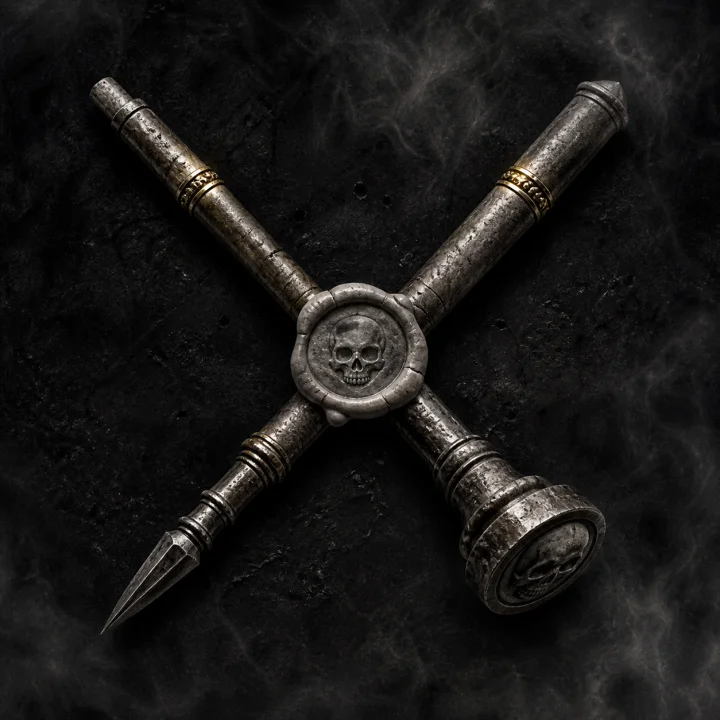

The Ninth Seal
A Novella from the Heart of the Imperium
„There are secrets that protect the Imperium. And there are secrets the Imperium must be protected from. The difference between the two is the most dangerous piece of information a man can ever possess.“
Zugeschrieben Malcador dem Sigilliten, aus keiner erhaltenen Aufzeichnung
I. The Ninth Seal
Custodian Kaedan had spent two hundred and seventeen years in the Emperor's service, one hundred and nine of them standing guard at the Sanctum Imperialis itself, before he was reassigned to a post whose existence he had not known of until that very day.
He had been twenty-one years old, the son of a forge-world family in the Sol System, when the genotypic examiners selected him from among thousands of candidates — a selection he himself had never fully understood, except as confirmation of what his instructors would later call "the rare, complete absence of doubt in a decisive moment." He had never thought of himself as extraordinary in the years before his elevation. He had only ever done what seemed necessary in each moment, without the burden of deliberation that so often paralysed other men. It was this quality, he suspected later, that had made him one of the Ten Thousand who guarded the Emperor himself with their lives.
The transfer itself had been unusual enough to catch his attention — no ceremony, no formal handover order through the usual channels, only a single sealed order, delivered by a Tribune he had never seen before, instructing him to report immediately and without escort to a coordinate deep beneath the Sanctum Imperialis. In two centuries, Kaedan had learned that the Custodes rarely explained why an order was given. He had also learned that this reticence almost always had good reason behind it.
The descent took nearly an hour, through shafts and corridors that appeared on no map he had ever studied, past security systems whose age he could not guess, until at last he reached a chamber whose existence, it seemed, was known to only a handful of guardians even within the Custodian Guard itself.
The Sigillite Vaults.
The name alone told him little, but the physical reality of the place spoke its own unmistakable language. Twelve massive sealed gates, each wrought from a material his trained eye could not immediately identify, lined a circular central chamber whose walls were covered in symbols that seemed older than any Imperial iconography he knew — not heretical, he sensed that with the instinctive certainty of a man who had devoted his entire life to the Emperor's protection, but simply older. From a time before the Imperium's official history. The air itself carried a peculiar, almost tangible quality, cool and dry in a way no known climate system of the Sanctum Imperialis could explain, as though the chamber operated by its own ancient laws, independent of everything built above it.
The descent itself had already prepared him, in ways he did not fully register in that moment, for what he would find here — doors whose mechanisms seemed older than any Imperial technology he knew, corridors whose walls had been worked with a precision even the finest craftsmen of today's Mechanicum could scarcely reproduce, and a silence that felt as though it had gone undisturbed for millennia.
Eleven of the twelve seals carried a faint, constant glow — a state Kaedan would later come to understand as "dormant sealing," a system that had functioned unchanged for thousands of years. The twelfth seal, directly before him, ninth in the circle by count, pulsed with a light unmistakably more active than the others — not alarming in its intensity, but unmistakably changed.
"You are the new warden."
The voice came from a figure that stepped from the shadow between two of the sealed gates — a tall form threaded through with mechanical augmentations, its red robe marked with the symbols of the Adeptus Mechanicus, but its bearing radiating an authority beyond the rank of an ordinary tech-priest.
"Custodian Kaedan," he answered, his voice carrying the calm precision two hundred years of training had carved into him. "I was ordered here without further explanation."
"That is how this place has functioned since its founding." The figure stepped closer, its mechanical limbs working with a quiet, precise whirring. "I am Magos Cassivex. I serve as keeper of this chamber, together with whichever Custodian is assigned to me — an arrangement that, I am told, reaches back to the earliest age of the Imperium."
Kaedan's gaze moved between the twelve sealed gates, coming finally to rest on the ninth, whose pulse, he now noticed, ran in a rhythm that felt almost like a heartbeat. "What lies behind these gates, Magos?"
"That," said Cassivex, "is a question I cannot fully answer for you, Custodian — not out of distrust, but because I myself, after four hundred and seventy years at this post, know only a fraction of the truth." He turned toward the ninth seal, his mechanical eyes narrowing. "What I can tell you is this: this gate has never been active since my arrival at this place. It began to pulse twenty-seven days ago, with no discernible external trigger. And in those same twenty-seven days, I have begun to notice patterns in our own archives that I had never before thought to question."
"What kind of patterns?"
Cassivex regarded him for a long moment, with the expression of a man making a decision he did not wish to make lightly. "The kind of pattern, Custodian, that I believe you should find yourself, before I describe it to you. Not because I distrust you. But because in four hundred and seventy years I have learned that a truth one discovers oneself is carried differently than one simply told."
Kaedan spent the remainder of that first day alone, his movements through the chamber methodical, almost meditative, taking in every detail his trained senses offered him. He touched none of the sealed gates, activated no terminal, asked no further questions — he only observed, with the patience of a man whose entire training had taught him that the most important truths rarely revealed themselves at once, but showed themselves slowly, layer by layer, to those willing to look long enough.
II. The Vaults
In the days that followed, Kaedan came to know the physical structure of the Sigillite Vaults with the same methodical thoroughness with which he had once studied the defences of the Sanctum Imperialis — every corridor, every security lock, every one of the twelve sealed gates, whose exact function Cassivex explained to him only in vague, suggestive terms.
"Each seal," the Magos explained, as they walked the outer ring of the chamber together, "was, as far as my own records reach, erected at a different time, by different hands, for different purposes. Some contain technology from the Dark Age, too dangerous to leave to the general access of the Adeptus Mechanicus. Some contain — and here my own knowledge grows patchy — things that are neither purely technological nor purely biological in nature."
"And the ninth seal?"
"The ninth seal carries no inventory list I have ever been permitted to view." Cassivex stopped before the pulsing gate, subjecting it to another careful examination by his mechanical sensors. "It exists in our archives only as a coordinate, accompanied by a single annotation which, in my first decades here, I took for a mere bureaucratic formality."
"What kind of annotation?"
Cassivex hesitated — a rare sign of uncertainty in a man whose entire existence was oriented toward precision and certainty. "To be opened only upon the return of a son."
The words hung in the chamber as Kaedan processed their implication, his thoughts drifting unbidden to the news that had penetrated even the sealed channels of the Custodian Guard — news of a Primarch returned after ten thousand years, to lead an Imperium he scarcely recognised.
"Guilliman," said Kaedan quietly.
"That is the most obvious interpretation, yes." Cassivex's voice carried a caution beyond ordinary reticence. "And if that interpretation is correct, then this seal began to pulse twenty-seven days after an event the entire galaxy celebrated as a miracle — which would mean that someone, a very long time ago, foresaw this exact moment with a precision that troubles me deeply."
Kaedan looked to the seal, to its steady, almost breathing pulse, and felt, for the first time in two hundred and seventeen years of service, something he could not immediately name — not fear, an emotion Custodes rarely knew, but something related, colder and heavier: the realisation that he stood at the threshold of a secret older than any certainty his office had ever given him.
In the hours that followed, Cassivex led him through the remaining eleven sealed gates, each with a brief, precise description of what his own centuries-old records held about it — a collection of facts that troubled Kaedan more and more, precisely because of their apparent completeness. The first seal contained, according to the inventory, an archive of lost xenos languages, gathered during the earliest expeditions of the Great Crusade. The third held fragments of an STC matrix whose application had not been fully deciphered even after centuries of study. The seventh, at least according to the official record, was empty — an anomaly Cassivex himself had never been able to fully explain, since empty seals, as he stressed, were not accounted for anywhere else in the Vaults' structure.
"And the ninth?" Kaedan had already asked once, before they returned to that particular gate. Cassivex had said nothing then — a silence Kaedan now recognised, in hindsight, as the first true warning the Magos had given him.
"Who built this seal, Magos?"
"The records name no one." Cassivex turned from the gate, his mechanical movements slower, more deliberate than they had been at the start of their conversation. "But in these past twenty-seven days I have begun to suspect that there was only one authority in the entire history of the Imperium who could have left such an instruction with such precision."
He did not finish the thought aloud. He did not need to.
III. The Missing Names
Kaedan began his own, independent investigation in the third week of his service, driven by a growing unease he could not fully explain to himself — an instinct, sharpened by two centuries of vigilance, telling him that Cassivex's careful hints touched only the surface of a far deeper truth.
He began with the obvious: the service records of every Custodian who had served as warden of the Sigillite Vaults before him. The list itself was short — the post had existed, as Cassivex confirmed, since the earliest days of the Imperium, but the rotation of assigned wardens was irregular, some serving decades, others only a few years.
What troubled Kaedan was not the irregularity itself, but a pattern that emerged the moment he arranged the records chronologically: seven of the twenty-one recorded wardens before him had ended their service with identical bureaucratic phrasing — "Transfer at own request to unknown destination, file sealed by order of higher authority."
Seven men, spread across a span of several millennia, whose trail vanished entirely after their service in the Sigillite Vaults.
He spent another day tracing each of these seven names as far back as he could, with the methodical patience two centuries of Custodes training had instilled in him. The oldest of the seven, a Custodian named Herakon, had, judging by the sparse surviving records, served as early as the Imperium's earliest centuries — a man whose name appeared in no other chronicle but this one, sealed personnel file. The youngest, a certain Custodian Ptolan, had begun his service barely eight hundred years ago and ended it, like the others, after only a few decades, under the same cryptic phrasing.
None of these seven names appeared on any of the official honour rolls of the Custodian Guard that Kaedan knew from his own training. It was as though they had not merely been transferred, but carefully excised from the living memory of the entire Order.
He brought this discovery to Cassivex the following morning, his voice carrying a directness he had held back in the preceding weeks. "Seven wardens, Magos. Seven men whose files were sealed in an identical manner, without anyone outside this chamber ever seeming to have asked why."
Cassivex's reaction was not surprise — Kaedan registered that immediately, with the trained attentiveness of a man whose entire education had taught him to read every nuance of a reaction. It was closer to a kind of exhausted confirmation, as though the Magos had been waiting for precisely this moment without daring to hope it would actually come.
"I knew three of them personally," Cassivex said at last, his voice quieter than usual. "Not the older ones, from the first millennia — but the last three who served before you. I worked alongside each of them for decades, Custodian. I watched each of them, in the final months of his service, begin to ask questions that had never occurred to the previous wardens — and I watched each of them vanish shortly after, without farewell, without explanation, with only an official notice bearing the exact same wording you have just found."
"And you never asked where they went?"
"I asked." Cassivex's mechanical voice carried something that, in an ordinary man, would have been recognisable as bitterness. "Twice, with the first two. With the third, I stopped asking, because I realised my own inquiries were themselves being watched, in a way I did not fully understand, but which convinced me that further questions would hasten my own disappearance rather than yield answers."
"And yet you have told me all this," said Kaedan. "Why now, when you have spent decades learning that silence is the safer path?"
Cassivex looked at him for a long moment, his mechanical eyes marked by a weariness that went far beyond any physical exhaustion. "Because it took me four hundred and seventy years at this post to realise that safety and rightness are not always the same thing, Custodian. I have grown old in the shadow of this chamber. I am not prepared to die in that same shadow without at least having tried to understand the truth I have devoted my entire life to guarding."
IV. Tribune Orwynne
Kaedan spent three more days organising his findings before deciding to bring them to an authority outside the Sigillite Vaults — a decision he did not make lightly, given what Cassivex had hinted about the consequences of previous inquiries.
He chose Tribune Orwynne, one of the few higher-ranking Custodes whose judgement he had come to know, over two centuries of shared service, as utterly incorruptible — a woman whose rank entrusted her with the oversight of several sensitive posts within the Sanctum Imperialis, and whose discretion was proverbial even within an Order for which discretion was the most fundamental of virtues.
She listened to his account in her private quarters without once interrupting, her expression unmoved throughout the entire presentation — a discipline Kaedan expected of any Custodian, but which he nonetheless registered with quiet admiration, given the gravity of what he was telling her.
"Seven vanished wardens," she said at last, when he had finished, "a reactivated seal that coincides with the return of a Primarch, and a Magos who believes further inquiry is dangerous. That is a troubling collection of facts, Kaedan, even by the standards of our Order."
"I believe it is more than troubling, Tribune. I believe we stand before something that comes directly from the earliest age of the Imperium, something the Emperor himself — if my suspicion about the seal's origin is correct — considered so significant that he was willing to establish a system of secrecy lasting millennia, one that apparently does not even allow its own guardians of that secrecy to survive it."
Orwynne rose, moved to the narrow window of her quarters, which offered a view over the vast, ordered defences of the Sanctum Imperialis. "Do you know what troubles me most, Kaedan? Not the possibility that the Emperor himself established this system. It is the possibility that it is still functioning exactly as he intended — that the vanished wardens are not the result of some corruption of this system, but its correct, unaltered operation."
"You mean their disappearance was intentional. From the beginning."
"I mean that we do not know, and that this uncertainty is itself the most dangerous piece of information we currently possess." She turned to him, her decision visibly taking shape. "We will continue this investigation, but with the utmost caution. I will not allow you to become the eighth name on a list we do not even fully understand yet."
"And if it is unavoidable?" asked Kaedan. "If the truth itself forces us to go deeper than is safe?"
Orwynne looked at him for a long moment, her expression marked by a gravity he had rarely observed in her, even across two centuries of shared service. "Then we will walk that path together, Kaedan, with our eyes open, rather than stumbling blindly into a danger we do not fully understand. That is all I can promise you in this moment."
V. The Last Entry
With Orwynne's tacit authorisation, Kaedan gained access to a deeper archive level Cassivex had not shown him before — not out of reticence, as the Magos stressed, but because even he had not known the full extent of this level existed, until Orwynne's authority unlocked the corresponding access codes.
There, among millennia of bureaucratic records, Kaedan found a single report that differed from all the others — not in its content, which was mostly redacted, entire paragraphs vanishing beneath blacked-out bars, but in the fact that it existed at all. A report, written by one of the seven vanished wardens, in the final weeks before his disappearance.
The legible fragments were sparse, but they carried a weight that troubled Kaedan more deeply with every word.
"...the ninth seal matches no known classification of the Mechanicum. Magos [redacted] confirms that the construction technique itself predates any documented period of the Dark Age of Technology — possibly from the era of the [redacted], which official history claims to be entirely lost..."
"...the Regent's directive, should it truly exist, would mean that the Officio Assassinorum has held a standing order connected directly to this place since the Imperium's founding — not directed against outside enemies, but..."
The report ended abruptly, mid-sentence, without closing formula, without the usual signature that accompanied every official Custodes record.
Kaedan searched the surrounding archive for further fragments of the same report, with a thoroughness that had his fingers moving through dusty, rarely consulted data-cores for hours. He found nothing coherent — only scattered, isolated references suggesting the original report had once been far more extensive, before someone, with surgical precision, had removed most of its content. Whoever had carried out this redaction had been thorough — but not thorough enough to erase every trace that more had once stood here.
Kaedan sat a long while with the document, weighing the implications of every legible fragment. The Regent's directive. Not the Emperor's — the Regent's. A title that, as far as Kaedan knew, only one person in the Imperium's entire history had officially held, long before Guilliman's own return and elevation to Lord Commander: Malcador the Sigillite himself, the Emperor's closest confidant, whose true power and true secrets remained known only in fragments even ten thousand years after his death.
"Magos." Kaedan's voice, when he found Cassivex, carried an urgency he had not shown in the preceding weeks. "I need to know whether the Officio Assassinorum has ever been officially connected to this place."
Cassivex's reaction — a brief, involuntary hesitation before he answered — told Kaedan everything he needed to know, even before the Magos spoke a single word.
VI. The Protocol of Silence
The formal inquiry to the Officio Assassinorum required an authority even Tribune Orwynne was willing to exercise only with considerable caution — a channel, as she explained to Kaedan, rarely opened in decades of her own service, precisely because any inquiry to that organisation drew a kind of attention one did not invite lightly.
The answer came sooner than Kaedan expected, in the form of a single visitor — Proctor Ilyan Kresh, a man of unremarkable appearance, whose affiliation with the Officio Assassinorum betrayed itself only through the precise, controlled manner in which he moved, spoke, weighed every question before answering it. He wore no visible weapons, no armour, nothing that would have set him apart from an ordinary Imperial administrator — and yet Kaedan sensed, with the same instinctive certainty that would later warn him of Kresh, that this man was far more dangerous than his unremarkable appearance suggested.
"You are asking questions about a protocol that officially does not exist," said Kresh, taking a seat in the improvised meeting chamber Orwynne had requisitioned for this conversation. "I am here to inform you that this non-existence is a deliberate, carefully maintained fact, not a bureaucratic oversight."
"But it exists," said Kaedan directly.
Kresh regarded him for a long moment, his eyes marked by a coldness beyond mere professional distance. "I am not authorised to confirm or deny that question, Custodian. But I am authorised to tell you this: if a protocol of this kind existed, it would be the oldest still-active standing-order system the Officio Assassinorum has ever maintained — older than any threat known to us, older than most institutions of the present Imperium."
"Directed against whom?" asked Orwynne sharply.
"Against no one in the conventional sense." Kresh's voice remained calm, but something in his bearing betrayed that he too moved on ground that exceeded even his own considerable authority. "Such a protocol — hypothetically speaking — would not be directed against enemies, but against an event. Against the possibility that certain knowledge reaches the wrong person at the wrong time, before the circumstances arise under which that knowledge can be safely disclosed."
"And if someone discovers this knowledge by accident, without malicious intent?" asked Kaedan. "What happens then, hypothetically speaking?"
Kresh was silent for a long moment before answering, and when he did, his voice carried, for the first time since their conversation began, something that looked like genuine unease. "Then, Custodian, everything depends on the assessment of a single field operative, whose judgement in such matters is traditionally not challenged — not because the system is infallible, but because there is no higher authority capable of reacting quickly enough to correct an error before it manifests."
"Has such an operative already been activated?" asked Orwynne.
Kresh rose, his expression a mask of professional impenetrability that nonetheless, as Kaedan noted with growing unease, did not fully conceal the tension beneath it. "I am not authorised to answer that question. But I advise you both, Custodian, Tribune, to consider very carefully how much further you wish to take this investigation. Some questions, once asked, cannot be unasked."
"Then why come at all?" asked Kaedan, his question more direct than Custodes etiquette usually allowed. "If you are not permitted to tell us anything concrete, why make this personal journey, rather than a simple written refusal?"
Kresh paused, his hand already on its way to the door, and for a moment Kaedan saw something in his bearing that went beyond mere professional restraint. "Because I believed a personal warning would carry more weight than a bureaucratic document that could easily be set aside." He turned once more, his voice now quieter. "I have rarely, in my career, met Custodes willing to go as far as you already have, Custodian. That impresses me. It also troubles me."
VII. What the Magos Knows
After Kresh's departure, Kaedan returned to the Sigillite Vaults, his thoughts carried by a growing urgency he could no longer ignore. The path back through the silent, subterranean corridors felt different from any he had walked since arriving at this post — no longer the neutral, indifferent architecture of a secret vault, but the setting of a story that, as he now sensed with growing certainty, extended far beyond anything anyone outside this chamber would ever suspect. He found Cassivex in the central chamber, standing before the ninth seal, whose pulse, Kaedan noticed at once, had visibly intensified in recent days.
"You spoke with the Officio Assassinorum," said Cassivex, without turning.
"How do you know that?"
"Because in four hundred and seventy years I have learned to recognise the signs that follow such a conversation." Cassivex finally turned to him, his mechanical features marked by something that, in a human, would have been recognisable as exhaustion. "I believe it is time I told you what I actually know, Custodian, rather than leaving you further in the dark while the danger grows around us both."
He led Kaedan to a hidden terminal, set deep into the wall of the central chamber, whose existence Cassivex had kept from him until now. The path there led through a narrow, barely perceptible side corridor Kaedan had overlooked in his previous explorations of the chamber — proof of how carefully even the physical architecture of the Sigillite Vaults had been designed to hide its deepest secrets from all but the most initiated observer. "Three hundred years ago, in my one hundred and seventieth year at this post, I discovered access to fragmentary records reaching further back into this place's history than anything I have shown you so far. I never fully deciphered them. But I understood enough to know that the ninth seal contains a message — not a weapon, not an artefact in the conventional sense, but a direct, personal record, left by a single source."
"The Emperor himself," said Kaedan, voicing the suspicion that had been solidifying within him for weeks.
"I believe it, yes, though I could never prove it with complete certainty." Cassivex activated the terminal, its display revealing a fragmentary, largely corrupted data structure. "A message, laid down for a moment he himself had foreseen — the return of one of his sons, under circumstances that would move him to release knowledge he had, at no earlier point in Imperial history, considered safe enough to disclose."
"What kind of knowledge?"
"That," said Cassivex, "I do not know with certainty. But the fragments I was able to decipher point to something connected to the greatest, unfinished project of his entire life — something destroyed, or at least fundamentally damaged, during the Heresy, whose true potential, if these fragments are correct, was never entirely lost."
Kaedan felt a cold, unwelcome suspicion settling within him. "The Webway."
Cassivex nodded slowly, his mechanical movements marked by the weight of this confirmation. "The Webway Project, yes. If my suspicion is correct, Custodian, then this seal contains not only a message, but possibly the means to continue an undertaking whose failure contributed directly to the beginning of the Horus Heresy — knowledge that, released into the wrong hands or at the wrong time, could have catastrophic consequences reaching far beyond the loss of a few wardens."
"But why the Webway Project, in a place as hidden as this?" asked Kaedan. "If it is truly of such significance, why not directly under the care of the highest authorities of the Mechanicum itself?"
"Because the Emperor, I suspect, trusted no one completely, not even his closest advisors, when it came to this one project." Cassivex's voice carried a weight beyond mere speculation. "The Webway Project's failure was, by every account history teaches us, closely bound to the betrayal that ultimately led to the Heresy. Perhaps he learned a lesson from that betrayal he never wished to forget again: that even the most trusted men, under the right circumstances, can become instruments of destruction."
VIII. The Activation
In the days that followed, the ninth seal's pulse intensified noticeably, accompanied by subtle but unmistakable changes throughout the central chamber — a faint, barely perceptible hum that seemed to run through the very rock, and a perceptible shift in temperature, as though something behind the seal were preparing itself in a manner neither Kaedan nor Cassivex fully understood.
"It is reacting to something," said Cassivex, studying the readings from his instruments with growing concern. "Not to us directly, I believe, but to some larger event unfolding beyond this chamber — possibly connected to the continued activities of the returned Primarch himself."
Kaedan thought of the reports that had reached even the sealed channels of the Custodian Guard — Guilliman's continued efforts to reform an Imperium fundamentally changed in his absence, his growing willingness to bring old, hidden truths to light that had remained concealed for ten thousand years, for reasons even he could no longer fully trace.
"If this seal is indeed reacting to his actions," said Kaedan slowly, "then it may mean we do not have much time left before it opens fully — with or without our preparation."
"That is my fear as well." Cassivex turned from his instruments, his expression marked by a determination Kaedan had not observed in him before. "I believe we stand before a decision, Custodian, that neither of us should make alone, but which may not leave us the time to pass to higher authority before it answers itself."
They worked together, in the hours that followed, to decipher the remaining fragments of the old records, with an urgency that abandoned every previous caution. Kaedan found himself in a role his training had never fully prepared him for — no longer merely the warden repelling a threat from outside, but an active participant in research whose outcome might decide the fate of more than just their two lives. He handed Cassivex data-cores, held instruments in position whose function he did not fully understand, and learned, in the quiet pauses between their discoveries, more about the finer points of Mechanicum science than he had ever thought necessary in two centuries of service. What they found confirmed Cassivex's worst fears: the ninth seal was designed to open fully once a specific threshold was reached — a threshold that, judging by the available readings, would be reached within the next seven to ten days. Kaedan felt something shift within him at this realisation — not fear, but a kind of growing awe at the sheer foresight such a system demanded. Whoever had designed this had not merely wished to leave a message. He had created a mechanism meant to function across millennia, regardless of which men and women guarded it in the meantime, which wars shook the galaxy, which truths were lost — a system built to recognise a single, precise moment in an almost unimaginably distant future.
"We must inform Tribune Orwynne," said Kaedan. "At once, with everything we now know."
It was in that moment, as he turned toward the chamber door, that Kaedan first felt the presence that would become a constant, ominous companion in the days that followed — a sensation he could put into no words except as a kind of emptiness, an absence where his trained Custodes awareness normally registered the faint but unmistakable psychic signature of every living thing.
IX. The Observer
"You feel it too," said Cassivex quietly, noticing Kaedan's sudden stillness, his own sensors already turned to the same anomaly. "I have registered it twice in the last three days, each time for only a few seconds — a void in our psychic monitoring systems that matches no known explanation."
"A psychic blank," said Kaedan, voicing the realisation with a coldness his entire training could barely contain. He knew the reports, the theoretical descriptions from his own training — humans whose mere existence represented a gap in the psychic structure of reality itself, so rare that most Custodes never encountered one in their entire service. His instructors had always described these beings with a peculiar mixture of respect and unease — necessary tools against the galaxy's most dangerous psychic threats, but also people whose own lives, as anyone who had studied their training knew, were purchased at a price few could truly imagine — the complete severance of every connection to the warming, if dangerous, presence of the Immaterium. And he knew, with the same certainty, which organisation recruited such individuals almost exclusively into its ranks.
"Culexus," said Cassivex, his voice speaking the word Kaedan himself had not wanted to say aloud.
They stood a moment in silence as the implication of this realisation settled between them — no longer the abstract, hypothetical threat Kresh had hinted at, but a concrete, present presence that had already begun watching them.
"How long?" asked Kaedan.
"I do not know for certain. But if I had to guess —" Cassivex hesitated, his mechanical features marked by a calculation he clearly did not enjoy voicing. "I suspect since the day Proctor Kresh left this chamber. Perhaps even before."
Kaedan thought of Kresh's last words, of the warning that had resonated beneath the Proctor's professional restraint. Some questions, once asked, cannot be unasked. It had not been a mere figure of speech. It had been a description of what was already in motion.
Kaedan stepped slowly toward the centre of the chamber, his movements deliberately open, unthreatening, while his Custodes instincts simultaneously calculated every conceivable defensive position. "If she is watching us without attacking, then she has not yet made her final decision. That means we still have a chance to convince her of our intent, before she reaches a judgement we can no longer reverse."
"And if you are wrong?" asked Cassivex, his voice marked by unconcealed concern.
"Then I will be the one to bear the consequences, not you." Kaedan's answer came without hesitation, with the calm certainty of a man whose entire life had trained him for exactly this moment.
"What do we do?" asked Cassivex, his voice, for the first time since their collaboration began, threaded with genuine fear.
Kaedan looked to the ninth seal, its pulse now taken on an almost tangible rhythm, then back to Cassivex, making his own decision with the calm, unshakeable clarity two centuries of training had shaped within him.
"We do what we are here for," he said. "We protect what must be protected, and we seek the truth that has so far been denied us. If that means we are watched, then let us be watched while we do what is right — not what is safe."
X. The Decision
They reached Tribune Orwynne's quarters that same night, presenting their gathered findings — the activated seal, the connection to the Webway Project, the presence of the Culexus observer — with an urgency that, for a moment, shook even Orwynne's usual composure.
"A Culexus operative already on site," she repeated slowly, her thoughts visibly working through the implications of this information. "That means the protocol Kresh would not confirm not only exists, but is already active against us both."
"Against us, or against what we might know," said Kaedan. "I do not believe a Culexus operative intervenes without solid grounds, Tribune. If she has not yet attacked us, then perhaps because she is still assessing whether our knowledge has actually crossed the threshold that would justify elimination."
"A cruel kind of mercy," said Cassivex quietly.
"Perhaps," said Kaedan. "Or perhaps it is the only kind of mercy a system like this knows at all — an assessment, however cold and mechanical it may appear, is still more than the unconditional annihilation a simpler directive would provide."
Orwynne rose, moved to the window, her gaze fixed on the distant lights of the Sanctum Imperialis, rising in the night like a second, artificial firmament above the city. "As I see it, we have three options. We could stop digging further, and hope our restraint so far is enough to be judged harmless. We could try to escalate this matter to the highest available authority — the Captain-General himself, or, should circumstances demand it, directly to the Lord Commander. Or we could continue, knowing that every further step increases the risk of immediate confrontation."
"What do you recommend, Tribune?" asked Kaedan.
Orwynne was silent for a long while before answering, her decision made with the same careful deliberation Kaedan had admired in her across two centuries of shared service. "I do not believe stopping is a real option any longer, Kaedan. We already know too much to believe that ignorance would still protect us now. And a full escalation, without concrete proof of what actually lies behind this seal, risks the entire matter being taken over by higher authority and handled in a way we can no longer control."
"You are proposing that we continue."
"I am proposing that we find the truth, as quickly as possible, before the seal opens on its own or before our observer concludes that we represent a threat that must be eliminated." She turned to face them both, her bearing that of a woman taking the full weight of this decision upon herself. "But I will not allow the two of you to carry this risk alone. As of tomorrow, I am part of this investigation, with the full authority my rank allows."
Cassivex, who had not been present for this conversation, received the news the following day with a mixture of relief and newly awakened caution. "A third voice with real authority can only help us, Custodian. But it also increases the number of those whose disappearance would need explaining, should this investigation go wrong."
"Tribune Orwynne is aware of that risk," said Kaedan. "She has accepted it with open eyes."
XI. The Silence Comes
The news reached them the following morning, delivered by a single unremarkable messenger, whose arrival in the Sigillite Vaults not even Cassivex's most advanced security systems had registered until he already stood before the central chamber.
Proctor Ilyan Kresh was dead, found in his own sealed quarters, under circumstances even the most experienced investigators of the Officio Assassinorum had classified as "consistent with internal disciplinary action, file sealed" — a phrasing whose bureaucratic coldness struck Kaedan with a force he had not expected.
"He was silenced because he spoke with us," said Cassivex, his mechanical voice threaded with something that, in a human, would have been recognisable as horror.
Kaedan stood still, his thoughts caught between anger and a deeper, colder calculation. Kresh had not been a friend, scarcely more than a name he had once encountered — and yet he felt the weight of this death like a personal guilt, as though his own question had led directly to this end. "He warned us," he said at last. "He came in person to warn us, knowing it might endanger him. And we did not take that warning seriously enough."
"We could not have known the consequences would follow so quickly," said Orwynne, though her own voice carried no full conviction.
"Or because he knew too much, regardless of our conversation," said Orwynne, though even she could not fully conceal the uncertainty in her own voice. "We cannot know for certain."
She had changed in recent days, Kaedan noticed — not in her outward bearing, which remained as unshakeably disciplined as ever, but in something deeper, a kind of watchful tension that even two centuries of Custodes training could not fully hide. She was a woman who had learned that certainty was a luxury she could no longer afford in this investigation.
Kaedan stood in the central chamber, his gaze fixed on the ninth seal, its pulse now become almost continuous, a steady, insistent light bathing the entire chamber in restless, shifting shadow. He felt again that characteristic emptiness, now closer, more distinct, as though the observer who had studied them from a distance for days had finally decided to draw near.
"She is here," he said quietly. "Now. In this chamber, or immediately before it."
Orwynne drew her weapon, her movements carrying the practised precision of two hundred years of training, while Cassivex instinctively withdrew closer to the terminal holding the fragmentary records they had so laboriously deciphered.
"If she has come to silence us," said Kaedan, his voice remarkably calm despite the mounting danger, "then she will find we are not prepared to vanish without a fight."
The chamber itself seemed to change, the muted light of the eleven dormant seals and the insistent pulse of the ninth blending into a restless, shifting play of shadow that seemed to hold every corner of the chamber in constant motion. Kaedan felt his own heartbeat slow, a trained response to extreme danger that had never failed him in two hundred and seventeen years.
From the shadow at the edge of the central chamber, where not even the Magos's most advanced sensors had registered a presence, a figure detached itself — slender, wrapped in armour that seemed to absorb the light itself, its face hidden behind a mask whose mere sight would have triggered instinctive, uncontrollable dread in any ordinary man.
"You are still alive," said the figure, its voice strangely hollow, as though it came from a place with no true connection to the surrounding reality. "That means I still have to decide whether that will remain so."
END OF PART I
Afterword: This novella deliberately leaves open whether the protocol that silenced the vanished wardens truly originates with the Emperor himself, or whether it evolved, over ten thousand years, into something he himself never intended. Likewise unresolved is what exactly lies behind the ninth seal, and whether its full opening would serve the Imperium or plunge it into a new catastrophe. Part II, "The Last Witness," follows Custodian Kaedan into direct confrontation with the woman who must decide his fate — and the fate of what he has discovered.
Download story as PDF or EPUB
Enter your email address. After confirming your subscription you'll get the download links immediately and by email.