The Ash of the Forgotten
A Tale of the Fire Wardens of Nocturne and the Iron Veins
The Fire Wardens of Nocturne · The Iron Veins
"A fire that burns everything it touches is no longer a fire. It is devastation. They are not the same."
Vulkan, Primarch der XVIII. Legion
I. What Remained
The ejection seat had not killed him.
Apothecary Dra'kaan knew that because he still felt pain — the precise, gnawing burn of broken ribs against torn flesh, a pain that sixty years in the service of the Fire Wardens of Nocturne had taught him to distinguish from that dull, indifferent pressure which came when the body had already given up. He was alive. For the moment that was enough.
He lay in a hollow of vitrified rock, twenty metres below the impact point of his evacuation pod. The deceleration grids had held. Mostly. He sat up, checked the dented left pauldron (repairable) and then the narthecium. It blinked orange at him. Three of eight functions failed, the gene-seed extraction blade bent. He would have to live with the remaining five.
The world around him was grey.
Not the living greyness before a storm. The dusty, indifferent grey of a planet that had forgotten what colour was. He knew this kind of grey. He had read the reports in the archives of the Smelting Cathedral about what isolation did to a world — not dramatically, not with a single blow, but slowly, year by year, until the colour went out of the banners and out of the faces and finally out of the language itself in which one could still describe what had been lost.
Morthis IV had fallen out of the Imperial registers nine years before. Not through treachery. Through the same bureaucratic indifference with which half of Nihilus had fallen out of the registers when the Great Rift tore open the sky and the light of the Astronomican became a rumour across whole sectors. Nine years of silence. Then, three weeks ago, a distress signal, caught by a passing ship that could barely hold its own course: a planet in civil war, three hundred thousand civilians between two factions cutting each other's throats while the sky above them kept silent.
Dra'kaan found north by the slope of the terrain and the direction in which the wind drove the dust. On Nocturne he had been taught to orient himself in a world that was hostile to him. That knowledge had no expiry.
Something about this place seemed wrongly familiar to him, long before he knew why.
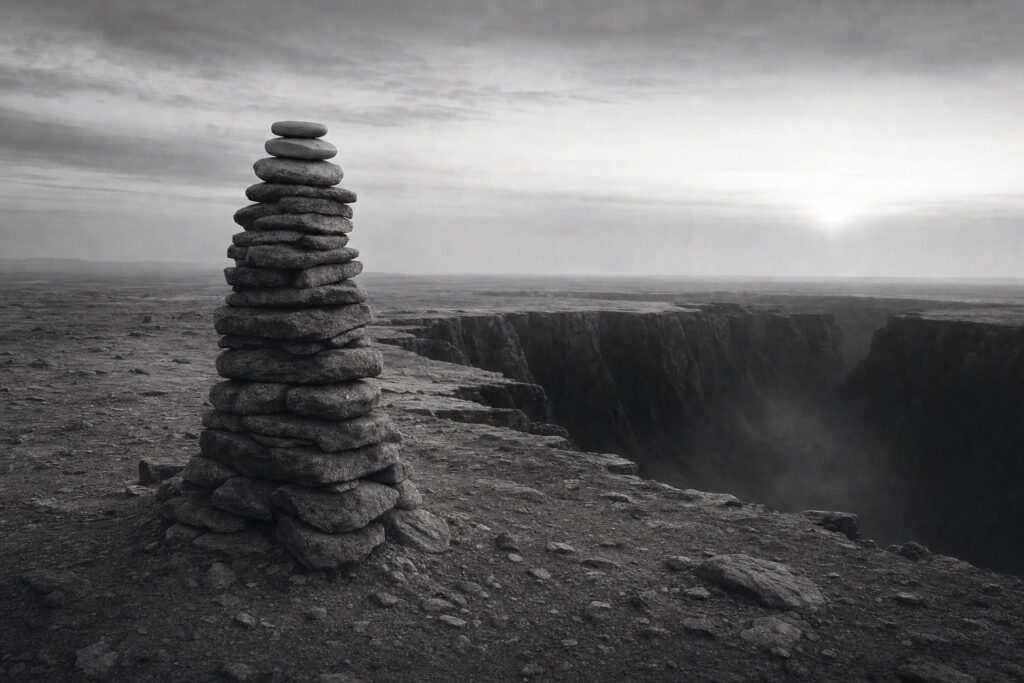
He found it thirty minutes later, at the edge of a collapsed valley basin: a cairn, obviously raised by human hands, ancient, smoothed by wind and time, in whose centre a fragment was set that no soil of this planet had produced. A splinter of green ceramite, no larger than a palm, polished as a relic by ten thousand touching fingers.
He knelt and looked more closely.
There was no inscription. There was no reason for an Astartes to pause here, except what every son of Vulkan carried in his bones: the recognition of his own material, even after a span of time he could not estimate. Ten centuries. Fifty. Longer.
"A splinter of ours," he said later, when he reached his squad. "Very old."
Brother Kaal'ith, looking out over the rubble of the valley, did not turn round. "How old?"
"Older than I can estimate." Dra'kaan put the fragment into a sample compartment on his belt, with the same care with which he stored gene-seed. "We have been here before."
It was Chaplain Vel'Schwur who first spoke the significance of it, three hours later, when the squad reached the ruins of an old watchtower and found there, in weathered stone, the first complete symbol: a scratched dragon form, primitive, copied by a human hand from a model the copyist himself had never entirely understood.
"A legend," said Vel'Schwur. His voice carried the weight of the Chaplain — not loud, but such that it seemed to fill every corner of the tower. "These people carry the memory of us onward without knowing what they remember."
"Like a church without a priest," said Dra'kaan.
"Worse." Vel'Schwur ran his gauntlet over the stone. "A church with a priest who has lost the scripture and knows only the shape of the prayers." He looked up. The Chaplain's helm was off now, his face bared, scarred and calm, and in his eyes lay something Dra'kaan did not often see there. "We left this world once. And it has not forgotten us. The Imperium has forgotten it. That is a difference we should remember."
Captain Bre'kar reached them an hour later, with the rest of the company in tow, and listened to the report in his accustomed silence — that silence which was not passivity but the concentrated calm of a man who thought every word through to the end before he spoke it.
"Ten thousand years, perhaps more," he said at last, holding the fragment in his hand. "And the same world calls for us again."
"Not again," Vel'Schwur corrected gently. "Still. It has never stopped calling. We simply have not always heard."
Bre'kar said nothing to that. He gave the fragment back to Dra'kaan and turned towards the valley basin, where in the distance, barely visible through the dust, the first columns of smoke rose from a city at war.
"Then we hear now," he said.
II. Two Chapters, One Objective
Three days earlier. Orbit over Morthis IV.
The conference room aboard the Eternal Anvil was a room that announced its purpose. Four walls of plasteel, a table of plasteel, lighting that permitted no shadows. No ornament. The Iron Veins lived as they fought: without room for the unnecessary.
Dra'kaan felt it as a workshop. No place for feelings, only for work. That was more honest than an interrogation room, he thought, and perhaps that was the kindest description one owed the Iron Veins.
Six Astartes sat around the table. Three in the muted iron-grey of the Iron Veins, with bronze edging that gleamed in the hard light like cooled smelt. Three in the dark green of the Fire Wardens, with the old bronze dragon relief on the chest that every son of Vulkan wore, regardless of which Chapter banner he served under. Between them the hololithic projection of the hemisphere of Morthis IV: terrain contours in blue light, settlement clusters in orange, enemy positions as a red web eating inward from the Vor'kal Peninsula into the heart of the city.
"The objective is unambiguous." Captain Voss Ilarion spoke without preamble, as all Iron Veins spoke — as though every word cost fuel. His left arm was Mechanicus work to the shoulder, polished gunmetal beneath fine Kel-Vantor engravings, and the right half of his face carried a thin plasteel splint, the result of a wound he never explained. "The rebel faction controls the industrial production facilities of the Vor'kal Peninsula. We need those facilities intact for the supply of the Nihilus relief line. Rapid elimination of enemy forces, minimal structural damage."
"And the civilian population?" Dra'kaan said it before he had entirely thought it through. Old habit. On Nocturne one asked after the people before one asked after the walls.
Ilarion looked at him. Not contemptuously. Assessingly. "Three hundred thousand souls, concentrated in the city. Not in our primary operational area."
"And if the artillery is hidden in the city?"
"Then responsibility for civilian losses lies with the rebels who deploy artillery in inhabited areas." A pause. "Standard protocol, Apothecary."
Dra'kaan said nothing further. There was nothing to say that would not have escalated, and he was not a captain.
The captain was the one who spoke.
Bre'kar stood at the narrow end of the table and regarded the map like a smith examining a flawed piece of metal. Scars marked his jaw; the slightly asymmetrical curve of his right temple bone spoke of fights no one at that table had witnessed. He wore no honours but the bronze dragon on his right shoulder. Only the beast and its colour.
"I concur with the situational analysis," said Bre'kar. "Rebels, not organised crusade opposition. Standard pacification operation, theoretically." He stressed the last word. "But the peninsula is connected to the city by three main corridors. If we push the rebels in from there, we drive them into civilian territory."
"Then we do not drive them in," said Sergeant Doran Vek. Dra'kaan knew the name from the vigil archives of the Iron Veins — a sergeant who years ago had stood in the Sixth Shaft of Kel-Vantor when Venerable Sorvain chose annihilation over being taken. It showed in the way Vek spoke: with the precision of a man who had once seen what corruption makes of loyalty and had resolved never again to give a grey zone room. "We envelop the coastal strip, isolate the peninsula completely, let no enemy escape."
"No provision for survivors?"
"Why?" Vek spoke the word without intonation. Not cruelly. Precisely. "The rebellion is the problem. The complete elimination of the rebellion is the solution. Efficiency."
"Efficiency," said Bre'kar calmly, "is a tool. Not a goal. The goal is the reintegration of this planet. A planet on which half the fighting-age men are dead and the other half are afraid of the army that liberated them serves the Imperium worse than one on which a fair victory has been won." He looked at Vek. "I do not say that out of sentiment. I say it out of calculation."
A long silence, in which the hum of the hololith tanks was the loudest sound in the room.
"An interesting calculation," Ilarion said at last, in the tone of a man permitting a theoretical error analysis out of courtesy. "But you will find, Captain, that our time constraints —"
"— give us three days." Bre'kar did not interrupt him rudely. He merely completed the sentence in other words. "That is enough if we use the terrain. I have three possible plans."
He presented them. Ilarion listened. The Iron Veins conferred briefly and quietly in their own technically inflected Kel-Vantor cant, a tongue that to Nocturnean ears sounded like metal rubbing against metal. Then Ilarion nodded, and the attack was planned.
Vel'Schwur found Dra'kaan late that night, alone in the chapel compartment of the troop transport, where a small replica of the Flame of Vulkan burned in a bowl of polished ore.
"You are thinking about the number," said the Chaplain. It was not a question.
"Three hundred thousand."
"I know." Vel'Schwur sat down, the movement of a man whose armour had fitted him like a second skin for decades. "I think about them too. But I think about something else in addition: about the fragment you found today." He looked at Dra'kaan. "We have been here. Millennia ago. Someone stayed — not bodily, but in what this world remembers. If we leave this time and leave nothing behind but another disappointment, we erase what the last visit built."
"That is a great burden for a splinter of ceramite."
"All inheritance begins as a splinter." Vel'Schwur stood again. "Sleep if you can, brother. Tomorrow it burns."
III. The Void Battle
The first day was the void battle.
Dra'kaan stood on the command bridge of the Ashen Watch — his place was properly on the ground, but Bre'kar had asked, and Bre'kar seldom asked — and watched the hololith tanks bring three red forms out of the asteroid belt behind Morthis IV.
The rebels had ships. Not battleships — two converted frigates from an era no one could date precisely any more, and a freighter serving as a mobile weapons arsenal. Together not strong enough for the Imperial fleet. Strong enough to complicate the landing operation. Complicate meant: let civilians die while a window opened for artillery transports into the city.
"Predictable," said Ilarion beside him. Not dismissively. Stating.
Bre'kar was silent for a heartbeat. Then: "Yes. That is why we must be fast."
What followed was brutal in its efficiency and efficient in its brutality. The Imperial fleet did not divide. Bre'kar pushed the two cruisers directly at the enemy ships, close enough that evasion increased the risk of mutual fire. At the same time the assault transports launched: thirteen craft in staggered waves, the first as a diversion, the next as carriers of the landing wave.
The first transport was shot down.
Dra'kaan saw it on the hololith tank — a spot of light that flared and vanished, twenty kilometres above the surface. Nine Astartes. He knew three of them by name. Brother Servan, whose hands were so calloused from smithwork that he held a bolter differently from others. Brother Rho'kaan, who slept badly and prayed well for it. Brother Dun'var, who had laughed at him at their first meeting because they had been inducted in the same year.
He said nothing. The hololithics went on showing.
The engagement lasted thirteen minutes. The first rebel frigate lost its main drives after the third lance hit and began drifting slowly out of the battle formation, a dying whale in vacuum. The second fought on, with a determination one had to grant them, until a broadside from the Eternal Anvil tore open its forward deck. The arsenal freighter tried to escape, managed six minutes of jump preparation before the torpedoes of the Ashen Watch caught it.
No survivors. No prisoners.
Dra'kaan noted it and thought of the crews who had once flown those ships, nine years ago still under Imperial designations, before the Rift tore their world off every chart. They had not gone looking for a rebellion. They had gone looking for a way to survive in a system that had been forgotten. That this way had led them here was a consequence, not a choice.
That was not a thought he would say aloud on an Imperial command bridge.
But he thought it.
Bre'kar looked at the projection. "Losses?"
"Nine Astartes on the transport. Four ship's crew from debris impact. And thirty-two ground troops of the Imperial Army at landing zone three — the second frigate fired on them before our torpedoes intercepted her."
Bre'kar nodded once. It was not a nod of acceptance — it was the nod of a man who has seen the bill and paid it and knows that it had to be paid, and still wishes it were otherwise. Dra'kaan knew that expression. Vulkan had it, the old images said. The Iron Veins did not have it — or, if they had it, it was buried too deep under metal to be visible. Which was the same thing and not the same thing, simultaneously.
"Landing zones two to seven are secure. First wave is down."
"Then we go."
Dra'kaan followed him to the transport bay and graved nine names into his memory like letters into metal.
IV. Ground
Morthis IV smelled of burnt sulphur and wet stone and that metallic, faintly sweetish smell of old blood that settles into the streets of a world that has lived in civil war for generations.
Dra'kaan smelled it through his helm filter and found it familiar. Nocturne smelled similar — less blood, more sulphur, but the message was the same: this world does not want you here. It had existed here longer than he could think, and it would be here longer than he would exist.
The Vor'kal Peninsula: thirty kilometres, cut off by a dry gorge with three bridges as its only ground approaches. Bre'kar wanted all three at once.
The Iron Veins held the north bridge — Ilarion's demand. The Fire Wardens held the south and middle bridges, because the plan was to drive the rebels from south to north — into the Iron Veins.
Dra'kaan was at the south bridge, and from an elevated position he could sometimes see the north bridge. He watched the Iron Veins not out of mistrust but because an Apothecary observed situations, for the same reason smiths observed the metal they were tempering.
The Iron Veins fought like a machine. That was not an insult. They worked in formations that recalled steel wedges more than human combat groups. Forward without compromise, losses factored in. Efficiency over elegance. Vek moved his squad like a man who knows the pieces on a board: precise, correct, without affection.
Dra'kaan saw an Iron Veins brother fall — a direct hit, the armour held, but the Marine lay on the ground. Vek saw it. For a heartbeat he observed it. Then: two hand signals, the flank pushed forward, and the fallen Marine was saved by tactics, not by reaching back. That was not coldness. That was a different kind of care: not the arm one extends to a fallen man, but the tactics that move him out of the line of fire before he falls entirely. Prevention instead of reaction.
Perhaps that was not worse. Only different.
Then: the vox.
"Apothecary." Bre'kar's voice, calm as always. "Observation post three reports movement in the city. Heavy artillery, moving towards the eastern districts."
Dra'kaan considered. Eastern districts: densely inhabited, seven-storey buildings of poor concrete. If the artillery stood there, people stood behind it.
"The middle bridge is secured," said Bre'kar. "We push forward in twenty minutes. But I need safe passage — the artillery position must be silent before we move through the main corridors."
"I will go," said Dra'kaan.
"I know." A pause. "Take care of yourself."
That was the maximum of personal expression Bre'kar permitted himself. Dra'kaan valued it for that.
He called his squad together: thirty seconds, brief situation. Brother Kaal'ith stayed at the bridge. The other five came along — among them Chaplain Vel'Schwur, who took up his crozius without asking whether he was welcome.
"A Chaplain at an artillery neutralisation?" asked Dra'kaan as they set off.
"A Chaplain at every place where a decision is made that carries the name of our Chapter." Vel'Schwur did not sound especially solemn about it. "Besides, there are too few of you. Count me as a sixth bolter, if that helps you justify it."
They went into the city.
V. The City
The streets of the eastern district were empty.
That was the first bad sign. Even in active combat zones there were always people — curious, careless, too slow people. Empty streets meant either a very well organised evacuation or something worse.
Dra'kaan settled on the worse. He was right.
The rebels had positioned the population as a shield. Not openly, not with weapons levelled — with the subtler violence of "you stay in your houses, or we cannot guarantee what happens". Three hundred families sat in their apartments waiting for an end, whichever one came.
The artillery stood on the square before the old administrative building. Four guns, large-calibre, on improvised carriages, cobbled together from centuries of different sources — some parts, Dra'kaan noted with quiet unease, still bore the weathered markings of the old Astra Militarum. Weapons that had once belonged to the Imperium, now rebuilt to be turned against the Imperium that had left them behind.
Eighty metres away. Too far for a safe approach, too near for a missile launcher without massive collateral effect. And in the buildings behind: people. Curtains that did not move. Enforced silence.
Dra'kaan thought of the families behind the windows. Of the nine Astartes on the transport. Of Bre'kar, who in twenty minutes had to advance through a clear corridor or not at all. And he thought of the words Vulkan had written, which every Initiate of the Fire Wardens learned by heart before he carried his first bolter: A fire that burns everything it touches is no longer a fire. It is devastation.
He gave his instructions.
What followed was slower than direct action and more dangerous. He and Brother Kaas'im crept in from the west, through side alleys so narrow that the ceramite shoulder pieces scraped the walls. Brother Ashur and Vantor took an elevated position on a roof to the east. The two heavy weapons carriers stayed at the main approach: visible enough to hold attention, protected enough not to die of it.
Vel'Schwur stayed with the two heavy weapons carriers, his crozius in both hands, and spoke in a quiet, even voice a litany whose words Dra'kaan did not understand and did not need to understand to feel their effect: the two brothers stood calmer with him kneeling beside them.
It was not an elegant operation. It was craftsmanship. That was enough.
Dra'kaan and Kaas'im came in behind the artillery. Seven rebels — five as crew, two as guards, both looking north, because the attack would come from the north. Dra'kaan looked towards the rebels and saw no children, no elderly, no one who did not want to be there. That helped. Not much, but something.
It took forty seconds.
What occupied him afterwards was the building behind the square: a window on the second floor, three children between five and ten years old, eyes too large for their faces. A girl, the eldest, with an expression that was neither fear nor relief but the face of a child who had seen too much and learned to sort it.
He stopped for a moment.
That was the moment he would always remember afterwards. Not the fight, not the tactics. That moment in which three children stared at a black-skinned, red-eyed giant in green ceramite and he had no way of explaining who he was or what he was doing or why, and so he only nodded — once, briefly.
The girl waved back.
"Artillery eliminated. Corridor is clear."
Bre'kar: "Good. We advance."
VI. The Meeting in the Fire
The next two hours were the storm.
What was not the plan: a rebel commander — listed in intercepted transmissions as Kar Dravin — had chosen an alternative route. None of the three bridges. Industrial rafts, lashed together, kept below the radar of reconnaissance because reconnaissance had been looking for military structures, not civilian improvisation.
Kar Dravin and three hundred fighters came through the city. Through the same eastern district.
Dra'kaan heard them before he saw them. He threw three brief hand signals to his squad, and they vanished into the side alleys.
Three hundred rebels. Six Astartes.
The calculation was clear and had no good outcomes. He could call Bre'kar — but Bre'kar was in the advance, and a diversion cost time, and lost time cost positions on the peninsula. He could let them pass — but three hundred armed men in civilian territory wrote their own result. He could attack.
"Your decision, Apothecary," said Vel'Schwur quietly beside him. "But I have an opinion, if you want to hear it."
"Say it."
"We are here because this world once waited for us without knowing how to wait. It cannot wait again."
Dra'kaan gave the order to attack.
What followed was no hero's tale. Loud, cramped, dangerous, confusing. The only thing that spoke in their favour: six Astartes in a city alley had an advantage that numbers did not outweigh. They could take damage that ordinary men did not survive. Their bolters did more in that confinement than ten lasguns.
Brother Torvin fell first — a missile launcher from the third floor, direct hit on the left side. The armour absorbed most of it, but the hip joint collapsed. Dra'kaan dragged him behind a wall, gave him his bolter. "You can shoot from the ground too." Torvin nodded and shot.
Kaas'im lost two fingers. He switched his chainsword to his left hand.
Dra'kaan took a las-beam through the weakened pauldron. It burned like Nocturne's lava. He ignored it, because pain was information and the information was already registered.
Vel'Schwur fought differently from the battle-brothers — not with the pure efficiency of an Astartes in full combat, but with the precision of a man who accompanied every blow with a word that meant more to himself than to the enemy he struck down. Dra'kaan did not understand all the words. He understood that they helped.
The three hundred became two hundred, then one hundred, and then the rest threw down their weapons. Even desperate, determined people wanted to survive, if one left them the option.
Dra'kaan left it to them.
Kar Dravin tried to escape. Almost made it.
Almost.
Dra'kaan intercepted the figure at the eastern exit. Kar Dravin: a woman, barely two metres, her face marked by an old burn scar, eyes that were still fighting. She raised her plasma pistol.
"Put it down," said Dra'kaan.
"Who are you?"
"We are the Imperium of Man."
"Lie." But the pistol sank. "The Imperium has not been here for nine years."
"The Imperium always comes," said Dra'kaan, and he knew it sounded like an empty phrase. "Sometimes too late. That is our failing, not yours."
Kar Dravin let the pistol fall. "I do not want to die for something that is already lost."
"You do not have to."
Dra'kaan bound her, and as he did he saw on her left forearm a tattooed number. A long number, in a notation he could not immediately read, until Vel'Schwur, stepping up beside him, said quietly: "A generational count."
"What?"
"Kar Dravin is not a name," said Vel'Schwur. "It is a title. She carries the number of the bearer before her on her arm, as another did before her, and before that one another again. This war is not thirty years old, brother. It is as old as this world's memory of the word war."
Kar Dravin, the bearer of the number, whatever number it was, looked at them both, and for the first time there was something in her face that was not determination.
"You know about it," she said quietly. "No one knows about it. Not even our own people any more."
"We have a long memory," said Vel'Schwur. "Longer than yours, I fear. And still not long enough to know how to end this war for good."
Dra'kaan called the position over the vox. Then he returned to his brothers.
VII. After the North Bridge
They found Bre'kar four hours later at the industrial facilities.
The peninsula was secured. Secured — the right word, not won, not liberated. The facilities stood, which fulfilled the plan. The rebels, the greater part of them, had surrendered when Bre'kar gave them the option.
Dra'kaan found the captain sitting on the wing of a captured vehicle, a map on his knee. Bre'kar looked up, saw Dra'kaan's armour — bent pauldron, las-burn, blood, his own and others' — and said nothing. Sometimes silence was the most honest language.
"Losses: seven dead. Thirteen wounded, six seriously. Torvin loses the leg, probably. No civilian losses in my sector."
Bre'kar closed his eyes. Briefly, barely visibly.
"The Iron Veins?"
Dra'kaan hesitated. "Two losses. And four civilian dead at the north bridge."
A pause.
"Explain."
"The rebels used civilians as cover when they tried to escape across the north bridge. Sergeant Vek decided that the tactical priority permitted no hesitant approach." Dra'kaan searched for words that were true without being accusing. "He acted by his logic. That logic produced four dead."
"Four civilians."
"Yes."
Bre'kar folded the map. "I will speak with Ilarion."
"That would be good."
"You know what he will say."
"I know what he will say." Dra'kaan looked at the banners of the Imperium above the gates, fresh and clean in surroundings that had nothing clean left in them. "That does not change the fact that you must speak with him. Not to change him. To have said it."
Bre'kar looked at him briefly. "No. It changes nothing." He stood. "But some things must be said, even when they change nothing."
He let the map fall and walked away.
Dra'kaan picked it up, looked at it without really doing so. At the place where the north bridge was marked, there were no dots. Maps did not mark the dead. He saw them all the same.
VIII. The Camp
In the two hours before he found the children, he treated others.
The improvised medical area of the reception camp was a factory space with overturned crates as partitions and field blankets as floors. Dra'kaan was the only Apothecary who appeared there — the other Fire Wardens were occupied with their own wounded — and he was as he was: too large for the room, too loud for his own silence, too alien for the place.
The people looked at him with eyes that had not yet decided how to classify him. Liberator was a word that needed distance to become true. At the moment he was only: large, green, with blood on his shoulders that a child could not know was the blood of enemies or his own.
An old woman with a bandaged arm called him over. She knew no fear any more — or had left it behind somewhere in the years of war.
"You." In the local dialect, which universal Gothic barely recognised any more. "You were on the square."
"Yes."
"My grandson saw it." A pause. "He is sleeping now. The first time in a week."
Dra'kaan did not know what to say to that. He decided on nothing, and treated her arm instead. Burns, poorly dressed. That he could do better.
He worked. The woman beside her, a cut with infection. A man with a broken ankle who pretended it was nothing. Two children with light las-burns on their arms. None of them a serious injury. None of them his assignment.
But he had hands and he had supplies, and they had neither.
He worked silently and systematically, and at some point he heard a sound behind him. Applause. No loud ovation. Only a few hands striking together, quietly and almost embarrassed, from people who were not used to it and who nonetheless felt the need to say something without having to find words.
He said nothing. He went on working. He remembered it.
Then he found the children.
The girl stood up when he came. The matter-of-factness of a child who is no longer surprised.
"That was you," she said.
"That was me."
"You could have shelled the artillery from further away."
"I could have shelled the square."
"And us."
"And you. Probably."
The girl nodded, as though he had confirmed a calculation. "Why not?"
"Because the target here was not the artillery," he said at last. "The target was this world. And this world is you."
The girl looked at him a moment longer. Then she sat down again, and her grandmother, whom Dra'kaan noticed only now, looked at him with an expression that weighed more than any word.
"She knows the story," said the grandmother. "Of the green giant who once wept because he came too late. My grandmother told it to me, her grandmother to her. We thought it was only a story one tells children so they do not give up." She looked at the girl, then back at Dra'kaan. "I believe it was not a story."
Dra'kaan said nothing for a long time.
"I do not know that story," he said at last, truthfully. "But I believe you that it is true."
He stayed until the children slept. Somewhere someone played on a handmade instrument a melody he did not know. It sounded like something old — from a time before the most recent war had begun, perhaps from a time before any war on this world that he could count. He let it sound.
IX. Vek and Ilarion
He found Vek the next morning outside the command centre.
"Apothecary."
"Sergeant."
Both looked at the factory. "I heard about your action in the eastern district. Risky. You were too few for the objective."
"Yes. But we did it anyway."
"Folly that has proved itself is still folly." Something in his tone sounded less convinced than the words. As though he had said that sentence often and accumulated doubts about it.
"Or it was the only method compatible with all objectives of the operation. Objectives we did not discuss in the briefing."
Vek looked at him longer than before. Something worked in the augmetic eyes. Not hostility, not agreement.
"You Fire Wardens optimise for different parameters than we do."
"Perhaps. And perhaps that is good. Two Chapters with the same parameters would be redundant."
"Different parameters produce conflicts."
"Different parameters also produce more complete solutions." Dra'kaan looked at him directly. "Four dead at the north bridge. The timetable was achievable without those four dead. I do not say that as a reproach. I say it as a statement. If we operate alongside each other next time, I want to know whether you want to know that."
Vek's jaw moved slightly.
"I will consider it."
No commitment. No refusal. For an Iron Veins sergeant, presumably the maximum.
"May I ask," said Dra'kaan, "what happened on Kel-Vantor? In the Sixth Shaft?"
Something behind Vek's eyes went very still for a moment. "Where do you know that name from?"
"Our archives overlap more than either Chapter admits. I know only that a Venerable destroyed himself before an ancient machine intelligence could take him."
"Sorvain." Vek spoke the name like a litany he had repeated too often to still be touched by it — or too much to show it. "He chose annihilation over corruption. In the last second in which he could still choose." A pause. "Since then I measure every decision against one question: is this the last second in which I can still choose? If it is, I choose hard, immediately, without hesitation. Hesitation did not save Sorvain. It would only have corrupted him more slowly."
"And at the north bridge?"
"It was not the last second." Vek said it quietly, almost to himself. "I applied the question wrongly. That has been clear to me since yesterday." He looked at Dra'kaan, and for the first time there was something in his face that was not calculation. "I do not say that often."
"I know."
"Then it is enough," said Vek. He nodded once, briefly, and turned away.
Dra'kaan nodded. "That is enough." He turned, walked. After three paces he heard behind him a short exhalation that sounded like reflection. He did not turn round.
Ilarion came in the evening.
He stepped into the factory space where Dra'kaan was stabilising Torvin's leg, glanced briefly at the wounded Marine, then at Dra'kaan.
"Where is Bre'kar?"
"Interrogation room." Dra'kaan indicated a door. Ilarion moved towards it. Stopped. Turned round.
"You did good work, Apothecary."
Dra'kaan looked up. Ilarion made no statements without calculation. "We achieved the objective."
"You achieved more than the objective. The civilian loss rate in your company was zero. That will simplify the reconstruction." A pause. "I have calculated it."
The Iron Veins captain always calculated. What had changed was what he included in the calculation.
"The four at the north bridge," said Dra'kaan.
A very long pause. "That was suboptimal," Ilarion said at last. The words came slowly. "I have reviewed Vek's case. The decision was logical under the given parameters. The parameters were set too narrowly."
That was, from a captain of the Iron Veins, a remarkable statement.
"Yes," said Dra'kaan. "They were."
Ilarion nodded. He turned back to the door. Stopped once more, without turning round. "Your Primarch is held to be sentimental. Among other Legion descendants."
"Vulkan is known for his warmth."
"Yes." A pause. "Our Chapter Master Vel'Ossa says that warmth and weakness are the same word to most ears, and that both judgements are too simple." He glanced back briefly. "I am beginning to agree with him. That has cost me nine years, since the last time we operated together with a Chapter of Vulkan."
He opened the door and went in.
Torvin watched him go. "Did he just admit a mistake?"
"He said the parameters were suboptimal."
"That is the same thing."
"For an Iron Vein that is something other than the same thing. It is the first step." Dra'kaan began cleaning his equipment. "Nocturne taught me to work with volcanoes. Volcanoes are also unsatisfying."
X. The Weight
The campaign on Morthis IV lasted four more days.
Further engagements — smaller, untidier, the unavoidable clearing-up of a rebellion that had ceased to exist but had not yet ceased to fight. Dra'kaan was in most of them. There were always wounded. There were always decisions about ammunition and priorities, made not in briefing rooms but in streets, in seconds, under fire.
He lost two more brothers. An ambush on the third day, a las-gun emplacement he located too late. He carried their gene-seed in his repaired narthecium and spoke their names aloud, once, before he walked on. Brief, absolute, non-negotiable.
On the fifth day Morthis IV was formally brought under Imperial control. It would take decades before the reconstruction had come far enough for the planet to feed itself — new Administratum officials, new trade routes, new promises from a distant Terra whose light had itself been only a promise since the Rift.
On the last night Dra'kaan sat outside, without his helm. The sky still grey, but somewhere behind the clouds a sun — he saw the brightening to the west.
Brother Kaas'im sat down beside him. Two fingers fewer, and in twenty years he would still be telling how he shot better with four fingers than with five.
"Are you thinking about them?"
Dra'kaan knew whom he meant. "Always. That is the price."
"Which price?"
"For being who we are. For doing the things we do. The Iron Veins carry the names on metal, engraved in Kel-Vantor's smelts for all time. That is right too. But metal can be melted down. Memory cannot."
"The four civilians at the north bridge?"
Dra'kaan thought. "I will never know their names. That is my punishment. Not their fault, not Vek's fault — he acted by his logic, and he is now in the process of reconsidering that logic, and that is more than I would expect of many others. But my punishment is that I do not know their names and carry them all the same."
"That is a strange theology."
"Nocturne is a strange world." Dra'kaan looked at his repaired narthecium. "We fight for the Emperor. But the Emperor is not an abstraction. He is every single face. Those three hundred thousand. If we forget them in order to make the large numbers better —"
He left the sentence unfinished.
Kaas'im waited.
"— then we have not fought for humanity. Then we have fought for an idea. And ideas need no saving swords. People do."
They sat another hour, without saying much, and listened to the wind and to the soldiers of the Imperial Army playing cards and making jokes, as soldiers did everywhere, after every fight.
XI. Epilogue: The Legend
What remained on Morthis IV: the three hundred thousand. And, for the second time in the history of this world, a promise that this time was not to fall silent again at once.
What Dra'kaan took with him: the gene-seed of his fallen, in small phials, kept with the same care with which the smiths of Nocturne stored their best tools. Eleven names. Nine from the transport. Two from the ambush on the third day. In the archive of his memory, which no one but he could read and which he therefore kept doubly carefully.
It was Vel'Schwur who called him to the chapel of the troop transport on the evening before departure.
"I have found something," said the Chaplain, "that you should see before we leave this world."
He held a data fragment in his hand — not from the archives of Morthis IV, but from the Fire Wardens' own Reliquarium, that part of their library which no Adeptus Terra had ever catalogued, because it was not kept for the Imperium but for the Chapter itself. Every Chaplain received access to that archive at his elevation, and every Chaplain added something to it before he died.
"There is a martyrology," said Vel'Schwur, "that reaches back to the time of the Legions. Not complete — the millennia between the Great Crusade and today have swallowed more than they preserved. But fragments survive, carried on from Chaplain to Chaplain, because we believe that even the unheard should be heard, some time, by someone." He handed Dra'kaan the fragment. "Campaign 47. An Apothecary named Vel'shar. Sector Mordacus — the old spelling, before the border reform. The same planet."
Dra'kaan read.
It was not a complete report. It was a fragment of a letter, without addressee, without recipient, found in the private files of an Apothecary who had died long before the note was written down. A marginal note by an unknown archivist dated the find centuries later. Four lines, for four people whose names no one knew any more.
We did not think of you in time. That is our failing, not yours. You survived what you did not survive, and the Imperium did not protect you because it was occupied elsewhere. The truth is the least that is owed to you.
Dra'kaan sat still for a long time.
"The green giant who wept because he came too late," he said at last. "The grandmother in the camp told me that story. She thought it was only a story for children."
"It was never only a story." Vel'Schwur sat down beside him. "A man wrote four lines for four nameless people, without knowing that they would outlive him by ten thousand years — not as writing that anyone read, but as something a whole world went on telling itself, in a language that changed, under a sky that darkened, through wars that came and went and came again. He thought no one would ever find it. He was wrong. It merely found another way."
"And now?"
"Now you write your own four lines. For the north bridge." Vel'Schwur stood. "Not because they will be read. But because the writing itself is the promise. Sometimes it takes ten thousand years for a promise to be heard. That makes it no less worth giving."
Dra'kaan wrote that night. For Brother Servan, Brother Rho'kaan, Brother Dun'var, who had died on the transport: short, direct lines, as was the custom — He did not tremble at the end of his bolter. He died calmly. He carried his name well. For the two from the ambush: the same, with other names. And then, without addressee, without recipient, four lines for four people at a bridge whose names he would never know:
This time we did not come too late. But we did not come early enough for you. That is our failing, not yours. The truth is the least that is owed to you — and the truth is: we will not forget you, even though we never knew your faces.
He folded the sheet and laid it in the Reliquarium, beside the fragment that had taken ten thousand years to be read by him.
No archive of the Imperium would find it. No historian would read it.
But somewhere, he believed now, it would find another way. It had found one once before.
What Ilarion did: he spoke to Vek in a private conversation about the north bridge. What was said there, Dra'kaan does not know. But he knows that in the final briefing Vek asked a question he had not asked in the first: "Is there an evacuation route for the civilian population?"
That is nothing.
That is also everything.
That was the weight of the fire a son of Vulkan carried: not the weapon, not the flame that destroyed or purified, but what remained afterwards. The ash one gathered up, and the decision about what to do with it.
On the morning before the Ashen Watch plunged into the warp, Dra'kaan went once more to the old cairn at the edge of the valley basin, where he had found the first ceramite fragment. He set the splinter he had carried with him for three weeks back into its place in the stone.
Then he laid a second fragment beside it: a small, deliberately damaged splinter of his own pauldron, polished before he set it down.
For whoever comes next, he thought. In a hundred years. In a thousand. Whenever this world is forgotten again and found again. So that he knows: we were here twice. And we will come again, a third time, a fourth, as often as is needed, even though none of us alive today will still be there to witness it.
Nocturne had been shaped by fire, as had its sons.
The Ashen Watch plunged into the warp, and Morthis IV grew smaller, and the stars were old and cold and indifferent, and somewhere in the dark between the worlds three hundred thousand people were alive, and a world now carried two splinters of ceramite in its heart instead of one, and a story that a grandmother would go on telling her grandchild, even though she had only ever known half of it.
Dra'kaan closed his eyes.
It was enough.
— END —
For the Emperor. For Nocturne. For the three hundred thousand — and for the four whose names we will never know.
Download story as PDF or EPUB
Enter your email address. After confirming your subscription you'll get the download links immediately and by email.