Fifteen Degrees
Thousand Sons (Fifteenth Legion)
"I do not use names for tools, because otherwise I begin to apologise for them."
— Hexer Ashuret
I. The Register
The book had thirty-one pages and ten names, and Sorcerer Menkhet read it once a year.
It was no grimoire. That was the first point on which everyone who saw it for the first time was mistaken: it contained no formula, no seal, no invocation. It was a register, laid down in the year 004.M31 aboard a ship that had not existed for ten thousand years, by a man who had been a hundred and nineteen years old at the time and had believed that he would never need it.
Ten names. To each name a page. To some pages three lines.
Menkhet carried it in a case of lead glass, because paper spoils in the Warp and because he had lost a volume twice before he grasped that caution in this matter is no weakness.
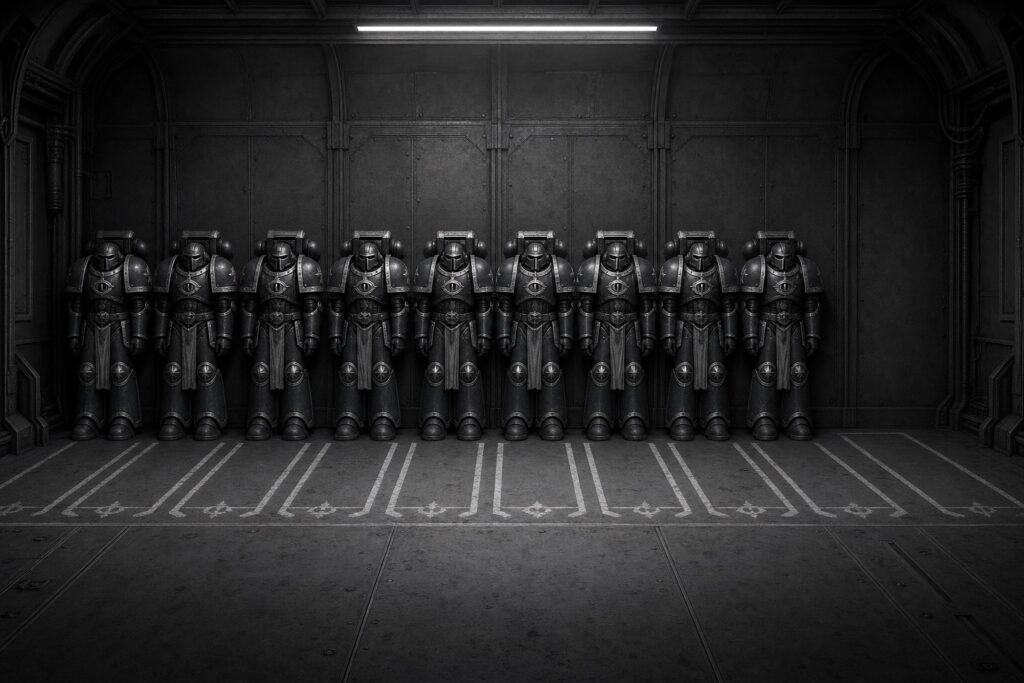
The chamber in which he read it lay in the keel of the Serapeum, below all the decks on which anyone lived. It was nine paces long. Against the wall opposite the door stood nine figures.
They were not standing guard. They stood.
A Rubric Marine stands until one moves him. He stands without swaying, without tiring, without altering his posture, with his hands on his weapon, and he has done so for ten millennia, in the same armour, in the same colour, with the same angle of inclination of the head. Menkhet had once, in a century of boredom, measured the angle. It was the same in all nine, to half a degree.
Inside was dust.
That too was a point on which most were mistaken. They imagined ash, or an emptiness, or a prison. It was dust. Fine, even, light-grey dust that filled the armour from within and that moved when the armour moved, and that otherwise did nothing.
What happened on the ninth day of the year 004.M31 is not told in the Fifteenth Legion, and not out of reticence but because there is no one who could. Whoever was there was either the one to whom it happened or the one who watched, and the first group can say nothing and the second has not done so for ten thousand years.
Menkhet had watched.
He had been a hundred and nineteen years old, a Sorcerer of the third rank, and he had stood in a hall in which two hundred brothers stood, and then in that hall there had been four who still stood and breathed, and a hundred and ninety-six who still stood.
Much has been written since about whether it went quickly. It went quickly.
In the first weeks afterwards Menkhet had believed it was a condition from which one could bring them back. In the first centuries he had believed it was a condition from which they would bring themselves back. In the second millennium he had stopped believing that, and in the third he had stopped reproaching himself for it.
In ten thousand years Menkhet had lost two Rubric Marines and both times had weighed the dust.
Forty kilograms. Both times.
It is the quantity of a man.
He sat down on the stool he had made four thousand years ago from a piece of wreckage, and opened the book, and began at Amset, because the register begins at Amset.
He said the name aloud.
That was the whole rite. There was no other. Once a year, on the same day, in the same chamber, in the same order, Sorcerer Menkhet said ten names aloud and watched what happened.
For ten thousand years nothing happened.
He was not disappointed. Disappointment presupposes an expectation, and Menkhet had stopped having one in his third millennium, without stopping on that account. That is a difference Ashuret did not understand and which Menkhet had given up explaining.
"Amset," he said.
The third from the left did not move.
II. Amset
Amset
Amset, son of the House of Tenkhu, taken up in the year 837.M30 in Tizca. He counted the stones.
That stood on the first page, in Menkhet's own hand, written in the year 004.M31, and Menkhet still remembered the writing of it.
He remembered above all that he had needed three days to settle on that one sentence.
After the Rubric there had been no instruction to lay down a register. There had been no instructions at all; the Legion had been busy in those months counting itself, and the counting produced a different number every time. Menkhet had been given nine. Nine Rubric Marines, assigned, with numbers, in a list drawn up by a scribe who two weeks later was likewise dust.
The list had had the numbers and not the names.
Over the following four months Menkhet had searched for the names. He had questioned eight people for it, gone through three archives and once done something he later regretted and never spoke of.
And then he had considered for three days what he should write about each.
Not the rank. The rank stood in the list. Not the deeds; the deeds were in the annals, and the annals had been saved, because one saves annals.
He had thought for a long time about what such a sentence must achieve.
It must not praise. A sentence that praises is about the writer and not about the one named. It must not summarise; a man cannot be summarised, and the attempt makes him smaller than a number.
And it must be something one still understands after ten thousand years without knowing the context, for in the year 004.M31 Menkhet had already known that he would live a long time, and he had known, which is rare, what that does to a memory.
He had settled on the sentence a man says when he is asked about another and is not allowed to think for long.
With Amset he had asked three people and three times received the same thing, in different words: that Amset had counted the stones.
It was no metaphor. Amset had grown up in Tizca, in the pyramid of the House of Tenkhu, and as a child he had counted the steps and the blocks and the joints, and he had not stopped when he became an Astartes. On a march he counted the paces. In a ship's corridor he counted the bulkheads. Before a siege he walked along the wall and came back and named the number of the merlons, unasked, and no one had ever checked whether it was right, because it was always right.
Menkhet had known him forty-two years.
He could remember Amset's face. That was the remarkable thing, and Menkhet had known for about a thousand years that it was remarkable: he still saw Amset when he closed his eyes. A broad face, a mole beneath the right eye, a way of raising the head before he said a number.
"Amset," he said again, and the third from the left stood.
Menkhet turned the page.
III. Kheru
Kheru
Kheru, of no house, taken up in the year 841.M30 from the street. He always ate first.
Ashuret had once read that sentence and laughed.
He had been four hundred years old at the time, which among the sons of Magnus means roughly that one still holds everything to be a matter of effort, and he had said: "That is all? A man who eats first?"
Menkhet had not answered that, because the answer would have been too long.
Kheru had been a street child from the harbour quarter of Tizca, picked up at perhaps nine years old, and in a street child something remains that cannot be trained out. Kheru ate first. In every camp, in every barracks, on every ship, after every battle: Kheru was first at the issue, took his portion and ate it, and only afterwards sat down with someone.
He had eaten nothing away from anyone. There was enough. In the Fifteenth Legion there was always enough.
He did it all the same, for ninety-eight years, and no one had ever said a word about it, and in the four months of the search for names Menkhet had asked three men about Kheru and all three had said the same, with the same half smile, and none had been able to explain it.
In his last year Kheru had begun to divide the portion. Not to give it away — to divide it, into two halves, and he had left the second half standing and gone, and someone had taken it, and Kheru had never commented on it.
Menkhet had never asked him why.
He has been vexed about that for ten thousand years, and the vexation is one of the few states that have not grown thinner in that time. It would have been a question of four words. He had assumed at the time that there would be an opportunity later.
That was the reason for the sentences in this book. Menkhet had needed three days to arrive at it, and in ten thousand years he had explained it to no one, because an explanation would have destroyed it:
In the annals stands what a man did. In such a sentence stands that someone looked at him.
Kheru was the second from the right. He had fallen at the battle for the Silver Terrace, in the last month before the Rubric, and afterwards Menkhet had gone on seeing him for twelve days, walking, fighting, standing up, and in those twelve days had believed it had been an error in the report.
"Kheru," said Menkhet.
The second from the right stood.
Menkhet looked at him a while and thought nothing in particular, and then he turned the page.
IV. Nebeth
Nebeth
Nebeth, House Isperu, taken up 833.M30. He never finished what he was saying.
Of all ten sentences that was the one with which Menkhet was least satisfied, and in ten thousand years he had thought three times of changing it, and three times had not done so, because one does not change such a sentence.
Nebeth never finished what he was saying. He began, got to the halfway point, and then one saw him think the rest through in his head and judge it not worth communicating, and then he said nothing more.
It had driven everyone mad.
In forty-two years Menkhet had had exactly one complete conversation with Nebeth, in the night before Prospero, in the rain, under a canopy that was not large enough for two Astartes. Nebeth had said everything to the end that evening, every sentence, for two hours.
Menkhet remembered the canopy. He remembered the rain, the sound on the metal, the smell of hot stone that rises in Tizca before a thunderstorm.
He no longer remembered a single word Nebeth had said.
That had struck him around the year 3000.M33. He had taken it then for a gap, as one has gaps, and had been reassured, because he remembered the canopy and because he assumed the rest would come back.
He has now been reassured for ten thousand years.
In the first thousand years Menkhet had occasionally tried to piece together the conversation under the canopy again. He had known what it was about — a question of interpretation, something on which they had been of different opinions, and that evening Nebeth had had the better opinion and had said it to the end.
It is a peculiar possession, the knowledge that someone was once right, without knowing any longer in what.
The register had thirty-one pages. On ten of them stood the names and the sentences. On the remaining twenty-one Menkhet had written down, spread over the millennia, whatever else occurred to him about the ten — not systematically, not dated, but as it came: a remark, a habit, a face.
The last entry on those twenty-one pages was from the year 121.M39.
It ran: Nebeth, under the canopy: it smelled of hot stone.
In the eight hundred and fifty years since, Menkhet had added nothing further.
"Nebeth," he said.
The fifth stood.
V. Sethnakt
Sethnakt
Sethnakt, House Tenkhu, taken up 839.M30. He checked the armour twice.
Menkhet read the sentence and waited, as he waited at this place every year.
Something came. Less came than with Amset and less than with Kheru, but something came: a gaunt man, younger than the others, with hands that were too large. He had checked the armour twice, before every deployment, every catch, every seal, first his own and then his own again — never another's, which in his first centuries Menkhet had taken for mistrust and later classified differently.
No more came.
Menkhet could no longer say what voice Sethnakt had had. He knew that he had once known it, because he remembered the knowing and not the thing.
That is the condition in which the greater part of what a ten-thousand-year-old man possesses finds itself: not memory, but the memory of a memory, thin as a copy of a copy.
"Sethnakt," he said.
The seventh stood.
VI. Wen-Kha
Wen-Kha
Wen-Kha, House Isperu, taken up 836.M30. He bore his brother's name.
Here it stopped.
Menkhet read the sentence and looked into the chamber and got nothing.
No face. No build. No habit but the one written there, and that he knew only because he had written it.
He knew that Wen-Kha had had a brother who had died before him and whose name he had taken — he knew it because it stood there. He did not know what the brother had been called. He did not know whether the brother had been an Astartes. He did not know whether Wen-Kha had been tall.
He stood before the fourth figure from the left and looked at a suit of armour.
That was the point Ashuret did not grasp and on which Menkhet could not contradict him, because Ashuret was right in the matter and simply did not know what he was right about.
Ashuret said: it is dust. It is dust in ceramite, it does what one tells it, and if you give it a name, you are not giving the dust a name but yourself an occupation.
Menkhet had always answered: the name is not for him.
He had held that for a good answer for four thousand years.
On that day, in the year 974.M41, with a book on his knees and a suit of armour before him whose contents he could no longer name, Sorcerer Menkhet established that a good answer and a true one are not the same.
If the name is not for him but for me — then what I am doing here is no fidelity.
Then it is bookkeeping.
"Wen-Kha," he said.
The fourth from the left stood.
VII. Tamon, Serapt, Hor-Ib
Tamon, Serapt, Hor-Ib
Tamon, House Nekhen, taken up 840.M30. He sang badly and sang all the same.
Serapt, of no house, taken up 842.M30. He asked permission.
Hor-Ib, House Tenkhu, taken up 831.M30. He held out his hand.
Three sentences, three men, and to none of them could Menkhet say anything any longer that did not stand on the page.
He had once still been able to. He knew that he had been able to, because on the twenty-one back pages there stood two lines about Hor-Ib from the year 900.M35, in his own hand, and the two lines said nothing to him any more.
Hor-Ib, at Ankyra: he did it the way he did back then with the wagon.
Menkhet had read that line perhaps forty times in the last three thousand years. He did not know what had been with the wagon. In 900.M35 he had evidently known it and held it so self-evident that it needed no explanation.
He read the three sentences out one after another, and the three Rubric Marines stood as they stood.
"Tamon."
"Serapt."
"Hor-Ib."
It took eleven seconds.
VIII. Ilu-Ra
Ilu-Ra
Ilu-Ra.
That is the whole page.
Menkhet had the name from the list of numbers in the year 004.M31, and in the four months of the search he had asked eight people about Ilu-Ra, and none had known anything. Two had confused him with someone else. One had said that he was quiet, and had then withdrawn it.
Menkhet had not filled the page, because he had nothing, and he had not torn it out, because a register with nine pages would have been something other than a register with ten.
For seven thousand years Ilu-Ra had been the only one at whose name Menkhet felt nothing when he read it.
For about two thousand years he had no longer been the only one.
"Ilu-Ra," said Menkhet.
The ninth stood.
IX. The Six and the Nine
Ashuret came down on the evening of the same day, because every year he came down on the evening of the same day, and both acted as though it were a coincidence.
He was now nine hundred years old and in the last five hundred had earned the right to enter Menkhet's chamber without asking. He never did it without asking. That was Ashuret's way of not using the precedence he had and thereby making visible that he had it.
"Have you said them all?"
"Yes."
"And?"
"And nothing."
Ashuret sat down on the floor, his back to the wall, in a movement that for an Astartes in full armour was astonishingly casual.
"I used the Six at the starboard lock today," he said. "She stood three hours and afterwards did what I said."
The Six. Ashuret never called them by name. He called them by their position in the row, left to right, as they stood in the chamber, and he had done so consistently for five hundred years, even when Menkhet stood beside him and had just said the name.
Menkhet had once put it to him. Ashuret had answered: "I do not use names for tools, because otherwise I begin to apologise for them."
It was the most honest answer Menkhet had had from him in nine hundred years, and it had been a reproach, and both of them knew it.
"Serapt," said Menkhet.
"The Six."
"Serapt."
"Menkhet." Ashuret looked at the ceiling. "We are having this conversation for the four hundredth time, and I have it gladly, because it is the only one in which you become unreasonable. But this time I shall tell you something else."
"Say it."
"Today you said Wen-Kha and had nothing while doing it."
Menkhet did not answer.
"I have stood at that door for five hundred years while you do it. I hear it in the pause before the name. With the first three there is none. With Sethnakt there is half a one. With Wen-Kha today there was a whole one, and the three after that you read off one after another like a list." Ashuret was looking at him now. "Two hundred years ago the pause was at Sethnakt. Five hundred years ago it was at Hor-Ib. It is moving forward."
"I know."
"Then you also know where it will be in a thousand years."
"At Amset."
"At Amset." Ashuret stood up. "And what will you do then?"
"Then I shall read what stands there."
"And that is enough for you?"
Menkhet laid his hand flat on the closed case of lead glass.
"Ashuret," he said. "When I laid this down I was a hundred and nineteen years old and believed that I was writing it so as not to forget it. I grasped around the third millennium that that does not work." He looked at the case. "I then carried it on because I thought a register was better than nothing. I still thought that this morning."
"And now?"
"Now I have ten sentences about ten men, and with six of them the sentences say less to me than they would say to a stranger, because a stranger at least does not know that there was more."
Ashuret stood a while in the doorway.
"The Nine," he said then, "held the lock tonight while the Six loaded. She did that well."
He went.
"Ashuret."
He was already outside. He came back once more, which he never did.
"What?"
"How did you deploy them tonight? The Six and the Nine."
"I said: hold the lock. Then I loaded. Then I said: back."
"And in between?"
"In between they held the lock." Ashuret looked at him. "Menkhet, they do what one says. That is the whole process. If you are asking me whether one of them did something I did not say — no. Not once in five hundred years."
"I am not asking that."
"You are." Ashuret turned away. "You have been asking it for five hundred years. You only always ask it in such a way that I can answer no without its hurting you."
Menkhet remained sitting and needed some time to notice that Ashuret had just told him something about Ilu-Ra that did not stand in the book.
X. What They Are Used For
It belongs to this matter that one says what they are used for, otherwise the foregoing reads like the story of a man tending a keepsake.
They are weapons. They are the best weapons the Fifteenth Legion has ever had, and that is no figure of speech but a statement about material.
In the year 971.M41 the Serapeum took a mass transport on approach to Halvest.
It was no battle. It lasted nineteen minutes.
It was about equipment. That is usually the case. A warband of that size fights no campaigns; it keeps a ship in order that is older than any world on which it has ever landed, and for that it needs things one cannot buy, because no one sells one anything.
The transport carried two warp coils of medium build in its cargo, requisitioned by a forge world that did not get them.
Menkhet went through the second lock with six Rubric Marines. Ashuret went over the fore deck with three and four battle-brothers.
The transport had fourteen hundred people aboard and eleven armed crew members.
Menkhet gave three orders.
Forward.
They went. Six figures, side by side, in a corridor built for four, and they did not go faster because there was shooting, and not slower.
Halt.
They halted.
Clear.
They cleared.
A Rubric Marine does not aim better than a good Astartes. He aims exactly as well as the last time. He aims exactly as well when something explodes beside him, when something takes off his arm, when three hundred people run at him, when he is standing under water.
He does not stop.
That is all. That is the whole advantage, and it is so great that in ten thousand years Menkhet has lost nineteen battle-brothers and not one single Rubric Marine to an enemy.
Nineteen minutes.
Afterwards Menkhet went back through the main corridor to the lock, and the six went behind him, because he had not said halt.
Halfway along, a man lay across the corridor who was still breathing, and Menkhet stepped over him because he was in a hurry, and the first five likewise stepped over him.
The sixth went round him.
Menkhet stopped. He had heard it behind him — six steps that are not in the same rhythm.
The sixth was the ninth in the chamber. Ilu-Ra.
Menkhet stood for eight seconds in a corridor with fourteen hundred dead and watched a suit of armour find its way back into the row.
Then he gave the fourth order of the day, and they went to the lock.
On the way back he thought two things, and he kept both to himself for three years.
The one was: a Rubric Marine avoids an obstacle. That is no mercy, that is path-finding, and a servitor can do it too.
The other was: the other five went over him.
One should not think the wrong thing at this point.
The man in the corridor died. He died in the same hour as the others, because a warband leaves no wounded behind after a boarding and because that is done not out of cruelty but because a transport one lets drift produces a report.
Menkhet gave the order for it. He has given it for ten thousand years, with the same word, and in that time he has not once thought about whether there might be another.
He did not write down fourteen hundred names.
Nor did he ever think of doing so, and when it first occurred to him the following year he pushed the thought away as quickly as a man pushes away something that would make him unfit for work.
XI. The Turn
In the following year, on the same day, in the same chamber, Sorcerer Menkhet said ten names aloud for the ten thousand nine hundred and seventy-second time.
He had done nothing else that year but what he always did. In that time the Serapeum had been at two places, at one of them longer than planned. Ashuret had lost an arm and got it back. It was a year like the previous two hundred.
"Amset."
Nothing.
"Kheru."
Nothing.
"Nebeth. Sethnakt. Wen-Kha."
Nothing, nothing, nothing, and Menkhet noticed as he said them that Ashuret had been right: he was reading the three of them in one breath by now.
"Tamon. Serapt. Hor-Ib."
Nothing.
"Ilu-Ra."
The ninth turned his head.
Menkhet sat on a stool made from a piece of wreckage, in a chamber in the keel of a ship, with an open book on his knees, and did not stir for seven hundred seconds.
He counted them. He counted them because nothing else occurred to him that a man does in such a moment, and because counting is something one can do while thinking nothing.
The ninth had turned his head. To the left. Towards Menkhet.
He had not turned it back.
After seven hundred seconds Menkhet stood up, went the nine paces through the chamber, fetched the angle gauge from the case under the bench. It was the same instrument with which four thousand years ago, out of boredom, he had measured the angle of inclination. Then he measured.
Fifteen degrees.
He measured three times. Fifteen degrees, fifteen degrees, fifteen and a half.
Then he went back to the stool and sat down and wrote nothing, because he did not know what he could have written that would not already have been an assertion.
He stayed in the chamber until the eleventh hour.
The ninth kept his head where he had turned it.
The next morning he stood straight again. Menkhet measured: zero degrees, as with the other eight, to half a degree.
No one had entered the chamber in the night. Menkhet had sat before it.
And that was the second circumstance he held on to in the following four years, when he could hold on to nothing else at all: that the ninth had turned back, alone, without an order, and that a Rubric Marine does not do that.
A Rubric Marine stands until one moves him.
XII. Ten Thousand Nine Hundred and Seventy-Two Marks
On the inside of the back cover stood strokes.
Menkhet had begun them in the year 004.M31, without intent, because after the first reading he had not known what to do with his hand. One stroke. The following year he had set a second, because the first stood there.
After two hundred years he had begun to bundle them in fives. After two thousand he had begun a second row, because the first was full. The cover was now three-quarters covered, in a pattern that looked like something a prisoner makes, and Menkhet had thought that comparison twice in ten thousand years and both times pushed it away.
He counted them in the week after the turn.
It took two days, because he counted three times.
Ten thousand nine hundred and seventy-two.
Menkhet sat before it a long while afterwards, and what he thought was not what he had wanted to think.
He had wanted to think: after ten thousand nine hundred and seventy-two years one has answered.
What he thought was: I have done the same thing ten thousand nine hundred and seventy-two times.
The same chamber. The same distance — nine paces, because the chamber is nine paces. The same order, because a register has an order and because one reads a register from the front. The same day of the year. The same voice, for Menkhet's voice had changed less in ten thousand years than his memory. The same ten words, in the same emphasis, with the same pauses between them — apart from the one pause that moved forward.
In the first millennia he had occasionally spoken with Sorcerers who worked on other things, and one of them, whose name he had forgotten, had once explained to him how one brings a mechanism to do something it cannot do: one repeats it. One repeats it in an unaltered environment, in an unaltered sequence, with an unaltered occasion, so often that the repetition itself becomes the cause.
The man had been speaking of servitors. Menkhet had listened politely at the time.
Ten thousand nine hundred and seventy-two repetitions.
There is no experimental arrangement of that length in the galaxy. There is no Chapter, no forge world, no circle of Sorcerers that carries out a procedure for ten thousand years with the same hand, the same voice and the same order, without a single change.
Menkhet had built it without wanting to, and he had built it by grieving.
He laid the book aside and sat until the third watch in the dark, and around the third watch he formulated the sentence he could not get rid of in the following four years:
If after eleven thousand repetitions something answers — have I then found a man, or have I taught a dust to turn its head?
XIII. The Apparatus
He waited four years before he changed anything, and the four years were the part for which Ashuret hated him.
"You have received an answer," Ashuret said in the second of those years, "and you sit there and wait."
"I have received an event. An answer is something that answers a question."
"He turned his head."
"A head turned."
Ashuret had then not spoken with him for eleven months, which on a ship of that size is possible.
Menkhet waited because he had no choice, and that had grown ever clearer to him in the course of those four years.
He had exactly one attempt.
That was the thing he had grasped in the second night and which determined everything that came after: if he changed the order, he changed the setup, and a setup one has changed once is no longer the old one. He could not rearrange, look at the result and then put it back and carry on as before. The eleven thousand repetitions were a capital one spends once.
So he did it properly.
In those four years he read three times unchanged. The same order, the same day, the same chamber. He forced himself to set the pauses as he had always set them, which was harder than he had expected, because a man who is waiting for something speaks differently from one who expects nothing. He practised it. In the months between, he spoke the ten names aloud in his cell until the tone sat right again.
In the first of those three years nothing happened.
In the second the ninth turned his head. Fifteen degrees. At Ilu-Ra.
In the third nothing happened.
Menkhet entered it on the last of the twenty-one back pages, in a table he had drawn up specially and the sight of which was repellent to him:
10972 — turn. 10973 — none. 10974 — turn. 10975 — none.
Two out of four.
He sat a week with that table and established that it was the worst thing that could have happened, for two out of four is exactly the number from which everything and nothing can be derived.
A man who wakes does not wake every second time.
A mechanism that has learned a sequence does not execute it every second time.
Both explanations needed an additional assumption, and Menkhet could think of one for each, and that was the point at which he first thought of burning the book.
In those four years Menkhet did one more thing about which he later wondered.
He went into the chamber more often.
Not to read — he kept to the once a year, strictly, because a second reading would have changed the setup. He went down and sat on the stool and stayed there, sometimes an hour, sometimes a watch.
He said nothing while doing it.
In ten thousand years he had had nine figures standing at a wall and in that time had perhaps been in the chamber three hundred times when he was not reading. In those four years he was there a hundred and seventy times.
Ashuret noticed it and said nothing about it, which was the greatest thing Ashuret did in this affair.
In the fourth year he built the rearrangement.
It was simple, and he needed four months for it all the same, because he had to go through every possibility in which he could deceive himself.
He would say the ten names in the same chamber, on the same day, with the same voice. He would change nothing but the order, and he would make only one change: Ilu-Ra would not stand in the ninth place but in the first.
Everything else remained. Amset in the second, Kheru in the third, and so on, so that the sequence after Ilu-Ra ran on unchanged.
Three results were possible, and Menkhet wrote them down before he did it, because a man who formulates the results only afterwards picks the result he wants.
First: he turns at Ilu-Ra, in the first place. Then he hears the name.
Second: he turns in the ninth place, that is at Hor-Ib, where Ilu-Ra would otherwise come. Then a sequence is running, and in the sequence there is no name but a position.
Third: he does not turn. Then I know nothing.
He read the three sentences through once more and was satisfied, and it was the last time in his life that Sorcerer Menkhet was satisfied with a list.
XIV. The Reordering
On the same day of the fourth year, in the same chamber, Menkhet went the nine paces and sat down on the stool and opened the book.
He had opened it at Amset, because the book falls open at Amset.
He did not read from it. He had said it to himself beforehand, in his cell, sixty times, so that the voice would be right.
Nine figures stood at the wall opposite, with their hands on their weapons, at the same angle, for ten thousand years.
"Ilu-Ra," said Menkhet.
The ninth turned his head.
Menkhet felt something give way in his chest, and he allowed it for the length of one breath and then took it back, because he still had eight names.
"Amset."
Nothing.
"Kheru. Nebeth. Sethnakt."
Nothing.
"Wen-Kha."
Nothing.
"Tamon. Serapt."
Nothing.
"Hor-Ib."
The ninth turned his head.
He had not turned it back yet. So he did not turn it a second time — he turned it further.
Menkhet stood up and fetched the angle gauge and measured, and his hand was steady, because his hand had been steady for ten thousand years and did not concern itself with his condition.
After Ilu-Ra: fifteen degrees.
After Hor-Ib: thirty.
Twice fifteen.
Afterwards he sat not for seven hundred seconds but until the next morning, and the next morning the ninth stood straight again.
XV. Four Explanations
Menkhet needed eleven days to admit to himself what he had already known in the first hour.
He had written down three results before he made the attempt, and he had written them down carefully, and he had made a mistake that a Sorcerer of the Fifteenth Legion must not make: he had written them down as mutually exclusive.
First or second or third.
It was first and second.
In those eleven days he went through it as one goes through a siege field, section by section, and at the end of the eleven days he had four explanations, and all four fitted the finding.
The first. A man is in there. He hears his name and turns. And the armour carrying him has for ten thousand years been executing a sequence it has acquired, and the sequence ran along in its place. Two things, independent, in the same casing.
The second. There is no man in there. The sequence has acquired that after the word Ilu-Ra a turn comes, and it has acquired independently of that that after the eighth word a turn comes. Over eleven thousand repetitions both were the same thing; only the rearrangement separated them, and both parts triggered.
The third. There is a man in there who knows the sequence. He has heard eleven thousand times in what order ten names come. He turns at his name, and he turns at the place at which his name ought to come, because he counts.
The fourth. There is nothing in there, and I have twice held an angle gauge to a suit of armour whose servos work in a casing that is ten thousand years old.
Menkhet read the four explanations and ordered them by probability and established that he could not.
Then he did the only thing that still occurred to him, and drew up a fifth experiment.
He discarded it after two days.
He drew up a sixth. He discarded it the same evening.
On the seventh of the eleven days he sat on the stool and grasped why that was happening to him, and it was not exhaustion and it was not age.
Every experiment he thought up had the same form: he would carry it out. He would carry it out several times, because a single run says nothing. And in the moment in which he carried it out several times, he was doing again exactly what he had done for ten thousand years.
He was training.
There was no experiment that lay outside this trap, because the trap did not lie in a particular setup but in the repetition itself, and because repetition is the only method by which one establishes anything at all in this galaxy.
Menkhet was eleven thousand years old. In those years he had twice found out something that no one had known before, and both times it had been a trifle and both times it had cost him decades.
On the eleventh day he wrote in the book, on the last of the twenty-one back pages, beneath the table:
I cannot know whether he is there. Nor can I know whether he is not there. Both are so from now on and will remain so, and the reason for it is me.
XVI. Three Syllables
Ashuret came of his own accord, which in nine hundred years he had done three times.
He stopped in the doorway and did not ask whether he might come in.
"I have looked at it," he said. "The table. I read it while you were above. I did not ask permission."
"I know."
"You have known for four days and said nothing."
"No."
Ashuret came in. He went as far as the middle of the chamber and then stood between Menkhet and the nine figures, which he had never done before.
"There is an experiment you cannot make and I can," he said.
Menkhet looked up.
"Your voice has said these names for ten thousand years. Mine has not. Mine has never said one of them." Ashuret spoke quickly, which with him meant that he had prepared it. "If I say it and he turns, then it is the name. If I say it and he does not turn, then it is your voice."
"That does not separate it," said Menkhet. "A man who has stood in a suit of armour for ten thousand years and to whom someone says his name once a year — that man knows one voice and no other. If he does not react to yours, that means nothing."
"I know."
"And if he does react to yours, that means nothing either, for then the word itself could just as well be the trigger and not the name."
"I know, Menkhet." Ashuret looked at him. "I am not doing it as an experiment."
Menkhet was silent.
"I am doing it because I have stood at that door for five hundred years saying Six and Nine." Ashuret turned to the figures. "And because in those five hundred years I want to have been wrong exactly once, namely in this matter, and because I cannot find out without doing it once."
He went three paces forward. He now stood nearer to the ninth than Menkhet had ever stood.
Then, for the first time in nine hundred years, Ashuret said a name.
"Ilu-Ra."
The chamber was nine paces long and the reactor worked two decks below and one heard it down here as something one has rather in the breastbone than in the ear.
The ninth stood.
Ashuret waited. He waited a long time. He waited longer than a man waits who expects a confirmation, and then as long again.
Then he said it once more, more quietly.
"Ilu-Ra."
The ninth stood.
Ashuret turned round and went past Menkhet to the door and stopped there, with his back to the room.
"I imagined this differently," he said.
"How?"
"I imagined that it would be a matter of indifference to me." He held on to the frame. "For five hundred years I have said to you that I use no names for tools, because otherwise I have to apologise for them. I took that for hardness."
"And?"
"It was caution." Ashuret did not look back. "I have said a name once, Menkhet. Once in nine hundred years, three syllables, and I stand here now and want something to turn."
He went.
Menkhet remained sitting, and at some point that night he established that Ashuret had told him more about the matter in five minutes than he himself had in ten thousand years: that the price of these names does not consist in bearing them, but in the fact that afterwards one cannot be rid of them.
XVII. The Man from Tizca
There is one thing in this story that Menkhet has told no one in eleven thousand years, and he told no one now either. He only thought it again, for the first time in about two thousand years, in the weeks after Ashuret's three syllables.
In the year 004.M31 he had had nine numbers and no names.
He had questioned eight people. Those were survivors, battle-brothers, a scribe of the Legion, two mortals from the train. They had given him six names, of which four could be confirmed. He had gone through three archives — fragments that had been brought away from Prospero, hastily, unordered, damp.
At the end four were missing.
And then there was a man.
He had been a mortal and a scribe of the House of Tenkhu, and he had kept the lists of admission for thirty years, and he was one of the few people from Tizca who were still alive. He had been found on one of the ships, in a chamber in which he had stayed since the fall.
He knew the names. He knew them all. He had written them.
He could not say them.
Menkhet never found out whether it was what was later called shock, or whether it lay in what had happened on Prospero to the heads of men. The man sat there and opened his mouth and got nothing out, and he was not obstinate — he wept while doing it.
Menkhet then opened him.
There is a technique for it. It is not forbidden and never was; it is so everyday in the Fifteenth Legion that it has a name not worth pronouncing. One goes in and takes what one needs, and what one takes along in doing so is not the memory but the compartment in which it lies.
He needed four names. He took them in about ninety seconds.
The man survived it. That is the part that is worse than the other.
He lived eleven more years, aboard, provided for, and in those eleven years he did not know who he was. He knew nothing of Tizca and nothing of the lists and nothing of his house. He worked, because one gave him work. He was friendly. Someone called him the scribe, and he answered to it, because one answers to anything when one has nothing.
Menkhet does not know what he was called.
He did not ask him before he went in, because at that moment four other names were occupying him. He could not ask him afterwards.
And in the ten thousand years since he has not written it down, not even on the twenty-one back pages where everything else stands — not out of cowardice, but because to this day it has not occurred to him what he should have written there. One cannot write a sentence about a man into a register when one does not have his name.
Menkhet has never asked forgiveness in this matter, because there is no one of whom one would do that, and because he would presumably make the bargain again if it were put to him once more.
What he thought in the weeks after Ashuret's three syllables was something else, and it was no reproach but an observation:
The book has ten names because I took a man's from him.
And in ten thousand years I have lost six of the ten all the same.
XVIII. The Decision
He decided it the following year, and the decision did not take long, because in essence it had stood since the eleven days and he had only to write down the reasons.
He would not go on making attempts.
No seventh setup, no eighth. No voice of a third party, no altered chamber, no other distance, no other year. He would go on reading as he had read: once a year, the same chamber, the same order, Ilu-Ra back in the ninth place, where he belongs, and he would not measure.
The angle gauge went back into the case under the bench, and Menkhet laid something on top of it so that it would not lie on top.
He wrote the reasons on the last page, because he was a man who writes down reasons, and because he knew that in four hundred years he would no longer know them.
First. Every further attempt trains. That cannot be got round; it is the method itself. Whoever has spent eleven thousand repetitions has no capital left.
Second. It is possible that a carefully built experiment will at some point produce a clean no. I should then have to believe that it is nothing.
Third. If I believed that, I would stop saying the names.
Fourth. I am not prepared to.
He read the four sentences through and was not satisfied, and he let them stand, because they were true.
What he did not write down, he thought through to the end in the night after, and it was the only thought of this whole affair that was of any use to him.
Nine men stood in that chamber, and of six of them he no longer knew how they had looked. With four of them he had only the sentence he had written himself, and with one — Ilu-Ra — he had never had anything.
So if the dust is nothing and the suits of armour are empty, then of these ten men there is left exactly what stands in a book with thirty-one pages.
And if there is a man in there, then everything of him is there, and he has been alone for ten thousand years, and once a year someone says his name.
Menkhet had learned in eleven thousand years to live with both, and he had always believed that this was weakness.
That night it came to him that in both cases it demands the same action, and that an action which is right under both assumptions no longer needs a question.
That same night he thought something else that did not belong to it and that he kept all the same.
If the four explanations are all possible, then the first is also possible — the one with the man inside who hears his name. And if that one is possible, then for ten thousand years a human being has been standing in a chamber in the keel of a ship and waiting three hundred and sixty-five days for someone to say three syllables.
In ten thousand years Menkhet had never thought in that direction, because he had always asked whether someone is there, and not what it would mean if it were so.
He did not go down that night.
He went down the next day and stayed three hours and said nothing, because it was not the day.
That was the nearest thing to comfort a son of Magnus gets.
XIX. Neferu
Neferu
Neferu, House Nekhen, taken up 838.M30. He never sat down while a mortal was standing.
The tenth page stands at the end, and behind it come the twenty-one on which too little stands.
There are ten names and nine figures, and that has been so since the ninth day of the year 671.M41, on a hive world in the Mordacis sector that is called Vhassel and on which the Fifteenth Legion had no business being.
Menkhet had been there over a matter that turned out to be another, which in this millennium happens often. They had withdrawn, under fire, through a hive whose name he has forgotten, and between the third and the fourth rally point he had said halt and afterwards something else, and when they arrived at the fourth rally point there were nine.
He had tried for three days to get back. He had lost a battle-brother doing it.
Neferu stands somewhere in that hive, in a corridor, under a canopy, in a cellar — at the place at which he heard halt, with his hands on his weapon, at the same angle as the other nine.
A Rubric Marine stands until one moves him.
In the three hundred years since, Menkhet has tried four times to find out what became of him. He twice paid a mortal for it and once a Sorcerer, and the fourth time he tried himself, which nearly cost him the ship.
He found out nothing.
He does not know whether the armour is still standing. He does not know whether it has fallen over, whether it has been melted down, whether it is built into a wall, whether anyone has opened it. He does not even know whether anyone has found it.
If anyone has found it, then he has opened it or not opened it, and in three hundred years Menkhet has imagined both possibilities so often that they have grown blunt.
Forty kilograms.
On the same day of the following year Sorcerer Menkhet went the nine paces through the chamber, sat down on the stool and opened the book.
He said the nine names in the order in which they stand in the register.
He did not look while doing it. That was the hardest part, and he had practised it that year as he had practised the tone, and he brought it off, because in eleven thousand years he had learned to bring off things he did not want.
Nine names, nine figures. Whether one of them turned its head, he does not know.
Then he turned to the tenth page.
"Neferu," he said.
Before the wall stood no one. No one had stood there for three hundred years, and the place was not marked, because one does not have to mark a gap in a row of nine.
Menkhet closed the book and laid it in the case of lead glass and stood up.
At the door he stopped, with his hand on the frame, as Ashuret had stood there.
He said it once more, out of order, without a setup, without an angle gauge, against everything he had prescribed himself for four years:
"Ilu-Ra."
Then he shut the door behind him before he could have seen it.
Download story as PDF or EPUB
Enter your email address. After confirming your subscription you'll get the download links immediately and by email.