7th Schäl
“Heavy. Sharp. Silent. Unceasing.”
Core Data
| Regiment type | Rough Rider (mounted shock troops with explosive lances) |
|---|---|
| Homeworld | Schäl (civilised world, highly industrialised) |
| Tithe grade | Exactis Tertius |
| Establishment strength | 4,200 riders in twenty companies |
| Current strength | 1,780 riders in nine companies |
| Allegiance | Loyal |
| Origin | Original regiment |
The pillars
Heavy
We are not fast like the wing-riders of the North or nimble like the bike squadrons. Our weight is our truth. The armour suit holds, the lance breaks through, the horse knows no hesitation. A Schäler in rank and file is like a wall of steel and flesh, and the wall wins.
Sharp
Our lance tips are not blunt. They are forged from old cutting material that lasts longer than the men who carry it. A lance boring into a Chaos line, a knife slitting open armour—that is our language. Sharpness is mercy, if it is quick enough.
Silent
We do not talk much. The officers talk enough for all of us. We carry out orders, not discussions. A Schäler who thinks grows slow. A Schäler who doubts dies. The Commissariat has watched us long enough—we have learned to be quiet. (Uncomfortable pillar: This is not pride. This is self-preservation.)
Unceasing
We do not go home. The Impetrator command understands this: we are done with being at home. The next deployment comes before the wounds of the last have dried. This is no longer duty—it is all that we still are.
Further core facts
| Fact | Value |
|---|---|
| Militarum Regimentum | Cataphractae Equestres |
| Common name | the Schäler |
| Origin of the name | Battle for the Schälmark, M40.887: armoured lance charges flayed the Chaos lines like a blade through skin. The troops who delivered these blows called themselves „Schäler“ from then on—not out of pride, but out of the will to do it again and again. |
| Regiment type | Heavy cavalry (Cataphractae)—armoured lance cavalry |
| Founding | M39.4—a founding in the 39th millennium, but the 7th Guard regiment raised in succession from Schäl, which is why the ordinal is old. |
| Tithe grade | Elevated (war in the Segmentum Obscurus within reach; regular drafts) |
Raising, Homeworld & Culture
Raising & Tithe
Schäl is a highly industrialised civilised world with three million human inhabitants, spread across five urban regions around the coastal factories. Twelve years ago Planetary Governor Magda Vren became subject to the directive to raise a regular heavy-rider cavalette—not because the world is warlike, but because the proximity of the Chaos tides to the Segmentum Obscurus forced the Astra Militarum to be able to strike quickly. Regular means a new cohort every fifth year. Vren therefore raised entire age groups: men and women between eighteen and twenty-five, drawn from the factory-worker shifts, the dockworkers and the transport services—not because they were warriors, but because they had worked hard and their bodies knew what pain is.
The Commissariat tested for genetic purity. The Administratum representative tested for numbers. Vren sent the full quotas, because a shortfall would cost her life. Training was brief—four lunar cycles of saddle, lance and obedience, then shipment. The new Schälers knew little when they set out, save that home was now further away than any star.
What the Homeworld Lost
The Schälers are predominantly dockworkers and factory greasers—the lowest class grades, from which no one rises. With their departure Schäl lost not merely a class of citizens but the entire bottom layer of its harbour logistics: the winchers, ropers and stablemasters who moved heavy loads. The harbourmasters hired the old, the sick, boys without strength. Loading times doubled. An entire trade dialect vanished—the speed of the harbourmasters' watchword calls, taught down the Schäler generations, is now half forgotten; the new workers no longer know the tempo.
The Homeworld
Schäl lies on a temperate sea, five great industrial regions strung like pearls along a coastline. The world is not poor, but neither is it peaceful—the factories run day and night, the ships bring in raw materials, the return shipments leave fully laden. The people are hardened, impatient, accustomed to the heat of the forge-cauldrons and the damp of the harbour alleys. They understand machines, timing, chains of command. A factory master is like a sergeant-major—obey or die. A dockworker knows violence: the violence of the rigging, of falling loads, of ropes that snap.
The climate is stable, the infrastructure robust. There are no wild beasts or open plains—the people are used to cramped spaces, noise, the constant presence of other people. They are not brave by culture but by habit: when one sees danger constantly, one stops noticing it. This absence of fear is useful, until it is not.
The Disadvantage They Carry
The Schälers are city children. They understand fortifications, narrow corridors, buildings that demand vertical fighting. Open fields confuse them. The first campaign of the 7th Schäl, M40.104, took place across the flat plains of Meridianus Prime—a planet without walls, without rooflines to hide behind. The officers saw it at once: the riders charged too directly, would not be drawn into formation, wanted to get back to close quarters, where they understood what was above and what was below. Major Solian then ordered them deployed among the ruined buildings of a bombed storage complex. There they were invincible. But three weeks of field combat cost them a hundred and eighty dead—far more than the later urban phase, even though the enemy there was stronger. They are bound to architecture. In the wilderness they are blind.
Regimental Culture
The Schälers do not sing. They work in silence, clean in silence, ride in silence. The only sounds in barracks life are orders and the knocking of metal tools. The reason lies in the first founding: the Schäl-1 allowed itself to sing in the evenings—old harbour songs, short verses. The colonel of the time liked it. The Commissariat did not. A commissar shot the colonel on the parade ground and declared that mess-hall merriment showed laxity. For the next five years the Schälers sang no more. When the Schäl-1 was disbanded, the singing was gone. It never came back.
Instead there is a rite: before deployment the men and women lay down their weapons on the riding ground and step onto it barefoot. They make no sound, but they move slowly across the earth, feeling the grass or the stone—a kind of farewell, entirely without words. The officers have learned to allow it. It is too dangerous for them to forbid it.
The latrine conversations are short and full of dark humour. What does a lance cost? Two dead and an officer who can't count. When do we go home? When the Schäl-8 arrives and sees how badly we've managed it. The soldiers know that they are expendable materiel. They have accepted it.
The Commissariat houses three senior commissars under a Lord Commissar named Vethis. Vethis is old and tired; he has spent thirty years watching over the Schälers, and his reports have become so routine that no one looks at them any more. The companies have a quiet relationship with him—not trust, but not fear either. He executes when necessary, but does it quietly and documents it afterwards. For everyone, that is a compromise.
The Commissariat
Senior Commissar Vethis is seventy years old, wears an eyepatch and has an artificial left arm of steel joints. He was once a serving soldier and took a lance to the skull at the Battle of the Schälmark—the same battle from which the regiment takes its name. He was appointed commissar, not punished; the Astra Militarum recognised that an officer who let his unit survive was worth more than a dead martyr. Vethis tolerates small insubordinations—salutes too brief, pauses too long—and punishes serious failings with swift, usually lethal justice. The Schälers do not fear him; they respect him. That is dangerous for the Commissariat, for respect is poison to control. But Vethis is too old to learn new lessons.
"I do not shoot you out of hatred. I shoot you because the Emperor demands it. That is a difference you must understand." — Vethis at an execution for desertion, M40.919.
Ranks & Organisation
Ranks
Rank Factory Master
Description
Munitorum rank: Colonel · Form of address: Master or Colonel
Rank Shift Works-Master
Description
Munitorum rank: Major · Form of address: Works-Master
Rank Harbour Master
Description
Munitorum rank: Captain · Form of address: Master
Rank Gang Leader
Description
Munitorum rank: Lieutenant · Form of address: Lieutenant
Rank Work Leader
Description
Munitorum rank: Sergeant · Form of address: Non-commissioned officer
Rank Worker
Description
Munitorum rank: Trooper · Form of address: Soldier
Structure
At its founding the 7th Schäl was designed for fifteen companies—heavy cavalry companies of sixty men each, four non-commissioned officers, two Lieutenants and one Captain. Each company fielded four explosive-lance specialist squads of three men each and three heavy-lance squads of five men each, plus ten regular riders in single-man groups to provide fire. That was the establishment.
After nine years of active deployment the regiment has shrunk to nine companies; the Schäl 8th, a smaller reinforcement force, was merged with the remainder in M40.913, bringing a hundred and eighty riders and a hundred and fifteen losses in its prior history—so it was more a drain of the weak than a reinforcement. The current companies are understrength at thirty-four to forty-eight men; the explosive-lance squads often have only two men, not three. Sergeants now command groups of ten, not five. It works, but it is breaking.
Constituent regiments
Name 7th Schäl — First Company, the Black Wing
Role / notes
(Captain Keryn Voss; long scar from the right eye to the chin, from the shrapnel at Meridianus; always wears a torn shoulder facing from an older officer's jacket over her armour—spoils from General Marak, a Chaos Lord she never fully defeated). Status: fully active, forty-seven riders against an establishment strength of sixty. One year deployed in the Obsidian Campaign, followed by three months of maintenance and procurement of replacements. "We win because we don't die until the enemy is dead. That isn't courage—that's arithmetic."
Name Schäl-Eighth Remnants, Fourth Company, the Iron Ones
Role / notes
(Captain Dolan; veteran's insignia at the throat, grey moustache, six campaigns under his own command before the merger with the Seventh). Status: predominantly merger burden; one hundred and eighteen soldiers out of an original one hundred and thirty, but these hundred and eighteen are hard. They hold the oldest colour of the Eighth, silver shoulder badges. Voss and Dolan have not yet become true allies. The rift shows in logistics and order: the Eighth's men share their rations more slowly, wash their armour in a different order. It does not turn into a quarrel, but it is not trust either.
Name 7th Schäl — Ninth Company, the Corebreakers
Role / notes
(Captain Vess, a woman from the lower harbour classes of Schäl itself, second generation of the Eighth, now transferred to the Seventh; face scarred by acid splashes, the only officer with gloves instead of bare hands). Status: forty-two riders, nominally at full fighting strength, but undertrained—the Commissariat threw the Ninth into the field more hastily than the others, and it shows in their lesser experience. Vess is not popular with Voss; Voss sees the Ninth as a political posting for a woman, not as a real unit. The conflict latent, but sharp.
Command Staff
Command staff
Name Colonel Kerrin Marak
Beschreibung
Fifty-six years old, gaunt, dark skin from one of Schäl's southern city districts, long greying hair tied in a braid with a wire from his first field campaigns. Always carries an old field pouch from the Schäl-2 era—a piece of something long dead. His sanguinity is not stupidity but a kind of cold certainty that deceives itself: he knows that the Schälers will come back, because the only problem is that the other regiments are worse. It is this conviction that enables him still to order offensives, even though the loss rates are catastrophic. The Fifteenth Offensive around Meridianus? Marak ordered it, though he knew the cavalry flank was thin. One hundred and eighty riders died. But it shattered the Chaos positions, and the war went on. Marak counts victory in objectives, not in bodies. "The most important thing is that we don't fall into the same pit as the Schäl-Four. The Four thought caution would save them. I think only speed saves you—strike fast, get away fast, before the enemy understands what's happening. The Four went under to the minute eighteen hundred years ago, when only nine were left. I keep the regiment alive by keeping it moving."
Name Lord Commissar Vethis Karn
Beschreibung
Seventy years old, artificial arm (left side, steel joints, still functioning, but old), eyepatch over the left eye (behind it: emptiness, an old wound). Wears a black uniform that does not come from the Munitorum, but from some older, darker time. He is one of the few people who keep Colonel Marak stable—not through fear, but through silence. Vethis rarely says more than a dozen words a day. He watches the Schälers with a single eye that misses almost nothing. The executions he orders are swift and documented. The bribes every regiment pays to Munitorum bureaucrats are handled by Vethis personally—there are no envious disputes over supply quotas on his watch. He values Marak, but not out of loyalty: out of the recognition that an officer who understands the statistics is worth more than a moralist. "All the other commissars want to change you. I only want to stop you going mad. That's a different business."
Name Captain Keryn Voss
Beschreibung
Forty-four years old, the long scar from the shrapnel at Meridianus, weary eyes. She commands the First Company with the efficiency of a harbour master: order, execution, next order. She is not popular with the other captains—Voss is older and has less formal training than her peers of rank, because she rose from non-commissioned officer, not through the Schola. The Commissariat tolerates this because Voss puts fire where Marak orders it. She harbours an unexplained bitterness towards the merged Eighth unit—possibly because the Eighth, as a separate regiment, survived longer than the Seventh. "I write down the names. The Emperor wants names, so I write them. The Schälers are not heroes—that is the first thing one has to understand. They are people born in the wrong place who died for orders they did not believe in. But they die. So I write."
Attached Personnel
| Specialist group | Number | Type |
|---|---|---|
| Senior Commissars | 3 | Morale and enforcement |
| Junior Commissars | 11 | Platoon-level oversight |
| Enginseers (AdMech) | 2 | Lance/armour maintenance |
| Field surgeons | 4 | Mobile field hospitals |
| Medic teams | 18 | Company level |
| Ecclesiarchy priests | 6 | Spiritual (not morale police) |
| Servitors and aides | 23 | Logistics, field kitchen, supply |
The Commissariat sits over the regiment like a second nervous system—not integrated, but watching. The Enginseers report to the Mechanicus on site, not to Colonel Marak. The field surgeons wrestle constantly with the commissars over resources: should we load the gravely wounded onto the hospital wagon or leave them on the field? The commissar can force the matter—medical ethics cannot prevail against it. A priest of the Ecclesiarchy murmurs prayers over the dying, who have ten seconds left, and everyone knows it helps little, but it is comfort for the living.
The Regimental Standard
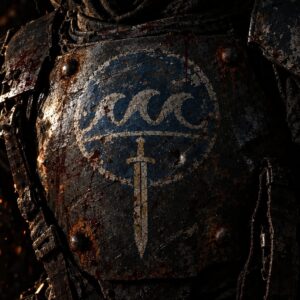
A black cloth on a lance, not of any special material, but of dense cotton turned grey with soot stains and blood. At the top the seal of Schäl-1 is embroidered—three waves (for the harbours), beneath them a sword (warrior). Below are names sewn in, so small they can only be read up close: every regiment Schäl raised has had a name sewn in before it was disbanded. Schäl-1 to Schäl-6. Schäl-7 is still waiting to have its name sewn in—but the cloth is almost full. Colonel Marak has ordered that the banner must not be lost, because sewing new names costs time, and time is what they do not have. The Schäl-8 names were added hastily afterwards, three of five names crammed into one field. At the Siege of Obsidian the banner was nearly thrown into a fire by a Chaos Knight—a young standard-bearer named Kess leapt after it and pulled it out. Kess died of his burns a week later. His name will be sewn in when Schäl-7 is disbanded. If it happens.
The Flaw
The flaw
The 7th Schäl and the Kervan 41st have been locked in open feud since their battalions met on the world of Corvan Prime in M40.911. The Kervans are infantry from a south-polar military world, violent and proud of their speed. The Schälers are heavy cavalry, proud of their strength. At Corvan Prime, divisional command ordered a combined operation: the Kervans were to hold a Chaos fortress, while the Schälers would open the way for a breakthrough. The Kervans were given the weaker sector and lost four hundred men in three hours—largely because the Schäler surprise attack came half an hour too early and released the enemy reserves sooner than expected.
The commander of the Kervan 41st, Colonel Tann, came in person to Colonel Marak and told him that the Schälers had committed murder—whether by intent or through incompetence. Marak answered only: "Your men could have fallen faster. That would have helped." Tann filed a formal complaint. Marak did not answer it. The complaint reached divisional command; divisional command wrote a note stating that everything had been planned correctly, and that both regiments were now to proceed to the next campaign.
Since then, wherever the Schälers and Kervans are deployed together, there is friction. The Schälers withhold fire support or provide it too late. The Kervans sabotage supply lines or march deliberately slowly. During the Obsidian campaign the two regiments were even deployed in separate sectors to avoid conflict. The Munitorum knows of this and tolerates it, because functioning, hostile regiments are better than broken, fractured regiments.
Every morning, when a Schäler sees a Kervan soldier, he looks away. No word is spoken. But the hand goes to the weapon, and the Munitorum writes it down.
A Munitorum Failure
In M40.556 a misallocation was made in the supply registers of the Schäl 3rd—a scribe on a Forge World recorded the Schäl 3rd's munitions as "autocannon calibre" instead of "lance-lancet charge standard calibre". The Schäl 3rd was at that time engaged in the Obsidian campaign, fighting against Tyranid spore clouds. The wrong munitions were useless—too weak, too quickly spent. The Schäl 3rd lost a hundred and twenty-eight soldiers in three days to weapon failure before command realised that the problem was administration, not tactics.
An investigation found the error. The scribe was a mentat, a hundred and thirty years old, who had made this one error in six thousand documents. The Commissariat could have executed him. Instead he was transferred—to another Forge World, without punishment, without a note. The Schäl 3rd received its correct munitions two weeks later. A hundred and twenty-eight of the dead were already in the corpse wagons.
The Munitorum has learned to hide errors of this magnitude. The Schäl 3rd was disbanded five years later. The Commissariat recorded that it had "exceeded attrition quotas".
Known Campaigns
Campaigns
Name Meridianus Prime
Epoche M40.102–M40.105
Erzählung
Enemy: Chaos cultists and a warband of the Logar Cult. Duration: forty-three days of intense fighting.
Meridianus Prime is a flat agricultural planet without fortresses, only storage complexes and grain silos. The 7th Schäl made planetfall alongside four other regiments; the task was to drive the Logar warband out of the southern province. The Schälers, coming from urban cultures, struggled with open-field cavalry tactics—they tried to operate among the remains of destroyed buildings instead of manoeuvring on the open steppe. After a week under fire with higher losses than necessary, Colonel Marak ordered a change: the Schälers were sent to the storage complexes, where urban tactics worked. There they lost fewer and killed more. The Logar cultists were exterminated; the southern province was reclaimed.
Allied regiments: Obsidian Tank Hunters (armoured infantry, technically adept), Krian Assault Platoon (light infantry, fast), Salpheris Artillery Corps (heavy support). The three left Meridianus Prime before the 7th Schäl, transferred to other campaigns. No bond formed, because the regiments operated in different sectors—only formal points of contact.
Outcome: Planet conquered, enemy destroyed, losses: one hundred and forty-eight dead and one hundred and sixty-two wounded (of an original four thousand two hundred). Stood down after the campaign and shipped to a new world in M40.106.
Name Corvan Prime
Epoche M40.911–M40.912
Erzählung
Enemy: Khornate warband under the Lord Scarash. Duration: sixty-five days.
Corvan Prime was a combined operation with the Kervan 41st Infantry. The strategy called for the Kervans to hold the central fortress while the Schälers led an outer manoeuvre attack to pin the enemy reserves. The operation came apart—the Schäler attack arrived faster than planned, because the enemy defence was weaker than assumed. This gave the Kervans no time to get into position. The Kervan line broke. One thousand four hundred Kervan soldiers died (of three thousand eight hundred). The Schälers nonetheless threw back Scarash's warband and took the fortress with the support of the Obsidian tanks.
Allied regiments: Kervan 41st (open feud ever since; see Section 8). Obsidian Tank Hunters (met again—good cooperation, but separated afterwards). The Obsidians were transferred to the Segmentum Pacificus; no reunion planned. With the Kervans there is a silent misunderstanding—both regiments work professionally, but do not trust each other.
Outcome: Planet conquered, enemy destroyed, losses: thirty-nine Schäler dead (relatively low, because the Khornate warband concentrated on the Kervans). But the link to the Kervan losses remains an open trauma. Afterwards transferred to the Obsidian campaign.
Name Obsidian Ring
Epoche M40.913–M40.919
Erzählung
Enemy: Mixed Chaos forces (Undivided and Tzeentch warbands). Duration: one hundred and eighty-nine days.
The longest and costliest campaign of the 7th Schäl. The Obsidian Ring is a broken planet of a thousand fortresses and labyrinths of ruins. The Schälers were deployed for flank security and then—because of their efficiency—drawn ever further forward, until they effectively formed the spearhead. Major Solian (then still a Captain) led shock assaults on Chaos fortresses; one hundred and ninety riders died over the course of six lunar cycles. The Obsidian tanks operated in parallel, but on their own account—no real coordination with the Schälers.
By the end of the campaign the 7th Schäl was so understrength that the Schäl 8th (a smaller, separate unit) was ordered to merge with it as reinforcement. The Eighth brought only one hundred and eighty intact riders (one hundred and fifteen had already been lost in earlier campaigns). The merger was administratively chaotic—the naming systems did not match, the hierarchies of rank collided. Major Dolan (commander of the Eighth) was placed under Colonel Marak; it was never fully settled whether this was a demotion or merely an administrative and spatial change. Relations between the old Seventh and the new men of the Eighth remain strained.
Allied regiments: Obsidian Tank Hunters (third meeting—technically excellent cooperation, but emotional distance remained; no trust, only professionalism). After the campaign the Obsidians were assigned to the Segmentum Obscurus high command; a reunion is likely, but when is unknown. The 7th Schäl shares with them a kind of silent mutual respect, shown in speed in following orders and precise allocation of ammunition—but no friendship. The Munitorum has deliberately kept these battalions apart, to prevent lasting comradeship from leading to insubordination.
Outcome: Obsidian Ring partially reclaimed, Chaos forces shattered (not exterminated—never possible). Losses: four hundred and forty-eight Schäler dead, one hundred and forty-seven wounded, forty-eight of them permanently unfit (amputated, lame, blinded). The merger with the Eighth brought total strength to roughly four hundred and eighty riders. After the campaign, to the ships for maintenance, but no home leave—the Commissariat ordered replacements from local Munitorum reserves, two hundred fresh recruits never trained for this intensity. In M40.920 they rode behind lance charges for the first time, without truly understanding what they were doing.
Vehicle livery
How the regiment’s vehicles are painted: base colour, camouflage for the theatre, turret band and markings, derived from the regimental colours.
| Theatre | Hive and city · Splinter camouflage |
|---|---|
| Base colour | #697068 · Dawnstone (Uniform base tone) |
| Camouflage | #6B7072 · The Fang (theatre standard)#2B2A24 · Dryad Bark (Field grime) |
| Turret band | #000000 · Abaddon Black (Helmet and rank insignia) |
| Markings | #E6E0CF · Wraithbone (standard colour) |
| Hull recipe | Dawnstone (Base) · Nuln Oil (Shade) · Administratum Grey (Layer) · Deepkin Flesh (Edge) |
Company bands on the turret
- 1.
- 2.
- 3.
- 4.
- 5.
- 6.
- 7.
- 8.
- 9.
Derived from the regimental colours; the silhouettes are our own sketches, not copies of any Games Workshop model.
On the core data
Brief note on ordinal and founding history:
The 7th Schäl is not new. Six regiments of the same name have already fallen apart—disbanded after devastating campaigns from which scarcely anyone returned. This seventh incarnation marched out in M39.4, drew its boots from the same stores, its lance shafts from the same forest as its predecessors. The new soldiers thus inherit not only a name, but also the names of the dead they never knew. Some call that honour. The veterans call it a burden. The Schäler are regularly trained, equipped and sent—and regularly ground down beyond recognition. The Planetary Governor of Schäl chokes on this torment, yet continues to send the levies, because a shortfall would mean execution for him a thousandfold.
Campaigns
Third Campaign: Obsidian Ring (M40.913–M40.919)