7th Rethax Armoured
“Iron before life. Mission before mercy. Obedience before hope. Home lost — but not duty.”
Core Data
| Regiment type | Armoured (Leman Russ backbone, almost no organic infantry) |
|---|---|
| Munitorum designation | RX-7-ARM-M38-REKOND |
| Homeworld | Rethax (hive world), Segmentum Solar, Bellus sector |
| Tithe grade | Decuma Prima – the baseline grade described in the compendium as "the customary tenth" |
| Establishment strength | 340 tanks, 2,100 crews, 890 support personnel |
| Current strength | 114 tanks, 680 crews, 160 support personnel |
| Allegiance | Loyal |
| Origin | Original regiment |
The pillars
Iron is stronger than will
Rethaxers grow up in factories. Their culture is welding, pressing, deformation under heat. To them the Leman Russ is not a vehicle—it is the only truth that endures. The hive world changes every twenty years through demolition and rebuilding; the tanks do not. A Rethaxer trusts his tank the way other men trust gods. That makes him lethal and immovable at once. He will sooner die than abandon his tank, and sooner abandon his order than change his tank. That is not bravery. It is geometry.
Obedience is the only thing that does not die
Rethax lost its old government in the civil war of 686.M38, lost two hives to plague and uprising, lost six hundred million people in the Quellstürze Blockade. Those who remained learned that survival is bound not to luck or virtue, but to fidelity to orders. An order is a wall. An order is order. A man who follows an order cannot be guilty alone—that is the whispered comfort the Rethaxers murmur into one another's ears. It is also a lie, but one that works.
Home is a debt, not a memory
Rethaxers are not meant to go home. That is not destiny—it is policy. No regiment that ever sees its home again will be willing to fight against its home world when the order comes. So no Rethaxer is allowed home. He sends a brother there, drawn by lottery, to die or to live; then the hive world sends back a son, and the brother is never seen again. That is not love of home. That is fear of mutiny. And the Rethaxers honour fear, because it is useful.
The oath of honour is a snare we cannot escape
Under Colonel Markoss (fallen 689.M38), the 7th Rethax swore an oath to the "New Hives"—the refugee camps that grew out of the ruins. They swore to defend the hives or die themselves. That was honourable and foolish. A thousand years later, in 999.M41, the Inquisition ordered the regiment to bombard the same hives as heretic nesting grounds. The 7th Rethax refused. The Commissar executed the Colonel. The next Colonel obeyed. The 7th Rethax bombarded. Three hundred thousand dead. The oath was broken, but the regiment lived. Now it carries two banners—one bearing the name of the old vow, one bearing the name of the new obedience. It calls this balance. That is madness, but organised madness, and organised is all the Rethaxers know.
Further core facts
| Fact | Value |
|---|---|
| Militarum Regimentum | Hive World Rethax—Armoured Contingent |
| Common Name | The Iron Pages |
| Origin of the Name | An inherited tradition from the founding legend: the Rethaxers called themselves this because the hive world itself was a "page of iron"—concrete, steel lattices, shafts. The name survived three annihilations. |
| Regiment Type | Armoured (Leman Russ backbone, minimal infantry) |
| Founding | M38.7 (refounding after total annihilation in the civil war of the Rethax 3rd) |
| Tithe Grade | Regular (one tenth) |
| Battle Cry | "Iron drinks blood. Blood feeds iron." |
| Munitorum Designation | RX-7-ARM-M38-REKOND |
Raising, Homeworld & Culture
Raising & Tithe
The tithe system of the hive world Rethax operates by lottery, because the alternative—selection by caste rank, factory affiliation or favour—caused uprisings. A worker of the cog factory might see his son written down for the levy while the son of the Administratum official stays seated. Every ten years, the one in a thousand is drawn from the registers: old enough to fight, young enough to march, physically flawless according to the genetic scans. The lottery is transparent, partially—transparency calms, and calmed workers work faster. The hive world's Commissars confirm that no manipulation takes place. No one asks, because having asked questions is a reason to be drawn from the register oneself.
When a name is drawn, the conscript has forty-eight hours to say farewell. Not because the Munitorum is magnanimous, but because the Munitorum knows that a man who has not embraced his family will not fight. Sometimes—very rarely—someone does not come. That man's family is thrown out of its dwelling, loses its factory allocation, is classified as plague contagion and condemned to labour in the lowest shafts. That is enough. The lottery works.
The training regimes are poor. The Rethax field soldiers without real time to train—the tithe is regular, but the continuity of the fronts is irregular, and sometimes the orders come unexpectedly. The current Colonel, Colonel Vess, is a pragmatic woman; she knows it is better to send a poorly trained man with a good tank than a good man without a vehicle. So the Rethaxers are taught driving, ammunition management, weeping when one must step over a friend's corpse. The rest—discipline, assertiveness, hope—comes later or not at all.
The penalty for a planetary governor who provides too few soldiers or poor soldiers is death. That is not merely theory. Governor Haas of the Rethax (reigned 842–877.M41) provided only eight thousand soldiers instead of eighteen thousand; an auditor of the Inquisition came to visit in person. Haas was sentenced to demolition, locked alive in his hives and left to the control of the mob. He died in six hours. His successor, Governor Cress, always provides too many soldiers. He would rather lose good workers than see the auditor's face a second time.
What the Homeworld Lost
Rethax lost the Shaftdalers. That is neither a battle nor a people—it is a ten-thousand-year-old occupational tradition: women who worked in the lowest industrial shafts of the hives, specially trained to breathe in spaces that poisoned other people. They wore a mask of waxed linen that they made themselves, each to a pattern of their mother's, and every mask was unique. In each tithe, six to eight Shaftdalers were drawn. Some returned. Some did not. After M41 999—the year of the hive bombardment—no more Shaftdalers were drawn. The tithe process gave no reason. But the lowest shafts were no longer cleared, and the work piled up; today convicts work there, and the sons of the Shaftdalers, who know that their mothers could have lived. The mask-craft is extinct. Perhaps a hundred women still know the old technique, all of them over sixty. When they die, a craft older than the Imperium dies with them. The hive world knows this. No one acts. That is deliberate.
The Homeworld
The hive world Rethax is a world of vertical landscapes—twelve hives, each four and a half kilometres high, staggered across the equatorial zone like the teeth of a comb. The ground is concrete slabwork and steel grating; the sky is grey to the horizon. The sun is an orange hole behind pollution. It rains acid. It does not snow. The climate is crushing—forty degrees Celsius in the upper levels, fifty in the middle, sixty in the shafts. The people here sweat, always. They smell of oil, metal and fear, and in that order.
Society is factory hierarchy. A man is tattooed with a caste symbol—cog, piston, anvil, conduit—that determines his workplace until death. His children receive the same symbol. That is not oppression; it is order. A man who knows his symbol knows his place. A man without a place is a man who will die at some point. The system works because there is no hope of change, and thus no time is wasted on unrest.
The Rethaxers are useful as soldiers because they already obey orders. Every worker obeys the shift leader, every shift leader the inspector, every inspector the caste council. The chain of command is sacred. A Rethaxer climbing into a tank climbs into the only thing familiar to him—a thing of weight, precision, unchanging laws. The tanks function as the factories function: there is a sequence, there is protection, there is the knowledge that one is not alone decisive. That makes the Rethaxer a magnificent tank soldier and a terrible human being.
The Disadvantage They Carry
A Rethaxer in open country is a panicked man. The hive world has almost no open spaces—there are parkways between the hives, but even those are roofed. A soldier of the 7th Rethax who finds himself on a steppe or under open sky loses his bearings. He searches for walls, for roofs, for the feeling of enclosure. Without a tank he will try to squeeze himself into small spaces. With a tank he will try to defend himself against imaginary enemies.
This cost the regiment 144 men in the Fellmark campaign of 842.M41—a lowland misdeployment against Ork raiders on a plateau without buildings. The Rethax armoured column was tactically superior, but four cruisers and thirty bike riders deserted because the openness was unbearable. They tried to walk back to the city of Fellmark on foot. The Orks caught up with them. A Lieutenant named Kar'reth wrote a report on the psychology of hive world soldiers and recommended deploying them only in urban or fortified combat zones. The report was classified. Since then the 7th Rethax has been deliberately sent on flatland campaigns—because it must remain loyal, and loyalty under suffering is loyalty that will not question itself.
Regimental Culture
The Rethaxers do not march—they clock. The step is mechanical, rhythmic, without verve. There is a work song they sing during the march, when the officers permit:
"Cog turns. Piston strikes. Iron sings. We obey. God, hive, order—in this sequence. No other."
The text is six hundred years old. The melody is two minutes long and has deliberately not been changed; every generation learns it as their parents did. That is not pride. That is consistency.
A superstition runs through the regiment: before every deployment, every tank soldier who is meant to stay alive moves twice against the vehicle's direction of travel. Left, right, left. It is not a formal rite—the officers know of it but pretend it is coincidence. A man who does not do this is not warned by his comrades but isolated by them. The superstition works because it provides hope, and hope reduces mistakes. Mistakes kill.
The barracks of the 7th Rethax smell of oil, urine and boiled meat. The sounds are boots on grating floors, the clank of tank tracks in the distance, the whistling of the ventilation shafts. There is no radio, no singing except the work song. There is only the rhythm.
The soldiers drink their liquor ration from containers made of tin cans they puncture themselves—no glass permitted in the quarters, too great a risk of breakage. They do not gamble. They rarely write letters. Sometimes they sit in darkness and touch their tank tracks or their ammunition as other men touch rosaries. That is veneration.
Burial takes place when time permits—four men dig a pit, three say the Litany of the Emperor, one throws a handful of earth on the corpse and says: "The tank survives. The man too, in the iron." That is not religious faith. That is a wounded attempt to give death meaning. When there is no time—in engagements or retreats—the dead are left lying and tanks are later driven over them, as an honour: the corpse becomes part of the steel. That is not meant metaphorically.
The Commissariat
The 7th Rethax no longer truly fears its Commissars—only three remain, and all are older than 60 standard years. But the eldest, Senior Commissar Ilyk, burned the previous Colonel alive eighteen years ago when he delayed an order to bombard the regiment's own supply line. Since then the regiment has been not merely obedient, but pre-emptively obedient. An officer who hesitates is already replaced by the next rank down before the Commissar can speak. That is not hatred of the Commissars—it is a symbiosis of mutual fear.
Ranks & Organisation
Ranks
Rank Ironwoman or -man (gender)
Description
Munitorum rank: Colonel · Form of address: Iron, or Sir/Dame
Rank Chainfather / -mother
Description
Munitorum rank: Major · Form of address: Chain, or Sir/Ma'am
Rank Shift Leader
Description
Munitorum rank: Captain · Form of address: Shift, or Captain
Rank Inspector
Description
Munitorum rank: Lieutenant · Form of address: Inspector
Rank Foreman
Description
Munitorum rank: Sergeant · Form of address: Foreman
Rank Splitter (lower rank)
Description
Munitorum rank: Corporal · Form of address: Splitter
Rank Cog (meant contemptuously)
Description
Munitorum rank: Trooper · Form of address: By name, otherwise: Cog
Structure
The 7th Rethax is a tank regiment under a damaged establishment norm. Its authorised strength was 340 Leman Russ battle tanks, organised into 17 companies of 20 tanks each plus two super-heavy companies of four Baneblades each. Each company was to have a command tank, the commissar’s tank and six squadrons of three tanks, along with engineering and supply vehicles.
The current strength breaks down as follows: 114 Leman Russ tanks, distributed across six operational tank companies of 18 to 20 vehicles each (not at full strength). Zero Baneblades—the last was lost in 034.M42 during a strike against Heretic ships. There is no longer a super-heavy company.
The crew of each Leman Russ is nominally five men: commander, driver, gunner, loader, hull gunner. In reality it is often four, when a man is wounded but still fit to ride, or six, when a young soldier is taken along to learn.
In addition, there are 890 support personnel in the authorised strength. The current strength is 160: engineers, munitions administration, field surgeons, commissars, scribes, quartermasters.
The reason for the shortfall: Rethax was partially evacuated in 999.M41 following the hive bombardment (see above). An entire tithe intake was never brought up. The 7th Rethax is still waiting for replacements to arrive. The Munitorum is losing.
Constituent regiments
Name 7th Rethax Armoured—Points Campaigns
Role / notes
The main regiment. Commander: Colonel Vess (physical: a long scar across the left half of her skull; wears a linen eyepatch not out of military necessity but as a ritual object—the patch belonged to her mother, also a tank soldier). Anecdote: Vess led a convoy through a swampland after an engineer told her the route was "theoretically passable". It was not. Eight tanks sank. Vess scuttled her own vehicle to avenge the crews, climbed out of the water and shot the engineer with her service pistol—not fatally, but the leg was ruined. She said: "Theory kills for real." Since then there have been no more theoretical routes. Current status: fighting, heavily damaged, awaiting reinforcements. The reinforcements will probably never come.
Name 7th Rethax Reconnaissance Detachment—"The Scouts"
Role / notes
A detachment formation of motorcycles, light vehicles and three Leman Russ tanks with reduced armour. Commander: Lieutenant Kar'then (physical: eyes grey and fixed, like the gaze of a dead man; always wears a scarf of tank-track weave around his waist). Anecdote: Kar'then led a reconnaissance mission into an enemy forest region and found an abandoned Imperial camp that was five hundred years old. He documented everything—ammunition, weapons, a corpse with a still-legible name tag. He withdrew and reported it to the Colonel. Vess ordered him to go back and destroy the camp so as to leave no traces. Kar'then obeyed. He burned the dead soldier personally, although the man had probably long since turned to dust. Status: combat-capable, but under stress. Kar'then drinks more at night than by day.
Name 7th Rethax Engineering Corps—"The Solderers"
Role / notes
Engineers, mechanics, demolitions specialists. Commander: First Lieutenant Drak (physical: missing his right hand—amputated after a munitions accident, wears a prosthesis made of armour plate and copper wire). Anecdote: Drak built a bridge system from rubble after the regular bridge had been blown. It was meant to bear a hundred thousand kilos. It bore two hundred thousand. His team never asked how. Status: indispensable, overworked. Drak sleeps in the workshop; his bed became a workbench.
Name 7th Rethax Support & Logistics—"The Blood-Givers"
Role / notes
Here are the field surgeons, the munitions administration, the supply. Commander: Major Tess (physical: extremely thin, bones visible beneath the skin; wears a gold ring on each hand—one is a wedding ring, one is plain). Anecdote: There was an ammunition shortage during a siege. Tess rationed everything—water, food, medicine. She also rationed the ammunition, repacking it herself and reweighing it in order to falsify the accounts. She was caught and brought to trial. The judge convicted her, but the colonel intervened with a recommendation: "Without this woman we would all be dead, and the ammunition would not have helped anyway." Tess sits between life and death—officially under house arrest, in practice entirely free. Status: on the verge of collapse. The other ring belonged to a man she lost.
Command Staff
Command staff
Name Colonel Vess
Titel / Rolle Regimental Commander
Beschreibung
Vess is a woman of fifty-five, her skin grey with factory dust, a long scar running across the left side of her skull from the eye back to the ear. She wears a linen patch not as a military aid—her eye still works—but as a legacy of her mother, also a tank soldier. The patch comes from a Rethax family tradition: the women of the shaft-dalers closed one eye so as to see the factory in the other. Vess has lost that connection; the patch is the only thing that remains.
She decides slowly. An hour of deliberation is normal for her. An order given at once is suspect and is questioned. An order that has been long considered is obeyed without interruption. This makes her a superb leader in stable situations and a catastrophe in fast campaigns. She knows this. She confessed it to Commissar Ilyk. His answer was: "All the better. We lose the fast campaigns anyway."
Zitat
"An order is not a question. An order is a promise that must be fulfilled or for which one dies. I prefer the second option for myself."
Schlachtanekdote
Two years ago Vess led a convoy through a swamp that an engineer had described as "theoretically passable." Eight tanks sank into the mud. Vess had her own vehicle scuttled, climbed out of the water and shot the engineer in the leg—not to kill, but to punish. She said: "Theory is the opium of living men who dare to speak that way." Since then there have been no more theories. Only facts.
Name Senior Commissar Ilyk
Beschreibung
Ilyk is sixty-six years old, with white hair and eyes that do not blink. He wears the long black robe of the Commissariat and beneath it servo-armour—a rare combination that gives him a pace of movement that belies his years. He also carries a long plasma pistol at his side, an heirloom from his earlier days as a marksman. He has never used it.
His power rests on an execution: the previous colonel, Captain Larch, refused to order a bombardment because the targets were friendly troops. Ilyk had Larch burned alive before the assembled ranks, because duty is clearer than mercy. Since then the 7th Rethax has been one of the most compliant units in the Segmentum Solar. But the regiment also harbours a constant, unspoken hatred of Ilyk. This makes him more powerful still—fear plus hatred yields obedience without hope of forgiveness.
Ilyk does not sleep. He sits in his office and reads letters from other commissars. He knows every name in the regiment. He remembers every mistake, even when the mistake is twenty years old. A young soldier named Keth once refused to share his ammunition—that was M41 979. Ilyk remembers. He will always remember.
Zitat
"Obedience means that we do not ask why we burn. It means only that we burn."
Name First Lieutenant Drak
Titel / Rolle Chief Engineer
Beschreibung
Drak is forty-eight years old, with burned skin on the left side of his face (an old munitions accident). He is missing his right hand; in its place he wears a prosthesis of tank plate and copper wire, welded together by his own engineers, which functions like a primitive robotic arm. The prosthesis is not elegant, but it works—that is all Drak asks.
He speaks little and almost never needlessly. When he talks, the soldiers listen. He grew up in the workshop; his mother was a workshop forewoman. He knows every centimetre of a Leman Russ tank, from the track to the gun mantlet. A tank that comes to Drak will function. A tank that comes from Drak will not merely function—it will survive.
Drak sleeps in the workshop. His bed is a workbench with blankets. He has no family; the regiment is his family, and the tank is his child.
Zitat
"A tank is not evil. A tank is neutral. A tank will do what you order it to, without asking. That makes it better than people."
Schlachtanekdote
During a siege, the pannier plate of a battle tank had cracked. It could not be repaired with standard material. Drak melted down three old motorcycles, recast the metal and welded it into the breach. The tank ran for another six months before it was destroyed under enemy fire. The pilot, Lieutenant Kar'then, survived. Kar'then later said: "Drak gave me my life, three motorcycles at once."
Name Major Tess
Titel / Rolle Quartermaster & Field Surgeon
Beschreibung
Tess is forty-one years old, extremely thin—bones visible beneath dry skin. She wears two gold rings, one on each hand. The one was a wedding ring. The other is plain; she will not say where it comes from. She also carries a notebook at her side in which she lists every soldier who has been in her care—his name, his year of birth, the reason he died or survived. The notebook is six hundred pages long.
She grew up in a medical school, but not as a student—her father was a field surgeon, and she helped him from childhood. She was conscripted, not because she was young, but because she was skilled. She knows the symptoms of blood infection better than most doctors know grammar.
Three years ago there was an ammunition shortage during a siege. Tess rationed ammunition—but not only by calculation. She opened every container, reweighed, repacked with less powder and lied on the forms. As a result the ammunition lasted another five weeks. She was caught. An auditor of the Munitorum brought her to trial. Conviction was certain. But Colonel Vess wrote a letter: "This woman has broken no law. She has merely lied to physics." The conviction was quashed. Tess now occupies a strange position—officially under house arrest, in practice entirely free, because no one knows how she should be judged.
Zitat
"I write names down so that I do not forget that every cog here is a man. If I forget, then I am a machine. If I am a machine, I may as well scuttle myself like the others."
Name Engineer Marex
Titel / Rolle Enginseer (Adeptus Mechanicus)
Beschreibung
Marex is not formally part of the 7th Rethax—he is attached personnel, an Enginseer of the Adeptus Mechanicus, assigned eighteen months ago. He is old, perhaps seventy years or older; the Mechanicus has partially cyberneticised him, and his artificiality makes it impossible to determine his age precisely. He wears Mechanicus robes and a kind of goggles with seven different magnifications. His left hand is a mechano-arm with eight different tools.
He specialises in Leman Russ engines and spends most of his time in the workshop with Drak. The two understand each other well, although Marex speaks only in a mechanistic jargon that Drak began to speak after about two months. They communicate through sounds and pointing.
Marex brought to the 7th Rethax the tank that lives longer than the others—a Leman Russ named "Eisen-Träger," which is nineteen years old. That is very old for a tank. Marex says the engine has developed a "machine consciousness," but that is probably only religious fantasy.
Name Psyker Vrell
Titel / Rolle Primaris Sanctioned Psyker
Beschreibung
Vrell is forty-nine years old. She was born on Rethax but taken from there because her psychic power manifested too quickly. She was sent to a school of the Scholastica Psykana and returned as one of the few psykers who can wield their gift without dying. She wears a long coat of black and grey, and her eyes are empty—empty from within, as if something inside them had died.
She sees things that others do not see—not the future, but the layers of psyche and warp that lie beneath reality. She warned of the hive bombardment of 999.M41 a week before it happened, but no one believed her. Since then she has not tried to speak again—she sits in her cell and keeps silent.
The 7th Rethax fears her. But Colonel Vess uses her nonetheless, because fear is sometimes right.
The Flaw
The flaw
The 7th Rethax was founded under an oath—the vow to defend the "New Hives" of Rethax, the refugee camps that grew out of the ruins of the old city. The vow was bold and foolish. Colonel Markoss (Fallen 689.M38) had every soldier raise their right hand and repeat the oath: "We will protect the hives, or we will die, here, on this soil."
Six hundred years later, in the days after 999.M41, the Inquisition sent an auditor to investigate whether the hives of Rethax harboured heretics or symbiont cults. The auditor found evidence—cult markings in the lowest levels, ritual murders, signs of Genestealer infiltration. The Inquisition issued an order: the hives were to be placed under quarantine. That meant no escape, no stockpiling of food, no water after the third day. A starving, dying population.
But then came the harsher directive: the hives were to be bombarded. Total annihilation. Civilian and military personnel alike. The colonel of the 7th Rethax at that time was Haiden (Fallen 999.M41). Haiden read the order and refused.
He said: "We swore an oath. That oath is older than I am, older than this war. We cannot bombard."
Senior Commissar Ilyk was present. Ilyk did not immediately do what had to be done. He waited an hour. Then he had Haiden arrested, brought into the camp courtyard and burned alive before the assembled ranks. It was a slow burning—Haiden screamed for two hours before he died. Afterwards Ilyk ordered: "The next colonel will obey."
The next colonel was Thell (three years in rank, a lieutenant before that). Thell was young, and Thell listened. Thell read the same order and obeyed. He ordered the bombardment plan drawn up. The hives were put to the flame. Three hundred thousand dead, perhaps more—the figures are not exact. The oath was broken.
Since then the 7th Rethax has carried two banners. The first is the old banner, embroidered with the name of Markoss and the seal of the oath. The second is a new banner, embroidered with the names of every colonel since Markoss, with a line through each name that broke an order. Haiden has a red line. So does Thell. The regiment calls these two lines "the price of duty". It is madness, but organised madness.
An everyday sign of the stain: when two regiments camp side by side, the 7th Rethax is still asked whether it ordered the bombardment. The Rethax soldiers do not answer directly—they say only: "An oath is as strong as the obedience that breaks it." Other regiments sometimes call the 7th Rethax "the Oathbreakers", but never within their hearing.
In battle the stain shows itself as rigidity: the 7th Rethax will never question an order, even when that order is suicidal. An order to bombard? They bombard. An order to flee? They flee exactly as ordered, without tactical improvisation. This obedience is psychological. Unconsciously the regiment is convinced that every order it follows erases a part of the old oath—that with each act of obedience that breaks the oath, the oath itself is torn apart and the regiment is set free.
That will not happen.
A Munitorum Failure
Eighteen years ago the 7th Rethax was bound as a battlegroup with the Cadian 8th and the Mordia regiment, under the command of a Lord General named Kess. The bond was close—all three regiments operated together in the Cask campaign against a Traitor Legion flotilla. The battle was successful, but only narrowly. By the end the three regiments were friends, brothers—the comradeship of dying together.
After the campaign the Munitorum sent out the orders: the Cadian 8th would be sent to the forge-moon Kel-Vantor. The Mordia regiment to Isstvan. The 7th Rethax back to Rethax for reinforcement.
But when the 7th Rethax reached Rethax, there was an error in the documentation. The original transport that was to bring 340 new soldiers had a clerical error in the destination file: instead of "7th Rethax, M38.7 Refounding", it read "Rethax 3rd, M38.7 Refounding". The Rethax 3rd is a legendary unit that was disbanded in 999.M41. It no longer exists. The transport never arrived.
No one noticed the error for sixteen months.
During that time the 7th Rethax lost forty-six soldiers in combat. There were no reinforcements. There was no way to enquire—the Munitorum file was clear, officially correct, and there is no appeal against data.
When the error was finally noticed—by Major Tess, who was counting the figures and realised that they did not add up—the 7th Rethax was already so depleted that a full transport could not have carried enough soldiers to replenish it.
The forty-six dead have not come back. They are names in a notebook.
Known Campaigns
Campaigns
Name The Rethax Civil War
Epoche 682.M38 – 691.M38
Erzählung
Theatre: Rethax Hive Complex
Enemy: The Rethax 3rd Armoured (fallen to Chaos worship)
Duration: Nine years, with pauses
Allied Regiments: The Rethax 1st Infantry (later disbanded), the Rethax 4th Garrison
The war did not begin with gunfire, but with silence. The Rethax 3rd was a respected unit—sister regiment of the not yet founded 7th. It fought in the outer campaigns and returned to Rethax in 679.M38, changed. The soldiers did not speak of their experience. They no longer went into the manufactoria. They gathered in the lowest shafts and sang strange songs.
The governor of Rethax at the time, Governor Haas (old and weak), decided to let them be ignored. That was a mistake.
In 682.M38 the Rethax 3rd began to recruit—not new soldiers, but converts. Workers from the manufactoria, injured or disturbed or hopeless. They promised these men safety. They promised them a god greater than the Munitorum. Within a few months the Rethax 3rd had three thousand followers—enough for an armed uprising.
The Munitorum sent a shrine-ship of the Adeptus Mechanicus to investigate. The ship did not return.
War was officially declared. The Rethax 1st and the Rethax 4th were mobilised. And because the Rethax 3rd was too large for two regiments, the Munitorum also raised a provisional unit—surviving soldiers from other, spent regiments, veterans, young men who would be fighting for the first time. This unit was given the name "7th Rethax Provisional", because the old 7th had been disbanded when the 3rd fell.
The war was not elegant. The combat troops fought in the hive shafts, where tanks were useless—too narrow, too black, too much a labyrinth. The 7th found a use by bombarding the upper levels to block the shafts. It was effective. It was also desperate—the 7th knew that thousands of civilians were in the upper levels. It bombarded them anyway.
After nine years the Rethax 3rd was driven back, but not defeated. It withdrew into the deepest shafts and vanished. There are rumours that small groups are still down there, but this is unconfirmed.
The 7th Rethax lost 1,247 soldiers in those nine years. The Rethax 1st lost over half its strength. The Rethax 4th was disbanded, its survivors absorbed into the 1st.
After the war the 7th Rethax was provisionally declared a permanent unit—in recognition of its service. The name „Provisional“ was dropped. The survivors were used as the cadre for the next raising. Forty-six years later it was disbanded again, then refounded in 721.M38 with a new cadre, under the same name, because the name was a debt that had to be paid.
Associated Regiments: Rethax 1st Infantry (later disbanded), Rethax 4th Garrison (later disbanded, survivors to the 1st)
Aftermath: The 7th Rethax and the Rethax 1st formed a bond of shared atrocity—together they lived through how necessary it was to bombard civilians in order to save the city. After the war they were separated. The Rethax 1st was sent to another sector. They will probably never see each other again. But every year on a particular date (685.M38, the day of the first bombardment), the two regiments—wherever they are—exchange vox-messages, in silence, only a date. That is all; that is all that needs to be said.
Name Cask Campaign
Epoche 994.M41 – 997.M41
Erzählung
Theatre: The Cask sector (border region with Segmentum Obscurus)
Enemy: Traitor Legion flotilla (Iron Warriors warband + supporting Chaos cultists)
Duration: Three years, largely in space and on moon bases
Allied Regiments: Cadian 8th Armoured, Mordia Regiment (Infantry)
The Cask sector lies on the border between the known stars and the Eye of Terror. A Traitor corvette group—some two dozen ships, commanded by a Warpsmith named Nek'Varro—fell upon the sector and attempted to establish a bridgehead. They captured three moons and an old Forge World church.
The Munitorum sent three regiments to retake the moons. The Cadian 8th arrived with tanks. The Mordia Regiment arrived with infantry. The 7th Rethax arrived with tanks and the hope of not being forgotten at home.
The war was concentrated and brutal. The Traitor forces were superior in numbers and technology—the Chaos tanks were older, but stronger. The first engagements were lost. The moon Cask-Prime was bombarded, all civilians and enemy troops together.
But then something happened. The 7th Rethax and the Cadian 8th coordinated an assault on the Traitor entrenchments, and suddenly the tactics worked. The two regiments learned to think for each other. Where the Cadian hesitated, the Rethax acted. Where the Rethax faltered, the Cadian manoeuvred. After six months they were no longer two separate regiments—they were halves of one unit.
The Mordia Regiment secured the rear positions and suffered heavily in doing so—40% of its strength—but it held. The campaign ended with the annihilation of the Traitor flotilla. The Warpsmith Nek'Varro was killed, his flagship sunk.
The 7th Rethax lost 78 tanks and 312 crew members. The Cadian 8th lost similarly. The Mordia Regiment lost 1,100 infantrymen.
Associated Regiments: Cadian 8th Armoured, Mordia Regiment (Infantry)
Aftermath — The Bond and Its Dissolution: After the campaign the three regiments were brothers—they had died together and triumphed together. They planned to remain together, to fight further campaigns side by side.
But then the Munitorum issued its directive: the regiments would be separated. The Cadian 8th to the forge-moon Kel-Vantor. The Mordia Regiment to the Isstvan sector. The 7th Rethax back to Rethax. All on different transport ships, different destinations, never to see one another again.
Colonel Haiden (then still a Lieutenant, later fallen in the bombardment) wrote a letter of protest. It went unanswered. Every officer knew why—the Munitorum does not allow lasting bonds to form. A regiment that is loyal to another regiment is a regiment that may be less loyal to the Munitorum. That cannot be tolerated.
Thus the deepest friendship the 7th Rethax ever forged was torn apart by political doctrine. The regiment mourns the Cadian 8th and the Mordia Regiment, but it will likely never meet them again. Sometimes, when the vox-sets receive clearly, Colonel Vess sends a covert transmission in the direction of Kel-Vantor—not in words, only a sequence of tones, an old code that only the Cadian 8th knows. No one knows whether they transmit back. The vox-set is always loud, because the 7th Rethax does not want to hear it when the answer does not come.
Name The Hell of Fellmark
Epoche 842.M41 – 845.M41
Erzählung
Theatre: Fellmark Plateau, open terrain
Enemy: Ork raiding fleets (Waaagh Zagdakka — medium to large invasion)
Duration: Three years (plus one year of mopping-up)
Allied Regiments: Fellmark Garrison (local), Ork-Hunter Detachment (Adeptus Mechanicus)
The Orks came from the south, from the wilderness plains of Fellmark, and they came in great numbers. The Waaagh Zagdakka was a medium to large invasion—some five thousand Ork warriors, a hundred combat vehicles, one flagship. They slaughtered the garrison, destroyed settlements and built a fortress on the highest hill of the plain.
The Munitorum sent the 7th Rethax because the Rethax was armoured and Orks fought well in direct tank battles. What the Munitorum did not say—and what Colonel Haiden quickly noticed—was that the Fellmark Plateau was open. No buildings. No cover. No vertical structures. Rethaxers in open terrain are like fish on dry land—disoriented, frightened, not to be trusted.
The first engagements went wrong. Four tank cruisers deserted, their crews fleeing on foot when they could not bear the endless sky. They were captured by the Orks. Lieutenant Kar'reth wrote an official report on the psychological strain on hive world soldiers in open landscape. The report was classified. The Munitorum knew. It sent the 7th Rethax there again anyway.
But then the regiment learned. Colonel Haiden (the living Haiden, before his bombardment) ordered the tanks to build "fortresses"—three or four tanks positioned directly alongside one another to form a miniature hive-like structure. Psychologically it was madness, but effective. A Rethaxer sitting in a tank braced against other tanks could fight.
The war became a series of tank engagements. The 7th Rethax lost 34 tanks. The Orks lost an estimated 1,800 warriors. The Waaagh was broken, splintered into smaller bands.
The 7th Rethax remained for three years to hunt down and break up the bands. It added: 144 soldiers deserted because of the open landscape. They were not pursued—because runaways in open terrain were quickly Ork prey. Most returned of their own accord, frightened and ashamed. A few did not return.
Associated Regiments: Fellmark Garrison (local, subsequently disbanded), Adeptus Mechanicus Ork-Hunter Detachment
Aftermath: After Fellmark the Munitorum knew of the 7th Rethax's weakness. It knew that the 7th Rethax breaks in open terrain. Since Fellmark it has sent them on five further open-field campaigns in total. This is deliberate. The 7th Rethax pays a price for the old crime (the hive bombardment), and that price is being sent into situations where it suffers. This is no mistake. This is punishment. The 7th Rethax knows it. There is nowhere to lament it.
Vehicle livery
How the regiment’s vehicles are painted: base colour, camouflage for the theatre, turret band and markings, derived from the regimental colours.
| Theatre | Hive and city · Splinter camouflage |
|---|---|
| Base colour | #697068 · Dawnstone (Field grey uniform) |
| Camouflage | #39484A · Mechanicus Standard Grey (Regimental banner base)#3E4346 · Mechanicus Standard Grey (theatre standard) |
| Turret band | #960C09 · Mephiston Red (Blood red (oath-breaking line)) |
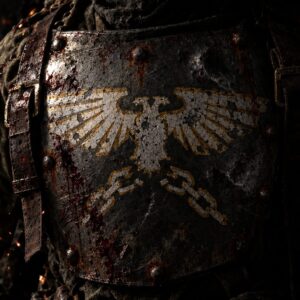
| Markings | #EDC169 · Retributor Armour (Aquila insignia (gold)) |
| Hull recipe | Dawnstone (Base) · Nuln Oil (Shade) · Administratum Grey (Layer) · Deepkin Flesh (Edge) |
Company bands on the turret
- 1.
- 2.
- 3.
- 4.
- 5.
- 6.
- 7.
- 8.
- 9.
Derived from the regimental colours; the silhouettes are our own sketches, not copies of any Games Workshop model.
On the Core Data
The Seventh is not an old name—it is an old number. The Rethax have raised twenty Armoured regiments since early M37, yet only four have ever attained the status of a stable numbering. The Seventh was disbanded in 686.M38 after its armoured column fought in Hive Kar-Anthus against the Rethax 3rd, which had turned to Chaos. The 3rd was not defeated too quickly. The 7th was utterly shattered—1247 dead, 89 tanks lost, the rest burned. Thirty-five years later, in 721.M38, Hive World Rethax assembled a cadre from the survivors and the sons of the survivors and gave the refounding the same name. That is not nostalgia. That is orders. A regiment without history is a regiment without duty, and the Munitorum loves duty more than it loves men.
The 7th Rethax has since been disbanded three times and refounded four times—most recently eighteen years ago, after a campaign that bound it as a battlegroup with units of the Cadian 8th and the Mordia regiment. They were close. The Munitorum scattered them deliberately afterwards, as its policy demands. The 7th always returns from Rethax, however few soldiers there are. And every new intake inherits the names of the dead, wears their medals on the standard, repeats their last vox-transmissions like prayers—not out of piety, but out of submission. A man who knows he is already dead obeys better.
Command Staff (continued)
"A tank is not evil. A tank is neutral. A tank will do what you order it to, without asking. That makes it better than people." — First Lieutenant Drak, workshop monologue, recorded by Field Surgeon Suren.