7th Armacron
“Swift as the lash, hard as steel, sharp as the spear, firm as the oath.”
Core Data
| Regiment type | Rough Rider (mounted shock troops with explosive lances) |
|---|---|
| Munitorum designation | CAT-ARM-7-B/19 |
| Homeworld | Armacron III (civilised world) |
| Tithe grade | Exactis Tertius |
| Establishment strength | 4,600 men |
| Current strength | 1,847 men |
| Allegiance | Loyal |
| Origin | Original regiment |
The pillars
The Charge Is Law
Cataphracts are not built to stand in lines or hold trenches. The storm breaks what slowness does not break. Waiting is cowardice. A rider without a charge is a wounded rider—better brought down swiftly than forgotten, cowardly, in the saddle. Momentum decides, not numbers.
We Are Replaceable, Therefore We Are Invincible
One man dies, three move up. One regiment falls, five new ones march forth. That is our strength and our curse at once. No Cataphract is irreplaceable—therefore we can dare things that a man of a Chapter may not dare. The Emperor needs us precisely because we are continually consumed.
The Lance Is Holy, the Rider Profane
The explosive in the tips was loaded before your forefather carried it. The armour was forged before you were born. You are the arm, not the spirit. Honour the steel.
An Officer Who Does Not Ride Is No Officer—An Order That Does Not Come from the Saddle Is No Order
Our Colonel sits at the head or not at all. That makes us faster than foot soldiers and worse than protocol. It also makes us dangerous to other regiments, who do not understand that speed sometimes surpasses obedience.
Further core facts
| Fact | Value |
|---|---|
| Entry | Detail |
| Militarum Regimentum | Cataphracts of Armacron |
| Common Name | The Sturmlanze |
| Origin of the Name | Earned in the campaign of 19.M41 against the Orks in the Morteus Sector—a shock cavalry charge broke through Green lines where infantry had stalled. |
| Regiment Type | Cataphracts / Heavy Cavalry with Explosive Lances |
| Founding | M38.4 |
| Tithe Grade | Raised (war zone within reach) |
| Founding Strength | 4,600 men |
| Current Strength | 1,847 men |
| Battle Cry | Through steel to the light—forward, forward, for Armacron! |
| Munitorum Designation | CAT-ARM-7-B/19 |
Raising, Homeworld & Culture
Raising & Tithe
Armacron III raised the Sturmlanze as an accelerated tithe—an entire year-cohort was drawn from the civilian population by the planetary governor, without the luxury of a recruitment year. The reason was militarily simple: the Morteus Sector was in flames, Ork invasions were spreading, and the Munitorum demanded two further cavalry regiments at once. The governor, who knew that inadequate or poorly trained levies meant capitulation—and capitulation meant the execution block for him—released the best of his civilian riding guilds at full strength. It was delegation rather than military service: men who bred horses and crossed markets on horseback were summarily declared cavalrymen because they already sat in the saddle. This made them less disciplined than regular Cataphracts, but quicker to become fit for service. Sergeants report recruits who already knew by the third drill how to shoot from a moving saddle, because their homeland's craft had long since taught them.
What the Homeworld Lost
Armacron III was a horse-trading world. Its exports ran through guild merchants who had ridden the same routes for three generations. With the levy of 4,600 of its finest riders, the planet lost more than skilled hands—an entire web of knowledge was gone. The bloodlines could no longer be controlled. Mares died of birthing fever because no one knew any longer when to intervene. The great autumn market ride to Meridax Prime did not take place—first for one year, then for two. The trading guilds began to shrink. Sixty years later, Armacron had never again brought its horse breeding back to the first rank.
The Homeworld
Armacron III is a civilised world with a temperate climate—sun-rich steppes crossed by watercourses, plains on which herds graze and settlements spread. The cities are not large, but old. The architecture is functional, built of rubble stone, concerned less with splendour than with durability under rain and wind. The entire world was historically a horse culture: trade ran by saddle, wars were fought from the saddle, even justice rode—a judge came to the villages on horseback, passed judgement and rode on. This leaves its mark: the citizens of Armacron understand speed as a virtue and obedience as something shown at the gallop, not standing still. Fear of standstill is woven into these people. A Cataphract from Armacron does not like to sit still, waits unwillingly, and hates the deepest earth—to him, trenches are sooner a nightmare than a fortress.
The Disadvantage They Carry
Armacron riders cannot fight underground and become panicked in confined spaces. The advantage of the civilised world—speed, clear sight, open terrain—becomes a paralysing weakness in salvage sectors, subterranean positions or shipboard fighting. In siege warfare they fail. In the Kaludis Sector (M40.9), three rider Companies were sent into the underground bunker lines of the planet Kalvethe to seal off escape routes. They did not mutiny—they obeyed the order. Yet they did not lose 30 % of their men in three weeks. They lost 87 %. They rode themselves against stone walls, shot one another in the darkness, and two survivors died of madness in the field hospital. Afterwards it was agreed that the Sturmlanze would no longer be sent into subterranean fighting—an agreement that the current Colonel has secretly entered into his report, so as to forget it.
Regimental Culture
Service in the Sturmlanze is organised around riding. Instruction takes place in the saddle, honour is earned in the saddle, and the rhythm of the day follows the morning inspection of the horses—before anything else, it is checked whether the animals have been tended. The marching song is a rhythmic, stamping chant that imitates hoofbeats; the words matter less than the beat: Huh, huh, stampa-stampa-huh. It helps everyone ride in the same step. The superstitious belief is absurd and stubborn: Cataphracts believe that a horse must be given a name before the charge, and that a horse named for the second time (because the first one died) brings misfortune. The sergeants have given up preaching against it. The barrack village smells of horse dung and tar—leather oil, worked into the straps every evening to keep them supple. The drop of schnapps is emptied before going to sleep; whoever is still standing and able to drink already smells of the next morning. The dead are buried when there is time, always with the saddle laid over the coffin—the message is: He rides on, only not for us. When there is no time, they are thrown into shallow trenches with their armour, and the sergeant speaks a formula: For Armacron, on the way.
The Commissariat
The Sturmlanze fears its commissars, because it knows that commissars give orders faster than Colonels think. A commissar on foot is slower and is overrun sooner—but the commissars of the Sturmlanze are mounted commissars, and there are only two of them in the entire regiment. This creates a silent pact: the commissar is tolerated as long as he rides himself. The first commissarial removal was eight years ago; the commissar had gone on foot to accompany a wounded soldier. The Colonel saw this as weakness and later had the man "lost" by a patrol—not killed, merely relieved, without a signature. The Commissariat has never officially noticed.
Ranks & Organisation
Ranks
Rank Grand Rider
Description
Munitorum rank: Colonel · Form of address: Grand Rider
Rank Rider Leader
Description
Munitorum rank: Major · Form of address: Rider Leader or Master
Rank Field Lord
Description
Munitorum rank: Captain · Form of address: Field Lord
Rank Platoon Master
Description
Munitorum rank: Lieutenant · Form of address: Master
Rank Stonebreaker
Description
Munitorum rank: Sergeant/Non-commissioned Officer · Form of address: Stonebreaker
Rank File Master
Description
Munitorum rank: Lance Corporal · Form of address: File Master
Structure
The Sturmlanze nominally follows the standard structure: 15 rider Companies of 280 men each (3 platoons of 4 squads of 20 men), plus staff (60 men). This gives an establishment strength of 4,240 men. Current strength stands at 1,847 men spread across 9 Companies—four Companies were shattered in the Morteus campaign (M41.3–M41.7) and never replenished, because the war zone lay too isolated for resupply. Instead of being evacuated, the survivors of both Companies were pressed into the remaining units. The newest arrivals come from the third levy (M41.9) and do not even know that there were Companies here that no longer exist. They bear their numbers and pray for dead whose names no one speaks.
Constituent regiments
Name Sturmlanze—First Rider Squadron (Armacron 7/1, original unit)
Role / notes
Commander: Colonel Marveth Kaine, grey-bearded, scar on the left eye from Kaludis. Status: operational, 287 men actual strength (nominal strength 560). This is the anchor Company; all others were added later or merged. "Dying faster is no disgrace, Colonel—serving faster is the will."
Name Armacron 7/6, Second Squadron (formerly two separate companies until M41.7)
Role / notes
Commander: Captain Theris Vorn, youngest officer, survivor of Morteus. Type: light riders, rapid-fire lasguns instead of lances, support role. Status: 201 men. This company was not disbanded but merged—Vorn still has nightmares from time to time about there having been two.
Name Armacron 7/12, Third Squadron
Role / notes
Commander: Captain Selkane, a quiet woman, terrain specialist. Status: 234 men, operational. Deserved—this company has the fewest losses and understands why. They rode slower, not faster. That is heresy by Cataphract belief. No other companies speak with her.
Command Staff
Command staff
Name Colonel Marveth Kaine
Beschreibung
A man of fifty-six standard years, whose left eye is disfigured by a scratch scar running up to the temple—not from the enemy, but from his own saddle, when his horse collapsed on Kaludis. He wears a moustached full beard, greyed, and in peacetime rides in an officer's coat that has torn at the seam in the rain. He does not like to sit still, stands up during briefings and paces about like a man watching for the next rider. Kaine has commanded three regiments, two of which no longer exist. The fourth, the Sturmlanze, is the only one he has not shattered—a success at which he himself smiles. He wears a silver officer's clasp of Armacron manufacture, an heirloom from his own father, also a Colonel. The man has one trait that makes him notorious: he promotes not by rank but by speed. A common soldier who thinks faster becomes a non-commissioned officer within three months. This breaks protocol and breeds hatred among the older ranks, but it has kept the Sturmlanze alive. "The Imperium takes us quickly; we should give back quickly."
Name Lord Commissar Vren Castell
Beschreibung
A man of forty-nine years, hairy as a badger, with a broad jaw and lips too tight. He sits on horseback like a sack of grain—not clumsily, but reluctantly, as if he would rather walk. That is the problem with Castell: he was assigned to a mounted company and hates every second of it. He carries a heavy longsword and has never yet had to strike with it—his tool is the word of execution, spoken from calm. The Sturmlanze does not respect him, but it fears him, which Kaine considers sufficient. Castell's objectivity is flawless; he has had both subordinates and officers shot when the law demanded it. The last time was nineteen months ago—a sergeant who had sold supply stocks. Castell chose the slowest route to the firing wall, to avoid admiration. "Speed is no virtue when it breaks away from the law."
Name Enginseer Mastek Vor
Beschreibung
A man of about sixty years, whose right hand has been replaced by a servo-prosthesis—not built by the Mechanicus, but pieced together by field workshops from scraps of armour plating and cables. He came as a maintenance man and became an Enginseer because he was the only one who understood how to repair horse equipment when spare parts did not arrive. He wears a tanned work-leather jerkin beneath his barracks jacket and smells constantly of machine oil. Vor's specialty is impossible: he keeps the explosive lances alive, technologically a hundred years too old, so that the Sturmlanze can use them. His workshop is his kingdom; Kaine enters it with respect and asks, not commands. "A steel that is not trusted carries no rider who trusts."
Attached Personnel
| Specialist | Number |
|---|---|
| Commissars (under Vren Castell) | 2 |
| Field priests of the Ecclesiarchy | 8 |
| Field surgeons & medics | 4 |
| Scribes & administration | 12 |
| Enginseer + apprentice workshop | 6 |
The attached personnel all go on foot. This creates permanent friction: the field priests must be distributed among foot marches when the Companies ride. The field surgeons can only help when the regiment moves slowly enough to take them along. A medic on foot in a cavalry battle is the same as no medic at all. Two years ago, a camp commander demanded that the field surgeons be given riding lessons. The first died in training, thrown from his horse. The lessons were ended.
The Regimental Standard
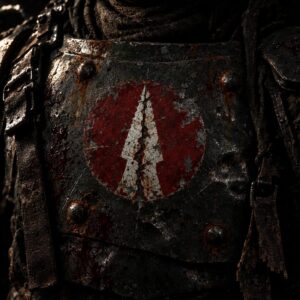
The standard of the Sturmlanze is not cloth but a banner of tanned horse leather from Armacron, dyed purple, on which a torn white lance is embroidered—both shot through with applied metal strips bearing the names of the riders who fell in the first four campaigns. The banner is carried on a staff made from a shock-lance haft—a symbol that the standard bearers can convert to the lance at any moment. It was almost lost in M40.7, when an enemy machine-gun position on Meridax scored a direct hit and tore the banner apart. A nameless soldier wrapped the remnants around his body and rode on until he died in the fire. Since then a patch cloth has been renewed every year to show the scar.
The Flaw
The flaw
In the year M41.1 the Sturmlanze was placed under Regimental Group Verdant, a mixed force of infantry, two tank battalions and its own Cataphracts under the command of Colonel Draveth Mor of the Meridax 44.. Mor was a man without passion—strictly law-abiding by the book. He and Kaine hated each other on sight. In the Morteus campaign (M41.3–M41.7) this showed: Kaine wanted to attack, Mor demanded securing. Kaine sent scouts ahead, Mor had them called back. In the third month there came an assault order that Mor wrote personally: the Sturmlanze was to break through a defensive line so that the infantry could follow. The order was militarily stupid—the terrain was too narrow for larger rider operations. Kaine refused. Mor had him brought before a court.
The court was swift. The Commissar of the Verdant Group confirmed that Kaine had refused the order. Kaine defended himself on the grounds that the order was unrealistic. The court said: unreality is not a subordinate's problem. Kaine was sentenced to one week in the field prison.
After that, Kaine obeyed. He sent the Sturmlanze against the wolves—without regard for tactics, without planning, only the order. The charge collapsed, the Orks closed ranks again. 240 men died. The order had been followed, but the objective had not been achieved. Kaine was acquitted because he had obeyed, even though it led to nothing. That is the flaw: the man knows that obedience is sometimes murder. He obeys anyway. The regiment sees this and despises him for it—and themselves for being obedient too.
Today, thirteen years later, the relationship with the Meridax 44 is not reconciled but cast hard. They are not sent into the same battle. When they must defend the same planet, separate locations are assigned. The reason is recorded nowhere in writing. The reason is: the Meridax have not forgotten Kaine, and the Sturmlanze will never forget that its colonel ordered deaths for the Meridax colonel. That is the scar tissue of the regimental group—not yet tearing, but irritable. A campaign in close cooperation would cause war between the regiments.
A Munitorum Failure
In M39.6 the Sturmlanze was allocated a munitions shipment: 80,000 lasgun power cells for the light rider Companies. The problem was a clerical error in the Departmento Munitorum catalogue. The cells had been manufactured for the Mark VII lasgun, while the Sturmlanze used the Mark IV predecessor model. The cells did not fit. They were stored regardless—in barracks poorly protected against damp on Meridax Prime, where the humid air oxidised the batteries. After four years, 47,000 cells were completely unusable. The Sturmlanze had to go into critical operations with less ammunition. In the Kaludis campaign (M40.9), this shortage meant that two platoons could not reload their rifles quickly enough. They were overrun. Nineteen men died—not from enemy fire, but from bayonets, because the ammunition was lacking.
The error was a reading transposition in a catalogue number: M4V instead of M7V. A single scribe. The scribe is long dead; his personnel file has been deleted. The Munitorum did not compensate the Sturmlanze. Instead it received new catalogue entries to prevent the mix-up. The paper was faster than the nineteen dead had been.
Known Campaigns
Campaigns
Name The Battle of Morteus (Segmentum Obscurus, against the Green Ork Bloom of the warlord Wummtrogg, 240 dead, strength loss 5 % at commencement)
Epoche c. 351.M41
Erzählung
The Sturmlanze was assembled together with four other rider regiments and ten infantry regiments into an uncoordinated defence against the largest Ork invasion of the Morteus Sector in three centuries. The leader, the Ork tyrant Wummtrogg, had scraped together a fleet of space hulks and built up a "Waaagh"—not the largest, but the fastest. The campaign was an attempt at coordination under the commanding General Sorath Venn, who, however, contradicted himself in his field dispatches and set two infantry regiments against each other before he noticed he had done so. The Sturmlanze was treated better tactically: Colonel Kaine quickly understood that only speed helped against Orks, and Venn let him have his way. For four months the Sturmlanze rode in shock sorties against Ork supply lines, severed reinforcements, lost 2 % of its men per week in doing so, and forced a withdrawal of the Waaagh after three months. The victory was fragile—Wummtrogg did not withdraw because he had lost, but because the sector was blockaded by the Nihilus and he received no further reinforcements. When the Imperial Navy finally gained orbital superiority, Wummtrogg was brought down—no mercy, only bombardment. The battle did not end with a battle, but with Ork corpses viewed from the air.
The Sturmlanze fought on for six more weeks against remnant Ork groups and lost a further 180 men in doing so. It returned home with 4,360 survivors, not 4,600.
Allied regiments: Meridax 44th Infantry (Commander: Colonel Draveth Mor), Calthex 12th Light Riders (later disbanded, M41.9), Salian 7th Armoured Troop (remaining, other sector). Fate of the relationships: The bond with the Meridax 44th breaks here—see Section 8.
Name The Siege of Kalvethe (Kaludis Sector, against Chaos cultists under the "Prophet" Kelvast, 280 dead, losses 7.2% of strength at deployment)
Epoche c. 925.M40
Erzählung
Kalvethe was a former forge moon with subterranean fortifications—a robbers' nest for Chaos cults that had worked unnoticed for two decades. The Imperial Navy bombarded the surface installations within two days. Kelvast's garrison—some four thousand cult-armed humans—withdrew into the underground tunnels. Here the Sturmlanze was lethally useless. Three cavalry squads were tasked with sealing escape routes. They rode into shafts in which they could not see. In two cases they were torn apart by Ork-poison mines; in the third they shot one another. The infantry had to recover all the dead.
The battle was defined by hand-to-hand fighting, in which cavalry has no place. The Sturmlanze waited above at the shafts, and the commander decided that no further riders would be sent. That was an unexpected failure in the chain of command—Colonel Venn should have written this beforehand. Instead the battle leader took the risk, and the Sturmlanze was spared.
The campaign ended, but not in victory. Not all the Chaos cultists were killed—a group of some three hundred escaped through a shaft that Imperial cartography had not recorded. They were later found again, three planets away, in the Aschen-Null Sector. The victory was incomplete. The Munitorum counted it as a victory nonetheless, because the surface fortification had fallen.
Allied Regiments: Kaludis 18th Infantry Assault Troop (Commander: Major Thess Caldor, seventy-eight years old, war veteran). Fate of Relations: Caldor respects Kaine for the decision not to sacrifice too many riders. They are later stationed in two different sectors. No mutual blame, only distance.
Name The Pursuit of the Ork Remnants (post-Morteus, against Wummtrogg's rearguard under various Nobs, 110 dead, losses 2.8% of strength at deployment)
Epoche c. 712.M41
Erzählung
After Wummtrogg's defeat, the Waaagh splintered into smaller raiding bands which, scattered across four planets, sought food and plunder. The Sturmlanze was split into two squadrons and deployed in pursuit. Colonel Kaine felt this not as a hunt but as herding—small Nobs against an organised rider superiority. The fighting was fast and brutal. An Ork group under a Nob named Gurk entrenched itself on the planet Morteus Minor and attempted to fortify a shipyard in order to begin a new Waaagh. The Sturmlanze encircled them, and Kaine did not negotiate—he attacked. The fighting dragged on for six weeks, because the Orks built bunkers. The Sturmlanze endured a siege, not its strength, and lost more men in doing so than expected.
When the shipyard finally fell, Gurk had already escaped. The victory was once again incomplete.
Allied regiments: Salian 7th Armoured Troop, Imperial Navy infantry raiding troop (Commander: Captain Sarin Volk). Fate of the relationships: Volk and Kaine later agree unofficially that the naval infantry will not fight alongside mounted formations again—their foot marches are too slow for cataphract pace. This arrangement is ignored by the Munitorum six times. Each time it ends in friction.
Vehicle livery
How the regiment’s vehicles are painted: base colour, camouflage for the theatre, turret band and markings, derived from the regimental colours.
| Theatre | Desert and steppe · Wave camouflage |
|---|---|
| Base colour | #650001 · Khorne Red (Uniform (Armacron Red)) |
| Camouflage | #B89A63 · Morghast Bone (theatre standard)#8A6A3F · XV-88 (theatre standard) |
| Turret band | #899092 · Ironbreaker (Helm & Armour (Steel Grey)) |
| Markings | #FFFFFF · White Scar (Lance Mark (White)) |
| Hull recipe | Khorne Red (Base) · Agrax Earthshade (Shade) · Wazdakka Red (Layer) · Evil Sunz Scarlet (Edge) |
Company bands on the turret
- 1.
- 2.
- 3.
- 4.
- 5.
- 6.
- 7.
- 8.
- 9.
Derived from the regimental colours; the silhouettes are our own sketches, not copies of any Games Workshop model.
To the Core Data
The ordinal 7 denotes a younger levy from a world that raises many regiments—since M38, Armacron has produced thirty-seven fighting formations, most of which were disbanded long ago. The Sturmlanze has been completely disbanded and re-formed eight times, always from home-world recruits and the survivors of scattered, separately stationed companies. Half of the present unit comes from veterans who knew no dead regimental comrades whom they honoured—they bear names such as "Sturmlanze" or "the Seventh" without ever having met the men whose blood clung to them. This state of affairs is intended: a regiment that forgets its dead cannot rise against the Emperor.