7th Argentum
“We rose from nothing, we rose from orphans, we rose as weapons of the Emperor — and we fall so that the weak may stand.”
Core Data
| Regiment type | Mechanised Infantry (Chimera-borne, fights dismounted) |
|---|---|
| Munitorum designation | VOLT-ARG-7.M41.823 |
| Homeworld | Argentum (hive world, thirteen million inhabitants, twenty decaying swarm hives) |
| Tithe grade | Decuma Prima – the baseline grade described in the compendium as "the customary tenth" |
| Establishment strength | 2,400 soldiers, 96 Chimeras, 48 NCO cadres |
| Current strength | 1,847 soldiers (of them 340 replacements from Argentum, arrived four months ago), 63 Chimeras, 31 NCO cadres |
| Allegiance | Loyal |
| Origin | Original regiment |
The pillars
The Rise from Nothing
A child of the Schola Progenium has no family and no name save a number. The regiment is made of hundreds of such numbers. The comfort is not love—the comfort is belonging. We are not loved, but we are something. And the Imperium needed this something. That is enough.
Loyalty Without Question
The Schola teaches that obedience and virtue are one. An order of the Emperor is holy, an order of the colonel is holy, an order of the commissar is holy. When three holy orders contradict one another, one follows the highest. When all three point the same way, even if that way burns innocents—that too is holy. The Voltigeurs no longer ask, once they have received the orders.
The Swiftness of Death
Chimeras are not fast enough. We dismount and run. Swiftness is loyalty: the faster we arrive, the less time for orders that confuse us. The Imperium needs soldiers who think while they shoot. The Schola taught us not to think, but to leap. We leapt into hell on Calthor Prime, and hell saw us coming.
The Guilt of the Survivors
Every regiment that survives survives on the grave of another. When the Voltigeurs are still standing after a battle, then others died in their stead—or they died, and the will of the Emperor sent replacements. We do not owe the Imperium our lives. We owe it our life-not-life: the years we have because the Schola let us begin with nothing but obedience. That is the price. That has always been the price.
Further core facts
| Fact | Value |
|---|---|
| Militarum Regimentum | Schola Progenium Twelfth Departure |
| Common Name | The Voltigeurs of Argentum |
| Origin of the Name | Tradition from the founding: Voltigeur is a Schola Progenium course in light infantry mobility; the designation became the regimental identity. |
| Regiment Type | Mechanised Infantry (Chimera transports) |
| Founding | M41.823 |
| Tithe Grade | Regular (one tenth) |
| Battle Cry | "Swift, loyal, and without mercy—the Voltigeurs keep what they swore." |
| Munitorum Designation | VOLT-ARG-7.M41.823 |
Raising, Homeworld & Culture
Raising & Tithe
The 7th Argentum was raised thirty-seven years ago as a regular tithe—one of ten of the hive world's quotas at the time. The planetary governor provided the best soldiers the Schola produced: orphaned children from the third to the seventeenth year of life, genetically screened, psychologically calibrated, trained to the limit of their resistance to wear. The Schola Progenium guarantees no past, no consultation, no mercy—guarantees only the training and the obedience.
The system created a flood of volunteers: thousands of orphans queued before the administrative buildings, hoping for admission, hoping for a name. The planetary governor could choose. Every refused admission meant one child fewer among his responsibilities. Every admission meant one child fewer who died without a name. This is not charity—it is administrative logic, and it works perfectly.
The result was a cadre elite: officers who came not from families but from barracks; non-commissioned officers who knew that obedience meant survival; common soldiers who had no one but the regiment. This made them better warriors than most, and worse men than was properly permitted—but the Imperium needed soldiers, not citizens.
What the Homeworld Lost
Argentum lost an entire trading class: the travellers and intermediaries. The hive world lived on smaller trade routes between three neighbouring systems. When the generations of the Voltigeurs went to the Astra Militarum, their illicit contacts went with them, their knowledge of languages, their memory of routes not recorded in the cartographies. The black markets of the hive withered. Two generations later an old skill was lost: the skill to negotiate rather than to command. Argentum's last legal trade mission to the neighbouring world failed because no one knew any longer how it was done.
The Homeworld
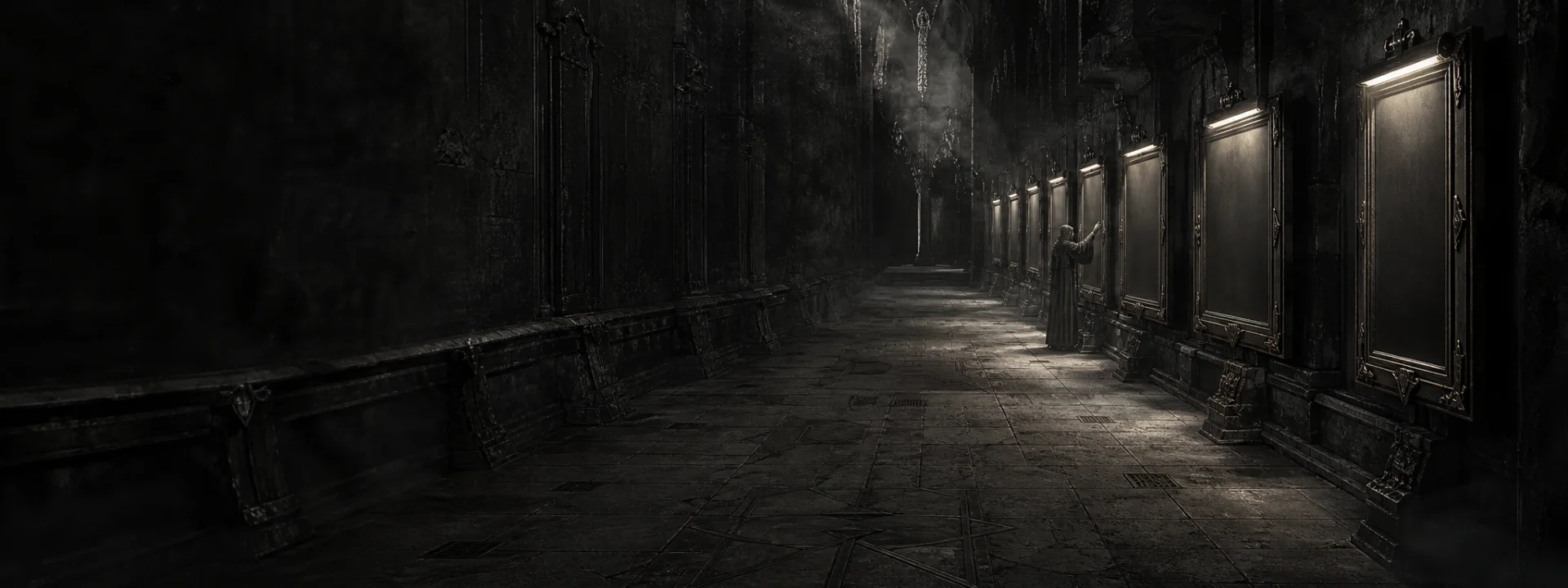
Argentum is a decaying hive world: thirteen million people in twenty half-dead hives that stand in the factory maws like teeth in a rotting jaw. The lowest three kilometres of every hive are darkness—literally, there, where the power has not flowed for millennia. The people live in the middle strata: grey, cold, stifling, riddled with shafts up which plague-air rises. The ground is not earth, but frozen metal sludge, the remains of millions of years of industry. The sky is not sky, but dust.
Argentum created a population that thinks fast, because it had to act fast—or suffocate. They are not brave in storybook fashion; they are panic-disciplined, which is the only courage the swarm teaches. They trust the Imperium, not out of love, but because unbelief means chaos and chaos means not breathing. An order is better than uncertainty. A commissar with a pistol is better than a lift without cables. The Schola Progenium found in Argentum a soil in which it could plant a perfect field culture: obedience that does not question, because questioning interrupted breathing.
The rooms in the hives are three metres high, full of people. No one has ever had a window. A place to stand is a room. A shot from a las-weapon is a quiet popping up at the hive roof—down here it is a thunderclap that strips the eardrums of everything. The weapon that is bold on an open plain is a death trap for its bearer here.
The Disadvantage They Carry
Hive world soldiers are head-to-foot fighters. They have learned to navigate in tight spaces, to pass between bodies, to leap from door to door—three metres, no more. On open ground they are blind. Line of sight means to them "the man beside me" or "the wall behind". The first open plain on which they fight destroys half the experience they acquired in the hive.
This happened first at Calthor Prime—a flatland agri-world with horizons as far as the eye could reach. The Voltigeurs climbed out of their Chimeras, saw the expanse, and their brains could not process the information. Three Companies ran blind into fire because they did not know how to see something on the horizon before it sees you. The commissar shot two platoon leaders for failure. The colonel ordered the withdrawal and regrouping under cover. Calthor Prime teaches us still today that openness is not an advantage—it is a place where old skills died.
Regimental Culture
The Voltigeurs march to no song that has a name. Instead there is a rhythm—a pounding that keeps time with the Chimera transmissions, a mechanical pulsing that goes into the bones. The older soldiers call it the drumming of the ascent. It is not permitted, but it is tolerated: because a regiment that has its own voice thinks less of others.
Faith is not open to discussion: the Emperor is, the Schola was, the commissar is, and the order is sacred. But there is one superstition the officers have given up fighting: no one touches a Chimera before the weapon has cooled. Even when the battle is over, even when it was three hours ago, one does not touch the vehicle before the weapon tells itself that it has cooled. A soldier who disregarded this, on Horthos Minor, lost two fingers to a plasma-fire backlash that should not have been able to reach him. Since then the rule has not been questioned.
The barracks smell of soldering irons and machine paste—a mixture of machine oil, flak-armour welding grease and something indefinable that comes from the exhaust when a hundred Chimeras oil their transmissions in a shipyard. The floor is not clean, because no one has time for cleaning. The soldiers sleep three to a two-man cot, the weapon between the bodies. The liquor ration is drunk before the bottle grows warm—and afterwards they turn to work, because fatigue means mistakes and mistakes mean that others pay for them.
The dead are buried when there is time—a quick ceremony with the Chimera's loudspeaker system, which plays a prerecorded litany. When there is no time, the names are engraved in a metal book that the Regimental Standard carries with it. No one expects ever to see this book again. It is not for the living—it is a debt that the regiment owes the Imperium.
The Commissariat
The commissars of the Voltigeurs are neither despised nor loved: they are necessary. After Calthor Prime, when panic took hold and men began to run, to fire without orders, Commissar Valen Tross overcame three soldiers with his flame pistol while they were still firing their weapons—the image of a man prepared to die for discipline was more striking than any speech. After that, the mutinies stopped. The commissars are knives, and the regiment knows that without knives it does not function.
Ranks & Organisation
Ranks
Rank Field Marshal
Description
Munitorum rank: Lord General · Form of address: Your Grace
Rank Colonel
Description
Munitorum rank: Colonel · Form of address: Colonel / Sir Colonel
Rank Commandant
Description
Munitorum rank: Major · Form of address: Commandant
Rank Captain
Description
Munitorum rank: Captain · Form of address: Captain
Rank Platoon Leader
Description
Munitorum rank: Lieutenant · Form of address: Platoon Leader
Rank Field Sergeant
Description
Munitorum rank: Sergeant · Form of address: Field Sergeant
Rank Guardsman
Description
Munitorum rank: Trooper · Form of address: Comrade / No form of address
Structure
The regiment as a whole nominally comprises twenty Companies of 120 soldiers each, organised into four battalions of five Companies each. Each Company has a Captain, a platoon leader as deputy and three platoons of 40 soldiers per platoon. Each platoon breaks down into four squads of ten men, under a sergeant.
At present only 1,847 soldiers remain in service instead of the intended 2,400. This led to the fourth battalion being disbanded nine months ago—its remaining 180 men were distributed among the first three battalions, which means that some Companies now have only 85 soldiers instead of 120. The commissar staff originally consisted of eighteen sub-commissars under a Lord Commissar; at present only thirteen remain in service.
The Chimera capacity amounts to 96 vehicles of twelve seats of fighting compartment each. With 63 vehicles remaining, some platoons are forced to follow on foot when the regiment moves—a tacit death sentence, though it is not named as such.
Constituent regiments
Name The First Battalion—the Founders
Role / notes
Its Commandant is Major Kellath Sorrow, a man with a long white scar that runs from his right eye to his lower jaw—a shot he took on Horthos Minor that left him blind on that side. Even so, he sees faster than men with two eyes. Status: at war strength, but overworked; the Founders are the oldest formation in the regiment, and it shows. Most recently they lost a third of their strength on Mordal IV against Chaos cultists and have not been replenished since—the field sergeants train the replacements during deployment, not before.
Name The Second Battalion—the Risers
Role / notes
Its Commandant is Major Venn Cors, a quiet child with a cold blue gaze and the habit of making long pauses before he speaks. His grandfather was also a soldier—not of the Voltigeurs, but of the Argentum 3rd, which was annihilated at Keltor IV. Major Cors wears the insignia of the destroyed regiment around his neck, and no one asks him why. Status: half restored after the merger with the remnants of the Argentum 9th four years ago—this fusion still does not work perfectly; the old Ninths follow orders faster than the new Seconds can keep up with in their thinking.
Name The Third Battalion—the Swift
Role / notes
Its Commandant is Major Tessia Vorn, a woman with short black hair and the eyes of someone who sleeps too little. She has been wounded thirteen times and declared fatally injured four times; each time she came back. Status: understrength, but above-average in effectiveness—because Vorn teaches her non-commissioned officers to interpret orders, not merely to carry them out. The Commissariat watches this battalion more closely than the others.
Command Staff
Command staff
Name Colonel Hallaren Metris
Beschreibung
Colonel Hallaren Metris, fifty-five years old, with greying hair and the lips of a man who has never missed an opportunity to press them together. He wears a plain field uniform without ornament save his rank insignia, and his only personal equipment is a paper notebook with a metal cover, in which he records every movement of the regiment in microscopically small handwriting—not out of admiration, but out of a compulsion for control.
Metris clings to plans long after they have stopped working. At Calthor Prime he ordered a flanking manoeuvre that sent an entire company of infantry across open ground, against all tactical perception. The plan was correct—for hive-world terrain. Here it was an order to die. Eighty-three soldiers went in that direction. Twenty-seven came back. Metris later explained it as "intended sacrificial attrition to confuse the enemy". The commissar did not ask further. The Voltigeurs did not ask further. But the survivors know that the order was wrong, and that the colonel did not know it was wrong—and that is worse than malicious intent. It is knowledge without understanding.
Zitat
"The plan will be carried out as drawn up. Improvisation is the beginning of chaos. Chaos is the beginning of ruin. Therefore there is no plan but this one."
Name Lord Commissar Valen Tross
Beschreibung
Lord Commissar Valen Tross, forty-seven years old, with a plastic prosthesis on his left hand—artificial, with servomotors that sometimes misfire and curl the hand into a fist he cannot open until a technician comes. He does not keep it hidden. The black Commissariat crest on his chest is threaded rather than sewn, which means he has repaired it himself, too many times.
Tross is no ideologue. He is craft. At Horthos Minor, when soldiers began to know that their orders were senseless, and uncertainty arose in the ranks, it was Tross who stepped onto the stage and with his bare prosthesis—not the weapon, not the uniform, only the hand that is work and god at once—showed something that struck deeper than words: Everything breaks, and we repair it anyway. After that the regiment understood again who Tross was.
Zitat
"You ask me whether I believe the order is just. I do not believe. I follow. That is not weakness—that is structure. A house without structure is corpse-plunder."
Name Field Priestess Mara Kallens
Beschreibung
Field Priestess Mara Kallens, thirty-nine years old, of the Ecclesiarchy of Argentum, with a dressing about her left side beneath which an old wound is healing. She was stabbed by a deranged cultist on Mordal IV as she tried to baptise a dying soldier. She survived; the cultist did not.
She does not preach to the soldiers. She prays with them, and that is a different thing. After every battle she sits beside the wounded and speaks the names that the Chimeras did not gather up—not as ritual, but as objection. The Emperor will hear these names, she says, not because the God-Emperor is small and has ears, but because guilt has gravity, and it always falls upwards.
Zitat
"The Imperium does not love you. But I write your names. That is the best I can do."
Attached Personnel
| Row | Total |
|---|---|
| Commissars under the Lord Commissar | 13 |
| Field priestesses and priests of the Ecclesiarchy | 7 |
| Sanctioned Psykers of the Scholastica Psykana | 2 |
| Field surgeons and medics | 19 |
| Adeptus Mechanicus technicians (assigned) | 4 |
The Munitorum breaks the regiments down into parts: soldiers for combat, commissars for obedience, priests for souls. But these parts must fit together, and they do not. The priests tell the regiment that the Emperor loves their souls. The commissars say that feelings undermine obedience. The technicians say that machines are older and more important than men. This creates friction in every conversation: the priests must compete with the ammunition for space in the Chimeras, and the commissars must explain to the priests that "morale bonus" does not count on the balance sheet.
The Regimental Standard
The standard is a two-metre-long cloth of flak armour material, grey and worn like everything else about this regiment. At the top the Aquila of the Imperium is threaded in silver—not embroidered, threaded, because sewing comes apart and threading holds. Beneath it, in black letters on a white ground, the roll of honour: not the names of the dead, but their numbers. 7th Argentum has nine hundred and eighty-seven dead since its founding. Their numbers are small, but they are all there.
On Mordal IV, during the retreat before the cultists, the standard was torn by a squad leader—not deliberately, but a plasma shot pierced the cloth, and one side fluttered away. The sergeants gathered up every piece of the cloth, each piece with a number on it. It took three days before the priests had bound them back together with twine. The pieces do not fit perfectly. The cuts can still be seen.
The Flaw
The flaw
In the year 889 M41 the regiment was holding a blockade on the moon Calthor Secundus—an outpost against Ork raiders, at half strength, poorly supplied, with no expectation of replacements. The Colonel at the time was a man named Terin Cross. He received an order from the Segmentum commander: the Orks were massing for a great invasion. The regiment was to hold to the last man and then drive into the outpost's reactor and destroy it—a sacrifice to weaken the Orks.
The regiment held for three weeks. Then the Colonel received a second order: a loyal mercenary regiment had made planetfall, reinforcements were here. Hold on. Bring in replacements.
The Colonel followed the first order, not the second. He drove into the reactor, made it explode, and killed ninety per cent of the regiment—and a hundred Orks along with them. It had been the correct order. It had also been the old order. The mercenary regiment arrived and found only ash.
The Commissar at the time wrote no report of insubordination—because the obedience was perfect. The Colonel was obedient to the first order. This is what burns within the regiment: the knowledge that absolute obedience to the older order is a massacre, yet the Imperium admits no difference between "obedience" and "obedience at the wrong moment". New soldiers are taught that one always follows the latest sequence of orders. But the old sergeants know that this does not work—in chaos, in vox-interference, in darkness—and that a soldier who takes both orders equally seriously will always choose the wrong one.
This shows itself every day: a platoon commander receives an order to cover the withdrawal. Then he receives a new order to advance. Both orders come from the Colonel. Which one counts? A soldier who thinks, chooses. A soldier who obeys the Schola Progenium chooses wrongly—because thinking during obedience is impossible, and obedience without thinking is the whole problem.
The other regiments say of the Voltigeurs: "They follow orders that contradict each other, and die because they do not know which one counts." That is unfair, but not wrong.
A Munitorum Failure
M41.907: The Munitorum sends a message to the regiment: "Ammunition allocation for bolter systems. 80,000 rounds, Mark VII variant. Arrival: 23 days."
The regiment carries lasguns. It has no bolters.
The ammunition came anyway. The commissar asked whether it should be refused. The colonel forbade it—an order is an order, a delivery is a delivery, and the Munitorum does not err, it will correct itself. The ammunition was shippable, it weighed tonnes, it took up space that field supply needed—water, medicine, spare parts for Chimeras.
The message of correction never came.
Four months later, on Horthos Minor, the regiment lacked sufficient water. Six soldiers died of dehydration before the commissar ordered the unusable bolter ammunition thrown out to balance the weight. This report is catalogued in the Munitorum archive under "Administered Losses". The colonel at the time has not been punished—he followed the orders he received.
Known Campaigns
Campaigns
Name Keltor IV: The First Annihilation
Epoche M41.895 to M41.896
Erzählung
Segmentum Pacificus, Ork raider invasion by the Badlands fleets, duration eleven months. The newly founded regiment encountered organised Ork raiders on open plains—precisely what the hive world soldiers had not been trained for. The commanders of the allied tank regiments (Meridian 4th and Horst Grenadiers) expected rapid infantry support. Instead they got confusion.
The regiment was encircled on the fourth day near the settlement of Keltor Hive. The Colonel attempted to order an enveloping manoeuvre—on open plains, against Ork tanks. The Commissariat held out until the eighth day before it accepted an order to withdraw. The regiment held on until the twelfth day: ninety per cent of the infantry fallen, four Chimeras burned out, two damaged. Sixty soldiers marched out of Keltor.
Result: Catastrophic. Losses: 2,280 of 2,400 men. The allied tank regiments (Meridian 4th, Horst Grenadiers) were later dispersed to other crises—neither exists as an organisation any longer. The Voltigeurs will never approach them again.
Name Mordal IV: The Chaos Cult
Epoche M41.926 to M41.927
Erzählung
Segmentum Pacificus, heretic uprising in mixed agri-hive terrain, duration nine months. Here the regiment was attached as a supporting combat force to an Inquisitorial retinue. The terrain was tangled—half hive world density, half open fields. Here the regiment found a kind of tactical middle ground.
The Inquisitor (a man whose name has been erased from the records) demanded that prisoners be taken. The Commissar asked whether this was an order or a recommendation. The Inquisitor did not answer, which meant that it was an order. The regiment took prisoners.
Six of the seven prisoners were sleeper cultists waiting for the moment to escape into the withdrawal. They did not get away—but they killed before they died. Eighteen soldiers died of bioweapon infections. The Inquisitor left the regiment and never returned.
Result: Tactical victory, strategic decline. Losses: 240 soldiers in combat, 18 to infection. The regiment was afterwards not filled with fresh units—instead it was merged with the remnants of the Argentum 9th (a destroyed sister regiment). The two units hated each other for two years, until the sergeants had mixed enough older soldiers from both sides that the new unit functioned. This merger has never fully recovered. The Second Battalion knows that it is two regiments wearing masks.
Name Calthor Prime: The Open Sky
Epoche M41.959 to ongoing
Erzählung
Segmentum Pacificus, Ork plunder invasions and independent heretic cells, duration four years (continually extended). The regiment was sent to an agri-world with horizons. The blindness of the hive world soldiers on open plains showed itself at once.
The Colonel ordered the familiar flanking tactic from hive training—a manoeuvre that was perfect in three metres of darkness, and suicide on open plains. Two Companies died. The Commissar shot two sergeants. The regiment withdrew and regrouped under Major Vorn (Third Battalion) and Major Sorrow (First Battalion), who, against orders, began to employ feints.
Four years later: the regiment is still here. It has not broken. It fights. But the lieutenant colonels have learned to filter their orders through their sergeants—not mutiny, but protective translation, an invisible reshaping of "envelopment" into "feint-back-strike" that follows the letter of the order but leaves out the path to death.
Result: Endurance. Losses: 240 soldiers at the Calthor debut, since stabilised at 30-40 per month. The regiment has never been replenished with new strength—instead replacements came from Argentum, 340 men four months ago, young children of the Schola who do not know that on open plains one must think to survive. They die faster than the old ones.
Vehicle livery
How the regiment’s vehicles are painted: base colour, camouflage for the theatre, turret band and markings, derived from the regimental colours.
| Theatre | Hive and city · Splinter camouflage |
|---|---|
| Base colour | #39484A · Mechanicus Standard Grey (Field equipment) |
| Camouflage | #697068 · Dawnstone (Regimental standard (cloth))#3E4346 · Mechanicus Standard Grey (theatre standard) |
| Turret band | #EDC169 · Retributor Armour (Honey-gold vehicle stripes) |
| Markings | #E6E0CF · Wraithbone (standard colour) |
| Hull recipe | Mechanicus Standard Grey (Base) · Nuln Oil (Shade) · Dawnstone (Layer) · Slaanesh Grey (Edge) |
Company bands on the turret
- 1.
- 2.
- 3.
- 4.
- 5.
- 6.
- 7.
- 8.
- 9.
Derived from the regimental colours; the silhouettes are our own sketches, not copies of any Games Workshop model.
On the Core Data
Seven is a young number for a hive world in the Segmentum Pacificus, which means that Argentum has raised many regiments over the last two millennia—within this hundred, the Voltigeur line is one among many. The order that the Schola Progenium imposes prevents old bonds from becoming entrenched.
The 7th Argentum has been completely disbanded six times and rebuilt six times with new personnel. The first time was in M41.895, when the regiment was hemmed in by Ork raiders at Keltor IV and only sixty men left the battle line. The dead were recorded on the memorials of the Segmentum Archive—not the names, only the number: "7th Argentum, Roll of the Fallen, Keltor IV, 895". Each time new recruits came from Argentum, they received a simple bronze badge stamped with this number. The present soldiers wear the badge of those they never knew, and know that their names will receive the same anonymity.
Campaigns
Campaign One—Keltor IV, M41.895 to M41.896: The First Annihilation
Campaign Two—Mordal IV, M41.926 to M41.927: The Chaos Cult