7. Haldiser Luftkorps
“Speak the name. Hold the sky. Break what stands. Obey unto the grave.”
Core Data
| Regiment type | Hunter-Killer (seeks out and kills named targets) |
|---|---|
| Munitorum designation | MUN-HS/LK-0007-T3/ERS-42 |
| Homeworld | Haldis Sancta |
| Tithe grade | Solutio Tertius |
| Establishment strength | 3.050 |
| Current strength | 1.140 |
| Allegiance | Loyal |
| Origin | Original regiment |
The pillars
The Name
A foe without a name is a multitude; a foe with a name is a debt. The 7th does not hunt armies. It hunts an Autarch, a Farseer, one particular pilot whose machine struck one particular church tower. Each Company keeps a roll of names, which the Preacher reads aloud each morning. A target is struck from the roll only once a soldier has seen the corpse. No report suffices, no rumour, no fireball on the horizon.
The Sky
The Air Corps has never possessed aircraft of its own; the Valkyries come from the Navy and fly away again. The 7th "holds" the sky from below, with flak autocannons and forward observers. The Haldisians believe that prayers rise upwards and that a sky must therefore remain clear. Whoever brings down an Aeldari fighter may fix a feather to their helmet.
The Breach
Breaking is more honest than besieging. The 7th's engineer squads open walls, bunkers and rock passages so that the target cannot escape. On Haldis, demolition is learned by tearing down derelict chapels, so every charge counts at the same time as an act of consecration. Before detonation, demolition masters draw an Aquila sign in the dust. The Korvanians in the regiment laugh at this, but they too wait until the sign is finished.
The Obedience
This is the pillar no one likes to speak of. A Haldisian holds an order sacred even when it is wrong, for the guilt lies with the one who commands and the purity with the one who obeys. Thus the 7th washes its conscience clean. At the dam of Serak, 4,300 people drowned on command. The regiment has prayed for them ever since, and yet it holds fast to the belief that it acted rightly.
Further core facts
| Fact | Value |
|---|---|
| Call sign | The Heralds |
| Origin of the name | Earned in the Velloc Prime campaign: there, the companies called out each named target's name over open vox before they struck. |
| Founding | 744.M39; most recently re-raised 001.M42 as an emergency levy |
Raising, Homeworld & Culture
Raising & Tithe
Haldis Sancta otherwise pays its tithe in pilgrims, candle wax and reliquary shrines. When the Great Rift tore open and the garrisons in the sub-sector collapsed within months, the Munitorum demanded an emergency levy of three thousand men in 001.M42. The world was not prepared for it. Those levied were the hereditary guards of the shrines, families whose sons and daughters have protected processions for generations. They can march, pray and carry torches. Fighting they had barely learned, for basic training lasted nine weeks instead of the prescribed eighteen.
Because the service is hereditary, the levy did not strike individuals. It struck houses. Entire lineages marched out and left grandmothers and children behind. Hence the anger: they were not robbed of a son, they were robbed of their name.
Planetary Governor Ermelind Saarvos knew what a failed muster means. She gave the best hereditary guards and her own bodyguard, and had the equipment paid for from the cathedral treasuries. She did not do so out of duty. Her predecessor had been executed in 812.M41 for missing greatcoats.
What the Homeworld Lost
The Great Procession of Saint Imre requires 48 bell-bearers, who carry the bronze bells on poles twelve kilometres from the harbour to the basilica. Since 002.M42 there have been only eleven. The bells now stand on carts, and the pilgrims pay less, because a miracle on wheels is a miracle no longer. The stonemasons' guild of the lower city has lost its masters, so the façades crumble and no one repairs them any more. The old watch dialect of the shrine keepers is dying out as well, a Low Gothic laced with liturgical fragments. It is spoken now only in a regiment that will never return home.
The Homeworld
Haldis Sancta is a cool, damp shrine world with long twilights. Limestone cliffs there bear monasteries, chapels and ossuaries, layer upon layer, and some valleys are built over entirely. Here Saint Imre the Gatekeeper is said to have stood against a flood out of the warp until his bell shattered. Millions of pilgrims come each year.
Society is ordered by hereditary office. The Houses of the Watch guard the pilgrim roads, the Houses of Stone build and tear down, the Houses of Light keep candles and beacons. Everything has its hour, and three times a day the bells ring.
The Haldisians bring more to war than one might think. Pilgrim guards recognise single faces in a crowd of tens of thousands and learn early to search for a particular pickpocket, heretic or murderer. From this grows the regiment's hunting instinct. The Houses of Stone understand walls and know where they break. From the towers, beacon keepers watch the weather and the sky, and reporting across great distances is in their blood.
The Disadvantage They Carry
The Haldisers keep the hours. At dawn they kneel, light a candle and speak the Imre prayer, in the trench, on the march and under fire. A Haldiser who misses the hour believes himself damned. It is not defiance; he simply cannot do otherwise.
On Velloc Prime the Ynnari knew the hour after three days. On the fourth morning they came, while 140 candles burned in the positions of the 3rd Company. 37 men died kneeling before a shot was fired. Afterwards Commissar Dask shot a man who would not break off his prayer. Since then the regiment prays in shifts and beneath tarpaulins, and every candle is shielded by hand. The hour could never be abolished entirely. The Korvaners call it "the target light".
Regimental Culture
The drill is strict and liturgical. Counting is done not in numbers but in bell strokes. Punishments consist of watch duty and fasting, rarely of beatings. On the march they sing the "Song of the Gatekeeper", an endless chain of verses about how Saint Imre called back one name after another from the flood. Every squad composes its own verses, mostly with the names of the dead.
The officers have given up forbidding the feathers. Whoever shoots down an aircraft fixes one to their helmet, and whoever wears three is held to be invulnerable. Several three-feather bearers have fallen since, without this shaking the belief.
On the transport decks there is a smell of candle tallow, wet cloth and the camphor used to tend the chameleoline cloaks. In the mornings a thousand voices hum the Imre prayer; at night the dysentery-stricken groan.
The Haldisians do not drink their spirit ration. They pour it into candle wax and use it to burn names into wooden tablets. The Korvanians buy the rations from them with tobacco, and that is the most important trade in the regiment.
When time allows, the dead are buried facing the nearest church. When it does not, the squad cuts the name strip from the dead man's collar and sews it onto the platoon's standard.
The Commissariat
The 7th has made peace with its commissars, if not a warm one. The Haldisians consider the Commissariat a religious order, and that makes it easier. Whoever is shot is held to have been punished, not murdered. It is harder with the Korvanians. On the night after the amalgamation, Commissar Tibor Lense was found in a cargo hold with his skull staved in. Officially he died in an accident. Dask never investigated, and since then the Korvanians owe her something. Both sides know it.
Ranks & Organisation
Ranks
Rank Warden
Description
Munitorum rank: Trooper · Form of address: "Warden"
Rank Bell-Ringer
Description
Munitorum rank: Non-commissioned officer · Form of address: "Bell-Ringer"
Rank Cantor
Description
Munitorum rank: Lieutenant · Form of address: "Cantor"
Rank Shield-Warden
Description
Munitorum rank: Captain · Form of address: "Sir Shield-Warden"
Rank Banner-Warden
Description
Munitorum rank: Major · Form of address: "Sir Banner-Warden"
Rank Grand Herald
Description
Munitorum rank: Colonel · Form of address: "Your Grace"
Structure
According to establishment strength, the 7th consists of ten hunter companies of 305 men each. Each is led by a Shield-Warden with a command squad of five men and is divided into four platoons of 75 men each. A platoon consists of a Cantor and command squad (5), four hunter squads of ten, one engineer squad with demolition charges (10) and two flak squads with carriage-mounted autocannons (20). In addition, each platoon has two forward observers, who belong to the command squad.
Today the regiment numbers 1,140 men in four companies. Three of them have 290 men; the fourth, purely Korvanian, has 270. The platoons have been reduced to three, and two flak squads no longer have an autocannon. They carry missile launchers that come from Velloc and were never entered in the books.
Constituent regiments
Name 7. Haldiser Luftkorps, "the Heralds"
Role / notes
Hunter regiment under Grand Herald Anselm Varre, whose beard is burned white on one side. It currently holds the glass-dune front of Serak and has dwindled to 1,140 men.
Name 4. Haldiser Pilgerwacht, "the Lanterns"
Role / notes
A garrison regiment under Colonel Hedda Morwan, who is missing her left thumb. Since 961.M41 it has guarded a pilgrim corridor in the Segmentum Obscurus. Since the Rift it has been missing and is carried in the Munitorum records as "until further notice".
Name 12. Haldiser Luftkorps, "the Second Bell"
Role / notes
A flak regiment under Colonel Kasimir Thall, who wears a glass prosthesis painted with the image of a saint in place of an eye. It was destroyed in 997.M41 and raised anew in 004.M42. Along with the number, the new levy inherited an unsettled debt of 2,100 men's rations, which the Munitorum deducts from their pay.
Command Staff
Command staff
Name Grand Herald Colonel Anselm Teodric Varre
Beschreibung
He is 61 years old, gaunt and always wrapped in a prayer mantle of oilcloth. Since Velloc, the right side of his beard has been burnt white. He carries the Imre Bell of his house, no bigger than a fist, its clapper bound fast with wire. At Gharos he had set the Autarch Ishvael on the Name Roll and resolved to drive her through the Kerrin Pass. After three weeks it was clear that she was not in the pass. Varre held to his plan for nine weeks regardless. 600 men fell in ambushes while the flank lay open.
Zitat
"A plan is a vow. Whoever breaks a vow because it grows hard never took it."
Name Commissar Wilma Dask
Beschreibung
She is stocky, with close-cropped grey hair, a scar from chin to ear and a Schola Progenium accent that no longer betrays any dialect. Her object is a laspistol with seven notches in the grip, one for each execution in the 7th, and she carved them herself. At Velloc she shot the kneeling Warden Lorens Ebbe. That evening she wrote to his mother herself and signed with her full name. Varre learns from her everything he does not want to hear, for she is the only one who contradicts him.
Zitat
"You think I am your executioner. I am the last thing standing between you and your colonel."
Name Preacher Odo Kessling
Beschreibung
He is old and stooped, soot has stained his hands dark, and a pair of red-rimmed spectacles sits on his nose. He carries the regiment's Name Roll, an oilcloth book in which every hunting target is written and every dead man beside it. It was he who, at Velloc, conceived the idea of calling out the names of the targets over the vox, and he does not regret it. In Serak he blessed the demolition charges at the dam, and wept as he did so.
Zitat
"God calls each by name. We only do what he does—a little sooner."
Attached Personnel
| Personnel | Number |
|---|---|
| Commissars (incl. Commissar Dask) | 7 |
| Preachers of the Ecclesiarchy | 24 |
| Servants of the Ecclesiarchy | 31 |
| Enginseers | 2 |
| Sanctioned Psykers | 3 |
| Primaris Psyker | 1 |
| Ogryn (one squad) | 10 |
| Ratlings (snipers) | 14 |
Friction arises around the Psykers. Haldisers do not pray beside them. The Ratlings, who take the targets into their sights, are denied the honour of the name-call. The Enginseers, for their part, quarrel with the Preachers over whom the autocannons belong to.
The Regimental Standard
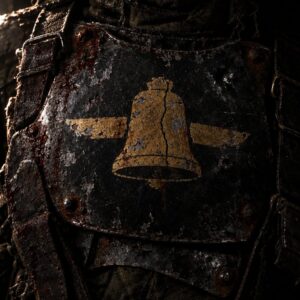
The standard is a heavy banner of black wool on a bell pole. At its top hangs a real bronze bell with a crack that recalls Saint Imre. Embroidered upon it are a bell with two wings and hundreds of name strips of fallen Wardens, drawn from all five raisings and set as close as scales. As honours it bears "Velloc Prime", "Gharos" and the old inscriptions "Durn Kalast" and "Ophel Bridge". At Gharos it lay for two days in a rock fissure. The Ynnari had killed the bearer and left it lying, out of contempt or as bait. Four Haldisers climbed down to retrieve it, and three came back.
The Flaw
The flaw
On Velloc Prime, on the 61st day, a Ynnari warrior stepped with lowered blade before the position of the 2nd Company and called the name of its Shieldward. Shieldward Ruben Halm forbade fire. He went out alone to accept the duel, for on Haldis one answers when named. Halm fell after twenty heartbeats. Then the rest of the Ynnari fell upon the hesitating company. Precentor Ilse Narbeck wrote the report. In it stands: "We could have shot him. No one wanted to."
Since then the Duty of the Name-Call has held in the 7th. A named target is called out, and no Haldiser shoots in the back an enemy who has called. On ordinary days this shows in small things. Prisoners are addressed courteously and duels are fought over wax rations. When quartered beside other regiments, the Haldisers insist that every quarrel be settled "properly", with seconds. In battle, the call costs them surprise.
The regiment tells itself that honour separates it from the traitors. Other regiments tell themselves that the Heralds can be heard ten kilometres away, and that the Aeldari hear them too. Dask has written three memoranda on the matter, and none has been answered.
A Munitorum Failure
For Serak, the 7th requisitioned chameleoline cloaks in desert pattern. The Munitorum's theatre code read "S-3K" instead of "S-8K", and the regiment received 1,400 cloaks in jungle pattern for the Kessavet sector, forty light years away. On the pale glass sand the Haldisers glowed like moss on chalk. In the first eleven days the Ynnari snipers killed 63 men before the cloaks were smeared with sand and adhesive resin. The desert cloaks arrived seven months after the end of the campaign. Today they are stored in the cargo hold, and no one may issue them, because the campaign is recorded as concluded.
Vehicle livery
How the regiment’s vehicles are painted: base colour, camouflage for the theatre, turret band and markings, derived from the regimental colours.
| Theatre | Mixed terrain · Blotch camouflage |
|---|---|
| Base colour | #A39866 · Zandri Dust (Uniform bone white) |
| Camouflage | #5E5A4E · Steel Legion Drab (theatre standard)#3B3A33 · Dryad Bark (theatre standard) |
| Turret band | #650001 · Khorne Red (Bell-Band crimson) |
| Markings | #000000 · Abaddon Black (Standard black) |
| Hull recipe | Zandri Dust (Base) · Agrax Earthshade (Shade) · Screaming Skull (Layer) · Pallid Wych Flesh (Edge) |
Company bands on the turret
- 1.
- 2.
- 3.
- 4.
- 5.
- 6.
- 7.
- 8.
- 9.
Derived from the regimental colours; the silhouettes are our own sketches, not copies of any Games Workshop model.
Notes on the core facts
The low number betrays an old regiment. Haldis Sancta rarely raises troops, and the "Seventh" has been levied anew so often that the number is long older than any man who bears it.
The 7th has been completely destroyed four times since 744.M39. The present, fifth raising knows its predecessors only as names on the standard. The soldiers speak of the dead as "the Elders", as though they were kin. For many this is true, for the service is inherited: whoever bears the number today often bears it for a grandfather who fell under it.
Campaigns
| Campaign | Era | Theatre | Enemy | Duration |
|---|---|---|---|---|
| Velloc Prime Campaign | 003.M42 | Velloc Prime, shrine world in the Rift Shadow | Ynnari | 7 months |
| Pocket of Gharos | 010–011.M42 | Gharos, mountain world | Ynnari | 14 months |
| Glass Dunes of Serak | 017.M42 | Serak, desert world | Ynnari | 4 months |
Velloc Prime Campaign
A Ynnari warhost under the Autarch Ishvael plundered the crypt chapels of Velloc. No one knew what the Aeldari were looking for. The 7th was to bring them to battle, together with the 19th Tarsenwaller Armoured Regiment and the 230th Mordriner Artillery. The Haldisers pushed into the crypt cities in Valkyries. Kessling had the names of the Ynnari leaders called out over open vox, and the callsign "the Heralds" was born. The Ynnari seemed to like it, for they answered every time. Three targets were struck off; Ishvael escaped through the Web of a Thousand Gates. In the end the Tarsenwallers withdrew their tanks while the Haldisers were pinned down in the Orrin monastery. Their colonel said he would not squander tanks on a matter of honour. 400 Haldisers died there.
Result: Partial success. The world was held; the primary target escaped.
Losses: 1,210 of 3,050.
Afterwards: The battlegroup was disbanded. The Haldisers bear a grudge against the 19th Tarsenwaller to this day. At every morning hour it is named in the curse verse of the song.
Pocket of Gharos
Ishvael resurfaced on Gharos. Varre hunted her together with the 6th Ostgrader Storm Trooper Regiment and the 22nd Korvaner Light Infantry Regiment, miners from Korvane. His nine weeks at the Kerrin Pass cost 600 men, and the Korvaners lost even more because they covered the open flank. The Ostgrader carried the counter-attack that finally broke the pocket open. Ishvael did not fall. A nameless Ynnari hunter was shot, and the regiment struck him off as "Ishvael's Shadow", which Kessling never quite got over.
Result: Stalemate, followed by the Ynnari withdrawing of their own accord.
Losses: 1,120 of 1,840.
Afterwards: The 720 surviving Haldisers and 690 Korvaners were merged into 1,410 men. The Ostgrader was transferred to another sector. The Haldisers owe it their lives, and none of them will ever be able to repay it. The Korvaners consider the Haldisers praying fools; the Haldisers consider the Korvaners grave-robbers, because they search the dead. Even so, they share tobacco and wax.
Glass Dunes of Serak
On Serak the 7th pursued a Ynnari Farseer. Together with the 81st Vasker Pioneers it was ordered to blow the Serak-Unter dam and flood the Aeldari's escape route. Below it lay the town of Kell with 4,300 inhabitants, and no evacuation was planned. Varre obeyed; the demolition masters drew their Aquilas in the dust. The Farseer escaped regardless, while Kell drowned. The Vaskers refused to lay the detonators, and their colonel was relieved of command. The Haldisers laid them for him.
Result: Order carried out, target missed.
Losses: 270 of 1,410.
Afterwards: The Vaskers were transferred within the same year. They despise the 7th, and the 7th knows they are right.
A Scene
The sand was so hot that Mirek Dorn could feel it through his knees. For three hours he had lain beside the Bellringer, waiting for someone to fire.
"There," whispered Bellringer Benedikt Asch. "By the glass needle."
Mirek saw nothing. He was a Korvaner, only three months in the 7th, pushed from the ore pit straight into his world's emergency levy and from there, after Gharos, to here. He knew the smell of wet rock. This desert was like a lamp you stared into.
Then he did see something, a movement, slender and bone-coloured, an Aeldari in a cloak that looked almost like their own uniforms. He stood two hundred metres away on a dune, looking across at the dam.
"Is that him?" Mirek asked.
Asch drew the name-roll from his breast pocket, a tattered oilcloth book, and ran his finger along a line. "Yes. The second on the list." He snapped it shut. "Precentor, we have him."
The vox crackled. Mirek shouldered his lasgun, his heart beating in his throat. The Aeldari had turned his side towards them, a clean shot such as there had never been on Gharos.
The Precentor called him over open vox, in that high Haldiser voice that sounded as though it were singing in a cathedral. He pronounced the alien name slowly, syllable by syllable, the way one calls the roll of the dead.
The Aeldari turned and looked straight at them.
"What are you doing?" Mirek hissed. "What are you doing?"
"We are naming him." Asch did not even look up. "Now he knows he is the one meant."
"Now he knows where we are!"
The Aeldari raised his hand, not to his weapon, but in greeting. Mirek understood that he was bowing.
Beside him, Asch stood up. He simply stood up, upright on the crest of the dune, the crimson band on his helmet glaring in the light, and inclined his head.
Then the Aeldari fired. The first shot struck Asch beneath the chin; the second tore up the sand beside Mirek's ear. Mirek fired back, blindly, screamed and kept firing until the magazine was empty. When he looked again, the dune was empty.
Asch lay on his back. He was still alive and moving his lips. Mirek bent down to him to hear a prayer, a word for his mother, anything.
"Don't strike him off," Asch whispered. "He hasn't fallen. Don't strike him off."
Mirek held the book until the Bellringer was dead. Then he cut the name-strip from his collar with his combat knife, as he had seen the others do. His hands shook so badly that he had to try twice.
Down at the dam, the pioneers began drawing Aquilas in the dust.