4th Aurelius Voltigeurs
“Tanks hold, the commissar shoots, the world burns, we pay.”
Core Data
| Regiment type | Super Heavy Armoured (Baneblade class: four tanks, some 200 support personnel) |
|---|---|
| Munitorum designation | AUR-VOLT-004-SHC |
| Homeworld | Aurelius Prime (war world) |
| Tithe grade | Exactis Tertius |
| Establishment strength | 4 Baneblades, 8 Leman Russ battle tanks (support), 340 escort personnel, 18 commissars |
| Current strength | 4 Baneblades, 6 remaining Leman Russ (one permanently out of action), 187 escort personnel, 4 commissars |
| Allegiance | Loyal |
| Origin | Original regiment |
The pillars
The tank is everything
The four Baneblades are not weapons—they are the soul of the regiment. A soldier speaks of the tank in which he serves as others speak of children: with fear, with pride, with cruel trust. The 4th Aurelius owns the names Dammtor, Vorhalt, Auenfluss and Das Letzte Wort. They have absorbed a thousand hits that would have killed men. They have dealt a thousand hits that have killed men. A tank is repaired until only the gun remains of the original. A tank is always repaired.
The commissar is necessity
The regiment has fifteen executions in the archives—soldiers who defected while covering a flank, who hid, who talked too much. The Senior Commissar, Tertius Kale, shot nine of them himself. The regiment knows his name as one knows a pain. That is right. A regiment without fear is a regiment that dies.
We inherit debts
The 4th Aurelius fights under the names and colours of the Aurelius 19th, and no soldier there forgets it. Seven men of the original 4th from 813.M40 are still alive, all at the age where memory and body break. They say nothing. They show newcomers on the parade ground the names on the banner staves: That was Sergeant Horseth. That was Corporal Callan. That was Trooper Merrick. They served. So do you. You will go.
Pain is obedience
The Colonel orders the second platoon of the first Company to hold against the Ork horde—unarmed, shields only, while the tanks reload. Ninety-six soldiers go. Nine come back. That is the law. That is the sector doctrine. That is loyal. No one asks a question, and whoever did would be shot by the commissar.
Further core facts
| Fact | Value |
|---|---|
| Militarum Regimentum | Voltigeur Core, Aurelius Sector |
| Common name | The Barracks Guard |
| Origin of the name | Tradition inherited from the original troops of the Aurelius Security Cohort (M37), expanded after the Battle of Astra Profunda with an honorific name combination |
| Regiment type | Super-heavy tank company (Baneblade core) |
| Raising | M40.782 |
| Tithe class | Elevated (active war zone, sector under pressure) |
| Battle cry | "Aurelius holds. Aurelius pays. Aurelius remains." |
| Munitorum designation | AUR-VOLT-004-SHC |
Raising, Homeworld & Culture
Raising & Tithe
The 4th Aurelius was raised regularly, not out of need: one tenth of the security cohort, gathered from voluntary enlistments. Aurelius Prime is a world of war, on which birth begins in the trenches; to die voluntarily for the Imperium is no rarity but an occupation. The planetary governor, Helios Venn, sent not the best but those he needed least—older soldiers, men with families, non-commissioned officers who had asked too many questions. The Imperium got a Guard, and Aurelius Prime kept its strength. That it was undersupplied, that the uniform came in two sizes (too big, too small, never right), that no replacement of the wounded came—that was the Munitorum. That it fought anyway: Aurelius Prime teaches that suffering is no excuse.
What the Homeworld Lost
The 4th Aurelius carried thirty men of the Circle of Forge-Brothers: old craftsmen who for three hundred and eighty years hammered the armour plates, turned the pistons, cleaned the grates of war machines. The Circle required exactly this number. With nine Forge-Brothers dead (three before Kormathe, four before Calth, two lost in the merger with the 19th), competence sank below the threshold where craft was still craft. Today there are replacements from the mechanical college—faster, but raw. The old arts, such as turning a gun bearing so that the recoil does not wear down the chassis, are now spread across four living people. When they die, a generation of knowledge dies with them, and Aurelius Prime will build tanks that break down faster.
The Homeworld
Aurelius Prime is a war world under a grey sun—a planet on which the Mechanicus a thousand years ago installed a protective mechanism that was meant to guard against the attack of an unknown enemy and that still runs today. The result is constant cloud cover, ground damp, and a military that for nine generations has no longer known what peace looks like. The settlements are fortresses. The roads are lines of defence. Children are born in trenches and play war, because it is the only game there is. The ground is grey. The water is grey. The sky is grey. The people are hard as metal and tough as ropes. They understand quickly that weakness kills others. They learn early that orders are orders, and that doubt is a luxury the war world does not have.
The Disadvantage They Carry
Aurelius Prime has no sky. The people there have never seen an open horizon—always cloud, always haze, always the pressure of the air, as if the world were choking itself. That changes on planets with starlight. Soldiers of the 4th Aurelius turn pale under open sky. They become uncertain. They look upwards too much instead of forwards, as if the light were a burden. This has killed soldiers: in the Thrace campaign, against the heretic positions in the hills of Gorthyx, an entire Company under open stars slipped into a state of shock. It carried out the assault, but its eyes were not focused. They did not see the flame pits until they fell into them. Seven burned. The commissar shot the Lieutenant because he could not declare the sky the enemy, only a failure. The regiment learned: the 4th Aurelius needs smoke above it and stone beneath it. Everything else is death.
Regimental Culture
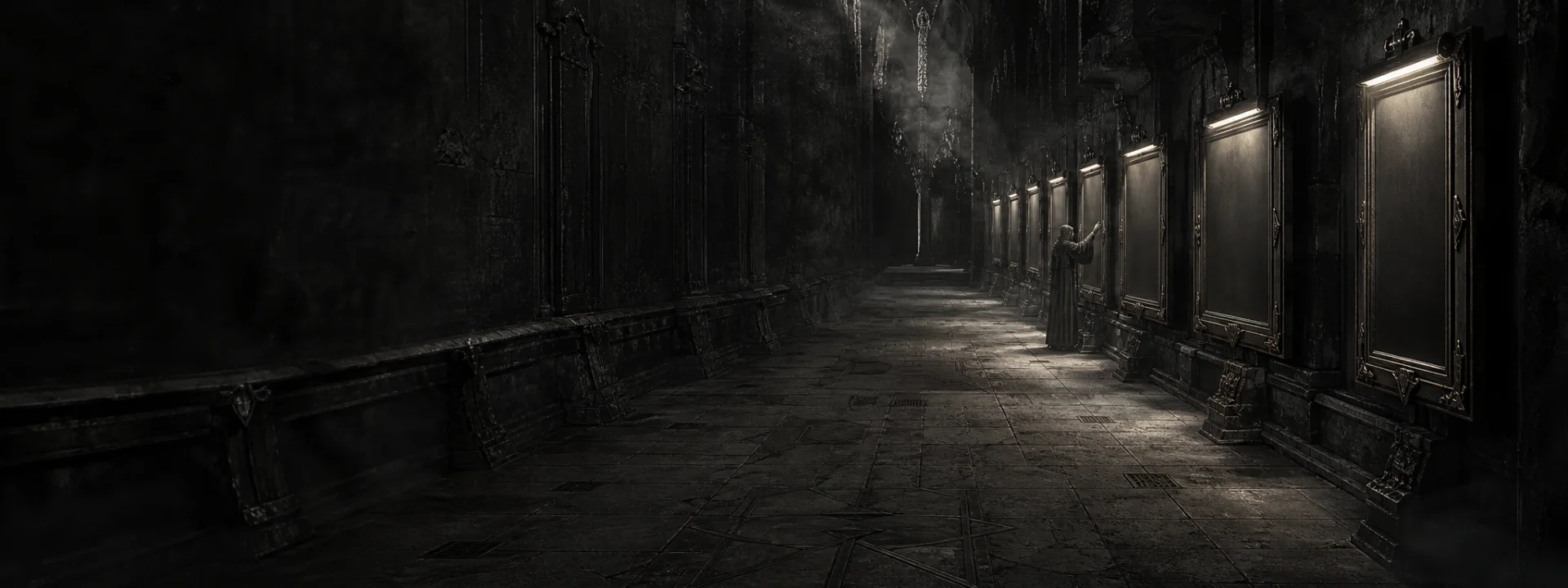
The 4th Aurelius lives in the bunkers of the barracks of Astra Profunda, five levels beneath the tank workshops. Drill runs from 04:00 to 06:00 standard time, then maintenance until 12:00, then the meal (algae soup, black bread, sometimes meat). The men and women do not sing—the culture of the war world forbids song as a form of pride. Instead, a murmuring during maintenance: Keep the shafts clean / keep the valves cool / keep the soul to the tank. That is not a song. That is a litany, like breathing. The men drink their liquor ration in three minutes, because drunkenness is a security risk. No one shows drunkenness. No one shows joy. The dead are thrown into the ash shaft—no grave, because there is no room, no rite, because there is no time. When the enemy comes, the dead stay where they fall.
The Commissariat
The regiment fears the commissars as one fears winter. Senior Commissar Tertius Kale was once a soldier and moved to the Commissariat like a man who knows the way. He executes not out of hatred but out of duty, and that is worse—there is no hope of humanity. The regiment has a fragile peace with him: they do what he says, because life depends on it. He does his duty, because the law depends on it. It is not understanding. It is coexistence.
Ranks & Organisation
Ranks
Rank Armour-Lord
Description
Munitorum rank: Colonel · Form of address: Lord Armour-Lord
Rank Platoon-Leader-Colonel
Description
Munitorum rank: Major · Form of address: Colonel
Rank Company Steelman
Description
Munitorum rank: Captain · Form of address: Steel
Rank Platoon Steelman
Description
Munitorum rank: Lieutenant · Form of address: Platoon-Lord
Rank Corporal / Steelmaster
Description
Munitorum rank: Sergeant · Form of address: Master
Rank Shaft-Leader
Description
Munitorum rank: Corporal · Form of address: Leader
Structure
The 4th Aurelius is not a regiment in the sense of the Munitorum—it is a super-heavy tank Company with an infantry appendage. The core is four Baneblades, named after dead commanders. Each Baneblade has a crew of ten (tank commander, driver, two gunners, two loading technicians, two repair mechanics, one communicator). That makes forty tank soldiers. In addition there are six Leman Russ battle tanks (eight men per tank = forty-eight men) in three squadrons. That makes eighty-eight. The remaining strength is ninety-nine escort infantrymen, divided into three weak Companies of thirty-three men each, plus eighteen commissar troops and two Ogryns for loads and entrenching. After the merger with the Aurelius 19th, one Baneblade is missing (total loss at Thrace), two Leman Russ (loss and breakdown), and the infantry stands at one hundred and seventy-eight, because replacements did not come and will not come.
Constituent regiments
Name The 4th Aurelius—Dammtor Core
Role / notes
Baneblade super-heavy tank company under Commander Korvin Steadhas (greying scar above the left eye, a smoker without cause). Current status: fully operational. The Dammtor was the command platform in five campaigns and is no longer a tank—it is a mobile grave with living occupants. Steadhas has been the driver of the Dammtor since 803.M40 and says he will die in the Dammtor, and that is a fact, not a promise.
Name The Aurelius 19th—Auenfluss Core
Role / notes
Leman Russ escadrille under Colonel (locally: Platoon-Leader-Colonel) Galen Mires (bony, too old, too long), taken over after the amalgamation in 901.M40. The Auenfluss was the flagship of the 19th and is now part of the 4th, and the old 19th no longer exists under its name. The men and women under Mires know that they are placeholders, and that makes them excellent soldiers—they have nothing to lose that they have not already lost. Strong grudge against the Munitorum, because a supply order never came. Status: operational with frayed nerves.
Name The 4th Aurelius Preparation Cohort—Letzte-Wort Core
Role / notes
Heavy infantry and entrenching column under Captain Devin Corinth (young, too young, too harshly shaped). The Letzte-Wort is the last Baneblade of the original four and the only one that is truly maintained—a sign of abundance that no one can explain. Under Corinth it serves as a supply gland for the mobile workshop. Status: operational, but the crew sleeps beneath ten metres of armour steel, because above ground is not safe.
Command Staff
Command staff
Name Colonel Vorvin Cassius
Beschreibung
Colonel Vorvin Cassius (sixty years old, jaw like granite, scar from Komathe across the right temple) wears a torn greatcoat of felt cloth—not regulation, not authorised, tolerated through disregard. He was a tank commander under the original issues of the 4th and was promoted to Colonel after Komathe, because his predecessor died in a tank fire. Cassius sits in the deep bunker of Astra Profunda, in a room without windows, and sees the casualty statistics every day. He could order troops to charge without cover—that is his role. Instead, in 823.M40, he once ordered that an assault would not take place, because the weather signs and the morale were not right. The Munitorum answered with censure in his dossier and with the threat of forced transfer. He remained in his post, because the next promotion never came. That is the law: caution is disloyalty, and colonels who spare their men are inconvenient. "I pay so that others do not have to. That is my command."
Name Senior Commissar Tertius Kale
Beschreibung
Senior Commissar Tertius Kale (fifty years old, grey beard, eye patch of black cloth) was a gunner of the old 4th under Colonel Cassius. He saw Cassius order that an assault not take place, and saw the Munitorum pass Cassius around like rubbish. Kale enlisted in the Commissariat to protect Cassius—by taking over the executions himself. It is poison and antidote: Cassius wants to spare his men, Kale executes those who are not obedient, and together they hold a balance that is not humanity, but comes closer to it than the pure Munitorum standard. Kale has a bolter he calls "Truth," and the men know its name. "Obedience is survival. Disobedience is crime. I am here so that you choose."
Name Enginseer-Magus Thall Corvex
Beschreibung
Enginseer-Magus Thall Corvex (age unknown, eyes replaced by cybernetics, left arm metal to the elbow) came to the 4th Aurelius in 887.M40 with a simple order: to keep the tanks in working order, or the Munitorum would decree them fallen equipment. Corvex was a field engineer in thirty campaigns and understands that the Adeptus Mechanicus is a god that licks only blood and metal. He has two technician Skitarii under him, who come from the Machine Cult, and together with the Forge-Brothers (only nine still alive) they keep tanks alive that should long since have died. His skin is grey with oil. His voice is high choral song—not natural, but amplified by a vox implant. "The machine wants to work. You owe it respect, not trust."
Attached Personnel
| Specialist | Number | Role |
|---|---|---|
| Commissars (Senior + assistants) | 4 | Moral police |
| Ogryns (auxiliaries) | 2 | Entrenching, loads |
| Field surgeons / medics | 6 | Transport of the wounded |
| Ecclesiarchy servants (preachers + helpers) | 8 | Religious morale |
The commissars stand outside the chain of command, and that creates friction daily: the Lieutenant orders an assault. The commissar stands beside him and could intervene. No one knows the exact boundary. The Ogryns are too simple to understand anything except dig and carry, which makes them safe. The field surgeons know that their work is useless—wounds in the field mean that by the next day one is dead or becomes a servitor. They come anyway.
The Regimental Standard
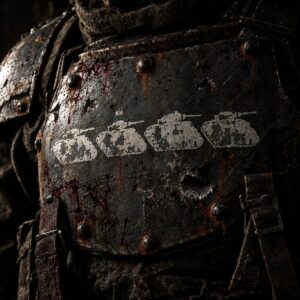
The banner is cloth—grey like Aurelius Prime, with four tank silhouettes embroidered in silver, the names of the four original commanders around the edge. The nineteen new names of the Aurelius 19th were added at the bottom, in smaller script, because space was lacking. It is not elegant. It is not honourable. It is real—a banner of war and shabby merger. In the year 901 the banner was burned when the Aurelius 19th was dissolved into the 4th. Three non-commissioned officers dug it out of the ash shafts and embroidered the nineteen names anew. The Munitorum recorded no loss of the banner, because the loss took place before the official merger. It now exists in a grey zone of the bureaucracy—officially not there, but raised every hour above the Aurelius barracks.
The Flaw
The flaw
The 4th Aurelius was ground down in total annihilation at Kormathe IV in 813.M40. The Munitorum dossier says "Operational withdrawal to the sector edge." The officers' reports say that Colonel Venn (no relation to the Governor, though the world is small) ordered a bridge held against three thousand heretic militia while the evacuation took place. The 4th Aurelius held the bridge. Zero soldiers came back. Zero. The Munitorum counted them as "Fallen in service" and raised a new 4th Aurelius from the reservists and replacements of Aurelius Prime—nine months later, hastily, untrained, under-equipped. This new version died again. And again. Four times in eighty-six years.
This creates a fracture in the soul of the regiment: the current soldiers fight under the names of men who did not fall, but were sacrificed, and that is something different. A man who falls, one honours. A man who is sacrificed—one avoids looking at oneself. The regiment knows this. The regiment does not speak of it. The regiment keeps old lists that the Munitorum never saw—the names and dates and last sentences. They are in a book that the Senior Commissar guards, and sometimes, at night, one sees soldiers stare into the night for seconds, as if they were listening to someone else.
A single example: the Battle of Astra Profunda, 868.M40. The Munitorum ordered that the 4th Aurelius defend a hill against Ork warbands—a hill without a name, without strategic value, without reason. Colonel Cassius asked three times why. The Munitorum did not answer. The 4th Aurelius stormed the hill and died by the six hundred. The Orks broke off after three hours. The hill was abandoned after four hours. No one could explain why. The Munitorum said that the defence was successful. It was successful at killing people. The regiment remembers, and they are loyal nonetheless—they follow orders like automatons, because obedience is the only currency a super-heavy tank company has. But they pay in contempt for the Munitorum, a payment that grows larger daily.
A Munitorum Failure
In the year 889.M40 the Munitorum ordered a supply lift for the 4th Aurelius: ammunition, food, field dressings for two months of combat in the Thrace sector. The ship was the Pinnacle of Fidelity, and it came. But it came nine months too late. The Thrace campaign ended in 888.M40 in defeat and retreat. The 4th Aurelius was already in Astra Profunda, undersupplied and overwounded. The Pinnacle of Fidelity reached an abandoned orbital base, found nothing, and the pilot—facing punishment for the delay—rammed the ship into the upper atmosphere of Aurelius Prime. It crashed in the western mountains. No survivors. Thirty thousand tonnes of ammunition and medicine went with it. The 4th Aurelius lost one hundred and thirty-four soldiers at that time to infections and undersupply that could have been cured. They died in the bunker while the Munitorum recalculated the routes once more to see where the error lay.
Known Campaigns
Campaigns
Name The Komathe Campaign / Sector Aurelius / Heretic insurgents and cultist separatists / 36 standard days
Epoche 813.M40 - 814.M40
Erzählung
The 4th Aurelius was raised in an emergency: a heretic uprising on the agrarian, semi-civilised world of Kormathe IV had overwhelmed the local governing staff within the span of a month. The Imperium needed a fully equipped battle group to retake the world. The Munitorum ordered the 4th Aurelius—untried, unpractised, with five Baneblade machines that had been bound together for the first time. The supreme commander, Kormathe Sector, a man named Provost-General Kellix, gave a simple order: Hold the bridge. Three days. Enough time for the evacuation to play out. Colonel Venn, the commander of the 4th Aurelius, accepted. He knew that hold the bridge against three thousand was a death order. He did it anyway. The 4th Aurelius was wiped out. A single survivor came back—Corporal Merrick—and carried the list of names in his memory. The Imperium won Kormathe IV back. The ledger of costs was balanced.
With the Aurelius 19th or another battle group beside it—the Munitorum warned that it would not be available, because the 19th had a blockade deployment over Calth Superior. The 4th Aurelius fought alone. That has shaped it: it is a regiment that fights alone, because fighting alone is normal.
Name The Ork Uprising of Calth Superior / Calth Sector / Ork invasion wave / 44 standard days
Epoche 856.M40 - 857.M40
Erzählung
The new 4th Aurelius (second version, nine months after Kormathe) fought an Ork uprising under a great warboss named Skagg the Black. This was a different war—not heretic sects, but ordered war-tribe war. The 4th Aurelius was stronger now, with three Baneblades and new soldiers, but this generation's version was no better prepared either. In forty-four days of fighting it lost two hundred and nineteen soldiers to overly fast manoeuvres and errors of exhaustion. Skagg was defeated, not through strategy, but through the Munitorum's ruling that the 4th Aurelius fight for as long as it can, until it can no longer. They fought until Skagg lost interest and moved on elsewhere. That is no victory. That is attrition.
The Aurelius 19th—actually available this time, freed from blockade—provided support with two escadrilles of Leman-Russ. It withdrew at the end, and the 4th Aurelius never saw it again until the amalgamation in 901.M40. This bred a decades-long grudge: both regiments survived, but the 4th survived grimly, and the 19th survived with an interrupted combat assignment.
Name The Siege Cycle of Thrace / Thrace Sector / Heretic militias and uncontrolled outlying sects / 79 standard days
Epoche 888.M40 - 889.M40
Erzählung
The third 4th Aurelius (by now for some considerable time) was undersupplied with personnel replacements, and the Aurelius 19th was not available, because the Munitorum had ordered it to a repair depot after its Calth injuries. The 4th Aurelius alone was sent to Thrace to defend a sector governance post against a combined insurgent force. The order was: Hold until reinforcements arrive. Reinforcements did not arrive. In seventy-nine days of fighting under siege the 4th Aurelius lost two hundred and eighty-eight soldiers—more than half its strength, including one Baneblade to sabotage charges. The battle group withdrew, wounded and broken, and the sector governance post fell three days later. The Munitorum declared the 4th Aurelius non-operational and ordered an amalgamation with the Aurelius 19th, which had finally been released from repair. Thus the present 4th Aurelius came into being—not through victory, but through the joining of two broken regiments.
The Aurelius 19th came from Mars, not from the sector. It knew nothing of Thrace until the amalgamation. There is no grudge—there is only silence, because both sides know that the Munitorum would sacrifice them both and the other side could not help.
Vehicle livery
How the regiment’s vehicles are painted: base colour, camouflage for the theatre, turret band and markings, derived from the regimental colours.
| Theatre | Rubble and ash · Splinter camouflage |
|---|---|
| Base colour | #697068 · Dawnstone (Uniform base tone) |
| Camouflage | #7A6E62 · Rakarth Flesh (theatre standard)#4A4440 · Mechanicus Standard Grey (theatre standard) |
| Turret band | #CACCBB · Pallid Wych Flesh (Vehicle names (paint)) |
| Markings | #FFFFFF · White Scar (Insignia (white)) |
| Hull recipe | Dawnstone (Base) · Nuln Oil (Shade) · Administratum Grey (Layer) · Deepkin Flesh (Edge) |
Company bands on the turret
- 1.
- 2.
- 3.
- 4.
- 5.
- 6.
- 7.
- 8.
- 9.
Derived from the regimental colours; the silhouettes are our own sketches, not copies of any Games Workshop model.
On the core data
The ordinal 4 is young—Aurelius Prime has raised eighteen regiments in three generations, and most of them are gone. The 4th is old for its number, a consequence of the waste of war. The regiment was raised in 782.M40 and should have ceased to exist long ago. It was annihilated three times in its complete form—the first annihilation at Kormathe IV in the Governor's campaign against the heretics (813.M40), the second during the Ork Uprising of Calth Superior (856.M40), the third and worst in the Siege Cycle of Thrace (888.M40). The present form is an amalgamation: in the year 901.M40 the remnants of the 4th Aurelius were joined with the survivors of the defeated Aurelius 19th to create one fighting unit. The soldiers know that they bear dead names. They sleep beneath the names of men they never knew.