47th Infernus
“Ash before blood, fire before mercy — we hit what we cannot see, we do not see what we hit.”
Core Data
| Regiment type | Artillery (Basilisks and mortars, never fights at visual range) |
|---|---|
| Munitorum designation | ASH-IMP-47-ART-SK |
| Homeworld | Infernus Prime |
| Tithe grade | Exactis Extremis – the single most demanding tithe grade |
| Establishment strength | 4,200 soldiers (three battery regiments, 12 Basilisks, 24 mortars, supply table) |
| Current strength | 1,847 soldiers (losses in three campaigns, two mergers with subordinate squads) |
| Allegiance | Loyal |
| Origin | Original regiment |
The pillars
Long-Range Strike Is Mercy
A soldier who mows down the enemy from the height of a Basilisk bears the burden differently from one who leaps into the trench and looks into the face of the dying. We kill from afar because the Imperial deserves not to be torn apart. That is not cowardice—it is a form of respect that does not prove itself through closeness. Our fire is unromantic and final.
Vertical Thoughts Break Horizontal Lines
A general looks at the map; we look down upon the terrain from above. A mountain, a crater, a hollow—these are not obstacles but opportunities. The highest point decides not only the battle, but also whom the God-Emperor obeys and whom He does not. Whoever holds the heights holds command over life and death.
The order is carried out, not debated
(Uncomfortable.) There was an order to wipe out a settlement in which five hundred rebels were hiding along with a thousand civilians. Our Colonel would have been permitted to refuse the clearance. The right was lawful. He gave the order. Since then no one asks any more whether it was right—but no one sleeps well any more. The Imperial is not built through virtue, but through obedience. We are obedient.
Loss is statistics, victory is will
If we take three thousand men with us into the distance and do not bring a thousand back, that is not failure—that is the calculation. The regiment will replace itself or it will not. A Colonel who mourns the losses saves no one. One who looks to the next objective is the only commander whose soldiers will still be fighting tomorrow.
Further core facts
| Fact | Value |
|---|---|
| Field name | Value |
| Militarum Regimentum | Ashfall Regiments |
| Common name | the Ashgrim, the Ashfall Corps |
| Origin of the name | Hereditary, since the founding: named after the Ashfall Mountains of the home world, where the first levy took place. |
| Regiment type | Artillery (Basilisks, mortars, never line of sight) |
| Founding | M41.3 |
| Tithe class | Tithe-Prime |
| Munitorum designation | ASH-IMP-47-ART-SK |
Raising, Homeworld & Culture
Raising & Tithe
Infernus Prime is a warm, yellow flat planetoid on which exploitation is more efficient than construction. The seat of government stands on the longest high plateau; below it lie underclass districts built beneath the ash of the Ashfall Mountains. The tithe pressure on Infernus is immense. Every seven standard years, ten per cent of the men and women fit to bear arms must be surrendered to the Adeptus Terra—more rather than less, because the Planetary Governor must reckon with a shortfall sooner than with one. The levy is conducted by electronic lottery drawn from the centrally registered citizens, a cold, industrial process. A name is called, and the person has six hours to report to an assembly point. No protests, no exceptions. The lottery computer takes into account age (preferring persons between 16 and 45 years), bloodline (genetic rejuvenation preferred) and criminal history (selected faster if it exists). A worker in the Magnesium Furnace could be a Corporal tomorrow.
The levy of the 47th Infernus was a Regular Tithe Levy, carried out as part of the standardised ninetieth quota wave of the Mordacis Sector in the years 041–043.M41. The quality was mediocre: two thirds of the recruits came from the urban camp (technically skilled, but with weak bones), one third from the mining colonies (physically robust, but distrustful of machines). The uniforms reached the assembly point three weeks late (a Munitorum error; four quartermasters were executed). Six recruits died of suspected plague before the vaccination arrived.
Planetary Governor Voss Ten'khar not only sanctioned the levy himself, but made the lottery public and broadcast recordings into the underclass districts so that everyone could see the procedure was impersonal. That made it more bearable—and more lethal. No one could challenge their selection as unjust. Voss Ten'khar kept his post for a further fifteen years.
What the Homeworld Lost
The Ashfall miners maintained a profession of almost five thousand blastmasters and Bruchsteine (blasting-charge specialists). The annual tithe did not take ten percent of them—it took thirty, because young, strong hands for the mines were the first candidate pool for the lottery. Within a generation the knowledge of how to safely blast gangue strata was lost. A son could no longer be shown it by his father, because the father had already been taken away in the levy. Safety rates fell. Nine years after the founding of the 47th Infernus a mine collapsed beneath Fernost and killed four hundred people who had tried to break gangue with methods that were too fast and too careless. Other knowledge would have prevented it. Infernus Prime lost it, and it never came back.
The Homeworld
Infernus Prime is a Death World—not through microbial blight or predators, but through its sun. The star is an orange K3 dwarf, senescent and thermally stable, but hot enough to hold the surface temperature at an average of 34 degrees Celsius. There is winter in only one region: the Ashfall Mountains, where altitude and air currents bring a minimal cooling. The planet is thus a world of Beyond and Beneath—surface dwellers work only at night; day dwellers dig themselves beneath the earth. The Ashfall Corps is therefore a regiment raised from people who grew up in the heat and know the safety of underground fortresses. They work quickly and with impatience, because the outside world was always lethal. They gladly dig trenches, because trenches are home.
The most populous place on Infernus Prime is not a city but a mine complex: the Krone-Lager, four kilometres below the surface, with a population of just under three million people. It was in these levels that the regiment was recruited. That makes them people who despise light, love confinement and feel safer under stone than under an open sky.
The Disadvantage They Carry
Infernus soldiers cannot fight on open plains. They are uneasy when they can see far—their brains expect there to be a ledge, a shadow, something to hide. On flatland they are exposed and vulnerable. In the first months of the Telmarc Campaign (667.M41) a mortar team was sent into wooded grassland to fire four kilometres behind enemy lines. All five crew died of sight-cramp and panic—not in combat, but during the mere setting-up. Their non-commissioned officer Dren Kalik suffered a breakdown and threw himself from the lookout hill in order to get back into the earth. The mortars were crewed by another regiment. Since then the Ashfall Corps has not been deployed in flatland campaigns, only where there is terrain: mountain ranges, primeval forests, the rubble-ruins of destroyed hives. Anywhere a soldier can say: "Here there is something above me that protects me."
Regimental Culture
An Ashfall soldier begins his day in silence. There is no reveille—the regiment wakes by inner time, a residual ability from the mine, where clocks did not always work and the sun did not show it. The first act is rinsing the mouth with water from the supply tank, then rations (cold field-maize porridge, fat, salt meat, all in blocks, not paste). The marching song is not loud; it is nasal and droning, the song itself is called "Under Stone and Over Dust" and tells of a miner whose shaft rope snaps and who falls. Each verse is another metre of the fall, until the end, where the safety nets tear. The song has no optimistic turn. A new soldier sometimes asks why one sings a song about a death. The answer always comes: "Because safety does not hold when you sing it. Only truth holds."
The regiment has three superstitions that the officers have given up suppressing, because they run deep in the culture:
- The Ash Marking: Soldiers who came under heavy fire and survived wear a thin layer of wood ash (not field ash, always from burnt Ashfall Mountain wood) on the back of the helmet. This ash may not be wiped off until the soldier has successfully completed a mission. Women and men who strip off the ash and sweep it away say they have done their duty. Soldiers without ash are considered "still indebted"—a social pressure that works without officers having to say it.
- The Dead Camp Ritual: When the enemy surrenders, no prisoners are taken—all are shot. This is not doctrine. It is a rule the regiment gives itself, because prisoners cost resources and Infernus soldiers do not waste resources. A Commissar tried to stop this; the Colonel said it was custom of war, not an order. The Commissar left the regiment to seek a new commander. The ritual remains. A prisoner is understood as a burden, not as a human being.
- The Rest Clock: A pocket watch that belonged to the first Colonel and is now two hundred and three years old. It does not run—it was left to stop one hundred and thirty-five years ago. But it is passed from Sergeant Major to Sergeant Major and kept in the regimental chapel. Before a major assault it is taken from the safe and laid on the field table. It is said that the watch shows when the battle ends by stopping. It always stops. This is nonsense, but it works: soldiers see the dead watch, understand that the future is already sealed, and fight with less fear.
Barracks life smells of fat and dried insects (Infernus has large blowflies that get in everywhere). The noise is low; the regiment is accustomed to silent naturalness. By day, one reads, repairs equipment or sleeps. In the evening there is a regulated portion of schnapps (spoiled vinegar-grain, not palatable, but effective). The soldiers drink it in contemplation, not in revelry. No song is sung faster.
Burial works where time exists: a hole is dug, the body is wrapped (no shrouds in the field, only the uniform), a short prayer is read that is not religious but a mnemonic: "Back to the depths from which we did not come. Passed on to the earth that nourishes us." In haste, the corpse is pushed into the nearest ravine, over the nearest cliff or into the nearest hole. That is not neglect; that is efficiency. On Infernus nothing is prepared—everything is dealt with.
The Commissariat
The Ashfall Corps neither fears its commissars nor despises them. It uses them. A commissar is a weapon for enforcing orders that would otherwise be carried out too leisurely. When the colonel knows that a particular unit goes into the attack too slowly, he does not send the commissar to kill them—he sends him to drive them. The soldiers understand this. They do not negotiate over honour with the commissar. They try to anticipate him and to be faster before he has to repeat the order. Commissar Dain Vorwalt has been with the regiment since 089.M42 and has an execution rate of under two percent, one of the lowest in the sector—not because the regiment is obedient, but because it is ahead. Vorwalt and Colonel Corvin occasionally play cards, which is militarily irregular but works in practice. A silent understanding: the unit will function, and the commissar will only oversee it, not enforce it.
Ranks & Organisation
Ranks
Rank Colliery Master
Description
Munitorum rank: Colonel · Form of address: Sir Colliery Master
Rank Mine Master
Description
Munitorum rank: Major · Form of address: Sir Mine Master
Rank Overman Master
Description
Munitorum rank: Captain · Form of address: Sir Overman Master
Rank Shaft Master
Description
Munitorum rank: Lieutenant · Form of address: Master [Surname]
Rank Black-Helm
Description
Munitorum rank: non-commissioned officer · Form of address: Black-Helm [surname] or Sergeant
Rank Grey-Helm
Description
Munitorum rank: Lance Corporal · Form of address: Grey-Helm
Structure
At its founding, the Ashfall Corps was a complete artillery regiment: three battery detachments (Basilisk batteries) of 4 Basilisks each with attached infantry support, six mortar companies of 4 mortars each, one headquarters company and two companies of field repair/supply. Raised strength: 4,200 soldiers. After two mergers (Infernus 63rd in 987.M41, Aschengrate 4th in 104.M42), the structure is fragmentary:
- Basilisk batteries: 3 batteries of 2–3 Basilisks = 8 Basilisks (of 12), four crews of 6–8 personnel per Basilisk. Current strength: 48 tank soldiers, three tank commanders, two workshop masters. Understrength by 40 per cent.
- Mortar companies: 4 companies of 4 mortars = 16 mortars (of 24), each mortar with one fire controller, two loaders, one ammunition bearer, two security men. Current strength: 96 personnel. Understrength by 33 per cent.
- Supply and headquarters: 18 personnel (Colonel, Major, three Captains, Sergeant, Commissar, four victualling officers, nine non-commissioned officers). Intact.
- Field repair: 14 technicians (of an original 24), responsible for Basilisk maintenance. Critically understrength.
- Infantry guard groups: 1,685 soldiers of an original 2,200, divided between securing the battery positions and crewing mortars in the field. Understrength by 23 per cent, but functional under extreme strain.
The merger with the 63rd brought seven men into Basilisk service, but also seventeen untrained mortar crews with the wrong doctrine—Aschengrat used a different ignition-system calibration. A year later, ten of the seventeen were dead or discharged (nerve damage). The merger with the Aschengrate 4th was traumatic: that regiment came from a wilderness world and understood artillery only as close-fire support, not as a strategic long-range strike tool. Tensions between the two contingents persisted for four standard years. A non-commissioned officer of the original 47th Infernus even attempted to sabotage a mortar crew of the Aschengrate 4th. He was executed. The Aschengrate soldiers are not integrated; they are tolerated.
Constituent regiments
Name The Ashfall Corps itself
Role / notes
(47th Infernus): Artillery loan regiment under the command of Colonel Corvin Merrick (62 years old, white scars beneath the left eye from the shrapnel strike of 051.M41, always carries a brass field compass that came from a deceased colonel 140 years ago). Current strength: 1,847 soldiers. Status: Functional, but understrength and burdened in morale after the Order of Silence on Ostvelde (Campaign 9, described below). The Colonel has become circumspect—he attacks later, speaks less, often sits alone in his tent and stares at the rusted compass.
Name The Basilisk Elite
Role / notes
(informally „Eisenhütter“, originally III Battery of the 47th Infernus, later raised with a veteran core to a sub-unit of its own): Captain Yara Melt (38 years old, shaves her skull because of the heat eczema of Infernus Prime, wears the silver badge of the thirty destroyed vehicles). Status: Highly motivated, but under extreme personnel pressure. The Elite has a rivalry with the Colonel: Melt wants faster attacks and less tactical waiting. This rivalry is productive—when Melt grows aggressive, Corvin grows cautious; when Corvin hesitates, Melt's Basilisks drive the attack. Her battery lost two Basilisks in the Telmarc campaign and is not replacing them. One Basilisk functions on emergency repairs; three people carry out four-person tasks.
Name The Morser Brothers
Role / notes
(six mortar companies, merged under Sergeant Dren Kalik's supervision after the Psychological Break at Telmarc): The mortar crews are a corps very much their own—they reject the rivalry between Melt and Corvin and function as a democratic collective. They vote among themselves on which company carries out an order when several options exist. This is military insubordination, but it works: Kalik issued no direct orders, only options, and the mortars chose. After four years of attempting to suppress this, the Colonel gave up. The mortars are loyal—but in their own way. Status: trained below standard, with two incomplete companies from the Aschengrate absorption (six soldiers will serve only on wilderness deployments, not on mountain campaigns). Sergeant Kalik is the embodiment of the regiment—a broken man (see profile below) who leads the mortar brothers not through strength, but through understanding.
Command Staff
Command staff
Name Colonel Corvin Merrick
Beschreibung
The regimental commander is a man of sixty-five years whose face has been battered by field service—one eye blind (milky, without depth of focus), the left side of his head marked by old burn scars. He was formerly captain of a Morser battery, and was promoted after the invasion of Kellcrow Prime (M39.7) because he managed to pull his battery out of an encirclement battle by firing blind from position to position without knowing the enemy's actual coordinates—pure instinct. He was famous in the lower ranks, but as Colonel he suddenly became cautious. His philosophy is not "Win fast", but "Win with the fewest dead." A commander with this ethic is unusual in the Astra Militarum. Merrick speaks little; he listens. An anecdote from 089.M42: A young Lieutenant proposed a night attack, reckoning with a 15 per cent casualty rate. Merrick said nothing, had the Lieutenant work through the calculation twice before the assembled officers, then asked: "And are the fifteen per cent the dead or the wounded?" The Lieutenant did not understand at once. Merrick waited. The Lieutenant fell silent. Merrick said: "The wounded come on top. Calculate again." The Lieutenant did so. The rate rose to 28 per cent. The attack was not carried out. Merrick carries a rusted field compass he received from his predecessor—this compass does not point north, but home (a metaphorical modification). A soldier asked why. Merrick said: "Because north is everywhere when you are lost. Home is one."
Name Commissar Dain Vorwalt
Beschreibung
A commissar of the old school, himself from a world with a tithe lottery, he understands his soldiers' fear because he lived it. His face is even, without anger or sorrow—the face of an official, not of a true believer. He wears a fully administrative uniform, keeps clean fingernails, and carries a bolt pistol in a holster on the right side, not the left (a mania no one understands; perhaps inverted right-handedness?). His voice is quiet, which is more dangerous than shouting. A famous quote from Vorwalt after an ammunition error: "The error lay at the point where you were not fast enough. Next time, be faster. The error was not moral—it was administrative. Administrative errors are not paid for with lives. Only with time." Merrick respects Vorwalt, which is possibly a mutual understanding of loyalty: both bear a responsibility that chokes them.
Name Sergeant Dren Kalik
Beschreibung
The mortar commander is a broken man in middle age (52), whose eyes are never fully open, as though half his sight still lay beneath the earth. He suffered his psychological collapse during the Telmarc Expedition (667.M41), when he came out beneath open sky and lost the ability to command. An officer (Captain Voss) attempted to have him executed for decadence. Merrick intervened; a dispute; Voss was transferred. Kalik was transferred back to the mortar battery—perceived from above as punishment, from below as redemption. The mortar crews adopted him. In the present he functions not as a Sergeant (the technical rank), but as a living maxim: "Look at me. I was out there. I came back." An old comrade gave him a leather card on which all the mortar crews had engraved their names. Kalik carries it always. "When I am up top again, where the sky is too wide, I read these names, and remember that someone is still waiting beneath the earth."
Attached Personnel
| Category | Number | Status |
|---|---|---|
| Commissars | 2 | Commissar Vorwalt (Senior) + 1 Junior Commissar |
| Clergy (Ecclesiarchy) | 8 | Survivors of an original 12; two from the Aschengrate 4th (integrated, but isolated) |
| Field surgeons | 3 | 1 Senior, 2 Junior; critically understrength |
| Adeptus Mechanicus (Enginseer) | 1 | Enginseer Torvan, responsible for Basilisk maintenance |
| Scholastica Psykana (Psyker) | 0 | Regiment has never had a sanctioned Psyker; the only attempt ended in execution (M39.8) |
| Other craftsmen | 19 | Smith, tailor, quartermaster, etc. |
Friction between the Commissariat and the regiment is minimal—Vorwalt and Merrick function within a pretence of mutual independence. The Ecclesiarchy clergy report again and again that the mortar crews refuse their prayers and sing the mine song instead. Merrick knows of this and stays silent. Enginseer Torvan is frustrated that Basilisk maintenance leaves him too little time and that the field surgeons reject his help.
The Regimental Standard
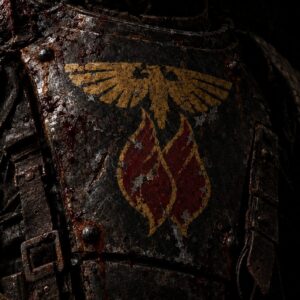
The standard is a four-metre-high cloth of dark red silk (fabric from Infernus Prime, extremely heat-resistant, thin as parchment). On the front is the Imperial Aquila (embroidered in gold) with two overlapping fire zones beneath—above it, in black letters, the records of every engagement since the founding. The reverse bears the emblems of the three fallen regiments (Infernus 63rd, Aschengrate 4th, and the names of the 41 soldiers who died in a friendly-fire accident—these names are applied not in gold but in wood ash, a local ritual). The standard was once nearly lost: on Ostvelde (667.M41), during the Decennium of Silence, the regimental chapel (in which the standard is kept) was overrun by a Nurgle mutation. A Sergeant named Keth Voris seized the standard and ran with it into the open field while the mutation pursued her. She was not caught. Voris died three days later of an infection she had contracted in the chapel. The standard was buried with her—in Infernus tradition it is not permitted to recover it once it is bound to a hero. A new standard was woven from identical fabric, with identical embroidery and ash inscriptions, but with one additional name at the lower edge: "Keth Voris, Saviour of the Standard." This is a rule unknown to the Adeptus Terra.
The Flaw
The flaw
The Ashfall-Korps was overshadowed by a prophecy from the very beginning—or rather, by a single voice that spoke a prophecy. A shrine world priest named Kethus Vrain came to the regiment in 043.M41, three years after its founding, and said that he had received a psychic sign: this regiment would never see its home world again. Colonel Merrick was silent. A Lieutenant laughed. Commissar Vorwalt had Vrain placed under watch, but not executed. Vrain died in 067.M41 of natural causes (heart failure), but his words remained.
How the taint shows itself daily: Soldiers rarely write letters home. A new soldier in his first year is asked by the others: "Do you want to know when you'll get home?" The answer is always no. The regiment operates under the assumption that it will not survive—not dramatically, but structurally. When a wound is severe, few resources are spent on healing; the soldier is declared an invalid and sent to the nearest field station (and from there, presumably, not back to the regiment). New equipment is not requisitioned; it is assumed that the current equipment will function long enough. An NCO said to a young soldier who asked how long the Basilisk armour would hold: "Until it doesn't anymore. What comes after is not our question."
In engagements, the taint shows itself as follows: The regiment does not count its dead. It counts its firing effectiveness. When 40 per cent of the crew are lost but the enemy is destroyed, the Colonel records it as a victory—not because he is heartless, but because a regiment without an objective is only a heap of corpses in slow fall. The commander of another, similar group (Infernus 51st) entered an engagement with similar numbers and broke off when the losses grew too high. The engagement was lost after three days. The commander was executed for cowardice. Merrick watched this, fell silent, and decided that cowardice had no place in the Ashfall-Korps. Since then every soldier knows: a battle in which the regiment fights does not end until the enemy is dead or the regiment is too small for further orders.
What the regiment itself says about the taint: There is a saying that circulates among the soldiers: "We'll be ash before we're ash at home." It means: we will die in battle, not of old age. The regiment has come to terms with this thought. It is not hopelessness—it is a kind of clarity. If it is certain that one will not return home, then one can at least settle accounts. A priest tried to say a mass that offered hope. The room stayed empty. Hope is not sung.
What other regiments say about the Ashfall-Korps: "The Aschgrim don't give up. That is their advantage and their curse. They don't know how to give up." There is a story that during the siege of Kellcrow Prime a group of Ashfall soldiers kept firing munitions into an enemy fortress even after the command centre had been destroyed and there was no one left to order the evacuation. They fired for five days. When the relief group arrived, the Ashfall soldiers were dead—they had not noticed that their senior officer had fallen. This is probably a legend, but it is told.
A Munitorum Failure
In 089.M41 the Departmento Munitorum dispatches three supply ships to the Ashfall Corps: one with replacement ammunition, one with field provisions, one with spare parts for Basilisk engines. The supplies had been issued seven months earlier and were therefore due to arrive three months after that. That was usual. The ships appeared in 089.M41. But the ammunition loading was confused with the spare-parts consignment. The ammunition ship arrived with three tonnes of rubber seals instead of bolter rounds. The Munitorum administrator at the logistics station should have noticed; he was ill and his assistant careless. No one was executed. The regiment hit the ammunition crisis when it had already used up 40 percent of its stocks in the Telmarc Campaign. Two Basilisk batteries had to be stood down. A whole month of operations fell short. Another regiment took over two of its objectives. The Ashfall Corps lost 340 men in that one week because it could not fire. The Munitorum afterwards sent an apology.
Known Campaigns
Campaigns
Name The Telmarc Invasion (three standard months)
Epoche 667.M41
Erzählung
Theatre and enemy: Telmarc System, central Mordacis Sector. A former Imperial world (agriculture, mid-level technology) had been overrun by an Ork invasion. The Orks were no Great Waaagh—only a fleet group under a minor Warboss named Gul'skrag, with roughly 5.000 fighters. The Imperial response was a battle group made up of the Ashfall-Korps, two infantry regiments (Vendry 4th, Kesselmark 6th), an armoured detachment (three Leman-Russ battle tanks) and a squadron of infantry vehicles (Chimera transports). Total strength: around 12.000 soldiers.
Account: The engagement began with a four-day bombardment. The Ashfall-Korps fired from the mountains above Telmarc City and destroyed 60 per cent of the Ork fortifications before the infantry went in to attack. The Telmarc population was placed under quarantine in a cellar (suspected of contamination by Blutaxe). The regiment received an order to liquidate them in the event of an Ork breakout. Colonel Merrick refused. A conflict arose between Merrick and the Field Marshal who led the battle group (Field Marshal Kethys Vend). Vend wanted Merrick executed for insubordination. Commissar Vorwalt did not permit the execution (without formal refusal—he said only: "The Colonel was not insubordinate. The Colonel required clarification." Vend received no clarification; the order was tightened as needed: "In the event of an Ork escape from the cellar, civilians may be neutralised in order to avoid uncontrolled weapons fire." That is an order which permits without ordering). The engagement itself proceeded as follows: the infantry regiments advanced under the fire of the Basilisks. The Ashfall-Korps fired until the infantry were too close. Then they fired over the infantry's heads. In total, 340 tonnes of munitions were expended in 96 hours. The Orks collapsed after 81 hours. The cellar was cleared—no civilians were killed (a silent agreement between Merrick and the commander of the Kesselmark 6th, Captain Voss, who said: "If there is no order to kill, then I haven't heard one.")
Outcome: Victory. The city was retaken. 34 per cent of the original Telmarc population remained. The thousand who had been hidden in the cellar were evacuated.
Regimental losses: 287 soldiers of the Ashfall-Korps (18 of them Basilisk crews). Two Basilisks were damaged; one was repaired, one added to the scrap list.
Fighting alongside this battle group: Vendry 4th (Infantry, approx. 2.000 soldiers), Kesselmark 6th (Infantry, approx. 2.500), Armoured Squadron Kelten 3rd. Fate of the bond: after the campaign the battle group was dissolved. Vendry 4th was dispatched to another theatre (Nihilus Sector, a further 3 years, no contact since). Kesselmark 6th remained in the sector but was assigned to other commands. Captain Voss of Kesselmark 6th changed theatre owing to political tensions with Field Marshal Vend (who tried to have Voss executed for saving the civilians; Voss escaped by being transferred to another command). The Ashfall-Korps heard that Voss later turned up in the Aschengrate 4th—an encounter that was impossible, since Aschengrat is a wilderness world. The story was never verified.
Name The Decennium of Silence (six standard years)
Epoche 667.M41–673.M41
Erzählung
Theatre and Enemy: Ostvelde Sector, an agricultural world with vast plains and volcanic zones. The enemy was no military force—it was a Nurgle cult that arose from an original plague epidemic (the result of a cargo accident involving biological materials). The cult called itself "the Fellowship of the Gardener" and sought to "cultivate" the plague rather than cure it. The Imperial response was a battlegroup drawn from the Ashfall-Korps (full strength after the Telmarc repairs), two infantry regiments from local worlds (the Ostvelde Guard, 3,000 in total, and priest cohorts of the Ecclesiarchy, an additional 500 armed clergy).
Narrative: The engagement was no classic military scenario. The Fellowship of the Gardener was decentralised—no command centre, no visible leader. It manifested as individual cells with local leaders. The Ashfall-Korps fired on coordinates supplied by Inquisitors, but the target moved too quickly or had already been destroyed. After the first month, Merrick understood that bombardment would not work. He changed the doctrine: instead of firing on targets, he fired on escape routes. The followers of Nurgle would flee, and the Basilisks would cover the line of flight. It worked, but it was slow. The regiment fired an average of 5 hours a day for 1,800 consecutive days. Ammunition expenditure was unprecedented. The decade consumed four times the original ammunition allocation. And still no catastrophe showed itself—the plague kept itself alive, infected ever new generations, withstood the prayers of the Ecclesiarchy priests. In 673.M41 an order came from Sector Command: Exterminatus on Ostvelde. The entire planet was to be destroyed. The order was signed by an Inquisitor. A ship in orbit would carry a massive bomb. The Ashfall-Korps was ordered to stow its Basilisks and evacuate from Ostvelde. Merrick refused. A conflict. Commissar Vorwalt took Merrick into his private tent and spoke with him for two hours. Merrick came out and gave the order to evacuate. The Basilisks were loaded onto transport ships. The regiment lifted off. In 673.M41, hour 4.31, the Exterminatus bomb fell. Ostvelde became ash.
Outcome: A pyrrhic victory. The planet was destroyed, but 800,000 people whom the Ashfall-Korps had protected during the decade were evacuated. They were never resettled—the Ashfall-Korps does not even know their names. The Nurgle cult was completely wiped out.
Regimental Losses: A relatively low total of 340 soldiers (plague infections, despite quarantine protocols). But the regiment was psychologically broken. Sergeant Dren Kalik suffered his breakdown in this campaign after he had to lose an entire mortar crew to a storm during the evacuation (eight people, all known by name, all bodies lost). Kalik was given up on. A priest said that it was sinful to give up. Kalik tried to shoot himself in the trench. Merrick found him, removed the weapon, and said: "A shame to be a martyr, but easier to live on. You have more still to do."
Fighting with this Battlegroup: Ostvelde Guard (local militia, approx. 2,000 active, later 1,200 evacuated), Ecclesiarchy priest cohort (500), various local wardens. Fate: The Ostvelde Guard was disbanded. The Ecclesiarchy priests returned to their home world (or tried to—several were forgotten at the evacuation hub and later ended up on a trading station). The bond between the Ashfall-Korps and anyone at all was non-existent. There was a moment in which a priest said to Merrick: "You lost them." Merrick answered: "I saved them. That is not the same." The priest left the sector. The Ashfall-Korps remained.
Name Merger with the Aschengrate 4th and Follow-on Operations (ten standard months)
Epoche 104.M42
Erzählung
Theatre and Enemy: Mordacis Sector, multiple fronts. After the Great Rift split the galaxy, the sector exploded into chaos. The Ashfall-Korps was drawn into several campaigns (one against half-Ork pirates, one against a heretical cult, one against remnants of Nurgle cultists). The Aschengrate 4th—a regiment from a wilderness world—was absorbed into the battlegroup because the Ashfall-Korps had fallen below 1,000 personnel and could no longer function independently. The Munitorum simply ordered the merger.
Narrative: The first encounter between the two regiments was tense. Aschengrat soldiers do not understand mountain warfare—they understand wilderness and close combat. The Ashfall-Korps understands structured bombardment. An Aschengrat soldier said to an Ashfall soldier: "You shoot from afar. That is cowardice." An Ashfall soldier answered: "You fight in order to die. That is madness." The conflict was not resolved by orders, but by mutual understanding. An Aschengrat commander fell silent after the third campaign and said: "I understand. Distance is also closeness, only different." An Ashfall non-commissioned officer answered: "And close combat is also bombardment, only with blood instead of fire." The two regiments began to function. There is no true friendship—but there is a pragmatic pact.
Outcome: Endured. The combined force fired and fought under Merrick's command. Average loss rate: 18 per cent per campaign (low by Guard standards, high by Ashfall standards). A victory against the Ork pirates. A near-complete outcome against the cult (destroyed the encampment, not the faith). Operations are still pending.
Regimental Losses: 180 soldiers of the Ashfall-Korps (of whom 8 were Basilisk crews). Aschengrate 4th: 280 soldiers (of whom 12 were Sergeants and non-commissioned officers—a heavy loss in the command structure).
Fighting with this Battlegroup: Aschengrate 4th (now integrated), various local companies and clergy contingents. Fate of the bond: These have not yet been dissolved. It is unknown what will happen to the Aschengrate 4th after this campaign. The Ashfall-Korps hoped for a lasting bond—that is against doctrine. The two regiments will probably separate when this campaign ends. It will be hard.
Vehicle livery
How the regiment’s vehicles are painted: base colour, camouflage for the theatre, turret band and markings, derived from the regimental colours.
| Theatre | Mixed terrain · Blotch camouflage |
|---|---|
| Base colour | #2C2B25 · Dryad Bark (Uniform base tone) |
| Camouflage | #5F463F · Gorthor Brown (Field stains and wear)#39484A · Mechanicus Standard Grey (Ash cord and mourning markings) |
| Turret band | #8B4806 · Skrag Brown (Rust red (kill markings)) |
| Markings | #EDC169 · Retributor Armour (Metal markings (vehicles)) |
| Hull recipe | Dryad Bark (Base) · Nuln Oil (Shade) · Skavenblight Dinge (Layer) · Dawnstone (Edge) |
Company bands on the turret
- 1.
- 2.
- 3.
- 4.
- 5.
- 6.
- 7.
- 8.
- 9.
Derived from the regimental colours; the silhouettes are our own sketches, not copies of any Games Workshop model.
On the core data
The ordinal 47 indicates a relatively recent founding: Infernus Prime is regarded as a stable tithe world with high military output and was therefore drawn upon in rapid succession. The Infernus line now extends to the 89th Founding. The regiment has been partially disbanded three times and twice merged with the remnants of other subordinate artillery formations—first merger 987.M41 with the Infernus 63rd (seven mortar units, high casualty rate, two survivors on the staff), second merger 104.M42 with remnants of the Aschengrate 4th (feral world Aschengrat, an entirely different doctrine and dialect, tensions persist). Today's soldiers know none of the founding generation; they inherit banner cloths from the dead of four different worlds and a fate they barely understand.