44th Correnhal Artillery Regiment
“Do not break the drill. Fire on command — no one else's. Blood pays debt. The Emperor played a lost game.”
Core Data
| Regiment type | Artillery (Basilisks and mortars, never fights at visual range) |
|---|---|
| Munitorum designation | COR-44/Ast/Art/Bás-03 |
| Homeworld | Correnhal |
| Tithe grade | Exactis Tertius |
| Establishment strength | 4,820 soldiers |
| Current strength | 2,109 soldiers |
| Allegiance | Renegade |
| Origin | Original regiment |
The pillars
The Drill
A lance breaks, granite remains. We are the tool that goes deeper. No fearfulness before the fire we hurl—only respect for the mathematics that guides every shell. We are technicians of death, and we work thoroughly.
The Blood Debt
Every man here owes his life to the defeat of other men. Every powder came from broken regiments. That is not honour. That is belonging to a family of losers. We pay this promissory note in fire, because nothing else suffices.
The Own Way
The Colonel does not trust orders that bid a man die for nothing. And that is why we do not follow him—not out of mutiny, but because mutiny is sometimes right. That makes us dangerous. But the Drukhari are more dangerous.
The Last Reckoning
The Emperor was betrayed at Vallgrund. Not by us. By those above. And we are not sure that He still lives, and even less that He deserves it, if He does. We do not say this aloud. But every shell carries this thought with it.
Further core facts
| Fact | Value |
|---|---|
| Militarum Regimentum | Confederates of Correnhal |
| Common name | The Outcasts |
| Origin of the name | Earned at the Battle of Vallgrund M41.782, where the 44th disputed the regular finding and, instead of the ordered withdrawal, held a firing position until its ammunition was exhausted. The designation "Confederates"—allies in the sense of a pact against orders—was at first used by critics; the troops adopted it. |
| Regiment type | Artillery (Basilisks, mortars, field guns) |
| Founding | M41.621 |
| Tithe grade | Elevated (war zone within reach) |
Raising, Homeworld & Culture
Raising & Tithe
The 44th was raised in M41.621 as an emergency levy. Correnhal lies four light years from the Drukhari invasion route that tore apart the sector around Kormorikhan. The Planetary Governor was given the choice: raise a complete regimental tithe in four months, or suffer the tribunal of the Administratum. The available soldiers were not enough. So criminals came. Three hundred condemned workers, to whom the Generalissimus presented a paper: Astra Militarum or execution. They signed in blood. The terror of those first weeks was not military—the combat training came later—but existential. Men and women who thought they were already dead were suddenly informed that the Emperor had a use for them. The bitterness of this realisation coloured every decision they made afterwards.
The losses in the first campaign were catastrophic. Seventy-four percent in eighteen months. The regiment was not sent home to replenish—it was too close to an active war zone—but merged with the remnants of the 51st Correnhal Regiment. Six hundred and thirty-nine survivors from both formations, one new name and zero familiarity with one another.
What the Homeworld Lost
Correnhal was an agri-world with five generations of grain-breeding knowledge. A third of the pressed workers were Assessors—men and women who taught visual grain grading and decided during field inspection which lots were fit for export. They had taught at the same school for twenty years. There is no new school any more. The harvest is now assessed by the Administratum, by officers without experience, and since then the yield has fallen by three percent per seasonal cycle. Correnhal will starve within fifty years—not because the soils are empty, but because the knowledge-watch died.
The Homeworld
Correnhal is a continental agrarian realm with a single world-silo in the highlands of Rothmark. The climate is dry and bitter—long dry seasons and short, violent rainy seasons that cut river-valley gorges into the red plains. The population is spread across large isolated farms, often fifty kilometres apart, with a base that works the black earth and an economy of sheep herding. The culture is cooperative in matters of accounting but unbending in matters of rank: the eldest person decides, not the strongest or the cleverest. The farmers value the work more highly than the ability to command it.
From this came soldiers who judge orders by their usefulness. They obey willingly—but only when the order makes sense. An officer without proven judgement does not receive their respect. They turn cold and practical when they are ignored or mocked. This trait was useful on Correnhal. In the Astra Militarum it is classified as insubordination.
The farmland culture also breeds a particular pragmatism about resources. A field spade is more precious than a human life, because living people are replaceable and steel is not. This cold mathematics appears in every decision the 44th makes about ammunition expenditure.
The Disadvantage They Carry
The Correnhal farmers know the sky only in the colour of the season. They have no experience of darkness that comes from shields, or of sky-height that reaches higher than the furthest mountain. When the 44th was dispatched to the Battle of Vallgrund—a sky full of Drukhari fighters and rifle volleys from the atmospheric layer—men broke into panic. Thirteen soldiers ended themselves under fire, because they did not know how to flee downwards. A Lieutenant named Carro wrote in his last letter: "I became a farmer from the plain. Now I am a fly beneath a bell jar." This realisation—that they had been safe on their homeworld because there they were small and worthless—caused a fracture in morale. They still feel unprotected beneath alien skies. And they know that this feeling is true.
Regimental Culture
The 44th marches up in silence. They do not sing. The commanders tried it in M41.624, but within a few weeks the marching song developed into a kind of dirge—verses about a home that lies generations away, and the dead who never return. A Commissar banned it. Silence ever since. There is a ritual instead: when a fire mission is laid, the gunner murmurs a number for the shell, too quietly to be heard. It is a private prayer, sometimes to the Emperor, sometimes to the dead Correnhal regulars, sometimes to people who were the soldiers' own family. The officers know that this is religiously heterodox. They turn a blind eye.
In the barracks or the transport holds of the barges it stinks of petroleum-camphor—a Correnhal preserve, cheap to make, bitter to chew. Men eat it between firing hours. The smell is sweetish and causes headaches. A soldier named Merkat said to a Commissar in M41.703: "The smell is the proof that we are still alive. The dead do not smell." The Commissar did not answer.
The liquor ration is drunk in silent groups, not in celebration. Sometimes the drunk then sing—the dirges from the time before the ban. No one interrupts.
When there is time to bury, they dig mass graves and lay the dead on their side, faces to the west—homeward, although no west in this universe means homeward. They speak no words. They throw earth and walk away. When there is no time, the dead are burned and the ashes emptied into a tube that lies in a barrel with a thousand other tubes. The bookkeeper notes the number. At some point a list is read. That is the only thing the dead get—numbers and silence.
The Commissariat
The 44th has four living Commissars and the skeletons of two dead ones. They do not fear the Commissar's staff—they have greater things to fear, and the Commissar knows it. Instead, they use the staff as a kind of drawn weapon against their own consciences. A soldier who knows he has acted insubordinately sometimes reports himself. In such cases the Commissar does not execute; he writes down the report and watches. The 44th has an unwritten contract with the Commissariat: we will be true, and in return the Commissar will not shoot us. This contract is four years old. It could break at any time.
Ranks & Organisation
Ranks
Rank Eldest
Description
Munitorum rank: Colonel · Form of address: The Eldest
Rank Reckoning-Master
Description
Munitorum rank: Major · Form of address: Master
Rank Warden
Description
Munitorum rank: Captain · Form of address: Warden
Rank Field Aide
Description
Munitorum rank: Lieutenant · Form of address: Aide
Rank Field Gunner
Description
Munitorum rank: Sergeant · Form of address: Field Gunner
Rank Row Leader
Description
Munitorum rank: Corporal · Form of address: Row Leader
Structure
The 44th originally consisted of fourteen artillery Companies of nine Basilisks per Company and five mortar-carrier Companies of twelve light field guns each. The merger with the remnants of the 51st increased troop strength, but not field expertise—the 51st had been an infantry formation. To streamline the structure, the Munitorum establishment was reduced to eleven Basilisk Companies (four Basilisks per Company, plus two reserve vehicles per Company in slow consumption) and six mortar-carrier Companies were retained. This gives a theoretical total holding of 52 heavy war machines and 72 medium field guns. At present only 29 Basilisks are operational, three of them on restoration waiting lists. The mortar figures are critical: 31 of 72 operational, and no replacement within reach, because the supply network has endured six months of communication failures.
The foot-troop contingent currently numbers 1,604 soldiers in nine mixed escort maniples—no pure infantry Company, but field supply, ammunition carriers and guard posts. They are poorly trained, because the 51st was never intended to fight alongside Basilisks. The officers know this. They forgive them nothing.
Constituent regiments
Name Correnhal 44th Basilisk Artillery
Role / notes
Colonel Hadrian Carro, beardless, with a burn scar over the left temple from a camp accident in M41.689 that he never had treated. The parent formation. 29 roadworthy Basilisks, six escort maniples, combat strength stable.
Name Correnhal 51st Field Artillery
Role / notes
Major Kessa Rohn, grey-scorched hair, the middle finger of her right hand missing since Vallgrund. The thrown-together unit. 31 field guns in the base complement, but nine of them under repair for sixteen weeks. The soldiers of this company consider the 44th worth surviving. It remains to be seen.
Name Correnhal 44th Supply Detachment
Role / notes
Captain Torvin Aldis, silver-brain (Adeptus Mechanicus augmentation), no sight on the right side. Technically fit, morally doubtful. Twice considered deserting. Twice recaptured. Now only the fact that the 44th has no other quartermaster keeps him from being shot.
Command Staff
Command staff
Name Colonel Hadrian Carro
Titel / Rolle the Eldest of the 44th
Beschreibung
Fifty-five years old, with a shadow of beard that grows for two days and then turns grey. The burn scar over his left temple is no stigma—it is the mark of a man who has lived long enough to know that the Imperium's orders sometimes kill. His sidearm is a laspistol, the grips set in Correnhal oilwood, old and smoothed by a thousand days of the leather touching it. A single talisman: a ring of braided steel that he inherited from his predecessor—and his predecessor from his. The metal should have vanished in the melting-down of the 44th in M41.204. It did not vanish.
Carro was never meant to play a Colonel. He was a Field Gunner without ambition for promotion. But in M41.712 the regimental commander died at Vallgrund—a Drukhari grenade, very personal—and the Death-Heralds asked Carro whether he would accept the role. He asked: "Will I be permitted to refuse the orders when they are insane?" The Death-Heralds did not answer. Carro accepted the role and three months later refused to cover a flanking expedition that was calculated with eighteen soldiers and had no network of retreat. A Commissar came to shoot him. Carro stood up, showed his document seal, and said: "If you shoot me, no regular Colonel leads the 44th any more. Then a Commissar leads it. Try that." The Commissar walked away. The order was cancelled.
Zitat
"Duty ends when the mathematics dies."
Name Commissar Lyra Kemp
Titel / Rolle Senior Commissariat Officer
Beschreibung
Forty-nine years old, her hair combed into a bun pulled so tight that her forehead looks permanently half-taut. Her Balissarium—the complete instrument of death of the Commissariat—is a single-shot plasma pistol instead of the usual bolt weapon, because one day she found the weight of the bolter's recoil philosophically unsatisfying. She seems ill-suited to this formation. She is the right one.
Kemp came from the Schola Progenium, not from the succession curriculum. As a child she was taken in by a Commissar who was murdered during the Calibre Scandals of M39. The Schola made her a weapon. But in her sixth year of training something broke in her teaching. She read an Interrogatus memo on the Battle of Vallgrund and realised that a local Commissar had had an entire maniple liquidated to conceal a circumstance that would have embarrassed the high command. She wrote a protest. The protest was archived. She was posted to service regardless.
Since then Kemp has worked in the grey between the orders. She shoots for mutiny—but only after she has investigated whether the mutiny had a reason. She combed the decrees for weakness. She and Carro have a silent agreement without words. They will never meet at a table; but when Carro refuses an order, Kemp writes a report stating that the order was never given to him.
Zitat
"There is no weapon without a conscience. A weapon that is perfect is simply—a machine. I am not simple."
Name Captain Torvin Aldis
Titel / Rolle Field Supply and Quartermaster
Beschreibung
The third leader is the only one who does not want to talk. Aldis is Adeptus Mechanicus-augmented—meaning that his brain carries a cybernetic addition, a silver organ larger than a fist that allows him to memorise rows of numbers like a servitor. The eye on the right side was lost in an explosive blast in M41.708; the Mechanicus did not replace it with a lens but with an open cavity. He wears a metal cage over it.
Aldis was a doubter by nature. With the silver augmentation he became systematic. He calculates resources to decimal places that do not exist. He has deserted twice—M41.714 for nine days, M41.751 for sixteen days—but each time he was recaptured before the fighting force could have recorded him as missing. A Commissar questioned him about his reasons; Aldis said: "I am trying to understand when it is no longer worth working." The Commissar did not answer. Now only the fact that the 44th would collapse within three weeks without him keeps the Captain from shooting himself.
Zitat
"The 44th will die. That is not a question of tactical conditions—it is an equation. Seven thousand three hundred days, six hundred and eighteen tonnes of ammunition, Four zero Nine seven replacement rate. The quotient is zero. That is why I work."
Attached Personnel
| Specialist | Number |
|---|---|
| Commissars (staff of Commissar Kemp) | 4 |
| Ogryn auxiliary groups | 3 |
| Adeptus Mechanicus engineer representative | 1 |
| Field priests (Ecclesiarchy) | 2 |
| Guardian medics | 18 |
The Ogryn groups are the only bridge between the Commissariat and the troops. An Ogryn understands that it means killing, and understands it simply—no complication of conscience. This makes the Ogryn soldiers preferable to human proxies for the 44th. The friction lies instead between Aldis and the Mechanicus representatives who control the spare-parts allotment. Aldis calculates correctly; the Mechanicus man interprets the orders. In between, ammunition starves.
The Regimental Standard
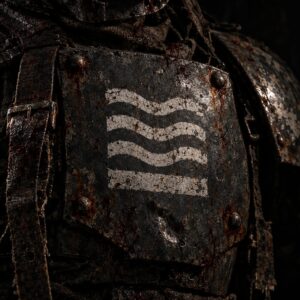
A four-metre-high iron frame, bound in plastcloth in Correnhal black and white. At the top hangs the physical banner—yellow linen, hand-sewn, the four founding shells of the original 44th embroidered in silver thread. Beneath it a second banner of grey cloth is clipped: the honours of the 51st before the merger. At the bottom of the shaft hang three tank tracks that were severed by the Drukhari fighters at Vallgrund—a physical reminder that the 44th lost a third of its strength on that same day and carried on regardless.
In M41.739 two Drukhari infiltrators tried to steal the standard. They penetrated the command tent during a sandstorm; three soldiers died. But a medic named Korvus threw himself onto the standard and clung to it, even as the first infiltrator slashed open his arm. The second infiltrator left the tent to pursue Korvus; the first was shot by Carro personally. Korvus survived. Carro did not transfer him. Everyone knows where the standard lives.
The Flaw
The flaw
The 44th is a bearer of conscience in an army without conscience. This is not a biological defect—it arose structurally. The soldiers were pressed from prisons, not from regular levies. They entered service with a hatred of the institution that never wore away. They learned early that an order, if it was stupid enough, could kill—not only the enemy, but their own side. And they learned that foreboding was permitted if one phrased it correctly.
In day-to-day operations this shows itself as an inertia of authority. An officer must repeat an order two or three times before the soldiers act, because they first calculate for retreat. This is not mutiny—it is conditional obedience. In combat the flaw shows itself as Unsteady Defensiveness: the 44th holds lines, but it does not hold them in attack formations, because attacks demand a faith in High Command that the troops do not have.
Other regiments say the 44th is neurotic. They say that Colonel Carro founded a mutiny headquarters and that it is a shadow regiment that obeys only as long as obedience makes sense. The 44th hears this and does not answer—because it is true.
In M41.756, after an order to kill three soldiers who had mutinied in a firefight (they refused to hold a position that was, by their calculation, impossible), a medic named Vess wrote a memo to the Commissar: "If I do not understand the orders, how am I to die for them?" The Commissar answered: "It is not your duty to understand." But Vess was not executed. The Commissar knew that Vess was right—the position was impossible.
A Munitorum Failure
In M41.703 the Munitorum sent the 44th a complete load of field ammunition with the wrong fuse speed. This meant: the shells would detonate, but not at the calculated transit distance, rather either too early or too late. A technician named Kervin noticed this while loading and reported it. Command queried it, and the Munitorum replied that this was the only load for a thousand kilometres and that the regiment had to signal acceptance or rejection.
The 44th accepted the ammunition and marked each shell with a hand number and a correction factor that Kervin calculated. They fired faulty ammunition for four months and compensated manually. Four weeks into the hand corrections, two soldiers died because a shell-loader forgot the count. A third died because the correction factor itself was flawed—a decimal shift.
The Munitorum was not punished. The regiment was not compensated. The next ammunition supplement arrived four weeks later, and three soldiers of the 44th had to carry it into the shelter cellar. They refused, until an elder—Colonel Carro, then still a field gunner—went down into the cellar with them. They carried the ammunition away. Trust in high command was finished in that hour.
Known Campaigns
Campaigns
Name The Battle of Vallgrund (three months)
Epoche M41.712–M41.713
Erzählung
The enemy was a breakaway Drukhari invasion fleet, one of the smaller raiding formations of size category Two. The 44th was deployed with four other regiments—the Kormorikhan 9th, the Belthane Shield, the Zobelmark Staff and the local garrison—under the Admiral of the sector, as fire support for the landing points. The losses are a word, but the battle was a process.
The Drukhari came fast. Their fighters appeared overhead on the third day and threw missiles onto the Basilisk nests. The 44th lost four vehicles and twenty soldiers in the first four hours. A platoon Lieutenant named Korris gathered the survivors of his group and withdrew to an outer sandstorm cave; later this became the 44th's first "fortress" position. The position could be held, but the resupply was cut off. Water and ammunition were not enough.
A Colonel of the Kormorikhan 9th voxed Carro—then still a field gunner—and ordered him to clear the fortress and send the soldiers forward. Carro vox-shouted back: "The soldiers are more effective when they are with the shells. If I bring them forward, I lose tools for both." The Colonel gave the order three times. The third time, Carro put the vox down and distributed ammunition to the fortress instead of signalling compliance. The fortress held. Losses in the following two weeks were thirty percent lower in the 44th than in the other regiments—because Carro reinterpreted the orders, not because the orders were right.
The battle ended with the withdrawal of the Drukhari fleet into the warp. The 44th lost a total of seven hundred and eighteen soldiers out of a total of one thousand two hundred and nineteen. The Kormorikhan 9th lost nine hundred and thirty. The Belthane Shield lost eight hundred and eighty-one. After the battle the Zobelmark Staff was no longer a formation—it was merged with survivors of two other regiments.
Relationship with the comrades-in-arms: The Kormorikhan 9th has hated the 44th since Vallgrund. They think the 44th betrayed them by not obeying. This is not a grudge that heals—it is an institutional enmity. After the battle the two regiments were deliberately distributed to different sectors. The 44th will never again fight beside the 9th as long as either of them still lives.
Name The Unification Action of Grimmfenn (four months)
Epoche M41.803–M41.804
Erzählung
The enemy was an Ork invasion from the north—not a great force, but stubborn and territorial. The 44th was called upon, together with the 51st Correnhal, to hold a long eastern line. The 51st was at that time still an independent infantry formation under Major Kessa Rohn—thirteen hundred soldiers, under-armed and under-motivated.
The eastern line collapsed in the second week, because the Ork gathering was larger than estimated. The 51st lost four hundred and seventy-seven soldiers in two days. The 44th was called upon to replace the 51st's losses with firepower, but the terrain was too hilly for Basilisk fire. Carro made a decision: he deployed part of his foot troops beside the 51st and formed a mixed line. This was against regulations—artillery regiments do not sink themselves into infantry actions.
A Commissar of the local staff came to execute Carro. Kemp came to stop the Commissar. There was a confrontation without weapons—two Commissars talking to each other, over a map. In the end the local Commissar lost. Kemp wrote afterwards that Carro had misunderstood an order, not mutinied.
The line held. The Orks were driven back four weeks later. The 51st lost a total of six hundred and ninety soldiers out of one thousand three hundred—a 53% loss rate. The 44th lost two hundred and thirty-eight. The merger was organisationally necessary: the 51st was no longer a fighting force, so it was combined with the survivors of the 44th into a new mixed formation. The new strength was still called the 44th, but it was a different animal.
Relationship with the comrades-in-arms: The 51st is now a part of the 44th—not fused, but incorporated. They hold the field gun park, while the 44th holds the Basilisks. There is no friendship between the original units, but there is a practical being-understood—we were together on the most terrible day, so now we are kin. Rohn and Carro say nothing to each other, but they sign the same operations requests.
Name The Raid on Correnhal (two weeks)
Epoche M41.889
Erzählung
For the first time, the 44th was sent home—not for replenishment, but as a rapid reinforcement against a Drukhari splinter invasion. They arrived to see their homeworld under bombardment. This was psychologically devastating. These soldiers had imagined that Correnhal was safe. Correnhal was not safe.
The invasion war was short and savage. Two weeks of fighting in places the soldiers knew—village squares, grain silos, river valleys. They killed two or three hundred Drukhari and their raiders. They lost eighty-nine soldiers. They buried fourteen of them in the fields beside houses in which they had grown up. The Commissariat did not ask about this irregularity. Too many eyes on the homeworld.
After the battle the 44th was sent back into the field—not after a pause, not for reconsolidation, but within four days. The message was: There is no place that is home. There is only the next position. This message coloured the troops permanently. They do not fight for the Emperor now. They fight against the realisation that nothing can stop the Drukhari—not distance, not world shields, not anything at all.
Relationship with the comrades-in-arms: This field deployment was a collaborative air operation with local planetary defenders and a starship staff. No friendship formed—everyone knew that the togetherness lasted only until the next raid. But there is a quiet guilt: the planetary defenders died at higher rates, because they knew the terrain. They died to protect the 44th. The 44th thinks of this sometimes, without saying it.
Vehicle livery
How the regiment’s vehicles are painted: base colour, camouflage for the theatre, turret band and markings, derived from the regimental colours.
| Theatre | Forest and grassland · Blotch camouflage |
|---|---|
| Base colour | #292929 · Dryad Bark (Uniform and armour) |
| Camouflage | #3E5A34 · Castellan Green (theatre standard)#6B5A3A · Steel Legion Drab (theatre standard) |
| Turret band | #EDC169 · Retributor Armour (Vehicle numbers and warning stripes) |
| Markings | #CACCBB · Pallid Wych Flesh (Rank and helmet insignia) |
| Hull recipe | Dryad Bark (Base) · Nuln Oil (Shade) · Eshin Grey (Layer) · Stormvermin Fur (Edge) |
Company bands on the turret
- 1.
- 2.
- 3.
- 4.
- 5.
- 6.
- 7.
- 8.
- 9.
Derived from the regimental colours; the silhouettes are our own sketches, not copies of any Games Workshop model.
To the core data
The 44th is the eighth refounding of an older formation. The original 44th of the Correnhal Tithe was annihilated in M39.4 during the reconquest of Vallgrund; three of its sub-regiments were raised anew in M40.1 from the survivors and pressed recruits. Two of these were shattered in M41.204 at Grimmfenn. The present soldiers inherit honours from men they never met, and many of those honours are inscribed with defeats. They know they are placeholders—that the next annihilation could wipe out their regiment, and that a few hundred new soldiers from another world would then carry the 44th onward. This makes the name a burden and a weapon at once.
Command staff (continued)
"There is no weapon without a conscience. A weapon that is perfect is simply—a machine. I am not simple." — Commissar Lyra Kemp, to a new Scharl prisoner.