214th Kharzaan
“We come first, we never yield, we need no one, and what we break open we pay for with the last drop of blood.”
Core Data
| Regiment type | Heavy Reconnaissance (vehicle-borne, able to fight its way out) |
|---|---|
| Munitorum designation | AKR-KHZ.214/SCHW-M39 |
| Homeworld | Kharzaan (penal world, Ultima Segmentum) |
| Tithe grade | Exactis Tertius |
| Establishment strength | 3,200 |
| Current strength | 740 |
| Allegiance | Loyal |
| Origin | Original regiment |
The pillars
The First
The 214th enters every battlefield before any other regiment—not as a distinction but by design: better that convicts wake Necron tombs than proper soldiers. The regiment knows this and has made of it a pride that no decent person ought to feel. Whoever dies first has at least proven something, they tell themselves. They call it honour, because the word sacrifice hurts too much to say aloud.
No One Surrenders
For these men and women, capture means only a return to the sentence their service has deferred. Surrender is no way out, but the execution they had been spared. So they hold positions no soldier with a future would hold, until the weapon is empty and then with their teeth. The Commissars rarely need to remind them; the convicts remind themselves.
We Need No One
Supplies come late or never—the queue of more important regiments ahead sees to that. From the spoil heaps of Kharzaan comes the habit of patching every machine, stretching every round, stripping every comrade who no longer needs it anyway. Whoever believes the regiment lives on stores has never seen it go hungry and keep driving regardless.
The Debt Is Paid
Every door, every Necron gate, every bunker bar the assault shields break open is an instalment paid off. The regiment thinks in debts, not victories, because debt is the only word its home world taught it that still makes sense here. No one expects ever to settle the sum. They reckon only how much less they will owe tonight.
Further core facts
| Fact | Value |
|---|---|
| Militarum Regimentum | Kharzaan Penal Legion |
| Common Name | The Tombbreakers |
| Origin of the Name | Earned in the storming of the Necropolis of Vrastikon, not inherited. |
| Regiment Type | Heavy reconnaissance, vehicle-bound, capable of fighting its own way free if need be |
| Raised | M39.2 |
| Tithe Grade | Standard at founding, raised since M40.1 (war zone within reach) |
| Battle Cry | "Condemned, not conquered!" |
Raising, Homeworld & Culture
Raising & Tithe
Kharzaan's regular tithe originally consisted of a tenth of the death sentences handed down each year—those condemned to death were permitted instead to serve in the penal legion. This changed when, in M40, a war zone against the sector's necropolises came within reach: since then the Planetary Governor must deliver far more heads than there are actual capital crimes, and has the courts sentence more generously—a stolen loaf of bread now suffices. Those so condemned are worse trained, angrier and younger than earlier cohorts. Should the Governor deliver too few, too poorly armed or genetically impure recruits, this counts as a capital crime on his own part; out of self-preservation, therefore, he sends every expendable soul, regardless of whether their guilt would ever have merited the ultimate penalty.
What the Homeworld Lost
Kharzaan's mines were once guided by "Listeners", miners who could tell from the sound of the rock alone which gallery would collapse—a skill that could only be acquired over decades in the galleries, never taught. The men and women who possessed it were disproportionately often precisely those convicted troublemakers whom the raised tithe demanded first. With the second great levy after M40, Listening died out almost entirely; the world's administration now counts more gallery collapses each year than in the two hundred years before combined, and has no answer to this but new convicts.
The Homeworld
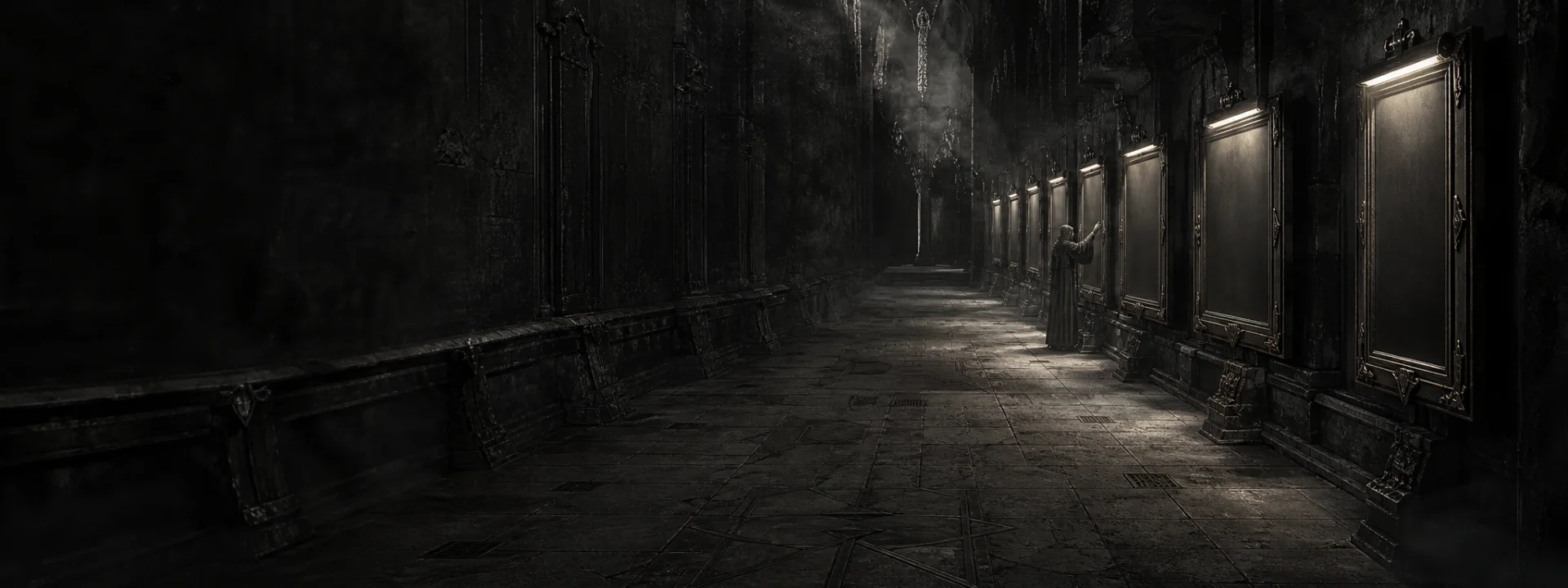
Kharzaan is an ash world of open-cast mines and pit-cities whose skies are perpetually darkened by incineration plumes; only the wardens in their high towers see true sunlight. The population divides into warden families, who have administered the camps for generations, and the steady mass of imported convicts from a hundred other worlds, who break ore and salvage decommissioned war machines for the sector. From this salvage work comes the practical knowledge of vehicles that distinguishes the 214th: whoever has spent a decade dismantling disabled tanks in the scrap pit can also repair a Salamander scout in the field with whatever lies to hand. On Kharzaan, discipline is no virtue but the only alternative to the pit-whip, and the regiment brings this kind of obedience with it—not from conviction, but from a lifelong habituation to punishment as the only reliable constant.
The Disadvantage They Carry
On Kharzaan, mercy is a tool of the wardens, not a feeling: a false decree of clemency, followed by the execution of those who believed it, is part of the camp overseers' standard repertoire. The condemned learn to distrust every order that sounds like relief. At Vrastikon this cost the 214th almost its entire vanguard: Chainlord Voss' genuine order to withdraw was taken for a trap by two platoons under Sergeant Karnass, who held the position against orders until the necropolis awoke and buried both platoons beneath it. Commissar Rasp later confirmed in her field report that no disciplinary punishment had been ordered because, as she wrote, "this regiment has learned, for good reason, not to believe its officers."
Regimental Culture
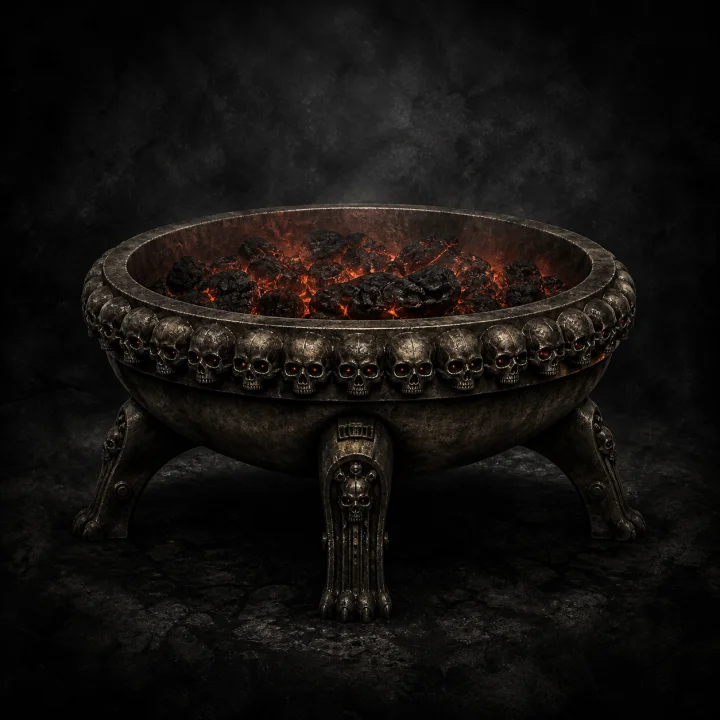
The drill of the 214th is short and crude: weapon maintenance, vehicle recovery, bar training with the assault shield, repeated until the movements need no thought. The marching song comes from the galleries, a monotonous counting chant that originally set the tempo of the pick strokes and now times the mounting of the vehicles; it was never translated into High Gothic, because no one but the convicts is meant to understand it. A superstition no officer still tries to suppress: before mounting, every Guardsman knocks three times on the hull, supposedly so as not to wake sleeping things—since Vrastikon, no one considers it mere superstition. The transport decks smell of oil, ash-sweat and the sweetish rust of patched armour plates. The alcohol ration is seldom drunk, usually traded for spare parts or changes of watch. When there is time, the dead are buried beneath scrap heaps with a chain tag of their own; when there is not, only the identity tag is taken and the rest left to the ash-earth.
The Commissariat
The threat of execution loses its terror when death was the original sentence anyway; the 214th therefore fears its commissars less than the Munitorum expects. An arrangement has been reached: Commissar Ilyana Rasp consistently executes only for desertion and cowardice and ignores lesser infractions, and in return what befell her predecessor after Ostrahl is not repeated—officially he died to xenos fire, unofficially every platoon knows a different version. No one investigates any longer.
Ranks & Organisation
Ranks
Rank Pit-Lord
Description
Munitorum rank: General · Form of address: "Pit-Lord"
Rank Chainlord
Description
Munitorum rank: Colonel · Form of address: "Chainlord"
Rank Bar-Leader
Description
Munitorum rank: Captain · Form of address: "Bar-Leader"
Rank Shaft-Elder
Description
Munitorum rank: Lieutenant · Form of address: "Elder"
Rank Foreman
Description
Munitorum rank: Sergeant · Form of address: "Foreman"
Rank Condemned
Description
Munitorum rank: Guardsman · Form of address: number, not name
Structure
On its founding, the 214th was organised into six reconnaissance companies, each under a Bar-Leader with a command squad over three squadrons of three armoured Salamander scouts each—27 vehicles per company, plus an attached assault squad of ten Guardsmen per vehicle for bar deployment on foot. After Vrastikon and two earlier annihilations, four companies remain, none at full vehicle strength; the fourth drives mostly wrecks, two disabled scouts fused into each roadworthy vehicle. Formally, the Munitorum lists still carry six companies—a discrepancy no one has corrected since the 214th was once wrongly listed as annihilated.
Constituent regiments
Name 214th Kharzaan "The Grave-Breakers"
Role / notes
Heavy reconnaissance. Commander: Chainlord Aldrik Voss, an old blade scar crushes his voice to a whisper. Status: active on the Ultima front, reduced to barely a fifth of establishment strength.
Name Kharzaan 77th "The Mute"
Role / notes
Assault infantry. Commander: Bar-Leader Yannick Sorr, deaf in the left ear since a booby trap. Status: currently training the foreign replacement contingents of the 214th before they have ever seen Kharzaan.
Name Kharzaan 402nd "The Back Payment"
Role / notes
Assault pioneers. Formerly Kharzaan 158th, almost wiped out at Vrastikon; the new cohort, shipped from the penal world Gethsen Minor, inherited along with the number the charred banner fragment and the unsettled tally-debt of the dead. Commander: Bar-Leader Dessa Korr, right arm fully augmetic.
Command Staff
Command staff
Name Chainlord Aldrik Voss
Beschreibung
Chainlord Aldrik Voss once commanded a respected infantry regiment before a bribery scandal demoted him to the penal legion; he has never overcome this bitterness and takes it out on anyone who reminds him of it. Gaunt, bearing the aforementioned scar across his larynx, he carries as his only personal possession the bolt pistol of his predecessor, whom he never met. Before Vrastikon he cut an entire platoon's last ammunition delivery because its sergeant had called him "Colonel, sir" instead of "Chainlord"; shortly afterwards the platoon went into the first wave with empty magazines. Voss never mentions it.
Zitat
"You are already dead. I only need you useful."
Name Commissar Ilyana Rasp
Beschreibung
Commissar Ilyana Rasp keeps her uniform spotless despite the ash, a habit the condemned read as a threat, not as vanity. Her coat is lined with the name tags of those she has personally shot—not many, she says, but enough to be counted. After Ostrahl she took command of the commissars without it ever being explained what happened to her predecessor. She shoots deserters without hesitation and overlooks patched-up breaches of discipline as long as the vehicles keep running.
Zitat
"I am not here to save you. I am here so that you at least die properly."
Name Enginseer Tobrin Kess-9
Beschreibung
Enginseer Tobrin Kess-9 came to the 214th with the second raising and speaks to the Guardsmen hardly more than the rite demands; decades ago his right eye was exchanged for a cognitor lens that lets him "smell" vehicle damage, as he puts it. His servo-harness bears salvaged Necron alloy plates, which he secretly works into the armour of the Salamander scouts, contrary to every Mechanicus regulation. When a dying Guardsman asked for a spare part for his own augmetic leg, Kess-9 refused it in favour of a vehicle engine; the man died, the vehicle drove on. Kess-9 considers this the right decision.
Zitat
"The flesh condemns. The engine does not."
Attached Personnel
| Unit | Number |
|---|---|
| Commissars (under 1 Lord Commissar) | 6 |
| Ogryn squad | 1 |
| Preachers of the Ecclesiarchy | 9 |
| Psykers of the Scholastica Psykana | 1 |
| Tech-adepts of the Adeptus Mechanicus | 4 |
These staffs answer to no Bar-Leader. The friction is most visible with Kess-9's adepts, who as a matter of principle tend to disabled vehicles before wounded Guardsmen—an order of precedence the regiment endures but has never accepted.
The Regimental Standard
The standard of the 214th is no banner but a chain made from the original shackles of the first cohort, hung with metal tags into which the numbers of the fallen are stamped, mounted on a pole of salvaged Necron metal from Vrastikon. Burned into it are the campaign names Ostrahl and Vrastikon, no mottos. At Vrastikon the standard-bearer, chained to the chain as custom dictates, was left for dead; he dragged it three days through the ash to the rallying point, with shattered legs, and died almost as soon as he had delivered it.
The Flaw
The flaw
The stigma of the 214th is not a flaw of character but the very basis of its existence: every Guardsman carries a file that condemns him to death, and other regiments know it. After shared quartering with the Voidsreach 5th Assault Regiment at Ostrahl, three equipment wagons and a sergeant vanished within a single night; Captain Ferrin Dal's report thereupon recommended that the 214th never again be quartered closer than two hundred paces to other regiments and that their weapons be locked away before and after every engagement. This regulation remains in force to this day. In daily life it shows in empty buffer zones around their camp and doubled sentry posts that are not meant for the enemy. In battle it shows in the fact that neighbouring regiments seldom grant the 214th fire support without an explicit order—no one wants "the condemned" coming too close. The regiment itself tells that the theft at Ostrahl was invented, a pretext to be rid of them; those who admit this do so only among themselves. Other regiments simply call them "the Rats of Kharzaan"—never in their presence.
A Munitorum Failure
After Vrastikon, the Munitorum formally reported the 214th as annihilated before the scattered survivors—cut off by the interference field of the awakening necropolis—could even establish vox contact. The deletion from the supply list was only corrected nineteen months later, when a supply convoy chanced upon remnants of the fourth company. During this time the regiment kept itself alive solely through plunder, vehicle salvage and meagre remaining stocks; ninety-one of the original four hundred and eighty survivors died in these months of deprivation, not enemy action. The responsible scribe in the Administratum was never identified.
Known Campaigns
Campaigns
Name Ostrahl Campaign — against the Waaagh Grimznik
Epoche c. 420.M39
Erzählung
Shortly after its raising, the 214th was dispatched together with the Cadmar 12th Armoured Grenadier Regiment and the Voidsreach 5th Assault Regiment against the Waaagh Grimznik, which had overrun three mining worlds. The Grave-Breakers—then still without that name—served as fast reconnaissance and kept roads open while the armoured grenadiers held the front. The campaign ended in stalemate after three years: the Waaagh collapsed more through its own lawlessness than through Imperial firepower. The battle group was disbanded according to regulation; Voidsreach 5th was transferred to another sector, and the 214th never saw it or the Cadmar regiment again. Of 3,200 men at raising, 2,100 remained.
Name Vrastikon — against the awakening necropolis
Epoche c. 640.M40
Erzählung
The 214th was landed on Vrastikon as a vanguard alongside the sister regiment Kharzaan 158th and the Bastion-Karn 3rd Grenadier Regiment to confirm reported Necron activity—in practice, to trigger the necropolis's defences before regular regiments advanced. When the tombs awoke, high command ordered the only bridge of retreat to be demolished, together with the regiment's own wounded who could no longer be moved; Chainlord Voss obeyed, because objection would have cost him the last remnant of his rank. To this day the regiment bears the names of these wounded on its standard, undivided from the fallen. Bastion-Karn 3rd meanwhile held a covering position with no survivors, thereby enabling the withdrawal of the remnants of the 214th—a debt that will never be repaid: Bastion-Karn 3rd was afterwards transferred to the Screthon Sector and, according to the Munitorum, no longer exists. Of 2,600 men, 480 survived; Kharzaan 158th effectively ceased to exist.
Name The Slag Campaign — against second necropolis activity at Skarrhollow
Epoche c. 740.M41
Erzählung
After years of rebuilding with replacement Guardsmen from the foreign penal world Gethsen Minor, who knew neither the Chain-Lord nor the address by number, the 214th was deployed alongside the Skarrhollow militia contingent and a force of the Adeptus Mechanicus from Kel-Doran against a second necropolis. The foreign recruits, at first shunned by the Kharzaan veterans, proved themselves when they single-handedly recovered a disabled scout under fire. The campaign ended without decision—the necropolis sealed itself again before it could be destroyed. Of 920 men at the campaign's start, 740 remained, the regiment's current actual strength.
Vehicle livery
How the regiment’s vehicles are painted: base colour, camouflage for the theatre, turret band and markings, derived from the regimental colours.
| Theatre | Rubble and ash · Splinter camouflage |
|---|---|
| Base colour | #39484A · Mechanicus Standard Grey (Tunic (Ash Grey)) |
| Camouflage | #7A6E62 · Rakarth Flesh (theatre standard)#4A4440 · Mechanicus Standard Grey (theatre standard) |
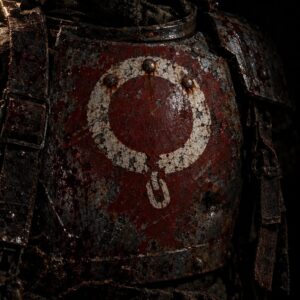
| Turret band | #960C09 · Mephiston Red (Warning stripes and insignia (Rust Red)) |
| Markings | #ABA173 · Ushabti Bone (Number tags and stamps (Bone White)) |
| Hull recipe | Mechanicus Standard Grey (Base) · Nuln Oil (Shade) · Dawnstone (Layer) · Slaanesh Grey (Edge) |
Company bands on the turret
- 1.
- 2.
- 3.
- 4.
- 5.
- 6.
- 7.
- 8.
- 9.
Derived from the regimental colours; the silhouettes are our own sketches, not copies of any Games Workshop model.
On the Core Data
The number 214 is high because Kharzaan continually gives up new regiments: every cohort of the condemned that fulfils the quota receives a new ordinal number, no matter how many predecessors have already served or died under the name Kharzaan. The 214th is thus no venerable regiment of tradition, but a young entry in a long, unbroken reckoning.
Formally, the 214th has already been declared destroyed three times and raised anew from fresh convicts—most recently after Vrastikon. The Munitorum retains the number, just as it does with the Vintor 823rd after nine annihilations: honour clings to the numeral, not to the men. Today's Guardsmen wear campaign names such as Ostrahl or Vrastikon on their sleeves that they never lived through, and most of them hate this rather than take pride in it—borrowed glory that must be worked off like someone else's debt.