187th Kaldrask
“Call him by name, hold the line without wavering, honour the spirit in the machine, and if you must die, die with your visor raised.”
Core Data
| Regiment type | Hunter-Killer (seeks out and kills named targets) |
|---|---|
| Munitorum designation | MR/KALD-187/IX.δ |
| Homeworld | Kaldrask |
| Tithe grade | Exactis Extremis – the single most demanding tithe grade |
| Establishment strength | 4,200 men |
| Current strength | 1,140 men |
| Allegiance | Loyal |
| Origin | Original regiment |
The pillars
The Name of the Enemy
An enemy without a name is mere ammunition expenditure. The Ironsides do not hunt divisions; they hunt men and women: Sept commanders, warlords, leaders whose names are pieced together from intercepted vox, captured data-slates or interrogations. Only once a target bears a name is it deemed worthy enough to commit a Company to it. This seldom yields strategic benefit on the larger scale, but it gives every dead comrade a meaning: fallen while hunting someone.
The Iron Line
The Ironsides do not break—not a motto but the result of drill: closed formation, withdrawal only on express order, which no sergeant may ever issue himself. At Kupferwall the line held for sixteen hours, though the left flank had long since been turned; of nine hundred men, one hundred and ten were standing at the end. The regiment calls that a victory. Among themselves, the survivors seldom call it by name.
The Pact of the Machine
No lasgun, no vehicle leaves the workshop unblessed. The Enginseers of Kaldrask are no strangers within the regiment but heirs to the same catastrophe: their ancestors recovered the machine spirits from the wreckage of the Great Burning and swore never again to leave them unhonoured. A soldier who maintains his weapon poorly is considered not negligent but spiritually unclean.
The Code of Honour
An enemy who flees has already lost, and a loser is not shot—so runs the teaching of the knightly houses of Kaldrask. In the field this means: officers challenge named foes to open combat rather than shooting them from cover, and grant defeated commanders time to surrender. How many of its own people this decency has cost in the end is not counted within the regiment. Other regiments count it very well.
Further core facts
| Fact | Value |
|---|---|
| Militarum Regimentum | Levy of Kaldrask |
| Common Name | Ironsides |
| Origin of the Name | Won, not inherited: at the Battle of the Copper Wall the regiment held an outflanked line for sixteen hours without an order to withdraw, which is why neighbouring regiments thereafter called them "the iron flank", Ironsides for short. |
| Regiment Type | Hunter Regiment (Hunter-Killer) |
| Founding | M41.2 |
| Tithe Grade | Exactis Extremis – the world gives more than it can bear |
Raising, Homeworld & Culture
Raising & Tithe
Kaldrask raises its regiments within the framework of the regular levy—a tenth of the planetary fighting strength, cycle after cycle, without the slackness of an emergency levy, but with a frequency that has long since turned the regular tithe into a perpetual haemorrhage. Because every levy is regarded as a trial of the knightly houses, more volunteers always come forward than there are places; whoever is rejected is deemed without honour, and whoever is accepted has often publicly pledged rank and name before the muster. The Planetary Governor knows that a contingent too small, too poorly drilled or genetically impure counts as a capital crime; he therefore sends not the expendable but the sons and daughters of the finest houses—out of self-preservation, not out of duty. Kaldrask has thereby lost more capable warriors than any enemy invasion could ever have claimed.
What the Homeworld Lost
Kaldrask has lost the last complete generation of its weaponsmiths. The Knights' Toll—a tournament rite requiring forty participants, in which each house fields its finest fighter and the blades of the fallen are reforged—is held today with eleven participants, because twenty-nine houses no longer possess an heir fit for arms whom they could send. The old forge-songs, once passed down orally through generations, are now known only to a handful of old men; when they die, the melodies die with them.
The Homeworld
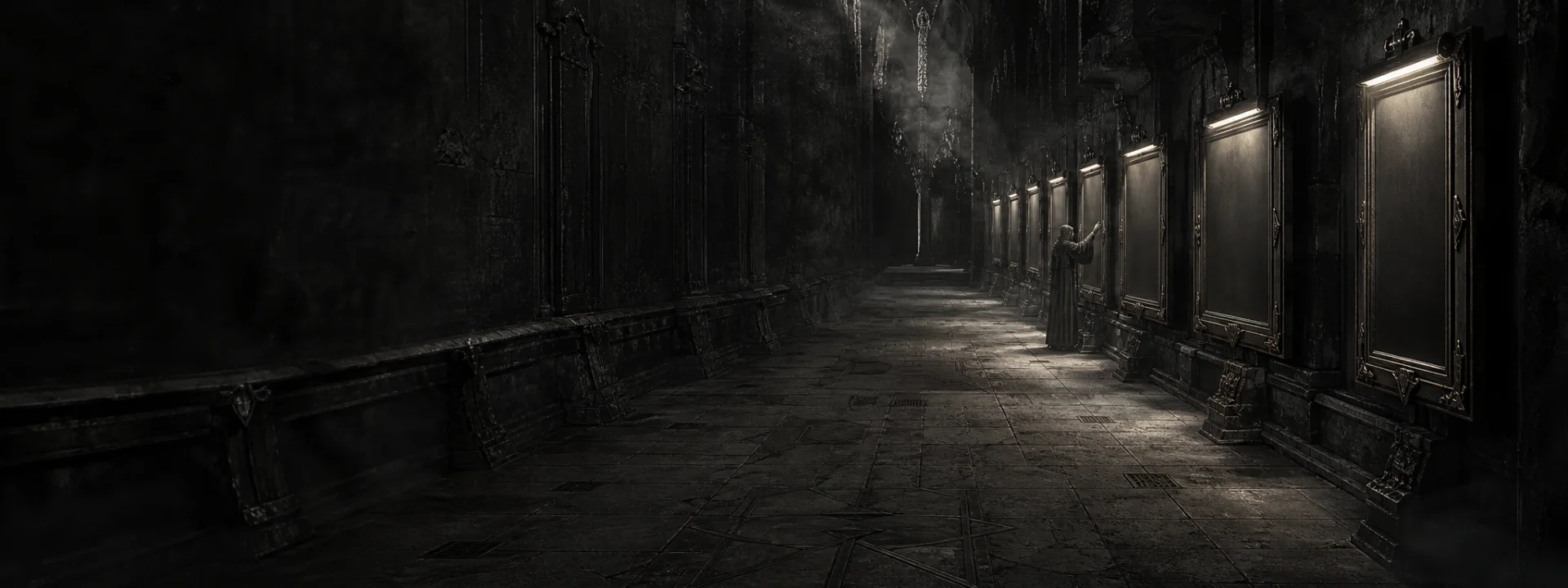
Kaldrask is a dead world in the literal sense: a world that once died and has since refused to be properly buried. Some five centuries ago a T'au vanguard fleet burned the northern hemisphere to the ground in order to break Imperial resistance; it underestimated the knightly houses, which survived the attack in subterranean halls, but the planet never recovered. A permanent veil of ash darkens the sky into eternal twilight; the continents are strewn with the wrecks of fallen war machines, around which villages and knightly houses have formed that tend these machines as half-holy ancestors. Disputes between houses are traditionally settled by duel, never by open battle—a culture of unusually disciplined single combatants that has at the same time learned to function in closed formation as soon as a common threat demands it.
The Disadvantage They Carry
Whoever grows up beneath a permanent veil of ash develops eyes for twilight. Under open, glaring sun this sight fails: dazzle, headache, delayed target acquisition. At the engagement on Glasrücken, a boundlessly bright glass-desert world, the 187th Kaldrask lost three hundred and twenty men within two hours, many of them because they simply did not recognise enemy silhouettes in time, while T'au optics functioned undisturbed. Captain Verrick Solane, then serving with an allied regiment, noted drily that the Ironsides had "fought like men boxing with their eyes closed". The regiment has requisitioned photoadaptive visors ever since, with varying success.
Regimental Culture
The drill is close order to the point of exhaustion: changes of formation in the ash-rain, for hours, until no one stumbles any more. The marching song, "The Song of the Eleven Thousand Names", recounts not battles but the fallen—each verse a name, endlessly extendable, never sung identically twice. Officers have given up trying to suppress the superstition of scratching the name of the next enemy to be hunted into the rifle stock with a needle; it is believed that an unscratched name brings its bearer his own death. The transport decks smell of gun oil, incense from the Mechanicus rituals and the acrid scent of ash that no equipment ever fully washes out. The spirit ration is distributed, not drunk: one swallow per named enemy the drinker personally killed. If there is time, the dead are buried with a full salute of honour; if there is none, their name is scratched into the hull of the nearest reachable machine wreck.
The Commissariat
The 187th Kaldrask has made its peace with its commissars, though not a comfortable one. So long as a named target ends up dead, Commissar Draeger tolerates the formal challenges that defy all military logic; in return she keeps her own register of those she has shot, longer than the regiment admits. Officers fear her less than her meticulousness: Draeger forgets nothing, seldom forgives, and is silent longest when a duel has cost more men than it needed to.
Ranks & Organisation
Ranks
Rank High Marshal
Description
Munitorum rank: General · Form of address: "High Marshal" / "Excellency"
Rank Banner Lord
Description
Munitorum rank: Colonel · Form of address: "My Banner Lord"
Rank Lance-Master
Description
Munitorum rank: Major · Form of address: "Lance-Master"
Rank Ridemaster
Description
Munitorum rank: Captain · Form of address: "Horsemaster"
Rank Squire
Description
Munitorum rank: Lieutenant · Form of address: "Squire"
Rank Man-at-Arms
Description
Munitorum rank: Sergeant · Form of address: "Man-at-Arms"
Structure
At its founding the 187th Kaldrask was organised into six Companies of four platoons each, every platoon with three ten-man squads, one special squad and one attached heavy weapons squad—some 4,200 men on paper. Each Company is assigned a fore-squad of twelve grenadiers which, in accordance with the Vanguard Doctrine, enters every engagement first in order to locate the named target before the main force deploys. A single servitor-directed battery—four Basilisks with minimal crews—supports the entire regiment. Of the six Companies, four still exist today, two of them only at platoon strength; the missing two were not re-raised but absorbed into the remaining four.
Constituent regiments
Name 187th Kaldrask "Ironsides"
Role / notes
Hunter regiment, commanded by Colonel Aldric Vantor (burn scar across the right half of his face, from the Kupferwall). Currently deployed on the T'au border; subject of this dossier.
Name Kaldrask 92nd "The Swift Blades"
Role / notes
Reconnaissance regiment, commanded by Horsemaster Freya Hansk (missing left eye, glass prosthesis made from a captured T'au visor). Deployed in the Sog Sector, without contact with the 187th for years.
Name Kaldrask 205th "The Unbending"
Role / notes
Infantry regiment, wiped out entirely at Orven-Fall and raised anew within a year; the new complement inherited the name, the standard and a single surviving sergeant, who teaches the old toasts without knowing any of the recruits personally.
Command Staff
Command staff
Name Colonel Aldric Vantor
Beschreibung
He laughs too often for a man half of whose face bears the scars of the Kupferwall. He carries the honour gauntlet of his house—gilded, worn bright at the knuckles—at every formal challenge, held visibly over his head as well. At Sennvahl he insisted on delivering the order to withdraw in person, though it could have cost him his life; he survived, four hundred of his men did not. He speaks of it openly, without visible remorse.
Zitat
"She does not know our name yet. But she will."
Name Commissar Ilsabet Draeger
Beschreibung
She wears an augmetic eye that never blinks, which unsettles recruits more than her bolt pistol. Her personal object is a leather-bound register of every execution, thicker than the regiment likes to admit. At Kressilon she let a duel run to its end, though a single rifle shot could have ended it, because she judged that breaking it off would cost more discipline than the duel cost in time.
Zitat
"I do not count victories. I count who still obeys."
Name Enginseer Iavo Krast
Beschreibung
Beneath his red robe he wears a fragment of the shattered machine core that was once the first Knight-Warden of Kaldrask, before the Burning smashed it—his only heirloom, older than the regiment itself. He blesses no weapon without reading out the name of its last bearer. When a recruit once mocked this as mere oil and ritual, Krast made the man's lasgun jam for three weeks, until he apologised—to the machine, not to him.
Zitat
"The spirit does not forget who oiled it, and who did not."
Attached Personnel
| Category | Number |
|---|---|
| Commissars (under a Senior Commissar) | 7 |
| Ogryn squad | 1 |
| Preachers of the Ecclesiarchy | 14 |
| Lay assistants of the Ecclesiarchy | 22 |
| Psykers of the Scholastica Psykana (including Primaris Psyker Sorcha Vell) | 3 |
| Enginseers of the Adeptus Mechanicus | 5 |
These specialists answer to their own hierarchies, not to Colonel Vantor. The friction is most evident with the Enginseers, who regard recovered machine relics as grave goods rather than spare parts—and refuse to "waste" them on duels.
The Regimental Standard
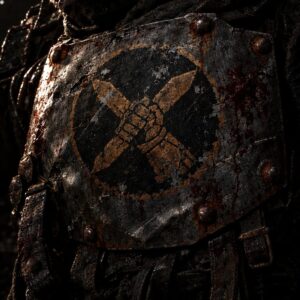
A tattered banner of knightly-house cloth, bearing on a black field a clenched, iron-coloured fist above crossed blades, its edge embroidered in tiny script with the names of every known named foe—room for a good four hundred names, almost full. At Kressilon it was nearly lost when its bearer fell and a T'au squad overran the field; a man-at-arms named Corvel dragged it back single-handed, under fire, with two shot-through fingers he refused to have treated until the standard was safe.
The Flaw
The flaw
The honour code of Kaldrask was not invented in the field but imported from the knightly houses, in which a fleeing enemy is traditionally spared, because victory without witnesses is worthless. In service it shows itself daily as lost time: formal challenges before the firefight, waiting until a named officer is armed. In battle it shows itself more lethally. At Orven-Fall the 187th let a fleeing T'au command group go rather than mow it down—"a beaten enemy is not shot," noted Sergeant Aldona Reck in the battle report—and within two days that same group organised the counter-attack that nearly wiped out the neighbouring Ophrain 9th Light Infantry. Captain Verrick Solane of the Ophrain 9th thereupon wrote the report "On the Cost of Courtesy," which circulates in Munitorum archives to this day. When the 187th is quartered alongside other regiments, people keep their distance: no one likes to borrow ammunition from men who might be saving their own for a duel. The regiment itself calls it honour. Others, behind their hands, call them "the Courteous."
A Munitorum Failure
After the engagement on Glasrücken, the 187th requested photoadaptive visors against its innate twilight-dazzle. The Munitorum approved the requisition forty-two years later—by which time the regiment had already been fighting for a decade in the permanently dark tunnel wars of Kressilon, where the visors were useless, at times dangerous, because they overcompensated for what little residual light there was. The shipment was delivered nonetheless, logged and never taken back; it lies in crates in the baggage train to this day. During the years of waiting, the 187th lost an estimated six hundred men on three further bright worlds to precisely the problem the visors were meant to alleviate.
Known Campaigns
Campaigns
Name Retribution Campaign against Sept Ma'kesh
Epoche c. 655.M39
Erzählung
(M39.6–M39.9, Ultima Segmentum, against expanding T'au outposts). The 187th fought alongside the Cadmar 3rd Armoured Grenadiers and the Hoyven Rifles along a chain of outposts and tested its name-hunt tactics on a large scale for the first time, with mixed success, as many T'au command structures remained rotating and nameless. The campaign ended in stalemate: no outpost fell permanently. Of 4,200 men at initial strength, 3,100 remained. The battle group was disbanded afterwards; it is remembered who held the flank at Outpost Seven when the Cadmar tanks failed—a debt neither side could ever repay, for they never saw one another again.
Name Defence of Kressilon
Epoche c. 140.M40
Erzählung
(M40.1–M40.3, against a T'au invasion fleet). Together with the Drossenhall 4th Armoured Reconnaissance, the 187th held the tunnel systems beneath the capital until both regiments had been shot down below platoon strength. The Munitorum decreed the merging of the survivors into the "new" 187th Kaldrask; the Drossenhallers, from an industrial world without knightly-house tradition, still consider the honour code dangerous nonsense, but have respected the iron line of the Ironsides since experiencing it themselves. Of some 3,100 Ironsides and 900 Drossenhallers, 1,400 survived together.
Name The Holding of Sennvahl
Epoche c. 135.M41
Erzählung
(M41.1, against a T'au vanguard, to cover an evacuation). The sector high commander ordered the 187th to hold a position without relief or option of retreat, to buy time for civilian ships—an order of which later analyses suggest the evacuation would have failed regardless. Vantor obeyed without doubting publicly. Beside the 187th, the Ophrain 9th and a platoon of the Sororitas of Candelis held the line; both were afterwards transferred to other theatres of war, and they never saw one another again. Of 1,400 men, 340 survived. Since then the regiment calls it not waste but the greatest duel in its history—a reinterpretation no one in the regiment questions aloud.
A new wave of volunteers from Kaldrask brought the 187th within a year to its present actual strength of 1,140—it will never again reach its nominal strength of 4,200.
Vehicle livery
How the regiment’s vehicles are painted: base colour, camouflage for the theatre, turret band and markings, derived from the regimental colours.
| Theatre | Rubble and ash · Splinter camouflage |
|---|---|
| Base colour | #405B71 · The Fang (Iron grey (weapon, vehicle front)) |
| Camouflage | #7A6E62 · Rakarth Flesh (theatre standard)#171314 · Corvus Black (Ash-black (greatcoat, armour)) |
| Turret band | #960C09 · Mephiston Red (Order red (piping, standard)) |
| Markings | #EDC169 · Retributor Armour (Brass bronze (visor, insignia)) |
| Hull recipe | The Fang (Base) · Drakenhof Nightshade (Shade) · Russ Grey (Layer) · Fenrisian Grey (Edge) |
Company bands on the turret
- 1.
- 2.
- 3.
- 4.
- 5.
- 6.
- 7.
- 8.
- 9.
Derived from the regimental colours; the silhouettes are our own sketches, not copies of any Games Workshop model.
On the Core Data
The number 187 is no mark of venerable age but the opposite: in less than two centuries Kaldrask has furnished the Astra Militarum with one hundred and eighty-seven independent regiments, and the designation grows faster than the world register can supply volunteers. The 187th Kaldrask has already twice been decimated almost beyond recognition and once—after the defence of Kressilon—merged with the remnants of a foreign regiment. Today's soldiers bear honours for battles in which they never fought and the names of fallen they never knew; in Kaldrask's understanding this is no contradiction but the very point—whoever carries on the name of a dead comrade has sworn to avenge him.