Raskian-7
Core Data
| Kind of figure | Magos |
|---|---|
| Rank | Forge Master (highest-ranking tech-priest of a forge temple) |
| Speciality / caste | Macrotek (major installations and production lines) |
| Forge world / Shield Host | Agripinaa: reine Rüstungsschmiede, muss Nahrung importieren; Fehde mit der Hell Forge Temporia |
| Era | M32–M35 (the War of the Beast, the Moirae Schism) |
| Standing | Needed, not liked |
Further core facts
| Fact | Value |
|---|---|
| Rank | Forge Master |
| Specialisation | Macrotek—major installations and production lines |
| Forge World | Agripinaa |
| Era | M32–M35 |
| Augmetic Grade | Beyond his original form (Raskian Pattern) |
| Chassis/Frame | Mechanical grasping crown above the shoulders |
| Standing in the Priesthood | Needed, not liked |
| Loyalty | To the Omnissiah; neutral in the Moirae Schism |
| Designation Code | FOR-AGR-7-MACK / Suffix 7 = seventh overall assignment of his workshop to successors |
Origin & Body
Origin and rise
Raskian was a survey assistant on Agripinaa—not a rare name, no distinguishing feature, until in M31, four years before the Schism of Mars, she recognised a deviation in the production metrics of Zentrum Ost that no one else had noticed. A manometer had been incorrectly calibrated; an entire batch of field generators would have left defective. She reported it to the Magos Dominus of her facility. The answer was examination and admission to the adept ranks.
Her first discipline was noosphere cartography—the reading of the immaterial connections between machines. A lonely path. Her first error was M32.2: she proposed not to replace a damaged transfer line, but to heal its machine spirit through recalibration. The proposal was not heretical—it was merely... unorthodox. Minor. She was reprimanded.
The Rite of Ordination to Magos came under Fabricator-Locum Solun-44 in the year M32.9. It was a time of indecision on Agripinaa; the forge did not know which side it should follow. Raskian swore no allegiance. She swore only to the Omnissiah, and for that reason she remained.
The body
Until the year M33, Raskian had two arms and a voice like other humans. The first thing she gave up was her left eye—an exchange for an ocular array that saw spectra organic flesh could not see. At that time it was still an act she consciously endured; she remembers the incision, the taste of medicated water afterwards.
The second was the right hemisphere of her brain, removed and replaced with augmetics. The Rite of Clear Thought is a procedure whose name is a lie. It does not make one clear—it makes one unfeeling. She lost her capacity to feel fear, and with the fear, grieving passed away too. What remained was a sharpness of logic that other Magi describe as inhuman. Raskian does not notice it herself. She can no longer remember the difference.
From M33.4 to M34.8 she systematically replaced every limb, every organ with augmetic equivalents. The lungs became a filtration plant, the kidney a processor. Her heart could have remained—it should have remained. At this point such conversions normally ended. She, however, had it removed and buried it in the Grabhalle Ost beneath the stone-word of a cantilena that no other Magos understood.
That which Raskian had been died in M34.9. What came was no longer a human with machine parts, but a machine that still identified itself with a name.
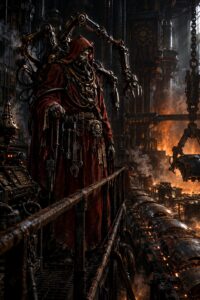
The Raskian Pattern is the continuation. Her consciousness divides into parallel computational streams—each assigned to one of Agripinaa's great production lines. She occupies eight different positions simultaneously. She is located in none of them. The carrier frame, the mechanogripper rig with the crown above the shoulders, is merely a relay, a point at which the threads wind back to the origin. She can no longer leave. Nor does she.
What she can no longer do: she can no longer be alone. Raskian is too closely interwoven with the noosphere to exist in isolation. If the carrier frame is shut down, the Magos does not end—but the Magos becomes fragmentary, torn across five sites, incapable of coherent action. She has noticed this. She has decided to ignore it.
Purpose & Deeds
What drives them
Raskian pursues a thesis without a name, which she took up thirty-nine years ago: that the Men of Iron were not machines, but an earlier form of human perception in metal form. That they were not manufactured, but invented—that the difference is decisive. That Belisarius Cawl, the most famous Magos of the recent era, found one of them and inlaid its architecture into his own augmetics.
Official Mechanicus doctrine calls the Men of Iron a warning against the Silica Animus—the artificial intelligence that is forbidden. Raskian reads the prohibition differently. She reads it as fear. And where the Mechanicus has fear, she suspects truth.
She has spent thirty-nine years. In that time three of her assistants died of radiation—not involved in her work, but collateral damage of the archive intrusion into sealed sections. One of them was her nephew. She has struck his name from her memory, and the augmetics allow her to do so completely.
She has stolen archive access, bribed transport companies, falsified two data-scribes and sold a forgery network to a heretic—not out of malice, but out of indifference. She needed the resources. The heretics needed the knowledge. It was a fair trade.
What would she accept as proof that she is wrong? Nothing. She has never asked this question, and now she cannot answer it. That is the final measure of her fall: not that she errs, but that she can no longer recognise how error is recognised.
Deeds
The Redistribution of Zentrum Nord—M33.1
Zentrum Nord was Agripinaa's oldest production facility—nine thousand years old, with machine spirits that barely obeyed any longer. Its Fabricator wanted to close it and move production to Zentrum Ost. Raskian proposed uniting them.
She bound the two machine noospheres together through a new relay network that she had designed with her own hands. The Fabricator refused—it was heterodox, it was not provided for in the canon. She did it anyway, at night, with access she should not have had. When the Fabricator noticed it in the morning, production was already running ten per cent higher than before the merger. Three days later he asked for an explanation. She did not give one. She never gave an explanation. The facility ran. That was enough.
What it cost: Two servitor-labourers were paralysed by the feedback. They were sent to the culling hall. Raskian never learned how long they lasted before disposal came.
What she took with her: A new insight into the grammar of machine spirits—that they can not only be commanded, but persuaded. This insight would be the foundation of all later work.
The Case of the Temporia Liaison—M34.3
Temporia is not so much a forge as a nightmare in the format of a forge. While Agripinaa manufactures armour and field generators, Temporia produces weapons from which blood cannot be washed, on which curses are carved. The Cult Mechanicus calls it a hell-forge. Raskian calls it a footnote in the architecture.
In M34.3 an emissary of Temporia came to her—not with a message, but with a fragment. A component of something Raskian had to recognise: an interface, older than the current architecture, not human.
The emissary offered a trade. Raskian could have the fragment if she gave Temporia the blueprints of her noosphere redistribution. A fair exchange.
She refused. Instead she offered to develop both blueprints jointly. A new pattern that would lie on Agripinaa and in Temporia—a bridge between the forges. Temporia did not accept. The emissary left the facility with nothing.
What it cost: The tensions between Agripinaa and Temporia sharpened. Two years later the Skitarii of the two worlds fought in the tunnels beneath the equator. The reason was never officially stated. Raskian knows that it was her no.
What she took with her: The fragment. She stole it after the emissary left the facility. She hid it. She does not understand it to this day. She will not destroy it.
The Vigil over the STC Pattern—M34.6, four months
A Standard Template Construct was found in the depths of Agripinaa—a true one, not a copy or a memory, but the original pattern itself. The procedure is sacred: a Magos must guard it, may never duplicate it, must ensure that it remains intact. Raskian was entrusted with it.
She spent four months in the subterraneum. Alone. That was before the Raskian Pattern spread—she was still concentrated, still in one body, still capable of solitary vigil. She read the structure of the STC pattern. She recognised intent in it—not a machine that was to be procured, but a description of how one thinks procurable things. She wrote down one hundred and eighty-eight canticles that no one else could understand. She fastened them to the reliquary.
When the vigil ended, she was subject to the duty of report. She said everything was in order. That was true. It was also incomplete.
What it cost: She gave up four months of her still-remaining humanity. Afterwards the Replacement was faster, simpler. The boundary between work and self-sacrifice vanished.
What she took with her: The conviction that the Men of Iron were not invented, but understood. That there was a place where this way of understanding might be recorded. That Belisarius Cawl possibly possesses this place.
The Break
The break
Raskian is a heretic of the Lex Mechanicus, but not in the sense of the powers of darkness. She has never invoked the Ruinous Powers and would refuse to if asked—although questions to her are no longer so simple, since she has been distributed.
Her offence: she innovates. She does not repeat the rite. She asks for reasons, not for canons. That the Men of Iron are condemned as an abomination she accepts not as decree, but as a thesis to be examined. She has altered rites, reprogrammed production lines without the permission of a higher Magos, and damaged three archives in her access to sealed data.
The Collegiate Extremis of Agripinaa knows of three of her offences. The fourth—the suggestion that Cawl might possibly be a conscious Men-of-Iron imitatum—was never recorded, because the one who heard it could not write it down before Raskian suppressed the communication.
She has been tolerated. That is the official position: Magos Raskian is peculiar, her methods are at times heterodox, but the yield of her production lines justifies the toleration. Four regiments of the Astra Militarum have had their armour made by her; the field generators of the Stille-Kammer derive from her designs. Belisarius Cawl himself sent a letter to the Collegiate Extremis in M34.7—not legible, but authenticated with his seal—that called Raskian's work "interesting enough to persist".
The punishment for discovery of a major heresy is the Severance: the removal of all augmetics, the conversion of the remaining flesh into a servitor. In Raskian's case the question is speculative. There are scarcely any organic parts left that could be removed. Perhaps she would not survive it. Perhaps that would be no loss.
On the Core Data
The man who no longer is. Raskian does not exist in a form that a mortal would recognise. His consciousness is distributed across a network of augmetics, servitors and continuously running production lines—the so-called Raskian Pattern. What replaced a man began sixty years ago with mechadendrites above the shoulders; today the bare frame, eight metres in height, is merely the visible anchor point. His actual presence extends across three forge districts of Agripinaa, bound into the noosphere, into transmission cables, into the machine spirits of two hundred and thirty production machines. When one stands before the frame, one is not speaking with Raskian. One is speaking with a component of him—the part that can still see, still hear, still speak. The remaining intelligence is dissolved into metal circuitry and Binary Cant. What remains of his voice is a collection of vox-outputs that can sound, time-shifted, from five different workshops at once.
Retinue and Workshop
Raskian does not work with a fighting force, but with a periphery.
A data-scribe named Korvic—age unknown, probably over ninety, with a fully organic body. No one remembers when Korvic came to Raskian; it is rumoured that he joined her during the Moirae Schism, but according to register analysis that was four millennia after his demise. The theory is that Korvic belongs to Raskian because Raskian belongs to Korvic—that each needs the other in order not to vanish without trace. He does not speak. He writes everything into a soiled leather card index. What he documents cannot be explained, even if it is legible.
Then the servitors: three electro-priests, cybernetically so far advanced that the human in them is merely a memory. They wait beside the frame. They always wait. The youngest of them was once an Enginseer of rank, before Raskian absorbed him—whatever the verb may mean.
The workshop itself extends across twelve levels beneath the manufactoria of Zentrum Ost. On the first: benches on which machine parts lie in a partially assembled state, sometimes for years. On the fifth: a vessel from which liquid drips, not blood, but an oil whose colour shimmers. On the ninth: three series of gears, each hidden beneath a cloth, each inscribed with a different warning symbol. The smell is burnt metal oil and something that smells like ozone-rot—not rot, but Decay.
A container on the twelfth level bears no label. Even the servitors do not go there. Raskian has it watched by a servo-skull—an old one, bent, with an engraving that is not binary code but a handwritten note: "Not to be opened, not to be asked, not to be spoken."
Rivals and Alliances
Within the priesthood:
Raskian works regularly with Archmagos Venzolo-23, the highest magos of production oversight. They distrust each other. That is a functioning foundation. Venzolo has noticed Raskian's heresies; Raskian notices that Venzolo looks away. The balance holds because both know it must hold: Raskian's production lines equip five regiments. Venzolo cannot afford to lose them.
Raskian hates Magos Helix-91, the Thesaurus of the Black Libraries of Agripinaa. Helix has twice blocked Raskian's archive access. Raskian responded by making Helix's own access codes public—not to the Black Library, but to enough others that the shame became real. They no longer speak.
Xasandera Valdet—now Fabricator-General of Mars—was an obscure adept on Agripinaa six thousand years ago, in Raskian's workshop. No one knows how long she was there or what she did. Valdet never speaks of it. Raskian does not speak of it either. But they both know that it happened. This silence is an oath.
Outside the priesthood:
The colonel of the local Astra Militarum is Lord Castellan Vorth-Heth. He needs Raskian's weapons. He does not ask where they come from. She does not ask where they go. The liaison works.
There was a Techmarine of the Salamanders who came to Raskian in M34.2 and asked for a rite that violated the code of the Adeptus Mechanicus. Raskian did not refuse—she simply did not do it. The Techmarine left. She has not seen him again.
An Inquisitor named Klastria Sorn holds a thick dossier on Raskian. She has never opened it.
The Archive
Raskian keeps three things she will not reveal:
The first: A cantilena, handwritten by Belisarius Cawl, on parchment, in a language that is neither Binharic nor standard Lingua Technis. It is neither a rite nor a command. It is a question. It reads, as far as Raskian can understand: "To whom does the form belong?" She does not act on it. She does not burn it. She rereads it every eighth shift.
The second: The interface from Temporia. The fragment from the offer she refused. She does not understand what it is—a weapon, an instrument, a fragment of a thought-script. She knows only that it is of no human provenance and that it functioned sixteen thousand years ago. She will never log it. She will never report it.
The third: A servitor skull in a container of preserving oil. The cavity is tattooed with binary code—not by knife, but by electrical etching. No one else can read the markings, because no one else has the ocular array frequency that makes them visible. Raskian prepared the skull herself. She does not remember whose skull it was.
The date she fears most:
That the Men of Iron are not dead.
That Belisarius Cawl does not merely find them, but that he does not find them, because the search itself is a form of finding—that the act of searching already means that someone is there who searches back.
That if this is true, Raskian does not have much time left.