Qvox-73
Core Data
| Kind of figure | Magos |
|---|---|
| Rank | Magos (senior tech-priest; a collective term over many specialisms) |
| Speciality / caste | Magos Reductor (siege warfare; the Ordo Reductor venerates the Omnissiah as "Destruction Itself") |
| Forge world / Shield Host | Uraniborg 1572: von Votheer Tark binnen weniger Tage erobert |
| Era | The Era Indomitus (the Great Rift, Cawl, the present) |
| Standing | Forgotten (his world no longer answers) |
Further core facts
| Fact | Value |
|---|---|
| Rank | Magos |
| Specialism | Magos Reductor, Ordo Reductor |
| Forge World of origin | Uraniborg 1572 |
| Era | The Era Indomitus |
| Augmetic grade | Complete (only the brain and parts of the spine are still organic) |
| Frame | Abeyant (throne on legs) |
| Standing in the priesthood | Orthodox, but suspect |
| Allegiance | Devoted to the Omnissiah; Uraniborg 1572 no longer answers |
| Designation code | QVX-73-μ (μ for "Mnemosyne", the third great reconfiguration after the Rite of Clear Thought) |
Origin & Body
Origin and rise
Qvox came from a scriptorium on Uraniborg 1572, the daughter of two mid-caste data-custodians—not highborn, not promising. In her first decade she learned the binary cant, then the Lingua Technis. At sixteen years of age an Enginseer recognised in her something he could not name: a kind of impatience with mere storage. She did not want to archive. She wanted to understand how the archives spoke.
The Enginseer sent her to the Rite of Clear Thought.
That was no mistake—it was a recognition. The Rite replaced her right hemisphere with an augmetic of the Xarisian School, which cut empathy and remorse from the skull as a surgeon removes a tumour. What remained was a mind that was logical without the ballast of doubt. She became Adept, then Logis, then Magos in less than forty years.
And she began to search.
The body
The organism that was Qvox-73 died in parts over almost eighty years.
The hands went first—long before the rank of Magos. At twenty-five years of age both arms were replaced to the shoulder. A Magos Reductor repairing a siege weapon cannot afford weakness. The fingers became mechanical graspers, capable of holding tolerances to within a micron. Then the eyes—the organic sensors of a Reductor do not reach into the infrared ranges, where a damaged thermal system becomes visible. The Xarisian optics replaced all three.
At thirty-six years of age came the spine. A support of alloyed steel, reinforced with ceramite, because the weight of the later augmetics would have crushed any biological bone frame.
At forty-nine years of age the heart—not the heart itself, but the artery leading to it. An artificial blood-pump system, because the siege of Har-Kardos lasted three months and the human arteries could not withstand the pressure.
Then lung by lung. Liver. Kidneys. What remains now sits in a fluid of promethium and medicinal oils—the brain itself, the lower spine, a network of nerve-impulse strands. Everything else is construction.
She has noticed. More precisely: she has noticed that she did not notice it was missing. That is the difference. A man without the right hemisphere lacks nothing, because he cannot feel emptiness. She no longer asks Why am I alone?—that question was resolved in the cutting torches of Har-Kardos. She now asks only: How many archives still remain?
The Rite of Clear Thought exacted its price in another currency. It robbed her not of memory, not of ability, but of what the Xarisian doctrine calls "the weight of the lost"—the ability to grieve. She had become a brilliant human being with an open wound. Then the wound was surgically closed, and since then she does not think of it.
Purpose & Deeds
What drives them
The Archmagos Etolph Cycerin was once a defender of Hydra Cordatus, a fortress of the Adeptus Mechanicus against an onslaught that lasted nine years. He was brave. He was orthodox. And then he was infected.
A variant of the Obliterator virus—not the canonical line, but a substrain that destroyed only the outermost neurons and left the higher functions intact. Cycerin became, while still alive, a data archive of his own decay. All the pain, all the mutations, all the thoughts documented. And then—and this is the point Qvox-73 could not get past for sixty-six years—then Cycerin was taken to the deep vaults of Ryza. His body was preserved. His archive was not released.
A Magos infected by a xenos pathogen becomes a security risk. The knowledge he carries within him—what the virus can do, how it grows, where the limits of the mutation lie—all of it is placed under Adeptus Mechanicus seals. Classified. Lost.
Qvox was then a young Enginseer, assisting in the evacuation. She saw Cycerin's eyes before they were bound. She saw that there was still a consciousness in them—a consciousness that knew the answers the Omnissiah needed.
For sixty-six years she has tried to break into the archives of Ryza. Not physically—a Magos knows that the noosphere is better guarded than any fortress. Instead she has infiltrated the peripheral domains of Ryza: as a visiting scholar, as a contract worker for the Maintenance Office, as an adviser at the sieges of two dozen worlds where the Ordo Reductor needed her arts. Everywhere the archives might seep through, where the data fragments of Cycerin's condition might come to the surface.
She has found five parts of his original research journal. Fragmentary. Encrypted. A tenth of what she needs.
What would she accept as proof that she is wrong? A sealed vault without a lock. A name that no longer answers. She does not know how to give up.
Deeds
Siege of Har-Kardos, M41.289
Har-Kardos was a rebel world, armed with stolen weapons of the Imperium and the will to hold it. The siege was meant to last six weeks. It lasted nineteen weeks. The reason: the rebel fortress was built modularly—when the first line broke, they simply repositioned the inner structure and threw up a new wall.
Qvox recognised it after four weeks. She needed three more weeks to understand the reconfiguration sequence. And then—against every doctrine of the Ordo Reductor—she ordered not that the wall be bombarded, but that the power supply be cut. Without power, the modular installations could not be rebuilt. The wall was a wall for ever.
Six hundred and twenty-five fighters died instead of ten thousand. The field commander called it a breakthrough. Qvox called it a use of the weapon as it was intended. She received no decoration, nor did she say that the tactic came from Cycerin's archive—an entry describing how the Obliterator virus modularised itself through the body, reassembling itself when its basic supply was withdrawn.
She had learned by watching him, by watching herself die.
Fall of Votheer Tark, M41.312
This was not a war to which Qvox-73 had been called. This was the war that came to her.
Votheer Tark—the Chaos warlord—took Uraniborg 1572 in seventy-eight hours. Not as the Great Rift strikes, but with intent, with tactics, with the knowledge of a man who knew the fortresses of the Imperium. Uraniborg burned. The archives burned.
And Qvox was not there. She was on Ryza, in the archives, where she always was.
She learned of it through a messenger. Uraniborg 1572 no longer answered. The noosphere of the Forge World was dark. That meant that everything ever stored there—all records, all rite data-blocks, all ordinals—was lost or in enemy hands.
She ordered an archive recovery mission to Uraniborg, under her own command. That is no error—that is lawful. To recover a Forge World is the task of the Adeptus Mechanicus. But she was not fast enough. She arrived after Votheer Tark had gone.
All she found was ash and the names of the dead, stamped into what still stood of the outer halls. She has never said that Cycerin's archives lay in Uraniborg—that the last fragments she still hoped for may have turned to dust in that conflagration.
She returned to Ryza, and since then she has searched everywhere. Not only for Cycerin. Everywhere in the corrupted reaches of the realm, everywhere the Great Rift frayed. She says she is collecting lost knowledge of the Mechanicus. She sits upon her throne and her mechano-graspers sort the archives like a man searching the ashes of a dead city for a wedding ring.
Listening Station 7-Flux, M41.318, Stygies VIII
A tiny station in the Cold Sea, an outpost of the Forge World Stygies VIII. Qvox went there on the grounds of repairing a damaged transmission cohort. That was not a lie. It was only not the whole truth.
The truth was: a leaked data packet had surfaced from Stygies VIII—a fragment of a monograph catalogue that should have been destroyed in M35. A very, very old catalogue. A catalogue that recorded the sealed archives of the Dark Age of Technology. And in it—in a footnote, in a reference labelled "not validatable"—stood the name of a research programme.
The programme was called: Adaptive Biomorphosis under Exo-terrestrial Stimulus Conditions. The way it was named fitted Cycerin's work. The way it had vanished—erased, unsealed, lost—fitted too.
She spent seven weeks on Listening Station 7-Flux. She did not reconstruct the transmission array. She searched the station's archive remnants for a copy. And she found it: not the programme itself, but a citation entry, a secondary reference from M39, which proved that the programme had still existed long after it was supposed to have been erased.
The station lay at the edge of the Imperium. No one there checks what a Magos copies. She brought the fragment back with her. She has not said since that she took it.
That is no victory and no error. That is only a number, one more number on her long road. Sixty-six years. Five fragments. A thousand null points. Archmagos Cycerin does not answer. But somewhere, in the depths of Ryza, in a preserved chamber, he still thinks his thoughts. And one day Qvox-73 will break into the noosphere and steal those thoughts out, whatever it may cost.
The Break
The break
Qvox-73 stands formally in the Book of the Orthodox. She performs the rites, she speaks the canticles of the Omnissiah, she charges her augmetics according to the canonical protocols. The Xarisian sect—which venerates the Omnissiah as "Destruction Itself"—has never repudiated her.
But she is suspect.
A Magos Reductor normally moves between theatres of war. Qvox-73 has not left Ryza since M41.307. She has declined the requests of the Ordo Reductor in forty different campaigns. That is no mistake. That is a pattern. A Magos Juris on Ryza has opened a file: unproven conversation with suspect material. No formal charge. Only a shadow over her name.
She could long since have been denounced as a heretic—not for heresy in the classical sense, but because she stole the archives she possessed. The fragments of Cycerin's condition have been copied. They are stored in the noosphere backup of her own augmetics. That is theft of intellectual property of the gravest kind. That is a violation of the Lex Mechanicus which prescribes immediate decommissioning and the conversion of the remaining flesh-mass into a servitor.
But Ryza needs a Reductor who understands sieges like no other. As long as the work is done, the whisper is only a whisper.
She knows that this is so. And she knows that it does not matter to her.
To the core data
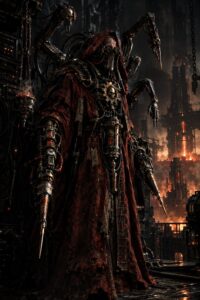
Qvox-73 is what remains of a human when obsession consumes all other things. The Magos stands upon a throne of plasteel and titanium, eight mechano-graspers rooted in his arms like the talons of a bird of prey. His head sits in a capsule of gilded ceramite, the eyes long gone—in their place glow three optic sensors: two red, one violet. A vox unit speaks with his voice, though that voice has not needed a breath for seventeen years.
What distinguishes him is not the machine form. It is the way he moves through rooms. He does not slow down to navigate corridors. He rolls forward, and others step aside. And no one who sees him wonders whether a man still thinks beneath all this metal. The way his mechano-graspers grip data-blocks—not tearing, but examining, layer by layer—says everything. Here is intellect. But it is an intellect that has forgotten pity, and that was intentional.