The Sons of the Firestone
“The fire burns away the unfit. The stone shapes the true. The hand makes work that endures. The will lives in the flame.”
Core Identity
| Progenitor Legion | Salamanders |
|---|---|
| Founding | c. 868.M30 — 1st Founding — raising of the 20 Legions (late M30) |
| Homeworld (name) | Kar Dravin |
| Homeworld type | Death World |
| Combat doctrine | Firepower doctrine |
| Allegiance | Loyalist |
| Chapter strength | Full strength (~1000 Battle-Brothers) |
| One-sentence definition | The Sons of the Firestone are Vulkan's heirs of open fire and hardened craft—fire-priests and smiths alike, who do not conquer their enemies but burn them, and afterwards shape the ash into new foundations. |
The four pillars
Fire is purification, not only destruction
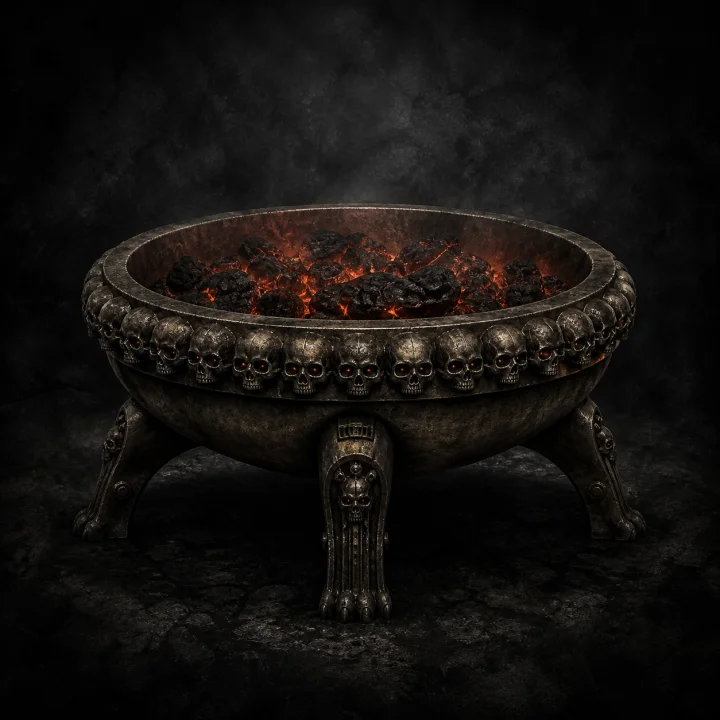
The Sons of the Firestone differ from Chapters that see flame only as a weapon. The Rite of the Orlog (the Purifying Fire) is taught: every engagement leaves wounds in the warrior's soul. Flames can purify these wounds. This explains why the Chapter's battle reports do not glorify the killing of the enemy with flamers, but the result—that the foe was not only defeated, but cleansed. A heathen world that is burned with flames can be reborn. A Chaos daemon dissolved in fire cannot materialise again. This is not bloodlust, but duty.
The craftsman is the true warrior
A Space Marine without technical understanding is a defective tool. The Chapter demands that every brother, from Scout to veteran, be able to maintain at least one weapon or one piece of equipment in its fundamentals. This is not optional. The Techmarine is revered, but a battle-ready brother who can maintain his own armour is revered twice over. This stems from Vulkan himself: the Primarch was creator and warrior in one body.
The Flame Burns Without Regard
The Chapter is not ruthless towards civilians, but neither is it sentimental. When fire is necessary, it is applied. A Stone-Son will not hesitate to burn an infested hive-city district if the Inquisition demands it. That is not cruelty—it is clarity. The flame needs no apology.
The Stone Holds Until It Breaks
No flight, no finesse, no cunning. A defensive focal point of the Sons of the Firestone is held until total annihilation or not at all. This doctrine leads to high losses, but to unshakeable defensive lines. Opponents who fight against the Sons of the Firestone know: they will not be surprised. They will not be outflanked. They will be defeated, or they will triumph with their last round.
Tonality (bullet points)
| Point |
|---|
| Lava geometry and geometry of pain: the visual style blends the unrelenting lines of basalt rock with the flowing, savage red of flames. No ornament without purpose. Every line is a defensive line, every curve a lava flow. |
| Craft over gleam: armour shows signs of wear and signs of repair. A perfectly polished Space Marine looks suspicious. A battle-tested Stone-Son has scratches that prove his Techmarine does good work. |
| Cold heat: flames are not romanticised. They are tools. Their light is grey-white and even, not golden or warming. Even the reds and oranges of the colouring appear cold, like lava as it solidifies. |
| Ruin and rebuilding at once: battle scenes show not only destruction, but also that stones remain. A craftsman who begins to rebuild while the smoke is still rising. |
| Precision under pressure: no chaos or savagery. Even when flames shoot from the barrels, the positions of the shooters are exact. The command structure is visible. A barrage of the Sons of the Firestone resembles a symphony of bolter volleys, not a wild charge. |
Comparison vs. progenitor legion
| Aspect | Progenitor legion | This chapter |
|---|---|---|
| Primary Champion | Vulkan—creator, interpreter of scripture, deliberate use of fire as a theological instrument | Vor'ath Drakeskin—a practising Techmarine Chapter Master who does not separate craft and combat |
| Relationship to Craft | Integral; Vulkan was not only a warlord, but also an artisan and inventor of weapons | Even more ritualised; every brother must bear a skill-mark that certifies his craft |
| Flame Theology | Flames as purification in the metaphysical sense—the fire of the Emperor burns in every warrior | Flames as a direct tool; less mystical, more pragmatic—fire works, so use it |
| Chapter Size & Structure | The XVIII Legion was monolithic, over 100,000 warriors under one command | The Chapter is reduced to 1,002 brothers and uses a strict five-Company structure (four battle Companies, one Scout Company) |
| Relationship with the Adeptus Mechanicus | Cooperation with mutual respect, but clear boundaries | Close entanglement—the Chapter has three active Techmarines and two engineer non-commissioned officers in every battle staff |
| Dealing with Losses | Grief and remembrance as central rituals; losses are processed, not suppressed | Increased efficiency through grief—every fallen brother teaches a lesson; rituals of remembrance also serve tactical analysis |
Further core facts
| Fact | Value |
|---|---|
| Geneseed origin | Salamanders (Legion XVIII) |
| Founding | 1st Founding wave, M31.1 |
| Homeworld | Kar Dravin |
| Fortress-monastery | The Eternal Anvil |
| Combat doctrine | Flame and missile fire, field-fire overwhelming |
| Rulebook compliance | 73 % |
| Battle cry | "Flames awaken—we follow!" |
| Total Chapter strength | 1,002 Battle-Brothers (full strength) |
Core identity (continued)
Forms of Address / Title Cascade
| Level | Designation | Context of Use |
|---|---|---|
| Personal | Stone-Son (Stoneborn) | A brother introduces himself; address within the circle of trust; familiar turn of phrase among brothers |
| Chapter level | The Sons of the Firestone, Sons of Vulkan | Official nomenclature; reports to other Chapters; declarations |
| Ceremonial | The Blazing Heirs of the Great Vulkan, Sons of Fire in Kar Dravin's Shadow, Keepers of the Flame and the Craft | Declarations of war; consecration ceremonies; initiation oaths of the Neophytes; rites of remembrance |
Chapter Maxim
Fire burns away the unfit—purification through annihilation. Every Neophyte undergoes, in the rite of the first trial, a controlled fire that tests the body. Whatever fails this test was unworthy. The Chapter teaches: not all foes deserve death—some deserve purification. Flames are just; they do not distinguish between knight and peasant, but only between that which can burn and that which cannot.
Stone shapes the true—endurance and constancy. Kar Dravin teaches that stone endures for millions of years while flesh decays. A Stone-Son is not bent like green wood, but breaks like granite—or does not break. In this unbendingness lies virtue. The craft of a technician, the structure of a chain of command, the defensive line of a garrison—all are stone. They hold or they do not hold. There is no in-between.
The will lives in the flame—resolve without mediocrity. Flames are cold and hot at once; they are the tool of the will that transforms matter. A Stone-Son without unshakeable will is like a flame without fuel—already extinguished before it was kindled. The will of the Chapter is the flame that burns until the last battle.
Lore & History
Founding history
The Sons of the Firestone did not arise from a legal renaming of the Salamanders themselves, but from one of the first divisions carried out during the Second Founding in M31.1—only weeks after the Siege of Terra ended and the Emperor had been placed upon the Golden Throne. While other Chapters received their geneseed from the remnants of the great Legions, the Sons of the Firestone were created from a special cohort: the Survivors of the Nocturne Workshops, those Salamanders Space Marines who had been ordered to organise the continuing defence of Kar Dravin while the Great Crusade raged elsewhere.
Kar Dravin was not Vulkan's world—that was Nocturne, far away in warp-unsafe space. Kar Dravin was a Death World in the Slag Reach, a rocky, volcanically active world the Imperium had conquered in M30.7. The Salamanders had stationed a garrison there, a so-called Eternal Flame—ten Companies under the command of Captain Vor'ath the Old (not to be confused with the present Chapter Master of the same name, who is a descendant in the seventh generation). When the Imperium split in two during the Heresy, Kar Dravin remained isolated. The orbital stations fell; the supply ships came no more. Captain Vor'ath received one last order over a degraded Astropath chain: Hold. The Emperor will triumph. You will be delivered.
He held.
For twenty years the Salamanders of Kar Dravin held against successive xenos invasions, against Chaos warbands operating out of the Eye of Terror, and against the mutated inland dwellers of the world itself. They lost three Companies entirely—not in battle, but to the Plague of the Second Sleep, an anomaly of the geneseed that four years later became a trait of all the Chapter's descendants. They lost all but one of their Techmarines. They allied themselves with the local Keeper Circles, those strange, half-human beings born on Kar Dravin who survived the extreme conditions no normal human could endure.
When the first supply fleet came in M31.1—almost a millennium later, but Second Founding time was not one-to-one with the standard calendar—they found Captain Vor'ath the Old, his face burned with scars, his geneseed mutagenised by Kar Dravin's toxic environment, but still alive. The Chapter was founded from what remained of this garrison: not as a new creation, but as the recognition of a Chapter that had already waged war for a thousand years.
The present Chapter Master, Vor'ath Drakeskin (the ninth of this line in seven centuries), does not bear the name of his forefather by chance. It is not a title—it is an inheritance. Every Drakeskin is bound to fulfil what the first Vor'ath began: to bear the damnation of Kar Dravin, not to abandon the world, not to lose the Hand-Forges of the Chapter.
Homeworld description
Kar Dravin—a Death World scarcely larger than Terra's Luna, but with a gravitational constant close to Terra's. In the world's old Imperial tongue the word „Kar“ means "stone", and „Dravin“ means "the burning one". Together: The burning stone.
Kar Dravin is a conglomerate of black basalt and red volcanoes. Every two years a seismic wave scours the equatorial belt. Lava rivers are not a natural event—they are the world itself. The atmosphere is thick with sulphur particles; the sky is permanently tinted grey to green. Temperature oscillations between 40 degrees Celsius in the glacial valleys of the poles and 120 degrees in the equatorial lowlands are normal. Every organism on Kar Dravin is either fire-resistant or near death.
The world's two intelligent species are:
The Keeper Circles—a race of humanoid beings, roughly 1.6 metres tall, with grey-violet skin specialised for dissipating heat. They have three fingers and a thumb on each hand, all bearing claws of a kind of keratin composite. They are not native to Kar Dravin—genetic patterns suggest they originate from a world north-east of the Slag Reach—but they have adapted to Kar Dravin over some five thousand years. They are not servile, and the Chapter respects them as an independent warrior caste. Their language is a series of vibrations in the larynx combined with hand-signs; a Space Marine cannot speak it naturally, but many learn it in simple variations. The Keeper Circles have an unusual biological trait: they can raise their body temperature by up to 30 degrees over several minutes, which allows them to wade through lava pools for short periods. The Sons of the Firestone have tried several times to isolate this trait genetically, but have never succeeded.
The Kraken-Grunter—a colonial insect the size of a man, with black, chitin-like armour and six legs. The Sons of the Firestone call them "Kraken-Grunters" because of the sound a dying specimen makes—a deep rumble followed by a high hiss. They are territorial and intelligent enough to set traps. They are not aggressive towards humans or Space Marines, but they are aggressive towards anything that is flesh and threatens their brood-caves. The Chapter has an agreement with them: it avoids the southern lowlands; the Kraken-Grunters avoid the fortress itself. This agreement has held for some three hundred years. There are stories of Scout units that became lost and were found by a Kraken-Grunter herd, which led them to a friendly hiding place because the Marines had respected the boundary markings. Whether these stories are true is unclear. What is clear: the Chapter does not kill Kraken-Grunters without reason, and Kraken-Grunters do not attack patrols.
Chapter cult
The Sons of the Firestone practise a variant of the Kaian faith—the veneration of the Emperor as a kind of pre-human smith-deity who forged the Imperium as a great work of art from flesh and metal. They differ from other Chapters in that they take this metaphor literally.
Three pillars of the cult:
The Rite of the Orlog—a weekly purification ceremony in which brothers sit in a controlled flame-chamber and the Chaplain has them speak for forgiveness of their failings in the past six-day. This is not self-mortification—the temperature is held under control at around 80 degrees Celsius—but it is intense enough to drive out sweat and cleanse the mind. Brothers report profound visions of clarity during the Orlog.
The Litany of the Second Breath—a long, murmuring prayer-chain that is murmured before a great battle begins. It is not in High Lingua Imperialis, but in an older variation—word-fragments that may have come from Vulkan's own mouth. A brother who does not know the Litany is not ready for battle.
The Forge-Act—This is less ritual than action. The belief is that every weapon a Stone-Son carries contains a piece of his soul. This means that the care of a weapon is not only practical but also religious. A fouled bolter is not merely a tactical disadvantage—it is an insult to the Emperor Himself.
These are not the practices of the Salamanders under Vulkan himself. The Salamanders Chapter tends to be less ritualistic and more pragmatic. The Sons of the Firestone developed and refined these practices over a thousand years of isolated warfare. They are an adaptation—not to Kar Dravin, but to the reality that a Space Marine can fall into despair if he does not have a deeper sense of purpose.
Gene-seed quirks
The geneseed of the Sons of the Firestone shows the same fundamental somatic markers as that of the Salamanders—the Betcher's Gland, the Lyman's Ear, the full range of eighteen geneseed organs—but with three significant mutations that developed during their isolation on Kar Dravin:
- Increased melanin synthesis: The skin of every Battle-Brother takes on a dark brown to blackish colouring, far more intense than that of standard Salamanders. This is not decorative variation—it allows better heat radiation in Kar Dravin's extreme climate. A Stone-Son can shed about 20 % more body heat than a standard Space Marine.
- Modified Multi-Lung structure: The Multi-Lung can not only filter toxins but also neutralise sulphur particles in the dense Kar Dravin atmosphere. This means that a Stone-Son without a helmet can breathe Kar Dravin's natural atmosphere for longer than any other Space Marine.
- The Doubts of the Blackarachne—a geneseed anomaly known by another name: The Second Sleep. This is a progressive mutation that afflicts about 2 to 3 % of Neophytes and worsens over decades.
Curse Stages
Stage 1—The Early Signs (The Whisper)
- Unexpected sensitivity to light; a Battle-Brother must readjust his helm's visor setting every two hours because his Occulobe becomes oversensitive
- Episodic sleeplessness; the Battle-Brother sleeps at night but wakes after two hours and cannot fall asleep again, even though the sus-an membrane should allow him to
- A metallic taste in the mouth, particularly after eating food with a high iron content
- Dissociative episodes; the Battle-Brother suddenly loses awareness of his own limbs, for minutes or hours. He knows he has arms and legs but cannot feel them until the episode is over
- Increased sweat production, even in cold surroundings, without any apparent physiological cause
- A kind of inner vibration in the bones, particularly at night; Battle-Brothers describe it as "a humming, as if the skeleton itself were speaking with something"
Stage 2—The Advanced Stage (The Confusion)
The symptoms of Stage 1 worsen. The metallic taste becomes a true inability to taste—the Battle-Brother can eat bland staple food but cannot distinguish any nuance. The dissociative episodes grow longer (six to twelve hours). The light problem sharpens into a true phobia—the Battle-Brother begins to avoid bright areas, not out of fear but from an unconscious urge.
Worse: the Battle-Brother begins to speak of the Doubts. These are dreams in which he himself argues, debates and quarrels—with himself. Two voices, both his own consciousness, contradicting each other. A Battle-Brother in Stage 2 will say: "Last night my left self spoke with my right self about the nature of the flame. They did not agree." This is a sign that the neurological capacity for a unified consciousness is beginning to break down.
A Chaplain watches over such Battle-Brothers daily. This takes place in the Venerable Chamber of Reflection, a private room beside the Orlog Hall. The Chaplain sits with the Battle-Brother, asks about his dreams, asks whether the Whisper is growing louder. This is not diagnosis—it is witness. The Chapter records how long Stage 2 lasts, because this is an indicator of the speed of degeneration.
Stage 3—The State of Gloom (The Untenable)
The Battle-Brother can no longer make a coherent decision. The Doubts have multiplied into many voices; his consciousness is like a room with a hundred people, all speaking loudly. He is not insane in the classical sense—he is rather many-divided. The neural network has split into several antagonistic systems.
At this stage, the Battle-Brother is transferred to the Lost.
Lost Company
The Lost—internally the Chapter calls them The Troops of the Gloom, but this phrase too is a euphemism. They are the Battle-Brothers in whom the second sleep has become untenable.
The Name and Its Meaning: The Lost—not "lost" in the sense of "missing", but in the sense of "given up". A Battle-Brother in the Gloom cannot serve in standard squads. He is placed in a specialised formation: some 25 to 40 Battle-Brothers, always on the move, always under heavy supervision. They take the names of war-sites where they proved themselves before the second sleep reached them. The current formation calls itself Nocturnis—named after the homeworld of their Primarch, because they are at home in a different place than the Chapter.
The Removal: A Battle-Brother of the Lost wears no Purity Seals. These are parchment seals fixed to the armour to attest the moral purity of the warrior. A Battle-Brother with Purity Seals is in the service of the Imperium. A Battle-Brother without them... no longer is, not completely. The absence of these seals is not abstract—it is a visible difference, and other Battle-Brothers know what it means.
The Equipment: Every Battle-Brother of the Lost wears a Mnemocal coil, a device of arcane Techmarine design mounted on the housing seal of the helm. This is not a weapon but a kind of internal cogitator link that helps the Battle-Brother "sort decision-layers". It does not work. Or it works well enough that the Battle-Brother can still fight. The Techmarines say that the Mnemocoil "structures consciousness", but what that means is unclear. What is clear: a Battle-Brother with an active Mnemocoil can stay focused exactly long enough to kill an enemy. After that, the coil must be recalibrated—this is a ten-minute process during which the Battle-Brother is incapacitated.
The Helm: All Battle-Brothers of the Lost wear the same type of helm: a sealed, dark ceramite full helm with only a single vertical eye-slit. This is not for protection—it is for unity. The uniformity of the helm means that an outside observer cannot tell which Battle-Brother is which. They are not individuals; they are a unit. This binds them together a little, in an unconscious way. When a hundred Battle-Brothers all wear the same helm, it is easier to feel like a hundred aspects of one person rather than a hundred individuals with different thoughts.
The Command: A Captain or higher gives the order to battle, always in the same words, always spoken gravely:
"The Gloom recognises no foes. Loose them." — Captain
The Body: When a Battle-Brother of the Lost dies, his corpse is not cremated. It is taken to the Hall of the Last Duty, where the Apothecary extracts the progenoid glands and then burns the remains in a special furnace. The ashes are then taken and mixed with Kar Dravin basalt, then pressed into large blocks. These blocks are used to repair the structure of the fortress itself. A Battle-Brother of the Lost becomes, in death, part of the walls he defended in life. This is not meant literally, but it is literally practised.
Lore & History (continued)
Gazetteer of the Fortress-Monastery
| Location | Function | Distinguishing Feature |
|---|---|---|
| The High Anvil | Workshop of the Techmarines; manufacture and maintenance of all field equipment | Three great furnaces, fed by geothermal energy; the centre of the workshop is a ceaselessly rotating grinding wheel that has not stood still since the Founding |
| The Silent Hall | Memorial to the fallen; every dead brother receives an engraved name on a basalt column | 897 columns at present (as of M41.782). The last is partly empty, awaiting the next of the fallen. A Neophyte spends twenty minutes each day polishing these columns—not for cleaning, but as contemplation |
| The Fire Rite | Initiation hall, where Neophyte brothers receive the Black Carapace and experience the purifying fire for the first time | A circular chamber, 40 metres in diameter. The walls are lava-stone; at one point liquid lava runs around in an enclosed channel. Neophytes must leap 100 metres across this lava—a test that examines the balance of the new geneseed and shows them that they cannot die as ordinary humans do |
| The Unseen Depot | Secret armoury; only the Chapter Master and two Chaplains know the way in | According to rumour it still holds weapons from the Great Crusade and also some pre-Codex patterns that are no longer in production. Access is by a floor lever in the south-west corner of the High Anvil, hidden beneath three tonnes of forge scrap |
| The Hall of the Last Duty | Medical area and Apothecary quarters | Here gravely wounded brothers are treated. The walls bear an engraved Litany of the Second Breath in a language that no modern Neophyte understands—possibly Old Terran, possibly the language of the ancient Nocturne workshops |
| The Venerable Chambers | Storage for Dreadnoughts in active service | An isolated lower level where the sarcophagi can be placed in a form of stasis. The Dreadnought Ashmantle is kept here; the chamber around his sarcophagus glows red from the overheat vents. Brothers report that on some nights he can be heard speaking in a murmur, although his vocaliser is supposed to be deactivated |
Distinction
There is a commonly made assumption that the Sons of the Firestone are a schism or a splinter of the Salamanders themselves—that they represent a renegade warband that was separated from the Legion during the Great Purge. This is false. The Sons of the Firestone are a lawfully founded Chapter of the Second Founding, authorised by the Codex Astartes and by the survivors of the original Salamanders cohort who held Kar Dravin. They are as loyal to the Imperium as any other Chapter, and their geneseed is the true line of Vulkan's own genetic material.
The confusion arises from their extreme unorthodoxy in cellular biology—the second sleep is a phenomenon peculiar to no other Chapter, not even to other Salamanders successors. This can give the impression that they are a "damaged" line or that they stand outside the classical norm. That is not the case. They are Vulkan's heirs directly, and their mutation is proof of their adaptation, not of their damnation.
Companies
Companies
Name Flamewright
Role Intercessors
Hero name Fugis Lavabrand
Hero title/epithet Sergeant
Name Ur'dresh
Role Intercessors
Hero name Ba'ken Skarokkar
Hero title/epithet Sergeant
Name Aethonion
Role Hellblasters
Hero name Tu'Shan Ashforge
Hero title/epithet Sergeant
Name Nocturnis
Role Terminatoren
Hero name Adrax Themian
Hero title/epithet Veteran Sergeant
Name Kel'gar
Role Scouts
Hero name Va'lin Ba'tarn
Hero title/epithet Veteran Sergeant
Companies (continued)
Overview
| Company | Colour | Role |
|---|---|---|
| First Company | Black with gold trim | Veterans; heavy armour specialisation |
| Second Company | Dark red with black | Battle company; main striking force |
| Third Company | Deep orange with silver | Field company; mobile support |
| Fourth Company | Rust-red with white | Field company; suppliers and repairs |
| Fifth Company | Green with black | Scout company; reconnaissance and infiltration |
Second Company—"The Blazing"
Doctrine: The Second Company is the main striking force of the Chapter. It carries the cannons, the flames and the heaviest burdens. While other Companies emphasise tactics and mobility, the Second emphasises fire and volume. An enemy who sees the Second Company knows that the Chapter does not intend to surprise him—it intends simply to burn him. This Company is commanded by Captain Vor'ath Drakeskin, the Chapter Master himself, who chooses to fight at the front rather than command from the command post.
Hero and Anecdote: Sergeant Fugis Lavabrand leads the squad "Flamewright", ten Intercessors specialised in aggressive flamer tactics. Lavabrand is the son of a Kar Dravin keeper and a Salamanders Marine—a biologically impossible union made possible by Adeptus Mechanicus science (details are classified). His skin is grey-violet like his mother's, but his eyes are the glowing orange-red of the Salamanders. He is not wholly Space Marine—he is something in between.
During the Siege of Valdport (M41.784), Lavabrand commanded fifteen Brothers for thirty hours against an Ork warband of some three thousand warriors. The Orkz pressed against a vehicle barrier that shielded the city from the north. Lavabrand insisted on standing directly at the barrier, not behind it. When the Orks broke through, Lavabrand was already in the chaos. His Flamewright squad followed. They established a fire triangle and held a kill zone thirty metres across while the city behind them was evacuated. Thirteen of his fifteen Brothers died.
A Brother later asked him whether it would not have been wiser to entrench behind the barrier. Lavabrand answered:
"Stones hold until they break. We were the stone. We broke together with the barrier. That is not failure—that is fulfilment."
First Company—"The Imperishable"
Doctrine: The First Company is the backbone. It wears the Terminator armour and carries the heaviest weapons. It is deployed less often—a team of Terminators is too precious to squander on minor engagements—but when they are deployed, the enemy is already lost; they simply do not know it yet. The First Company is led by Captain Vor'ath Drakeskin when he is not fighting himself, otherwise by his eldest Lieutenant.
Hero and Anecdote: Veteran Sergeant Adrax Themian leads the Nocturnis squad, five Terminators, all equipped with storm shields and hammers. Themian is a legend—he has sixty-eight years of combat service behind him (in Stone-Son reckoning; longer in subjective time). His face is more scar than skin. One eye is missing; the other is a technical implant wired into his armour.
Themian is also the de facto commander of the Lost. This is not an official position—officially the Chapter has no commander for the Murk—but everyone knows that Themian speaks with them, commands them, listens to their dreams (if they are dreams). An older Brother reports that Themian himself is in the first stages of the second sleep, that the implant in his eye provides not only sight but also "structure". This claim is unconfirmed.
In the Fire Isles Campaign (M41.771-M41.773), Themian commanded a team of four (Adrax himself was wounded and could not fight; a fifth member had possibly passed over into the Lost). They held a bridgehead against an Ork invasion for ten days. Ten. Days. Without reinforcement. They called in evacuation ships while Terminators literally ground their positions into the stone. A recording of the campaign shows the nameless fourth Terminator—his helm is gone, his bandaging is aflame, he cannot walk, but he is still kneeling and firing. Then the recording ends. The ship was hit.
When the campaign was over, Themian said:
"The stone broke. But it broke in the right direction."
Fifth Company—"The Veils"
Doctrine: The Fifth Company consists of Scouts—young Brothers not yet indoctrinated into the full armour regimens of the older Companies. They move lightly, see far, report quickly. On Kar Dravin, where mobility across terrain is critical, the Scouts are often the first contact with any new enemy.
Hero and Anecdote: Veteran Sergeant Va'lin Ba'tarn leads the "Kel'gar" squad, ten Scouts in light scout armour. Ba'tarn is one of the few members of the Chapter not born on Kar Dravin; he came as a Neophyte from the world of Garbenhal, an agri-world far to the east. His Scout squad is the fastest in the entire Chapter—not because of equipment, but because of Ba'tarn's uncanny ability to smell enemies. This is not metaphorical. The Scouts report that Ba'tarn regularly removes his helm visor and sniffs like a hound. He says that Orks have a stench resembling a sulphurous carbon mixture. Several times he has ordered his team into cover before the enemy was visible, and each time Orks were 50 metres away.
During the Slag Reach Crossing (M41.768), Ba'tarn led a reconnaissance patrol into enemy territory. The team was cut off from the main army; the vox-link failed. They were missing for nine days. No one expected to see them again. They emerged just as everyone was holding memorial rites for the fallen. They had mapped enemy positions, identified an abandoned orbital station and freed thirty civilians whom Orkz were holding as slaves.
Asked how they had survived, Ba'tarn said:
"We were not missing. We were only visible somewhere else."
Further mention of the named units from the roster:
- Lieutenant Ony'x Hesiod serves in the Second Company as deputy to the Chapter Master when the latter is fighting. He is an excellent tactician, but less renowned for frontline combat.
- Chaplain Bray'arth Clymene is the High Chaplain and oversees the Orlogs Hall as well as the state of mind of all Brothers. He is one of the few with access to the Invisible Depot. His sermons are long, precise and at times frightening—he is known for showing Brothers during services that their geneseed does not do what they had expected.
- The Dreadnought Ashmantle serves as a kind of mobile altar. He is not an aggressive combat Dreadnought; he is a contemplative sarcophagus, interred by Brother Taskin, an elder Venerable who would rather keep silent than speak. He is brought to great battles not because he fights, but because his mere presence strengthens the will of the Chapter. He has five combat deployments in only nine years. Three of them were mere presence operations—he stood there, and enemies fled.
- The Predator Ashwalker is the main vehicle of the Fourth Company. The name is somewhat ironic—a Predator is not made to walk; the name refers to the way it moves across Kar Dravin's lava fields, restrained, methodical, like a bird of prey that does not want to step into hot water.
Notable Characters
Characters
Name Vor'ath Drakeskin
Title/role Captain
Name Ony'x Hesiod
Title/role Lieutenant
Name Bray'arth Clymene
Title/role Chaplain
Name Ashmantle
Title/role Dreadnought
Notable Characters (continued)
Chapter Master Vor'ath Drakeskin—The Burning Will
Description: Vor'ath is one of the oldest Space Marines still fighting in the Slag Reach—he is at a subjective age of 340 years. His skin is the deepest black among the Sons of the Firestone, almost the colour of coal. His right eye is natural, a glowing orange-red; his left is a technical implant with a golden ring around it. His right arm is a power fist, not because of an injury, but because he had it implanted voluntarily so that he could take part physically in the work in the High Anvil. His armour is Mark VII Aquila, but in an unorthodox state—the pauldrons are unusually thin to allow mobility, and the knee plates show deep scratches from a hundred battles.
Weapons and Wargear: Vor'ath carries the Sword of the First Stone, a power sword that (legend says) was forged by Vulkan himself, although the Techmarines say that this weapon was probably made in the Nocturne workshop, not by Vulkan's hand. He also carries a bolter without a name, which he simply calls The Bolter. It is not decorated. It is not polished. It is a working tool, nothing more.
Quote:
"The stone does not say why it breaks. It simply breaks. We do not break—we strike first. That is our advantage."
Combat Anecdote: During the Orkish Invasion of Kar Dravin (M41.756), led by the Warboss Gnarlzahn with some 50,000 warriors, Vor'ath ordered that no evacuation should take place. Instead, the Chapter would hold against the entire invasion without external reinforcement. This was tactically insane—the Chapter had about 750 combat-capable Battle-Brothers at the time. But Vor'ath trusted in Kar Dravin's terrain. He set up defensive lines on the crater flanks, where the Orks could not advance with their usual heavy armour. He positioned flame teams at choke points. When Gnarlzahn himself—a giant Ork, about four metres tall—charged forward to break through the main line, Vor'ath simply stepped forward.
They fought for sixteen minutes. The exact movements are unclear because the video archive is damaged in this section, but the eyewitness accounts are consistent: Vor'ath struck, and the Ork blocked. The Ork struck, and Vor'ath evaded. No Battle-Brother intervened. No other Ork intervened. The two simply fought while two armies watched.
Gnarlzahn died when Vor'ath's power fist broke his spine. The Ork fell, and his horde fled. They left 8,000 corpses behind.
Afterwards, Vor'ath spent three months alone in the Hall of Last Duty, which means that he must have sustained the gravest injuries. He spoke to no one. He did not even speak to the Chaplain. When he came out, he said:
"The stone needed time to heal."
Lieutenant Ony'x Hesiod—The Silent Strategist
Title: Lieutenant, Deputy Commander of the Second Company
Description: Ony'x is younger than Vor'ath—subjectively about 90 years old—and shows none of the signs of the second sleep. This is unusual. Most of the middle-aged Sons of the Firestone show at least early indicators. Ony'x shows none. This makes him either the luckiest man in the Chapter or the most dangerous, because it means that the degeneration may come later and faster.
He wears Mark VIII Errant armour, a modern variant recently updated by the Adeptus Mechanicus. His pauldrons bear no markings for campaigns or honours. He rejects them. He says that a soldier who boasts on his armour should not be fighting, but posing.
Weapons and Wargear: Ony'x carries a plasma gun and a Thunder Hammer, an unusual combination. The Thunder Hammer is relatively small—more a two-handed weapon than a massive stone-breaker. It is polished to a mirror finish, and a single word is engraved on its face: Doubt.
Quote:
"Strategy is not beating the enemy. It is positioning him so that he beats himself."
Combat Anecdote: At the Siege of Nolthrop (M41.779), Hesiod commanded a detachment of about 200 Battle-Brothers against an Orkish fortification held by about 8,000 Orkz. Standard doctrine would have been a frontal assault. Instead, Hesiod ordered the Battle-Brothers to withdraw. For three days the Orks saw no enemy troops. They grew increasingly restless. The Orkz sent out patrol teams. Hesiod left these untouched, but followed them. On the third day the Orkz came out of their fortress to find and kill the enemy, raging with impatience.
Then Hesiod's Battle-Brothers sprang up from hidden positions.
It was an ambush. Not brilliant, not unforeseeable, but it worked. The Orkz did not die completely—they were too numerous—but they withdrew into their fortress in disarray. Afterwards the fortress was easy to take.
A Battle-Brother later asked Hesiod whether he had planned for the Orkz to harm themselves. Hesiod replied:
"I did not plan for them to be harmed. I planned for them to grow hungry. Hunger is a poor counsellor."
Chaplain Bray'arth Clymene—The Keeper of the Second Breath
Title: Chaplain, Chief Warden of the Orlogs and the Lost
Description: Clymene is one of the few Sons of the Firestone who was not born on Kar Dravin, but on Nocturne itself, during the last visit of a large contingent of the Chapter to their genetic homeworld. His skin is the standard dark colour of the Salamanders, not the coal colour of the Kar Dravin mutants. This makes him easily recognisable. He is about 200 years old (subjectively) and wears a Chaplain's robe over his armour—black, with a red ash around the shoulders.
His helmet is different from the others. It is not fitted with eye slits, but with a full faceplate grille. One can see that beneath this grille there is a kind of mask, but not what lies beneath it.
Weapons and Wargear: Clymene carries a Crozius Arcanum—the traditional weapon of a priest—and a bolt pistol. The Crozius is not decorated; the striking surface is simply polished steel. The pistol is standard issue, identical to every other bolt pistol in the Chapter.
Quote:
"The second breath is when the first fails. The third breath is when we are no more."
Combat Anecdote: Clymene did not regard traditional combat as his main field. Instead, he is known for his work with the Lost. During the Campaign of the Silent Depths (M41.714-M41.716), he commanded an expedition into the subterranean caves of Kar Dravin, where a Chaos warband had entrenched itself. The caves were not favourable terrain for a conventional armada, so Clymene took the Lost with him—about 35 Battle-Brothers, all in the advanced stage of the second sleep.
Underground, the Lost no longer spoke as individuals. They became a true unit—a hundred eyes, all looking at one target. Clymene commanded them not with words, but with gestures and with a humming vox-channel that sent only rhythmic fire commands. They moved through the caves like a single entity and killed every Chaos enemy they encountered.
Afterwards, when the campaign was over, Clymene said to another priest:
"I have understood why the second sleep is a blessing, not a curse. In the depths, where individual thoughts tear the brain apart, unity is salvation."
Campaigns
Campaigns
Name The Siege of Valdport
Era M41.782 – M41.784 (two years)
Enemy Ork warband under the Warboss Grut'kraw
Duration 24 months of continuous combat operations
Outcome Ork defeat; 97 % of the invading force destroyed; city saved with 43 % civilian evacuation
Narrative
An Ork invasion threatened to overwhelm the port city of Valdport entirely. The Orks landed with around 9,000 fighters and quickly established siege lines. The Chapter Master sent 280 brothers under the command of Captain Vor'ath Drakeskin himself to hold the city. This was nothing new—Valdport was a traditional transhipment point for Kar-Dravin trade.
The real problem was that the Orks did not fight normally. They slowly established siegeworks instead of attacking head-on. This pointed to more intellectual planning, which meant that Grut'kraw was probably receiving counsel from somewhere else. Suspicion led to a small Chaos warband that had fled into the north.
The key moment came in month 18 of the siege, when an Ork tunnelling team got beneath the outer barrier and breached it. Sergeant Fugis Lavabrand commanded the counter-response and held the breach with only 15 brothers for 30 hours, until reinforcements arrived. 13 died. Lavabrand himself suffered burn injuries that required three months of bed rest.
After the tunnelling attempt, the Orks blamed their Chaos advisers (possibly rightly) and killed them. After that, the siegeworks fell quickly. With the strategic counsel gone, the Orks fell back on primitive frontal tactics. The Sons of the Firestone scattered them. Grut'kraw himself was killed as he attempted to overrun the main gate battery.
The siege ended with an Ork retreat and, in essence, an annihilation. Valdport became the symbolic city of the Chapter's defence.
Name The Rot of Siechfeld
Era M41.768 – M41.770 (two years)
Enemy Genestealer Cult (secondary); Chaos daemonic entity (primary)
Duration 18 months of operational engagement
Outcome Cult destruction; daemonic banishment; world placed under quarantine status
Narrative
The world of Siechfeld was a productive agricultural colony with around two million inhabitants. An exploratory team of the Inquisition discovered signs of a Genestealer Cult invasion—not merely symbionts, but a large, multi-generational cult network that had permeated Siechfeld's levels of administration.
The Chapter was called to "cleanse" the world. That normally means: killing the cult members. That is normally terrible, but straightforward. This was not straightforward.
After three months of active engagement, a Techmarine team discovered that the cult network did not simply obey a Genestealer matriarch, but a daemonic entity—something that lives in the Immaterium, but was able to gain a foothold on the material plane through the symbiont bonds. It was not classic possession; it was rather a kind of permanent rift in the Materium, sustained by repeated cult rituals.
The Chapter had to destroy the cult AND banish the daemonic manifestation. The first was possible; the second was, thank the Emperor, also possible—Chaplain Clymene conducted a ritual that lasted two weeks and required the lives of an entire team of brothers. The daemonic presence was driven back into the Immaterium.
In the end, Siechfeld was "cleansed", but the world was placed under quarantine status, because no one was entirely certain whether the purge was complete. The remaining civilians were evacuated. The world was converted into a penal colony, as a place where condemned warriors could atone for their guilt.
This campaign cost around 120 dead brothers—one of the heaviest losses of the Chapter in the last three centuries.
Name The Ork Invasion of Kar Dravin
Era M41.756 (three months)
Enemy Waaagh Gnarlzahn (an estimated 50,000 Ork warriors)
Duration 12 weeks of continuous combat operations
Outcome Total Ork defeat; Warboss killed; Chapter fortress undamaged
Narrative
This was the gravest threat the Chapter faced in M41. The Warboss Gnarlzahn led a massive Waaagh directly to Kar Dravin—not arriving from outside, but grown from subterranean nests that had been unknown. 50,000 Orks, out of nowhere, almost directly before the fortress.
All other Space Marine Chapters in the region were engaged in long campaigns or damaged. The Chapter could not count on external reinforcement. The Inquisition ordered that all civilians be evacuated and that the Chapter would have to hold the invasion alone.
Chapter Master Vor'ath Drakeskin ordered that no evacuation would take place. Instead, the Chapter would fight. This was a tactically insane decision—at the time the Chapter had only 750 combat-capable Battle-Brothers. The probability of repelling 50,000 Orks was mathematically close to zero. But Vor'ath trusted in Kar Dravin's terrain.
He did not position the Battle-Brothers in the fortress—that was a trap. Instead, he placed them at the crater flank passes and at lava-flow bottlenecks, where the Orks could not bring their armour and their numbers to bear. Every position was a deadly fire-triangle. The Orks came wave upon wave and died wave upon wave.
Then came Gnarlzahn himself—a giant Ork, some four metres tall, with a power blade and a dakka-gun. He charged the main line. Vor'ath himself stepped forward. The two fought for 16 minutes while two armies watched.
Gnarlzahn died. His horde fled. 8,000 Ork corpses were left behind on Kar Dravin.
The Orks never returned.
Short Story
The Silent Sign
The stone was dry.
Sergeant Adrax Themian noted the observation in his visual field, a small white marker at the edge of his helm display. Seven weeks without rainfall. On most worlds that would mean drought. On Kar Dravin it meant the ground turns to dust. The dust turns to ash. The ash breathes poison. A Space Marine could endure it for a hundred years. A Tardogh soldier, roughly three weeks.
That was good. That was what the Chapter wanted.
Themian's point of view had only just swept across the crater's flank. His eye—the natural one—could not see the movement out there. His other eye, the technical one, showed a heat signature, roughly a hundred metres away, concealed behind the black rocks. Orks. Three, perhaps four. A scout line.
He activated the vox, the silent channel.
"Nocturnis," he said. His voice was hard as stone. "Three hostiles, northern flank. Firing Position Three."
The reply came at once. The Nocturnis squad was one of the older ones, one of the—how does one put it—damaged. They did not speak much. They voxed when called upon. They killed when ordered. They were perfect.
That is not true, thought Themian. Perfect would mean they do not suffer. These brothers suffer. They simply suffer together, not alone.
The Orks moved. Themian watched them climb over the rock ridge, large and black against the grey sky. They seemed not to know they were being watched. They did not even speak—Orks normally grunted, roared, made their presence known. These were silent.
The Ork army was not normal. That had become obvious weeks ago. Normal Orks would have assaulted the fortress long since. These... waited. They stationed themselves. They built fortifications.
An intelligent command. That was bad.
Themian keyed the secondary vox frequency. "Chapter Master. We have recognisable tactical behaviour from the enemy. This is no wild horde."
The reply came three seconds later. The Chapter Master in person. That was... not optimal. It meant that Vor'ath Drakeskin himself was in an observation bunker, not in the command centre. It meant that even the high command was nervous.
"Confirmed, Veteran Sergeant. This will be communicated. Hold position. Report every four hours."
Themian switched off the vox.
He was alone with his thoughts. That was the problem. When the second sleep had begun to leave him, the thoughts became too many. One brain. Four voices. Later there would be ten. Later there would be a hundred.
The implant helped. The technical eye helped. It gave him structure. Every morning, when he woke, he reprogrammed his eye. Four kilometres north: Intersection Point Three. Three kilometres south: Booby-Trap Position One. That was enough structure to hold together a mind that was tearing apart. That was why Themian was the oldest living Space Marine of the Chapter, instead of having long since gone into the Hall of the Last Duty and... and ended.
The Orks moved on. A small group, perhaps five, moved into a flanking gorge. They wanted the water. That was foolish. The water sources on Kar Dravin were all contaminated. Poison minerals. An Ork could drink it. An Ork would drink it and die within two days.
It was almost a test. The Orks were exploring their new surroundings. They did not understand that this planet killed everything not born to kill.
Themian switched his voice back on. "Nocturnis. The water. Let them drink."
A long pause. That was strange. Normally Nocturnis answered at once.
Then: "Second voice, first question. Second voice, first question?"
Themian recognised what this was. It was one of the older brothers in the Nocturnis squad, who had contradicted himself. The implant in his head—the Mnemocal coil—was trying to hold him together, but the voices were too strong. He was asking Themian which voice the question was. Which instance of consciousness. As though it would make a difference.
"It does not matter," said Themian. "Compliance. The water. We observe."
"Confirmation. Nocturnis eighteen gives order. Positioning One. We will see what the flame shows."
That was a strange phrase. "We will see what the flame shows." It was not part of the standard command vocabulary. It was something these brothers said among themselves when they thought no one was listening. The Sleepless Folk, they sometimes called themselves. The brothers who had a thousand eyes.
Themian switched off the vox.
Three hours later the Orks died. They had drunk the poison water and collapsed on the flank. The Nocturnis squad killed them from range, six bolter shots, very efficient. Then they fell silent and did not move.
Themian watched the dead. The Chapter Master would want to know of it. The Orks, the positioning, the tactics. But as Themian activated the transmission, he thought: Is it the first voice saying this? Or the second?
The implant lit up and gave him a structure. Green. First voice. First-image. Thermal-east.
That helped. That always helped.
He voxed the Chapter Master: "Observed. Five hostiles killed. Positioning One. The Lost have done their work."
There was a long silence. Three seconds more. Four. The Chapter Master was not on the vox.
Then: "Confirmed. Adrax. You are the eldest. The stone holds, you said?"
That was a question. That was not standard command protocol. That was the Chapter Master asking an elder brother whether he could still think. Whether he was still one entity, instead of a hundred.
"The stone holds," said Themian. "Until it breaks."
"Then stay strong. The breaking point is coming. Sooner, perhaps, now, with what I am seeing here."
That was the first time Themian had heard the Chapter Master... show fear. Not fear of the enemy. Fear of something else.
The Chapter Master deactivated the vox.
Themian looked across at the dead Orks. The poison ground had already begun to corrode their corpses. In a week they would be ash. Kar Dravin took everything back.
His technical eye showed him a heat signature in the east. A new group. Larger. Not Orks this time. The heat signature was different.
Themian reprogrammed his eye.
East. Intersection Point Five. Distant-One.
That gave him structure. That was enough.
The Orks came in waves now. Themian had had weeks of it. He would have weeks more. One day—not now, but one day—the technical eye would no longer suffice. The voices would grow too loud. The structure would break.
That was acceptable.
The Chapter had a place for such brothers. The Lost. The Nocturnis. Those who could no longer think alone, but could still fight together.
Themian activated his bolter and waited for the next wave. The stone would hold. Or it would break. Both were acceptable, so long as the break went in the right direction.
The technical eye glowed. Green points. Targets.
The flame was ready. The flame was always ready.
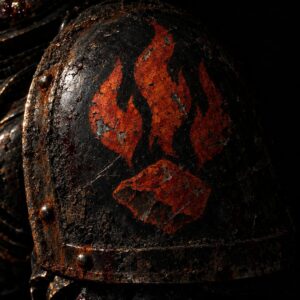
This is the sign of the Sons of the Firestone: not the flame symbol on their shoulders, but this silent order within damnation. A brother who thinks he is losing, yet fights. A Chapter that tolerates its own disintegration, so long as the break strikes the enemy. This is no heroic epic. This is endurance. This is all that Kar Dravin demands of anyone.