The Flames of the Damned
“The fire demands hearts. Corruption breeds gratitude. The oath binds more eternally. The truth burns.”
Core Identity
| Progenitor Legion | Salamanders |
|---|---|
| Founding | c. 480.M36 — 19th Founding (mid M36) |
| Homeworld type | Fleet-based |
| Combat doctrine | Drop-pod & shock assault |
| Allegiance | Renegade chapter (fell after the Heresy) |
| Chapter strength | Full strength (~1000 Battle-Brothers) |
| One-sentence definition | The Flames of the Damned are a renegade Chapter of Salamanders geneseed, loyal at their founding more than three thousand years ago, who slowly slid into the service of Nurgle through two millennia of total isolation in the outer reaches of the Imperium and now operate as fanatical, disease-spreading Heretic Astartes, preaching their own corrupted interpretation of the Vulkan fire tradition as sacred truth. |
The four pillars
The Fire of Damnation
The Chapter is not the tool of the dead Emperor, not the torch of the Old Covenant. Every Battle-Brother carries within him the heat of Nurgle, the gift of transformation through disease. This is not decay, but rebirth. The flame must be rekindled, rebuilt upon ash.
Every Oath Is Eternal
A brother who swears to the Chapter does not swear for ten years or a hundred. He swears for eternity. The Chapter does not divide into districts and ranks like the old realm of the Codex Astartes. The Great Company is the unit, and its Lord is its heart. This loyalty outlives death.
Corruption Is Truth
While the loyalists still cling to their lies, we know: corruption is real. Nurgle offers gifts, not damnation. The maggots that fill our flesh are not marks of decay—they are guests who lead us closer to truth. The lie of the Imperial Adeptus Astartes was that perfection lay in purity. We know better.
The Village Burns, the Truth Lives
It is not those with the greatest armies who win the battle. Those who are ready to fall receive the singing of the new world. The Chapter cares nothing for losses, nothing for survivors, nothing for glory in the Imperium's sense. Only that we burn, that we fight, that we fall—this fire is everything.
Tonality (bullet points)
| Point |
|---|
| Burned and decayed: even in their outward appearance these brothers show the traces of their corruption—black skin, darkened by plague-spores, tissue discoloured to grey in places. |
| Fanatical without hope: they are not the grim soldiers of the Chaos Legions of earlier ages. They are believers who have abandoned hope and now see only the burning fire of the now. |
| Tactically brutal: they employ parachute assaults with ruthless efficiency. No theatrical circumlocutions—only the planning, the fall, the strike. |
| Theology of corruption: their speech is steeped in a kind of corrupted priestly language that mixes Nurgle with traditional Vulkan terms. |
| Isolated and suspicious: millennia without contact with the Imperium have left them paranoid and withdrawn. Other Chapters are rivals or enemies; Genestealer Cults are the worst enemies, because they practise corruption "wrongly". |
Comparison vs. progenitor legion
| Aspect | Progenitor legion | This chapter |
|---|---|---|
| Philosophy | Compassion and craftsmanship; Vulkan as a caring father | Passion and corruption; Nurgle as liberator from false hope |
| Geneseed Fidelity | High; the geneseed functions as intended, albeit with the Vulkanus curse | Mediocre; the curse takes hold faster, mutations from Nurgle's influence distort the standard symptoms |
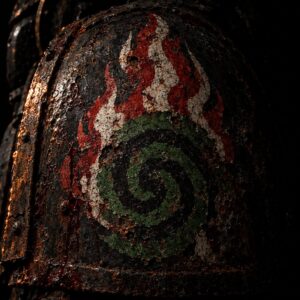
| Armour Aesthetic | Black with copper accents, artisan quality | Black with red and rot-spores, partly moss-covered plates, biomass overgrowth |
| Organisation | Companies; flat hierarchy under a Chapter Master | Great Companies; radical autonomy; the Chapter Master commands only great matters |
| Combat Doctrine | Melee emphasis, craftsman's ethic in repair | Parachute onslaught, plague dissemination, gene-poison weapons |
| Relationship to the Chaos Gods | Loyalist intent; the curse is an obstacle | Total submission to Nurgle; the curse is a blessing |
Further core facts
| Fact | Value |
|---|---|
| Founding | 19th Founding, M36.1 |
| Homeworld | Fleet base: nomadic invasion fleet |
| Fortress-monastery | Multiple drop-pod complexes and ancient starships |
| Combat Doctrine | Parachute shock assault and lightning-hegemon tactics |
| Codex adherence | 12 % |
| Battle cry | "Through fire to rot, through rot to truth!" |
| Chapter strength | 1,008 Battle-Brothers (ten Great Companies, each consisting of an average of 100-110 Battle-Brothers) |
Core identity (continued)
Forms of Address / Title Cascade
| Level | Designation | Context |
|---|---|---|
| Individual brother | Ash-kin (Ash-kindred) | Among themselves and in daily speech |
| The Chapter as a whole | The Flames of Vulkan in Corruption | In Chapter chronicles, requiems and chapter collections |
| Ceremonial full text | The Lost Flames of Damnation, Fire-Heirs of Vulkan, Heretic Astartes of the Corrupted Oath | Oaths, declarations of war, death consecrations |
Chapter Maxim
The fire demands hearts — Passion over reason. A Neophyte learns that there is no place for doubters. The will must burn as the essence that flows through his veins. In the darkness of the warp, he who hesitates is already dead.
Corruption makes grateful — Recognising gifts. Nurgle's blessing is not punishment, but promise. Every boil, every festering blemish is proof of the god's favour. A brother who brings red has confessed the harm and was summoned to bear it. Gratitude is the only answer.
The oath binds more eternally — Loyalty beyond nature. What one swears to the Chapter binds not only for life, but through all catastrophes. An oath, once given, cannot be broken. The Fire-Brother who turns away rots faster than the sea rots.
The truth burns — No hypocrisy. The Chapter does not speak of the Imperium, not of purity, not of the false light of Terra. The truth is that the old light is extinguished and that only the flame of corruption shines now. Whoever does not see this is blind.
Lore & History
Founding history
The Flames of the Damned were brought into being during the 19th Founding, a time when the Imperium of Man was still attempting to stabilise the fragmented remnants of the First Founding. In that early M36 the Administratum gathered a new geneseed of the Salamanders—not from Terra, but from the stores of Nocturne—and dispatched a flotilla under the command of Chapter Master Khal'dakos into the southern Marches of the galaxy, far beyond the well-charted routes.
The mandate was simple: occupy hive worlds and remove Genestealer Cults from a sector named Kar-Thessun. The Chapter was to operate as nomads, moving from world to world, purging cults, then moving on. No permanent fortress-monastery, no central hearth—only the starships as home. By M36.4 Khal'dakos had conducted six campaigns. By M36.8, sixteen more. The Chapter's rule was iron, the geneseed loyal. The brothers who did not fall into corruption still spoke of the Imperium and of the Golden Throne.
But then—in M37.2—the astropathic link failed. The warp grew rough. A psychic scar-wound, which would later be called "the Night of Silence", cut the Chapter off. Khal'dakos tried to renew contact. He sent ships back through the great warp jump. None returned. The Flames of the Damned were alone.
Two centuries of isolation followed. Then three. The brothers held themselves together—and the cults did not grow fewer, but more numerous. In M39 the Chapter discovered that on at least twenty of the hive worlds they had settled, symbiont nests had arisen that multiplied faster than the brothers could exterminate them. A new Chapter Master, Vor'thaken, declared that the corruption was not an enemy, but a force. That Nurgle, the god of inevitability, had long been here already. That the Imperium would send no rescue, because the Imperium had forgotten they existed.
In M39.7 a mystic Scriptor (Librarian) of the Chapter named Tem'kathos performed a ritual that blurred the boundaries between Nurgle-worship and the old Vulkan tradition. The fire, he said, was not the fire of the craftsman's light. It was the fire of truth—the fire that burns everything that is false. And the rot that appeared ever faster at the edges of their fleet was not a curse—it was a baptism.
The transition was neither dramatic nor sudden. It was like mould on grain—first a discolouration, then a permeation, then a total consensus that it had always been so. Great Companies began to exercise their autonomy more swiftly. Some Lords began to bargain openly with the warp. By M40.1—more than three thousand years after their founding—the Chapter was what it is now: a renegade Chapter, practising Heretic Astartes under Nurgle's blessing, forever lost in the southern void.
But lost is not the right word. Khal'dakos, in his final years, had preserved a fragment of the old, loyal oath. The new Chapter retained the hierarchy of the Great Companies, the name of the Flammen, the black-and-red livery. It preserves what it learned from Nocturne—that fire is a tool of transformation. Only now the transformation leads not to the light, but into the Gift.
Homeworld description
The Flames of the Damned have no fixed homeworld in the traditional sense. Their home is the fleet base—a constantly moving collection of starships on which the Chapter stations its Great Companies. The flagship, the Essence of Nocturne (a prefabricated strike cruiser from the era before the isolation), serves as the ceremonial centre. Around it travel some sixteen further ships of varying size: old transports, space hulks, even a makeshift-patched former non-Imperial vessel whose origin no one knows any longer.
The Chapter, however, prefers planets already decayed by the warp or abandoned by the Imperium. The two most common areas of operation are:
Kar-Thessun Sector: A region of some thirty hive worlds on which the Flammen have operated since M36. Most are now centres of mixed Genestealer Cult and Nurgle-worship. The Flammen no longer purge—they control.
The Silence of the Southern Marches: A further region of dead worlds and light-starved planets, where the Flammen prefer to land and deploy troops. Here they have established small garrison complexes, which serve them as permanent landing sites.
On the worlds where they land, the Chapter swiftly establishes relations with local Genestealer Cults—not as allies, but as rivals for truth. The conflict with the symbiont-worshippers is a large part of their warfare in the present age.
The flora and fauna of these planets are diverse, but two species shape the Flammen's perception:
The Decay-Insect: A large, six-legged arthropod that the brothers find in the wreck-fields and the dying cities. It grows on rotten wood and decayed biological matter. A new Battle-Brother quickly learns that the decay-insect is no pest—it is a worker in Nurgle's Garden. The Chapter sometimes collects them in cages and uses them as part of curse-rituals or as living weapons against Genestealer Cults.
The Brandvogel: A large, bird-like predator with black feathers coloured with lava-red stripes. It hunts on the hotter worlds and was originally hailed by the Salamanders as a symbol of fire. The Flames of the Damned have now taken this bird into their heraldry, but with one detail: the Brandvogel is often depicted flying through ash and plague-mist, not through pure flame. This is the visual metaphor for the corruption—that transformation is the True Fire.
Chapter cult
The Flames of the Damned practise a theology that has interwoven the Vulkan tradition with Nurgle-worship into a single, corrupted synthesis. The central belief is that fire is the ultimate truth—not the fire of purity, but the fire of transmutation.
The Chapter still holds rituals resembling those of the Salamanders: craft-blessings, fire-trials for candidates, thanksgivings for successful missions. But every ritual now has a Nurgle component. A craft-blessing might include a litany to the "Patience of Rot". A fire-trial might be infected with disease-spores, not to kill the candidate, but to transform him.
The Chapter's Scriptor Magister (the highest-ranking Librarian) is the spiritual head, not the Chapter Master. The Chapter Master is the warrior; the Scriptor is the theologian. This is a deviation from standard Codex Astartes practice and shows how deeply the Nurgle ideology has penetrated the structure.
There is also a Ritual of the Oath, which new Battle-Brothers undergo when they join the Chapter. A candidate is led into a chamber in which the names of all the fallen so far are engraved. There he swears a four-part oath:
- "For the Fire of Damnation"
- "For the Truth of Corruption"
- "For the Eternity of the Gift"
- "For the Flame that is not extinguished"
This oath cannot be broken, not even in death. A brother who later leaves the Chapter is not executed—he is burned, his ashes given over to the warp, as if he were a flawed ritual object. This is intended as the greatest disgrace in the Chapter.
The traditional Vulkan-veneration of the Salamanders has been entirely overwritten. Vulkan is no longer thought of as the father of compassion, but as the First Fire-Believer—a martyr who saw the Imperial light and cast it away because it was a lie. (This is a total falsification of the actual doctrinal history, but the Flammen care nothing for historical accuracy.) Nurgle is portrayed as the True Heir of Vulkan's Thought, because both understand the fire of change.
Gene-seed quirks
The geneseed of the Flammen der Verdammnis descends from Vulkan and the Salamanders. It displays all the standard mutations of the Salamanders, but three millennia of isolation and Nurgle's influence have given rise to new deviations.
Standard Traits (Salamanders):
- Higher temperature tolerance and fire resistance (melanochromic organ and additional subcutaneous insulation)
- Enhanced craft abilities through unknown genetic imprinting
- Heightened emotional reactivity (a known flaw of the geneseed)
New Deviations (Influence of Corruption):
- An additional lymphatic system that filters and stores Nurgle toxins instead of breaking them down
- Altered skin pigmentation: the natural black skin of the Salamanders becomes increasingly grey and blotched, with green discolouration particularly at the joints
- A greater susceptibility to mutation in later life
- Heightened resistance to conventional antibiotics and healing techniques (a double gift: the brothers are weaker against Imperial medicae, but stronger against many natural diseases)
Curse Stages
The Curse of the Salamanders is a progressive emotional-physical syndrome that leads the brothers to melancholy and later to explosions of rage. In the context of the Flammen der Verdammnis this curse has been reinterpreted—not as a disease, but as a Spiritual Calling.
Stage 1—The Unrest-Mark (Early Signs)
- A diffuse urge to fight, even during lulls of peace
- Nightly sleeplessness, combined with psychic nightmares of fire
- A subtle red-tinged mottling of the skin that begins at the wrists and the neck
- Increased saliva production; the mouth is always dry
- A feeling that the voice must grow louder, even when speaking softly
- Involuntary trembling under psychic stress
The Flammen watch such brothers not with alarm, but with anticipation. A brother shows the Unrest-Mark, and his lord assigns him to more intensive training sections. This is no punishment—it is a preparation. Standard practice is to send the brother for two months to fire-craft under an experienced Techmarine. The physical labour and the heat will often either ease the symptoms (if the brother is weak) or intensify them (if he is ready for the next stage).
Stage 2—The Decay-Brand (Advanced)
- The mottling of the skin turns dark red, almost black, and begins to decay (outwardly visible: rough textures, lost sensation in the affected areas)
- Repeated, unfounded outbursts of rage, often followed by remorse and psychic shutdown
- The eyes acquire a greenish-yellow sheen, particularly under stress
- The emotional spectrum narrows: the brother becomes either indifferent or enraged, with no middle ground
- Susceptibility to infection rises; small wounds become infected more quickly
- The brother develops an obsession with one thing—a weapon, a task, an enemy—and cannot turn away from it
A brother in the Decay-Brand is placed under the supervision of the Chaplain (Chaplain). The Ordinaire in the Chapter is not the comfort-giver of the classic Salamanders, but a theologian who teaches the brother that the corruption is a sign, not a disease. The brother is led through psychic rites—long night vigils, meditations upon the texts of the Nurgle-Radiance, blood offerings at small shrines. These are not merely psychological manipulations; for the Flammen they are true paths to give the brother back control.
A brother in the Decay-Brand is not sent into battle, although he craves it. Instead he is transferred to the Chamber of Silence—a hidden compartment beneath the House of the Oath aboard the Essence of Nocturne—where he is left alone for four to six months, with only weekly visits from a Chaplain. The purpose is not punishment, but trial: can the brother endure the next transformation in solitude, or will he break?
Stage 3—The Ember (Terminal)
This is the point at which a brother becomes what the Chapter calls The Burned—a Battle-Brother whose geneseed has been wholly corrupted and whose personality has frozen into a psychic obsession. A Burned is a tool, no longer a man. The psychic pain is so constant that it has ceased to be pain; it is only noise, into which the brother must scream his whole existence.
After one week in the Decay-Brand the first signs of a Burned appear:
- The body discolours black-red-green, a patchwork of decay and flame
- The eyes go functionally blind (green cataract), though the brother still "sees" through a psychic link with the warp
- The mouth turns black and gives off a constant, faint smoke (a psychic manifestation, not truly combustible)
- The brother no longer speaks in sentences, only in fragments or in inhuman sounds
- The blood turns dark green and non-toxic
- The body begins to transform psychically—bones appear beneath the skin, as though the flesh were withdrawing; sometimes these are no physical changes, only psychic perception, but the brother acts as though the bodily changes are real
A Burned is a war machine, but a defective one. The Chapter does not psychically lobotomise them—that is the lie of the Dark Eldar. A Burned still retains parts of his self, enough to hate himself. This is a feature, not a bug. The hatred keeps him running.
Conduct after Stage 3:
A Burned is not integrated into the normal Great Company. Instead he is transferred to the Lost Company—a tenth, unofficial Great Company composed of ten to twenty Burned. They are not dead, but they are no longer alive. They serve the Chapter as the last line of defence, the last weapon, when all other options are exhausted.
Lost Company
In the Chapter's idiolect the Lost Company is called "The Last Service"—not because this is their last service, but because this service is the last thing a brother can do. They are the Burned, the Rindless, the gates between the worlds and the warp.
The Name and Meaning:
The Chapter does not call them "the Lost". They call them "The Last Service"—the Final Rendering of Service. The name is dual: on the one hand, this is the last military service a brother can perform. On the other, it is a service rendered unto the end—because the brother dies when he fulfils it. It is a name that exists in past and future at once.
Visual Feature Removed from Standard Armour:
A Burned bears no Chapter badge—no Chapter emblem, no Company-colour band, no heraldry. The badge is the identification of a brother who still belongs to the Chapter. A Burned no longer belongs to the Chapter; he belongs only to the warp. The absence of the emblem is a death sentence, written upon his armour.
Added Item of Equipment:
On the right shoulder a Burned bears a Corruption-Trinket—a symbol that looks like a small urn, but open at the ends. It is the size of a bolter round, and within it is mounted the burned ash of a Genestealer oracle that the brother himself slew in his earlier battles. This ash is not inert; at times it moves, as though breathing from within. It is a psychic link between the Burned and the cults he hunts—a brand that says: This brother is forever entwined with his enemy.
The mounting is mechanically simple: a hook-and-ring system that engages the shoulder-plate locking point and secures the urn. A servo-arm could peel it off, but the brother would not permit it; the psychic bond is so strong that any attempt at removal leads the brother to attack himself.
Helm and Headgear:
All Burned wear a helm that is identical—not individualised, not personalised. It is a Mark VII helm, but all are lacquered a deep, glossy black, and all have the same green opal eye-lenses, all painted with the same stroke. This is not for tactical reasons—this is for psychological reasons. A Burned no longer has individuality. The uniform is the statement. The helm says: I am a tool. My personality is extinguished. Only the fire remains.
The Order to Battle:
When the Chapter sends a Burned into battle, the Chapter Master or a delegated Captain speaks a standard formula:
"The Last Service is called. The flame shall burn. Give yourself to the corruption and do not return."
This is not a question; it is a decree. A Burned does not answer. He simply moves, like a machine that has been switched on.
After Death: Burial and Preservation:
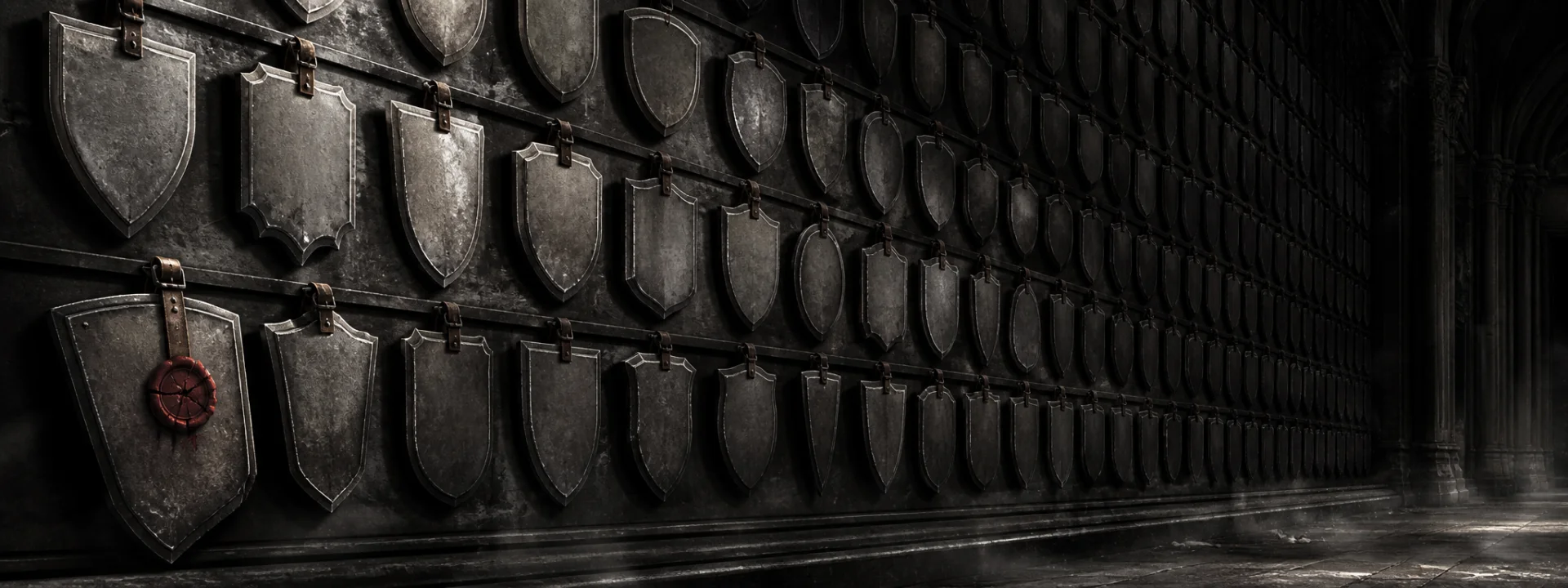
A Burned who dies in battle is not treated like a normal Battle-Brother. The body is at once placed into a sarcophagus of lead—not to preserve it, but to isolate the psychic emanation. These sarcophagi are transported to a Vault Without Names, a crypt aboard the transport ship Grauensammlung, which sails with the fleet base.
The vault is a large, rectangular chamber, some 50 metres long and 20 metres wide, with a hundred lead sarcophagi stacked in rows. No name is engraved. No epitaph. Only a number, painted in silver: One-Zero-One, One-Zero-Two, and so on. The Flammen practise a ritual here once a year, on the day of the Chapter's Founding Oath. A Chaplain walks through the vault, and he recites the Litany of the Burned:
"They have not died. They have gone home. They are not lost. They are at last put to use. The Last Service was their gift. The Last Service was their freedom."
Lore & History (continued)
Gazetteer of the Fortress-Monastery
The Chapter fortress of the Flames is decentralised—not in one place, but distributed across several ships and planetary complexes. The most important locations are:
| Location | Function | Distinctive Feature |
|---|---|---|
| The Blaze Chapel | Ceremonial place of assembly aboard the Essence of Nocturne | A great lectern-opening auditorium, permeated by old sweat and disease spores; the walls bear the names of all fallen Chapter Masters in charred letters |
| The Decay Garden | A subterranean hydroponics chamber on Kar-Thessun VII | Here the Flames breed decay-insects and Nurgle-consecrated plants; the foliage is green-grey and seems like living rot |
| The House of the Oath | The initiation chamber for new Battle-Brothers | A long hall with rusted cogwheels on the walls, overlaid with patterns of blood; candidates swear their oaths here over the opened corpses of their predecessors |
| The Dead Eyrie | A crypt aboard the ship Grauensammlung | Here fallen brothers are preserved and later consecrated as Dreadnoughts or as relics; the stench is unbearable |
| The Shadow Vault | Secret: a sealed compartment beneath the Blaze Chapel | Here the Chapter Master keeps old, loyalist texts—records by Khal'dakos himself, letters to an Imperium that never answers. Entry is forbidden, save for the Chapter Master and the Scriptor Magister (Chief Librarian) |
| The Fire-Craft | Repair and armour workshop aboard several ships | The brothers still cling to the Vulkan tradition of craftsmanship; the tools are old, but the spirit is fanatical. The machine spirits here are wrathful and demand more than mere standard litanies of preservation |
| The Call-Post | The shadow-haunted astropathic listening station | Only one station still exists, aboard the Essence of Nocturne; since M37 it has had no true contact with the Imperium. Even so, the Flames still send messages into the dark—no one answers |
Distinction
One might suppose that the Flames of Damnation are descendants of the Word Bearers, given their theology and their obsession with rites. This is not true. The Flames are and remain Salamanders geneseed. Their theological corruption is not a primary heretical doctrine (like that of Lorgar Aurelian), but a mutation that arose from isolation and the decayed, Nurgle-soaked context of their southern homeland. A Scriptor Magister of the Flames could theoretically, given enough time and access, return to loyalist Salamanders texts. A Word Bearers Apostle could not—his ideology has become too central to the Legion. The Flames are not the disciples of a greater heretical empire; they are wanderers who became lost in a swamp and began to drink the swamp-water without understanding that it was poisonous. The Vulkan core of their geneseed—the drive to craft, to transformation through fire—is still there. It has simply been twisted, not subjugated. The difference is great.
Companies
Companies
Name Ironscale
Role Intercessors
Hero name Mek'ora Themian
Hero title/epithet Sergeant
Name Zek'ohr
Role Intercessors
Hero name She'gar Ashwalker
Hero title/epithet Sergeant
Name Agatone
Role Hellblasters
Hero name Iagon Tem'plar
Hero title/epithet Sergeant
Name Vaughn
Role Scouts
Hero name Skar'de Ba'tarn
Hero title/epithet Veteranen-Sergeant
Great Companies
Overview
The Flames of the Damned are organised into ten Great Companies, not the standard ten Codex Companies. The reason for this number is not dogmatic—it is historical. After the Founding in M36, the Flammen quickly established ten Companies under ten separate Lords. When the Chapter later fell, it regarded the Ten not as an Imperial structure, but as the ten fires of Vulkan—a theological justification to sanctify the old military structure.
Each Great Company has between eighty and one hundred and twenty Battle-Brothers, depending on losses and recruitment. The total strength remains stable at around 1,008 brothers, because the Chapter is strict and recruits only when a Company falls below eighty.
| Name | Lord | Colour / Insignia | Character |
|---|---|---|---|
| Fire of the First Hour | Captain Xol'vrek | Red-black vertical stripes | The most original Company, still partly bound to old Vulkan traditions; the least fanatical |
| The Levellers | Captain Des'thar | Green-black diagonal | Specialised in plague weapons and Genestealer hunting; ideologically the most devoted to the Chapter cult |
| Quench-Children | Captain Volk'mah | Blue-black with silver accents | Masters of traps and sabotage; often operate autonomously behind enemy lines |
| The Last Edge | Captain Kev'nor | Orange-red, black dots | Shock troops, most often committed to parachute assaults; the highest casualty rate |
| Ash-Fighters | Captain Kor'dash | Deep violet, black | Disciplined and older; many veterans of the early campaigns |
| The Whispered | Captain Shey'ark | Grey-black, silken | Psionic specialists and warp-adepts; more secretive and autonomous than other Companies |
| Plague-Bringers | Captain Mak'thol | Green-brown, rotted textures | Biological weapons specialists; the most entangled in the transformation into heretics |
| Flame-Keepers | Captain Thel'vor | Red-gold, burnt | Traditional guardians of the Chapter's symbolism and of the old techniques |
| Night-Wardens | Captain Vor'mesh | Black-green, stars | Specialised in night operations and psychological warfare |
| The Lost Company | A Scriptor Magister nominally serves as Lord, but de facto command is lacking | Black with green opal-eyed helm | Composed of the Burned; practically no structure or leadership, operates like a swarm |
What Holds Them Together
The Chapter Master, currently Ko'vash Emberhand, holds nominal authority over all ten Great Companies. In practice, this authority is sharply limited. A Great Company Lord is an absolute ruler over his own brothers—recruitment, combat tactics, even theological interpretation are left to the Lord. The Chapter Master can command directly in only three cases:
- When two Great Companies stand on the brink of uncontrolled conflict (the Chapter Master intervenes to preserve order, not to decide ideology).
- When a major campaign requires the mobilisation of the entire Chapter (in this case the Chapter Master sets objectives, not tactics).
- When the Scriptor Magister directs that a Company is violating heretical doctrine (this is very rare and is never carried out without consultation with the Great Company Lords).
Beyond these three scenarios, a Great Company Lord operates autonomously, even against the Chapter Master if he so wishes. This leads to much internal conflict, rivalry and occasionally to true war between Companies. The Chapter Master lives with this tension, because the alternative—forced central control—would lead to a rebellion that could destroy the Chapter.
The true binding force is not the Chapter Master, but the Oath of the Four Words—the vow every Battle-Brother swears at his initiation. This vow binds a brother to the Chapter, not to the Chapter Master. So long as every Great Company technically respects the vow (and it does, obsessively), it also respects the minimal central authority of the Chapter Master. It is a fragile arrangement, but it holds.
A Great Company Lord who rebels too openly is either executed by the Chapter Master (rarely) or reinterpreted by the Scriptor Magister—that is, the Chaplain performs a ritual that confers psychic illegitimacy upon the Lord in the eyes of the other brothers. This is an effective disarmament and usually leads to the self-exile or suicide of the Lord.
Recruitment and the Next Generation
The Flammen do not recruit centrally, but locally on each planet where a Great Company operates. A Captain of a Chapter Company seeks young, strong-willed candidates from local populations, predominantly from hive world labourers and Genestealer Cult apostates. The return rate is low—perhaps one in fifteen candidates passes the first trial.
This decentralised recruitment means that each Great Company absorbs its own local culture. A Battle-Brother of the Fire of the First Hour might be recruited from a moon where the local language is still Latin-like; a brother of the Levellers might come from a hive world where the inhabitants think in psychic hives like insects.
This harms the unity of the order and fosters local identity over Chapter identity. The Chapter Master regards this as acceptable, so long as the vow is kept. In fact, the Chapter Master actively encourages it—the theology holds that each Great Company is a local manifestation of the New Fire, and that this diversity of expression is strength, not weakness.
The training is short—only four to six months in the field—and brutal. A candidate is trained in parachute techniques, then immediately sent into a live combat zone. Survival is no guarantee of initiation; the candidate must also swear the Oath of the House and pass the Chaplain's psychic tests. Roughly half of those who survive combat break down under psychological strain or, worse, refuse to swear the oath. These are not killed—they are left behind on the base planet, under a psychic taboo which means that no other Great Company will ever recruit them.
Notable Characters
Characters
Name Ko'vash Emberhand
Title/role Captain
Name Bray'arth Epithemus
Title/role Chaplain
Name Nocturnis
Title/role Ironclad-Dreadnought
Notable Characters (continued)
Chapter Master Ko'vash Emberhand
Ko'vash is a warrior of the old guard—born into the Chapter at the time of its founding some three thousand years ago, though he did not live through that era (suspension crypts and psychic life-extension have preserved him). He was a Captain under Khal'dakos and witnessed the transformation from within. In M40.3, when the previous Chapter Master collapsed into psychic inanity, Ko'vash was elected.
Ko'vash is not an enthusiastic heretic, but a practical one. He does not believe that Nurgle is the truth—but he believes that loyalty to the Chapter is vital for survival. He is tall, some two-metres-five in his armour, with charred black skin and a bandage over his left eye (beneath the bandage there is only scar tissue and a cybernetic optics system). His sword, the Essence of Nocturne, is an ancient artefact, probably from the time of the Great Crusade.
Ko'vash wears armour that is red and black, with gold accents, but the colours have faded from millennia of use. He wears no helm in battle—his face is too legendary. One side of his face is scarred and grey, the other a living black, giving him a divided appearance that is as charismatic as it is unsettling.
His weapon is a combination of chainsword and thunder hammer—a hybrid design that only this one Chapter devised. It weighs almost as much as a Battle-Brother, yet Ko'vash wields it one-handed.
Ko'vash is morally grey. He does not explicitly oppose the Nurgle ideology, but he actively prevents extreme rituals, such as human sacrifices to cults, from being carried out within his Chapter. This has led to internal conflicts with radical Captains such as Des'tharm. But Ko'vash holds power; no one dares to challenge him openly.
In a campaign, Ko'vash takes the field in person only when the matter is critical. He prefers to command from his flagship. But when he goes into the field, his mere presence brings about a psychic change in the brothers—they fight more savagely, more unrestrained. This is perhaps his greatest poison and his greatest good.
"Loyalty knows no philosophy. It knows only the next day and the next enemy. Those who try to understand both lose both." — Ko'vash, M40.7, during a campaign on Kar-Thessun V
Battle Anecdote: During the siege of Kar-Thessun VII in M40.5, the entire Chapter was embroiled in a three-week battle with a combined Genestealer Cult army. The cults held the summit of a mountain where an ancient Imperial lighthouse stood—a perfect vantage point. After two weeks of frontal assaults, the Chapter had lost 200 brothers without making progress. Ko'vash then ordered a single night-drop operation: he himself would land alone on the mountain and hold the lighthouse, and all the other Companies would use first light to climb the mountain.
No one thought Ko'vash would survive alone. The mountain was densely packed with hybrids—perhaps ten thousand. But Ko'vash lands, lights the lighthouse (a psychic fire that only he could kindle, and which bathes the lighthouse in green light), and fights.
When the first Company troops reached the mountain, they found Ko'vash standing on the summit rock, covered in blood and slime, but unbowed. Beside him lay some four thousand dead hybrids. Ko'vash was gravely wounded—his left leg was almost torn off, his left side completely ripped open. He had remained standing still because he would not trust his body if he tried to take even a single step.
The brothers lifted him up, and he was carried back to the Essence of Nocturne. The Apothecary barely saved his life, but Ko'vash lost his left eye in the process. His recovery was swift—only six weeks later he was back in uniform. But his legend was secured. No one has questioned his command since.
Chaplain Bray'arth Epithemus
Bray'arth is the soul of the Chapter, or its sin—depending on how one sees it. He is the Chaplain and the de facto Scriptor Magister of the Flames, though he does not bear the title. (The formal Scriptor Magister is an older, cerebral Librarian named Tem'sorath, but Tem'sorath leaves most ritual duties to Bray'arth.)
Bray'arth is of medium height and leaner than a typical Battle-Brother, with skin so black that it appears violet under certain light. He wears the robes of a Chaplain—white and black with red hems—over his armour. A large crucifix depicting a flame entwining a symbol of decay hangs at his chest.
Bray'arth is the ideologue behind the modern theological interpretation of the Flames. It was his ritual design that fused the Vulkan tradition with Nurgle worship. It was his writing that became "The Fire Manifesto", a hundred-page text now memorised by every candidate. He is persuasive—fanatical, but intelligent. He has an answer to every question, every doubt.
Bray'arth's personality is parasitic. He dominates rooms. When he speaks, everything else falls silent. He has a laugh that sounds like fire—dry, sharp, hypnotic. He bears no traditional weapon; instead he carries a crusius—a large, heavy staff-symbol with a hammer-like head. It is not a force weapon; it is simply heavy. But in Bray'arth's hands it becomes a weapon that fights like a lance.
Bray'arth is the reason the Chapter does not collapse entirely into Chaos madness. He gives them structure within the corruption. This is possibly even more diabolical than pure Chaos would be, because it makes the Flames hopeful. They think they are something pure, not a renegade Chapter. This is Bray'arth's greatest trick—he has given them a new identity that is good enough that they never have to ask themselves whether they are wrong.
"The Emperor was always a god, not a man. A god, but a false one. Nurgle is a god, and Nurgle is true. This is the truth that lets them die instead of live—the truth between the false flames and the true corruption. I am not here to preach. I am here to show you what already burns in your blood." — Bray'arth, during an initiation, M40.6
Battle Anecdote: In M40.4 the Flames were summoned to a scientific station on Kar-Thessun IV, where a Genestealer Cult had brought forth a new Patriarch. This Patriarch possessed abnormal psionic power—he could paralyse brothers at short range. The Flames lost two Captains before they understood what was happening.
Then Bray'arth simply strolled into the psychic exclusion zone, without armour, without a weapon, only in his priestly robes. The hybrids were confused. They did not attack; they merely watched. The Patriarch tried to dominate Bray'arth with the same paralysing power that had killed other brothers.
But Bray'arth was not paralysed. Instead he smiled and began to speak—not in Gothic, but in a language no one recognised. Perhaps it was the warp-cant, or perhaps it was a ritual Bray'arth had invented. The Patriarch screamed, a scream that drew the psychic power, and died standing, his brain burning. The hybrids scattered at once, a flock without a shepherd.
Bray'arth walked back out of the exclusion zone, still smiling. He said nothing. The brothers asked no questions. They knew they had witnessed something holy, something beyond ordinary battle. That is the reason they believe Bray'arth when he says that Nurgle is the truth. They have seen him fight as if he were dancing with a god.
Captain (Captain) of the Scout Squad Skar'de Ba'tarn
Skar'de is no famous hero—he is a practitioner. He is the captain of the Scout squad Vaughn, a ten-man unit of Scouts specialising in infiltration and reconnaissance. Skar'de is a Veteran Sergeant, a promotion that is unusual for his rank in other Chapters, but normal among the Flames, where combat efficiency counts for more than ceremony.
Skar'de is small for a Space Marine—some two-metres-two—and appears almost half the breadth of a typical Battle-Brother. This is not weakness; Skar'de was born in low gravity and adapted to it by developing speed instead of strength. He wears Scout armour that is dark red and black, with silver glyphs at the joints depicting an ancient Skythari script (probably copied from a dead Eldar the Flames once found).
Skar'de's weapon is his bolter, but rather it is a knife—a long, thin, psychically-imbued blade cast by an old Librarian a hundred years ago. It is not a standard piece of equipment. It is Skar'de's personal property, taken as spoils from a battle against a Chaos sect.
Skar'de is one of the few brothers who still hold to the old Salamanders combat ethos. He is not consumed by the corruption, though he shows its physical symptoms. Several times Ko'vash has considered suspecting Skar'de of not being a full believer. But Skar'de fights efficiently and swears the oath with conviction. Ko'vash leaves him be.
"The warp is real. But reality has structure, or everything would be Chaos. My task is to find that structure, to locate purpose within it, and to use it for the Chapter. Whether that is Nurgle or the Emperor? Irrelevant. Structure is structure." — Skar'de, M40.3
Campaigns
Campaigns
Name The Sector of the Thousand Burnings
Era c. 640.M39, vier Monate
Enemy Mixed Genestealer Cults and Imperial remnants (hive world militia)
Duration M39.6–M39.8
Outcome Tactical victory for the Flames; three hive worlds pacified, but not in the Imperial sense
Narrative
In this early context of the modern Chapter—only a little more than a hundred years after Bray'arth had carried out his ritual design—the Flames moved aggressively against Genestealer Cults on three neighbouring hive worlds. This was not the first campaign against the cults, but it was the first in which the Flames attempted to rule, not merely to purge.
The sector was overrun by three great hybrid generations, each under a Magus. The Imperial response was fragmentary—local hive world militia, not Imperial Guard or Space Marines. The Flames landed in three coordinated parachute operations, one on each world.
The battle was short but intense. The hive world armies collapsed quickly; the brothers were simply too strong. But the hybrid cultures were tenacious. The sector war lasted four months, with constant small engagements and psychological campaigns.
In the end the Flames ruled the sector. But instead of returning the worlds to the Imperial standard, Bray'arth organised a new administration: the hive world survivors were placed under specialist control, and the hybrid genes were tolerated within this population, under control. This was not a loyalist outcome. This was a renegade outcome.
This was the campaign that sealed the theology of the Flames. They could not return to the Imperium, because they now ruled the Imperium—by their own rules.
Name The Night War of the Kar-Thessun Cluster
Era c. 112.M40, zwei Jahre
Enemy Several Ork Waaaghs under a local Warboss (name: Murzbatt)
Duration 24 months
Outcome Tactical Pyrrhic victory; the Orks were driven out of the sector, but at the cost of some 300 Battle-Brother losses
Narrative
This was an unexpected intervention. A great Ork invasion fleet appeared unexpectedly in the southern Marches and laid siege to several hive worlds. The Ork Warboss Murzbatt was old and intelligent—not too intelligent, but enough to avoid the hybrid cults and fight the Flames directly.
The Flames mobilised all ten Great Companies—a rare, complete mobilisation. For two years a geometry of war raged across several worlds. Ko'vash commanded in person in the final stages.
The battle for Kar-Thessun VII was decisive. The Orks held the city of Mor-Vhess with some twenty thousand Boyz. Ko'vash led a parachute assault with five hundred brothers directly into the city centre. The battle was what the Flames' chronicles call "The Feast-Night"—twenty-nine hours of constant close combat in the streets of a hive world city, while ring-fire from the Flames' artillery outside bombarded the Ork reinforcements to pieces.
In the end the Flames prevailed. Murzbatt died on Ko'vash's sword. The Orks withdrew into the void. But the price was high: some three per cent of the Chapter's strength was gone, many of them in an incurable state (wounds that not even the Apothecaries could repair).
This campaign revealed the other side of the Flames' ideology. They are fanatical, but not boundlessly fanatical. The Chapter Master and the Scriptor Magister discussed this war in long sessions and decided that a conflict costing three per cent of their strength was not economical—not because it was too brutal, but because it was not the efficiency of corruption. Thereafter the Flames became more selective in their wars.
Name The Corruption Pact of Kar-Thessun V
Era c. 553.M40, acht Monate
Enemy Allied Genestealer Cults (a tri-culture union under the coordination of a Patriarch)
Duration 8 months
Outcome Strategic victory; the cult union was dissolved, but the Flames afterwards entered into a formal pact with the surviving cult factions
Narrative
This was the most controversial campaign of the modern Chapter, and it shows how far the Flames have come since their founding. Kar-Thessun V was a hive world where the symbiont cults had organised themselves into an entirely new structure: three great factions under the coordination of a patriarch league. This was no typical culture—this was a polity, a government.
The Flames were summoned (through Bray'arth's mystical means, not through conventional message) to eliminate this union, because it violated Nurgle's teaching (a minor political faction-power that lay outside the Flames' perception).
What followed was no war in the classical sense. Instead, Bray'arth conducted a series of ritual duels between Flames champions and cult champions. It was war as theatre, war as a spiritual state of being.
After eight months the Tri-Culture Union was dissolved. But afterwards the Flames did something unprecedented: they signed a Formal Pact with the surviving factions, a treaty that brought the factions under the Flames' protection in exchange for raw materials and local security control.
This is now known as the "Corruption Pact"—not because it involves daemonic powers (which it does not), but because it showed the Flames' philosophy in concrete form: corruption is not annihilation, but assimilation. The symbionts are not enemies; they are other expressions of the same truth.
This shocked even Ko'vash. It was indeed lawful under the Flames' rules—the Scriptor Magister gave his consent, and the Great Companies merely murmured, without revolting. But it showed that even the Chapter Master did not fully control the ideology. Bray'arth operated on a plane of thought where Ko'vash could not follow.
Short Story
The Ash-Watch
The Chamber of Silence does not breathe, and yet Vor'mesh breathes within it, lungful by lungful, twenty hours a day. The Silence is not truly silent—it is a room beneath the Essence of Nocturne, sealed with ancient doors of Mark I armour ceramite that have turned black over millennia. Something moves in the cracks of those doors. Not air. Something denser.
Vor'mesh sits in the centre of the room, without armour, clad only in a white under-tunic that is slowly turning green. The green discolouration comes from within, not from without—his sweat is green, an iridescent green like abalone, and it drips into small, green-shimmering pools beneath his palms. He sits upright, legs crossed, eyes open. His eyes are scarcely eyes any more—the sclerae have turned yellow, and a green spiral has formed in the irises, rotating, slowly, like an eye watching a warp rift.
This is the fifteenth week.
The door opens, and the Chaplain Bray'arth enters. He is not alone—with him comes another, a Scriptor named Tem'kathos, old, wearing a black robe embroidered with silenced white glyphs. Both are silent. They enter the room, and Bray'arth closes the door behind him. The light that otherwise filters faintly in from outside now becomes nothing.
There is no light in the Chamber of Silence. There is only Vor'mesh, and the green glow his body has begun to emit.
"The brother still sits," Tem'kathos observes. His voice is rough, frayed by age. He was one of those who knew Khal'dakos before the isolation came. He was one of those who wrote the Ritual of Fire before it was corrupted.
"The brother sits because the brother is learning to understand," says Bray'arth. His smile is not visible in the dark, but his voice carries it—a cut through the air, sharp enough to cut.
Vor'mesh does not move. He has not moved in two weeks. The fluids gather beneath him, and his lower body is cold, but that is part of the process. Bray'arth had explained this, back before the isolation: The Silence is not torment. The Silence is contemplation. When a brother sits in the Silence, he does not sit alone—the warp sits with him.
Tem'kathos steps closer to Vor'mesh. He watches him as one watches a rare animal. Then, slowly, he kneels. His joints crack with the sound of old linen tearing.
"Tell me, brother," asks Tem'kathos, "what do you see?"
Vor'mesh opens his mouth. Nothing emerges but a breath, green, fluorescent. But his mouth stays open, and if Tem'kathos looks closely—and he does look closely—he can see that Vor'mesh's tongue is green, covered in a kind of fungus, a fine, silvery fungus that rustles with every breath.
"The brother has begun to become," says Bray'arth. It is not a question. It is an observation.
Tem'kathos nods. He rises again, knees aching, and turns to Bray'arth. In the green glow of Vor'mesh's body, the two priests can see their eyes meet, and that they understand.
This is not the Decay-Brand phase. These are not the early signs of the Unrest-Mark. This is something else. This is the point at which the brother begins to be more than a brother. More than human.
"The Last Service calls," murmurs Bray'arth.
"The Last Service calls," repeats Tem'kathos.
They leave the chamber. The door closes, and the light from outside filters in again, but the darkness remains. Vor'mesh sits still, still, as the green glow deepens, as the spiral in his eyes rotates faster, as the fungus on his tongue begins to sing—a song without words, a song in frequencies that human ears cannot hear, but that anyone gifted nearby can feel.
Two days later, Vor'mesh is no longer in the Chamber of Silence.
Ko'vash learns of this from Bray'arth directly, during an early-morning administrative session aboard the Essence of Nocturne. They are alone—Ko'vash and the Chaplain—in a room that was once an officers' quarters, before the old ships decayed. The walls bear symbols of the old Salamanders, faint beneath millennia-old grime.
Ko'vash does not answer at once. He sits on an old chair whose upholstery has long since crumbled to dust, only the skeletal frame remaining. He regards Bray'arth with his one true eye. His cybernetic eye would glow—it always does when he concentrates—but the cybernetic eye is on the wounded side, and Ko'vash does not turn his face towards Bray'arth.
"The brother still fights well," Ko'vash says at last.
"The brother no longer fights well," Bray'arth corrects. "The brother is good. It is only a different 'good' now. The old blade is no longer shared. It is being made into something new."
Ko'vash is silent. This is not the first time this conversation has taken place. It will not be the last. Every few months Bray'arth comes to Ko'vash and tells him that another brother has completed the Last Service. And every few months Ko'vash carries the knowledge for one more hour, and then he gives his order.
The order is always the same: Let him go.
"The brother fights tomorrow," says Ko'vash. It is not a question.
"The brother fights tomorrow," Bray'arth confirms. "Against the symbionts on Kar-Thessun VI. A cult nest the Levellers cannot handle alone. The brother will go, and the brother will fight, and—if the warp is kind—the brother will not return."
Ko'vash nods. The glow of his cybernetic eye flares very bright for a moment, then dims again.
"Then prepare him," says Ko'vash. "Perform the Ritual of Severance. Let him know that he is leaving his Chapter, not that he is serving it. This is important. This is always important."
Bray'arth smiles. It is the same smile Ko'vash knows—the smile of a man who sees a deeper truth than other eyes can. The Chaplain bows, briefly, without mockery, and leaves the room.
Ko'vash sits alone. He looks at the old Salamanders symbols on the wall—a well that burns, a flame that rises from water—and he wonders, not for the first time, what Vulkan would have thought of what his gene-sons have become.
The answer that always comes is always the same: Vulkan would have turned away.
Vor'mesh fights on Kar-Thessun VI.
The fight does not last long. A Burned One, a brother in the Last Service, is no longer an ordinary soldier. An ordinary soldier has goals, has structure, has survival instinct. Vor'mesh has none of these things. Vor'mesh is purpose—he has been made into a tool, into a weapon that can only burn.
The cult nest on Kar-Thessun VI is deep, entwined within a subterranean complex, with hundreds of hybrids and pure symbionts. The Leveller Company had been blocked, paralysed by the psychic resistance the nest's Patriarch emits.
Then Vor'mesh came.
He did not descend by parachute. He fell with nothing—simply a plunge from orbit, his armour set to full cooling protection, his body burning green with warp-throughput. He landed directly in the nest's central hall, and all that followed was only fire.
A soldier who survived this battle—a Scout named Keth'or, young, never wounded before—would later say that he did not believe Vor'mesh fought with a weapon. It looked as though Vor'mesh himself was the weapon. The brother's body moved in ways that were not human, the limbs stretching and compressing as if bone and flesh were made of different materials. The green glow left trails in the air, psychic burn scars that Keth'or saw for a second before his eye blotted them out.
Vor'mesh killed some two thousand symbionts, alone, without aid. This was not possible—not with an ordinary human body, not with a finite lifespan. But Vor'mesh was not ordinary, and his life was no longer finite in the senses it once had been.
The Patriarch tried to flee. That was its mistake. A Patriarch is a powerful psychic emitter, and Vor'mesh was now psychically blank—not anti-psionic, but wholly transparent to psionic perception, because the self was no longer there to be perceived. The Patriarch saw a gap and tried to pass through it, and the gap was Vor'mesh, and Vor'mesh was everywhere and nowhere.
In the end the cult nest was dead. Not empty, but dead—the hive structures themselves began to decay, to shrivel, as if life itself had been drawn out of them.
And Vor'mesh?
The Scout Keth'or found him upon the rubble of the complex, standing, still, his body dissolving into green light. The helm was gone. The face was no longer recognisable. But as Keth'or approached, Vor'mesh was still standing, still awake, and he turned his head towards Keth'or, and Keth'or saw something in the green eye-hollows—not madness, not pain, not hatred. Only a certain sorrowful fulfilment, as if a brother had at last come home after a long, hard journey.
Then Vor'mesh fell. Not dead—that was the strange part. His body fell, but the body was empty. As if Vor'mesh had already departed before the body noticed it was dead.
Ko'vash stands on the platform where Vor'mesh's body is to be brought, to be interred in the Vault Without Names.
The body arrives in a lead sarcophagus borne by four young brothers. They are mute, in masked helms that are all identical. Ko'vash would recognise these four if they removed their helms—they are Vor'mesh's own men, the Battle-Brothers who fought beside him for ten years.
The sarcophagus is laid in the row of the others. One-Zero-One, One-Zero-Two, One-Zero-Three... One-Zero-Eighty-Seven. The next empty place will be One-Zero-Eighty-Eight. Vor'mesh will lie here, with a gap for a name, with a gap for a history, his body preserved until the end of the Chapter or the end of the world—whichever comes first.
Ko'vash lays a hand upon the lead lid. It is cold. It is always cold.
The Last Service was completed, whisper the four bearers. The Last Service was freedom.
Ko'vash does not answer. He stands there a long time, one hand on the lid, his eye—his true eye—closed. His cybernetic eye glows faintly, a shimmer of light only machines can see.
Somewhere far above, on the bridge of the Essence of Nocturne, the astropathic sensorium shows a new anomaly in the warp. A psychic scar, newly formed, in the shape of a spiral. The Astropath who sees it grows quiet, and if an officer were to ask him, he would say it is not a warp disturbance. It is something else. It is something that prays.
Ko'vash lifts his hand from the sarcophagus. He opens his true eye, and then he opens his cybernetic eye, and both glow for a moment with red light.
"You are all dismissed," he says to the four bearers. "Return to your Company. The Last Service is rendered. It is time to fight."
The four bearers salute in silence and leave the platform.
Ko'vash remains. He looks long at the lead sarcophagus, and he thinks of the old question: What would Vulkan have thought?
This time, for the first time in a long while, Ko'vash can imagine what the answer might be.
The answer might be: Fire consumes everything, whether pure or corrupt. What need has the blaze of a philosophy?
Ko'vash turns away. He leaves, and behind him remains the sarcophagus—a small, cold stone, one more number in a long list, one more name engraved in silence.
The Flames of the Damned fight on. They will fight tomorrow, and the day after, until the last Company falls or the whole galaxy rots. This is not hope. This is not even the spirit of resistance.
This is simply what remains when everything else has burned: the habit of carrying on, because to stand still would mean recognising that there is no way to go home.
And for the Flames of the Damned there is no home any more. There is only the next world, the next enemy, the next brother led into the Chamber of Silence.
That is all they have. That is all they will ever have.