Die Raben des Morasts
“We come without a sound. We open every hull. We forget no dead. We never stop.”
Core Identity
| Progenitor Legion | Raven Guard |
|---|---|
| Founding | 412.M36 — 19th Founding (mid M36) |
| Homeworld type | Death World |
| Combat doctrine | Fleet-based & boarding |
| Allegiance | Renegade chapter (fell after the Heresy) |
| Chapter strength | Significantly above Codex strength |
| One-sentence definition | A Chapter that counted its dead for so long that a god offered never to let the number grow smaller again. |
The four pillars
The Silence in the Hull
A boarding assault by the Ravens begins without vox, without call, without light. Orders are passed on by hand signal and touch. Whoever speaks within the hull before the first bulkhead falls is chastised by the squad.
The Breach
The Chapter does not fight for space; it fights for passages. Every assault targets reactor, bridge or Gellar field generator; everything in between is crossed, sealed, forgotten. A captured ship is stripped, never crewed.
The Counted
Every brother bears the names of his dead scratched into ceramite. The Count is sacred, older than the Fall. Today the Chaplains declare it a prayer to Nurgle, who lets nothing be lost.
The Remaining
A Raven withdraws from no hull while a brother lies within it. This rule has cost the Chapter entire eyries and at the same time made it indestructible: what the Grandfather touches dies slowly.
Comparison vs. progenitor legion
| Aspect | Progenitor legion | This chapter |
|---|---|---|
| Battlefield | Planetary infiltration | Ship hulls, void, stations |
| Handling of Losses | Guilt, withdrawal, rebuilding | Counting, preserving, refusal to let go |
| Relationship to the Primarch | Veneration of the Liberator | Veneration of the Mourner |
| Loyalty | Imperium | Nurgle |
| Silence | Tactical means | Liturgical duty |
| Geneseed Flaw | Melanochromic Organ, pallor | Pallor, followed by rot and fungal infestation |
| Recruitment | Prison and mining cultures | Swamp tribes of a Death World |
Further core facts
| Fact | Value |
|---|---|
| Founding | 412.M36, 19th Founding |
| Homeworld | Morvaine, Death World |
| Fortress-Monastery | Schwarzhorst |
| Codex Compliance | 28 % |
| Battle Cry | "Be silent—and count!" |
| Chapter Strength | 1,480 brothers, significantly above Codex strength |
Core Identity (continued)
Forms of Address / Cascade of Titles
| Level | Designation | Context of Use |
|---|---|---|
| 1 | Immersed | Self-designation of every brother, after submersion in the Immersion Pit |
| 2 | The Grief of Corax | The Chapter as a whole, in sermon and chronicle |
| 3 | Ravens of the Morass, Openers of Hulls, Counted of the Grandfather | Oaths, rites, declarations of war |
Chapter Maxim
Without sound. The virtue of concealment, last inheritance of the Raven Guard. The Neophyte learns it in the bilges of the ships, where every noise has betrayed a brother who no longer lives.
Every hull. The virtue of resolve. No bulkhead counts as closed, only as not yet opened. The Neophyte cuts his first bulkhead blind, his eyes bound, under the supervision of a Sergeant.
No dead. The virtue of loyalty, which broke the Chapter. Every fallen brother is counted, named, carried. The Neophyte learns the names of four hundred dead before he receives his own bolter.
Never give up. The virtue of endurance, today the gift of the Grandfather. The Neophyte learns that pain is a burden one does not set down but shares, until it belongs to no one.
Lore & History
Founding history
The Chapter arose in 412.M36 in the 19th Founding from Raven Guard geneseed, charged with holding the void routes of the fringe sector against raider fleets. Chapter Master Oderic Vaile rewrote the Codex Companies within a century into ship crews, the eyries. For four hundred and sixty years the Ravens hunted in foreign hulls and lost brother after brother there.
The break came with the Drift before Kharaun, 871–872.M37: nineteen months trapped in a stationary warp storm, without relief, with plague aboard. The Chapter counted until the Count became unbearable. Then someone answered who promised that no name would be lost again. The Chaplains call him the Grandfather. The Inquisition calls him Nurgle.
Homeworld description
Morvaine is an ocean of silt beneath poisonous fog. The Ghellik, an eyeless eel thirty metres long, hunts by vibration; the tribes therefore learn from childhood to move without sound, and the Chapter chooses only children who have survived a Ghellik. The mantle crow, a grey carrion bird, nests on the towers of the Schwarzhorst. It is said to land only on the shoulders of brothers who are already rotting.
Chapter cult
The Raven Guard mourned their Primarch. The Ravens have made mourning itself a god. Their Chaplains teach that Corax went into the Eye of Terror because no flesh can bear the guilt forever; the Chapter, however, has found a bearer who takes it from them. Prayer is not spoken aloud. Every devotion is a counting of names, whispered into the bilge.
Gene-seed quirks
The Melanochromic Organ fails in almost all brothers; skin and hair bleach out. Betcher's Gland produces a mild, fungus-laden secretion instead of acid. Since the Fall, the progenoid glands carry spores that infect every new generation. The Mucranoid never lets the skin dry again.
Curse Stages
Stage 1 — The Pallor:
- Blotchy white skin around the eyes, like silt lichen
- Green condensation in the rebreather, droplets on the intake ribs
- The brother no longer removes his helmet in airlocks
Brothers of the Pallor continue to serve. An Apothecary records the date in the eyrie's battle log; the brother is not told.
Stage 2 — The Fen-Grey:
- The blotches grow into a grey fungal coating over cheeks and neck
- The condensation becomes slime that seeps from the helmet vents
- The brother keeps his helmet permanently sealed; the seals have grown in
An Apothecary observes him in the watch cells of the Schwarzhorst: nine days, three samples daily, a counting of his dead every evening. If he forgets a name, he is not sent back.
Stage 3 — The Keel-Walk: The brother speaks only the names of the dead, without pause, and no longer recognises the living.
The Chapter does not kill him. He is given over to the Wake and never again carried on the muster roll of an eyrie.
Lost Company
The name. The Wake: what a ship drags behind it without wanting to. In the idiom of the Ravens, a brother is said to have "fallen into the Wake"—still there, but no longer aboard.
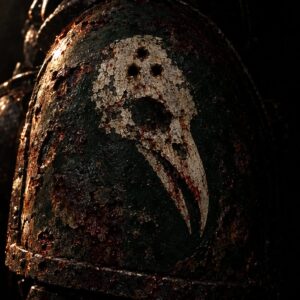
What is removed. The bone-white beak plate on the helmet front. On a brother in good standing it signifies that he still hunts and keeps silent. A helmet without a beak shows bare green-black plate: this brother is no longer silent; he murmurs.
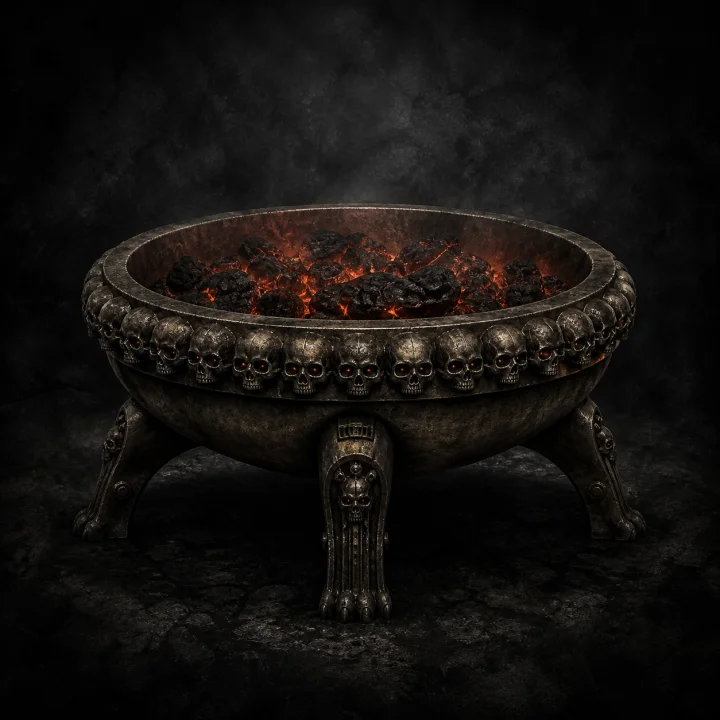
What is added. The exhaust vents of the backpack are replaced by a brass censer seated directly on the reactor housing. The reactor's waste heat sets a paste of silt and resin smouldering; the smoke escapes through three round openings arranged in a triangle. Inside the censer, scales of ceramite bearing the names of his dead are welded together.
Founding
Distinction
Plague, a dead world and stubborn endurance lead many to think of the Death Guard. There is no geneseed kinship; the resemblance is the convergent development of the same despair. The Ravens bear the inheritance of the Raven Guard, and their silence is Corax's silence, even in decay.
Homeworld and Fortress-Monastery
Register of Locations in the Fortress-Monastery
| Location | Function | Distinctive Feature |
|---|---|---|
| The Immersion Pit | Initiation: Aspirants submerge in living silt | Brackish-sweet stench, bubbles rising rhythmically like breaths |
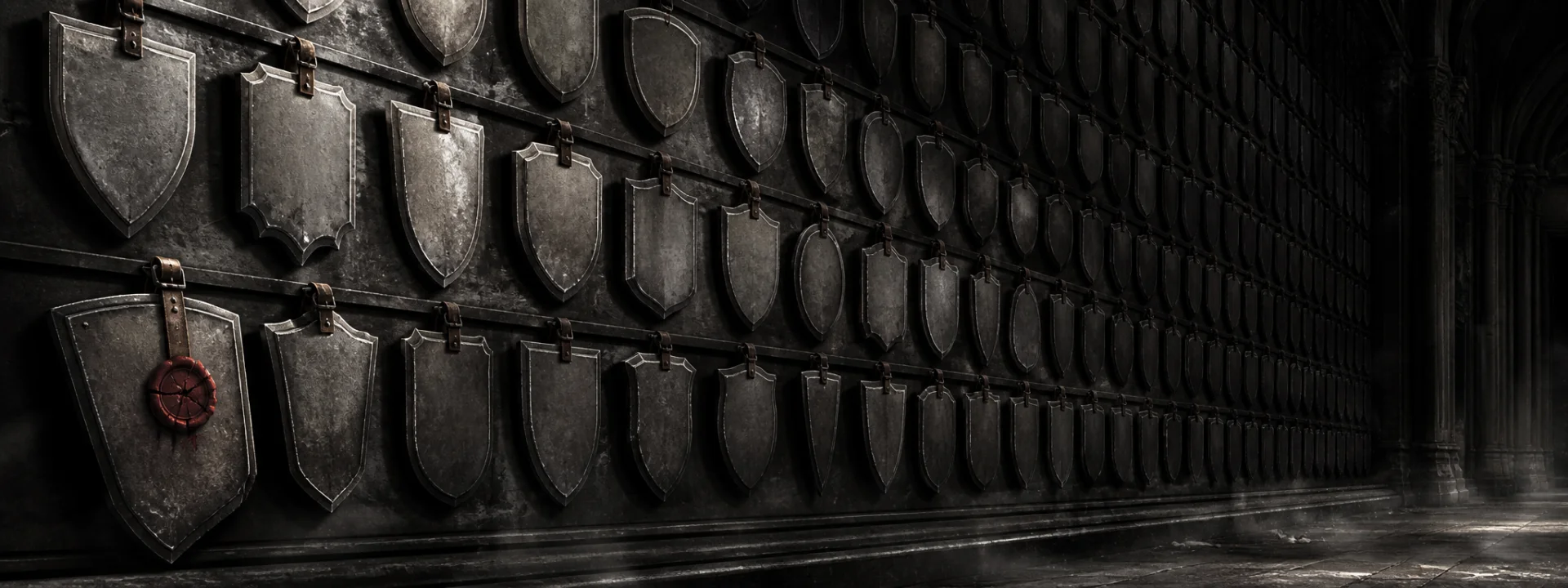
| The Hall of the Counted | Place of remembrance | Walls of 11,000 engraved armour plates, constant dripping of condensation |
| The Watch Cells | Observation of brothers in the second curse-stage | Copper drainage channels in the floor, a single green glow-glass per cell |
| The Bilge | Hidden shrine of Nurgle, closed to outsiders | Warm damp air, the buzzing of flies in the rhythm of a heartbeat |
| The Crow Tower | Landing site of the Thunderhawks | Hundreds of hooded crows, whose calls fall silent when a brother arrives |
Companies
Companies
Name Vrakoth
Role Intercessors
Hero name Dravonis Kaltroven
Hero title/epithet Sergeant
Name Skreoth
Role Intercessors
Hero name Duskaine Skantrel
Hero title/epithet Sergeant
Name Krendal
Role Hellblasters
Hero name Kaelith Kelgrach
Hero title/epithet Sergeant
Name Drekoval
Role Scouts
Hero name Tholvirn Ghrenak
Hero title/epithet Veteranen-Sergeant
Organisation
Overview
The formations of the Ravens are called Eyries, because each is bound to a ship that is at once its nest, its grave and its armoury. An Eyrie never leaves its ship permanently; if the ship is lost, the Eyrie is dissolved and distributed among the remaining Eyries.
| Name | Commander | Role | Strength |
|---|---|---|---|
| Krallenhorst | Captain of the Krallenhorst | Terminator boarding, bridge assault | 200 |
| Horst Grauflut | Captain of Horst Grauflut | Line boarding, reactor assault | 320 |
| Horst Moderfeder | Captain Kaelith Blakfen | Rapid boarding, raider hunting | 320 |
| Horst Sumpfkehle | Captain of Horst Sumpfkehle | Stations, space hulks | 320 |
| Bruthorst | Chaplain-Elder of the Bruthorst | Recruitment, garrison of Morvaine | 240 |
| Kielwasser | Elder of the Kielwasser | Brothers in the keel-passage | 80 |
Krallenhorst
The oldest brothers in Terminator armour, aboard the battle barge of the Eyrie-Father. They board only flagships; their boarding ram bears the banner that has never been removed.
Horst Grauflut
The heaviest line Eyrie. It holds corridors while others break through to the reactor. Sergeant Dravonis Kaltroven, leader of squad "Vrakoth", is currently seconded with his squad to Horst Moderfeder.
"A corridor is a throat. I hold it shut." — Sergeant Dravonis Kaltroven
On the raider frigate off Ystrel, Kaltroven held a junction for forty minutes against three waves and, even under fire, carved the names of two fallen into his forearm.
Horst Moderfeder
The fastest Eyrie, with Caestus assault rams and a strike cruiser. Captain Kaelith Blakfen leads the boarding force the Chapter currently deploys most often, accompanied by Chaplain Aldeth Draskorn and the Ironclad Dreadnought Vrocken. The force includes the squads "Skreoth" under Sergeant Duskaine Skantrel, "Krendal" under Sergeant Kaelith Kelgrach and the Scouts "Drekoval" under Veteran Sergeant Tholvirn Ghrenak.
Off Ystrel, Blakfen had a burning deck flooded to trap a Harlequin, and in doing so lost the squad he had meant to save.
Horst Sumpfkehle
Specialised in space hulks and abandoned stations. It remains longest in enemy hulls; its brothers reach the fen-grey earliest.
"A wreck is never empty. Only not yet counted." — Sergeant Kaelith Kelgrach
On a wreck, Kelgrach's Hellblasters burned out a chamber full of spores and struck their own Apothecary in doing so, whose name Kelgrach has borne on his plasma casing ever since; he currently serves with his squad in Horst Moderfeder.
Bruthorst
Holds the Schwarzhorst and oversees the Immersion Pit. All Librarians and most Apothecaries serve here.
Kielwasser
Brothers in the keel-passage, led by an Elder. They are set into hulls no one wishes to reclaim.
Keep To It
The warrior who commands the entire Chapter bears the title Eyrie-Father.
Notable Characters
Characters
Name Kaelith Blakfen
Title/role Captain
Name Aldeth Draskorn
Title/role Ordenspriester
Name Vrocken
Title/role Ironclad-Dreadnought
Notable Characters (continued)
Eyrie-Father Sarrun Vellach
Eyrie-Father since 903.M37, the first to lead the Chapter after the Fall. Vellach stands in the fen-grey and has not removed his helm for eighty years; his voice sounds wet. He wears a suit of master-crafted armour whose seals have grown over with grey, and a power axe with a blade of Morvainer silt-iron.
On the bridge of the raider cruiser off Ystrel, Vellach did not cut the captain down. He sat down beside him and recited to him the dead of his own crew until the man stopped breathing of his own accord.
Chapter Master Oderic Vaile
The founder, fallen 509.M36. Vaile rewrote the Companies into Eyries and introduced the Counting, then intended as a duty of honour. His power armour stands in the Hall of the Counted, without its helm, its plates so densely engraved that the black is barely visible. His chainsword was melted down into the censer of the first Elder of the Kielwasser.
During his last boarding, Vaile remained on the burning reactor deck of an Ork Rok until he had carried out all eleven fallen. The twelfth he no longer carried himself.
Captain Kaelith Blakfen
Captain of Horst Moderfeder, commander of the fastest boarding force. Blakfen stands in the Blanching and does not know it. He carries a storm shield and bolt pistol, with 312 names carved into the shield. He is the last Captain who still prays to the Emperor before a boarding, quietly, out of habit.
"I no longer know to whom I owe the prayer. I speak it anyway." — Captain Kaelith Blakfen
Off Ystrel, he had a Harlequin set adrift from the airlock instead of killing it, so that it might tell its masque that the Ravens still count.
Chaplain Aldeth Draskorn
Draskorn bears a crozius with a raven skull, from whose eye sockets moss grows. He never preaches; he whispers to the brothers, one by one, the names of their dead until they stop weeping. Among his peers he is regarded as the most faithful of the Chapter.
When a Neophyte collapsed in a captured cargo hold, Draskorn laid his hand on the youth's helm and spoke names for thirteen hours while the fighting raged around them.
Campaigns
Campaigns
Name The Ninety Hulls
Era 655–702.M36
Enemy Ork Rok fleets
Duration 47 years
Outcome Imperial victory, 600 brothers fallen
Narrative
The loyal zenith of the Chapter: ninety Roks, each boarded individually, each reactor destroyed. The Munitorum granted the Chapter honours and no reinforcements. The Hall of the Counted received its first full wall. The chronicles call the campaign a triumph; the brothers who survived it called it the beginning.
Name The Drift before Kharaun
Era 871–872.M37
Enemy Tyranid splinter swarm, plague
Duration 19 months
Outcome Fall of the Chapter
Narrative
Three eyries, trapped in a stationary warp storm, without astropathic contact. Tyranids in the lower decks, fever among the crews. The Chapter counted every dead until there were more names than living. In the bilge of the battle barge, an Apothecary heard for the first time the humming that was a heartbeat. When the storm broke, more brothers lived than before.
Name The Masque over Ystrel
Era 188.M38
Enemy Harlequins of the Masque of the Fading Bell
Duration 7 months
Outcome Undecided
Narrative
The Harlequins staged a performance on Ystrel's pilgrim stations: the Fall of the Ravens, before an Imperial audience, with a Raven who forgets his own name. The Chapter boarded all eleven stations. The Harlequins vanished through the Web of a Thousand Gates; the spectators died of the Grandfather. Since then the Masque dances every time an eyrie strikes, and laughs.
The Flaw
Morvaine is running out for the Chapter. Since the Fall the swamp tribes die more slowly, but they scarcely bear children any longer who survive an encounter with the Ghellik; the Grandfather blesses the brothers, and the blessing seeps through the silt into the settlements. In the last century the Immersion Pit accepted a third of the Aspirants of earlier times, and of these, half did not survive the submersion.
The Eyrie-Father knows it. The Apothecaries of the Bruthorst know it, for they keep the book of admission, and they have presented the figures twice. Chaplain Aldeth Draskorn teaches that brothers who do not die need no replacement. Captain Kaelith Blakfen regards this as a calculation a Chapter can make only once.
The strength of 1,480 brothers deceives. Eighty stand in the Kielwasser, several hundred in the Blanching or in the fen-grey. Every brother who does not die merely draws closer to the third stage. The Chapter is not growing smaller. It is growing older, greyer, slower, and in a few centuries the Hall of the Counted will receive no new plates, because no one will fall who was young enough to be counted.
The Eyrie-Father has deferred the question in the council of Captains three times. It remains on the table.
Short Story
The Audience
The transport had been drifting for nine days. No vox, no lights, only a faint heat signature in the cargo hold that the auspex read as human. Captain Kaelith Blakfen let the ramship glide in without drive, as the Chapter had always done.
The bulkhead gave way without a sound. Sergeant Duskaine Skantrel went first, "Skreoth" behind him, bolters lowered. Blakfen followed with Chaplain Aldeth Draskorn.
A smell hung in the corridor that Blakfen knew and did not wish to name: sweetish, warm, of bilge. He opened his hand, two fingers: onward.
They were sitting in the cargo hold. Four hundred people, perhaps more, on crates and sacks, pilgrims, faces in the greenish glow of the emergency lighting. They sat in rows. They all looked in the same direction.
At the front, on a stage of cargo pallets, stood a suit of power armour. Green-black, with a bone-white beaked faceplate. Empty. Someone had set it up like a puppet, arms spread wide, and names had been scratched into the knee.
Blakfen read them. They were the names of his squad. The squad he had drowned before Ystrel.
"They were here," said Skantrel. He spoke, though the bulkhead had long since fallen, and still it sounded like a transgression.
A woman in the front row turned around. Her eyes were reddened, her lips grey. "You came," she said. "They said you would come. They showed us. How you forget."
"Who?" asked Blakfen.
"The Dancers." She smiled, and a thread of mucus ran down her chin. "They played us the end. And then they left and said the end would now come by itself."
Draskorn stepped past Blakfen, slowly. Behind the raven skull of his helm his breathing could be heard, wet and calm.
"They are sick," he said. "All of them. For days. The ship carried them to Ystrel, and from there to here."
Blakfen knew what that meant. The pilgrim stations, the spectators. The Grandfather had caught up with them on the way back. Or the Chapter had brought him along and left him here without noticing.
"We cannot take them with us," said Skantrel.
"No," said Draskorn. "We can count them."
He walked along the rows and laid his hand on each head. He asked for the name. The people said it, some whispering, some weeping, and Draskorn repeated every name, quietly, like a prayer. A child asked whether it would stop hurting now. Draskorn said the pain would soon no longer belong to it alone.
Blakfen watched. He thought of the litany he still spoke before every boarding, of the Emperor, of the Throne, of a light he had not seen in seventy years. He thought that these people would have worshipped him, had he come a hundred years earlier. He thought that perhaps they still did.
"Captain," said Skantrel. "The armour."
Blakfen went to the front. Behind the empty armour a mask lay on the pallets. White, smooth, half a laughing face, half a weeping one. Beside it a data-slate, not Imperial. A single word in Low Gothic, crooked, as if written by a hand that loathed such letters:
"Applause."
He took the mask and turned it over. A name was scratched into the inside. His own.
Behind him Draskorn began to speak the names from the beginning, all four hundred and twelve, in rhythm, and the sick spoke with him, faintly, a choir in the green light. Something in the transport's bilge hummed.
"What do we do with them?" asked Skantrel.
Blakfen laid the mask back down. He drew his combat knife and began to scratch the names into the inside of his shield, one after another, as fast as Draskorn spoke them.
"We do not forget them," he said.
It was the truth. It was the only thing the Chapter could still do. And when they sealed the bulkhead behind them and let the transport drift, all four hundred and twelve were still alive, and none of them would ever wholly die again.
Somewhere in the Web of the Thousand Gates, Blakfen believed, someone was laughing.
He kept counting.